light SAAB 9-3 2009 Owners Manual
[x] Cancel search | Manufacturer: SAAB, Model Year: 2009, Model line: 9-3, Model: SAAB 9-3 2009Pages: 304, PDF Size: 44.31 MB
Page 239 of 304
239
Car care
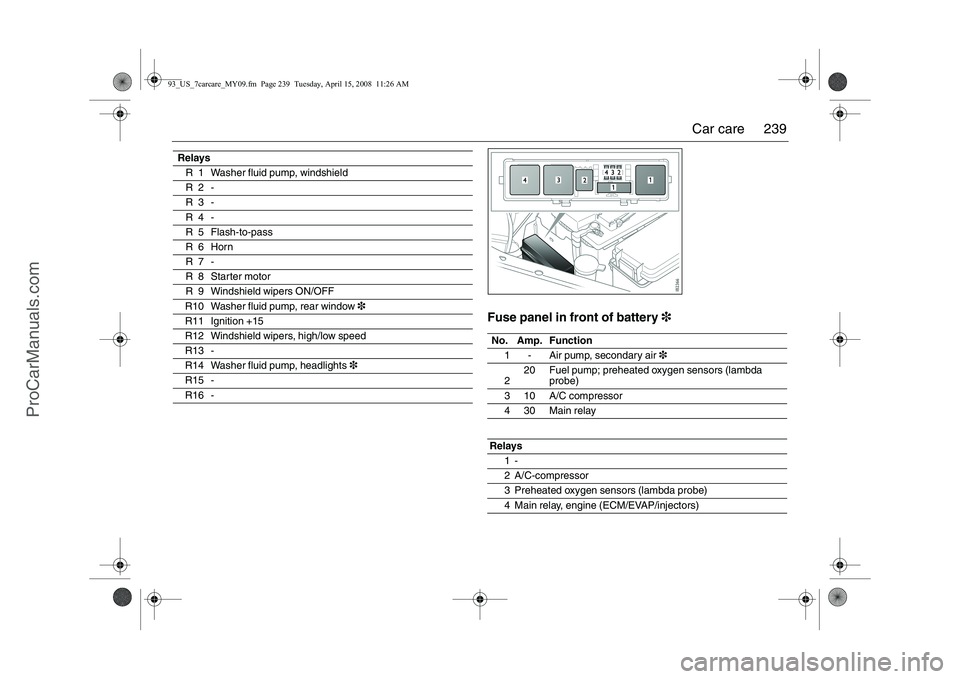
Fuse panel in front of battery 3
Relays
R 1 Washer fluid pump, windshield
R2 -
R3 -
R4 -
R 5 Flash-to-pass
R6 Horn
R7 -
R8 Starter motor
R 9 Windshield wipers ON/OFF
R10 Washer fluid pump, rear window 3
R11 Ignition +15
R12 Windshield wipers, high/low speed
R13 -
R14 Washer fluid pump, headlights 3
R15 -
R16 -
No. Amp. Function 1 - Air pump, secondary air 3
2 20 Fuel pump; preheated oxygen sensors (lambda
probe)
3 10 A/C compressor
430Main relay
Relays 1-
2 A/C-compressor
3 Preheated oxygen sensors (lambda probe)
4 Main relay, engine (ECM/EVAP/injectors)
93_US_7carcare_MY09.fm Page 239 Tuesday, April 15, 2008 11:26 AM
ProCarManuals.com
Page 244 of 304

244 Car care
Uniform Tire Quality GradingQuality grades can be found where applica-
ble on the tire sidewall between tread shoul-
der and maximum section width. For exam-
ple:
Treadwear 200 Traction AA
Temperature A
The following information relates to the
system developed by the United States
National Highway Traffic Safety Administra-
tion, which grades tires by treadwear, trac-
tion and temperature performance. (This
applies only to vehicles sold in the United
States.) The grades ar e molded on the side-
walls of most passenger car tires. The Uni-
form Tire Quality Grading system does not
apply to deep tread, winter-type snow tires,
space-saver or temporary use spare tires,
tires with nominal rim diameters of 10 to 12
inches (25 to 30 cm), or to some limited-pro-
duction tires.
While the tires available on General Motors
passenger cars and light trucks may vary
with respect to these grades, they must also
conform to federal safety requirements and
additional General Motors Tire Perfor-
mance Criteria (TPC) standards.
NOTICEWide wheels and tires with side walls that
are too low can:
Be damaged in potholes, etc.
Cause springs, shock absorbers and
wheel bearings and body mountings
to be overloaded
Affect the function of the ESP
®.
The speed and load limits of the tires
must not be exceeded; see page 249.
Wheels larger than 18" must not be fitted
on the Saab 9-3 for reasons above. The
permissible offset is 1.61 inch (41 mm).
WARNING
Mixing tires could cause you to lose con-
trol while driving. If you mix tires of differ-
ent sizes or types (radial and bias-belted
tires), the vehicle may not handle prop-
erly, and you could have a crash. Using
tires of different sizes may also cause
damage to your vehicle. Be sure to use
the same size and type tires on all wheels.
It’s all right to drive with your compact
spare temporarily, it was developed for
use on your vehicle. See “Compact
spare” on page 256.
WARNING
If you use bias-ply tires on your vehicle,
the wheel rim flanges could develop
cracks after many miles of driving. A tire
and/or wheel could fail suddenly, causing
a crash. Use only radial-ply tires with the
wheels on your vehicle.
93_US_7carcare_MY09.fm Page 244 Tuesday, April 15, 2008 11:26 AM
ProCarManuals.com
Page 251 of 304
251
Car care
DOT Markings: A code molded into the
sidewall of a tire signifying that the tire is in
compliance with the U.S. Department of
Transportation motor vehicle safety stan-
dards. The DOT code includes the Tire
Identification Number (TIN), an alphanu-
meric designator which can also identify the
tire manufacturer, production plant, brand
and date of production.
GVWR: Gross Vehicle Weight Rating see
page 285.
GAWR FRT: Gross Axle Weight Rating for
the front axle, see page 285.
GAWR RR: Gross Axle Weight Rating for
the rear axle, see page 285.
Intended Outboard Sidewall: The side of
an asymmetrical tire that must always face
outward when mounted on a vehicle.
Kilo pascal (kPa): The metric unit for air
pressure. There are 6.9 kPa to one psi.
Light Truck (LT -Metric) Tire: A tire used
on light duty trucks and some multipurpose
passenger vehicles.
Load Index: An assigned number ranging
from 1 to 279 that corresponds to the load
carrying capacity of a tire. Maximum Load rating:
The load rating for
a tire at the maximum permissible inflation
pressure for that tire.
Maximum Loaded Vehicle Weight: The
sum of curb weight; a ccessory weight; vehi-
cle capacity weight; and production options
weight.
Maximum Permissible Inflation Pres-
sure: The maximum cold inflation pressure
to which a tire may be inflated.
Normal occupant weight: The number of
occupants a vehicle is designed to seat mul-
tiplied by 150 pounds (68 kg). See “Loading
Your Vehicle” on page 250.
Occupant Distribution: Designated seat-
ing positions.
Outward Facing Sidewall: The side of a
asymmetrical tire that has a particular side
that faces outward when mounted on a vehi-
cle. The side of the tire that contains a white-
wall bears white letter ing or bears manufac-
turer, brand and or model name molding on
the other sidewall of the tire.
Passenger (P-Metric) Tire: A tire used on
passenger cars and some light duty trucks
and multipurpose vehicles. Recommended Inflation Pressure:
Vehi-
cle manufacturer´s recommended tire infla-
tion pressure shown on the tire placard, see
“Inflation - Tire Pressure” on page 240 and
“Loading Your Vehicle” on page 250.
Radial Ply Tire: A pneumatic tire in which
the ply cords that extend to the beads are
laid at substantially 90 degrees to the cen-
terline of the tread.
Rim: A metal support for a tire or a tire and
tube assembly upon which the tire beads
are seated.
Sidewall: The portion of a tire between the
tread and the bead.
Speed rating: An alphanumeric code
assigned to a tire indicating the maximum
speed at which a tire can operate.
Traction: The friction between the tire and
the road surface. The amount of grip pro-
vided.
Treadwear Indicators: Narrow bands,
sometimes called “wear bars”, that show
across the tread of a tire when only
2/32 inch of tread remains. See “When It Is
Time for New Tires” on page 242.93_US_7carcare_MY09.fm Page 251 Tuesday, April 15, 2008 11:26 AM
ProCarManuals.com
Page 256 of 304
256 Car careCompact spareThe compact spare is light and easy to
handle when changing the tire. Its use is
only permitted when a standard tire has sus-
tained a puncture. The maximum life of the
tire is only just over 2,000 miles (3,500 km).
Do not exceed 50 mph (80 km/h) with the
compact spare fitted.
The tire pressure should be 60 psi
(420 kPa). Put the punctured tire in the
spare wheel well under the trunk floor.
Have the standard tire repaired and refitted
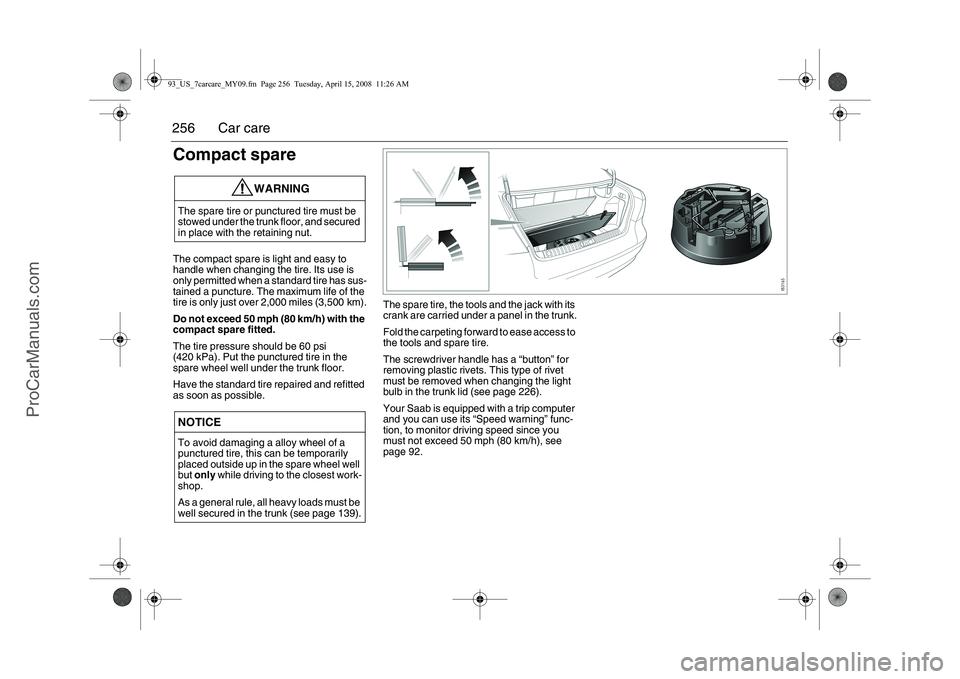
as soon as possible.The spare tire, the tools and the jack with its
crank are carried under a panel in the trunk.
Fold the carpeting forward to ease access to
the tools and spare tire.
The screwdriver handle has a “button” for
removing plastic rivets. This type of rivet
must be removed when changing the light
bulb in the trunk lid (see page 226).
Your Saab is equipped with a trip computer
and you can use its “Speed warning” func-
tion, to monitor driving speed since you
must not exceed 50 mph (80 km/h), see
page 92.
WARNING
The spare tire or punctured tire must be
stowed under the trunk floor, and secured
in place with the retaining nut.NOTICETo avoid damaging a alloy wheel of a
punctured tire, this can be temporarily
placed outside up in the spare wheel well
but
only while driving to the closest work-
shop.
As a general rule, all heavy loads must be
well secured in the trunk (see page 139).93_US_7carcare_MY09.fm Page 256 Tuesday, April 15, 2008 11:26 AM
ProCarManuals.com
Page 258 of 304
258 Car careDriving with a compact wheel
fittedObserve the following when the compact
spare tire is fitted:
The compact spare is light and easy to handle when changing a tire.
Do not drive further than necessary with the compact spare fitted - the maximum
life of the tire is only just over 2,000 miles
(approx. 3,500 km).
Refit the standard tire as soon as possi- ble.
Fitting a spare tire/wheel without pressure sensor will trigger a malfunction
message, see page 255.
Important considerations when driving with
a compact spare tire:
The car’s ground clearance is reduced. The car must not be driven with more than
one compact spare tire at a time.
Avoid driving against the curb.
Do not use snow chains.
Do not fit the wheel cover - this would conceal the warning text.
Changing a tire
WARNING
Do not exceed 50 mph (80 km/h). The
tire can overheat affecting the car’s
road holding.
Tire pressure: refer to page 291.
The spare tire or punctured tire must be stowed under the trunk floor, and
secured in place with the retaining nut.
WARNING
Lifting a vehicle and getting under it to do
maintenance or repairs is dangerous
without the appropriate safety equipment
and training. The jack provided with your
vehicle is designed only for changing a
flat tire. If it is used for anything else, you
or others could be badly injured or killed if
the vehicle slips off the jack. Use the jack
provided with your vehicle only for chang-
ing a flat tire.
Changing a tire can be dangerous. The
vehicle can slip off the jack and roll over
or fall on you or other people. You and
they could be badly injured or even killed.
Find a level place to change your tire. To
help prevent the vehicle from moving:
1 Set the parking brake firmly.
2 If you have an automatic transmis- sion, put the shift lever in PARK (P).
For a manual transmission, leave the
car in gear (1st or REVERSE (R)).
3 Turn off the engine and do not restart while the vehicle is raised.
4 Do not allow passengers to remain in the vehicle.
93_US_7carcare_MY09.fm Page 258 Tuesday, April 15, 2008 11:26 AM
ProCarManuals.com
Page 259 of 304
259
Car care
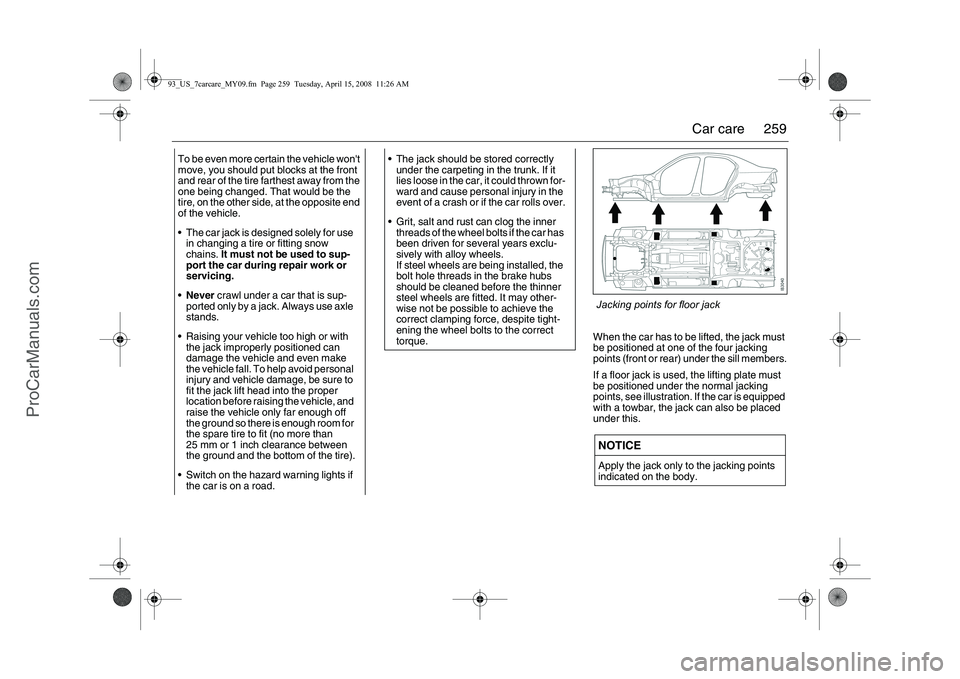
When the car has to be lifted, the jack must
be positioned at one of the four jacking
points (front or rear) under the sill members.
If a floor jack is used, the lifting plate must
be positioned under the normal jacking
points, see illustration. If the car is equipped
with a towbar, the jack can also be placed
under this.
To be even more certain the vehicle won't
move, you should put blocks at the front
and rear of the tire farthest away from the
one being changed. That would be the
tire, on the other side, at the opposite end
of the vehicle.
The car jack is designed solely for use
in changing a tire or fitting snow
chains. It must not be used to sup-
port the car during repair work or
servicing.
Never crawl under a car that is sup-
ported only by a jack. Always use axle
stands.
Raising your vehicle too high or with the jack improperly positioned can
damage the vehicle and even make
the vehicle fall. To help avoid personal
injury and vehicle damage, be sure to
fit the jack lift head into the proper
location before raising the vehicle, and
raise the vehicle only far enough off
the ground so there is enough room for
the spare tire to fit (no more than
25 mm or 1 inch clearance between
the ground and the bottom of the tire).
Switch on the hazard warning lights if the car is on a road.
The jack should be stored correctly under the carpeting in the trunk. If it
lies loose in the car, it could thrown for-
ward and cause personal injury in the
event of a crash or if the car rolls over.
Grit, salt and rust can clog the inner threads of the wheel bolts if the car has
been driven for several years exclu-
sively with alloy wheels.
If steel wheels are being installed, the
bolt hole threads in the brake hubs
should be cleaned before the thinner
steel wheels are fitted. It may other-
wise not be possible to achieve the
correct clamping force, despite tight-
ening the wheel bolts to the correct
torque.
NOTICEApply the jack only to the jacking points
indicated on the body.Jacking points for floor jack
93_US_7carcare_MY09.fm Page 259 Tuesday, April 15, 2008 11:26 AM
ProCarManuals.com
Page 261 of 304
261
Car care
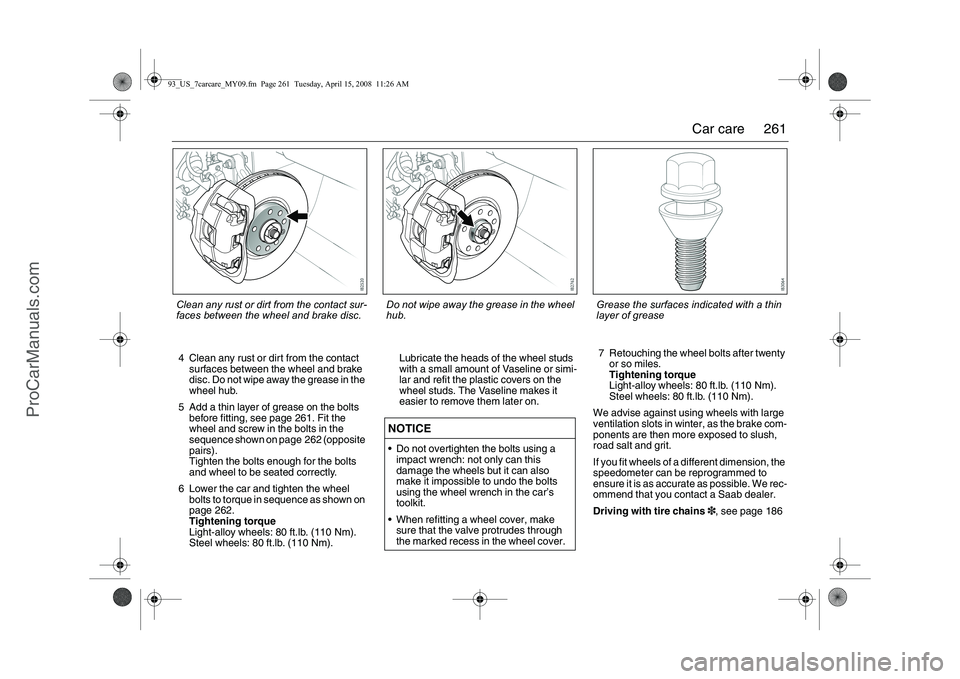
4 Clean any rust or dirt from the contact
surfaces between the wheel and brake
disc. Do not wipe away the grease in the
wheel hub.
5 Add a thin layer of grease on the bolts before fitting, see page 261. Fit the
wheel and screw in the bolts in the
sequence shown on page 262 (opposite
pairs).
Tighten the bolts enough for the bolts
and wheel to be seated correctly.
6 Lower the car and tighten the wheel bolts to torque in sequence as shown on
page 262.
Tightening torque
Light-alloy wheels: 80 ft.lb. (110 Nm).
Steel wheels: 80 ft.lb. (110 Nm). Lubricate the heads of the wheel studs
with a small amount of Vaseline or simi-
lar and refit the plastic covers on the
wheel studs. The Vaseline makes it
easier to remove them later on.
7 Retouching the wheel bolts after twenty
or so miles.
Tightening torque
Light-alloy wheels: 80 ft.lb. (110 Nm).
Steel wheels: 80 ft.lb. (110 Nm).
We advise against using wheels with large
ventilation slots in winter, as the brake com-
ponents are then more exposed to slush,
road salt and grit.
If you fit wheels of a different dimension, the
speedometer can be reprogrammed to
ensure it is as accurate as possible. We rec-
ommend that you contact a Saab dealer.
Driving with tire chains 3, see page 186
NOTICE Do not overtighten the bolts using a
impact wrench: not only can this
damage the wheels but it can also
make it impossible to undo the bolts
using the wheel wrench in the car’s
toolkit.
When refitting a wheel cover, make sure that the valve protrudes through
the marked recess in the wheel cover.Do not wipe away the grease in the wheel
hub.
Clean any rust or dirt from the contact sur-
faces between the wheel and brake disc.
Grease the surfaces indicated with a thin
layer of grease
93_US_7carcare_MY09.fm Page 261 Tuesday, April 15, 2008 11:26 AM
ProCarManuals.com
Page 263 of 304
263
Car care
Prevent the compressor getting wet.
The canister of seal ant can only be used
once. Replace a used canister at a work-
shop. We recommend that you contact an
authorised Saab workshop.
The tire repair kit can be used at tempera-
tures down to –22°F (–30 °C). At low tem-
peratures the sealant is more viscous and
so is less able to seal slightly larger
damage.
If a punctured tire is to be repaired:
Allow the engine to idle. The compressor will consume some energy.
Apply the handbrake.
Turn on the hazard warning light.
Position the warning triangle to warn other drivers.
The repair kit is stowed under the luggage
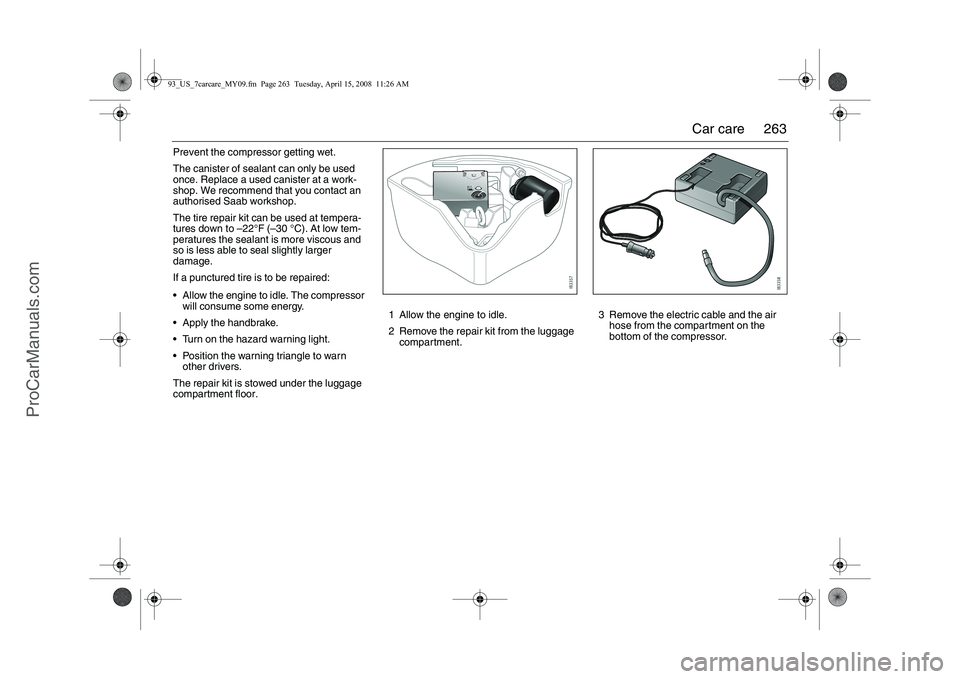
compartment floor. 1 Allow the engine to idle.
2 Remove the repair kit from the luggage
compartment. 3 Remove the electric cable and the air
hose from the compartment on the
bottom of the compressor.93_US_7carcare_MY09.fm Page 263 Tuesday, April 15, 2008 11:26 AM
ProCarManuals.com
Page 264 of 304
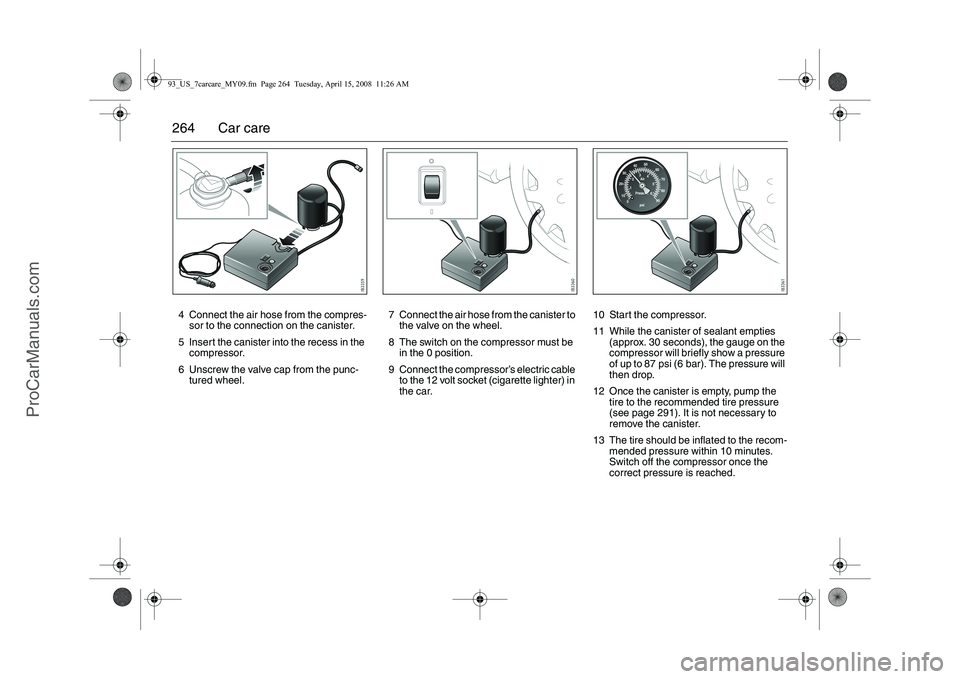
264 Car care4 Connect the air hose from the compres-sor to the connection on the canister.
5 Insert the canister into the recess in the compressor.
6 Unscrew the valve cap from the punc- tured wheel. 7 Connect the air hose from the canister to
the valve on the wheel.
8 The switch on the compressor must be in the 0 position.
9 Connect the compressor’s electric cable to the 12 volt socket (cigarette lighter) in
the car. 10 Start the compressor.
11 While the canister of sealant empties
(approx. 30 seconds), the gauge on the
compressor will briefly show a pressure
of up to 87 psi (6 bar). The pressure will
then drop.
12 Once the canister is empty, pump the tire to the recommended tire pressure
(see page 291). It is not necessary to
remove the canister.
13 The tire should be inflated to the recom- mended pressure within 10 minutes.
Switch off the compressor once the
correct pressure is reached.93_US_7carcare_MY09.fm Page 264 Tuesday, April 15, 2008 11:26 AM
ProCarManuals.com
Page 266 of 304
266 Car careSafety beltsCheck the function of the safety belts regu-
larly as follows:
Hold the diagonal strap and pull it sharply. The safety belt should lock and it should
not be possible to withdraw it further.
Check the anchorage points in the floor.
They must not have suffered rust damage.
If a belt is worn or has any fraying edges, it
should be replaced.
Safety belts must not co me into contact with
substances such as polishes, oil or chemi-
cals. If the belts get dirty, wash them with
warm water and a detergent or have them
replaced.
Upholstery and trimTo remove fluff and hairs from the seats,
door armrests and headlining, use a
vacuum cleaner, a moist lint-free cloth, or a
clothes brush. Remove spots and dirt using
a cloth moistened with lukewarm soapy
water.
When using a stain remover, always work
from the outside toward s the center to avoid
leaving a ring. If a soiled ring or spot should
remain, it can usually be removed using
lukewarm soapy water or water alone.
Spots left by liquids, such as soft drinks or
thin oil, must be removed at once with an
absorbent material, such as kitchen towel-
ling. Then clean with a stain remover.
White spirit is recommended for removing
grease and oil stains. A medium stiff brush
may also be used.
Cleaning and caring for leather
upholsteryThe principal reason for treating leather
upholstery is to maintain its elegant appear-
ance and to provide it with a protective film.
Discolor at ion caused by dust and wear
mainly affects the lighter shades, although
this is not detrimental to the leather, indeed,
the patina resulting from use is often consid-
ered desirable in leather. But if the leather is
allowed to become too grubby, it can start to
look shabby. Vacuum the leather regularly
with a soft brush attachment to remove
loose dirt and dust.
The leather upholstery should be cleaned
and reconditioned twice a year in conjunc-
tion with spring and autumn inspections. In
very warm, dry climates the leather may
need more regular reconditioning. Use con-
ventional leather care products. Follow the
instructions on the packaging.
Do not use harsh polishing agents, cleaning
agents, sprays, coarse soap or hot water.
Semi-Anilin is a leather that is colored
throughout which only has a thin protective
finish and is accordingly more sensitive than
a surface colored l eather and therefore
need more care to keep the protection and
ageing properties.
WARNING
If the car is involved in a crash, the safety
belts, belt pretensioners and other asso-
ciated components must be inspected.
We recommend that you contact a Saab
dealer.
Never make any alterations or repairs to
the safety belts your self. We recommend
that you contact a Saab dealer.93_US_7carcare_MY09.fm Page 266 Tuesday, April 15, 2008 11:26 AM
ProCarManuals.com