ESP SAAB 9-3 2009 User Guide
[x] Cancel search | Manufacturer: SAAB, Model Year: 2009, Model line: 9-3, Model: SAAB 9-3 2009Pages: 304, PDF Size: 44.31 MB
Page 95 of 304
95 Instruments and controls
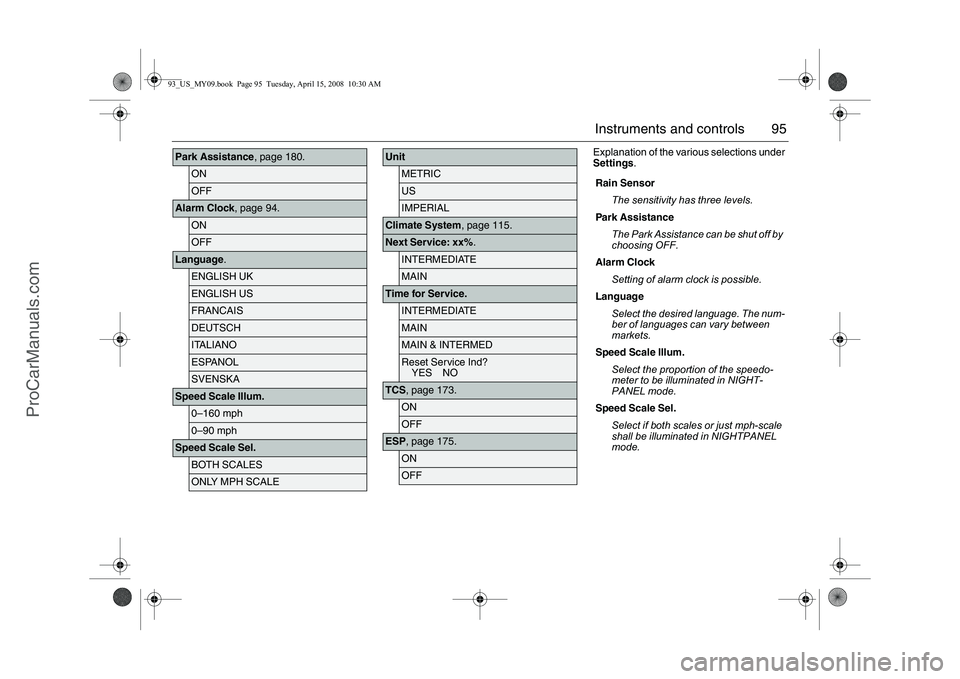
Explanation of the various selections under
Settings.
Park Assistance, page 180.
ONOFF
Alarm Clock, page 94.
ONOFF
Language.
ENGLISH UKENGLISH USFRANCAISDEUTSCHITALIANOESPANOLSVENSKA
Speed Scale Illum.
0–160 mph0–90 mph
Speed Scale Sel.
BOTH SCALESONLY MPH SCALE
Unit
METRICUSIMPERIAL
Climate System, page 115.Next Service: xx%.
INTERMEDIATEMAIN
Time for Service.
INTERMEDIATEMAINMAIN & INTERMEDReset Service Ind?
YES NO
TCS, page 173.
ONOFF
ESP, page 175.
ONOFF
Rain Sensor
The sensitivity has three levels.
Park Assistance
The Park Assistance can be shut off by
choosing OFF.
Alarm Clock
Setting of alarm clock is possible.
Language
Select the desired language. The num-
ber of languages can vary between
markets.
Speed Scale Illum.
Select the proportion of the speedo-
meter to be illuminated in NIGHT-
PANEL mode.
Speed Scale Sel.
Select if both scales or just mph-scale
shall be illuminated in NIGHTPANEL
mode.
93_US_MY09.book Page 95 Tuesday, April 15, 2008 10:30 AM
ProCarManuals.com
Page 96 of 304
96 Instruments and controls
Resetting the service indication
Reset the service indication in accordance
with the following:
1 Turn the ignition switch to the ON posi-
tion, the engine must be switched off.
2Select Settings using the steering
wheel controls, or .
3 Press and hold the SET button until
given audible confirmation.
4Select Time for Service.
5 Press the SET button.
6 To the question Reset Service Ind?
select YES (Press CLR button to undo).ClockAdjustments can be made in the Infotain-
ment system.
See separate Manual. Unit
Select the desired group of units.
Next Service: xx%
The SID includes two mutually inde-
pendent counters, one for the main
service and one for the intermediate
service. When a service is carried out,
e.g. intermediate service, the counter is
reset for the intermediate service. The
counter for the other service type, main
service, continues unaffected. This
means that once a service has been
carried out, the counter may show e.g.
47% even though a service has just
been carried out. The percentage
refers, then, to the other service type.
MAIN
Main services are carried out at specific
meter settings. This interval varies
depending on market and engine var-
iant. Contact a workshop for more infor-
mation. We recommend that you con-
tact an authorised Saab workshop.INTERMEDIATE
The intermediate service, on the other
hand, is carried out depending on the
number of cold starts and the climate
conditions in which the car is driven, for
example. This is why the interval for
this type of service varies.
MAIN & INTERMED
A combined service is carried out when
the counters of both service types are
close to one another.
Time for Service.
A service indication must only be reset
after the service has been performed.
TCS/ESP
Select whether the system shall be on
or off. The car has either TCS or ESP.
93_US_MY09.book Page 96 Tuesday, April 15, 2008 10:30 AM
ProCarManuals.com
Page 109 of 304
109 Instruments and controls
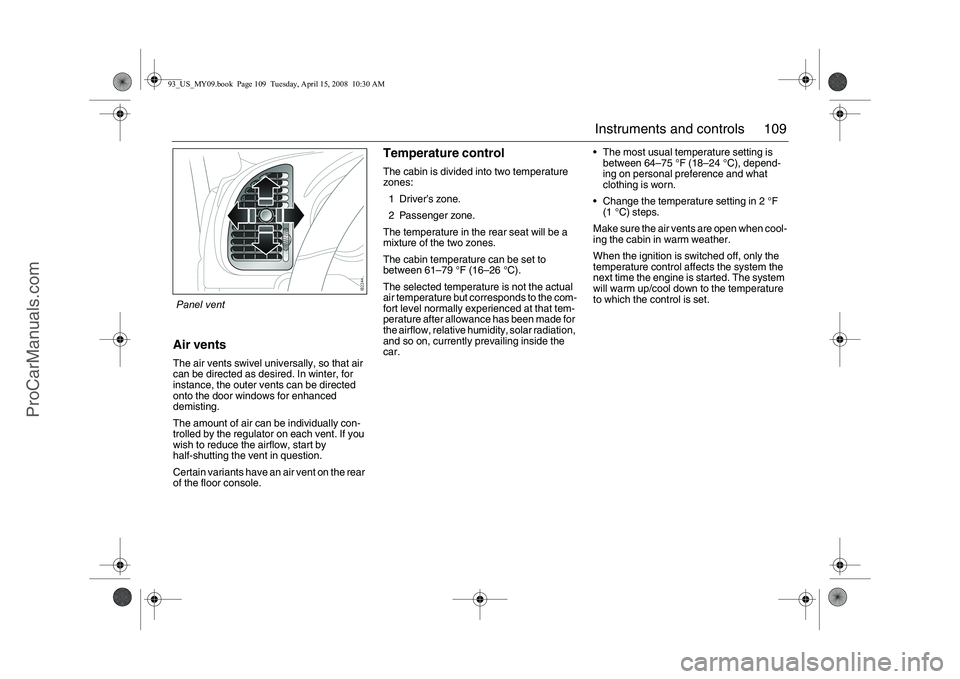
Air ventsThe air vents swivel universally, so that air
can be directed as desired. In winter, for
instance, the outer vents can be directed
onto the door windows for enhanced
demisting.
The amount of air can be individually con-
trolled by the regulator on each vent. If you
wish to reduce the airflow, start by
half-shutting the vent in question.
Certain variants have an air vent on the rear
of the floor console.
Temperature controlThe cabin is divided into two temperature
zones:
1 Driver’s zone.
2 Passenger zone.
The temperature in the rear seat will be a
mixture of the two zones.
The cabin temperature can be set to
between 61–79 °F (16–26 °C).
The selected temperature is not the actual
air temperature but corresponds to the com-
fort level normally experienced at that tem-
perature after allowance has been made for
the airflow, relative humidity, solar radiation,
and so on, currently prevailing inside the
car. The most usual temperature setting is
between 64–75 °F (18–24 °C), depend-
ing on personal preference and what
clothing is worn.
Change the temperature setting in 2 °F
(1 °C) steps.
Make sure the air vents are open when cool-
ing the cabin in warm weather.
When the ignition is switched off, only the
temperature control affects the system the
next time the engine is started. The system
will warm up/cool down to the temperature
to which the control is set.
Panel vent93_US_MY09.book Page 109 Tuesday, April 15, 2008 10:30 AM
ProCarManuals.com
Page 119 of 304
119 Interior equipment
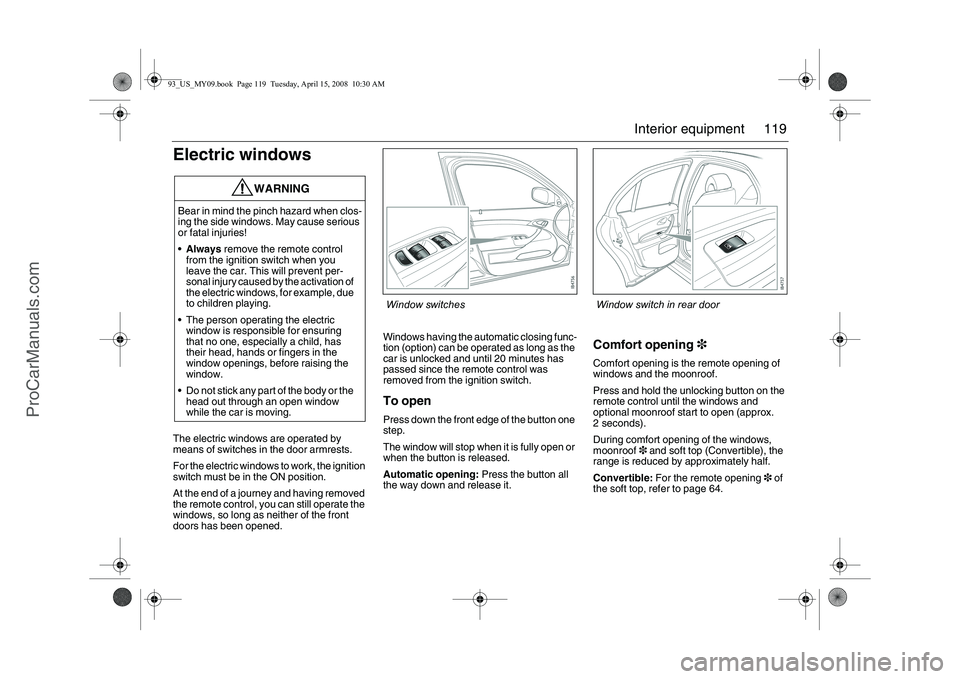
Electric windowsThe electric windows are operated by
means of switches in the door armrests.
For the electric windows to work, the ignition
switch must be in the ON position.
At the end of a journey and having removed
the remote control, you can still operate the
windows, so long as neither of the front
doors has been opened.Windows having the automatic closing func-
tion (option) can be operated as long as the
car is unlocked and until 20 minutes has
passed since the remote control was
removed from the ignition switch.
To openPress down the front edge of the button one
step.
The window will stop when it is fully open or
when the button is released.
Automatic opening: Press the button all
the way down and release it.
Comfort opening3Comfort opening is the remote opening of
windows and the moonroof.
Press and hold the unlocking button on the
remote control until the windows and
optional moonroof start to open (approx.
2 seconds).
During comfort opening of the windows,
moonroof3 and soft top (Convertible), the
range is reduced by approximately half.
Convertible: For the remote opening3 of
the soft top, refer to page 64.
WARNING
Bear in mind the pinch hazard when clos-
ing the side windows. May cause serious
or fatal injuries!
Always remove the remote control
from the ignition switch when you
leave the car. This will prevent per-
sonal injury caused by the activation of
the electric windows, for example, due
to children playing.
The person operating the electric
window is responsible for ensuring
that no one, especially a child, has
their head, hands or fingers in the
window openings, before raising the
window.
Do not stick any part of the body or the
head out through an open window
while the car is moving.
Window switches
Window switch in rear door
93_US_MY09.book Page 119 Tuesday, April 15, 2008 10:30 AM
ProCarManuals.com
Page 128 of 304
128 Interior equipmentMoonroof3The moonroof is operated by the control in
the roof console. For the moonroof to work,
the ignition switch must be in the ON posi-
tion.
If the car is equipped with windows having
the automatic closing function, the moon-
roof can be opened and closed so long as
the car is unlocked until 20 minutes has
passed since the remote control was
removed from the ignition switch.
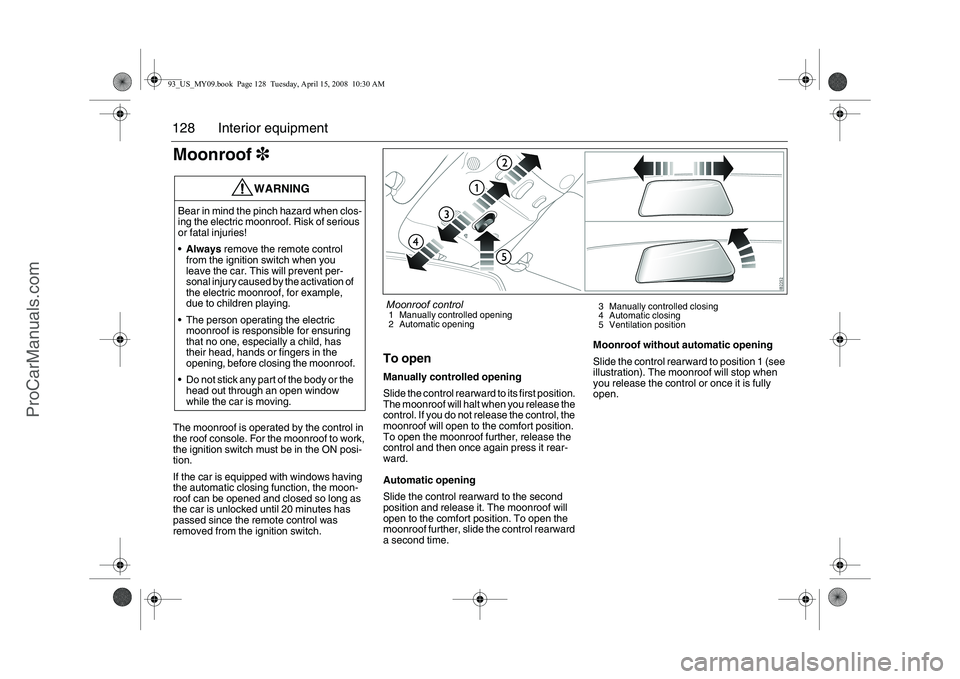
To openManually controlled opening
Slide the control rearward to its first position.
The moonroof will halt when you release the
control. If you do not release the control, the
moonroof will open to the comfort position.
To open the moonroof further, release the
control and then once again press it rear-
ward.
Automatic opening
Slide the control rearward to the second
position and release it. The moonroof will
open to the comfort position. To open the
moonroof further, slide the control rearward
a second time.Moonroof without automatic opening
Slide the control rearward to position 1 (see
illustration). The moonroof will stop when
you release the control or once it is fully
open.
WARNING
Bear in mind the pinch hazard when clos-
ing the electric moonroof. Risk of serious
or fatal injuries!
Always remove the remote control
from the ignition switch when you
leave the car. This will prevent per-
sonal injury caused by the activation of
the electric moonroof, for example,
due to children playing.
The person operating the electric
moonroof is responsible for ensuring
that no one, especially a child, has
their head, hands or fingers in the
opening, before closing the moonroof.
Do not stick any part of the body or the
head out through an open window
while the car is moving.
Moonroof control1 Manually controlled opening
2 Automatic opening3 Manually controlled closing
4 Automatic closing
5 Ventilation position
93_US_MY09.book Page 128 Tuesday, April 15, 2008 10:30 AM
ProCarManuals.com
Page 145 of 304

145 Interior equipment
Cargo net3
If possible, avoid having the rear seat
folded down when driving with a heavy
load, because the anchoring possibili-
ties are restricted when the rear seat
is in this position. That the rear seat
is in the upright is a basic require-
ment for protection against cargo
displacement in the event of a
crash.
Improve safety by fastening the outer
safety belts. Check that the red "indi-
cator-flag" next to the opening han-
dles is not visible. If the red "indica-
tor-flag" is visible the backrest is not
locked.
Match your speed and driving style to
how the car is loaded. The handling
characteristics of the car can be
affected since a load in the trunk will
alter the car’s center of gravity.
An object weighing 55 lbs. (25 kg) cor-
responds to a weight of 2200 lbs.
(1,000 kg) in a front-end collision at
32 mph (50 km/h).
Adjust the car’s load (passengers and
luggage) so that the gross vehicle
weight and the axle weight are not
exceeded, see page 284.
WARNING
Never overload the cargo net3. If the
elastic breaks this may cause per-
sonal injury. Do not use a cargo net
that shows signs of wear.
Never use the elastic floor net3 and
elastic side net3 when the rear seat is
folded down. These nets are only
intended to keep light objects tidy, not
for the anchoring of loads.
Secure the load in the luggage com-
partment firmly. Using a cargo net is
not considered as load securing.
The only purpose of a cargo net is to
prevent light objects from being
thrown forward into the cabin during
heavy breaking.
93_US_MY09.book Page 145 Tuesday, April 15, 2008 10:30 AM
ProCarManuals.com
Page 149 of 304

149 Starting and driving
Ignition switch ________ 150
Steering wheel lock ____ 151
Starting the engine ____ 152
Important considerations
for driving __________ 153
Refueling ____________ 156
Engine Break-in Period _ 160
Manual transmission___ 161
Automatic
transmission3______ 162
Cruise Control ________ 169
Braking ______________ 170
All-wheel drive (XWD)3173
Traction Control System
(TCS) ______________ 173
Electronic Stability
Program ESP
®
______ 175
Parking brake_________ 177 Parking _______________ 177
Saab Parking
Assistance3________ 180
Economical driving _____ 183
Driving in cold weather__ 185
Driving in hot climates __ 187
Towing a trailer3______ 188
Driving with a roof rack
load ________________ 192
Driving with a load _____ 192
Driving with the trunk lid
open________________ 193
Driving in deep water ___ 193
Towing the car _________ 193
Jump starting _________ 197
For long trips __________ 199
Starting and driving
3Asterisk means: equipment not fitted in all cars
(can depend on model variant, engine variant,
market specification, options or accessories).93_US_MY09.book Page 149 Tuesday, April 15, 2008 10:30 AM
ProCarManuals.com
Page 154 of 304
154 Starting and drivingThe light comes on in the event of an engine
or gearbox fault (cars with automatic gear-
box), which may cause driveability prob-
lems but that does not affect exhaust emis-
sion. The car can still be driven but perhaps
with limited performance.
Contact a dealer whenever an opportunity
occurs. We recommend that you contact a
Saab dealer.
Limp-homeThe engine management system has a
diagnostic feature that checks a number of
internal functions. If a fault is detected in the
throttle valve, the engine management
system will set the throttle system to the
limp-home mode. This means:
idling control will be poor (uneven idling
since regulated by ignition and fuel
supply)
engine performance will be reduced
the cruise control will not function
the capacity of the A/C compressor will be
limited.
If the diagnosis function detects a fault in the
engine management system, the light
"Service Engine Light also known as
CHECK ENGINE" indicator light in the
instrument panel will come on (see
page 83). Have the car checked at a work-
shop as soon as possible. We recommend
that you contact a Saab dealer.
Important considerations with
catalytic convertersThe catalytic converter is an emission con-
trol device incorporated in the car’s exhaust
system. It consists of a metal canister with a
honeycomb insert, the cells of which have
walls coated in a catalytic layer (precious
metal alloy).
NOTICE If the engine sounds strange there is a
malfunction. We recommend that you
contact a Saab dealer immediately.
The use of fuel with too low an octane
rating can cause serious engine dam-
age.
Limited performance.
NOTICEIf "Service Engine Light also known
as CHECK ENGINE" indicator light warn-
ing light starts to flash (indicating that the
engine is misfiring and the catalytic con-
verter can be damaged), ease off the
accelerator slightly. The light should go
out or start to shine constantly. If the light
continues to flash despite easing off the
accelerator, you may continue to drive the
car but at the minimum throttle permitted
by the current traffic situation. Have the
car checked as soon as possible. We rec-
ommend that you contact a Saab dealer.NOTICEUse only unleaded gasoline. Leaded gas-
oline is detrimental to the catalyst and
oxygen sensor and will seriously impair
the function of the catalytic converter.
93_US_MY09.book Page 154 Tuesday, April 15, 2008 10:30 AM
ProCarManuals.com
Page 157 of 304
157 Starting and driving
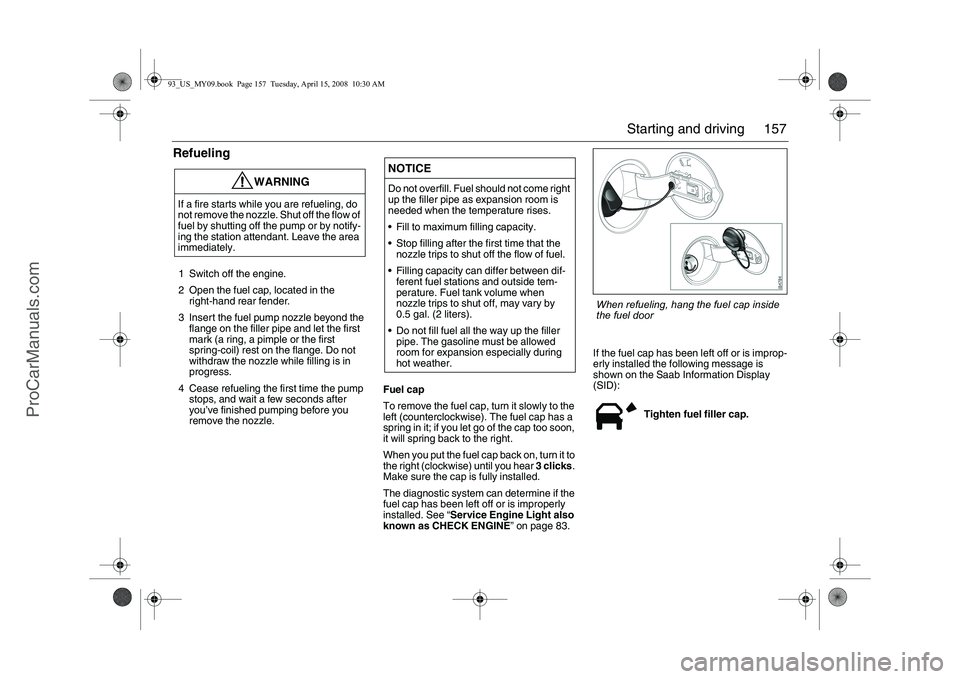
Refueling1 Switch off the engine.
2 Open the fuel cap, located in the
right-hand rear fender.
3 Insert the fuel pump nozzle beyond the
flange on the filler pipe and let the first
mark (a ring, a pimple or the first
spring-coil) rest on the flange. Do not
withdraw the nozzle while filling is in
progress.
4 Cease refueling the first time the pump
stops, and wait a few seconds after
you’ve finished pumping before you
remove the nozzle.Fuel cap
To remove the fuel cap, turn it slowly to the
left (counterclockwise). The fuel cap has a
spring in it; if you let go of the cap too soon,
it will spring back to the right.
When you put the fuel cap back on, turn it to
the right (clockwise) until you hear 3 clicks.
Make sure the cap is fully installed.
The diagnostic system can determine if the
fuel cap has been left off or is improperly
installed. See “Service Engine Light also
known as CHECK ENGINE” on page 83.If the fuel cap has been left off or is improp-
erly installed the following message is
shown on the Saab Information Display
(SID):
WARNING
If a fire starts while you are refueling, do
not remove the nozzle. Shut off the flow of
fuel by shutting off the pump or by notify-
ing the station attendant. Leave the area
immediately.
NOTICEDo not overfill. Fuel should not come right
up the filler pipe as expansion room is
needed when the temperature rises.
Fill to maximum filling capacity.
Stop filling after the first time that the
nozzle trips to shut off the flow of fuel.
Filling capacity can differ between dif-
ferent fuel stations and outside tem-
perature. Fuel tank volume when
nozzle trips to shut off, may vary by
0.5 gal. (2 liters).
Do not fill fuel all the way up the filler
pipe. The gasoline must be allowed
room for expansion especially during
hot weather.
Tighten fuel filler cap.
When refueling, hang the fuel cap inside
the fuel door
93_US_MY09.book Page 157 Tuesday, April 15, 2008 10:30 AM
ProCarManuals.com
Page 163 of 304
163 Starting and driving
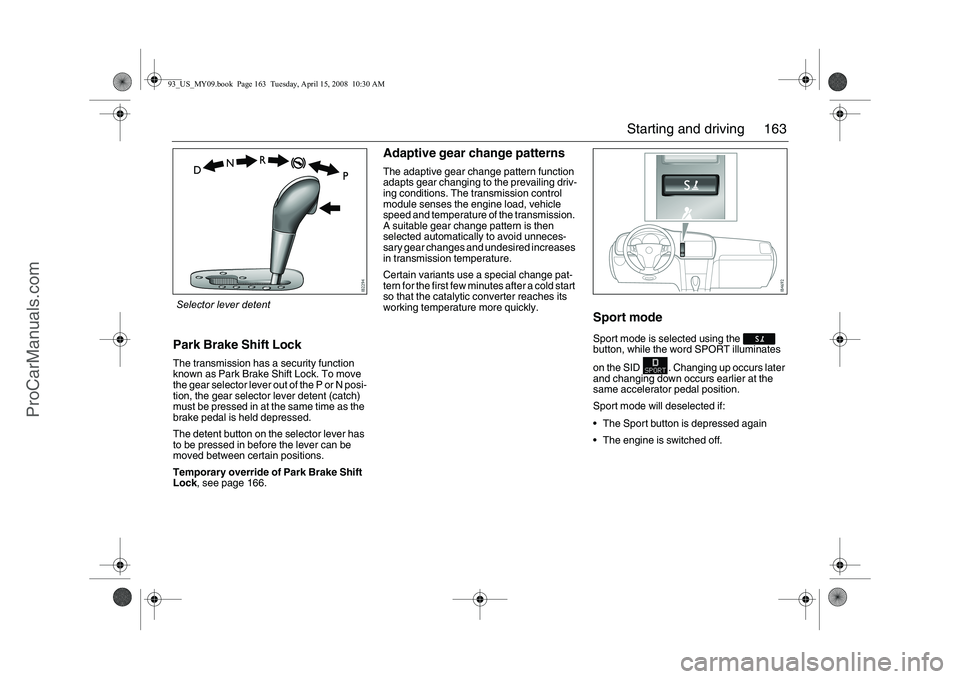
Park Brake Shift LockThe transmission has a security function
known as Park Brake Shift Lock. To move
the gear selector lever out of the P or N posi-
tion, the gear selector lever detent (catch)
must be pressed in at the same time as the
brake pedal is held depressed.
The detent button on the selector lever has
to be pressed in before the lever can be
moved between certain positions.
Temporary override of Park Brake Shift
Lock, see page 166.
Adaptive gear change patternsThe adaptive gear change pattern function
adapts gear changing to the prevailing driv-
ing conditions. The transmission control
module senses the engine load, vehicle
speed and temperature of the transmission.
A suitable gear change pattern is then
selected automatically to avoid unneces-
sary gear changes and undesired increases
in transmission temperature.
Certain variants use a special change pat-
tern for the first few minutes after a cold start
so that the catalytic converter reaches its
working temperature more quickly.
Sport modeSport mode is selected using the
button, while the word SPORT illuminates
on the SID . Changing up occurs later
and changing down occurs earlier at the
same accelerator pedal position.
Sport mode will deselected if:
The Sport button is depressed again
The engine is switched off.
Selector lever detent93_US_MY09.book Page 163 Tuesday, April 15, 2008 10:30 AM
ProCarManuals.com