child seat SAAB 9-3 2009 User Guide
[x] Cancel search | Manufacturer: SAAB, Model Year: 2009, Model line: 9-3, Model: SAAB 9-3 2009Pages: 304, PDF Size: 44.31 MB
Page 27 of 304
27 Safety
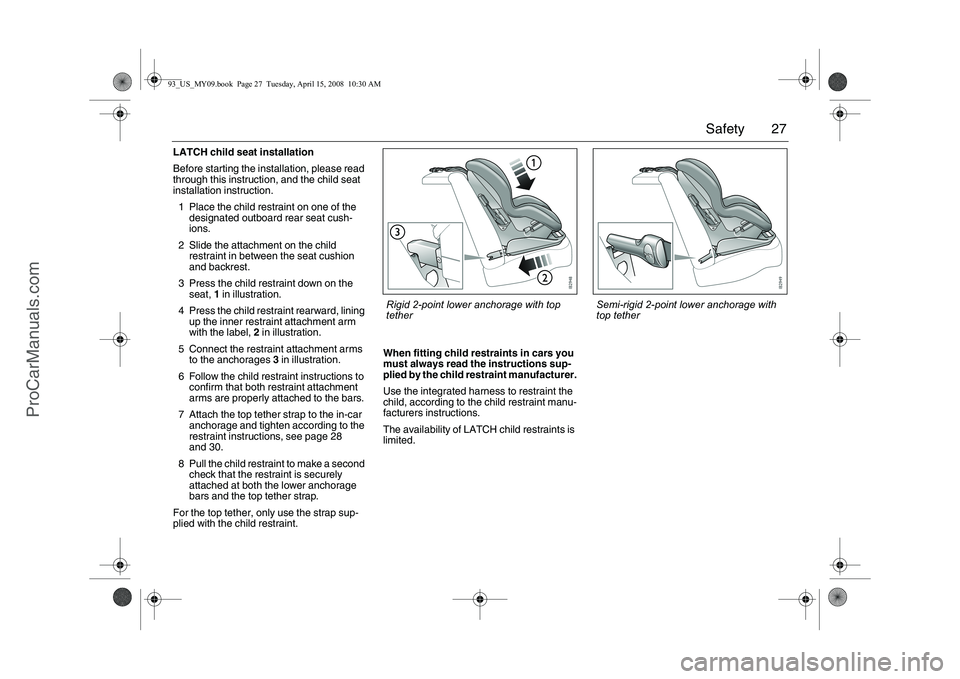
LATCH child seat installation
Before starting the installation, please read
through this instruction, and the child seat
installation instruction.
1 Place the child restraint on one of the
designated outboard rear seat cush-
ions.
2 Slide the attachment on the child
restraint in between the seat cushion
and backrest.
3 Press the child restraint down on the
seat, 1 in illustration.
4 Press the child restraint rearward, lining
up the inner restraint attachment arm
with the label, 2 in illustration.
5 Connect the restraint attachment arms
to the anchorages 3 in illustration.
6 Follow the child restraint instructions to
confirm that both restraint attachment
arms are properly attached to the bars.
7 Attach the top tether strap to the in-car
anchorage and tighten according to the
restraint instructions, see page 28
and 30.
8 Pull the child restraint to make a second
check that the restraint is securely
attached at both the lower anchorage
bars and the top tether strap.
For the top tether, only use the strap sup-
plied with the child restraint.When fitting child restraints in cars you
must always read the instructions sup-
plied by the child restraint manufacturer.
Use the integrated harness to restraint the
child, according to the child restraint manu-
facturers instructions.
The availability of LATCH child restraints is
limited.
Rigid 2-point lower anchorage with top
tetherSemi-rigid 2-point lower anchorage with
top tether
93_US_MY09.book Page 27 Tuesday, April 15, 2008 10:30 AM
ProCarManuals.com
Page 28 of 304
28 SafetyChild top tether anchorages for
forward facing child seatsSportSedan
Child restraints with a tether strap must be
attached according to Canadian and U.S.
safety standards.
If you have any questions regarding child
anchorages please contact your Saab
dealer.
The car is provided with three top tether
anchorages. Use the one that is right behind
the seating position in which the child
restraint is to be installed and attach the
restraint as follows:
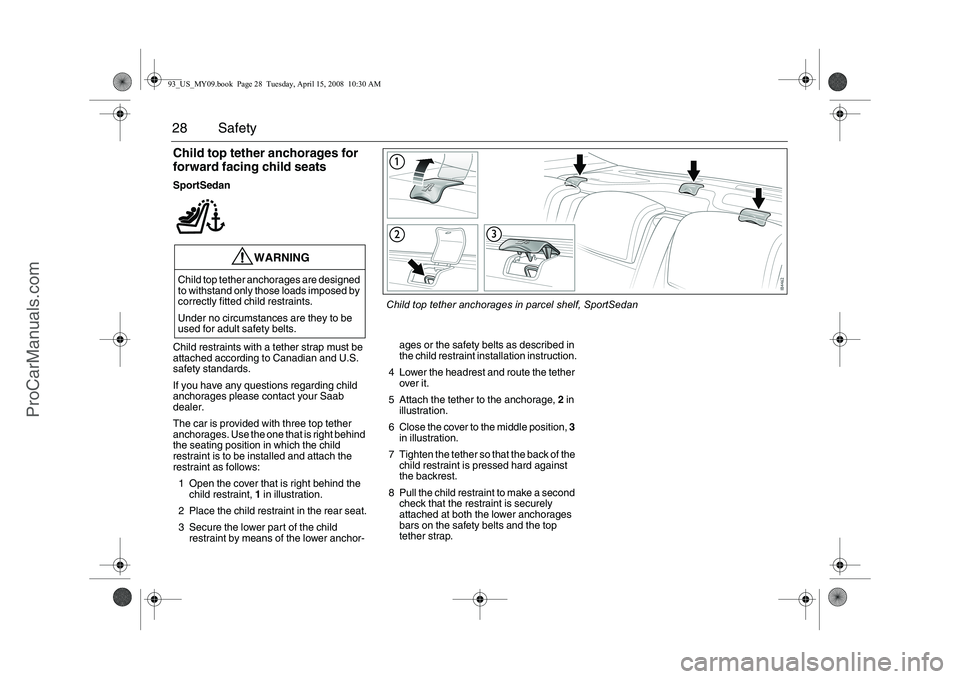
1 Open the cover that is right behind the
child restraint, 1 in illustration.
2 Place the child restraint in the rear seat.
3 Secure the lower part of the child
restraint by means of the lower anchor-ages or the safety belts as described in
the child restraint installation instruction.
4 Lower the headrest and route the tether
over it.
5 Attach the tether to the anchorage, 2 in
illustration.
6 Close the cover to the middle position, 3
in illustration.
7 Tighten the tether so that the back of the
child restraint is pressed hard against
the backrest.
8 Pull the child restraint to make a second
check that the restraint is securely
attached at both the lower anchorages
bars on the safety belts and the top
tether strap.
WARNING
Child top tether anchorages are designed
to withstand only those loads imposed by
correctly fitted child restraints.
Under no circumstances are they to be
used for adult safety belts.
Child top tether anchorages in parcel shelf, SportSedan
93_US_MY09.book Page 28 Tuesday, April 15, 2008 10:30 AM
ProCarManuals.com
Page 29 of 304
29 Safety
Child top tether anchorages for
forward facing child seatsSportCombi
Child restraints with a tether strap must be
attached according to Canadian and U.S.
safety standards.
If you have any questions regarding child
anchorages please contact your Saab
dealer.
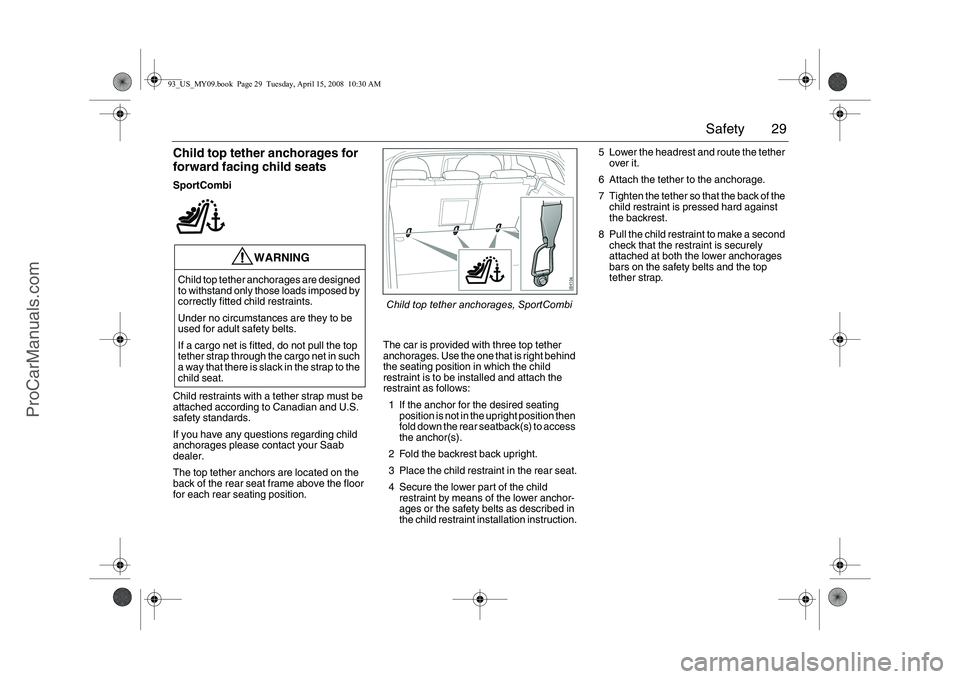
The top tether anchors are located on the
back of the rear seat frame above the floor
for each rear seating position.The car is provided with three top tether
anchorages. Use the one that is right behind
the seating position in which the child
restraint is to be installed and attach the
restraint as follows:
1 If the anchor for the desired seating
position is not in the upright position then
fold down the rear seatback(s) to access
the anchor(s).
2 Fold the backrest back upright.
3 Place the child restraint in the rear seat.
4 Secure the lower part of the child
restraint by means of the lower anchor-
ages or the safety belts as described in
the child restraint installation instruction.5 Lower the headrest and route the tether
over it.
6 Attach the tether to the anchorage.
7 Tighten the tether so that the back of the
child restraint is pressed hard against
the backrest.
8 Pull the child restraint to make a second
check that the restraint is securely
attached at both the lower anchorages
bars on the safety belts and the top
tether strap.
WARNING
Child top tether anchorages are designed
to withstand only those loads imposed by
correctly fitted child restraints.
Under no circumstances are they to be
used for adult safety belts.
If a cargo net is fitted, do not pull the top
tether strap through the cargo net in such
a way that there is slack in the strap to the
child seat.
Child top tether anchorages, SportCombi
93_US_MY09.book Page 29 Tuesday, April 15, 2008 10:30 AM
ProCarManuals.com
Page 30 of 304
30 SafetyChild top tether anchorages for
forward facing child seatsConvertible
Child restraints with a tether strap must be
attached according to Canadian and U.S.
safety standards.
If you have any questions regarding child
anchorages please contact your Saab
dealer.
The car is provided with two top tether
anchorages. Use the one that is right behind
the seating position in which the child
restraint is to be installed and attach the
restraint as follows:
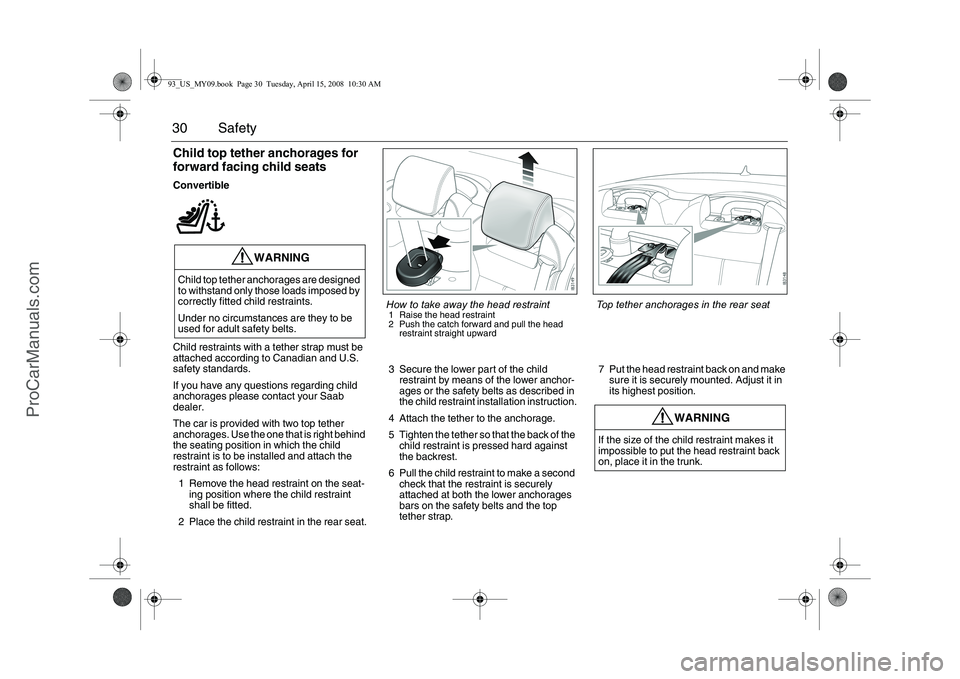
1 Remove the head restraint on the seat-
ing position where the child restraint
shall be fitted.
2 Place the child restraint in the rear seat.3 Secure the lower part of the child
restraint by means of the lower anchor-
ages or the safety belts as described in
the child restraint installation instruction.
4 Attach the tether to the anchorage.
5 Tighten the tether so that the back of the
child restraint is pressed hard against
the backrest.
6 Pull the child restraint to make a second
check that the restraint is securely
attached at both the lower anchorages
bars on the safety belts and the top
tether strap.7 Put the head restraint back on and make
sure it is securely mounted. Adjust it in
its highest position.
WARNING
Child top tether anchorages are designed
to withstand only those loads imposed by
correctly fitted child restraints.
Under no circumstances are they to be
used for adult safety belts.
WARNING
If the size of the child restraint makes it
impossible to put the head restraint back
on, place it in the trunk.
How to take away the head restraint1 Raise the head restraint
2 Push the catch forward and pull the head
restraint straight upward
Top tether anchorages in the rear seat
93_US_MY09.book Page 30 Tuesday, April 15, 2008 10:30 AM
ProCarManuals.com
Page 31 of 304
31 Safety
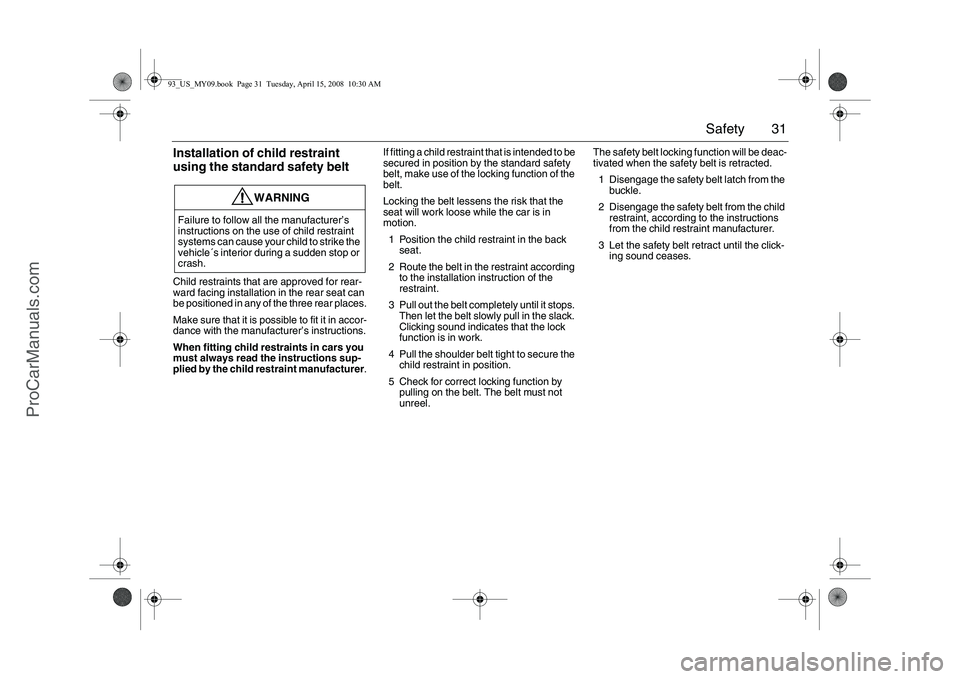
Installation of child restraint
using the standard safety beltChild restraints that are approved for rear-
ward facing installation in the rear seat can
be positioned in any of the three rear places.
Make sure that it is possible to fit it in accor-
dance with the manufacturer’s instructions.
When fitting child restraints in cars you
must always read the instructions sup-
plied by the child restraint manufacturer.If fitting a child restraint that is intended to be
secured in position by the standard safety
belt, make use of the locking function of the
belt.
Locking the belt lessens the risk that the
seat will work loose while the car is in
motion.
1 Position the child restraint in the back
seat.
2 Route the belt in the restraint according
to the installation instruction of the
restraint.
3 Pull out the belt completely until it stops.
Then let the belt slowly pull in the slack.
Clicking sound indicates that the lock
function is in work.
4 Pull the shoulder belt tight to secure the
child restraint in position.
5 Check for correct locking function by
pulling on the belt. The belt must not
unreel.The safety belt locking function will be deac-
tivated when the safety belt is retracted.
1 Disengage the safety belt latch from the
buckle.
2 Disengage the safety belt from the child
restraint, according to the instructions
from the child restraint manufacturer.
3 Let the safety belt retract until the click-
ing sound ceases.
WARNING
Failure to follow all the manufacturer’s
instructions on the use of child restraint
systems can cause your child to strike the
vehicle´s interior during a sudden stop or
crash.93_US_MY09.book Page 31 Tuesday, April 15, 2008 10:30 AM
ProCarManuals.com
Page 32 of 304
32 SafetyAirbag
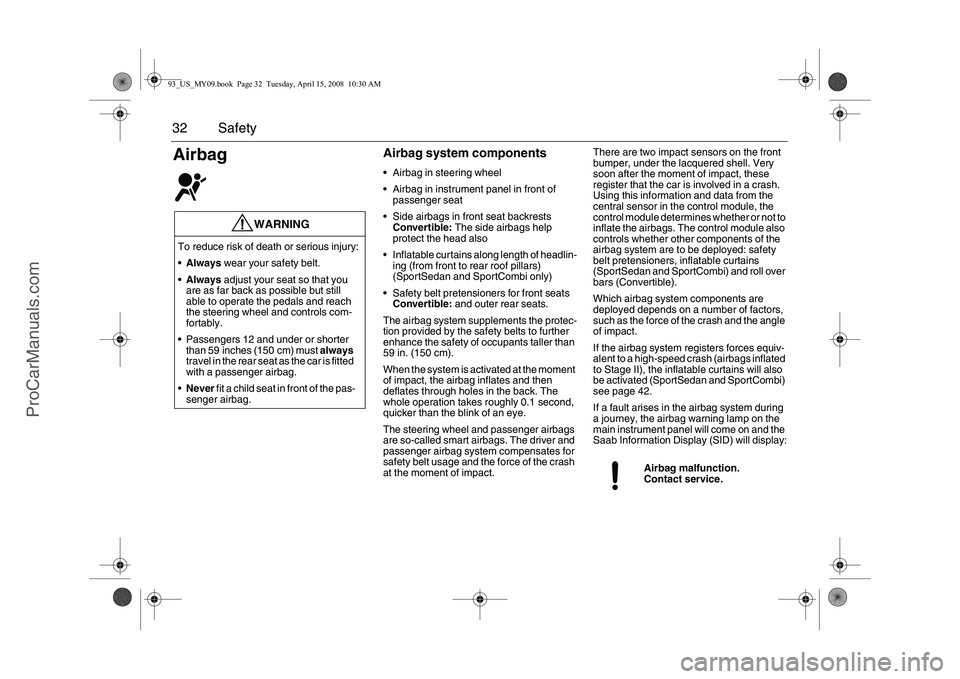
Airbag system components Airbag in steering wheel
Airbag in instrument panel in front of
passenger seat
Side airbags in front seat backrests
Convertible: The side airbags help
protect the head also
Inflatable curtains along length of headlin-
ing (from front to rear roof pillars)
(SportSedan and SportCombi only)
Safety belt pretensioners for front seats
Convertible: and outer rear seats.
The airbag system supplements the protec-
tion provided by the safety belts to further
enhance the safety of occupants taller than
59 in. (150 cm).
When the system is activated at the moment
of impact, the airbag inflates and then
deflates through holes in the back. The
whole operation takes roughly 0.1 second,
quicker than the blink of an eye.
The steering wheel and passenger airbags
are so-called smart airbags. The driver and
passenger airbag system compensates for
safety belt usage and the force of the crash
at the moment of impact.There are two impact sensors on the front
bumper, under the lacquered shell. Very
soon after the moment of impact, these
register that the car is involved in a crash.
Using this information and data from the
central sensor in the control module, the
control module determines whether or not to
inflate the airbags. The control module also
controls whether other components of the
airbag system are to be deployed: safety
belt pretensioners, inflatable curtains
(SportSedan and SportCombi) and roll over
bars (Convertible).
Which airbag system components are
deployed depends on a number of factors,
such as the force of the crash and the angle
of impact.
If the airbag system registers forces equiv-
alent to a high-speed crash (airbags inflated
to Stage II), the inflatable curtains will also
be activated (SportSedan and SportCombi)
see page 42.
If a fault arises in the airbag system during
a journey, the airbag warning lamp on the
main instrument panel will come on and the
Saab Information Display (SID) will display:
WARNING
To reduce risk of death or serious injury:
Always wear your safety belt.
Always adjust your seat so that you
are as far back as possible but still
able to operate the pedals and reach
the steering wheel and controls com-
fortably.
Passengers 12 and under or shorter
than 59 inches (150 cm) must always
travel in the rear seat as the car is fitted
with a passenger airbag.
Never fit a child seat in front of the pas-
senger airbag.
Airbag malfunction.
Contact service.
93_US_MY09.book Page 32 Tuesday, April 15, 2008 10:30 AM
ProCarManuals.com
Page 36 of 304
36 Safety
Front passenger seatThe system is the same as that used on the
driver’s side.
The airbag systems are interconnected and
have a common warning light . The pas-
senger airbag module is housed in the
fascia above the glove box and is marked
"AIRBAG".
Both airbags will be inflated in the event of a
moderate to severe frontal, or near-frontal
crash, even if the passenger seat is unoccu-
pied.
The car is equipped as standard with
a passenger airbag.
WARNING
Never secure a rear-facing child seat in
the right front seat of a car equipped with
a passenger airbag. Inflation of the airbag
in the event of a crash could seriously
injure or kill a child.
WARNING
Children can be killed or
seriously injured by the
airbag
The BACK SEAT is the SAFEST place
for children 12 and under or shorter
than 55 inches (140 cm)
ALWAYS use SAFETY BELTS and
CHILD RESTRAINTS
NEVER put a rear-facing child seat in
the front
Sit as far back as possible from the
airbag
Never allow a child to stand in front of
the seat or to sit on the lap of a front
seat passenger. Serious injury or
death could result if the airbag is
inflated in a crash.
The glove box must be closed while
travelling. An open glove box door
could cause leg injuries in the event of
a crash.
Never place anything on the dash or in
front of the seat as, in addition to being
a hazard to passengers, this could
interfere with the function of the airbag
in the event of a crash. The same
applies to the mounting of accessories
on the dash.
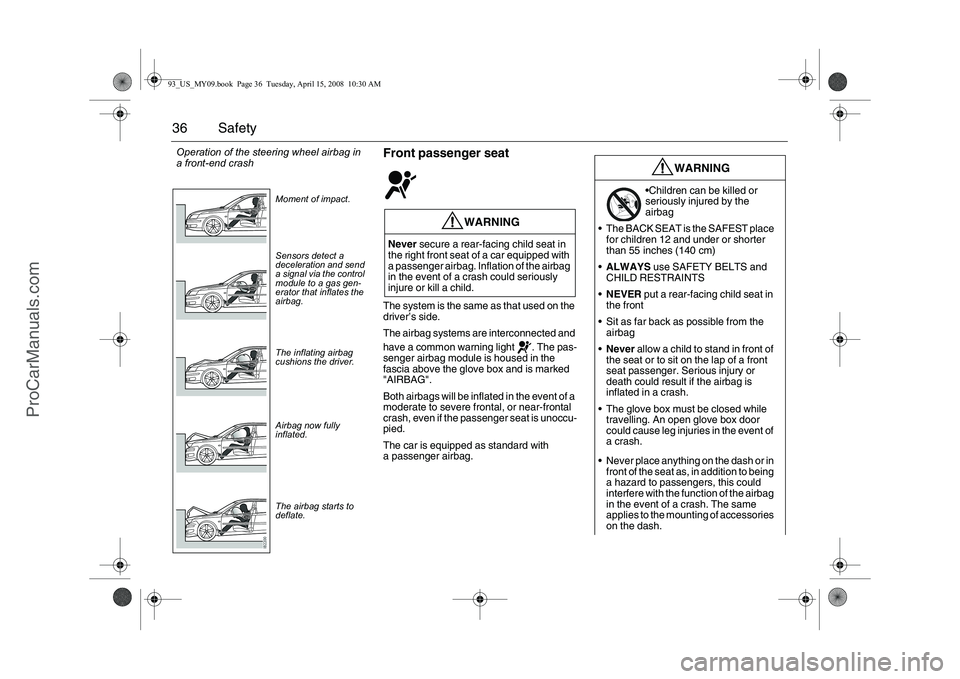
Operation of the steering wheel airbag in
a front-end crash
Moment of impact.
Sensors detect a
deceleration and send
a signal via the control
module to a gas gen-
erator that inflates the
airbag.
The inflating airbag
cushions the driver.
Airbag now fully
inflated.
The airbag starts to
deflate.
93_US_MY09.book Page 36 Tuesday, April 15, 2008 10:30 AM
ProCarManuals.com
Page 37 of 304
37 Safety
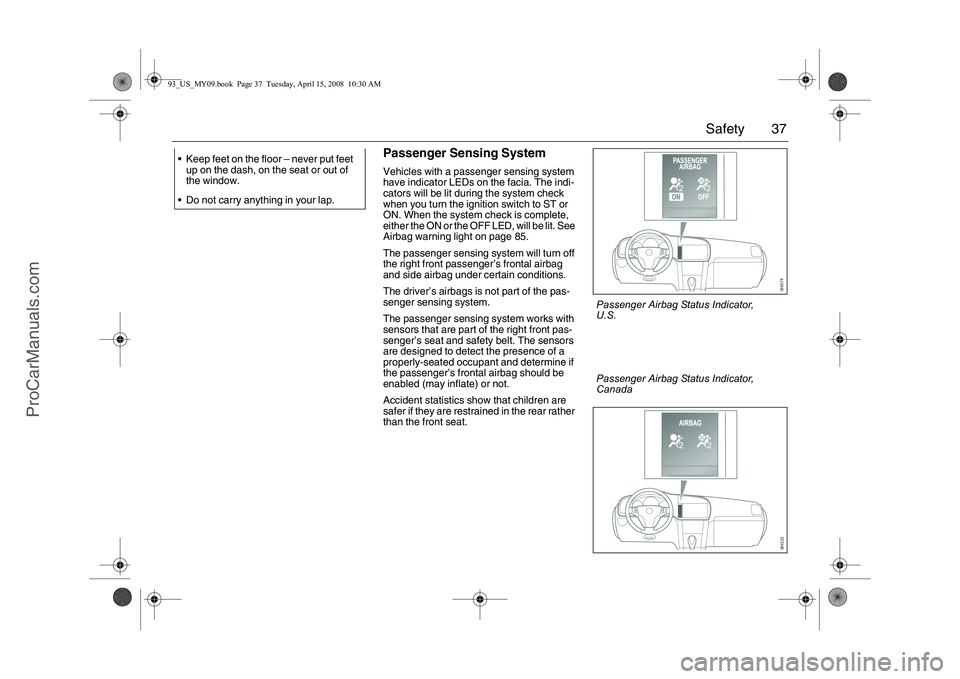
Passenger Sensing SystemVehicles with a passenger sensing system
have indicator LEDs on the facia. The indi-
cators will be lit during the system check
when you turn the ignition switch to ST or
ON. When the system check is complete,
either the ON or the OFF LED, will be lit. See
Airbag warning light on page 85.
The passenger sensing system will turn off
the right front passenger’s frontal airbag
and side airbag under certain conditions.
The driver’s airbags is not part of the pas-
senger sensing system.
The passenger sensing system works with
sensors that are part of the right front pas-
senger’s seat and safety belt. The sensors
are designed to detect the presence of a
properly-seated occupant and determine if
the passenger’s frontal airbag should be
enabled (may inflate) or not.
Accident statistics show that children are
safer if they are restrained in the rear rather
than the front seat. Keep feet on the floor – never put feet
up on the dash, on the seat or out of
the window.
Do not carry anything in your lap.
Passenger Airbag Status Indicator,
U.S.Passenger Airbag Status Indicator,
Canada
93_US_MY09.book Page 37 Tuesday, April 15, 2008 10:30 AM
ProCarManuals.com
Page 38 of 304
38 SafetySaab recommends that child restraints be
secured in a rear seat, including an infant
riding in a rear-facing infant seat, a child
riding in a forward-facing child seat and an
older child riding in a booster seat.
Your vehicle has a rear seat that will accom-
modate a rear-facing child restraint. A label
on your sun visor says, “Never put a
rear-facing child seat in the front.” This is
because the risk to the rear-facing child is so
great, if the airbag deploys.The passenger sensing system is designed
to turn off the right front passenger’s frontal
airbag if:
the right front passenger seat is unoccu-
pied
the system determines that an infant is
present in a rear-facing infant seat
the system determines that a small child
is present in a forward-facing child
restraint
the system determines that a small child
is present in a booster seat
a right front passenger takes his/her
weight off of the seat for a period of time
the right front passenger seat is occupied
by a smaller person, such as a child who
has outgrown child restraints
or if there is a critical problem with the
airbag system or the passenger sensing
system.When the passenger sensing system has
turned off the passenger’s frontal airbag,
the off indicator will light and stay lit to
remind you that the airbag is off.
Saab recommends that child restraints be
secured in a rear seat, but if a child restraint
has been installed and the on indicator is lit,
turn the vehicle off. Remove the child
restraint from the vehicle and reinstall the
child restraint following the child restraint
manufacturer’s directions and refer to
Installation of child restraint using the stan-
dard safety belt on page 31.
If after reinstalling the child restraint and
restarting the vehicle, the on indicator is still
lit, check to make sure that the vehicle’s
seatback is not pressing the child restraint
into the seat cushion. If this happens,
slightly recline the vehicle’s seatback and
adjust the seat cushion if possible. Also
make sure the child restraint is not trapped
under the vehicle head restraint. If this hap-
pens, adjust the head restraint.
If the on indicator is still lit, secure the child
in the child restraint in a rear seat position in
the vehicle and check with your dealer.
WARNING
A child in a rear-facing child restraint can
be seriously injured or killed if the right
front passenger’s airbag inflates. This is
because the back of the rear-facing child
restraint would be very close to the inflat-
ing airbag.
Even though the passenger sensing
system is designed to turn off the passen-
ger’s frontal airbag if the system detects a
rear-facing child restraint, no system is
fail-safe, and no one can guarantee that
an airbag will not deploy under some
unusual circumstance, even though it is
turned off. Saab recommends that
rear-facing child restraints be secured in
the rear seat, even if the airbag is off.93_US_MY09.book Page 38 Tuesday, April 15, 2008 10:30 AM
ProCarManuals.com
Page 39 of 304
39 Safety
The passenger sensing system is designed
to enable (may inflate) the right front
passenger’s frontal airbag anytime the
system senses that a person of adult size is
sitting properly in the right front passenger’s
seat. When the passenger sensing system
has allowed the airbag to be enabled, the on
indicator will light and stay lit to remind you
that the airbag is active.
For some children who have outgrown child
restraints and for very small adults, the pas-
senger sensing system may or may not turn
off the right front passenger’s frontal airbag,
depending upon the person’s seating pos-
ture and body build. Everyone in your vehi-
cle who has outgrown child restraints
should wear a safety belt properly —
whether or not there is an airbag for that per-
son.If a person of adult-size is sitting in the right
front passenger’s seat, but the off indicator
is lit, it could be because that person is not
sitting properly in the seat. If this happens,
turn the vehicle off and ask the person to
place the seatback in the fully upright posi-
tion, then sit upright in the seat, centered on
the seat cushion, with the person’s legs
comfortably extended. Restart the vehicle
and have the person remain in this position
for about two minutes. This will allow the
system to detect that person and then
enable the passenger’s airbag.Aftermarket equipment, such as seat
covers, can affect how well the passenger
sensing system operates. You may want to
consider not using seat covers or other
aftermarket equipment if your vehicle has
the passenger sensing system. See Adding
Equipment to Your Airbag-Equipped Vehi-
cle for more information about modifications
that can affect how the system operates.
WARNING
If the airbag readiness light in the instru-
ment panel cluster ever comes on and
stays on, it means that something may be
wrong with the airbag system. If this ever
happens, have the vehicle serviced
promptly, because an adult-size person
sitting in the right front passenger’s seat
may not have the protection of the frontal
airbag. See Airbag warning lamp on
page 43 for more on this, including impor-
tant safety information.
WARNING
Stowing of articles under the passenger’s
seat or between the passenger’s seat
cushion and seatback may interfere with
the proper operation of the passenger
sensing system.
93_US_MY09.book Page 39 Tuesday, April 15, 2008 10:30 AM
ProCarManuals.com