warning lights SAAB 9-3 2009 User Guide
[x] Cancel search | Manufacturer: SAAB, Model Year: 2009, Model line: 9-3, Model: SAAB 9-3 2009Pages: 304, PDF Size: 44.31 MB
Page 90 of 304
90 Instruments and controlsWhen a message is displayed
The odometer and tripmeter is temporarily
turned off when a two row message is dis-
played. The icon is displayed in the left part
of the display.
The warnings and indications that can be
shown on the SID are listed on page 294.
If there is more than one message on the
SID, a plus sign will be displayed to the left
of the first message. Each message will be
displayed for 10 seconds.
Press the CLR button to acknowledge a SID
message. If you acknowledge a message
but do nothing about it, the message will be
displayed again the next time you start the
car.
When the engine is switched off the warn-
ing/indicator lights still active are displayed,
this is to remind the driver. At this point the
warning/indicator lights previously acknowl-
edged with the CLR button are also dis-
played.
You can adjust the settings of several of the
car’s systems, such as the alarm3, rain
sensor3 and climate control system. These
are known as Settings se page 94.
Odometer and trip meterThe odometer records the distance trav-
elled in miles on U.S. vehicles and on Cana-
dian vehicles the distance indicated is in
kilometres, and the trip meter in miles and
tenths (kilometres and tenths of kilometres
on Canadian vehicles).Reset buttonThe reset button is positioned immediately
to the left of the speedometer.
Press once to resets the trip meter, the igni-
tion shall be in position ON.
Trip computer function of the SID
WARNING
It is strongly recommended that the SID
settings be changed only when the car is
stationary. The driver’s attention can oth-
erwise easily be distracted from the road.
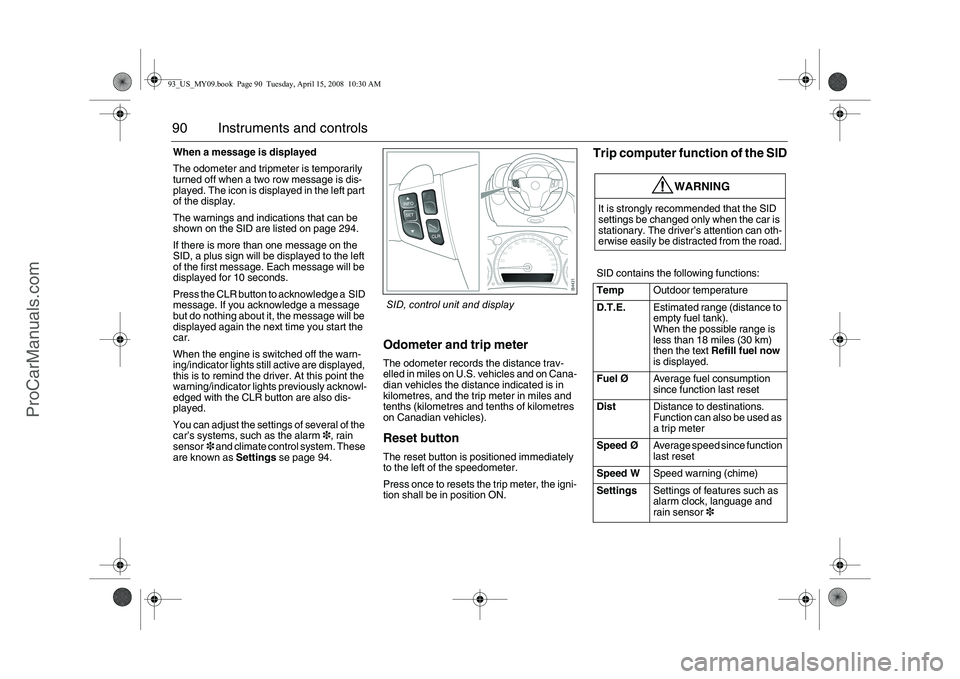
SID contains the following functions:
TempOutdoor temperature
D.T.E.Estimated range (distance to
empty fuel tank).
When the possible range is
less than 18 miles (30 km)
then the text Refill fuel now
is displayed.
Fuel ØAverage fuel consumption
since function last reset
DistDistance to destinations.
Function can also be used as
a trip meter
Speed ØAverage speed since function
last reset
Speed WSpeed warning (chime)
SettingsSettings of features such as
alarm clock, language and
rain sensor3
SID, control unit and display
93_US_MY09.book Page 90 Tuesday, April 15, 2008 10:30 AM
ProCarManuals.com
Page 93 of 304
93 Instruments and controls
You can check the distance left by selecting
Dist. At the same time you can check the
calculated time of arrival.
After the distance to destination has
decreased to zero, Dist will function as a trip
meter (see Using DIST as a trip meter). The
starting value for the trip meter will be the
last distance set for the Dist function.
Example: The Dist function is set to
100 miles. After the count-down has
reached 0 miles, Dist will act as a trip meter
beginning at 100 miles.Calculating the arrival time if a specified
average speed is maintained
(When will I arrive if I know how far I have to
drive and know what my average speed will
be?)
This function should be used before starting
out a journey.
First, set the distance under Dist.
1 Then select Speed Ø function.
2 Press and hold the SET button until
given audible confirmation.
3 Set the estimated average speed using
the steering wheel controls.
4 Confirm the setting by pressing the SET
button.
The distance and the calculated time of
arrival is now displayed.
The time of arrival is updated during the
journey based on the average speed since
Dist was set. The speed of the car must
exceed 12 mph (20 km/h).
By selecting Dist during the journey, you
can see how much distance is left to travel.
When Dist reaches zero it acts as a trip
meter. The trip meter starts from the dis-
tance that was set previously.
NIGHTPANELTo improve night-driving conditions inside
the car, the Night Panel mode can be
selected. In this mode, the amount of infor-
mation displayed is reduced, and only the
most important instruments and displays
will be illuminated.
When the NIGHTPANEL button is pressed,
only the speedometer will be illuminated.
All other instrument lighting will be switched
off and the needles drop to zero.
Note: All indicator and warning lights and
messages will operate normally if required.
Temp (when the outside temperature falls
or rises to between 26 and 38 °F (–3 and
+3 °C)) and D.T.E. (when the remaining fuel
is only sufficient for approx. 80 miles
(50 km) of driving) are even shown in Night
Panel model.
93_US_MY09.book Page 93 Tuesday, April 15, 2008 10:30 AM
ProCarManuals.com
Page 102 of 304
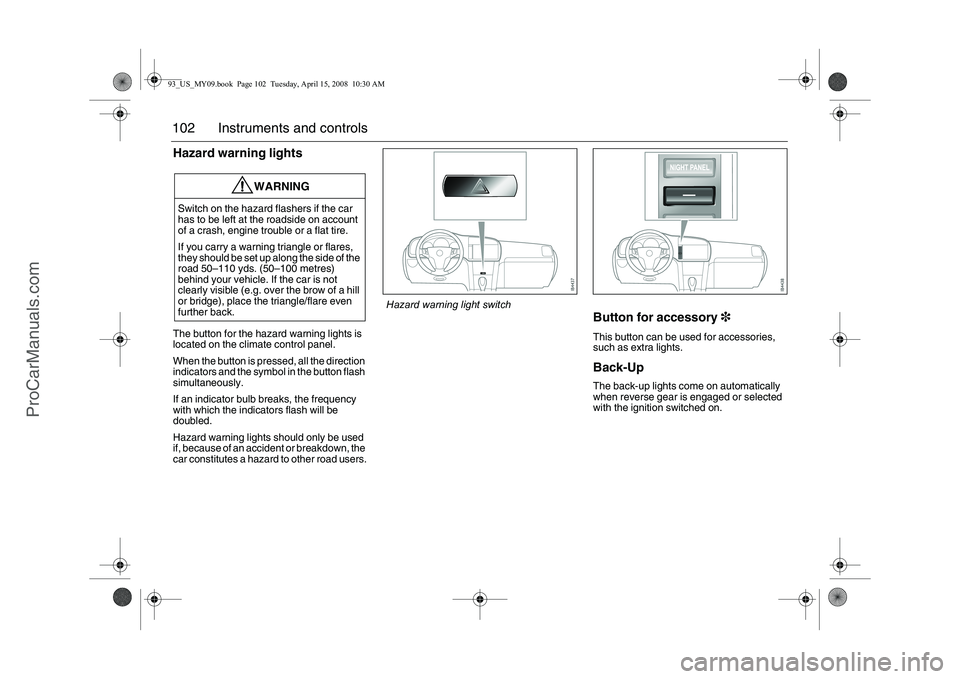
102 Instruments and controlsHazard warning lightsThe button for the hazard warning lights is
located on the climate control panel.
When the button is pressed, all the direction
indicators and the symbol in the button flash
simultaneously.
If an indicator bulb breaks, the frequency
with which the indicators flash will be
doubled.
Hazard warning lights should only be used
if, because of an accident or breakdown, the
car constitutes a hazard to other road users.
Button for accessory3This button can be used for accessories,
such as extra lights.Back-Up The back-up lights come on automatically
when reverse gear is engaged or selected
with the ignition switched on.
WARNING
Switch on the hazard flashers if the car
has to be left at the roadside on account
of a crash, engine trouble or a flat tire.
If you carry a warning triangle or flares,
they should be set up along the side of the
road 50–110 yds. (50–100 metres)
behind your vehicle. If the car is not
clearly visible (e.g. over the brow of a hill
or bridge), place the triangle/flare even
further back.
Hazard warning light switch
93_US_MY09.book Page 102 Tuesday, April 15, 2008 10:30 AM
ProCarManuals.com
Page 150 of 304
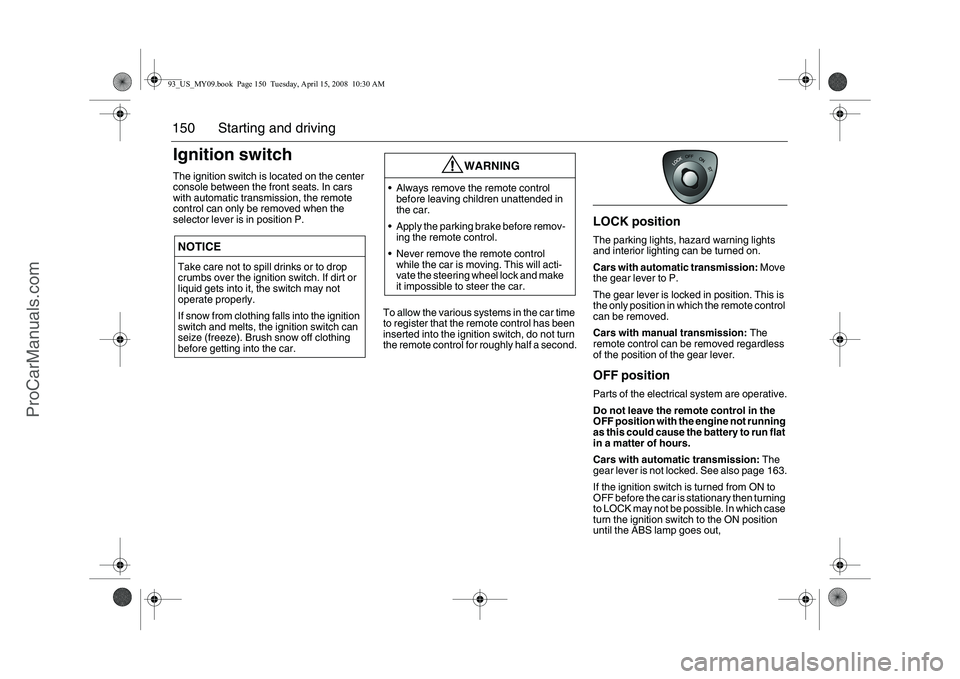
150 Starting and drivingIgnition switchThe ignition switch is located on the center
console between the front seats. In cars
with automatic transmission, the remote
control can only be removed when the
selector lever is in position P.
To allow the various systems in the car time
to register that the remote control has been
inserted into the ignition switch, do not turn
the remote control for roughly half a second.
LOCK positionThe parking lights, hazard warning lights
and interior lighting can be turned on.
Cars with automatic transmission: Move
the gear lever to P.
The gear lever is locked in position. This is
the only position in which the remote control
can be removed.
Cars with manual transmission: The
remote control can be removed regardless
of the position of the gear lever.OFF positionParts of the electrical system are operative.
Do not leave the remote control in the
OFF position with the engine not running
as this could cause the battery to run flat
in a matter of hours.
Cars with automatic transmission: The
gear lever is not locked. See also page 163.
If the ignition switch is turned from ON to
OFF before the car is stationary then turning
to LOCK may not be possible. In which case
turn the ignition switch to the ON position
until the ABS lamp goes out,
NOTICETake care not to spill drinks or to drop
crumbs over the ignition switch. If dirt or
liquid gets into it, the switch may not
operate properly.
If snow from clothing falls into the ignition
switch and melts, the ignition switch can
seize (freeze). Brush snow off clothing
before getting into the car.
WARNING
Always remove the remote control
before leaving children unattended in
the car.
Apply the parking brake before remov-
ing the remote control.
Never remove the remote control
while the car is moving. This will acti-
vate the steering wheel lock and make
it impossible to steer the car.
93_US_MY09.book Page 150 Tuesday, April 15, 2008 10:30 AM
ProCarManuals.com
Page 151 of 304
151 Starting and driving
approx. 2 seconds. Following which, turn it
back to OFF.ON positionThe entire electrical system is operative.
Do not leave the remote control in the ON
position when the engine is not running.
Turn the ignition switch to the OFF position
to disconnect the electrical system.
When you turn the ignition switch to ON,
some indicator and warning lights will come
on in the main instrument panel. These
should go out after about 3 seconds.ST - starter positionThe starter motor operates (automatic
transmission: selector lever must be in P or
N) when the ignition switch is turned to this
position. When released, the ignition switch
will spring back to the ON position.
The car has an electronic restart lock. If the
engine fails to start, the ignition switch must
first be turned back to a position between
OFF and LOCK before the starter motor can
be operated again.
Steering wheel lockThe steering wheel lock is electronic. The
lock engages when the remote control is
removed from the ignition and unlocks when
the remote control is inserted. A click can be
heard when the steering wheel lock locks
and unlocks.
If the car is parked with one front wheel
touching the curb, for example, you may
need to turn the steering wheel slightly
when you insert the remote control to allow
the steering wheel lock to unlock. If you do
not succeed on first attempt you must
remove the remote control before trying
again. Turn the steering wheel and insert
the remote control into the ignition switch.
If the steering wheel lock does not disen-
gage it will not be possible to turn the remote
control in the ignition switch.
The following message is shown on the SID:If a fault arises affecting the steering wheel
lock, the following message will be
displayed on the SID:
If the steering wheel lock malfunctions while
the remote control is in the ignition switch,
this may prevent the removal of the remote
control or prevent the car from being
restarted once the engine has been
switched off.
If you have to leave the car, lock the car by
pressing down the lock buttons on the
doors. Lock the front left door from outside
with the traditional key (see page 50). The
car is now locked but the alarm is inactive.
Pull out key, turn
steering wheel. Restart.
Steering lock malfunc.
Make a safe stop.
93_US_MY09.book Page 151 Tuesday, April 15, 2008 10:30 AM
ProCarManuals.com
Page 152 of 304

152 Starting and drivingStarting the engine
Starting the engineAvoid racing the engine or loading it heavily
before it has warmed up. Do not drive away
before the warning and indicator lights have
gone out.
The engine has an automatic choke and
should be started as follows:
Cars with manual transmission
To start the engine the clutch pedal must
be fully depressed.
1 Make sure the parking brake is applied.
2 Depress the clutch pedal but do not
touch the accelerator.
3 Start the engine. Let the ignition switch
spring back as soon as the engine has
started and is running smoothly.
Allow the engine to idle for about
10 seconds. Do not apply full throttle for at
least 3 minutes after starting.Cars with automatic transmission
The selector lever must be in the P or N
position.
1 The selector lever must be in the P or N
position.
2 Keep your foot on the brake pedal.
Note! Once the engine has started, the
brake pedal will sink. This is perfectly
normal.
3 Start the engine. Let the ignition switch
spring back as soon as the engine has
started and is running smoothly.
Allow the engine to idle for about
10 seconds. Do not apply full throttle for at
least 3 minutes after starting.
WARNING
When starting the engine:
– Sit down in the driver’s seat.
– Depress the clutch pedal fully (M/T). If
the gear lever is not in the neutral posi-
tion, the clutch pedal must be fully
depressed or the car will jump for-
wards or backwards, which may
cause a crash.
– Never start the car from outside the
vehicle, e.g. through a window that is
down. This could lead to serious per-
sonal injury.
Cars with automatic transmission:
select position P to remove the ignition
key. The key can only be removed in
this gear position.
Carbon monoxide (CO) is a colorless,
odorless, poisonous gas. Be alert to
the danger of CO – always open the
garage doors before starting the
engine in the garage.
Do not rest or sleep in the car when
parked with the engine running. There
is a risk of depressing the accelerator
which could lead to engine damage.
There is also a danger of CO poison-
ing if the exhaust system is leaking.93_US_MY09.book Page 152 Tuesday, April 15, 2008 10:30 AM
ProCarManuals.com
Page 188 of 304
188 Starting and drivingTowing a trailer3Make sure you are familiar with the legal
requirements regarding speed limits for
towing, maximum trailer weights, trailer
braking requirements, and also any spe-
cial driving licence provisions.
Trailer hitch attachment3Trailer hitch attachments are available as
accessories. These are designed for a max-
imum trailer weight of 3500 lbs (1588 kg),
with trailer brakes.
The towbar must not be installed on certain
models. Contact an authorised Saab dealer
for information.
An electrical connection3 for the towbar
and an electrical unit are provided in the
electrical center on the left-hand side of the
luggage compartment.
If the car has a 13-pin Saab genuine electri-
cal socket then it is possible to supply a
trailer/caravan with rear fog lights and
reversing lights. The caravan can also have
interior and exterior lighting even when the
car’s ignition is switched off. In which case,
remember not to load the battery for too
long so that it is discharged and pre-
vents the car from starting.
There is also access to power in the caravan
during a journey, the caravan battery can be
charged for example.
Also, if the car has SPA, this is deactivated
automatically if a trailer is hitched up and
correctly connected to the Saab genuine
trailer socket.
Saab recommendations:
Use a genuine Saab trailer hitch that is
designed and tested for your Saab.
WARNING
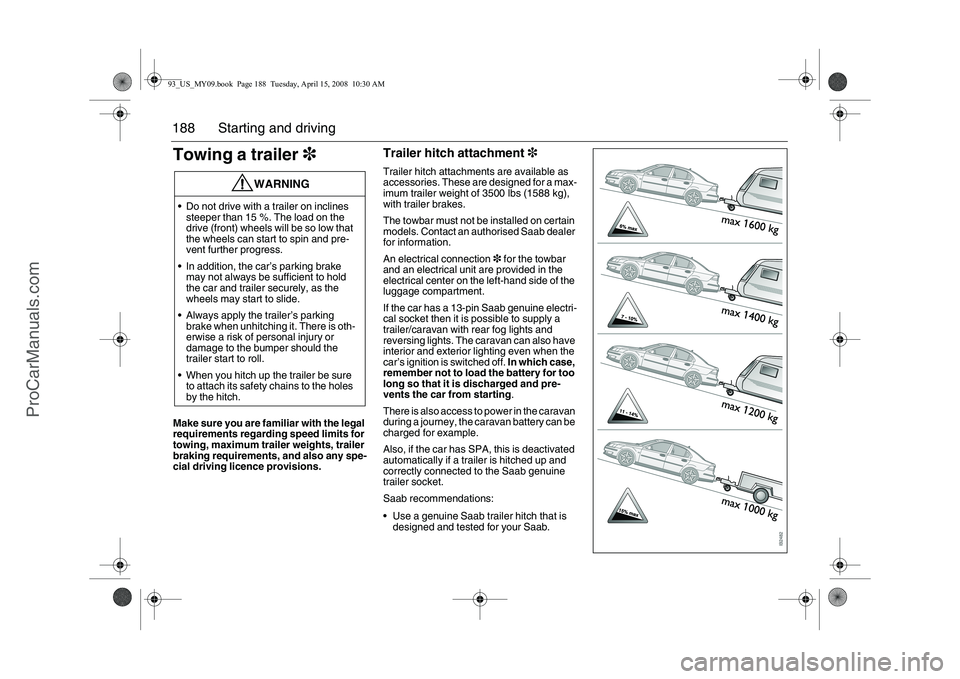
Do not drive with a trailer on inclines
steeper than 15 %. The load on the
drive (front) wheels will be so low that
the wheels can start to spin and pre-
vent further progress.
In addition, the car’s parking brake
may not always be sufficient to hold
the car and trailer securely, as the
wheels may start to slide.
Always apply the trailer’s parking
brake when unhitching it. There is oth-
erwise a risk of personal injury or
damage to the bumper should the
trailer start to roll.
When you hitch up the trailer be sure
to attach its safety chains to the holes
by the hitch.93_US_MY09.book Page 188 Tuesday, April 15, 2008 10:30 AM
ProCarManuals.com
Page 197 of 304
197 Starting and driving
Jump starting
It is essential when a donor battery is to be
used to jump start the car that the jump
leads be connected correctly to prevent
arcing.
To jump start your vehicle
1 Check the other vehicle. It must have a
12-volt battery with a negative ground
system.2 Get the vehicles close enough so the
jumper cables can reach, but be sure the
vehicles are not touching each other. If a
poor connection on the negative jumper
cable should exist, it is possible for
damage to be caused to electrical
systems/components of either vehicle
should inadvertent contact be made.
You would not be able to start your car
and bad grounding could damage the
electrical systems.
3 Turn off the ignition on both vehicles.
Turn off lights that are not needed, and
radios. This will avoid sparks and help
save both batteries and it could save
your radio.
WARNING
When working on the battery, highly
explosive gas can build up. A spark
could ignite this gas that collects
around the battery. Therefore, always
avoid sparks and open flames in the
vicinity of the battery.
The battery contains corrosive sulfuric
acid. Always wear a face mask or gog-
gles when working on the battery.
If battery acid gets into the eyes or
splashes onto skin or clothing, wash
the affected area liberally with water. If
acid gets into the eyes or a large quan-
tity makes contact with the skin, seek
medical help.
NOTICEIgnoring these steps could result in costly
damage to your vehicle that would not be
covered by your warranty.
Trying to start your car by pushing or pull-
ing it could damage your vehicle, even if
you have a manual transmission. If you
have an automatic transmission, your
vehicle cannot be started by pushing or
pulling it.
NOTICEIf the other system is not a 12-volt system
with a negative ground, both vehicles can
be damaged.
WARNING
You could be injured if the vehicles roll.
Set the parking brake firmly on each vehi-
cle. Put an automatic transmission in P
(Park) or a manual transmission in Neu-
tral.
93_US_MY09.book Page 197 Tuesday, April 15, 2008 10:30 AM
ProCarManuals.com
Page 218 of 304
218 Car careChanging bulbs
Auto checking of lightsThe bulbs that are most important from the
point of view of traffic safety are monitored
by the car’s electrical system. If one of these
bulbs should fail, a message will be dis-
played on the SID.
Example of SID message:
The following bulbs are not checked: park-
ing lights, front fog lights, reversing lights,
license plate lighting, side marker lights and
side direction indicators.
SportCombi
The tail lights and brake lights consist of
LEDs. If approx. 3/4 of the LEDs on one side
are broken then this is indicated in the SID. If a stop light bulb fails
SportSedan:
If a stop light bulb fails, the
adjacent taillight will act as a stop light to
ensure traffic safety. Change the broken
bulb when possible.
All rear light bulbs are of the same type and
rated 21 W, with the exception of the license
plate lighting which is rated 5 W.
WARNING
Before changing a bulb in the engine
bay, switch off the engine to avoid the
danger of fingers and hands being
injured by moving parts.
The radiator fan can cut in even when the
engine is switched off.NOTICESwitch off the ignition before changing a
bulb, to avoid possible short-circuiting.
Left low beam failure.
93_US_7carcare_MY09.fm Page 218 Tuesday, April 15, 2008 11:26 AM
ProCarManuals.com
Page 219 of 304
219
Car care
Wrong bulb fitted
If a low or main beam bulb of too high a
rating is fitted, a bulb failure message will be
shown on the SID (a too high wattage bulb
can damage the reflector).
If the following message is displayed but the
bulb shines, it is most likely that an incorrect
bulb has been fitted.
Note
When changing bulbs, fit the same type of
bulb (e.g. Long-Life) as that removed.
Headlight aiming , page 274.
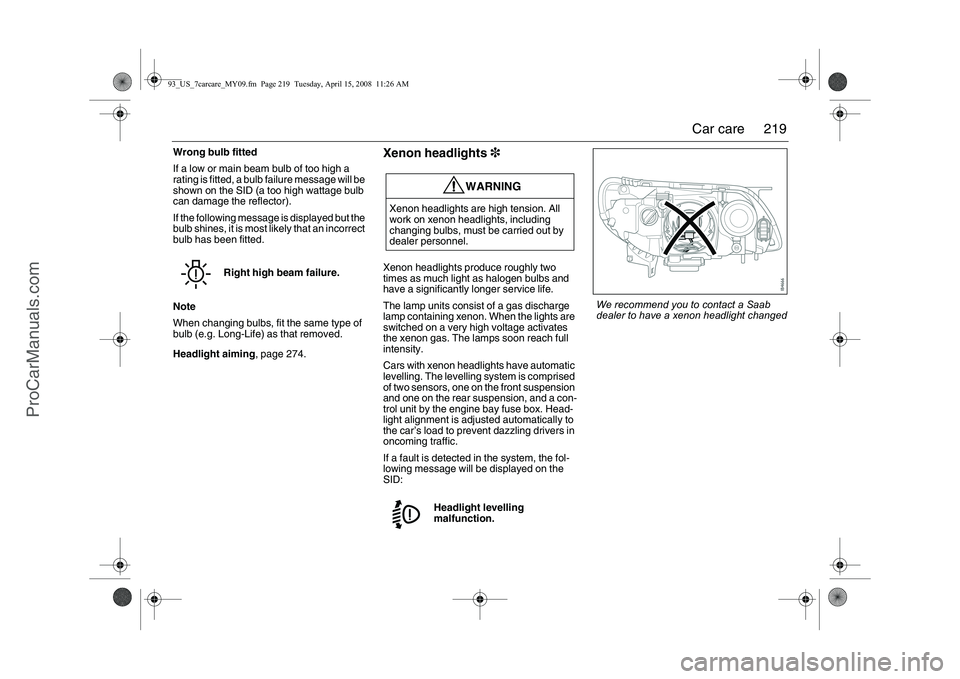
Xenon headlights 3Xenon headlights produce roughly two
times as much light as halogen bulbs and
have a significantly longer service life.
The lamp units consist of a gas discharge
lamp containing xenon. When the lights are
switched on a very hi gh voltage activates
the xenon gas. The lamps soon reach full
intensity.
Cars with xenon headlights have automatic
levelling. The levelling system is comprised
of two sensors, one on the front suspension
and one on the rear suspension, and a con-
trol unit by the engine bay fuse box. Head-
light alignment is adjus ted automatically to
the car’s load to prevent dazzling drivers in
oncoming traffic.
If a fault is detected in the system, the fol-
lowing message will be displayed on the
SID:
Right high beam failure.
WARNING
Xenon headlights are high tension. All
work on xenon headlights, including
changing bulbs, must be carried out by
dealer personnel.
Headlight levelling
malfunction.
We recommend you to contact a Saab
dealer to have a xenon headlight changed
93_US_7carcare_MY09.fm Page 219 Tuesday, April 15, 2008 11:26 AM
ProCarManuals.com