tire pressure SAAB 9-3 2009 Owner's Manual
[x] Cancel search | Manufacturer: SAAB, Model Year: 2009, Model line: 9-3, Model: SAAB 9-3 2009Pages: 304, PDF Size: 44.31 MB
Page 258 of 304
258 Car careDriving with a compact wheel
fittedObserve the following when the compact
spare tire is fitted:
The compact spare is light and easy to handle when changing a tire.
Do not drive further than necessary with the compact spare fitted - the maximum
life of the tire is only just over 2,000 miles
(approx. 3,500 km).
Refit the standard tire as soon as possi- ble.
Fitting a spare tire/wheel without pressure sensor will trigger a malfunction
message, see page 255.
Important considerations when driving with
a compact spare tire:
The car’s ground clearance is reduced. The car must not be driven with more than
one compact spare tire at a time.
Avoid driving against the curb.
Do not use snow chains.
Do not fit the wheel cover - this would conceal the warning text.
Changing a tire
WARNING
Do not exceed 50 mph (80 km/h). The
tire can overheat affecting the car’s
road holding.
Tire pressure: refer to page 291.
The spare tire or punctured tire must be stowed under the trunk floor, and
secured in place with the retaining nut.
WARNING
Lifting a vehicle and getting under it to do
maintenance or repairs is dangerous
without the appropriate safety equipment
and training. The jack provided with your
vehicle is designed only for changing a
flat tire. If it is used for anything else, you
or others could be badly injured or killed if
the vehicle slips off the jack. Use the jack
provided with your vehicle only for chang-
ing a flat tire.
Changing a tire can be dangerous. The
vehicle can slip off the jack and roll over
or fall on you or other people. You and
they could be badly injured or even killed.
Find a level place to change your tire. To
help prevent the vehicle from moving:
1 Set the parking brake firmly.
2 If you have an automatic transmis- sion, put the shift lever in PARK (P).
For a manual transmission, leave the
car in gear (1st or REVERSE (R)).
3 Turn off the engine and do not restart while the vehicle is raised.
4 Do not allow passengers to remain in the vehicle.
93_US_7carcare_MY09.fm Page 258 Tuesday, April 15, 2008 11:26 AM
ProCarManuals.com
Page 264 of 304
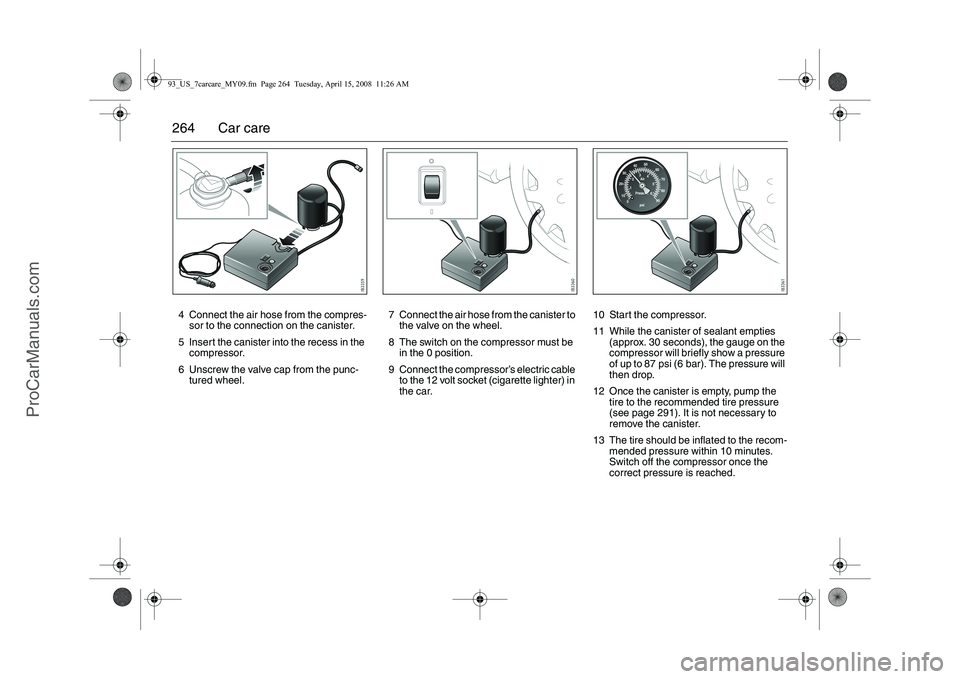
264 Car care4 Connect the air hose from the compres-sor to the connection on the canister.
5 Insert the canister into the recess in the compressor.
6 Unscrew the valve cap from the punc- tured wheel. 7 Connect the air hose from the canister to
the valve on the wheel.
8 The switch on the compressor must be in the 0 position.
9 Connect the compressor’s electric cable to the 12 volt socket (cigarette lighter) in
the car. 10 Start the compressor.
11 While the canister of sealant empties
(approx. 30 seconds), the gauge on the
compressor will briefly show a pressure
of up to 87 psi (6 bar). The pressure will
then drop.
12 Once the canister is empty, pump the tire to the recommended tire pressure
(see page 291). It is not necessary to
remove the canister.
13 The tire should be inflated to the recom- mended pressure within 10 minutes.
Switch off the compressor once the
correct pressure is reached.93_US_7carcare_MY09.fm Page 264 Tuesday, April 15, 2008 11:26 AM
ProCarManuals.com
Page 265 of 304
265
Car care
If the correct pressure is not reached
within 10 minutes, the damage to the tire is
too large to be repaired with the sealant.
Park the car in a suitable place and call for
assistance.
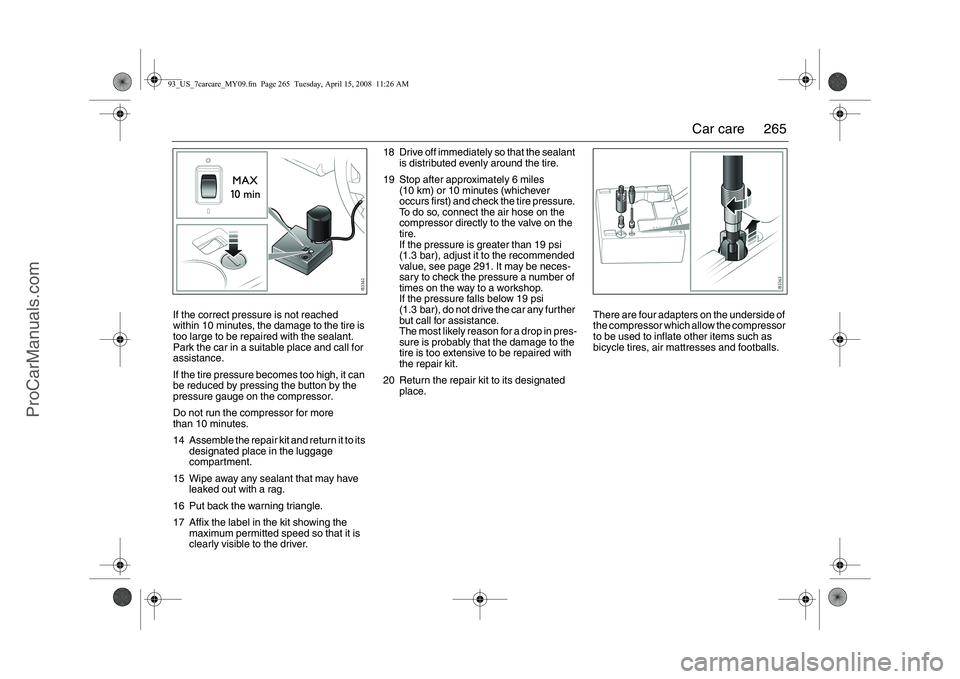
If the tire pressure becomes too high, it can
be reduced by pressing the button by the
pressure gauge on the compressor.
Do not run the co mpressor for more
than 10 minutes.
14 Assemble the repair kit and return it to its designated place in the luggage
compartment.
15 Wipe away any sealant that may have leaked out with a rag.
16 Put back the warning triangle.
17 Affix the label in the kit showing the maximum permitted speed so that it is
clearly visible to the driver. 18 Drive off immediately so that the sealant
is distributed evenly around the tire.
19 Stop after approximately 6 miles (10 km) or 10 minutes (whichever
occurs first) and check the tire pressure.
To do so, connect the air hose on the
compressor directly to the valve on the
tire.
If the pressure is greater than 19 psi
(1.3 bar), adjust it to the recommended
value, see page 291. It may be neces-
sary to check the pressure a number of
times on the way to a workshop.
If the pressure falls below 19 psi
(1.3 bar), do not drive the car any further
but call for assistance.
The most likely reason for a drop in pres-
sure is probably that the damage to the
tire is too extensive to be repaired with
the repair kit.
20 Return the repair kit to its designated place. There are four adapters on the underside of
the compressor which allow the compressor
to be used to inflate other items such as
bicycle tires, air mattresses and footballs.93_US_7carcare_MY09.fm
Page 265 Tuesday, April 15, 2008 11:26 AM
ProCarManuals.com
Page 272 of 304
272 Car care
washing will prevent paint damage from
acid rain and other airborne contami-
nants such as tree sap and bird drop-
pings. If any of these contaminants are
noticed on the car the finish should be
washed immediately.
Begin washing by rinsing the entire car with water to loosen and flush off heavy
concentrations of dirt (include the
underbody).
Sponge the car with a solution of either a good quality car soap or mild general
purpose (dish washing) detergent and
water.
Rinse car thoroughly with clean water
After washing, check and clear all drains in doors and body panels
Wipe the car dry, preferably using a chamois.
2 Clean the underside of the car during
the winter. Use high pressure water to
clean the car’s underside (floor panels,
wheel wells) at least at mid-winter and in
the spring. 3
Inspect the car frequently for leaks or
damage, and arrange for needed
repairs promptly. After washing or after
heavy rain, check for leaks. When wash-
ing the car inspect body surfaces for
paint damage. While checking for leaks,
lift the floor mats and check underneath
them. Water can collect in these areas
and remain for prolonged periods. Dry
any wet areas including the floor mats.
Have leaks repaired as soon as possi-
ble.
Use touch -up paint to repair small
scratches or minor finish damage. Areas
where metal is exposed will rust quickly
and MUST be repaired immediately by
touch-up or professional repainting.
Rust must be removed, the bare metal
primed and painted. Major body
damage should be repaired immediately
and new panels or exposed areas
should be undercoated with anti- corro-
sion material.
Repairs of this type are the owner’s
responsibility and are not covered under
warranty. Inspect the undercoating and touch up if
necessary.
Pay particular attention to the
fenders and wheel housings, which are
exposed to abrasion by flying gravel, etc. If
the composition has worn or flaked off, the
steel must be thoroughly cleaned and dried
before a fresh coat is applied. The cleaning
is best done with a scraper and a steel wire
brush, followed by washing with solvent.
Apply the new coating thinly, otherwise it
may run off or fall off when dry.
Recovery and/or
recycling of automotive
materialsInformation on the scrapping and recycling
of car materials is available on
www.saab.com.
93_US_7carcare_MY09.fm Page 272 Tuesday, April 15, 2008 11:26 AM
ProCarManuals.com
Page 274 of 304
274 Car carecompressor uses a lubricant that circu-
lates with the coolant.
Note
The A/C system cannot be switched on
when the outside temperature is below 32°F
(0°C). Turn on the A/ C system when the car
is standing in a warm place. Simplest is to
always have the A/C button pressed in. The
A/C system will then cu t in automatically
when the outside temperature is high
enough.
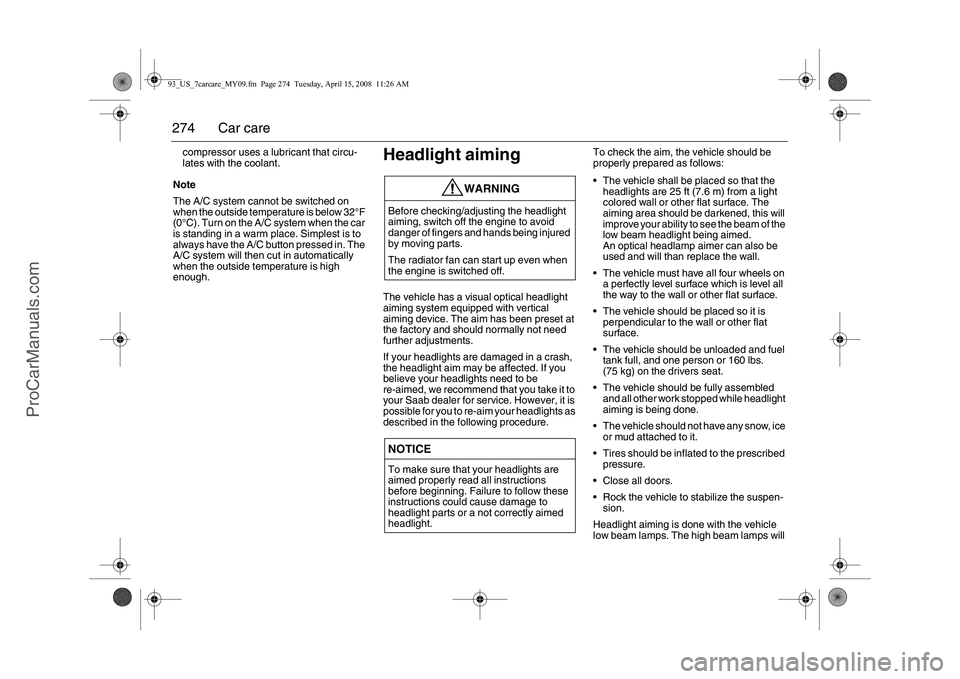
Headlight aimingThe vehicle has a visual optical headlight
aiming system equippe d with vertical
aiming device. The aim has been preset at
the factory and should normally not need
further adjustments.
If your headlights are damaged in a crash,
the headlight aim may be affected. If you
believe your headlights need to be
re-aimed, we recommend that you take it to
your Saab dealer for service. However, it is
possible for you to re-aim your headlights as
described in the following procedure. To check the aim, the vehicle should be
properly prepared as follows:
The vehicle shall be placed so that the
headlights are 25 ft (7.6 m) from a light
colored wall or other flat surface. The
aiming area should be darkened, this will
improve your ability to see the beam of the
low beam headlight being aimed.
An optical headlamp aimer can also be
used and will than replace the wall.
The vehicle must have all four wheels on a perfectly level surface which is level all
the way to the wall or other flat surface.
The vehicle should be placed so it is perpendicular to the wall or other flat
surface.
The vehicle should be unloaded and fuel tank full, and one person or 160 lbs.
(75 kg) on the drivers seat.
The vehicle should be fully assembled and all other work stopped while headlight
aiming is being done.
The vehicle should not have any snow, ice or mud attached to it.
Tires should be inflated to the prescribed pressure.
Close all doors.
Rock the vehicle to stabilize the suspen- sion.
Headlight aiming is done with the vehicle
low beam lamps. The high beam lamps will
WARNING
Before checking/adjusting the headlight
aiming, switch off the engine to avoid
danger of fingers and hands being injured
by moving parts.
The radiator fan can start up even when
the engine is switched off.NOTICETo make sure that your headlights are
aimed properly read all instructions
before beginning. Failure to follow these
instructions could cause damage to
headlight parts or a not correctly aimed
headlight.
93_US_7carcare_MY09.fm Page 274 Tuesday, April 15, 2008 11:26 AM
ProCarManuals.com
Page 286 of 304
286 Technical data
Engine
Engine oil
WARNING
The GVW and maximum axle loads must not be exceeded.
Note that if some accessories (e.g. towbar, CD changer) are
fitted, the available load capacity is reduced by the weight of
these.
When carrying a load in the trunk, make sure that it is lashed
down securely, particularly when part or all of the rear seat is
folded down.
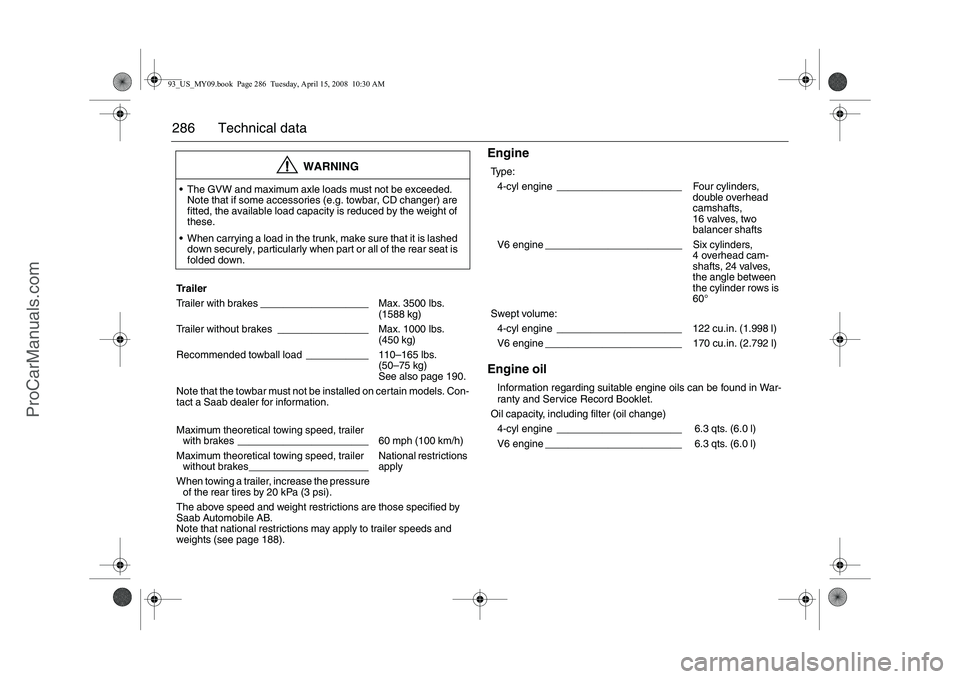
Trailer
Trailer with brakes ___________________ Max. 3500 lbs.
(1588 kg)
Trailer without brakes ________________ Max. 1000 lbs.
(450 kg)
Recommended towball load ___________ 110–165 lbs.
(50–75 kg)
See also page 190.
Note that the towbar must not be installed on certain models. Con-
tact a Saab dealer for information.
Maximum theoretical towing speed, trailer
with brakes _______________________ 60 mph (100 km/h)
Maximum theoretical towing speed, trailer
without brakes _____________________National restrictions
apply
When towing a trailer, increase the pressure
of the rear tires by 20 kPa (3 psi).
The above speed and weight restrictions are those specified by
Saab Automobile AB.
Note that national restrictions may apply to trailer speeds and
weights (see page 188).
Type:
4-cyl engine ______________________ Four cylinders,
double overhead
camshafts,
16 valves, two
balancer shafts
V6 engine ________________________ Six cylinders,
4 overhead cam-
shafts, 24 valves,
the angle between
the cylinder rows is
60°
Swept volume:
4-cyl engine ______________________ 122 cu.in. (1.998 l)
V6 engine ________________________ 170 cu.in. (2.792 l)
Information regarding suitable engine oils can be found in War-
ranty and Service Record Booklet.
Oil capacity, including filter (oil change)
4-cyl engine ______________________ 6.3 qts. (6.0 l)
V6 engine ________________________ 6.3 qts. (6.0 l)
93_US_MY09.book Page 286 Tuesday, April 15, 2008 10:30 AM
ProCarManuals.com
Page 288 of 304
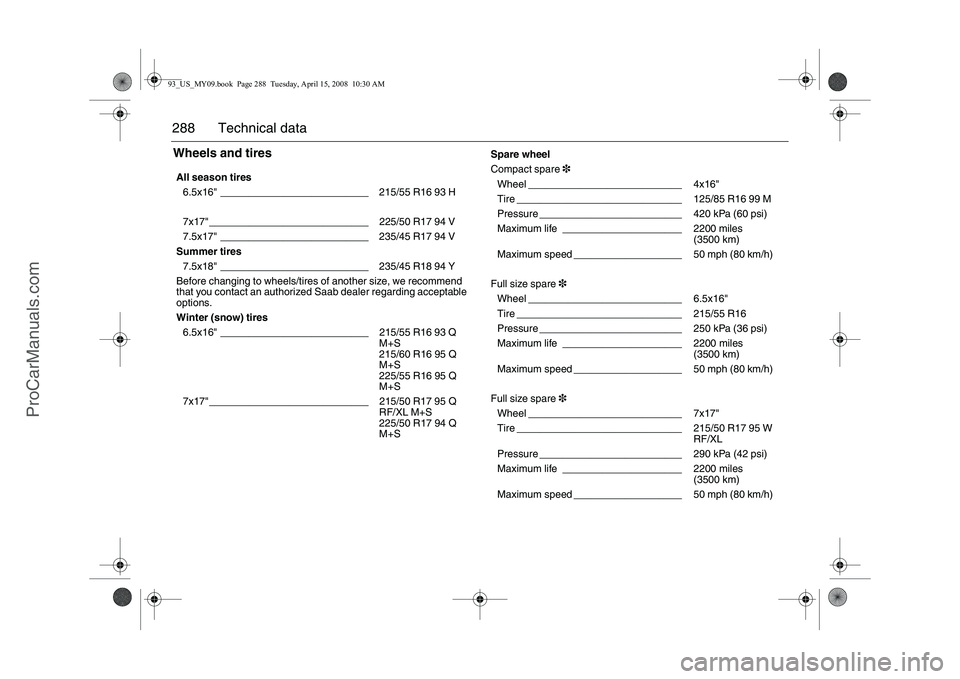
288 Technical dataWheels and tiresAll season tires
6.5x16" __________________________ 215/55 R16 93 H
7x17"____________________________ 225/50 R17 94 V
7.5x17" __________________________ 235/45 R17 94 V
Summer tires
7.5x18" __________________________ 235/45 R18 94 Y
Before changing to wheels/tires of another size, we recommend
that you contact an authorized Saab dealer regarding acceptable
options.
Winter (snow) tires
6.5x16" __________________________ 215/55 R16 93 Q
M+S
215/60 R16 95 Q
M+S
225/55 R16 95 Q
M+S
7x17"____________________________ 215/50 R17 95 Q
RF/XL M+S
225/50 R17 94 Q
M+SSpare wheel
Compact spare3
Wheel ___________________________ 4x16"
Tire _____________________________ 125/85 R16 99 M
Pressure _________________________ 420 kPa (60 psi)
Maximum life _____________________ 2200 miles
(3500 km)
Maximum speed ___________________ 50 mph (80 km/h)
Full size spare3
Wheel ___________________________ 6.5x16"
Tire _____________________________ 215/55 R16
Pressure _________________________ 250 kPa (36 psi)
Maximum life _____________________ 2200 miles
(3500 km)
Maximum speed ___________________ 50 mph (80 km/h)
Full size spare3
Wheel ___________________________ 7x17"
Tire _____________________________ 215/50 R17 95 W
RF/XL
Pressure _________________________ 290 kPa (42 psi)
Maximum life _____________________ 2200 miles
(3500 km)
Maximum speed ___________________ 50 mph (80 km/h)93_US_MY09.book Page 288 Tuesday, April 15, 2008 10:30 AM
ProCarManuals.com
Page 291 of 304
291 Technical data
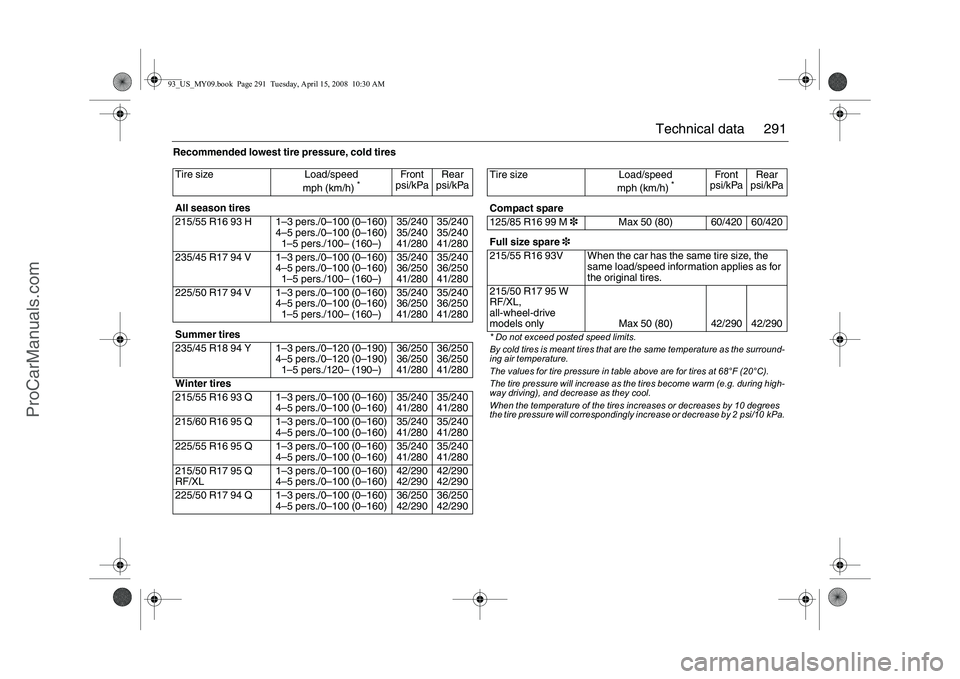
Recommended lowest tire pressure, cold tires
Tire size Load/speed
mph (km/h)
*
Front
psi/kPaRear
psi/kPa
All season tires
215/55 R16 93 H 1–3 pers./0–100 (0–160)
4–5 pers./0–100 (0–160)
1–5 pers./100– (160–)35/240
35/240
41/28035/240
35/240
41/280
235/45 R17 94 V 1–3 pers./0–100 (0–160)
4–5 pers./0–100 (0–160)
1–5 pers./100– (160–)35/240
36/250
41/28035/240
36/250
41/280
225/50 R17 94 V 1–3 pers./0–100 (0–160)
4–5 pers./0–100 (0–160)
1–5 pers./100– (160–)35/240
36/250
41/28035/240
36/250
41/280
Summer tires
235/45 R18 94 Y 1–3 pers./0–120 (0–190)
4–5 pers./0–120 (0–190)
1–5 pers./120– (190–)36/250
36/250
41/28036/250
36/250
41/280
Winter tires
215/55 R16 93 Q 1–3 pers./0–100 (0–160)
4–5 pers./0–100 (0–160)35/240
41/28035/240
41/280
215/60 R16 95 Q 1–3 pers./0–100 (0–160)
4–5 pers./0–100 (0–160)35/240
41/28035/240
41/280
225/55 R16 95 Q 1–3 pers./0–100 (0–160)
4–5 pers./0–100 (0–160)35/240
41/28035/240
41/280
215/50 R17 95 Q
RF/XL1–3 pers./0–100 (0–160)
4–5 pers./0–100 (0–160)42/290
42/29042/290
42/290
225/50 R17 94 Q 1–3 pers./0–100 (0–160)
4–5 pers./0–100 (0–160)36/250
42/29036/250
42/290
Tire size Load/speed
mph (km/h)
*
Fr o nt
psi/kPaRear
psi/kPa
Compact spare
125/85 R16 99 M 3Max 50 (80) 60/420 60/420
Full size spare 3
215/55 R16 93V When the car has the same tire size, the
same load/speed information applies as for
the original tires.
215/50 R17 95 W
RF/XL,
all-wheel-drive
models only Max 50 (80) 42/290 42/290
* Do not exceed posted speed limits.
By cold tires is meant tires that are the same temperature as the surround-
ing air temperature.
The values for tire pressure in table above are for tires at 68°F (20°C).
The tire pressure will increase as the tires become warm (e.g. during high-
way driving), and decrease as they cool.
When the temperature of the tires increases or decreases by 10 degrees
the tire pressure will correspondingly increase or decrease by 2 psi/10 kPa.
93_US_MY09.book Page 291 Tuesday, April 15, 2008 10:30 AM
ProCarManuals.com
Page 292 of 304
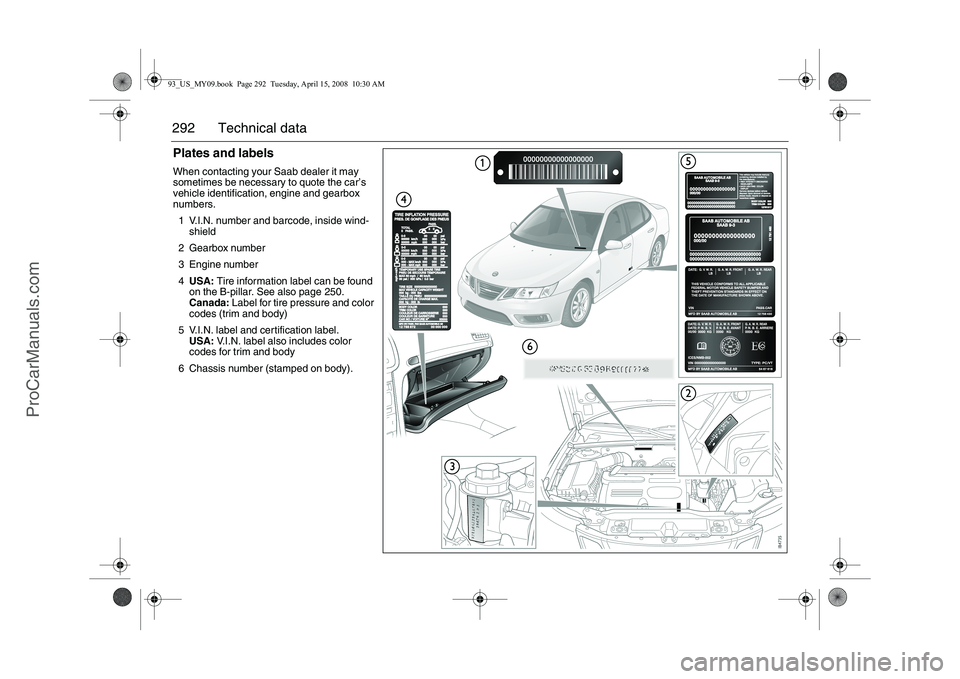
292 Technical dataPlates and labelsWhen contacting your Saab dealer it may
sometimes be necessary to quote the car’s
vehicle identification, engine and gearbox
numbers.
1 V.I.N. number and barcode, inside wind-
shield
2 Gearbox number
3 Engine number
4USA: Tire information label can be found
on the B-pillar. See also page 250.
Canada: Label for tire pressure and color
codes (trim and body)
5 V.I.N. label and certification label.
USA: V.I.N. label also includes color
codes for trim and body
6 Chassis number (stamped on body).93_US_MY09.book Page 292 Tuesday, April 15, 2008 10:30 AM
ProCarManuals.com
Page 295 of 304
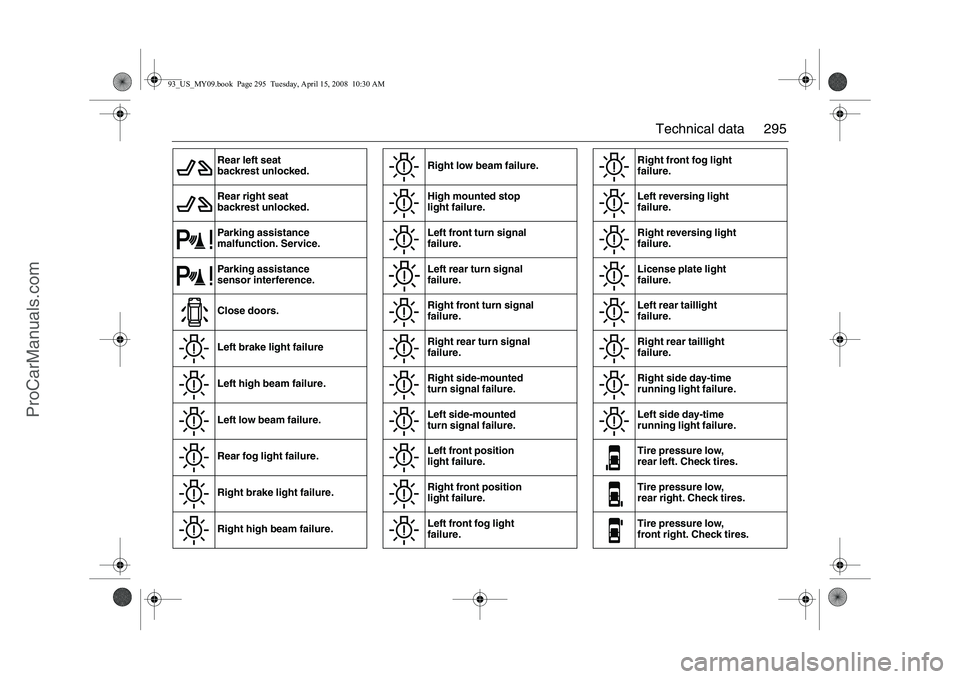
295 Technical data
Rear left seat
backrest unlocked.
Rear right seat
backrest unlocked.
Parking assistance
malfunction. Service.
Parking assistance
sensor interference.
Close doors.
Left brake light failure
Left high beam failure.
Left low beam failure.
Rear fog light failure.
Right brake light failure.
Right high beam failure.
Right low beam failure.
High mounted stop
light failure.
Left front turn signal
failure.
Left rear turn signal
failure.
Right front turn signal
failure.
Right rear turn signal
failure.
Right side-mounted
turn signal failure.
Left side-mounted
turn signal failure.
Left front position
light failure.
Right front position
light failure.
Left front fog light
failure.
Right front fog light
failure.
Left reversing light
failure.
Right reversing light
failure.
License plate light
failure.
Left rear taillight
failure.
Right rear taillight
failure.
Right side day-time
running light failure.
Left side day-time
running light failure.
Tire pressure low,
rear left. Check tires.
Tire pressure low,
rear right. Check tires.
Tire pressure low,
front right. Check tires.
93_US_MY09.book Page 295 Tuesday, April 15, 2008 10:30 AM
ProCarManuals.com