battery SAAB 9-3 2009 Owner's Guide
[x] Cancel search | Manufacturer: SAAB, Model Year: 2009, Model line: 9-3, Model: SAAB 9-3 2009Pages: 304, PDF Size: 44.31 MB
Page 193 of 304
193 Starting and driving
Driving with the trunk lid
openIf you must drive with the trunk lid open,
close all windows and the moonroof (if
equipped) and set the cabin fan to its high-
est speed setting.Driving in deep waterTowing the car
WARNING
Avoid driving with the trunk lid partly or
fully open, since exhaust fumes can be
drawn into the cabin.NOTICEDo not drive in puddles or water deeper
than 7 in. (20 cm) and do not drive faster
than 3–4 mph. Water can otherwise be
sucked into the engine. The engine will be
seriously damaged if water enters the
intake system.
WARNING
Remember that the brake servo does
not operate when the engine is off.
Much greater pressure than normal
will therefore be required to operate
the brake pedal.
Nor does the steering servo operate
when the engine is off. The steering
will therefore be much heavier than
usual.
The towing vehicle should always be
heavier than the vehicle on tow.
Never allow passengers to ride in the
car when it is on tow.
Always seek professional help if the
car needs to be recovered.
The ignition switch must be in the ON
position if the car is moved with the
engine not running.
The steering wheel lock must be dis-
engaged before towing the car.
The steering wheel lock disengages
when the remote control is inserted
into the ignition switch, if the battery
has sufficient charge.
93_US_MY09.book Page 193 Tuesday, April 15, 2008 10:30 AM
ProCarManuals.com
Page 197 of 304
197 Starting and driving
Jump starting
It is essential when a donor battery is to be
used to jump start the car that the jump
leads be connected correctly to prevent
arcing.
To jump start your vehicle
1 Check the other vehicle. It must have a
12-volt battery with a negative ground
system.2 Get the vehicles close enough so the
jumper cables can reach, but be sure the
vehicles are not touching each other. If a
poor connection on the negative jumper
cable should exist, it is possible for
damage to be caused to electrical
systems/components of either vehicle
should inadvertent contact be made.
You would not be able to start your car
and bad grounding could damage the
electrical systems.
3 Turn off the ignition on both vehicles.
Turn off lights that are not needed, and
radios. This will avoid sparks and help
save both batteries and it could save
your radio.
WARNING
When working on the battery, highly
explosive gas can build up. A spark
could ignite this gas that collects
around the battery. Therefore, always
avoid sparks and open flames in the
vicinity of the battery.
The battery contains corrosive sulfuric
acid. Always wear a face mask or gog-
gles when working on the battery.
If battery acid gets into the eyes or
splashes onto skin or clothing, wash
the affected area liberally with water. If
acid gets into the eyes or a large quan-
tity makes contact with the skin, seek
medical help.
NOTICEIgnoring these steps could result in costly
damage to your vehicle that would not be
covered by your warranty.
Trying to start your car by pushing or pull-
ing it could damage your vehicle, even if
you have a manual transmission. If you
have an automatic transmission, your
vehicle cannot be started by pushing or
pulling it.
NOTICEIf the other system is not a 12-volt system
with a negative ground, both vehicles can
be damaged.
WARNING
You could be injured if the vehicles roll.
Set the parking brake firmly on each vehi-
cle. Put an automatic transmission in P
(Park) or a manual transmission in Neu-
tral.
93_US_MY09.book Page 197 Tuesday, April 15, 2008 10:30 AM
ProCarManuals.com
Page 198 of 304
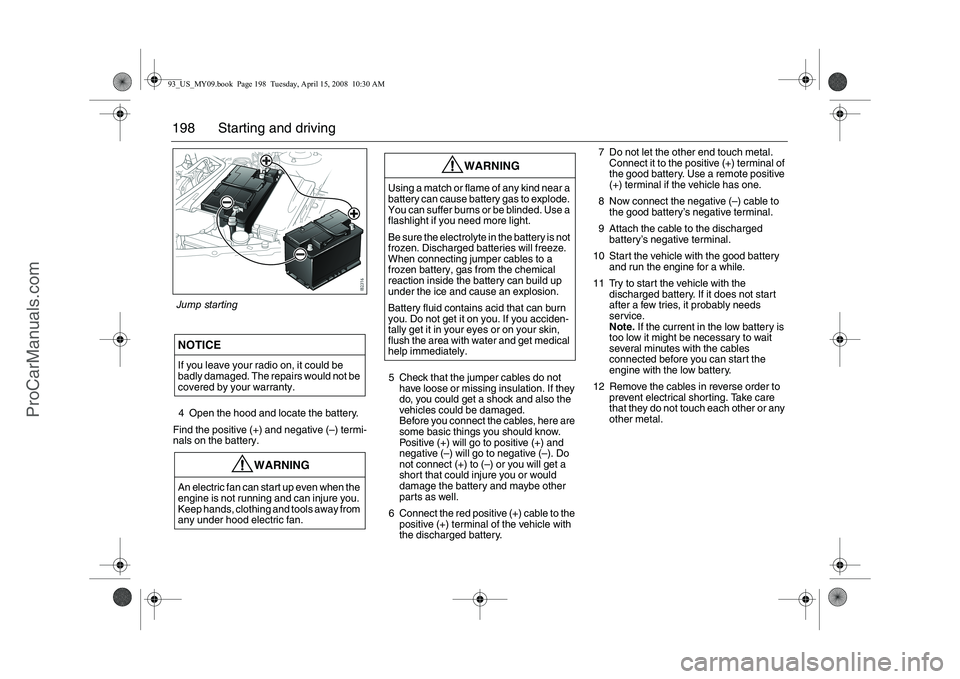
198 Starting and driving4 Open the hood and locate the battery.
Find the positive (+) and negative (–) termi-
nals on the battery.5 Check that the jumper cables do not
have loose or missing insulation. If they
do, you could get a shock and also the
vehicles could be damaged.
Before you connect the cables, here are
some basic things you should know.
Positive (+) will go to positive (+) and
negative (–) will go to negative (–). Do
not connect (+) to (–) or you will get a
short that could injure you or would
damage the battery and maybe other
parts as well.
6 Connect the red positive (+) cable to the
positive (+) terminal of the vehicle with
the discharged battery.7 Do not let the other end touch metal.
Connect it to the positive (+) terminal of
the good battery. Use a remote positive
(+) terminal if the vehicle has one.
8 Now connect the negative (–) cable to
the good battery’s negative terminal.
9 Attach the cable to the discharged
battery’s negative terminal.
10 Start the vehicle with the good battery
and run the engine for a while.
11 Try to start the vehicle with the
discharged battery. If it does not start
after a few tries, it probably needs
service.
Note. If the current in the low battery is
too low it might be necessary to wait
several minutes with the cables
connected before you can start the
engine with the low battery.
12 Remove the cables in reverse order to
prevent electrical shorting. Take care
that they do not touch each other or any
other metal.NOTICEIf you leave your radio on, it could be
badly damaged. The repairs would not be
covered by your warranty.
WARNING
An electric fan can start up even when the
engine is not running and can injure you.
Keep hands, clothing and tools away from
any under hood electric fan.
WARNING
Using a match or flame of any kind near a
battery can cause battery gas to explode.
You can suffer burns or be blinded. Use a
flashlight if you need more light.
Be sure the electrolyte in the battery is not
frozen. Discharged batteries will freeze.
When connecting jumper cables to a
frozen battery, gas from the chemical
reaction inside the battery can build up
under the ice and cause an explosion.
Battery fluid contains acid that can burn
you. Do not get it on you. If you acciden-
tally get it in your eyes or on your skin,
flush the area with water and get medical
help immediately.
Jump starting93_US_MY09.book Page 198 Tuesday, April 15, 2008 10:30 AM
ProCarManuals.com
Page 199 of 304
199 Starting and driving
Using a battery charger3/starter
unitTo avoid damaging the car’s electrical
system and electronics, the following rules
must be followed when charging the battery
or jump starting the car.
If the charger or starter unit can be set to
different voltages (6 V/12 V/18 V/24 V),
12V must be selected.
Follow the manufacturer’s instructions
supplied with the charger or starter unit.
No other apparatus that are grounded or
connected to the mains must be
connected to the car during charging or
jump starting.
The charger or starter unit must under no
conditions produce a voltage greater
than:
16 V continuous
18 V for 60 minutes.
If you are unsure about the charge rating of
the unit, disconnect the battery clamp from
the positive terminal before connecting the
unit to the battery.
For long tripsBefore starting off on a long journey, it is
advisable to have your car inspected by
your Saab dealer.
Obtain a few important items to take along
on your journey, such as spare bulbs, wiper
blades, fuses, a drive belt (poly-V-belt) and
the like.
You can check some points yourself before-
hand:
Check that no oil or fuel leaks out of the
engine or gearbox/transmission.
Check the coolant and power steering
fluid levels. Check also for leaks.
Inspect the drive belt (poly-V-belt) and
replace if it shows any signs of wear.
Check the battery charge.
Check the tires for tread pattern and air
pressure, including the compact spare
tire.
Take an extra remote control and keep it
separate.
Check the brakes.
Check all bulbs.
Check for the presence of the tool kit and
jack in the car.
93_US_MY09.book Page 199 Tuesday, April 15, 2008 10:30 AM
ProCarManuals.com
Page 201 of 304
201
Car care
Hood ________________ 202
Engine ______________ 203
Engine bay, 4-cyl engine 206
Engine bay, V6 engine _ 207
Engine oil ____________ 208
Air filter______________ 209
Transmission fluid ____ 210
Coolant ______________ 210
Brake/clutch fluid and
brake pads__________ 212
Power steering________ 213
Battery ______________ 214
Drive belt ____________ 215
Wipers and washers ___ 216
Wiper blades _________ 216
Changing bulbs _______ 218
Fuses _______________ 233 Tires _________________ 240
Automatic tire pressure
monitoring system ____ 253
Compact spare ________ 256
Changing a tire ________ 258
Safety belts ___________ 266
Upholstery and trim ____ 266
Textile carpeting _______ 267
Engine bay ____________ 267
Washing ______________ 267
Waxing and polishing ___ 270
Touching up the paint___ 270
Anti-corrosion treatment 271
Recovery and/or recycling of automotive
materials ____________ 272
Air conditioning (A/C) ___ 273
Car care
3 Asterisk means: equipment not fitted in all cars
(can depend on model variant, engine variant,
market specification, options or accessories).93_US_7carcare_MY09.fm Page 201 Tuesday, April 15, 2008 11:26 AM
ProCarManuals.com
Page 206 of 304
206 Car care
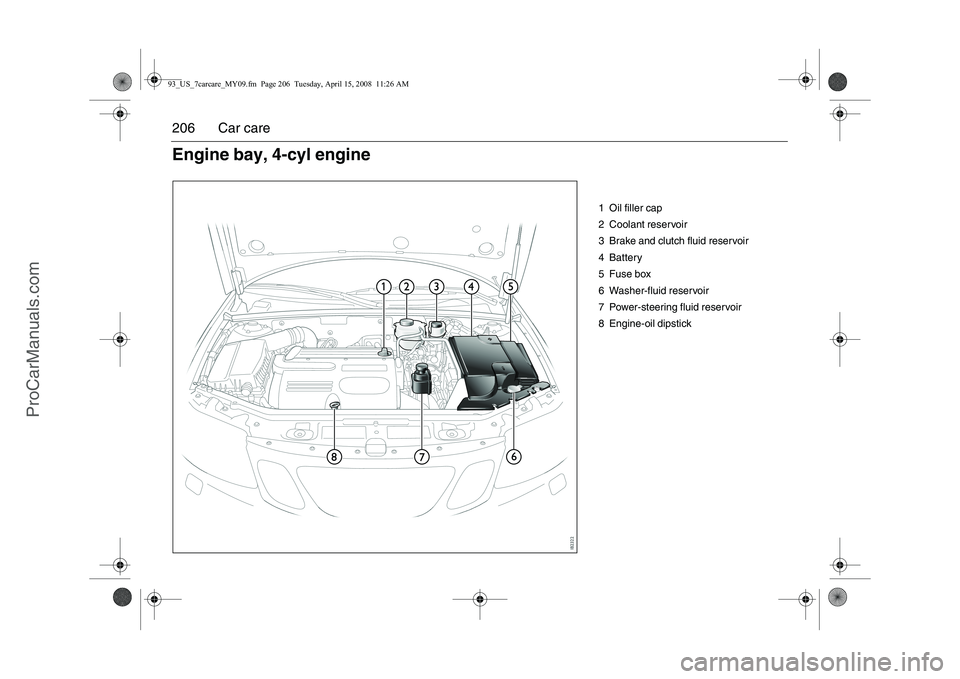
1 Oil filler cap
2 Coolant reservoir
3 Brake and clutch fluid reservoir
4Battery
5 Fuse box
6 Washer-fluid reservoir
7 Power-steering fluid reservoir
8 Engine-oil dipstick
Engine bay, 4-cyl engine93_US_7carcare_MY09.fm Page 206 Tuesday, April 15, 2008 11:26 AM
ProCarManuals.com
Page 207 of 304
207
Car care
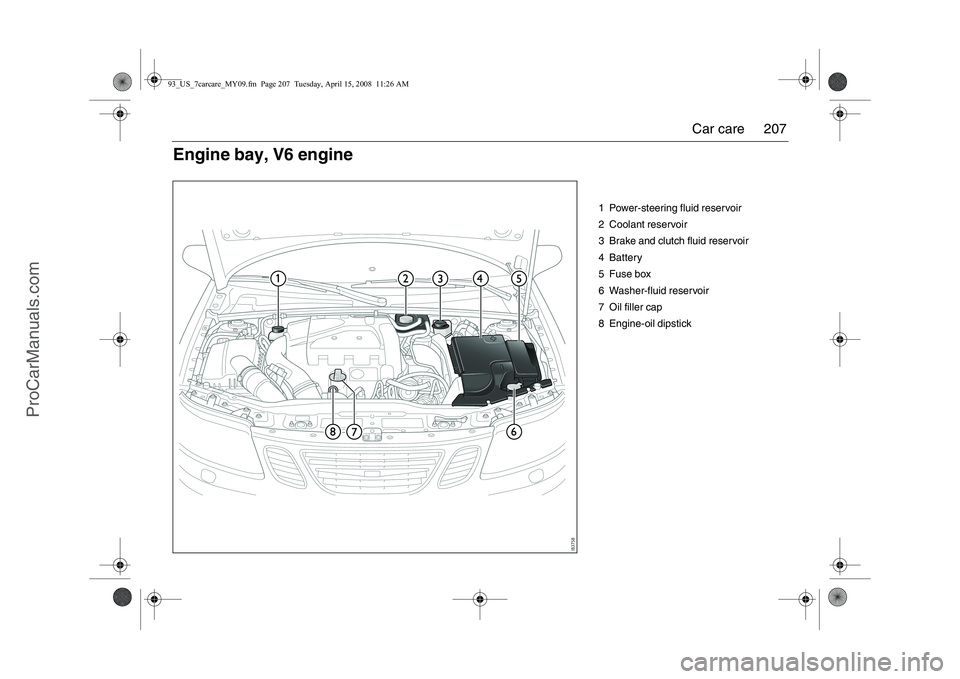
1 Power-steering fluid reservoir
2 Coolant reservoir
3 Brake and clutch fluid reservoir
4Battery
5 Fuse box
6 Washer-fluid reservoir
7 Oil filler cap
8 Engine-oil dipstick
Engine bay, V6 engine93_US_7carcare_MY09.fm Page 207 Tuesday, April 15, 2008 11:26 AM
ProCarManuals.com
Page 214 of 304
214 Car careBattery
The battery is maintenance free.
If frequent short journeys are made, the bat-
tery may need extra charging. This can be
done with a battery charger or by taking the
car for a long run.
If the battery is not being charged while the
engine is running, the following message
will appear on the SID:
Check the drive belt (see page 215). If the
belt is damaged, the engine may overheat,
the battery may not be charged and the A/C
compressor may not work. Always connect the positive (red) cable to
the battery’s positive (+) terminal, and the
negative (black) cable
to the negative (-)
terminal of the battery. Always disconnect
both battery leads when boost charging the
battery.
A car with standard equipment specifica-
tions and a fully charged battery can be left
for up to 40 days and still have a sufficient
charge for starting. If extra equipment is
fitted, such as a mobile phone, the charge
may only be sufficient for about 15 days.
WARNING
When working on the battery, highly explosive gas can build up. A spark
could ignite this gas that collects
around the battery.
Therefore, always avoid sparks and
open flames in the vicinity of the bat-
tery.
The battery contains corrosive sulfuric acid. Always wear a face mask or gog-
gles when working on the battery.
If battery acid gets into the eyes or splashes onto skin or clothing, wash
the affected area liberally with water.
If acid gets into the eyes or a large
quantity makes contact with the skin,
seek medical help.
Battery posts, terminals and related accessories contain lead and lead
compounds. Wash your hands after
handling
NOTICEA discharged battery can freeze and frac-
ture. Batteries should therefore always be
stored away from sub-zero temperatures.
Battery not charging.
Make a safe stop.
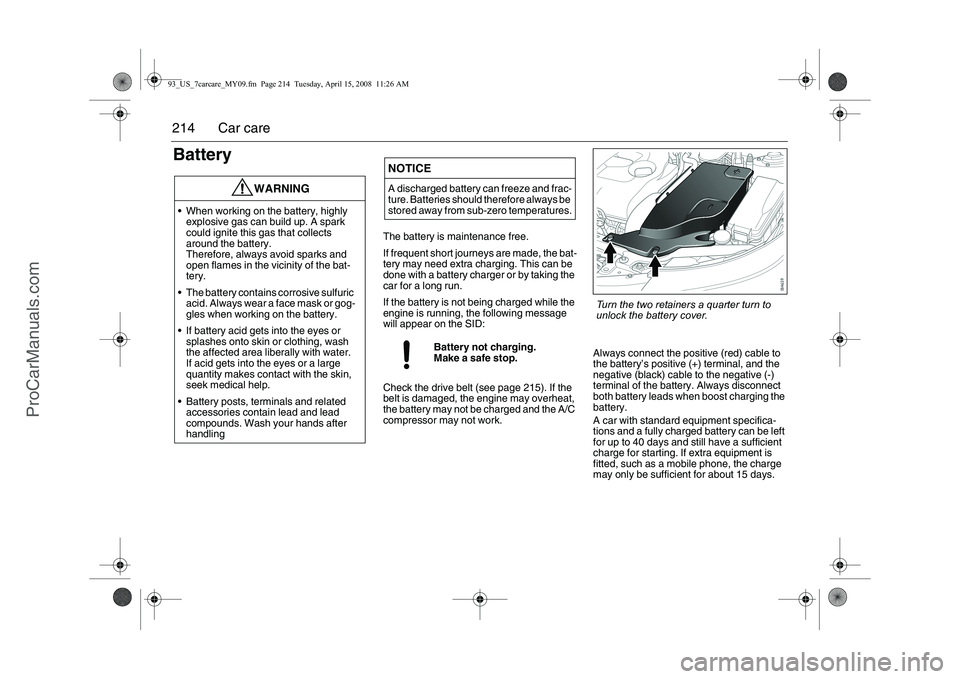
Turn the two retainers a quarter turn to
unlock the battery cover.
93_US_7carcare_MY09.fm Page 214 Tuesday, April 15, 2008 11:26 AM
ProCarManuals.com
Page 215 of 304
215
Car care
Drive belt
The alternator is situated on the right-hand
side of the engine. It is driven by a
poly-V-belt from the crankshaft pulley.
A slipping or broken poly-V-belt can
result in:
No charge to the battery
No A/C compressor function.
The belt tension is critical and is adjusted
automatically by the belt tensioner.
NOTICE If boost charging never use anything
but a 12-volt charger, see page 197.
• Do not connect th e battery termi-
nals, + and –, incorrectly.
Serious damage can occur to the car’s electrical system if a battery or alterna-
tor lead is disconnected while the
engine is running.
Exercise special care when removing and fitting the positive (+) cable so as
not to damage the battery disconnect
switch.
WARNING
Keep hands and clothing clear of drive belts when engine is running.
Always stop the engine before inspecting the drive belt.
The radiator fan is electric and can start even when the engine is
switched off.NOTICESerious damage can be done to the car’s
electrical system if an alternator lead is
disconnected while the engine is running.
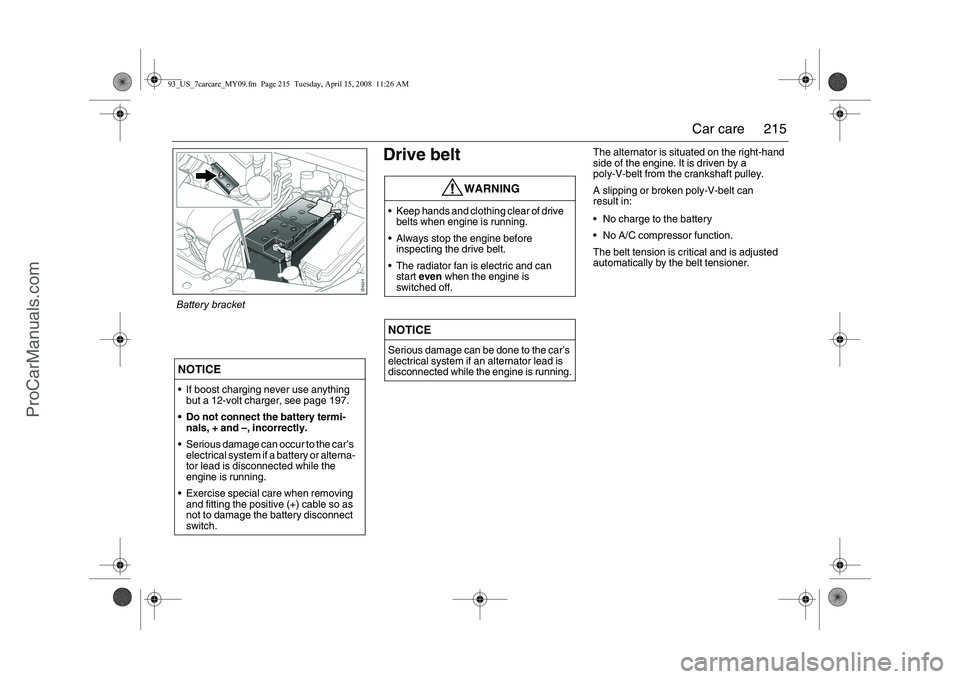
Battery bracket93_US_7carcare_MY09.fm Page 215 Tuesday, April 15, 2008 11:26 AM
ProCarManuals.com
Page 220 of 304
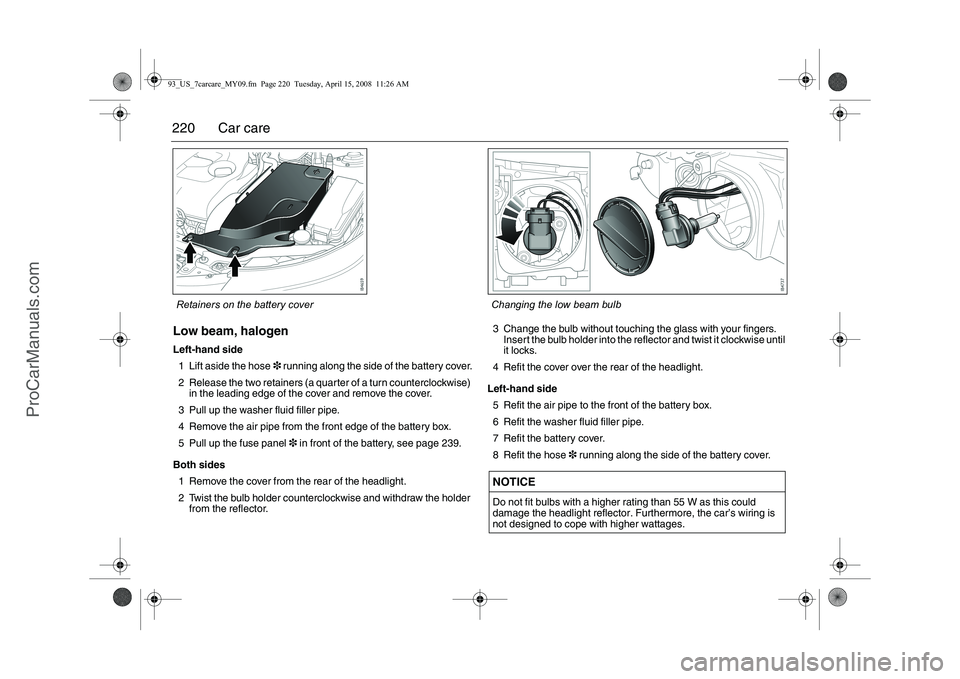
220 Car careLow beam, halogenLeft-hand side1 Lift aside the hose 3 running along the side of the battery cover.
2 Release the two retainers (a quarter of a turn counterclockwise) in the leading edge of the cover and remove the cover.
3 Pull up the washer fluid filler pipe.
4 Remove the air pipe from the front edge of the battery box.
5 Pull up the fuse panel 3 in front of the battery, see page 239.
Both sides 1 Remove the cover from t he rear of the headlight.
2 Twist the bulb holder counterclockwise and withdraw the holder from the reflector. 3 Change the bulb without touching the glass with your fingers.
Insert the bulb holder into the reflector and twist it clockwise until
it locks.
4 Refit the cover over th e rear of the headlight.
Left-hand side 5 Refit the air pipe to th e front of the battery box.
6 Refit the washer fluid filler pipe.
7 Refit the battery cover.
8 Refit the hose 3 running along the side of the battery cover.
NOTICEDo not fit bulbs with a higher rating than 55 W as this could
damage the headlight reflector. Furthermore, the car’s wiring is
not designed to cope with higher wattages.
Retainers on the battery cover Changing the low beam bulb93_US_7carcare_MY09.fm Page 220 Tuesday, April 15, 2008 11:26 AM
ProCarManuals.com