brake SAAB 9-3 2009 Workshop Manual
[x] Cancel search | Manufacturer: SAAB, Model Year: 2009, Model line: 9-3, Model: SAAB 9-3 2009Pages: 304, PDF Size: 44.31 MB
Page 218 of 304
218 Car careChanging bulbs
Auto checking of lightsThe bulbs that are most important from the
point of view of traffic safety are monitored
by the car’s electrical system. If one of these
bulbs should fail, a message will be dis-
played on the SID.
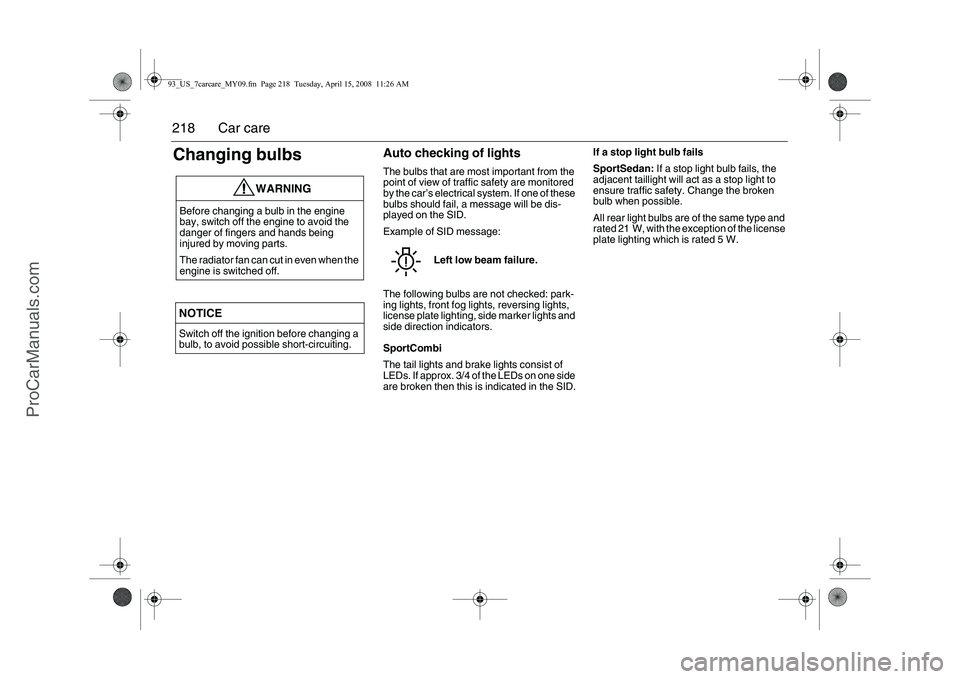
Example of SID message:
The following bulbs are not checked: park-
ing lights, front fog lights, reversing lights,
license plate lighting, side marker lights and
side direction indicators.
SportCombi
The tail lights and brake lights consist of
LEDs. If approx. 3/4 of the LEDs on one side
are broken then this is indicated in the SID. If a stop light bulb fails
SportSedan:
If a stop light bulb fails, the
adjacent taillight will act as a stop light to
ensure traffic safety. Change the broken
bulb when possible.
All rear light bulbs are of the same type and
rated 21 W, with the exception of the license
plate lighting which is rated 5 W.
WARNING
Before changing a bulb in the engine
bay, switch off the engine to avoid the
danger of fingers and hands being
injured by moving parts.
The radiator fan can cut in even when the
engine is switched off.NOTICESwitch off the ignition before changing a
bulb, to avoid possible short-circuiting.
Left low beam failure.
93_US_7carcare_MY09.fm Page 218 Tuesday, April 15, 2008 11:26 AM
ProCarManuals.com
Page 232 of 304
232 Car care
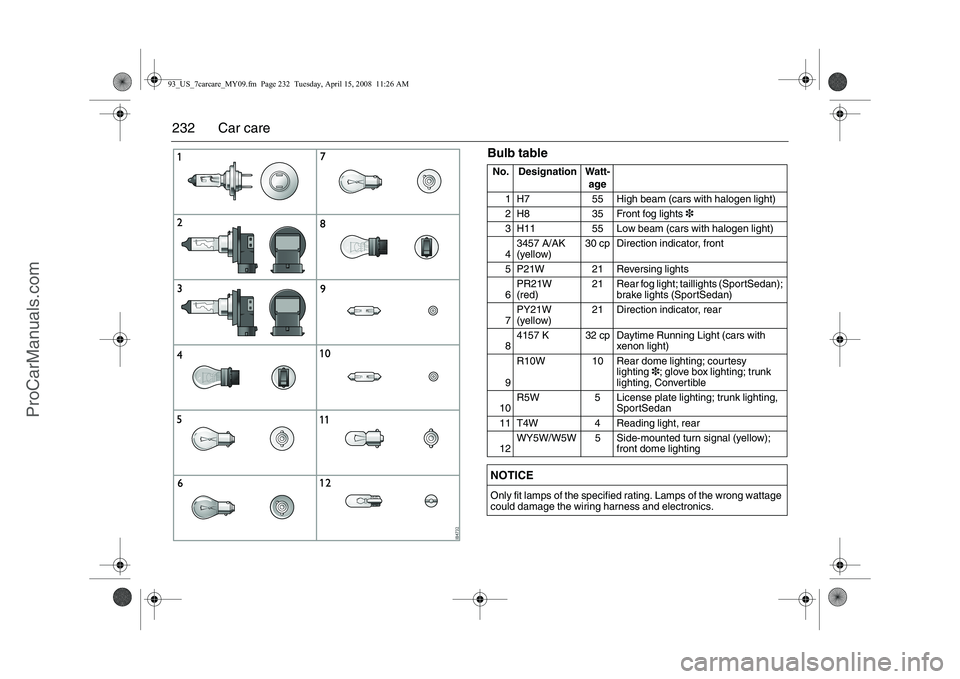
Bulb tableNo. Designation Watt-age
1 H7 55 High beam (cars with halogen light)
2 H8 35 Front fog lights 3
3 H11 55 Low beam (cars with halogen light)
4 3457 A/AK
(yellow) 30 cp Direction indicator, front
5 P21W 21 Reversing lights
6 PR21W
(red) 21 Rear fog light; taillights (SportSedan);
brake lights (SportSedan)
7 PY21W
(yellow) 21 Direction indicator, rear
8 4157 K 32 cp Daytime Running Light (cars with
xenon light)
9 R10W 10 Rear dome lighting; courtesy
lighting3; glove box lighting; trunk
lighting, Convertible
10 R5W 5 License plate lighting; trunk lighting,
SportSedan
11 T4W 4 Reading light, rear
12 WY5W/W5W 5 Side-mounted turn signal (yellow);
front dome lightingNOTICEOnly fit lamps of the specified rating. Lamps of the wrong wattage
could damage the wiring harness and electronics.
93_US_7carcare_MY09.fm Page 232 Tuesday, April 15, 2008 11:26 AM
ProCarManuals.com
Page 235 of 304
235
Car care
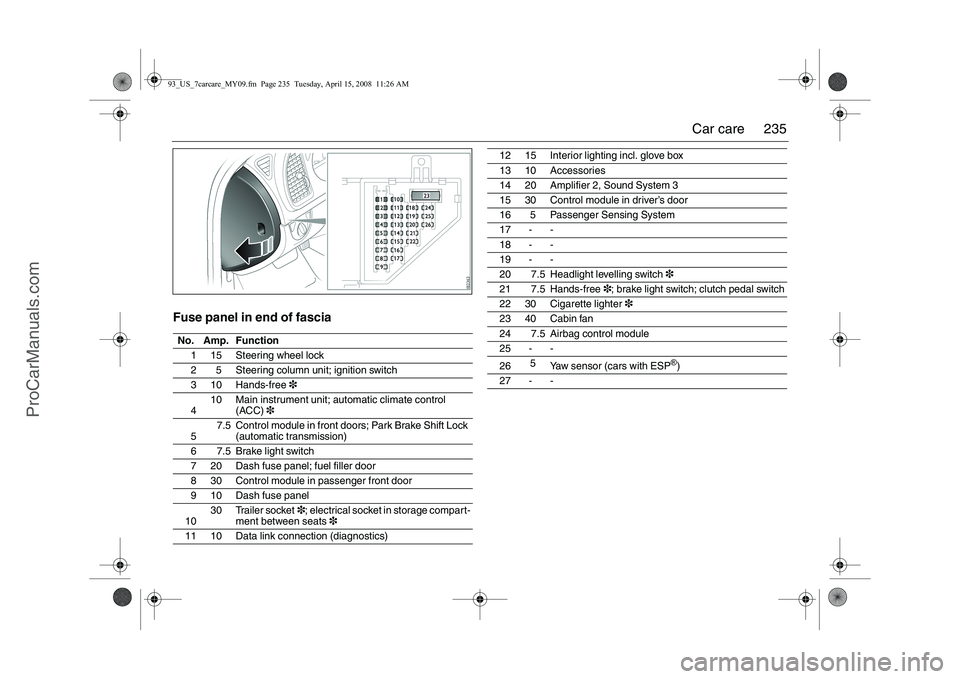
Fuse panel in end of fasciaNo. Amp. Function
1 15 Steering wheel lock
2 5 Steering column unit; ignition switch
3 10 Hands-free 3
4 10 Main instrument unit;
automatic climate control
(ACC) 3
5 7.5 Control module in front doors; Park Brake Shift Lock
(automatic transmission)
6 7.5 Brake light switch
7 20 Dash fuse panel; fuel filler door
8 30 Control module in passenger front door
9 10 Dash fuse panel
10 30 Trailer socket
3; electrical socket in storage compart-
ment between seats 3
11 10 Data link connection (diagnostics)
12 15 Interior lighting incl. glove box
13 10 Accessories
14 20 Amplifier 2, Sound System 3
15 30 Control module in driver’s door
16 5 Passenger Sensing System
17 - -
18 - -
19 - -
20 7.5 Headlight levelling switch 3
21 7.5 Hands-free 3; brake light switch; clutch pedal switch
22 30 Cigarette lighter 3
23 40 Cabin fan
24 7.5 Airbag control module
25 - -
26 5
Yaw sensor (cars with ESP
®)
27 - -
93_US_7carcare_MY09.fm Page 235 Tuesday, April 15, 2008 11:26 AM
ProCarManuals.com
Page 236 of 304
236 Car care
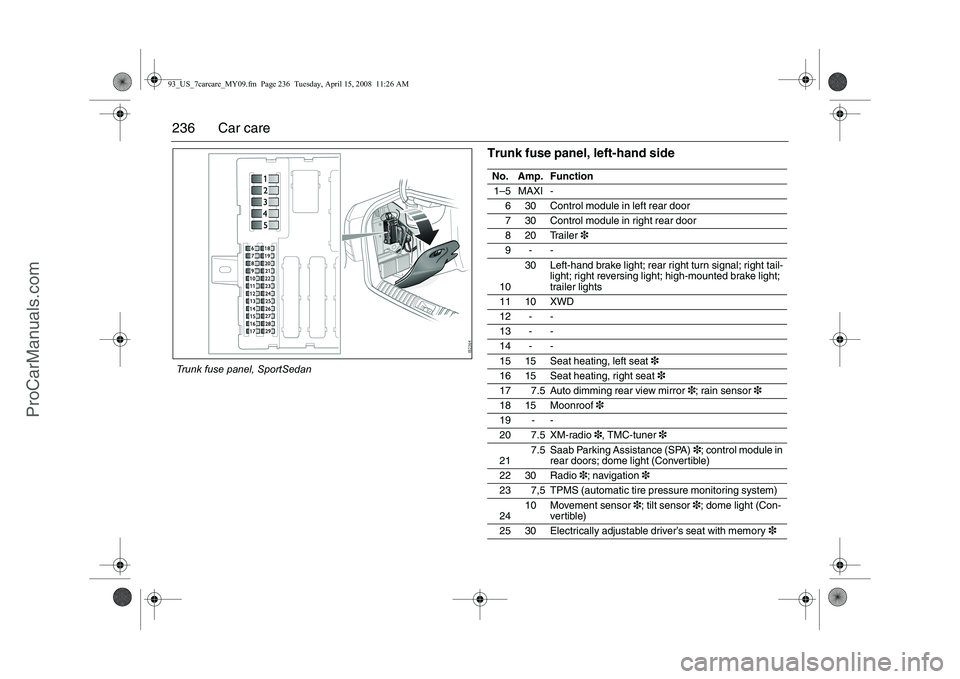
Trunk fuse panel, left-hand sideNo. Amp. Function1–5 MAXI -
6 30 Control module in left rear door
7 30 Control module in right rear door
820Trailer 3
9--
10 30 Left-hand brake light; rear right turn signal; right tail-
light; right reversing light; high-mounted brake light;
trailer lights
11 10 XWD
12 - -
13 - -
14 - -
15 15 Seat heating, left seat 3
16 15 Seat heating, right seat 3
17 7.5 Auto dimming rear view mirror 3; rain sensor 3
18 15 Moonroof 3
19 - -
20 7.5 XM-radio 3, TMC-tuner 3
21 7.5 Saab Parking Assistance (SPA)
3; control module in
rear doors; dome light (Convertible)
22 30 Radio 3; navigation 3
23 7,5 TPMS (automatic tire pressure monitoring system)
24 10 Movement sensor
3; tilt sensor 3; dome light (Con-
vertible)
25 30 Electrically adjustable driver’s seat with memory 3
Trunk fuse panel, SportSedan93_US_7carcare_MY09.fm Page 236 Tuesday, April 15, 2008 11:26 AM
ProCarManuals.com
Page 238 of 304
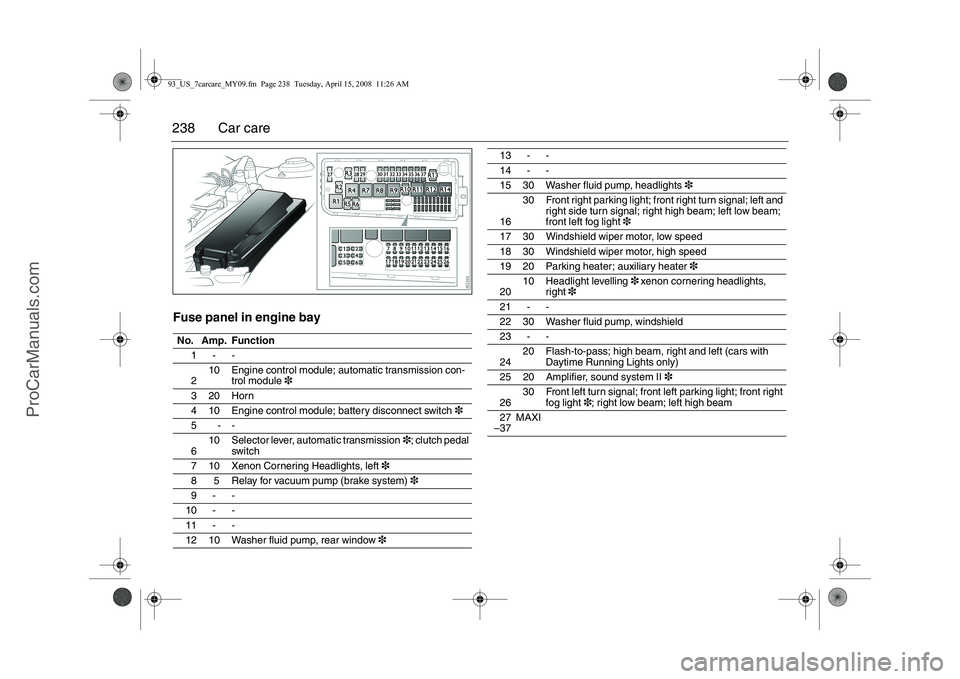
238 Car careFuse panel in engine bayNo. Amp. Function1--
2 10 Engine control module; au
tomatic transmission con-
trol module 3
320Horn
4 10 Engine control module; ba ttery disconnect switch3
5--
6 10 Selector lever, automatic transmission
3; clutch pedal
switch
7 10 Xenon Cornering Headlights, left 3
8 5 Relay for vacuum pump (brake system) 3
9--
10 - -
11 - -
12 10 Washer fluid pump, rear window 3
13 - -
14 - -
15 30 Washer fluid pump, headlights3
16 30 Front right parking light; fr
ont right turn signal; left and
right side turn signal; right high beam; left low beam;
front left fog light 3
17 30 Windshield wiper motor, low speed
18 30 Windshield wiper motor, high speed
19 20 Parking heater; auxiliary heater 3
20 10 Headlight levelling
3 xenon cornering headlights,
right 3
21 - -
22 30 Washer fluid pump, windshield
23 - -
24 20 Flash-to-pass; high beam, right and left (cars with
Daytime Running Lights only)
25 20 Amplifier, sound system II 3
26 30 Front left turn signal; front left parking light; front right
fog light 3; right low beam; left high beam
27
–37 MAXI
93_US_7carcare_MY09.fm
Page 238 Tuesday, April 15, 2008 11:26 AM
ProCarManuals.com
Page 246 of 304
246 Car careWheel ReplacementReplace any wheel that is bent, cracked or
badly rusted or corroded. If wheel nuts keep
coming loose, the wheel, wheel bolts and
wheel nuts should be replaced. If the wheel
leaks air, replace it (except some aluminum
wheels, which can sometimes be repaired).
See your dealer if any of these conditions
exist.
Your dealer will know the kind of wheel you
need.
Each new wheel should have the same
load-carrying capacity, diameter, width,
offset and be mounted the same way as the
one it replaces.
If you need to replace any of your wheels,
wheel bolts or wheel nuts, replace them only
with new Saab original equipment parts.
This way, you will be sure to have the right
wheel, wheel bolts and wheel nuts for your
vehicle.Notice:
The wrong wheel can also cause
problems with bearing life, brake cool-
ing, speedometer or odometer calibra-
tion, headlamp aim, bumper height, vehi-
cle ground clearance and tire or tire
chain clearance to th e body and chassis.
See “ Changing a tire ” on page 258. Used Replacement Wheels
WARNING
Using the wrong replacement wheels,
wheel bolts or wheel nuts on your vehicle
can be dangerous. It could affect the
braking and handling of your vehicle,
make your tires lose air and make you
lose control. You could have a collision in
which you or others could be injured.
Always use the correct wheel, wheel bolts
and wheel nuts for replacement.
WARNING
When fitting just
one new pair of tires,
these should be fitted to the rear wheels,
as these are more critical to the direc-
tional stability of the car (e.g. on braking
or in a skid). The existing rear wheels
should therefore be moved to the front.
WARNING
Putting a used wheel on your vehicle is
dangerous. You can’t know how it’s been
used or how far it’s been driven. It could
fail suddenly and cause a crash. If you
have to replace a wheel, use a new GM
original equipment wheel.
93_US_7carcare_MY09.fm Page 246 Tuesday, April 15, 2008 11:26 AM
ProCarManuals.com
Page 247 of 304
247
Car care
Tire Chains
Notice: If your vehicle does not have
235/45R17 size tires, use tire chains only
where legal and only when you must.
Contact your Saab d ealer regarding suit-
able snow chains. Install them on the
front tires and tighten them as tightly as
possible with the ends securely
fastened. Drive slowly and follow the
chain manufacturer’s instructions. If you
can hear the chains contacting your
vehicle, stop and reti ghten them. If the
contact continues, slow down until it
stops. Driving too f ast or spinning the
wheels with chains on will damage your
vehicle.
If a Tire Goes FlatIt’s unusual for a tire to “blowout” while
you’re driving, especially if you maintain
your tires properly. If air goes out of a tire,
it’s much more likely to leak out slowly. But
if you should ever have a “blowout”, here are
a few tips about what to expect and what to
do:
If a front tire fails, the flat tire will create a
drag that pulls the vehicle toward that side.
Take your foot off the accelerator pedal and
grip the steering wheel firmly. Steer to main-
tain lane position, and then gently brake to
a stop well out of the traffic lane.
A rear blowout, particularly on a curve, acts
much like a skid and may require the same
correction you’d use in a skid. In any rear
blowout, remove your foot from the acceler-
ator pedal. Get the vehi cle under control by
steering the way you want the vehicle to go.
It may be very bumpy and noisy, but you can
still steer. Gently brake to a stop – well off
the road if possible.
If a tire goes flat, the next part shows how to
use your jacking equipment to change a flat
tire safely.
WARNING
If your vehicle has 235/45 R17 size tires,
don’t use tire chains, there’s not enough
clearance.
Tire chains used on a vehicle without the
proper amount of clearance can cause
damage to the brakes, suspension or
other vehicle parts. The area damaged by
the tire chains could cause you to lose
control of your vehicle and you or others
may be injured in a crash.
Use another type of traction device only if
its manufacturer recommends it for use
on your vehicle and tire size combination
and road conditions. Follow that manu-
facturer’s instructions. To help avoid
damage to your vehicle, drive slowly,
readjust or remove the device if it’s con-
tacting your vehicle, and don’t spin your
wheels.
If you do find traction devices that will fit,
install them on the front tires.93_US_7carcare_MY09.fm Page 247 Tuesday, April 15, 2008 11:26 AM
ProCarManuals.com
Page 250 of 304
250 Car care
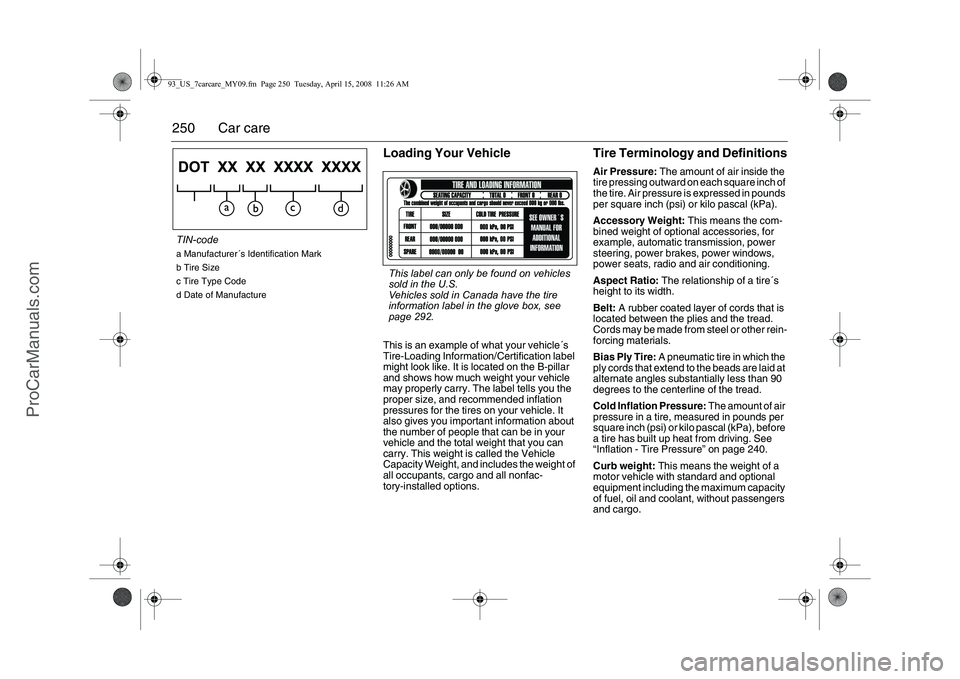
Loading Your VehicleThis is an example of what your vehicle´s
Tire-Loading Information/Certification label
might look like. It is located on the B-pillar
and shows how much weight your vehicle
may properly carry. The label tells you the
proper size, and recommended inflation
pressures for the tires on your vehicle. It
also gives you important information about
the number of people that can be in your
vehicle and the total weight that you can
carry. This weight is called the Vehicle
Capacity Weight, and includes the weight of
all occupants, cargo and all nonfac-
tory-installed options.
Tire Terminology and DefinitionsAir Pressure: The amount of air inside the
tire pressing outward on each square inch of
the tire. Air pressure is expressed in pounds
per square inch (psi) or kilo pascal (kPa).
Accessory Weight: This means the com-
bined weight of optional accessories, for
example, automatic transmission, power
steering, power brakes, power windows,
power seats, radio and air conditioning.
Aspect Ratio: The relationship of a tire´s
height to its width.
Belt: A rubber coated layer of cords that is
located between the plies and the tread.
Cords may be made from steel or other rein-
forcing materials.
Bias Ply Tire: A pneumatic tire in which the
ply cords that extend to the beads are laid at
alternate angles substantially less than 90
degrees to the centerline of the tread.
Cold Inflation Pressure: The amount of air
pressure in a tire, measured in pounds per
square inch (psi) or ki lo pascal (kPa), before
a tire has built up heat from driving. See
“Inflation - Tire Pressure” on page 240.
Curb weight: This means the weight of a
motor vehicle with standard and optional
equipment including the maximum capacity
of fuel, oil and coolant, without passengers
and cargo.
This label can only be found on vehicles
sold in the U.S.
Vehicles sold in Canada have the tire
information label in the glove box, see
page 292.
TIN-codea Manufacturer´s Identification Mark
b Tire Size
c Tire Type Code
d Date of Manufacture93_US_7carcare_MY09.fm
Page 250 Tuesday, April 15, 2008 11:26 AM
ProCarManuals.com
Page 258 of 304
258 Car careDriving with a compact wheel
fittedObserve the following when the compact
spare tire is fitted:
The compact spare is light and easy to handle when changing a tire.
Do not drive further than necessary with the compact spare fitted - the maximum
life of the tire is only just over 2,000 miles
(approx. 3,500 km).
Refit the standard tire as soon as possi- ble.
Fitting a spare tire/wheel without pressure sensor will trigger a malfunction
message, see page 255.
Important considerations when driving with
a compact spare tire:
The car’s ground clearance is reduced. The car must not be driven with more than
one compact spare tire at a time.
Avoid driving against the curb.
Do not use snow chains.
Do not fit the wheel cover - this would conceal the warning text.
Changing a tire
WARNING
Do not exceed 50 mph (80 km/h). The
tire can overheat affecting the car’s
road holding.
Tire pressure: refer to page 291.
The spare tire or punctured tire must be stowed under the trunk floor, and
secured in place with the retaining nut.
WARNING
Lifting a vehicle and getting under it to do
maintenance or repairs is dangerous
without the appropriate safety equipment
and training. The jack provided with your
vehicle is designed only for changing a
flat tire. If it is used for anything else, you
or others could be badly injured or killed if
the vehicle slips off the jack. Use the jack
provided with your vehicle only for chang-
ing a flat tire.
Changing a tire can be dangerous. The
vehicle can slip off the jack and roll over
or fall on you or other people. You and
they could be badly injured or even killed.
Find a level place to change your tire. To
help prevent the vehicle from moving:
1 Set the parking brake firmly.
2 If you have an automatic transmis- sion, put the shift lever in PARK (P).
For a manual transmission, leave the
car in gear (1st or REVERSE (R)).
3 Turn off the engine and do not restart while the vehicle is raised.
4 Do not allow passengers to remain in the vehicle.
93_US_7carcare_MY09.fm Page 258 Tuesday, April 15, 2008 11:26 AM
ProCarManuals.com
Page 259 of 304
259
Car care
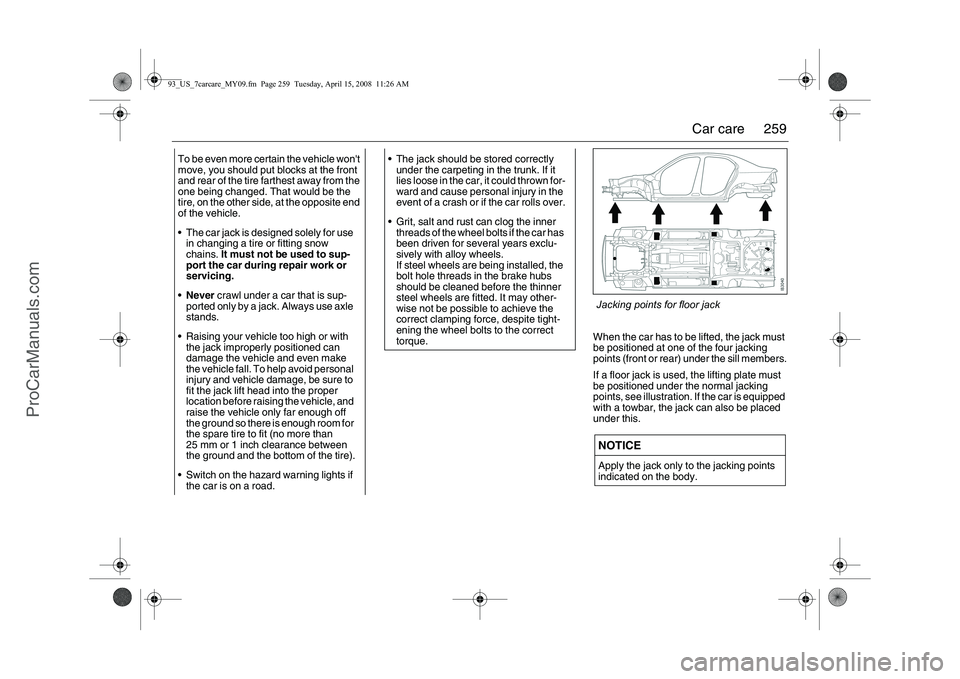
When the car has to be lifted, the jack must
be positioned at one of the four jacking
points (front or rear) under the sill members.
If a floor jack is used, the lifting plate must
be positioned under the normal jacking
points, see illustration. If the car is equipped
with a towbar, the jack can also be placed
under this.
To be even more certain the vehicle won't
move, you should put blocks at the front
and rear of the tire farthest away from the
one being changed. That would be the
tire, on the other side, at the opposite end
of the vehicle.
The car jack is designed solely for use
in changing a tire or fitting snow
chains. It must not be used to sup-
port the car during repair work or
servicing.
Never crawl under a car that is sup-
ported only by a jack. Always use axle
stands.
Raising your vehicle too high or with the jack improperly positioned can
damage the vehicle and even make
the vehicle fall. To help avoid personal
injury and vehicle damage, be sure to
fit the jack lift head into the proper
location before raising the vehicle, and
raise the vehicle only far enough off
the ground so there is enough room for
the spare tire to fit (no more than
25 mm or 1 inch clearance between
the ground and the bottom of the tire).
Switch on the hazard warning lights if the car is on a road.
The jack should be stored correctly under the carpeting in the trunk. If it
lies loose in the car, it could thrown for-
ward and cause personal injury in the
event of a crash or if the car rolls over.
Grit, salt and rust can clog the inner threads of the wheel bolts if the car has
been driven for several years exclu-
sively with alloy wheels.
If steel wheels are being installed, the
bolt hole threads in the brake hubs
should be cleaned before the thinner
steel wheels are fitted. It may other-
wise not be possible to achieve the
correct clamping force, despite tight-
ening the wheel bolts to the correct
torque.
NOTICEApply the jack only to the jacking points
indicated on the body.Jacking points for floor jack
93_US_7carcare_MY09.fm Page 259 Tuesday, April 15, 2008 11:26 AM
ProCarManuals.com