lock SAAB 9-3 2009 Repair Manual
[x] Cancel search | Manufacturer: SAAB, Model Year: 2009, Model line: 9-3, Model: SAAB 9-3 2009Pages: 304, PDF Size: 44.31 MB
Page 157 of 304
157 Starting and driving
Refueling1 Switch off the engine.
2 Open the fuel cap, located in the
right-hand rear fender.
3 Insert the fuel pump nozzle beyond the
flange on the filler pipe and let the first
mark (a ring, a pimple or the first
spring-coil) rest on the flange. Do not
withdraw the nozzle while filling is in
progress.
4 Cease refueling the first time the pump
stops, and wait a few seconds after
you’ve finished pumping before you
remove the nozzle.Fuel cap
To remove the fuel cap, turn it slowly to the
left (counterclockwise). The fuel cap has a
spring in it; if you let go of the cap too soon,
it will spring back to the right.
When you put the fuel cap back on, turn it to
the right (clockwise) until you hear 3 clicks.
Make sure the cap is fully installed.
The diagnostic system can determine if the
fuel cap has been left off or is improperly
installed. See “Service Engine Light also
known as CHECK ENGINE” on page 83.If the fuel cap has been left off or is improp-
erly installed the following message is
shown on the Saab Information Display
(SID):
WARNING
If a fire starts while you are refueling, do
not remove the nozzle. Shut off the flow of
fuel by shutting off the pump or by notify-
ing the station attendant. Leave the area
immediately.
NOTICEDo not overfill. Fuel should not come right
up the filler pipe as expansion room is
needed when the temperature rises.
Fill to maximum filling capacity.
Stop filling after the first time that the
nozzle trips to shut off the flow of fuel.
Filling capacity can differ between dif-
ferent fuel stations and outside tem-
perature. Fuel tank volume when
nozzle trips to shut off, may vary by
0.5 gal. (2 liters).
Do not fill fuel all the way up the filler
pipe. The gasoline must be allowed
room for expansion especially during
hot weather.
Tighten fuel filler cap.
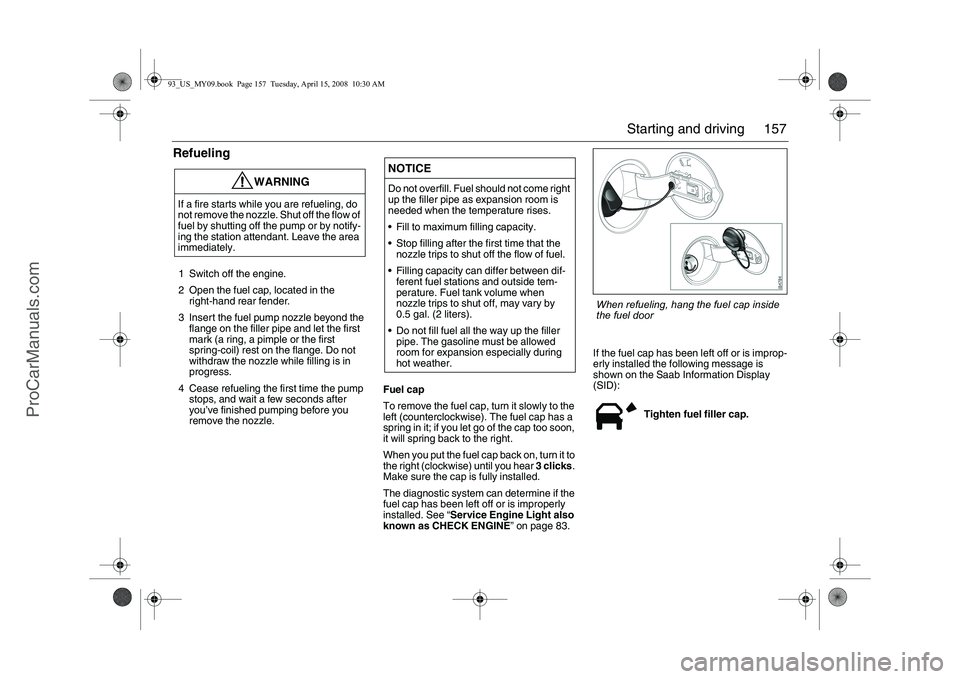
When refueling, hang the fuel cap inside
the fuel door
93_US_MY09.book Page 157 Tuesday, April 15, 2008 10:30 AM
ProCarManuals.com
Page 161 of 304
161 Starting and driving
Manual transmissionClutch interlockTo start the car, the clutch pedal must be
depressed.
When changing gear, fully depress the
clutch pedal and then release it smoothly. It
is inadvisable to drive with your hand resting
on the gear lever, as this can increase the
wear on the gearbox.
Before reverse (R) can be engaged, you
must lift the ring underneath the gear knob.NOTICEWhen reverse gear is to be engaged,
the car must be at a standstill with
the accelerator fully released.
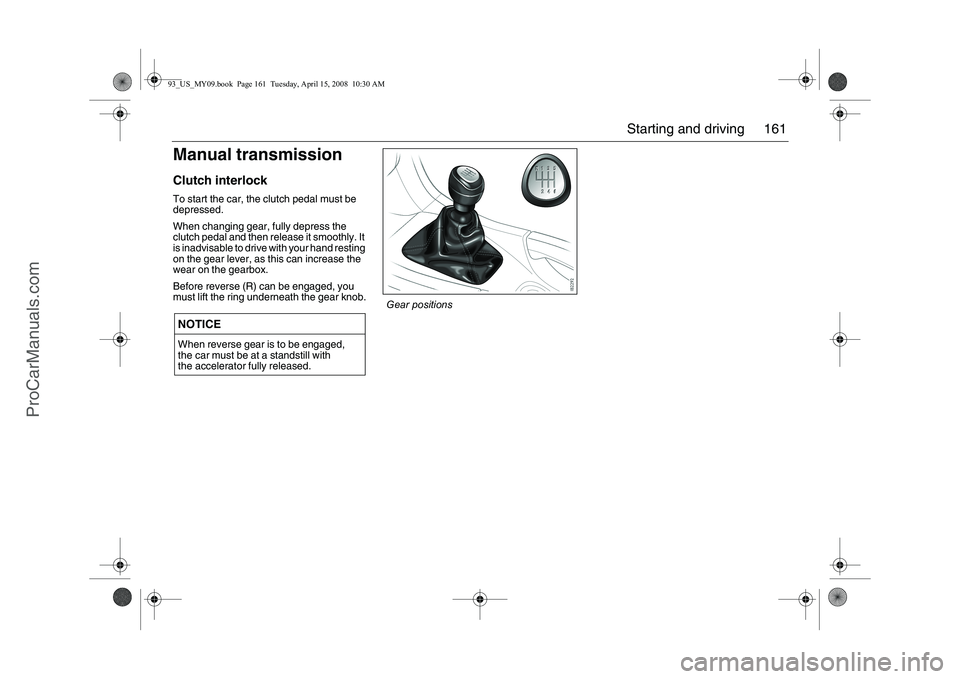
Gear positions
93_US_MY09.book Page 161 Tuesday, April 15, 2008 10:30 AM
ProCarManuals.com
Page 163 of 304
163 Starting and driving
Park Brake Shift LockThe transmission has a security function
known as Park Brake Shift Lock. To move
the gear selector lever out of the P or N posi-
tion, the gear selector lever detent (catch)
must be pressed in at the same time as the
brake pedal is held depressed.
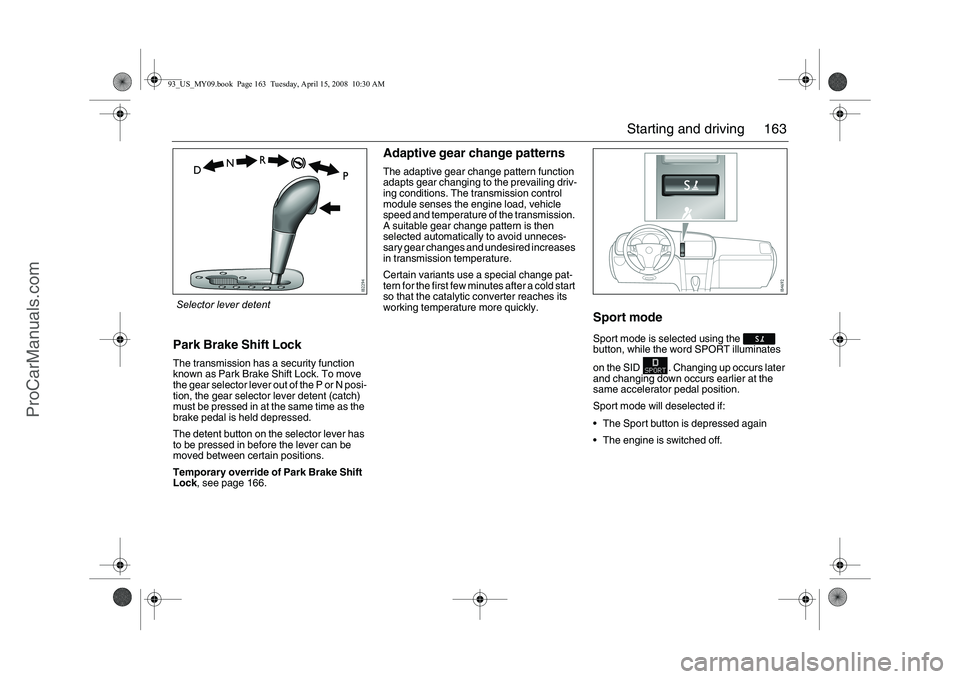
The detent button on the selector lever has
to be pressed in before the lever can be
moved between certain positions.
Temporary override of Park Brake Shift
Lock, see page 166.
Adaptive gear change patternsThe adaptive gear change pattern function
adapts gear changing to the prevailing driv-
ing conditions. The transmission control
module senses the engine load, vehicle
speed and temperature of the transmission.
A suitable gear change pattern is then
selected automatically to avoid unneces-
sary gear changes and undesired increases
in transmission temperature.
Certain variants use a special change pat-
tern for the first few minutes after a cold start
so that the catalytic converter reaches its
working temperature more quickly.
Sport modeSport mode is selected using the
button, while the word SPORT illuminates
on the SID . Changing up occurs later
and changing down occurs earlier at the
same accelerator pedal position.
Sport mode will deselected if:
The Sport button is depressed again
The engine is switched off.
Selector lever detent93_US_MY09.book Page 163 Tuesday, April 15, 2008 10:30 AM
ProCarManuals.com
Page 164 of 304
164 Starting and drivingThermal transmission protectionThe transmission has built-in protection
against overheating. If the temperature of
the transmission fluid exceeds 302 °F
(150 °C), engine torque will be limited to
147 ft.lbs. (200 Nm).
The following message is shown on the SID:
If this message appears, stop the car as
soon as it is safe to do so and allow the
engine to idle until the message has gone
out. The selector lever should be in
position P.
Lock-upThe transmission’s torque converter has a
lock-up function. This can lock the torque
converter, thus reducing the engine speed
and fuel consumption.Kick-downWhen the accelerator is pressed down fully,
a down change is made to optimize acceler-
ation, e.g. for overtaking.
Following this, the next higher gear will be
selected at the optimum engine speed,
unless you ease off the accelerator before
reaching this.
Driving in hilly country with a
heavy loadThe transmission fluid can overheat when
the gearbox is strained, for example, when
driving with a trailer on hilly roads. To avoid
the transmission fluid overheating, always
drive with the selector lever in the D posi-
tion. The adaptive gear change patterns are
then active.
High air temperatures or a faulty oil cooler
can also cause the transmission fluid to
overheat. Overheating reduces the service
life of the fluid. Gearbox too hot. Make a
safe stop. Open hood.
WARNING
Remember to use the braking effect of the
engine (1st, 2nd or 3rd gear) when you
are descending long or steep hills to
spare the brakes.
Overheating can cause the brakes to
fade!
93_US_MY09.book Page 164 Tuesday, April 15, 2008 10:30 AM
ProCarManuals.com
Page 166 of 304
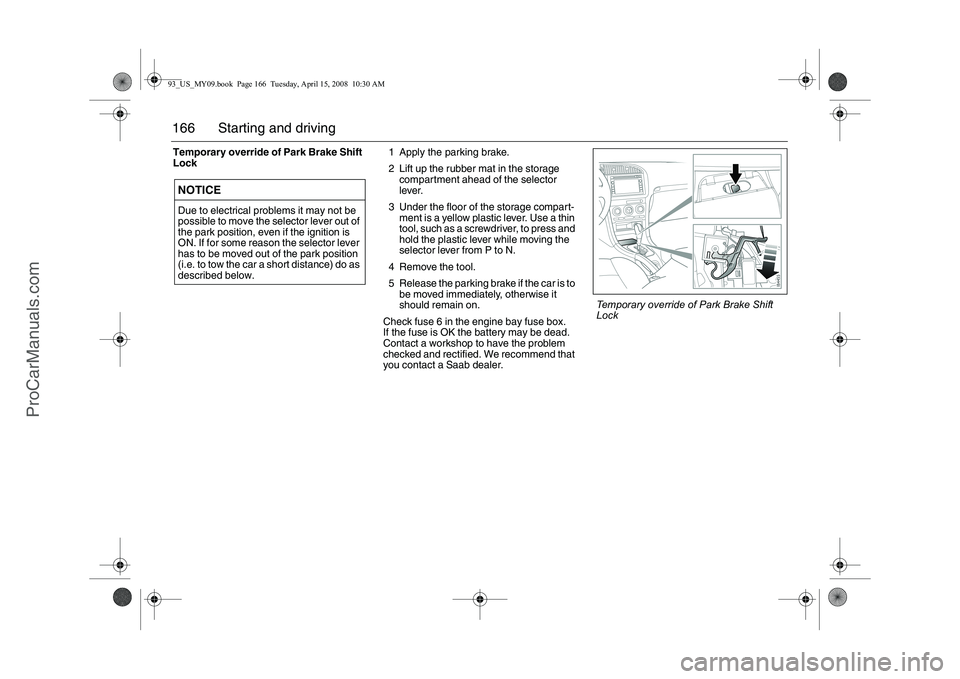
166 Starting and drivingTemporary override of Park Brake Shift
Lock1 Apply the parking brake.
2 Lift up the rubber mat in the storage
compartment ahead of the selector
lever.
3 Under the floor of the storage compart-
ment is a yellow plastic lever. Use a thin
tool, such as a screwdriver, to press and
hold the plastic lever while moving the
selector lever from P to N.
4 Remove the tool.
5 Release the parking brake if the car is to
be moved immediately, otherwise it
should remain on.
Check fuse 6 in the engine bay fuse box.
If the fuse is OK the battery may be dead.
Contact a workshop to have the problem
checked and rectified. We recommend that
you contact a Saab dealer.NOTICEDue to electrical problems it may not be
possible to move the selector lever out of
the park position, even if the ignition is
ON. If for some reason the selector lever
has to be moved out of the park position
(i.e. to tow the car a short distance) do as
described below.
Temporary override of Park Brake Shift
Lock
93_US_MY09.book Page 166 Tuesday, April 15, 2008 10:30 AM
ProCarManuals.com
Page 167 of 304
167 Starting and driving
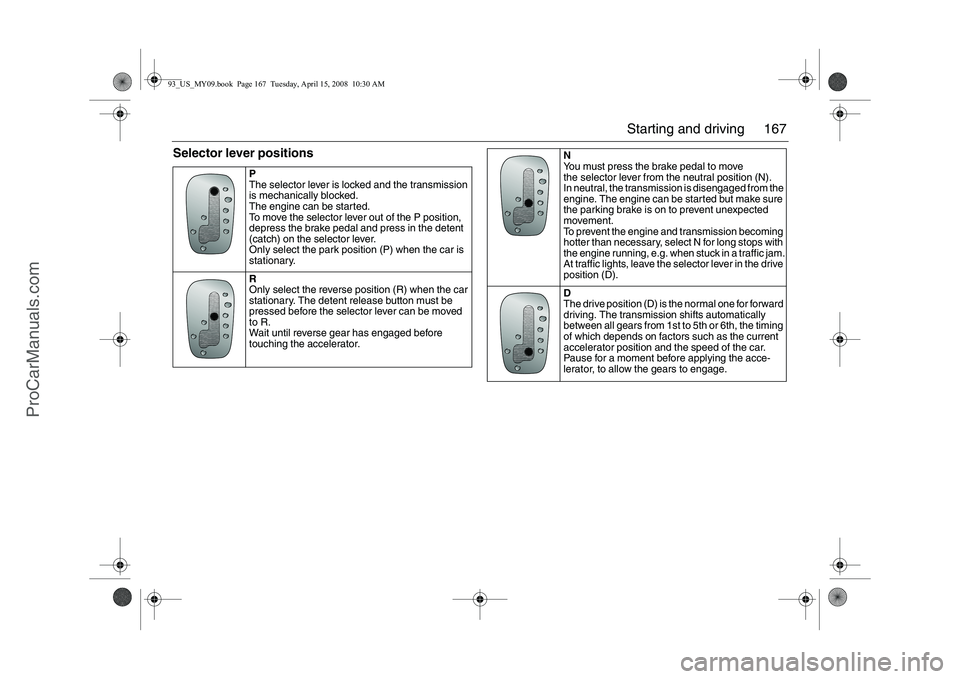
Selector lever positions
P
The selector lever is locked and the transmission
is mechanically blocked.
The engine can be started.
To move the selector lever out of the P position,
depress the brake pedal and press in the detent
(catch) on the selector lever.
Only select the park position (P) when the car is
stationary.
R
Only select the reverse position (R) when the car
stationary. The detent release button must be
pressed before the selector lever can be moved
to R.
Wait until reverse gear has engaged before
touching the accelerator.
N
You must press the brake pedal to move
the selector lever from the neutral position (N).
In neutral, the transmission is disengaged from the
engine. The engine can be started but make sure
the parking brake is on to prevent unexpected
movement.
To prevent the engine and transmission becoming
hotter than necessary, select N for long stops with
the engine running, e.g. when stuck in a traffic jam.
At traffic lights, leave the selector lever in the drive
position (D).
D
The drive position (D) is the normal one for forward
driving. The transmission shifts automatically
between all gears from 1st to 5th or 6th, the timing
of which depends on factors such as the current
accelerator position and the speed of the car.
Pause for a moment before applying the acce-
lerator, to allow the gears to engage.
93_US_MY09.book Page 167 Tuesday, April 15, 2008 10:30 AM
ProCarManuals.com
Page 171 of 304
171 Starting and driving
ABS brakesThe Antilock Braking System (ABS) modu-
lates the brake pressure to each wheel. The
pressure is automatically reduced just
before the wheel locks up and then
increases again to the point at which the
wheel is just about to lock. The wheel sen-
sors send information to the brake system’s
electronic control module for every 4 or so
inches (decimeter) that the car rolls. This
information is processed continuously to
ensure that the adjustment of the brake
pressure will be as exact as possible.
Adjustment takes place up to 12 times per
second.The brake system provides Electronic
Brakeforce Distribution (EBD). This distri-
butes the brake pressure between the front
and rear wheels, in such a way as to achieve
optimum braking performance irrespective
of the car’s speed or load.
The ABS has a built-in diagnostics function
which will switch on the ABS warning light
if a fault is detected in the system (see
page 82).
Note. The following message will appear
on the SID (and corresponding symbol
on main instrument unit) if a fault is
detected:
WARNING
It is prudent to try your brakes from
time to time, especially when driving in
heavy rain, through water collected on
the road, in snow, on a wet road sur-
face or in salty slush. In such condi-
tions, the brakes may take longer than
normal to take effect. To rectify this,
touch the brake pedal periodically to
dry the brakes out.
The same applies after the car has
been washed or when the weather is
very humid.
Avoid parking the car with wet brakes.
Before parking, and if the traffic condi-
tions allow, brake quite heavily so that
the brake discs and pads warm up and
dry.
The brakes are power assisted and it
should be kept in mind that the servo
unit only provides the power assis-
tance when the engine is running.
The brake pressure required when the
engine is off, (e.g. when the car is
being towed) is roughly four times the
normal pedal force required. The
pedal also feels hard and unrespon-
sive.
Overheating can cause the brakes to
fade!
WARNING
The additional safety afforded by the
ABS system is not designed to allow
drivers to drive faster but to make
normal driving safer.
To stop as quickly as possible, without
loss of directional stability, whether
the road surface is dry, wet or slippery,
press the brake pedal down hard
without letting up (do not pump the
pedal), declutching simulta-
neously, and steer the car to safety.
Antilock brake malfunc.
Contact service.
93_US_MY09.book Page 171 Tuesday, April 15, 2008 10:30 AM
ProCarManuals.com
Page 172 of 304
172 Starting and drivingThe ABS system will not reduce the braking
distance on loose gravel, snow or ice but,
because the wheels cannot lock up, steer-
ing control is retained.
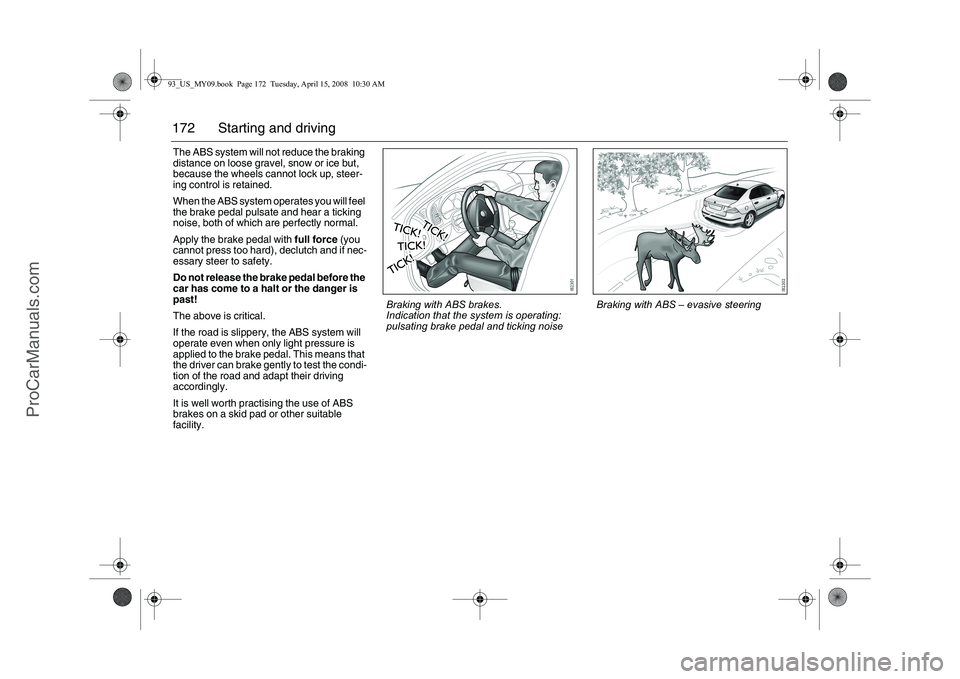
When the ABS system operates you will feel
the brake pedal pulsate and hear a ticking
noise, both of which are perfectly normal.
Apply the brake pedal with full force (you
cannot press too hard), declutch and if nec-
essary steer to safety.
Do not release the brake pedal before the
car has come to a halt or the danger is
past!
The above is critical.
If the road is slippery, the ABS system will
operate even when only light pressure is
applied to the brake pedal. This means that
the driver can brake gently to test the condi-
tion of the road and adapt their driving
accordingly.
It is well worth practising the use of ABS
brakes on a skid pad or other suitable
facility.
Braking with ABS – evasive steering
Braking with ABS brakes.
Indication that the system is operating:
pulsating brake pedal and ticking noise
93_US_MY09.book Page 172 Tuesday, April 15, 2008 10:30 AM
ProCarManuals.com
Page 174 of 304
174 Starting and drivingThe advantages of the TCS system are
most apparent when road surface friction is
so low that a lot of wheelspin can occur rap-
idly:
When the car is pulling away or accelerat-
ing with the front wheels on different
surfaces (e.g. one slippery and one dry),
the TCS functions like an electronic differ-
ential lock, making sure that both wheels
rotate at the same speed. The system
also functions when the car is reversing.
When cornering, if the inside front wheel
rotates faster than the other wheels.TCS OFF
lights up if:
The system has been switched off
manually. It cannot be switched off if the
car is travelling faster than 35 mph
(60 km/h).
There is a fault in the ABS system
A fault has been detected and the
system has therefore been switched
off and at the same time the following
message is shown on the SID:
TCS indicatorWhen the ignition switch is turned to the ON
position, the lamp is lit for about 4 seconds
while the system performs self-diagnosis.
The light comes on when the TCS is
operative, that is when one of the wheels
has lost its grip.
The fact that the TCS is operative indicates
that the limit for grip has been exceeded and
that the driver must exercise greater care.Temporarily turning the TCS offThe TCS is switched on automatically when
the engine is started.
It may be necessary to switch off the system
if the car has become bogged down, for
instance.
If a fault is detected in the ABS, the TCS will
be switched off automatically.
The cruise control system (if active) will
automatically be disengaged if the TCS is
operative.Disengage the system in Settings.
1Select Settings using the steering
wheel buttons, or .
2 Hold the SET button depressed until a
chime sounds.
3Select TCS.
4 Press the SET button.
5Select ON or OFF.
End by pressing the SET-button.
Go back/undo using the CLR-button.
Traction control failure.
Contact service.
93_US_MY09.book Page 174 Tuesday, April 15, 2008 10:30 AM
ProCarManuals.com
Page 175 of 304
175 Starting and driving
Electronic Stability
Program ESP
®
Anti-skid system
The ESP
® system employs both the
antilock braking system (ABS) and the trac-
tion control system (TCS). It is a system that
helps the driver to stabilize the car in
unusual circumstances that can otherwise
be more difficult to handle.
How the ESP
® system works
The ESP
® system can help to prevent the
car from skidding by braking one or several
wheels independently of the driver. The
engine output is then also reduced to pre-
vent the driving wheels from spinning. The
car has sensors that measure wheel speed,
yaw rate, lateral acceleration, steering
wheel position and braking pressure. The
values provided by these sensors are used
to calculate the actual direction of the car,
the intentions of the driver and whether the
ESP
® system should be engaged.
If this direction does not agree with that
intended by the driver, calculated from the
steering wheel position, the ESP
® system is
engaged.
The ESP
® system improves the driver’s
chances of retaining control over the car in
a critical situation.
WARNING
When driving normally, the ESP
® system
helps to improve the car’s stability and
maneuverability under slippery road and
extreme driving conditions. The ESP
®
system must not be regarded as a system
to enable the driver to maintain higher
speeds. The same precautions must be
adopted as normal for safe cornering and
driving on slippery roads must be
adopted.
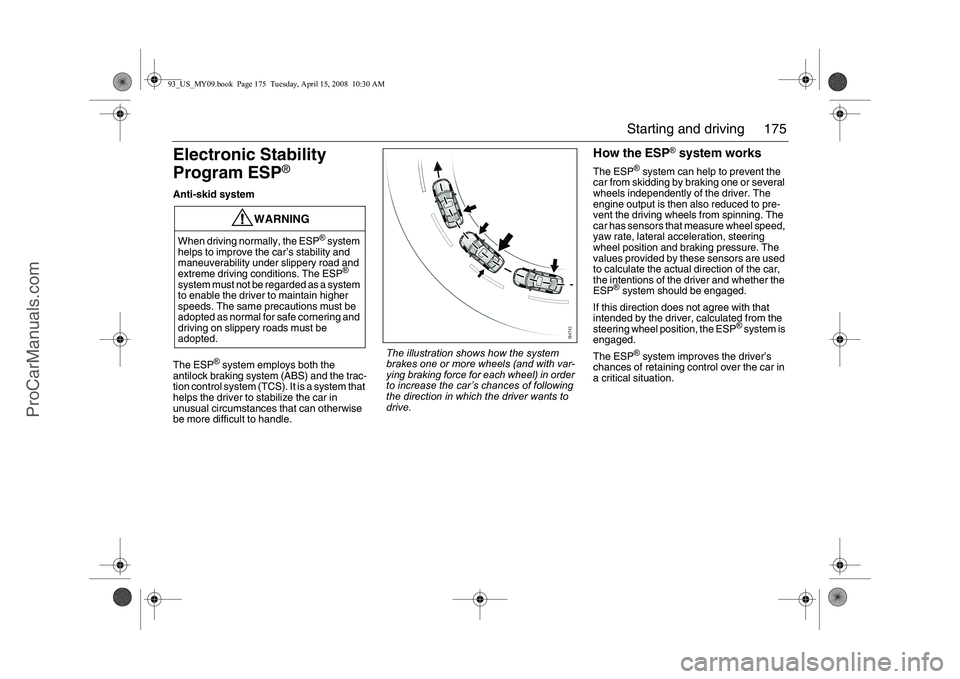
The illustration shows how the system
brakes one or more wheels (and with var-
ying braking force for each wheel) in order
to increase the car’s chances of following
the direction in which the driver wants to
drive.
93_US_MY09.book Page 175 Tuesday, April 15, 2008 10:30 AM
ProCarManuals.com