automatic SAAB 9-5 2000 Owners Manual
[x] Cancel search | Manufacturer: SAAB, Model Year: 2000, Model line: 9-5, Model: SAAB 9-5 2000Pages: 256, PDF Size: 14.24 MB
Page 3 of 256
3
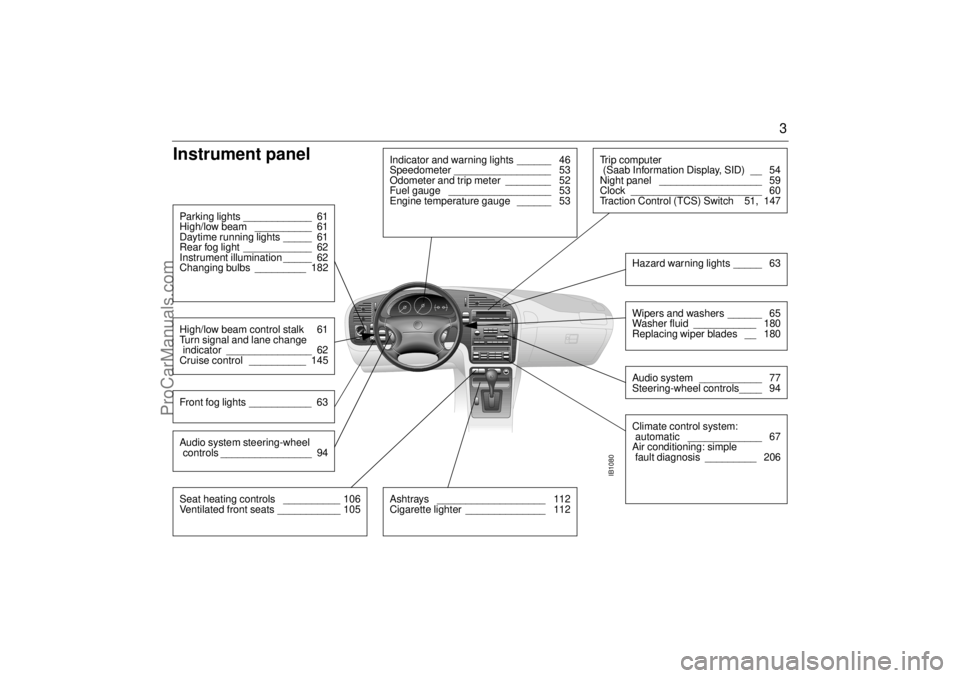
Instrument panel
IB1080
Indicator and warning lights ______ 46
Speedometer _________________ 53
Odometer and trip meter ________ 52
Fuel gauge __________________ 53
Engine temperature gauge ______ 53
Parking lights ____________ 61
High/low beam __________ 61
Daytime running lights _____ 61
Rear fog light ____________ 62
Instrument illumination _____ 62
Changing bulbs _________ 182High/low beam control stalk 61
Turn signal and lane change
indicator _______________ 62
Cruise control __________ 145Front fog lights ___________ 63
Ashtrays ___________________ 112
Cigarette lighter ______________ 112
Tr i p c o m p u t e r
(Saab Information Display, SID) __ 54
Night panel __________________ 59
Clock _______________________ 60
Traction Control (TCS) Switch 51, 147
Wipers and washers ______ 65
Washer fluid ___________ 180
Replacing wiper blades __ 180Audio system ___________ 77
Steering-wheel controls____ 94Hazard warning lights _____ 63Climate control system:
automatic _____________ 67
Air conditioning: simple
fault diagnosis _________ 206
Seat heating controls __________ 106
Ventilated front seats ___________ 105Audio system steering-wheel
controls ________________ 94
ProCarManuals.com
Page 5 of 256
5
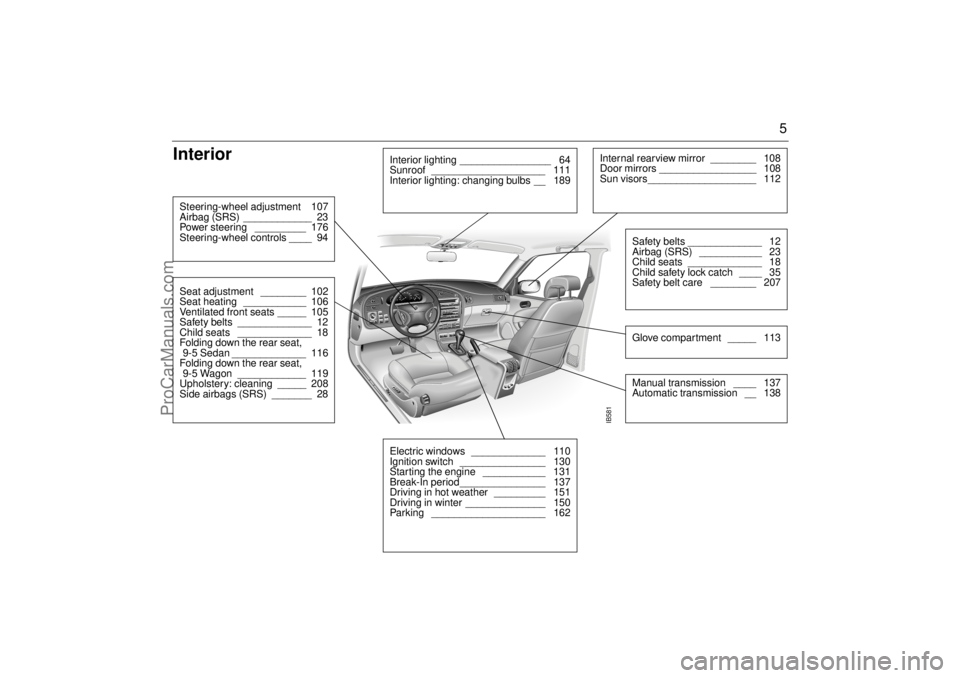
Interior
IB581Internal rearview mirror ________ 108
Door mirrors _________________ 108
Sun visors___________________ 112
Safety belts _____________ 12
Airbag (SRS) ___________ 23
Child seats _____________ 18
Child safety lock catch ____ 35
Safety belt care ________ 207Glove compartment _____ 113Manual transmission ____ 137
Automatic transmission __ 138
Electric windows _____________ 110
Ignition switch _______________ 130
Starting the engine ___________ 131
Break-In period_______________ 137
Driving in hot weather _________ 151
Driving in winter ______________ 150
Parking ____________________ 162
Steering-wheel adjustment 107
Airbag (SRS) ____________ 23
Power steering _________ 176
Steering-wheel controls ____ 94Seat adjustment ________ 102
Seat heating ___________ 106
Ventilated front seats _____ 105
Safety belts _____________ 12
Child seats _____________ 18
Folding down the rear seat,
9-5 Sedan _____________ 116
Folding down the rear seat,
9-5 Wagon ____________ 119
Upholstery: cleaning _____ 208
Side airbags (SRS) _______ 28
Interior lighting ________________ 64
Sunroof ____________________ 111
Interior lighting: changing bulbs __ 189
ProCarManuals.com
Page 6 of 256
6Engine compartment,
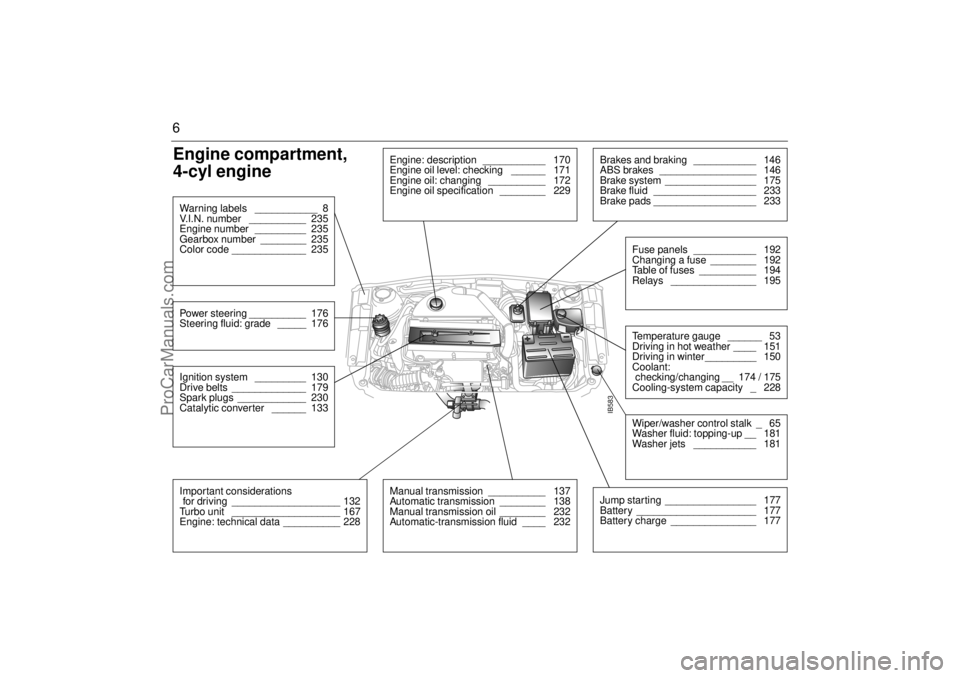
4-cyl engine
IB583
Engine: description ___________ 170
Engine oil level: checking ______ 171
Engine oil: changing __________ 172
Engine oil specification ________ 229
Brakes and braking ___________ 146
ABS brakes _________________ 146
Brake system ________________ 175
Brake fluid __________________ 233
Brake pads __________________ 233
Fuse panels ___________ 192
Changing a fuse ________ 192
Table of fuses __________ 194
Relays _______________ 195Temperature gauge ______ 53
Driving in hot weather ____ 151
Driving in winter_________ 150
Coolant:
checking/changing __ 174 / 175
Cooling-system capacity _ 228
Power steering __________ 176
Steering fluid: grade _____ 176
Wiper/washer control stalk _ 65
Washer fluid: topping-up __ 181
Washer jets ___________ 181
Jump starting ________________ 177
Battery _____________________ 177
Battery charge _______________ 177
Manual transmission __________ 137
Automatic transmission ________ 138
Manual transmission oil ________ 232
Automatic-transmission fluid ____ 232
Important considerations
for driving ___________________ 132
Turbo unit ___________________ 167
Engine: technical data __________ 228Ignition system _________ 130
Drive belts _____________ 179
Spark plugs ____________ 230
Catalytic converter ______ 133Warning labels ___________ 8
V.I.N. number __________ 235
Engine number _________ 235
Gearbox number ________ 235
Color code _____________ 235
ProCarManuals.com
Page 7 of 256
7
Engine compartment,
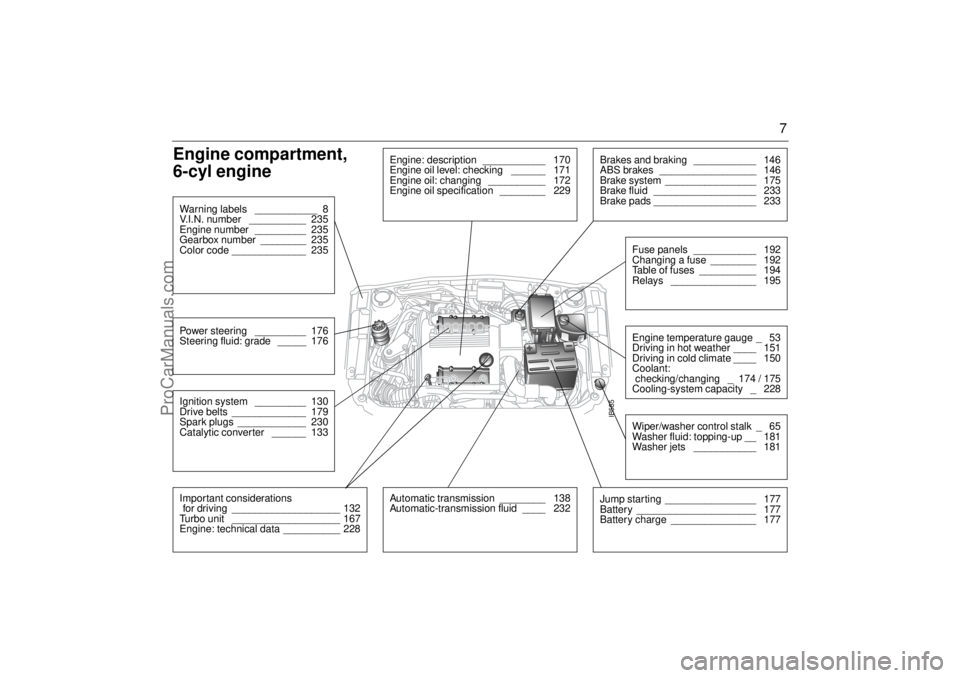
6-cyl engine
IB585
Warning labels ___________ 8
V.I.N. number __________ 235
Engine number _________ 235
Gearbox number ________ 235
Color code _____________ 235Ignition system _________ 130
Drive belts _____________ 179
Spark plugs ____________ 230
Catalytic converter ______ 133Important considerations
for driving ___________________ 132
Turbo unit ___________________ 167
Engine: technical data __________ 228
Automatic transmission ________ 138
Automatic-transmission fluid ____ 232
Brakes and braking ___________ 146
ABS brakes _________________ 146
Brake system ________________ 175
Brake fluid __________________ 233
Brake pads __________________ 233Jump starting ________________ 177
Battery _____________________ 177
Battery charge _______________ 177
Fuse panels ___________ 192
Changing a fuse ________ 192
Table of fuses __________ 194
Relays _______________ 195Engine temperature gauge _ 53
Driving in hot weather ____ 151
Driving in cold climate ____ 150
Coolant:
checking/changing _ 174 / 175
Cooling-system capacity _ 228
Power steering _________ 176
Steering fluid: grade _____ 176
Wiper/washer control stalk _ 65
Washer fluid: topping-up __ 181
Washer jets ___________ 181
Engine: description ___________ 170
Engine oil level: checking ______ 171
Engine oil: changing __________ 172
Engine oil specification ________ 229
ProCarManuals.com
Page 12 of 256
12 SafetySafety belts Three-point inertia-reel safety belts are pro-
vided for all seats.
Research has established that it is danger-
ous for rear-seat passengers not to wear
their safety belts.
Otherwise, in the event of an accident, the
rear-seat passengers can be thrown for-
ward against the front-seat backrests,
imposing much higher stresses on the
front-seat passengers and belts and result-
ing in needless injury to everyone in the car. Bear in mind that in certain states it is a legal
requirement for all occupants of the car to
wear a seat belt.
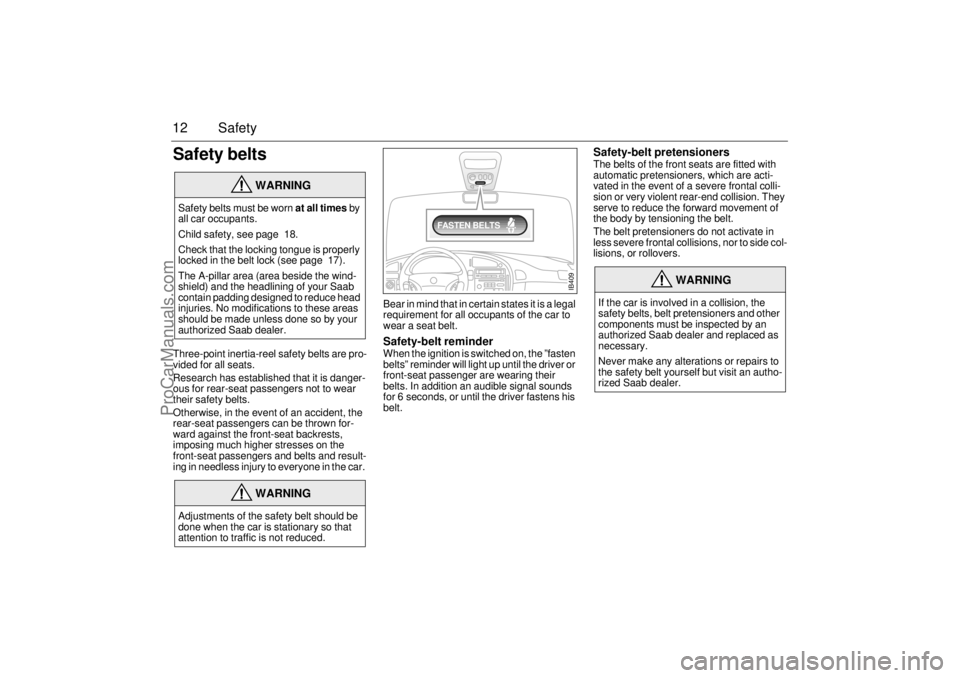
Safety-belt reminderWhen the ignition is switched on, the ”fasten
belts” reminder will light up until the driver or
front-seat passenger are wearing their
belts. In addition an audible signal sounds
for 6 seconds, or until the driver fastens his
belt.
Safety-belt pretensionersThe belts of the front seats are fitted with
automatic pretensioners, which are acti-
vated in the event of a severe frontal colli-
sion or very violent rear-end collision. They
serve to reduce the forward movement of
the body by tensioning the belt.
The belt pretensioners do not activate in
less severe frontal collisions, nor to side col-
lisions, or rollovers.
WARNING
Safety belts must be worn at all times by
all car occupants.
Child safety, see page 18.
Check that the locking tongue is properly
locked in the belt lock (see page 17).
The A-pillar area (area beside the wind-
shield) and the headlining of your Saab
contain padding designed to reduce head
injuries. No modifications to these areas
should be made unless done so by your
authorized Saab dealer.
WARNING
Adjustments of the safety belt should be
done when the car is stationary so that
attention to traffic is not reduced.
WARNING
If the car is involved in a collision, the
safety belts, belt pretensioners and other
components must be inspected by an
authorized Saab dealer and replaced as
necessary.
Never make any alterations or repairs to
the safety belt yourself but visit an autho-
rized Saab dealer.
IB409
FASTEN BELTS
ProCarManuals.com
Page 14 of 256
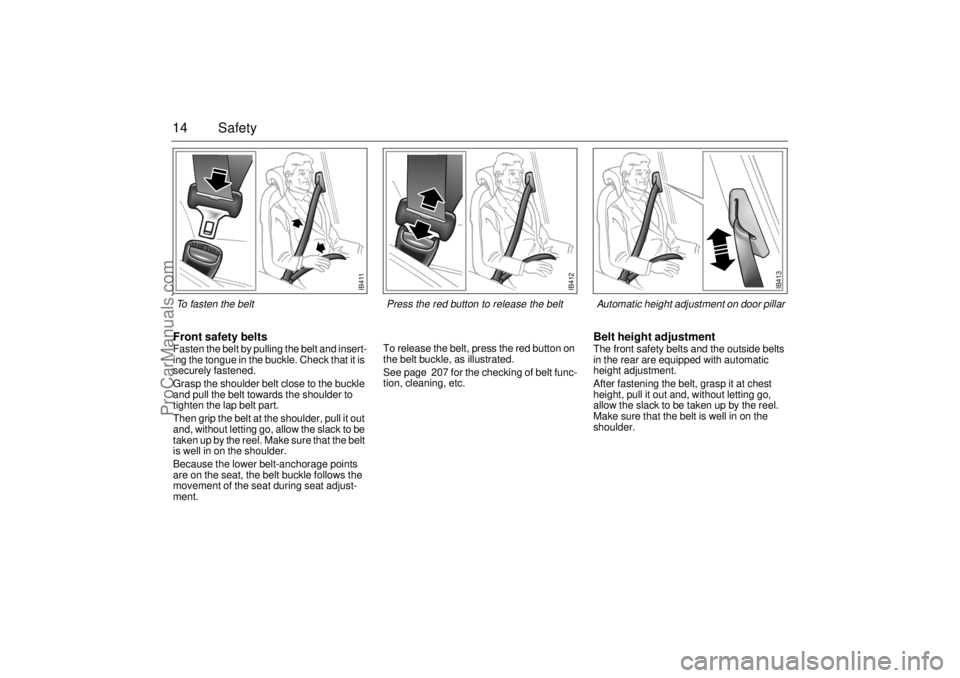
14 SafetyFront safety belts Fasten the belt by pulling the belt and insert-
ing the tongue in the buckle. Check that it is
securely fastened.
Grasp the shoulder belt close to the buckle
and pull the belt towards the shoulder to
tighten the lap belt part.
Then grip the belt at the shoulder, pull it out
and, without letting go, allow the slack to be
taken up by the reel. Make sure that the belt
is well in on the shoulder.
Because the lower belt-anchorage points
are on the seat, the belt buckle follows the
movement of the seat during seat adjust-
ment.To release the belt, press the red button on
the belt buckle, as illustrated.
See page 207 for the checking of belt func-
tion, cleaning, etc.
Belt height adjustmentThe front safety belts and the outside belts
in the rear are equipped with automatic
height adjustment.
After fastening the belt, grasp it at chest
height, pull it out and, without letting go,
allow the slack to be taken up by the reel.
Make sure that the belt is well in on the
shoulder.
IB411
To fasten the belt
IB412
Press the red button to release the belt
IB413
Automatic height adjustment on door pillar
ProCarManuals.com
Page 34 of 256
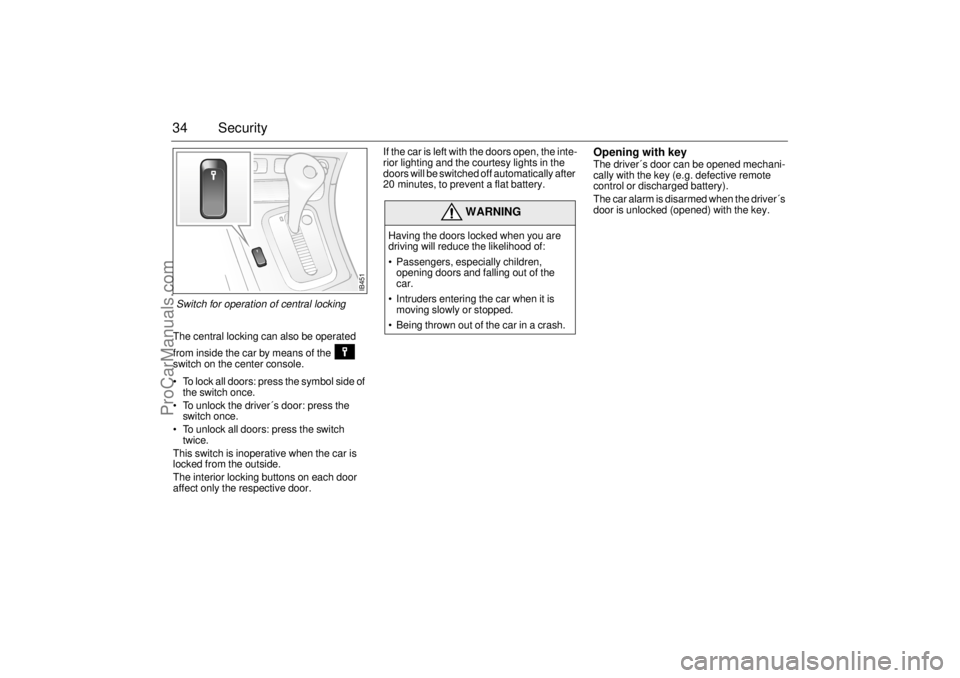
34 SecurityThe central locking can also be operated
from inside the car by means of the
switch on the center console.
To lock all doors: press the symbol side of
the switch once.
To unlock the driver´s door: press the
switch once.
To unlock all doors: press the switch
twice.
This switch is inoperative when the car is
locked from the outside.
The interior locking buttons on each door
affect only the respective door.If the car is left with the doors open, the inte-
rior lighting and the courtesy lights in the
doors will be switched off automatically after
20 minutes, to prevent a flat battery.
Opening with keyThe driver´s door can be opened mechani-
cally with the key (e.g. defective remote
control or discharged battery).
The car alarm is disarmed when the driver´s
door is unlocked (opened) with the key.
WARNING
Having the doors locked when you are
driving will reduce the likelihood of:
Passengers, especially children,
opening doors and falling out of the
car.
Intruders entering the car when it is
moving slowly or stopped.
Being thrown out of the car in a crash.
IB451
Switch for operation of central locking
ProCarManuals.com
Page 36 of 256
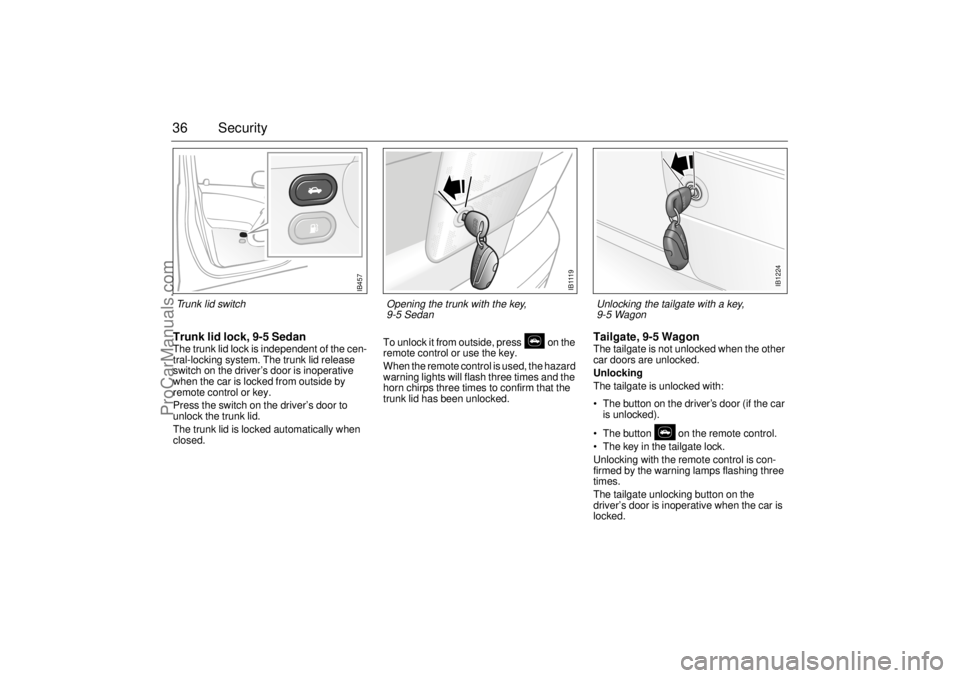
36 SecurityTrunk lid lock, 9-5 SedanThe trunk lid lock is independent of the cen-
tral-locking system. The trunk lid release
switch on the driver’s door is inoperative
when the car is locked from outside by
remote control or key.
Press the switch on the driver’s door to
unlock the trunk lid.
The trunk lid is locked automatically when
closed.To unlock it from outside, press on the
remote control or use the key.
When the remote control is used, the hazard
warning lights will flash three times and the
horn chirps three times to confirm that the
trunk lid has been unlocked.
Tailgate, 9-5 WagonThe tailgate is not unlocked when the other
car doors are unlocked.
Unlocking
The tailgate is unlocked with:
The button on the driver’s door (if the car
is unlocked).
The button on the remote control.
The key in the tailgate lock.
Unlocking with the remote control is con-
firmed by the warning lamps flashing three
times.
The tailgate unlocking button on the
driver’s door is inoperative when the car is
locked.
IB457
Trunk lid switch
I B 111 9
Opening the trunk with the key,
9-5 Sedan
IB1224
Unlocking the tailgate with a key,
9-5 Wagon
ProCarManuals.com
Page 39 of 256

39 Security
Activating the car alarm The car alarm (anti-theft system) is
activated/deactivated when the car is
locked/unlocked by the remote control or by
the key.
The car alarm cannot be activated if the
driver’s door is open or if the ignition switch
is in position ON.
If, on the other hand, one of the other doors
or the trunk or hood is open or opened and
not closed again during the 10-seconds
delay period, it will be excluded from the
alarm function.
If it is then closed, a new delay period of ten
seconds will start, and the door (or trunk or
hood will once again be secured by the
alarm system.
As usual, the LED will be on continuously
during the new delay period and will start to
flash once every third second after the
10-seconds period has elapsed.
Window-glass sensorThe car-alarm system incorporates a
sensor that monitors the window glass for
the sound of breakage. The sensor is fitted
inside the rear dome light.
To avoid false alarms, such as the alarm
being triggered by children or pets left inside
the car, the sensor can be temporarily dis-
abled.
To disable the sensor
To disable the sensor, first ensure that the
ignition has been switched off and key
removed from the switch. Then, press and
hold the NIGHT PANEL button until ”DOOR
ALARM ONLY” appears on the SID and a
chime sounds. The car alarm must now be
activated within three minutes, or the glass
sensor will become active again.
The glass sensor will be enabled again
automatically when the car is next unlocked.
The sensor can also be enabled again by
repeating the procedure for disabling it.
When the sensor has been enabled, ”FULL
THEFT ALARM” will appear on the SID.
If a fault is detected in the glass sensor,
”SERVICE THEFT ALARM” will appear on
the SID.
Electronic starting interlock
(immobilizer) When the key is inserted in the ignition, a
signal is sent to the receiver. If the signal is
verified, the engine can be started.
Each time the key is removed from the igni-
tion, the electronic immobilizer is activated.
This means that the car cannot be started
without the correct key is inserted in the igni-
tion and the immobilizer is thus deactivated.
If a fault is detected (e.g. in the transmitter)
”KEY NOT ACCEPTED” will appear on the
SID.
In this case, you can still start the car if you
turn the ignition key to ON and press one of
the buttons on the remote control (providing
that the receiver gets the right signal from
the remote control).
Take the car to an authorized Saab dealer to
have the system checked.
The LED double-flashes when the car is
immobilized.
ProCarManuals.com
Page 45 of 256
45 Instruments and controls
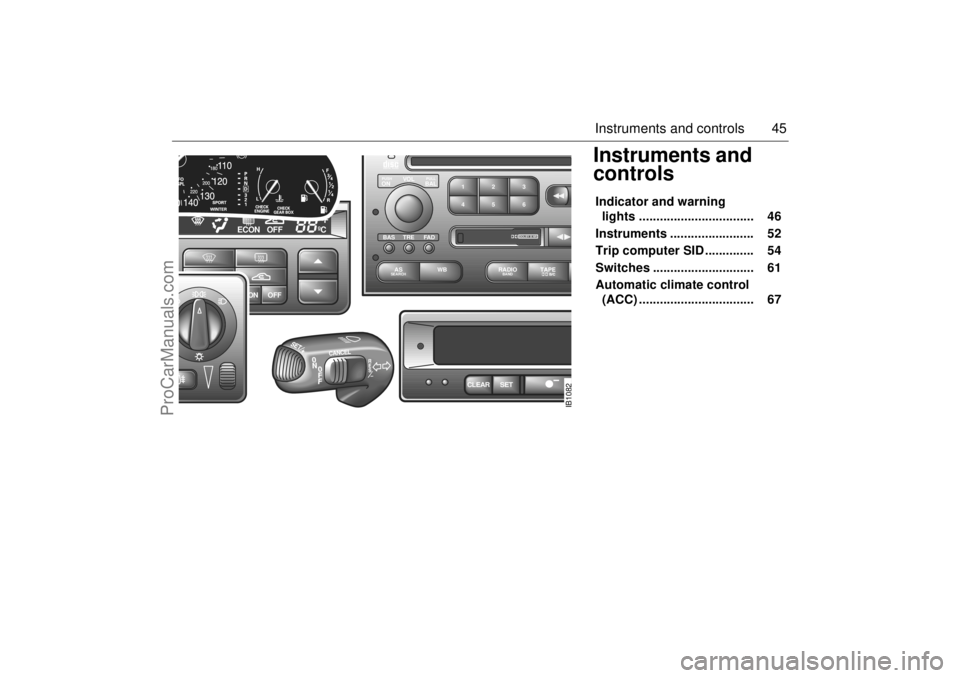
Instruments and
controls Indicator and warning
lights ................................. 46
Instruments ........................ 52
Trip computer SID .............. 54
Switches ............................. 61
Automatic climate control
(ACC) ................................. 67
ECON OFF
ºF
ºC
ECON OFF
CLEAR
SET
IB1082
VOL
TREBAL ON
FA D BAS
PULL PUSH
RADIO BAND
WB AS
SEARCH
2 13
5 46
DOLBY B NR
ProCarManuals.com