ABS SAAB 9-5 2000 User Guide
[x] Cancel search | Manufacturer: SAAB, Model Year: 2000, Model line: 9-5, Model: SAAB 9-5 2000Pages: 256, PDF Size: 14.24 MB
Page 175 of 256
175 Car care and technical information
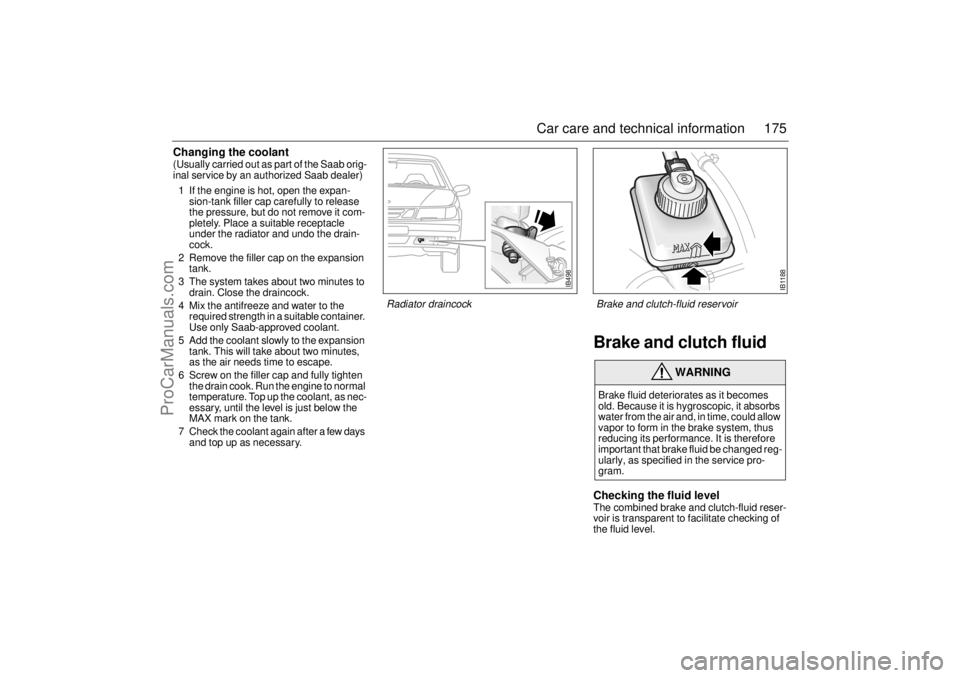
Changing the coolant (Usually carried out as part of the Saab orig-
inal service by an authorized Saab dealer)
1 If the engine is hot, open the expan-
sion-tank filler cap carefully to release
the pressure, but do not remove it com-
pletely. Place a suitable receptacle
under the radiator and undo the drain-
cock.
2 Remove the filler cap on the expansion
tank.
3 The system takes about two minutes to
drain. Close the draincock.
4 Mix the antifreeze and water to the
required strength in a suitable container.
Use only Saab-approved coolant.
5 Add the coolant slowly to the expansion
tank. This will take about two minutes,
as the air needs time to escape.
6 Screw on the filler cap and fully tighten
the drain cook. Run the engine to normal
temperature. Top up the coolant, as nec-
essary, until the level is just below the
MAX mark on the tank.
7 Check the coolant again after a few days
and top up as necessary.
Brake and clutch fluid Checking the fluid level The combined brake and clutch-fluid reser-
voir is transparent to facilitate checking of
the fluid level.
WARNING
Brake fluid deteriorates as it becomes
old. Because it is hygroscopic, it absorbs
water from the air and, in time, could allow
vapor to form in the brake system, thus
reducing its performance. It is therefore
important that brake fluid be changed reg-
ularly, as specified in the service pro-
gram.
IB498
Radiator draincock
IB1188
Brake and clutch-fluid reservoir
ProCarManuals.com
Page 194 of 256
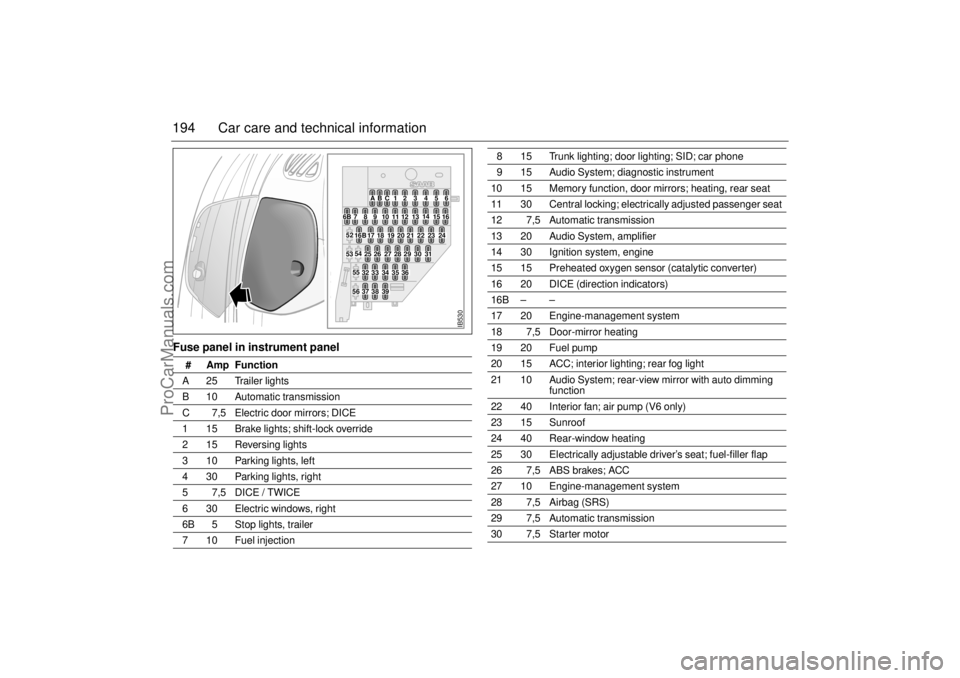
194 Car care and technical informationFuse panel in instrument panel
# Amp Function
A 25 Trailer lights
B 10 Automatic transmission
C 7,5 Electric door mirrors; DICE
1 15 Brake lights; shift-lock override
2 15 Reversing lights
3 10 Parking lights, left
4 30 Parking lights, right
5 7,5 DICE / TWICE
6 30 Electric windows, right
6B 5 Stop lights, trailer
7 10 Fuel injection
8 15 Trunk lighting; door lighting; SID; car phone
9 15 Audio System; diagnostic instrument
10 15 Memory function, door mirrors; heating, rear seat
11 30 Central locking; electrically adjusted passenger seat
12 7,5 Automatic transmission
13 20 Audio System, amplifier
14 30 Ignition system, engine
15 15 Preheated oxygen sensor (catalytic converter)
16 20 DICE (direction indicators)
16B – –
17 20 Engine-management system
18 7,5 Door-mirror heating
19 20 Fuel pump
20 15 ACC; interior lighting; rear fog light
21 10 Audio System; rear-view mirror with auto dimming
function
22 40 Interior fan; air pump (V6 only)
23 15 Sunroof
24 40 Rear-window heating
25 30 Electrically adjustable driver’s seat; fuel-filler flap
26 7,5 ABS brakes; ACC
27 10 Engine-management system
28 7,5 Airbag (SRS)
29 7,5 Automatic transmission
30 7,5 Starter motor
IB530
BC123456 A
14
121110987
13
6B
1516
2324
222120191817
16B
5425262728293031
3635343332
39383755525356
ProCarManuals.com
Page 196 of 256
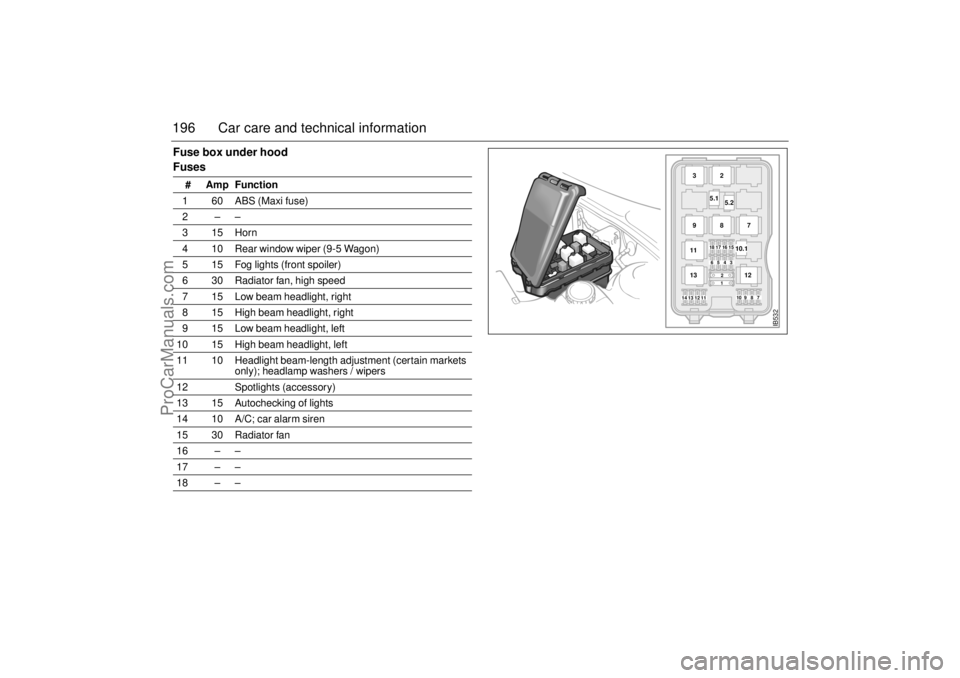
196 Car care and technical informationFuse box under hood
Fuses
# Amp Function
1 60 ABS (Maxi fuse)
2––
315Horn
4 10 Rear window wiper (9-5 Wagon)
5 15 Fog lights (front spoiler)
6 30 Radiator fan, high speed
7 15 Low beam headlight, right
8 15 High beam headlight, right
9 15 Low beam headlight, left
10 15 High beam headlight, left
11 10 Headlight beam-length adjustment (certain markets
only); headlamp washers / wipers
12 Spotlights (accessory)
13 15 Autochecking of lights
14 10 A/C; car alarm siren
15 30 Radiator fan
16 – –
17 – –
18 – –
IB532
18171615
14131211
10987
654312
10.1
3
5.2
5.12
9
8
7
11
12
13
ProCarManuals.com
Page 208 of 256

208 Car care and technical informationUpholstery and trimTo remove fluff or hairs from the seat uphol-
stery or headlining, use a moist, lint-free
cloth or a special lint remover (brush or
roller). Remove any dirty marks using a
cloth moistened with lukewarm soapy
water.
When using a stain remover, always work
from the outside towards the center to avoid
leaving a ring. If a soiled ring or spot should
remain, it can usually be removed using
lukewarm soapy water or water alone.
Wet patches left by spilt soft drinks or thin oil
must be wiped off immediately using an
absorbent material, such as kitchen paper,
and treated with stain remover.
Alcohol is recommended for removing
grease or oil stains, and a semi-stiff brush
may also be used.
Cleaning and caring for leather
upholsteryThe principal reason for treating leather
upholstery is to maintain its elegant appear-
ance and to provide it with a protective film.
Discoloration caused by dust and wear
mainly affects the lighter shades, although
this is not detrimental to the leather –
indeed, the patina resulting from use is often
considered desirable in leather. But if the
leather is allowed to become too grubby, it
can start to look shabby.
It is a good idea to clean and recondition the
leather twice a year – in conjunction with a
general spring-cleaning of the car – after the
winter and in the autumn, for instance. In
hot, dry climates, the leather will need to be
treated more frequently.
Moisten a soft cloth in a mild soap solution.
Carefully apply this damp (not wet) cloth to
the leather, working in light, circular move-
ments until the leather is clean. Repeat the
procedure using clean water and then leave
the leather to dry thoroughly. Finally, treat
the leather with a leather conditioner.Apply the leather conditioner using a soft
cloth and the same circular movements as
described above. After it has dried, polish
the leather with a soft, dry cloth. Follow the
directions given above. Do not use hot
water, unknown abrasive polishes, sol-
vents, sprays or soaps that might scratch
the leather.
Textile carpetingVacuum clean the carpeting regularly. Car-
pets can also be cleaned using a brush, or
carpet shampoo applied with a sponge. Do
not use vacuum cleaners outdoors unless
they are properly grounded.
ProCarManuals.com
Page 213 of 256

213 Car care and technical information
For long tripsBefore setting off on a long journey, it is
advisable to have your car checked over by
your Saab dealer.
Obtain a few important items to take along
on your journey such as spare bulbs, wiper
blades, fuses, a Poly-Vee-belt and the like.
You can check some points yourself before-
hand:
Make sure that the engine is in good con-
dition.
Check that no oil or gasoline leaks out of
the engine or gearbox/transmission.
Inspect the Poly-Vee-belt and replace it if
it shows any signs of hard wear.
Check the battery charge.
Check the tires for tread pattern and air
pressure, including the compact spare
wheel.
Check the brakes.
Check all bulbs.
Check for the presence of the tool kit and
the jack in the car.
Recovery and/or
recycling of automotive
materialsA typical car consists of metals (65–75%),
plastics (10–14%), rubber (5%) and small
quantities of glass, wood, paper and tex-
tiles.
Some of these materials can be recycled,
while others can be recovered in chemical
processes for reuse in new products or as a
source of energy.
While the Saab 9-5 was still at the draw-
ing-board stage, Saab engineers were
giving serious consideration to how the
maximum quantity of materials could be
reclaimed from the car on its eventual
scrapping. To facilitate sorting, plastic parts,
for instance, have been marked to identify
the precise nature of the plastic.
Approximately 90% of the materials in the
car can be recycled or recovered, where
facilities exist.
Before the car is scrapped, all the oils and
other fluids that could pollute the environ-
ment should be recovered from the car. It
may be of interest in this context to learn that
the refrigerant used in the Saab 9-5’s A/C
and ACC systems (R134a) contains neither
CFCs nor any other chlorine compounds.
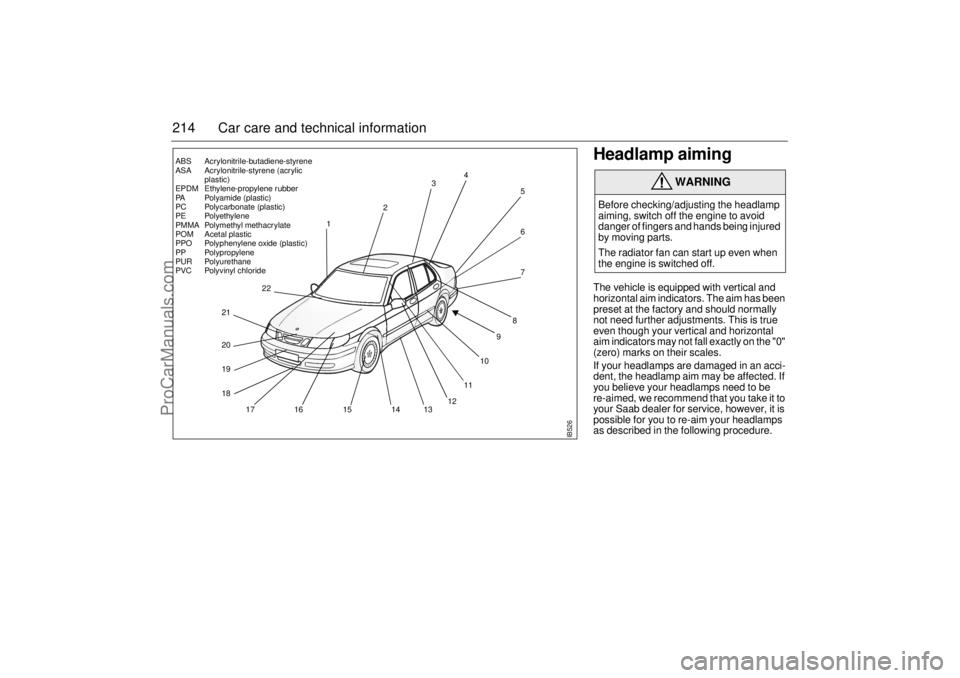
1 A-pillar trim: PP, PP/EPDM
2 Windshield trim: PP, PP/EPDM
3 Seals: EPDM
4 C-pillar trim: PP
5 Rear light cluster: PMMA
6 Corner infill panel: PPO/PA
7 Rear bumper, cellular core: expanded PP;
sheathing: PP/EPDM
8 Side-window casing: PP/EPDM
9 Fuel tank: PE
10 Side trim: PVC
11 A-pillar upholstery trim: PC/ABS, textile
12 Rearview mirror: ABS
13 Sill scuff plate: PP/EPDM
14 Wheel-arch liner: PP
15 Wheel cover: PA
16 Direction-indicator lamp lens: PMMA
17 Washer-fluid reservoir: PE
18 Front spoiler: PP/EPDM
19 Front bumper, cellular core: expanded PP;
sheathing: PP/EPDM
20 Fan shroud: PP
21 Radiator grille: ABS
22 Scuttle panel finisher: PC/ASA
ProCarManuals.com
Page 214 of 256
214 Car care and technical information
Headlamp aimingThe vehicle is equipped with vertical and
horizontal aim indicators. The aim has been
preset at the factory and should normally
not need further adjustments. This is true
even though your vertical and horizontal
aim indicators may not fall exactly on the "0"
(zero) marks on their scales.
If your headlamps are damaged in an acci-
dent, the headlamp aim may be affected. If
you believe your headlamps need to be
re-aimed, we recommend that you take it to
your Saab dealer for service, however, it is
possible for you to re-aim your headlamps
as described in the following procedure.
WARNING
Before checking/adjusting the headlamp
aiming, switch off the engine to avoid
danger of fingers and hands being injured
by moving parts.
The radiator fan can start up even when
the engine is switched off.
IB526
ABS Acrylonitrile-butadiene-styrene
ASA Acrylonitrile-styrene (acrylic
plastic)
EPDM Ethylene-propylene rubber
PA Polyamide (plastic)
PC Polycarbonate (plastic)
PE Polyethylene
PMMA Polymethyl methacrylate
POM Acetal plastic
PPO Polyphenylene oxide (plastic)
PP Polypropylene
PUR Polyurethane
PVC Polyvinyl chloride 1234
5
6
7
98
10
11
12
13 14 15 16 19
18 20 21
1722
ProCarManuals.com
Page 223 of 256

223 Maintenance and owner assistance
(c.) Check wheel alignment if irregular or premature tire wear is apparent.
Service Intervals **
Miles = U.S. Cars
Kilometers = Canadian Cars
1,000
(1,600 km)
10,000
(16,000 km)
20,000
(32,000 km)
30,000
(48,000 km)
40,000
(64,000 km)
50,000
(80,000 km)
60,000
(96,000 km)
70,000
(112,000 km)
80,000
(128,000 km)
90,000
(144,000 km)
100,000
(160,000 km)
Service #
1234567891011
Chassis
R Ball joint clearance, outer and inner steering joints and
rubber boots""""""""""
R Front suspension, rear axle mountings; retighten"
R Shock absorbers and bushes; tightness and condition"""
R Tire pressure, tread depth and wear (c.)"""""""""""
R Rotate tires, front to rear""""""""""
R Brake pads and discs; wear and condition""""""""""
R Brake lines and hoses"""""""""""
R Brake fluid level and renewal (max. 2-year intervals)""" ! "" ! "" ! "
R Check handbrake function"""""""""""
R Power steering fluid level"""""""""""
ProCarManuals.com
Page 224 of 256

224 Maintenance and owner assistance
Service Intervals **
Miles = U.S. Cars
Kilometers = Canadian Cars
1,000
(1,600 km)
10,000
(16,000 km)
20,000
(32,000 km)
30,000
(48,000 km)
40,000
(64,000 km)
50,000
(80,000 km)
60,000
(96,000 km)
70,000
(112,000 km)
80,000
(128,000 km)
90,000
(144,000 km)
100,000
(160,000 km)
Service #
1234567891011
Chassis (cont.)
RToe-in"""
R Cabin air filter!!!
R Cabin air absorptive filter!
R Door hinges, stops and locks###
R Airbag system, SRS warning lamps, visual inspection"""""""""""
R Safety belts; operation and visual inspection of belt for
tears and fraying"""""""""""
RWipers"""""""""""
R Washer system: check and top-up"""""""""""
R Reset service indicator""""""""""
Customer programming
R Carry out systems programming per customer request"
Road test
R Check performance of drive train, steering and brakes
and verify tire balance.
Check function of instruments and controls, including
horn, windshield wipers, cruise control and climate sys-
tem.
Note any noises or problems for correction."""""""""""
ProCarManuals.com
Page 233 of 256

233 Specifications
Brake system Wheels and tiresFootbrake (ABS) ___________________ Hydraulic disc
brakes with vacuum
servo unit. Diago-
nally split circuits;
ventilated discs on
front wheels. EBD
function, see page
146.
Handbrake _______________________ Acts on rear wheels
Brake fluid ________________________ DOT 4
Brake-fluid capacity _________________ 0.925 qts (900 ml)
Disc diameter:
Front __________________________ 11.34 in (288 mm)
Front, 9-5 2.3 Turbo Aero ___________ 12.05 in (306 mm)
Rear ___________________________ 11.26 in (286 mm)
Total friction area of brake pads:
Front __________________________ 36.3 in
2 (234 cm
2)
Rear ___________________________ 15.5 in
2 (100 cm
2)Wheel size ________________________ 6.5 x 16 or 7 x 17
9-5 2.3 Turbo Aero ___________________ Use 6.5 x 16 or
7 x 17 only
Tire size (summer tires):
6.5 x 16 wheels ___________________ 215/55 R16
7 x 17 wheels _____________________ 225/45 R17
Tire size (winter tires):
6 x 15 wheels (not 9-5 2.3 Turbo Aero) __ 195/65 R15 M+S
6.5 x 16 wheels ___________________ 205/55 R16 M+S
Recommended wheels for snow chains _ 6 x 15 (not 9-5 2.3
Turbo Aero) or
6.5 x 16
Compact spare:
Wheel ___________________________ 4 x 16
Tire _____________________________ T115/70 R16
Pressure_________________________ 60 psi (420 kPa)
Maximum life _____________________ 2,200 miles
(3500 km)
Maximum speed __________________ 50 mph (80 km/h)
ProCarManuals.com
Page 241 of 256

241 Index
IndexAA/C system, fault diagnosis ________ 206
A/C system, maintenance _________ 206
ABS brakes ____________________ 146
ACC ___________________________ 67
ACC functions ___________________ 70
ACC, automatic climate control ______ 67
ACC, calibration _________________ 75
ACC, condensation _______________ 76
ACC, programming _______________ 73
ACC, useful tips _________________ 75
Adjusting the steering wheel _______ 107
Adjustment, seats _______________ 102
Afterheater, V6-engine cars _______ 239
Air conditioning (A/C),
fault diagnosis and maintenance __ 206
Air distribution, ACC ______________ 72
Airbag _________________________ 23
Alarm __________________________ 38
Alarm functions __________________ 41
Alarm signals _________________ 38, 41
Alternator ______________________ 179
Alternator drive belt __________ 179, 231
Alternator rating _________________ 230
Anticorrosion treatment ___________ 211
Antidazzle rear-view mirror ________ 109
Ashtrays ______________________ 112
Audio System ___________________ 77Audio System, quick guide _________ 79
Autochecking of lights on starting ____ 52
Automatic climate control (ACC) _____ 67
Automatic transmission,
technical data _________________ 232
BBattery ________________________ 177
Battery charging/replacing _________ 178
Battery, boost starting ____________ 160
Belt guide ______________________ 12
Boost starting using jump leads ____ 160
Booster cushion __________________ 21
Brake and clutch fluid ____________ 175
Brake-fluid reservoir _____________ 175
Brakes, technical data ____________ 233
Bulbs, changing _________________ 182
Bulbs, table of __________________ 191CCD changer _____________________ 89
CD player ______________________ 87
CHECK messages _______________ 58
CHECKING _____________________ 58
Calibration, ACC _________________ 75
Cancelling the programmed settings __ 73
Car alarm _______________________ 38
Car care _______________________ 165
Car phone, installation _____________ 98
Cargo net, 9-5 Wagon ____________ 123Carpeting, care of _______________ 208
Cassette player __________________ 84
Catalytic converter,
important considerations _________ 133
Central locking ___________________ 32
Change language in SID ___________ 60
Change of address notification _____ 220
Changing a wheel _______________ 203
Changing bulbs _________________ 182
Changing the coolant _____________ 175
Changing the wheels round ________ 199
Changing wiper blades ___________ 180
Chassis number _________________ 235
Chassis number, key to ___________ 236
Child safety _____________________ 18
Child safety locks, rear doors _______ 35
Child seat, integral ________________ 21
Cleaning, engine bay _____________ 210
Clock _______________________ 59, 60
Colour code, body _______________ 235
Colour code, trim ________________ 235
Compact spare wheel ____________ 202
Condensation, ACC _______________ 76
Coolant _______________________ 174
Coolant, changing _______________ 175
Cruise control __________________ 145
Cup holder _____________________ 115
DDICE/TWICE ___________________ 193
Dampers ______________________ 232
ProCarManuals.com