ECO mode SAAB 9-5 2000 Owners Manual
[x] Cancel search | Manufacturer: SAAB, Model Year: 2000, Model line: 9-5, Model: SAAB 9-5 2000Pages: 256, PDF Size: 14.24 MB
Page 2 of 256
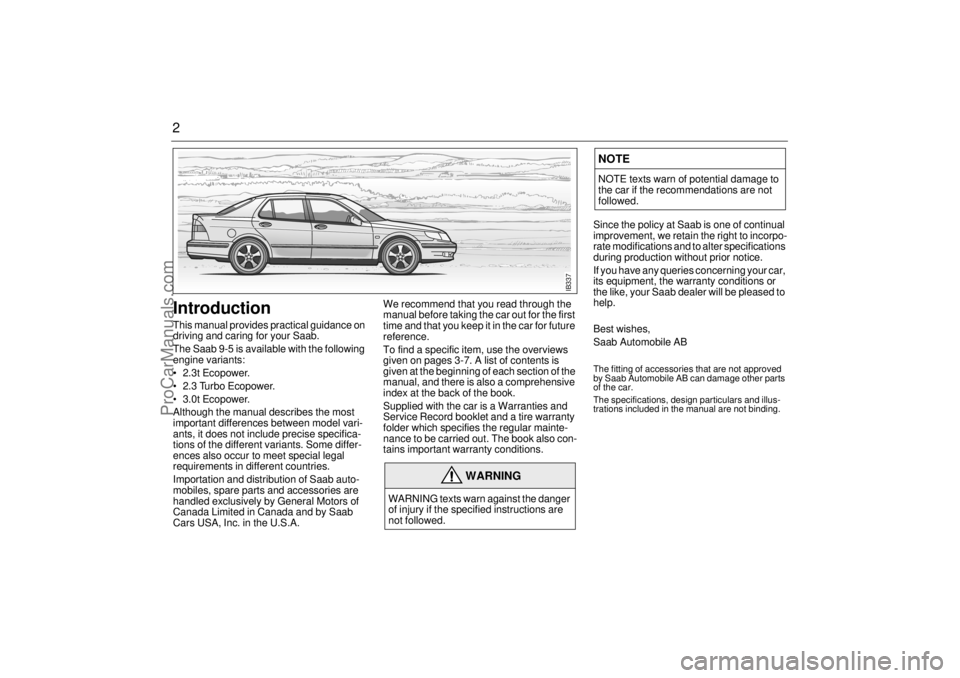
2Introduction This manual provides practical guidance on
driving and caring for your Saab.
The Saab 9-5 is available with the following
engine variants:
2.3t Ecopower.
2.3 Turbo Ecopower.
3.0t Ecopower.
Although the manual describes the most
important differences between model vari-
ants, it does not include precise specifica-
tions of the different variants. Some differ-
ences also occur to meet special legal
requirements in different countries.
Importation and distribution of Saab auto-
mobiles, spare parts and accessories are
handled exclusively by General Motors of
Canada Limited in Canada and by Saab
Cars USA, Inc. in the U.S.A.We recommend that you read through the
manual before taking the car out for the first
time and that you keep it in the car for future
reference.
To find a specific item, use the overviews
given on pages 3-7. A list of contents is
given at the beginning of each section of the
manual, and there is also a comprehensive
index at the back of the book.
Supplied with the car is a Warranties and
Service Record booklet and a tire warranty
folder which specifies the regular mainte-
nance to be carried out. The book also con-
tains important warranty conditions. Since the policy at Saab is one of continual
improvement, we retain the right to incorpo-
rate modifications and to alter specifications
during production without prior notice.
If you have any queries concerning your car,
its equipment, the warranty conditions or
the like, your Saab dealer will be pleased to
help.
Best wishes,
Saab Automobile AB
The fitting of accessories that are not approved
by Saab Automobile AB can damage other parts
of the car.
The specifications, design particulars and illus-
trations included in the manual are not binding.
WARNING
WARNING texts warn against the danger
of injury if the specified instructions are
not followed.
NOTENOTE texts warn of potential damage to
the car if the recommendations are not
followed.
IB337
ProCarManuals.com
Page 23 of 256
23 Safety
Airbag (Supplemental
Restraint System
"SRS") The supplementary restraint system (SRS)
comprises an airbag in the steering wheel,
a front passenger airbag and side airbags in
the front seats.
The system supplements the protection
provided by the safety belts to further
enhance the safety of occupants.
If a fault is detected in the SRS, the
AIR BAG warning light on the main instru-
ment panel will come on (see pages 48 and
26). When the system is triggered by impact of a
frontal collision, the airbags in the steering
wheel and passenger side of the dash board
are inflated, after which they deflate through
vents in the back of the bags.
The entire process takes less than
0.1 second – literally, faster than the blink-
ing of an eye.
These airbags are triggered only by moder-
ate to severe frontal or near-frontal colli-
sions. They will not be activated by minor
front-end impacts, rear-end or side impacts,
or by the car rolling over.
WARNING
To reduce risk of injury:
Always wear your safety belt.
Always adjust your seat so that you
are as far back as possible but still
able to reach the steering wheel and
controls comfortably.
Children 12 and under or shorter than
140 cm (55 inches) should always
travel in the rear as the vehicle is
equipped with an airbag on the pas-
senger side.
WARNING
Even if the car is equipped with an
SRS (airbag), safety belts must still
always be worn by all occupants.
Note that because an airbag inflates
and deflates extremely rapidly, it will
not provide protection against a
second impact occurring in the same
incident. Always use your safety belt.
Always sit with the whole of your back
in contact with the backrest of the seat,
and with your seat as far back as is
practical. This is to reduce the risk of
injury from contact with the backrest of
the seat when the airbag inflates and
also because the airbag needs space
in which to inflate.
Never attach anything to the steering
wheel or passenger side of the instru-
ment panel, as this could result in
injury if the airbag should inflate. The
same applies to anything you might
have in your mouth, such as a pipe, for
instance.
Some components of the airbag will
be hot for a short time. In some circum-
stances the airbag can cause burns or
abrasions to the body when the airbag
inflates/deflates.
Never rest your hands or forearms on
the steering-wheel center padding.
If the AIR BAG warning light remains
on after the car has been started or
comes on while you are driving, have
the car checked immediately by an
authorized Saab dealer. The warning
light could signify that the airbags may
not inflate in a crash, or they could
even inflate without a crash.
ProCarManuals.com
Page 26 of 256
26 SafetyAIR BAG warning light
SRS servicingThe SRS must be inspected as part of the
normal service program but otherwise may
be regarded as maintenance-free.
Scrapping or working on airbags
and belt pretensioners Frequently asked questions on func-
tion of airbags
Do you still need to wear a
safety b
elt if air-
bags are fitted?
Yes, always! The airbag merely supple-
ments the car’s normal safety system.
Moreover, the airbag will only be actuated in
a moderate to severe frontal, or near-frontal
collision, which means, of course, that it pro-
vides no protection in minor frontal colli-
sions, major rear-end or side-on collisions
or if the car rolls over.
The safety belts help reduce the chance of
the car occupants from being thrown around
and injured inside the car.
But they also ensure that, if a collision
occurs in which the airbags are inflated, the
airbag will make the optimum contact with
the occupant, i.e. square on from the front.
If the occupant meets the airbag in an offset
position, the protection afforded will be
reduced.
In addition, airbags provide no protection
against a secondary impact occurring in the
same incident. So there is no doubt about
the benefit of wearing safety belts at all
times.
Do not sit too close to the airbag: it needs
room to inflate.
The airbag inflates very quickly and power-
fully in order to protect an adult person in a
serious frontal collision.
WARNING
If the air bag readiness light stays on
after you start your vehicle, it means
the air bag system may not be working
properly.
The air bags in your vehicle may not
inflate in a crash, or they could even
inflate without a crash.
To help avoid injury to yourself or oth-
ers, have your vehicle serviced right
away if the air bag readiness light
stays on after you start your vehicle.
WARNING
Under no circumstances may any
modifications be made that affect the
steering wheel or the airbag’s electri-
cal circuitry.
Before starting any welding work on
the car, always disconnect the nega-
tive (–) battery lead and cover the con-
ductor.
Airbags and belt pretensioners must
be deployed under controlled condi-
tions before the car is scrapped or any
of the system’s components are
removed. Airbags or belt pretension-
ers that have been deployed as a
result of an accident must be replaced
by new ones.
Airbag-system components must
never be transferred for use in another
vehicle.
All work involving the scrapping or
replacement of airbags or belt preten-
sioners must only be carried out by
knowledgeable personnel.
ProCarManuals.com
Page 41 of 256

41 Security
Overview of functions
Alarm signals may differ between model variants for different coun-
tries.
Some of the car-alarm functions can be reprogrammed – con-
sult your Saab dealer for further details (see page 237). Locking/
activation Hazard warning lights flash once and the horn
chirps once.
The LED will come on for 10 seconds.
Unlocking/
deactivation Hazard warning lights flash twice and the horn
chirps twice.
The LED will come on for two seconds.
Unlocking/
deactivation of
trunk lid/tailgate
alarm Hazard warning lights flash three times and the
horn chirps three times.
The LED will flash three times per second for 10
seconds.
Alarm triggered Hazard warning lights flash for 5 min.
Siren wails for 30 seconds.
To switch off the alarm, deactivate the system in
the normal way (unlocking).
Window-glass
sensor The sensor detects if any window is broken and
triggers the alarm.
To disable the sensor, see page 39.
Remote control The range of the remote control is normally
5-10 yds. (5-10 metres), although it can be sub-
stantially more than this in ideal conditions.
If a remote control or key is lost, the new one will
have to be programmed from one of the remain-
ing remote controls to match the car’s unique
security code. Get in touch with an authorized
Saab dealer.Battery for
remote control The battery for the remote control will normally
have a life of 3-4 years. When the battery needs
changing, ”REPLACE KEY BATTERY” will
appear on the SID.
After fitting a new battery, press the unlock but-
ton on the remote control at least 5 times in suc-
cession while the car is within the range of the
remote control, so that the car alarm can recog-
nize the signals from the control.
If the remote control has been exposed to very
low temperatures, it may not function properly. If
this happens, warm it in your hands for a few
minutes.
If the remote control is not working, it may be
because the code signal has not been synchro-
nized with that in the control module for the car
alarm. To rectify this, press the unlock button on
the remote control 4-5 times in quick succession.
Car-battery
voltage If the battery is disconnected while the alarm is
active (car is locked), for example during an
attempt to steal the car, the alarm will be trig-
gered.
ProCarManuals.com
Page 42 of 256

42 SecurityOverview of LED signals and SID messagesSome signals may differ between model variants for different
countries.Status LED signal
Activation (during 10-second delay). Comes on for 10 seconds.
Alarm activated (after delay). Flashes once every third
second.
Deactivation. Comes on for 2 seconds.
Alarm not activated. Off.
Door, trunk lid/tailgate or hood open
or opened during delay period.Flashes three times per sec-
ond for 10 seconds.
Unlocking the trunk lid/tailgate. Flashes three times per sec-
ond for 10 seconds.
Closing of door, trunk lid/tailgate or
hood after delay period.Comes on for 10 seconds.
Car immobilized but not locked.
Car alarm not activated.Flashes twice at three sec-
onds intervals.
SID message Reason/action
SERVICE THEFT ALARM Probably a fault in one of the sensors
or the alarm siren.
Have the car checked by an autho-
rized Saab dealer.
KEY NOT ACCEPTED Fault in key transmitter or in igni-
tion-switch receiver.
Turn ignition switch to ON and press
the unlock button on the remote con-
trol. Start the engine.
Have the car checked by an autho-
rized Saab dealer.
REPLACE KEY BATTERY Fit a new battery in the remote con-
trol, see page 35.
DOOR ALARM ONLY Window-glass sensor disabled.
FULL THEFT ALARM Window-glass sensor in circuit.
REMOTE KEY
TRANSPONDRTurn the ignition key to position ON
and then press the button for open-
ing the trunk lid. SID displays the
number of remote controls and
transmitters (transponders) coded to
the car.
ProCarManuals.com
Page 55 of 256
55 Instruments and controls
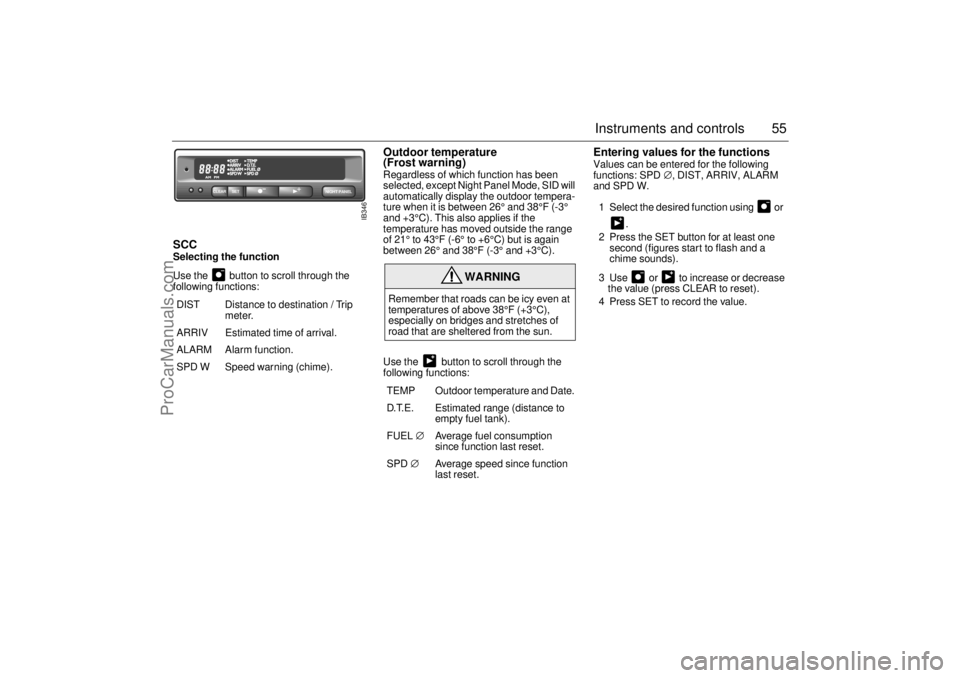
SCCSelecting the function
Use the button to scroll through the
following functions:
Outdoor temperature
(Frost warning)Regardless of which function has been
selected, except Night Panel Mode, SID will
automatically display the outdoor tempera-
ture when it is between 26° and 38°F (-3°
and +3°C). This also applies if the
temperature has moved outside the range
of 21° to 43°F (-6° to +6°C) but is again
between 26° and 38°F (-3° and +3°C).
Use the button to scroll through the
following functions:
Entering values for the functions Values can be entered for the following
functions: SPD∅, DIST, ARRIV, ALARM
and SPD W.
1 Select the desired function using or
.
2 Press the SET button for at least one
second (figures start to flash and a
chime sounds).
3 Use or to increase or decrease
the value (press CLEAR to reset).
4 Press SET to record the value.
DIST Distance to destination / Trip
meter.
ARRIV Estimated time of arrival.
ALARM Alarm function.
SPD W Speed warning (chime).
WARNING
Remember that roads can be icy even at
temperatures of above 38°F (+3°C),
especially on bridges and stretches of
road that are sheltered from the sun.
TEMP Outdoor temperature and Date.
D.T.E. Estimated range (distance to
empty fuel tank).
FUEL∅ Average fuel consumption
since function last reset.
SPD∅ Average speed since function
last reset.
NIGHT PANEL
CLEAR
SET
IB346
ProCarManuals.com
Page 59 of 256

59 Instruments and controls
1 This message cannot be removed by pressing
CLEAR. Depress the brake pedal.
2 This message will be displayed approxi-
mately 600 miles (1,000 km) before the next
scheduled service is due, or when 365 days
have elapsed since the last service. The
message should be cleared at the time of that
service (see the Saab Warranties & Service
Record Booklet).
If you have carried out the service yourself,
you can clear the message by pressing
CLEAR once. Reset by pressing CLEAR for
at least eight seconds, until ”SERVICE”
appears on the display and a chime sounds.
Night panelTo improve night-driving conditions inside
the car, the Night Panel mode can be
selected. In this mode, the amount of infor-
mation displayed is reduced, and only the
most important instruments and displays
will be illuminated.
When the Night Panel button is pressed,
only the speedometer will be illuminated (up
to the 87-mph or 140-km/h graduation), all
the other instruments illumination being
extinguished and their needles moved to
zero. Both the SID and the ACC displays will
be extinguished and the backlighting for
switches and other controls will be dimmed.
Note: All indicator and warning lights,
together with the display of CHECK mes-
sages, will operate as normal, except "Frost
warning", see page 55. The following conditions will wake up the
respective displays in the Night-Panel
mode:
Setting of the Audio system, SID or ACC
(display comes on for ten seconds).
CHECK message generated in the SID.
High engine revs cause the rev counter to
be illuminated until the engine speed has
fallen again.
If the quantity of fuel remaining falls below
4 gallons (15 liters), the fuel gauge will be
illuminated.
If the engine temperature rises above nor-
mal, the temperature gauge will be illumi-
nated.
If the speed of the car exceeds 84 mph
(135 km/h), the entire speedometer will
be illuminated.
In cars with automatic transmission, if the
selector lever is moved from D to position
3, 2 or 1, the selector indication on the
main instrument panel will be illuminated.
To restore the displays and lighting to the
normal mode, press the Night-Panel button.
ProCarManuals.com
Page 64 of 256
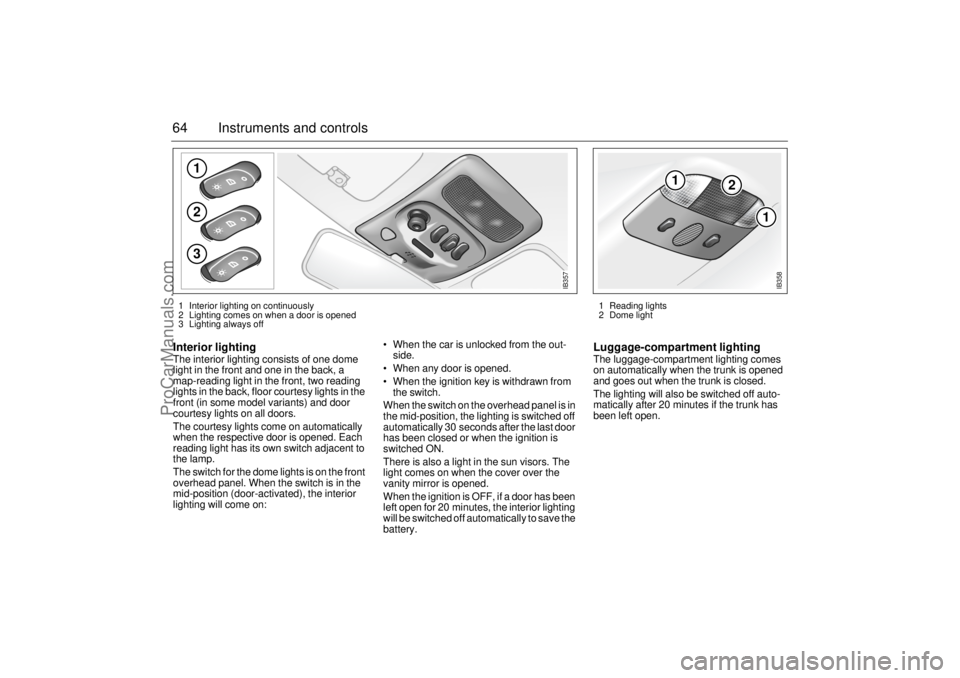
64 Instruments and controlsInterior lighting The interior lighting consists of one dome
light in the front and one in the back, a
map-reading light in the front, two reading
lights in the back, floor courtesy lights in the
front (in some model variants) and door
courtesy lights on all doors.
The courtesy lights come on automatically
when the respective door is opened. Each
reading light has its own switch adjacent to
the lamp.
The switch for the dome lights is on the front
overhead panel. When the switch is in the
mid-position (door-activated), the interior
lighting will come on: When the car is unlocked from the out-
side.
When any door is opened.
When the ignition key is withdrawn from
the switch.
When the switch on the overhead panel is in
the mid-position, the lighting is switched off
automatically 30 seconds after the last door
has been closed or when the ignition is
switched ON.
There is also a light in the sun visors. The
light comes on when the cover over the
vanity mirror is opened.
When the ignition is OFF, if a door has been
left open for 20 minutes, the interior lighting
will be switched off automatically to save the
battery.
Luggage-compartment lightingThe luggage-compartment lighting comes
on automatically when the trunk is opened
and goes out when the trunk is closed.
The lighting will also be switched off auto-
matically after 20 minutes if the trunk has
been left open.
123
IB357
1 Interior lighting on continuously
2 Lighting comes on when a door is opened
3 Lighting always off
1
2
1
IB358
1 Reading lights
2 Dome light
ProCarManuals.com
Page 70 of 256
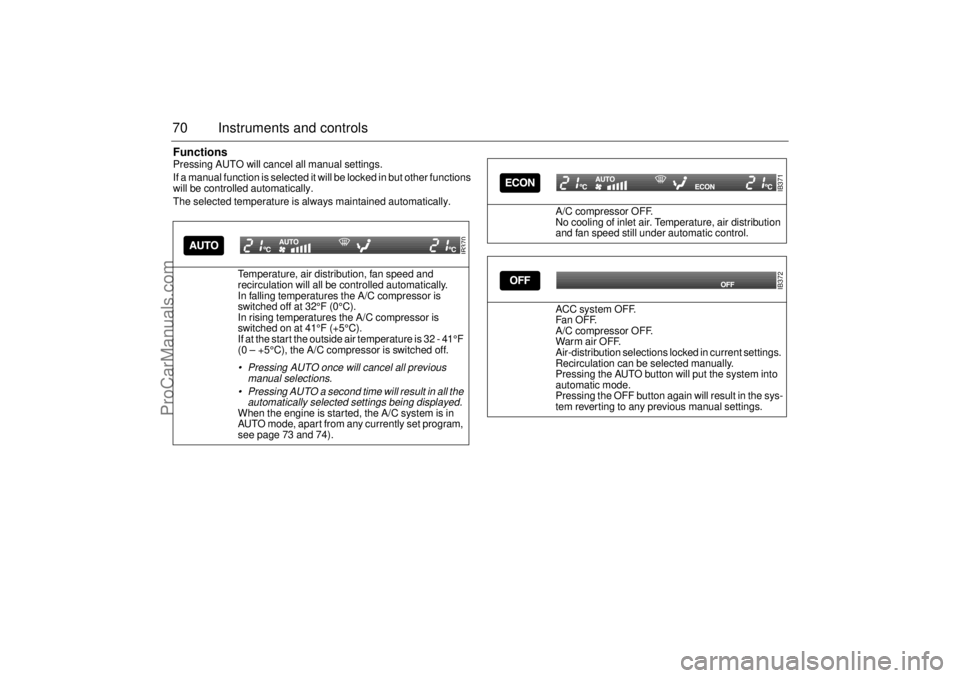
70 Instruments and controlsFunctionsPressing AUTO will cancel all manual settings.
If a manual function is selected it will be locked in but other functions
will be controlled automatically.
The selected temperature is always maintained automatically.
Temperature, air distribution, fan speed and
recirculation will all be controlled automatically.
In falling temperatures the A/C compressor is
switched off at 32°F (0°C).
In rising temperatures the A/C compressor is
switched on at 41°F (+5°C).
If at the start the outside air temperature is 32 - 41°F
(0 – +5°C), the A/C compressor is switched off.
Pressing AUTO once will cancel all previous
manual selections.
Pressing AUTO a second time will result in all the
automatically selected settings being displayed. When the engine is started, the A/C system is in
AUTO mode, apart from any currently set program,
see page 73 and 74).
IB370
A/C compressor OFF.
No cooling of inlet air. Temperature, air distribution
and fan speed still under automatic control.
ACC system OFF.
Fa n OF F.
A/C compressor OFF.
War m air OFF.
Air-distribution selections locked in current settings.
Recirculation can be selected manually.
Pressing the AUTO button will put the system into
automatic mode.
Pressing the OFF button again will result in the sys-
tem reverting to any previous manual settings.
IB371IB372
ProCarManuals.com
Page 74 of 256
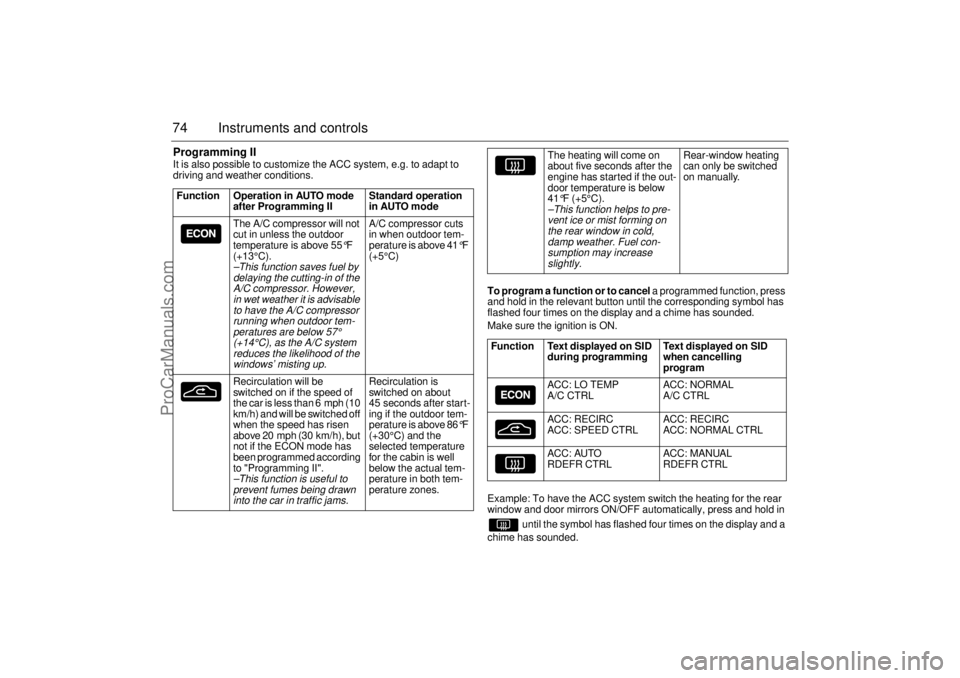
74 Instruments and controlsProgramming IIIt is also possible to customize the ACC system, e.g. to adapt to
driving and weather conditions.
To program a function or to cancel a programmed function, press
and hold in the relevant button until the corresponding symbol has
flashed four times on the display and a chime has sounded.
Make sure the ignition is ON.
Example: To have the ACC system switch the heating for the rear
window and door mirrors ON/OFF automatically, press and hold in
until the symbol has flashed four times on the display and a
chime has sounded. Function Operation in AUTO mode
after Programming II Standard operation
in AUTO mode
The A/C compressor will not
cut in unless the outdoor
temperature is above 55
°F
(+13°C).
–This function saves fuel by
delaying the cutting-in of the
A/C compressor. However,
in wet weather it is advisable
to have the A/C compressor
running when outdoor tem-
peratures are below
57°
(+14°C), as the A/C system
reduces the likelihood of the
windows’ misting up.
A/C compressor cuts
in when outdoor tem-
perature is above 41
°F
(+5°C)
Recirculation will be
switched on if the speed of
the car is less than 6 mph (10
km/h) and will be switched off
when the speed has risen
above 20 mph (30 km/h), but
not if the ECON mode has
been programmed according
to "Programming II".
–This function is useful to
prevent fumes being drawn
into the car in traffic jams.
Recirculation is
switched on about
45 seconds after start-
ing if the outdoor tem-
perature is above 86
°F
(+30°C) and the
selected temperature
for the cabin is well
below the actual tem-
perature in both tem-
perature zones.
The heating will come on
about five seconds after the
engine has started if the out-
door temperature is below
41°F (+5°C).
–This function helps to pre-
vent ice or mist forming on
the rear window in cold,
damp weather. Fuel con-
sumption may increase
slightly.
Rear-window heating
can only be switched
on manually.
Function Text displayed on SID
during programming Text displayed on SID
when cancelling
program
ACC: LO TEMP
A/C CTRL ACC: NORMAL
A/C CTRL
ACC: RECIRC
ACC: SPEED CTRL ACC: RECIRC
ACC: NORMAL CTRL
ACC: AUTO
RDEFR CTRL ACC: MANUAL
RDEFR CTRL
ProCarManuals.com