check engine SAAB 9-5 2000 User Guide
[x] Cancel search | Manufacturer: SAAB, Model Year: 2000, Model line: 9-5, Model: SAAB 9-5 2000Pages: 256, PDF Size: 14.24 MB
Page 53 of 256
53 Instruments and controls
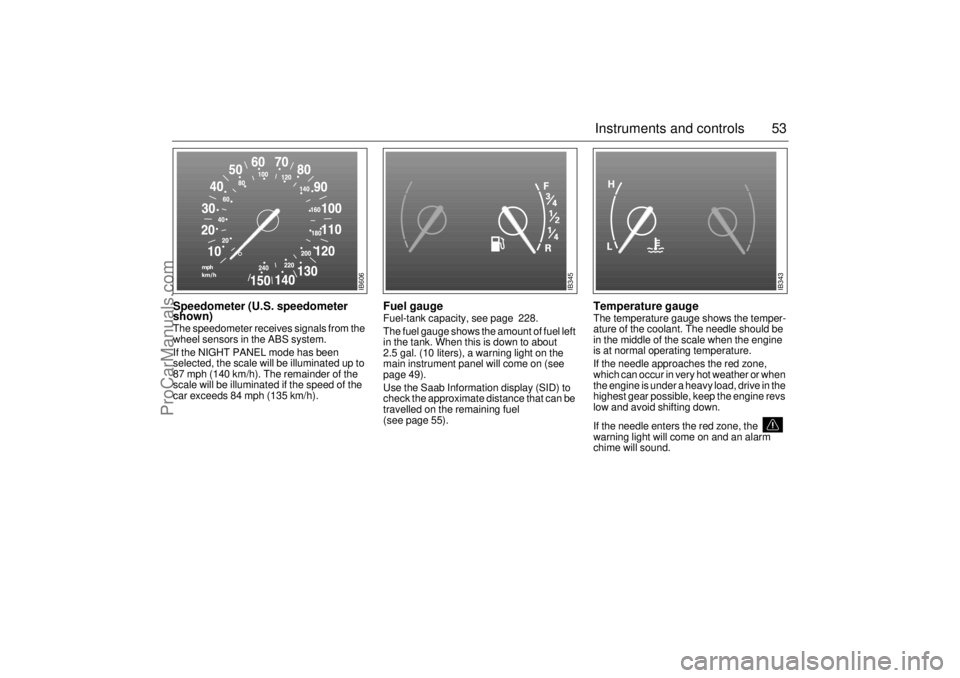
Speedometer (U.S. speedometer
shown)The speedometer receives signals from the
wheel sensors in the ABS system.
If the NIGHT PANEL mode has been
selected, the scale will be illuminated up to
87 mph (140 km/h). The remainder of the
scale will be illuminated if the speed of the
car exceeds 84 mph (135 km/h).
Fuel gauge Fuel-tank capacity, see page 228.
The fuel gauge shows the amount of fuel left
in the tank. When this is down to about
2.5 gal. (10 liters), a warning light on the
main instrument panel will come on (see
page 49).
Use the Saab Information display (SID) to
check the approximate distance that can be
travelled on the remaining fuel
(see page 55).
Temperature gauge The temperature gauge shows the temper-
ature of the coolant. The needle should be
in the middle of the scale when the engine
is at normal operating temperature.
If the needle approaches the red zone,
which can occur in very hot weather or when
the engine is under a heavy load, drive in the
highest gear possible, keep the engine revs
low and avoid shifting down.
If the needle enters the red zone, the
warning light will come on and an alarm
chime will sound.
IB606
IB345
IB343
ProCarManuals.com
Page 54 of 256
54 Instruments and controlsCheck fuse 15 (radiator fan) in the fuse
panel under the hood, see page 196.
If the needle repeatedly enters the red zone,
stop the car as soon as it is safe to do so and
check the coolant level by looking at the
level visible through the plastic tank - do not
remove the cap.
If the coolant level falls below the MIN mark,
the SID will display the message ”FILL
COOLANT FLUID”.
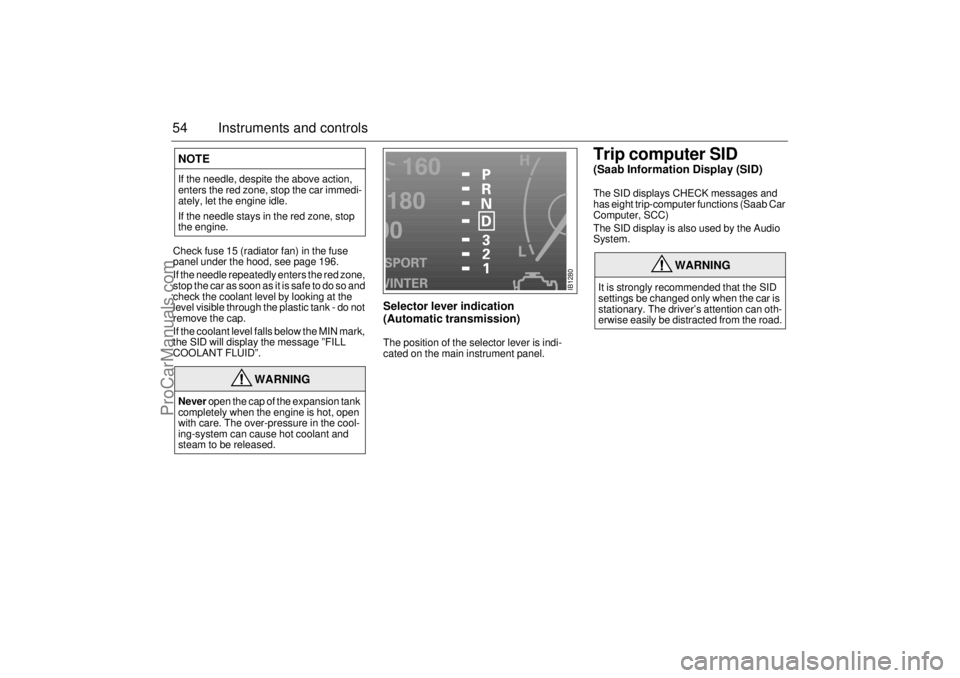
Selector lever indication
(Automatic transmission) The position of the selector lever is indi-
cated on the main instrument panel.
Trip computer SID (Saab Information Display (SID) The SID displays CHECK messages and
has eight trip-computer functions (Saab Car
Computer, SCC)
The SID display is also used by the Audio
System.
NOTEIf the needle, despite the above action,
enters the red zone, stop the car immedi-
ately, let the engine idle.
If the needle stays in the red zone, stop
the engine.
WARNING
Never open the cap of the expansion tank
completely when the engine is hot, open
with care. The over-pressure in the cool-
ing-system can cause hot coolant and
steam to be released.
WARNING
It is strongly recommended that the SID
settings be changed only when the car is
stationary. The driver’s attention can oth-
erwise easily be distracted from the road.
IB1280
ProCarManuals.com
Page 58 of 256

58 Instruments and controlsResetting values
To reset the values, press CLEAR for at
least four seconds.
The following functions will be reset
simultaneously:
Estimated range on remaining fuel
(function based on a fuel consumption of
28 mpg).
Average fuel consumption.
Average speed.
Arrival time (function based on current
speed).
Programmed values for DIST, ALARM and
SPD W will not be reset (see the respective
function).
CHECK messages When the engine is started, CHECKING will
appear on the display for about four sec-
onds, while the SID checks are being per-
formed.
When a CHECK message is generated
while the car is being driven, a chime will
sound, INFO DISPL will come on on the
main instrument panel, and the message
will appear on the SID. The number of mes-
sages that can be displayed by the SID
varies with the specification of the car.
If more than one CHECK message has
been generated, the
+ symbol will appear to
the left of the text on the display. The mes-
sages appear in order of priority.
If a new fault occurs while another message
is being displayed, the message relating to
the new one will appear for 10 seconds,
after which the display will return to the ear-
lier one.
Press CLEAR once to acknowledge a mes-
sage, whereupon it will be cleared from the
display. It will not be displayed again before
the ignition has been switched off and then
on again. The following messages may be displayed:
Message See
page
FRONT LIGHT FAILURE 182
REAR LIGHT FAILURE 185
FOG LIGHT FAILURE 186
BRAKE LIGHT FAILURE 185
TEST BRAKE LIGHTS
1)
185
WASHER FLUID LEVEL LOW 181
FILL COOLANT FLUID 174
REPLACE KEY BATTERY 35
KEY NOT ACCEPTED 42
SERVICE THEFT ALARM 42
TRANSMISSION OVERHEAT-
ING 141
TIGHTEN FUEL FILLER CAP 134
TIME FOR SERVICE
2)
218
ProCarManuals.com
Page 59 of 256

59 Instruments and controls
1 This message cannot be removed by pressing
CLEAR. Depress the brake pedal.
2 This message will be displayed approxi-
mately 600 miles (1,000 km) before the next
scheduled service is due, or when 365 days
have elapsed since the last service. The
message should be cleared at the time of that
service (see the Saab Warranties & Service
Record Booklet).
If you have carried out the service yourself,
you can clear the message by pressing
CLEAR once. Reset by pressing CLEAR for
at least eight seconds, until ”SERVICE”
appears on the display and a chime sounds.
Night panelTo improve night-driving conditions inside
the car, the Night Panel mode can be
selected. In this mode, the amount of infor-
mation displayed is reduced, and only the
most important instruments and displays
will be illuminated.
When the Night Panel button is pressed,
only the speedometer will be illuminated (up
to the 87-mph or 140-km/h graduation), all
the other instruments illumination being
extinguished and their needles moved to
zero. Both the SID and the ACC displays will
be extinguished and the backlighting for
switches and other controls will be dimmed.
Note: All indicator and warning lights,
together with the display of CHECK mes-
sages, will operate as normal, except "Frost
warning", see page 55. The following conditions will wake up the
respective displays in the Night-Panel
mode:
Setting of the Audio system, SID or ACC
(display comes on for ten seconds).
CHECK message generated in the SID.
High engine revs cause the rev counter to
be illuminated until the engine speed has
fallen again.
If the quantity of fuel remaining falls below
4 gallons (15 liters), the fuel gauge will be
illuminated.
If the engine temperature rises above nor-
mal, the temperature gauge will be illumi-
nated.
If the speed of the car exceeds 84 mph
(135 km/h), the entire speedometer will
be illuminated.
In cars with automatic transmission, if the
selector lever is moved from D to position
3, 2 or 1, the selector indication on the
main instrument panel will be illuminated.
To restore the displays and lighting to the
normal mode, press the Night-Panel button.
ProCarManuals.com
Page 130 of 256

130 Starting and drivingIgnition switchThe combined ignition switch and
gear-lever lock is located in the center con-
sole between the front seats. The ignition
key can only be removed when reverse is
engaged (automatic transmission: selector
in ”P” position).
The key fits all the locks on the car. The key
number is specified on the small plastic
strap that comes with the keys when the car
is delivered. Keep a note of the key number
in a safe place, as you will need to quote it if
ordering a replacement key.
See also page 32.
LOCK position Engage reverse and turn the key to LOCK.
Automatic transmission: select ”P”.
The gear lever is locked. This is the only position in which the key can be
removed.
The parking lights, hazard warning lights and interior lighting all work. OFF position Gear lever no longer locked.
Certain electrical circuits operationalON position All electrical circuits working. Do not leave the key in the ON position
when the engine is not running. Turn the key to OFF to switch off the
electrical circuits. In the ON position certain warning and indicator lights
come on as a check, and they normally are extinguished after about
3 seconds.ST (starter) position The starter operates when the key is turned to this position. When
released, the key will spring back to the ON position. If the engine fails to
start, the key must first be turned back to the position between OFF and
LOCK before the starter can be operated again.
When the starter motor is running, several electrical circuits are
disconnected to facilitate starting.
LOCK
OFFONST
LOCK
OFFONST
LOCK
OFFONST
LOCK
OFFONST
IB1120
ProCarManuals.com
Page 131 of 256

131 Starting and driving
If the car does not startIf the text “KEY NOT ACCEPTED” is shown
on the SID, after a failed start attempt, the
cause could be a fault in the transmitter in
the key, or in the receiver in the ignition lock.
The following should be done:
Turn the key back to the LOCK position.
Turn the key to ON.
Press one of the buttons on the remote
control (the LED stops blinking).
Start the engine.
Try another key. If this works, then the fault
is in the first key.
Contact an authorized Saab dealer for
checking and rectification.
Starting the engine Do not run the starter motor for more than
25 seconds at a time. Wait 20-30 seconds
before running the starter again, to give the
battery time to recover.
Avoid racing the engine or putting a heavy
load on it before it has warmed up. Drive
away as soon as the oil warning light has
been extinguished to enable the engine to
attain its normal temperature as quickly as
possible.
It is possible for air to enter the lubricating
system in conjunction with an oil or oil-filter
change, or if the car has been stored for
some time. This air can cause the hydraulic
cam followers to emit a ticking noise, which
can persist for up to 15 minutes after start-
ing. Although this is quite normal and does
not indicate any malfunction, it is advisable
not to exceed 3,000 rpm before the noise
has disappeared.
The hydraulic cam lifters are completely
service free; the valve clearance is set up at the factory and will not need any subse-
quent adjustment.
Starting the engineThe engine has an automatic choke and
should be started as follows:
Cars with manual gearbox
To start the engine the clutch pedal must
be fully depressed.
1 Depress the clutch pedal fully but do not
touch the accelerator.
2 Start the engine. Let the ignition key
spring back as soon as the engine has
started and is running smoothly – at very
low temperatures, you may need to run
the starter for up to 25 seconds.
Let the engine idle for about 10 seconds. Do
not open the throttle wide for at least
2-3 minutes after starting.
Cars with automatic transmission
1 The selector lever must be in the P or N
position.
2 Keep your foot on the brake pedal.
3 Start the engine. Let the ignition key
spring back as soon as the engine has
started and is running smoothly – at very
low temperatures, you may need to run
the starter for up to 25 seconds.
Let the engine idle for about 10 seconds. Do
not open the throttle wide for at least
2–3 minutes after starting.
NOTETake care not to spill drinks or to drop
crumbs over the ignition switch. If dirt or
liquid gets into it, the switch may not
operate properly.
WARNING
Always remove the key before leaving
the car.
Always apply the parking brake before
removing the ignition key.
WARNING
Carbon monoxide (CO) is a colorless,
odorless, poisonous gas. Be alert to
the danger of CO – always open the
garage doors before starting the
engine in the garage.
There is also a danger of CO poison-
ing if the exhaust system is leaking.
ProCarManuals.com
Page 132 of 256

132 Starting and drivingUseful tips on cold climate starting If the engine has failed to start after several
attempts in very cold weather, press and
hold the accelerator down to the floor and
run the starter for 5–10 seconds. This will
prevent the engine being flooded (exces-
sively rich fuel-air mixture).
Now start the engine in the normal way – do
not touch the accelerator.
If the engine stalls immediately after starting
(e.g. if the clutch was released too quickly),
do not touch the accelerator when restarting
the engine.
Limp-home modeThe car’s engine-management system
includes a diagnostic function that checks
numerous internal functions after the
engine has been shut off. If a fault is
detected in the throttle system, the
engine-management system puts the throt-
tle system into the limp-home mode. This
limits idling control, disables the cruise-con-
trol system and limits the capacity of the A/C
compressor.
If the limp-home mode is in operation
(“Engine malfunction” light on, see below)
and the outside temperature is close to or
below freezing, you may need to use some
throttle on starting (some pressure on the
accelerator).
If the diagnostic system has detected a fault
in the engine-management system, the
“Engine malfunction” light on the main
instrument panel will come on (see page
49), indicating that you should have the car
checked as soon as possible by an autho-
rized Saab dealer.
Important
considerations for
drivingThe engine-management system in the
Saab 9-5 is called Saab Trionic T7. The
system manages the ignition, fuel injection
and turbo boost pressure.
The Trionic T7 system developed by Saab
is an intelligent engine-management
system designed to achieve optimum driv-
ability under differing driving conditions.
The system makes adjustments automati-
cally, for instance, if the car is being driven
at altitude (oxygen-deficient air), for differ-
ent grades of fuel (AON 87–93) and for dif-
ferent load conditions.
1 Starting and driving
Refrain from using full throttle before
the engine has warmed up (before
needle in mid-range on temperature
gauge).
A safety function prevents the engine
from revving faster than 6,000 rpm by
limiting the induction air.
2 Stopping the engine
Do not rev the engine immediately
before switching it off - stop the engine
when it is idling.
3 Regulating the boost pressure
The system is optimized for fuel with an
octane rating of AON 90. One of the
ProCarManuals.com
Page 133 of 256

133 Starting and driving
advantages of the system is that it
enables the engine to be run safely on
lower-grade fuel, although not lower
than AON 87.
The maximum boost pressure is
adjusted automatically to the knocking
or pinging tendency of the engine.
Occasional, short-lived knocking when
the engine is under a heavy load is per-
fectly normal; the extent will depend on
the grade of fuel in the tank.
Isolated instances of knocking are
more likely to occur with low-octane
fuel. This controlled form of knocking,
followed by a reduction in the boost
pressure, is a sign that the wastegate is
functioning and is perfectly safe for the
engine.
Important considerations with cata-
lytic convertersThe catalytic converter is an emission-con-
trol device incorporated in the car’s exhaust
system. It consists of a metal canister with a
honeycomb insert, the cells of which have
walls coated in a catalytic layer (mixture of
precious metals).
NOTEIf constant knocking occurs every time a
load is put on the engine, this indicates a
malfunction in the system.
Have the car checked without delay by an
authorized Saab dealer.
WARNING
If the engine is being run with the car on a
rolling road or dynamometer, to ensure
adequate cooling, air must be blown into
the engine compartment and under the
car at a rate equivalent to the ram-air
effect that would be obtained at the corre-
sponding road speed.
NOTEUse only unleaded gasoline. Leaded gas-
oline is detrimental to the catalyst and
oxygen sensor and will seriously impair
the function of the catalytic converter.
IB661
2
1
3
Oxygen-sensor-controlled
injection system 1 Engine control module
2 Oxygen sensor (lambda probe)
3 Catalytic converter
ProCarManuals.com
Page 136 of 256

136 Starting and driving(MMT). If such fuel is used, your emission
control system performance may deterio-
rate and the malfunction indicator lamp on
your instrument panel may turn on. If this
occurs, return to your authorized Saab
dealer for service.
However, these blended gasolines are reg-
ulated and should never exceed these rec-
ommended blend percentages and service
station operators should know if their gaso-
lines contain detergents and oxygenates,
and have been reformulated to reduce vehi-
cle emissions. Nevertheless, if you begin to
notice a problem with the way your car starts
or runs shortly after it has been refueled, try
a different brand of gasoline.
FuelUse the correct type of fuel. The fuel filler
cap is located in the right rear fender. Do not
lift the nozzle while filling is in progress. NOTEHigher concentrations of methanol than
listed above, or the use of methanol-
blended gasoline without suitable
co-solvents and corrosion inhibitors,
can damage your car’s fuel system,
leading to the need for repairs which are
not covered by Saab’s product warranty.
WARNING
Gasoline is highly flammable and can
cause severe burns. Never use an
exposed flame in the vicinity of gasoline.
Never smoke when filling the vehicle up
with gasoline.
NOTEThe engine control module (ECM) mon-
itoring the engine parameters also
stores fault codes.
Under certain circumstances, this may
cause constant illumination of the
“Engine malfunction” lamp , thus
indicating a fault that must be checked
by your Saab dealer.
NOTE: always observe the following two
measures:
Make sure that the fuel filler cap is
screwed on correctly before the
engine is started. Screw on the fuel
filler cap until you hear 3 distinct
clicks.
Avoid driving with the fuel low level
indicator illuminated. The symbol
illuminates when less than approxi-
mately 2 gallons (8 litres) of fuel
remains in the tank.
ProCarManuals.com
Page 148 of 256

148 Starting and drivingTCS eliminates wheelspin. The same
applies when the car is reversing.
On cornering, if there is a tendency for the
inner front wheel to rotate faster than the
other wheels.
On overtaking.
TCS OFF The TCS OFF indicator on the main instru-
ment panel will come on:
If a fault has been detected and the
system has therefore been switched off.
If there is a fault in the ABS system.
If the system has been switched off man-
ually.
The indicator light will also come on for
4 seconds when the ignition key is turned to
ON, while an internal system check is per-
formed. TCS indicator The indicator light will come on for
4 seconds when the ignition key is turned to
ON, while an internal system check is per-
formed.
The TCS light in the tachometer comes on
when the system is operative, i.e. when the
wheels are not rotating at the same speed.
The fact that the TCS system is operative
indicates that the limit for grip has been
exceeded and that the driver must exert
greater care.
Turning the TCS off The TCS is switched on automatically when
the engine is started.
The system can be switched off manually by
the TCS button, whereupon TCS OFF on
the main instrument panel will come on. The
TCS system cannot be switched off if the car
is travelling faster than 35 mph (60 km/h).
It may be necessary to switch off the system
if the car has become bogged down, for
instance. Press TCS to switch it on again.
If a fault is detected in the ABS system, the
TCS will be switched off automatically.
The cruise-control system will automatically
be disengaged after one second if it is active
when the TCS starts to operate.
WARNING
In normal driving, the TCS system
enhances the safety of the car, but it does
not mean that the car can be driven faster.
The same care and prudence normally
applied should be displayed on cornering
and when driving on slippery roads.
IB478
ProCarManuals.com