door lock SAAB 9-5 2000 User Guide
[x] Cancel search | Manufacturer: SAAB, Model Year: 2000, Model line: 9-5, Model: SAAB 9-5 2000Pages: 256, PDF Size: 14.24 MB
Page 39 of 256

39 Security
Activating the car alarm The car alarm (anti-theft system) is
activated/deactivated when the car is
locked/unlocked by the remote control or by
the key.
The car alarm cannot be activated if the
driver’s door is open or if the ignition switch
is in position ON.
If, on the other hand, one of the other doors
or the trunk or hood is open or opened and
not closed again during the 10-seconds
delay period, it will be excluded from the
alarm function.
If it is then closed, a new delay period of ten
seconds will start, and the door (or trunk or
hood will once again be secured by the
alarm system.
As usual, the LED will be on continuously
during the new delay period and will start to
flash once every third second after the
10-seconds period has elapsed.
Window-glass sensorThe car-alarm system incorporates a
sensor that monitors the window glass for
the sound of breakage. The sensor is fitted
inside the rear dome light.
To avoid false alarms, such as the alarm
being triggered by children or pets left inside
the car, the sensor can be temporarily dis-
abled.
To disable the sensor
To disable the sensor, first ensure that the
ignition has been switched off and key
removed from the switch. Then, press and
hold the NIGHT PANEL button until ”DOOR
ALARM ONLY” appears on the SID and a
chime sounds. The car alarm must now be
activated within three minutes, or the glass
sensor will become active again.
The glass sensor will be enabled again
automatically when the car is next unlocked.
The sensor can also be enabled again by
repeating the procedure for disabling it.
When the sensor has been enabled, ”FULL
THEFT ALARM” will appear on the SID.
If a fault is detected in the glass sensor,
”SERVICE THEFT ALARM” will appear on
the SID.
Electronic starting interlock
(immobilizer) When the key is inserted in the ignition, a
signal is sent to the receiver. If the signal is
verified, the engine can be started.
Each time the key is removed from the igni-
tion, the electronic immobilizer is activated.
This means that the car cannot be started
without the correct key is inserted in the igni-
tion and the immobilizer is thus deactivated.
If a fault is detected (e.g. in the transmitter)
”KEY NOT ACCEPTED” will appear on the
SID.
In this case, you can still start the car if you
turn the ignition key to ON and press one of
the buttons on the remote control (providing
that the receiver gets the right signal from
the remote control).
Take the car to an authorized Saab dealer to
have the system checked.
The LED double-flashes when the car is
immobilized.
ProCarManuals.com
Page 40 of 256

40 SecurityAlarm signals When the car alarm is armed, it will be trig-
gered if any door, or the trunk lid or hood, is
opened or if a window is broken.
The alarm will also be triggered if an attempt
is made to bypass or short-circuit the igni-
tion switch, or to disconnect the battery.
If the alarm is triggered, the following alarm
signals will be set off:
Flashing of hazard warning lights for five
minutes.
Siren wailing for 30 seconds.
The alarm signals will stop if the alarm is
deactivated (car unlocked) during the alarm
period.
The alarm siren has a long-life battery
(approx. 10 years), see "SERVICE THEFT
ALARM", on page 42. When the battery
goes dead, the siren must be replaced: it is
not possible to change the batteries.
Panic-functionIn the car alarm system is a function called
"Panic-function".
To activate panic function:
Push and hold one of the buttons on the
remote control for 2 seconds, or if you are
sitting inside the car
Push the LOCK-switch on the center con-
sole for 2 seconds.
These actions will trigger the alarm (hazard
warning lights and siren).
To deactivate panic function:
Push one of the buttons on the remote
control, push the LOCK-switch in the
center console, turn the key in one of the
doors or turn the ignition to ON.
When the panic-function is activated the car
will be locked/unlocked depending upon
which button was pushed.
When the ignition is ON the panic-function
cannot be activated.
NOTE It is possible to inadvertently deacti-
vate the car alarm and at the same
time unlock the car, if the button on the
remote control is pressed by mistake
when the control is still within range of
the car.
When locking the car by remote con-
trol in extremely cold weather, it is
advisable to check that the lock
system has operated properly. To do
so, check that the interior locking but-
tons are all down.
If not, unlock and relock the car again.
ProCarManuals.com
Page 42 of 256

42 SecurityOverview of LED signals and SID messagesSome signals may differ between model variants for different
countries.Status LED signal
Activation (during 10-second delay). Comes on for 10 seconds.
Alarm activated (after delay). Flashes once every third
second.
Deactivation. Comes on for 2 seconds.
Alarm not activated. Off.
Door, trunk lid/tailgate or hood open
or opened during delay period.Flashes three times per sec-
ond for 10 seconds.
Unlocking the trunk lid/tailgate. Flashes three times per sec-
ond for 10 seconds.
Closing of door, trunk lid/tailgate or
hood after delay period.Comes on for 10 seconds.
Car immobilized but not locked.
Car alarm not activated.Flashes twice at three sec-
onds intervals.
SID message Reason/action
SERVICE THEFT ALARM Probably a fault in one of the sensors
or the alarm siren.
Have the car checked by an autho-
rized Saab dealer.
KEY NOT ACCEPTED Fault in key transmitter or in igni-
tion-switch receiver.
Turn ignition switch to ON and press
the unlock button on the remote con-
trol. Start the engine.
Have the car checked by an autho-
rized Saab dealer.
REPLACE KEY BATTERY Fit a new battery in the remote con-
trol, see page 35.
DOOR ALARM ONLY Window-glass sensor disabled.
FULL THEFT ALARM Window-glass sensor in circuit.
REMOTE KEY
TRANSPONDRTurn the ignition key to position ON
and then press the button for open-
ing the trunk lid. SID displays the
number of remote controls and
transmitters (transponders) coded to
the car.
ProCarManuals.com
Page 61 of 256
61 Instruments and controls
Switches
Daytime running lights
The parking lights and daytime running
lights come on automatically when the igni-
tion switch is ON.
Note to owners in the U.S.: If you do not
want Daytime Running Lights, this feature
can be disconnected: switch off the engine
and remove fuse No. 35 (see page 194).
Note to owners in Canada: Daytime Run-
ning Lights must not be disconnected as
they are a Canadian Federal legal require-
ment.
Parking lights
The parking lights can be switched on
regardless of the position of the ignition
switch.
Note:
The lighting switch must be in parking or
headlight position (low beam position only)
to operate the fog lights (see page 63).
Headlights
The headlights come on automatically when
the ignition is ON and go off when the igni-
tion switch is turned to the LOCK position.
The parking lights, however, can be on
when the ignition switch is in the LOCK posi-
tion.
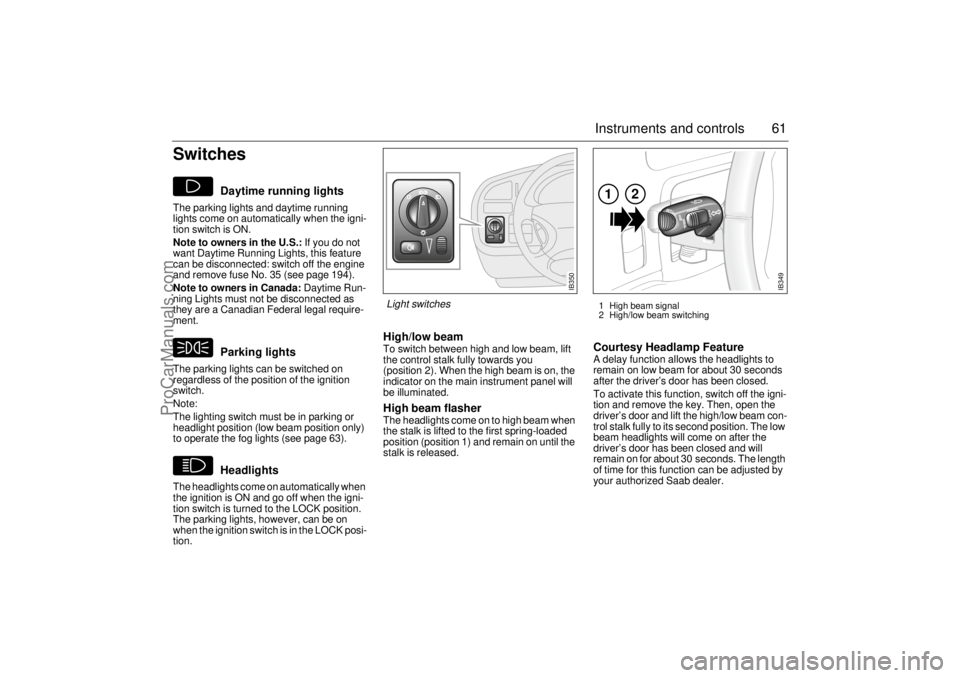
High/low beamTo switch between high and low beam, lift
the control stalk fully towards you
(position 2). When the high beam is on, the
indicator on the main instrument panel will
be illuminated.High beam flasher The headlights come on to high beam when
the stalk is lifted to the first spring-loaded
position (position 1) and remain on until the
stalk is released.
Courtesy Headlamp FeatureA delay function allows the headlights to
remain on low beam for about 30 seconds
after the driver’s door has been closed.
To activate this function, switch off the igni-
tion and remove the key. Then, open the
driver’s door and lift the high/low beam con-
trol stalk fully to its second position. The low
beam headlights will come on after the
driver’s door has been closed and will
remain on for about 30 seconds. The length
of time for this function can be adjusted by
your authorized Saab dealer.
IB349
1
2
1 High beam signal
2 High/low beam switching
IB350
Light switches
ProCarManuals.com
Page 64 of 256
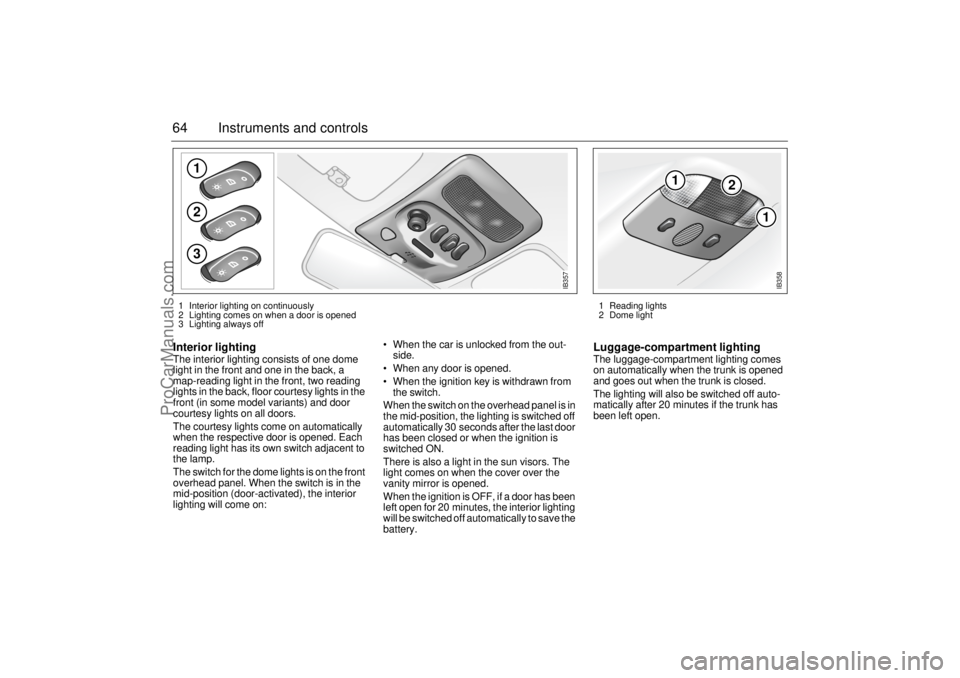
64 Instruments and controlsInterior lighting The interior lighting consists of one dome
light in the front and one in the back, a
map-reading light in the front, two reading
lights in the back, floor courtesy lights in the
front (in some model variants) and door
courtesy lights on all doors.
The courtesy lights come on automatically
when the respective door is opened. Each
reading light has its own switch adjacent to
the lamp.
The switch for the dome lights is on the front
overhead panel. When the switch is in the
mid-position (door-activated), the interior
lighting will come on: When the car is unlocked from the out-
side.
When any door is opened.
When the ignition key is withdrawn from
the switch.
When the switch on the overhead panel is in
the mid-position, the lighting is switched off
automatically 30 seconds after the last door
has been closed or when the ignition is
switched ON.
There is also a light in the sun visors. The
light comes on when the cover over the
vanity mirror is opened.
When the ignition is OFF, if a door has been
left open for 20 minutes, the interior lighting
will be switched off automatically to save the
battery.
Luggage-compartment lightingThe luggage-compartment lighting comes
on automatically when the trunk is opened
and goes out when the trunk is closed.
The lighting will also be switched off auto-
matically after 20 minutes if the trunk has
been left open.
123
IB357
1 Interior lighting on continuously
2 Lighting comes on when a door is opened
3 Lighting always off
1
2
1
IB358
1 Reading lights
2 Dome light
ProCarManuals.com
Page 112 of 256
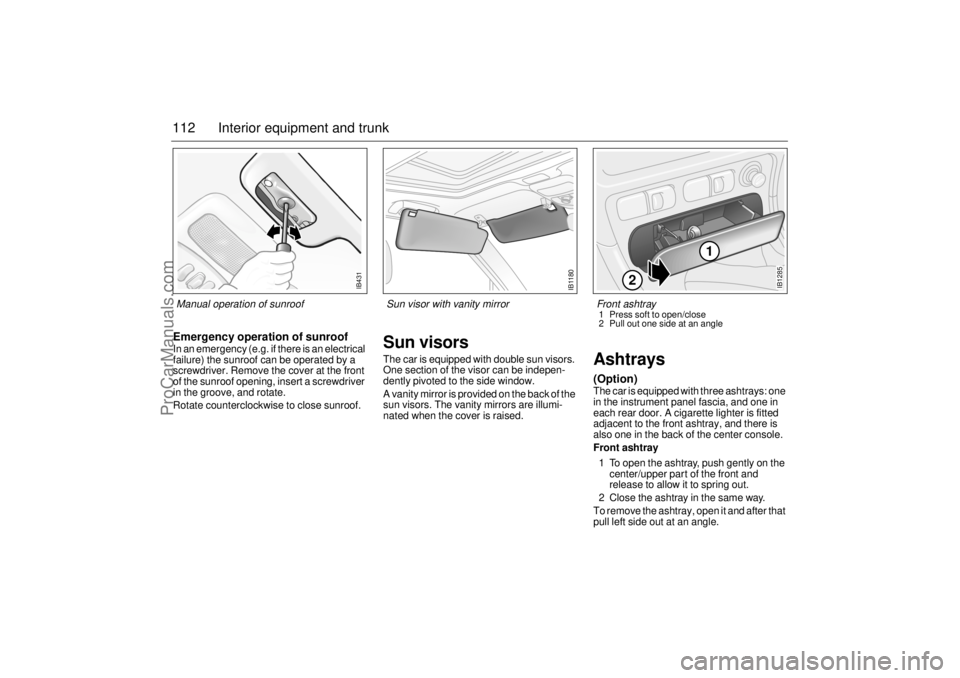
112 Interior equipment and trunkEmergency operation of sunroofIn an emergency (e.g. if there is an electrical
failure) the sunroof can be operated by a
screwdriver. Remove the cover at the front
of the sunroof opening, insert a screwdriver
in the groove, and rotate.
Rotate counterclockwise to close sunroof.
Sun visorsThe car is equipped with double sun visors.
One section of the visor can be indepen-
dently pivoted to the side window.
A vanity mirror is provided on the back of the
sun visors. The vanity mirrors are illumi-
nated when the cover is raised.
Ashtrays(Option) The car is equipped with three ashtrays: one
in the instrument panel fascia, and one in
each rear door. A cigarette lighter is fitted
adjacent to the front ashtray, and there is
also one in the back of the center console.
Front ashtray
1 To open the ashtray, push gently on the
center/upper part of the front and
release to allow it to spring out.
2 Close the ashtray in the same way.
To remove the ashtray, open it and after that
pull left side out at an angle.
IB1180
Sun visor with vanity mirror
IB1285
1
2
Front ashtray 1 Press soft to open/close
2 Pull out one side at an angle
IB431
Manual operation of sunroof
ProCarManuals.com
Page 113 of 256
113 Interior equipment and trunk
To refit, line up the slots on either side and
slide it closed.
Rear ashtrays
Open the lid to use ashtray.
To remove the ashtray, fully open the lid and
lift the ashtray straight out.
To refit the ashtray, make sure it engages
the two square recesses in the door trim.
The cigarette lighter sockets can also be
used for accessories (e.g. to charge a
mobile phone) when the ignition is ON.
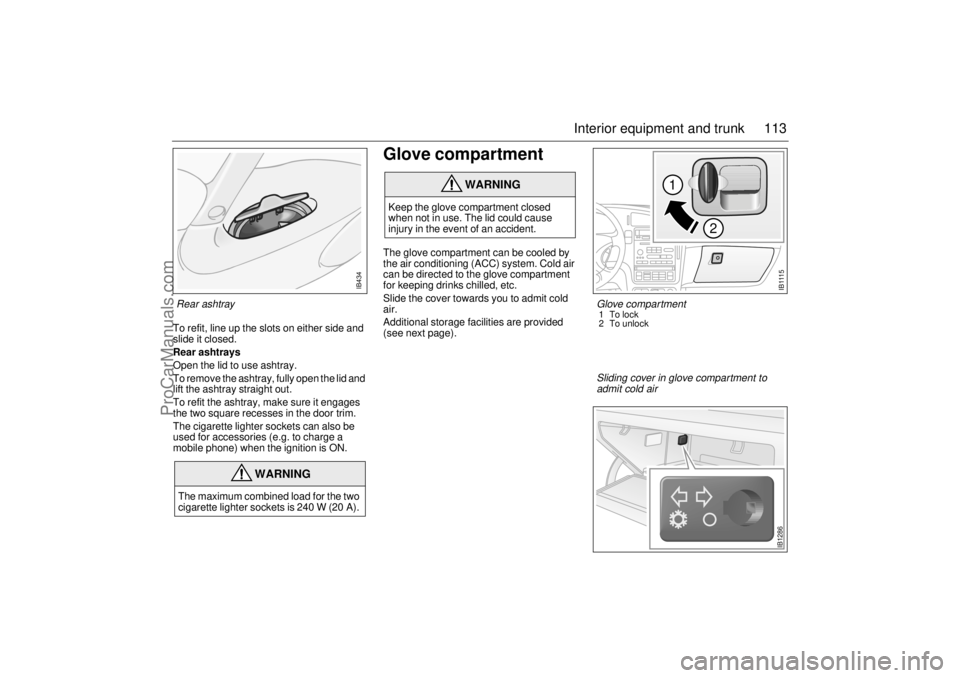
Glove compartment The glove compartment can be cooled by
the air conditioning (ACC) system. Cold air
can be directed to the glove compartment
for keeping drinks chilled, etc.
Slide the cover towards you to admit cold
air.
Additional storage facilities are provided
(see next page).
WARNING
The maximum combined load for the two
cigarette lighter sockets is 240 W (20 A).
WARNING
Keep the glove compartment closed
when not in use. The lid could cause
injury in the event of an accident.
I B 111 5
1
2
Glove compartment 1To lock
2 To unlock
IB434
Rear ashtray
IB1286
Sliding cover in glove compartment to
admit cold air
ProCarManuals.com
Page 131 of 256

131 Starting and driving
If the car does not startIf the text “KEY NOT ACCEPTED” is shown
on the SID, after a failed start attempt, the
cause could be a fault in the transmitter in
the key, or in the receiver in the ignition lock.
The following should be done:
Turn the key back to the LOCK position.
Turn the key to ON.
Press one of the buttons on the remote
control (the LED stops blinking).
Start the engine.
Try another key. If this works, then the fault
is in the first key.
Contact an authorized Saab dealer for
checking and rectification.
Starting the engine Do not run the starter motor for more than
25 seconds at a time. Wait 20-30 seconds
before running the starter again, to give the
battery time to recover.
Avoid racing the engine or putting a heavy
load on it before it has warmed up. Drive
away as soon as the oil warning light has
been extinguished to enable the engine to
attain its normal temperature as quickly as
possible.
It is possible for air to enter the lubricating
system in conjunction with an oil or oil-filter
change, or if the car has been stored for
some time. This air can cause the hydraulic
cam followers to emit a ticking noise, which
can persist for up to 15 minutes after start-
ing. Although this is quite normal and does
not indicate any malfunction, it is advisable
not to exceed 3,000 rpm before the noise
has disappeared.
The hydraulic cam lifters are completely
service free; the valve clearance is set up at the factory and will not need any subse-
quent adjustment.
Starting the engineThe engine has an automatic choke and
should be started as follows:
Cars with manual gearbox
To start the engine the clutch pedal must
be fully depressed.
1 Depress the clutch pedal fully but do not
touch the accelerator.
2 Start the engine. Let the ignition key
spring back as soon as the engine has
started and is running smoothly – at very
low temperatures, you may need to run
the starter for up to 25 seconds.
Let the engine idle for about 10 seconds. Do
not open the throttle wide for at least
2-3 minutes after starting.
Cars with automatic transmission
1 The selector lever must be in the P or N
position.
2 Keep your foot on the brake pedal.
3 Start the engine. Let the ignition key
spring back as soon as the engine has
started and is running smoothly – at very
low temperatures, you may need to run
the starter for up to 25 seconds.
Let the engine idle for about 10 seconds. Do
not open the throttle wide for at least
2–3 minutes after starting.
NOTETake care not to spill drinks or to drop
crumbs over the ignition switch. If dirt or
liquid gets into it, the switch may not
operate properly.
WARNING
Always remove the key before leaving
the car.
Always apply the parking brake before
removing the ignition key.
WARNING
Carbon monoxide (CO) is a colorless,
odorless, poisonous gas. Be alert to
the danger of CO – always open the
garage doors before starting the
engine in the garage.
There is also a danger of CO poison-
ing if the exhaust system is leaking.
ProCarManuals.com
Page 150 of 256

150 Starting and drivingIf idling, it will take much longer before the
engine becomes hot. Engine wear is
greatest during this warming-up phase.
Therefore drive away as soon as possible
after the engine is started and avoid high
revving.
Driving in a low gear results in higher fuel
consumption than in a high gear because
of the higher engine speed for a given
road speed. Always change up to a higher
gear as soon as traffic conditions allow
and use the highest gear as much as pos-
sible.
Check the air pressure in the tires once a
month. Incorrect pressures increase tire
wear. It is better to have slightly higher
pressure than lower.
Check fuel consumption regularly.
Increased consumption can indicate that
something is wrong and that the car
needs to be checked by an authorized
Saab dealer.
Practical trials on the roads have demon-
strated that substantial savings in fuel con-
sumption can be made if the above advice
is heeded.
Road conditions Wet roads increase fuel consumption, as do
unpaved roads and driving in hilly country
(the amount of fuel saved driving downhill is
less than the additional amount required to
climb the hill). Engine block heater (standard
equipment in Canada, accessory in
U.S.)The following are just some of the benefits
to the car and the environment of using an
engine block heater:
Lower fuel consumption.
Reduced wear on the engine.
Inside of car warms up faster.
Exhaust emissions substantially reduced
over short runs.
The engine heater is effective at outside
temperatures up to +15-20°C. The warmer
it is outside, the shorter the time the engine
heater needs to be connected. Longer than
1.5 hours is unnecessary.
If the car is equipped with a removable,
electrical cabin heater that is not in use, this
should be stored in the luggage compart-
ment.
Driving in winterBefore starting a journey in cold weather,
check that the wiper blades have not
become frozen to the glass. Brush any snow
away from the air intake for the heater
system (opening between hood and wind-
shield).
Periodically during the winter, add gasoline
anti-freeze to the fuel to dispel any conden-
sation in the fuel tank which could freeze
and cause problems in the system. Keep
the tank well filled to reduce the risk of con-
densation forming.
If the car is parked outside in freezing
weather, fuel additives (gasoline
anti-freeze) will not do any good as any con-
densation in the fuel tank will freeze. Con-
densation is caused by changes in the out-
door temperature or by the car being parked
alternately in a garage and outside.
It is particularly important when the roads
are slippery that the brakes and tires be in
good condition.
The car is equipped with tires designed to
provide optimum grip on both wet and dry
roads, although this has been achieved at
the expense of somewhat reduced grip on
snow and ice. For regular driving on snow
and ice, we therefore recommend that
winter (snow) tires be fitted.
Winter (snow) tires, particularly studded
tires (where use is legally permitted), gener-
ally make driving safer on snow and ice.
If winter tires are fitted, the same type must
be fitted on all wheels. Your Saab dealer will
ProCarManuals.com
Page 155 of 256

155 Starting and driving
Driving with a roof rack
loadThe maximum permissible roof load is
220 lbs. (100 kg).
Note that the roof load is included in the
car’s maximum permissible load (see page
226).
Strong, sturdy roof carriers designed spe-
cially for the car are available from your
Saab dealer. Always secure the roof load
safely. Fitting the roof carriers (accessory)
9-5 SedanThe carrier feet are marked with a top view
of the car and arrow indicating their posi-
tions.
1 Slip the plastic cover onto the adjustable
foot of the carrier (foot with knob for
tightening) to protect the paintwork
during assembly.
2 Open all the doors.
Fold back the rubber strip and find the
fixing holes. 3 Start on the left-hand side of the car.
Rest the carrier carefully across the roof,
with the rigid foot towards you. Hold the
foot clear of the roof to avoid damaging
the paintwork.
Fold back the rubber strip and insert the
pins on the foot into the fixing holes.
Make sure that the rubber strip comes
inside the plastic cover on the carrier.
Repeat the procedure with the other car-
rier.
4 Close the doors on the left-hand side of
the car gently, to hold the carrier feet in
place.
5 Now go around to the other side of the
car and remove the plastic cover from
the carrier’s adjustable foot. Fold back
the rubber strip and insert the pins on
the foot into the fixing holes. Do the
same with the other carrier and close the
doors gently. 6 Tighten each carrier by turning the knob
clockwise (by hand). Tighten just
enough to bring the foot up against the
edges of the fixing holes.
Remove the carriers when not in use, as
they increase fuel consumption.
The instructions that accompany the carri-
ers also include advice on driving with a roof
load - we strongly recommend that you read
them carefully.
WARNING
A roof load will affect the car’s center
of gravity and aerodynamics. Be
aware of this when cornering and driv-
ing in crosswinds.
Suit your speed to the prevailing con-
ditions.
IB480
IB481
ProCarManuals.com