fuel SAAB 9-5 2000 Owner's Manual
[x] Cancel search | Manufacturer: SAAB, Model Year: 2000, Model line: 9-5, Model: SAAB 9-5 2000Pages: 256, PDF Size: 14.24 MB
Page 149 of 256
149 Starting and driving
Economical motoringFactors affecting fuel consumption Fuel consumption is greatly affected by the
general driving conditions, the way in which
the car is driven and at what speeds, the
weather, the state of the road, the condition
of the car, etc. Breaking-in Fuel consumption may be somewhat higher
during the break-in period (the first 3,000–
4,000 miles (5,000–7,000 km) than stated
under ”Technical data”.
Weather conditions Fuel consumption can be as much as 10 %
lower in summer than in winter. The higher
consumption in cold weather is explained by
the longer time it takes for the engine to
reach normal operating temperature, and
for the transmission and wheel bearings to
warm up. Fuel economy is also affected by
the distance driven: short journeys of
3-5 miles (5-8 km) do not give the engine
enough time to reach normal temperature.
Strong winds can also affect fuel consump-
tion.
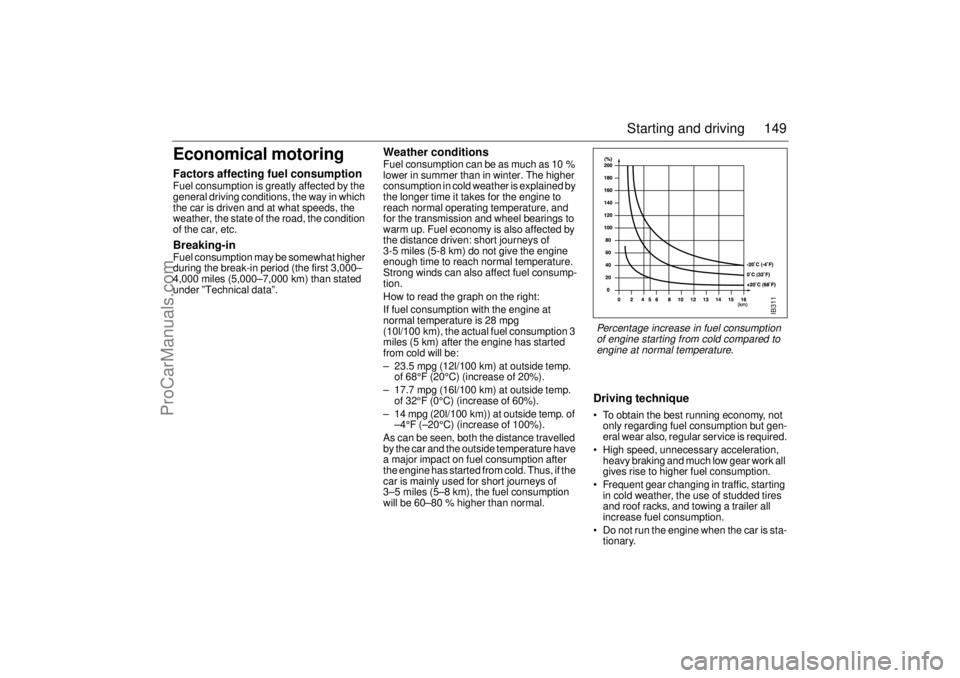
How to read the graph on the right:
If fuel consumption with the engine at
normal temperature is 28 mpg
(10l/100 km), the actual fuel consumption 3
miles (5 km) after the engine has started
from cold will be:
– 23.5 mpg (12l/100 km) at outside temp.
of 68°F (20°C) (increase of 20%).
– 17.7 mpg (16l/100 km) at outside temp.
of 32°F (0°C) (increase of 60%).
– 14 mpg (20l/100 km)) at outside temp. of
–4°F (–20°C) (increase of 100%).
As can be seen, both the distance travelled
by the car and the outside temperature have
a major impact on fuel consumption after
the engine has started from cold. Thus, if the
car is mainly used for short journeys of
3–5 miles (5–8 km), the fuel consumption
will be 60–80 % higher than normal.
Driving technique To obtain the best running economy, not
only regarding fuel consumption but gen-
eral wear also, regular service is required.
High speed, unnecessary acceleration,
heavy braking and much low gear work all
gives rise to higher fuel consumption.
Frequent gear changing in traffic, starting
in cold weather, the use of studded tires
and roof racks, and towing a trailer all
increase fuel consumption.
Do not run the engine when the car is sta-
tionary.
IB311
Percentage increase in fuel consumption
of engine starting from cold compared to
engine at normal temperature.
ProCarManuals.com
Page 150 of 256

150 Starting and drivingIf idling, it will take much longer before the
engine becomes hot. Engine wear is
greatest during this warming-up phase.
Therefore drive away as soon as possible
after the engine is started and avoid high
revving.
Driving in a low gear results in higher fuel
consumption than in a high gear because
of the higher engine speed for a given
road speed. Always change up to a higher
gear as soon as traffic conditions allow
and use the highest gear as much as pos-
sible.
Check the air pressure in the tires once a
month. Incorrect pressures increase tire
wear. It is better to have slightly higher
pressure than lower.
Check fuel consumption regularly.
Increased consumption can indicate that
something is wrong and that the car
needs to be checked by an authorized
Saab dealer.
Practical trials on the roads have demon-
strated that substantial savings in fuel con-
sumption can be made if the above advice
is heeded.
Road conditions Wet roads increase fuel consumption, as do
unpaved roads and driving in hilly country
(the amount of fuel saved driving downhill is
less than the additional amount required to
climb the hill). Engine block heater (standard
equipment in Canada, accessory in
U.S.)The following are just some of the benefits
to the car and the environment of using an
engine block heater:
Lower fuel consumption.
Reduced wear on the engine.
Inside of car warms up faster.
Exhaust emissions substantially reduced
over short runs.
The engine heater is effective at outside
temperatures up to +15-20°C. The warmer
it is outside, the shorter the time the engine
heater needs to be connected. Longer than
1.5 hours is unnecessary.
If the car is equipped with a removable,
electrical cabin heater that is not in use, this
should be stored in the luggage compart-
ment.
Driving in winterBefore starting a journey in cold weather,
check that the wiper blades have not
become frozen to the glass. Brush any snow
away from the air intake for the heater
system (opening between hood and wind-
shield).
Periodically during the winter, add gasoline
anti-freeze to the fuel to dispel any conden-
sation in the fuel tank which could freeze
and cause problems in the system. Keep
the tank well filled to reduce the risk of con-
densation forming.
If the car is parked outside in freezing
weather, fuel additives (gasoline
anti-freeze) will not do any good as any con-
densation in the fuel tank will freeze. Con-
densation is caused by changes in the out-
door temperature or by the car being parked
alternately in a garage and outside.
It is particularly important when the roads
are slippery that the brakes and tires be in
good condition.
The car is equipped with tires designed to
provide optimum grip on both wet and dry
roads, although this has been achieved at
the expense of somewhat reduced grip on
snow and ice. For regular driving on snow
and ice, we therefore recommend that
winter (snow) tires be fitted.
Winter (snow) tires, particularly studded
tires (where use is legally permitted), gener-
ally make driving safer on snow and ice.
If winter tires are fitted, the same type must
be fitted on all wheels. Your Saab dealer will
ProCarManuals.com
Page 153 of 256

153 Starting and driving
Recommendations for cars with auto-
matic transmission.
The following time limits are based on the
capacity of the cooling system in warm
weather, i.e. approximately 104°F (40°C).
When negotiating long hills, bear the follow-
ing important considerations in mind:
If TRANSMISSION OVERHEATING
appears on the SID, stop the car as soon as
it is safe to do so and wait until the warning
has been extinguished. When continuing
your journey, select a locked gear (1, 2 or 3)
that will allow you to drive at an engine
speed of about 3,000 rpm (see page 142).
Do not drive continuously with the WINTER
mode selected in hilly country when you are
towing a trailer, as this will increase fuel con-
sumption and risk overheating the transmis-
sion.
Trailer hitch loadThe weight distribution on the trailer makes
a lot of difference to the handling properties
of the car and trailer combination. As
regards single-axle trailers, whenever pos-
sible, concentrate the load over the wheels
and keep it as low as possible.
The trailer should be loaded so that the
maximum load on the towbar ball is 5% to
7% of the trailer weight with a maximum per-
missible tongue weight of 165 lbs. (75 kg).
Note that this load must be added to the total
load for the car. If this now exceeds the
specified load capacity, the load in the lug-
gage compartment will have to be reduced
by a corresponding amount. Driving considerations Always take extra care when towing a
trailer, as the car’s handling will be different
and its braking effect reduced. The trailer’s
braking system and suspension also have a
considerable effect on these characteris-
tics.
If the car is equipped with automatic trans-
mission, select position 1 when ascending
or descending steep hills. Gradient
of hill, % Maximum
trailer
weight, lbs.
(kg)Maximum dura-
tion, minutes
6-7 2000 (900) unlimited
8-9 2000 (900) 15 max
10-15 1000 (450) 15 max. NOTEIf the “Fault indicator, automatic trans-
mission” indicator comes on, cease
towing until the problem has been recti-
fied.
IB106
Distribution of load in trailer a Light
b Moderate
cHeavy
ProCarManuals.com
Page 155 of 256

155 Starting and driving
Driving with a roof rack
loadThe maximum permissible roof load is
220 lbs. (100 kg).
Note that the roof load is included in the
car’s maximum permissible load (see page
226).
Strong, sturdy roof carriers designed spe-
cially for the car are available from your
Saab dealer. Always secure the roof load
safely. Fitting the roof carriers (accessory)
9-5 SedanThe carrier feet are marked with a top view
of the car and arrow indicating their posi-
tions.
1 Slip the plastic cover onto the adjustable
foot of the carrier (foot with knob for
tightening) to protect the paintwork
during assembly.
2 Open all the doors.
Fold back the rubber strip and find the
fixing holes. 3 Start on the left-hand side of the car.
Rest the carrier carefully across the roof,
with the rigid foot towards you. Hold the
foot clear of the roof to avoid damaging
the paintwork.
Fold back the rubber strip and insert the
pins on the foot into the fixing holes.
Make sure that the rubber strip comes
inside the plastic cover on the carrier.
Repeat the procedure with the other car-
rier.
4 Close the doors on the left-hand side of
the car gently, to hold the carrier feet in
place.
5 Now go around to the other side of the
car and remove the plastic cover from
the carrier’s adjustable foot. Fold back
the rubber strip and insert the pins on
the foot into the fixing holes. Do the
same with the other carrier and close the
doors gently. 6 Tighten each carrier by turning the knob
clockwise (by hand). Tighten just
enough to bring the foot up against the
edges of the fixing holes.
Remove the carriers when not in use, as
they increase fuel consumption.
The instructions that accompany the carri-
ers also include advice on driving with a roof
load - we strongly recommend that you read
them carefully.
WARNING
A roof load will affect the car’s center
of gravity and aerodynamics. Be
aware of this when cornering and driv-
ing in crosswinds.
Suit your speed to the prevailing con-
ditions.
IB480
IB481
ProCarManuals.com
Page 163 of 256
163 Starting and driving
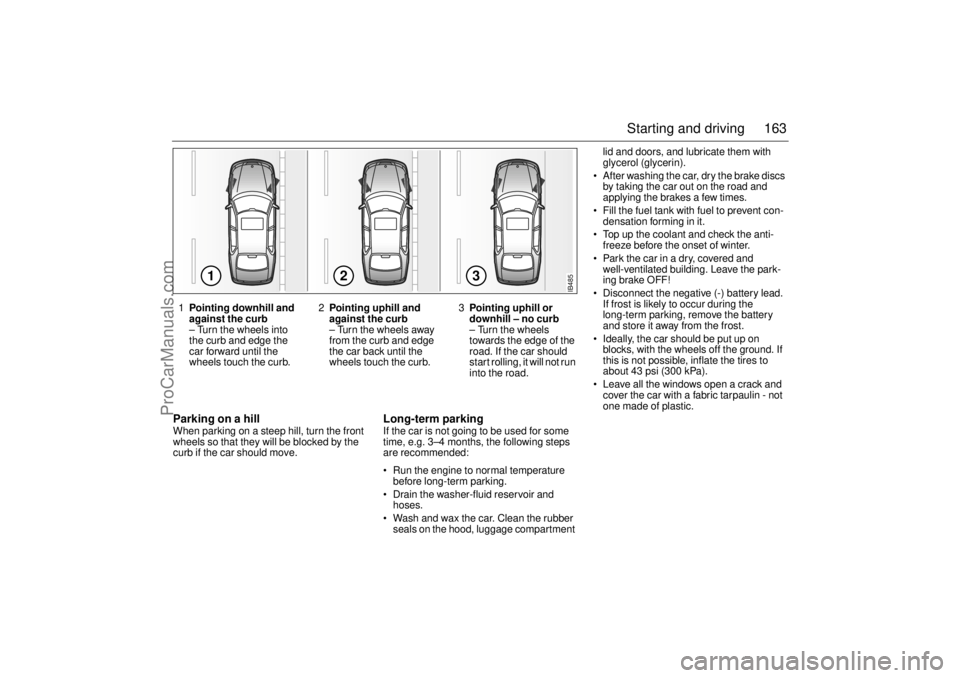
Parking on a hillWhen parking on a steep hill, turn the front
wheels so that they will be blocked by the
curb if the car should move.
Long-term parkingIf the car is not going to be used for some
time, e.g. 3–4 months, the following steps
are recommended:
Run the engine to normal temperature
before long-term parking.
Drain the washer-fluid reservoir and
hoses.
Wash and wax the car. Clean the rubber
seals on the hood, luggage compartment lid and doors, and lubricate them with
glycerol (glycerin).
After washing the car, dry the brake discs
by taking the car out on the road and
applying the brakes a few times.
Fill the fuel tank with fuel to prevent con-
densation forming in it.
Top up the coolant and check the anti-
freeze before the onset of winter.
Park the car in a dry, covered and
well-ventilated building. Leave the park-
ing brake OFF!
Disconnect the negative (-) battery lead.
If frost is likely to occur during the
long-term parking, remove the battery
and store it away from the frost.
Ideally, the car should be put up on
blocks, with the wheels off the ground. If
this is not possible, inflate the tires to
about 43 psi (300 kPa).
Leave all the windows open a crack and
cover the car with a fabric tarpaulin - not
one made of plastic.
123
IB485
1Pointing downhill and
against the curb
– Turn the wheels into
the curb and edge the
car forward until the
wheels touch the curb.2Pointing uphill and
against the curb
– Turn the wheels away
from the curb and edge
the car back until the
wheels touch the curb.3Pointing uphill or
downhill – no curb
– Turn the wheels
towards the edge of the
road. If the car should
start rolling, it will not run
into the road.
ProCarManuals.com
Page 169 of 256

169 Car care and technical information
Engine familiesSaab cars imported into the United States
and Canada meet all applicable emission
control standards. The engine family and
appropriate tune-up specifications are iden-
tified on a label affixed to the left front inner
fender.
These engine families meet applicable EPA
Federal Standards, California State Stan-
dards and Canadian Federal Standards and
are equipped with the following systems:
• Sequential multiport fuel injection system.
Three way catalytic converter.
Crankcase emissions control system.
Evaporative emission control system.
On-Board diagnostic (OBD II) system.
Emission control
systemsThe systems for controlling emissions to the
atmosphere require regular checking and
adjustment at the intervals specified in the
service program.
In addition to meeting the exhaust emission
regulations and thereby helping to keep the
environment clean, a correctly tuned engine
will also give maximum fuel economy.Saab Trionic engine management
systemThe Saab Trionic engine management
system is a unique Saab development that
combines sequential multiport fuel injection,
electronic distributorless ignition and turbo-
charger boost pressure control into one sys-
tem.
The Trionic engine control module (ECM)
monitors many different engine parameters
such as:
Intake manifold pressure.
Intake air temperature.
Crankshaft position.
Engine coolant temperature.
Throttle position and
The oxygen content of the exhaust gases.
The ECM receives information regarding
engine knocking from a sophisticated feed-
back function in the ignition discharge unit.
By processing all of this information, the Tri-
onic system can control fuel injector open-ing duration, ignition timing and turbo-
charger boost pressure to provide excellent
engine performance while maintaining low
emissions and fuel consumption.
NOTEThe Trionic engine management systems
continuously monitors the operation of
these systems and have on-board diag-
nostic capabilities (OBD II).
If the “Engine malfunction” lamp in
the main instrument illuminates, this indi-
cates that the Trionic ECM has detected
a problem. The car will continue to oper-
ate, but performance may be diminished.
You should have your car checked by a
Saab dealer as soon as possible.
ProCarManuals.com
Page 170 of 256
170 Car care and technical informationORVR (Onboard Refueling Vapor
Recovery)Hydrocarbon vapors formed when refueling
will be recovered by the car and not
released into the atmosphere. The hydro-
carbons are absorbed in a evaporative
emission canister. When the engine is sub-
sequently started, the evaporative emission
canister is gradually purged as air is sucked
into it through a shut-off valve. The hydro-
carbon/air mixture passes through the evap
canister purge valve and into the engine
where it is burned.
When refueling, make sure you screw the
filler cap on and keep turning until it has
clicked at least 3 times. Otherwise, it is pos-
sible for the CHECK ENGINE light to illumi-
nate and a “TIGHTEN FUEL FILLER CAP“
message to appear on SID.
Refueling, see page 134.
Engine2.3-liter engineThe 2.3-liter model is a transverse, 4-cylin-
der in-line engine with twin overhead cam-
shafts and 4 valves per cylinder.
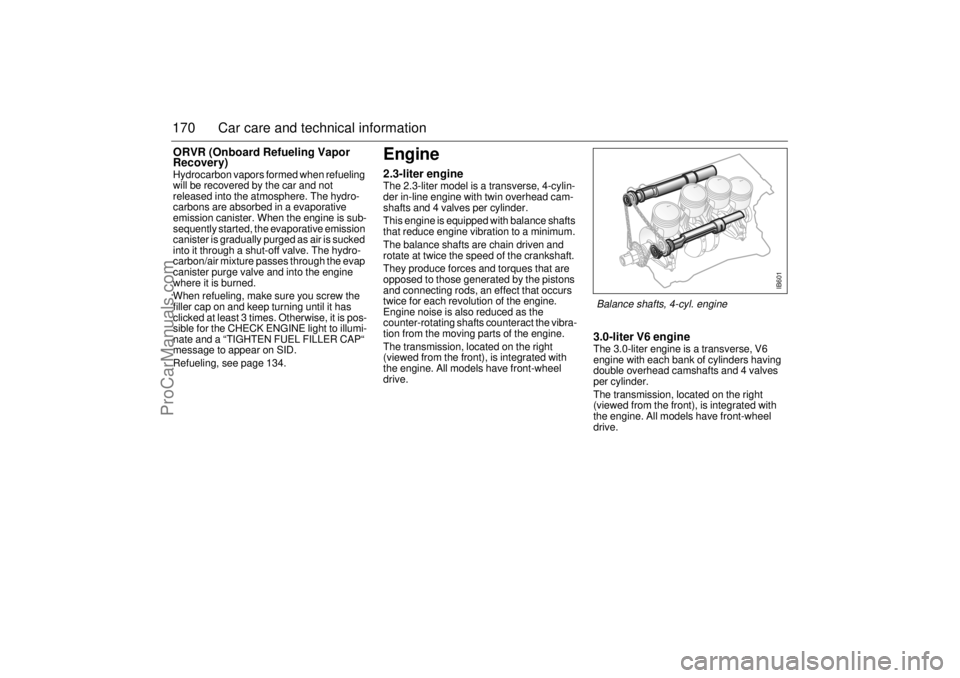
This engine is equipped with balance shafts
that reduce engine vibration to a minimum.
The balance shafts are chain driven and
rotate at twice the speed of the crankshaft.
They produce forces and torques that are
opposed to those generated by the pistons
and connecting rods, an effect that occurs
twice for each revolution of the engine.
Engine noise is also reduced as the
counter-rotating shafts counteract the vibra-
tion from the moving parts of the engine.
The transmission, located on the right
(viewed from the front), is integrated with
the engine. All models have front-wheel
drive.
3.0-liter V6 engine The 3.0-liter engine is a transverse, V6
engine with each bank of cylinders having
double overhead camshafts and 4 valves
per cylinder.
The transmission, located on the right
(viewed from the front), is integrated with
the engine. All models have front-wheel
drive.
IB601
Balance shafts, 4-cyl. engine
ProCarManuals.com
Page 194 of 256
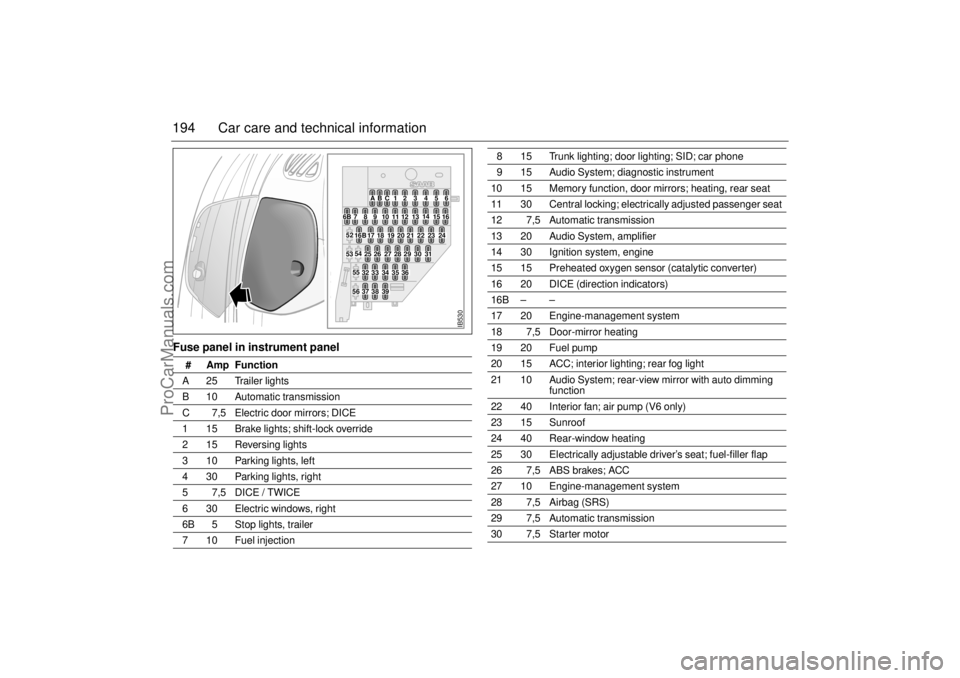
194 Car care and technical informationFuse panel in instrument panel
# Amp Function
A 25 Trailer lights
B 10 Automatic transmission
C 7,5 Electric door mirrors; DICE
1 15 Brake lights; shift-lock override
2 15 Reversing lights
3 10 Parking lights, left
4 30 Parking lights, right
5 7,5 DICE / TWICE
6 30 Electric windows, right
6B 5 Stop lights, trailer
7 10 Fuel injection
8 15 Trunk lighting; door lighting; SID; car phone
9 15 Audio System; diagnostic instrument
10 15 Memory function, door mirrors; heating, rear seat
11 30 Central locking; electrically adjusted passenger seat
12 7,5 Automatic transmission
13 20 Audio System, amplifier
14 30 Ignition system, engine
15 15 Preheated oxygen sensor (catalytic converter)
16 20 DICE (direction indicators)
16B – –
17 20 Engine-management system
18 7,5 Door-mirror heating
19 20 Fuel pump
20 15 ACC; interior lighting; rear fog light
21 10 Audio System; rear-view mirror with auto dimming
function
22 40 Interior fan; air pump (V6 only)
23 15 Sunroof
24 40 Rear-window heating
25 30 Electrically adjustable driver’s seat; fuel-filler flap
26 7,5 ABS brakes; ACC
27 10 Engine-management system
28 7,5 Airbag (SRS)
29 7,5 Automatic transmission
30 7,5 Starter motor
IB530
BC123456 A
14
121110987
13
6B
1516
2324
222120191817
16B
5425262728293031
3635343332
39383755525356
ProCarManuals.com
Page 195 of 256
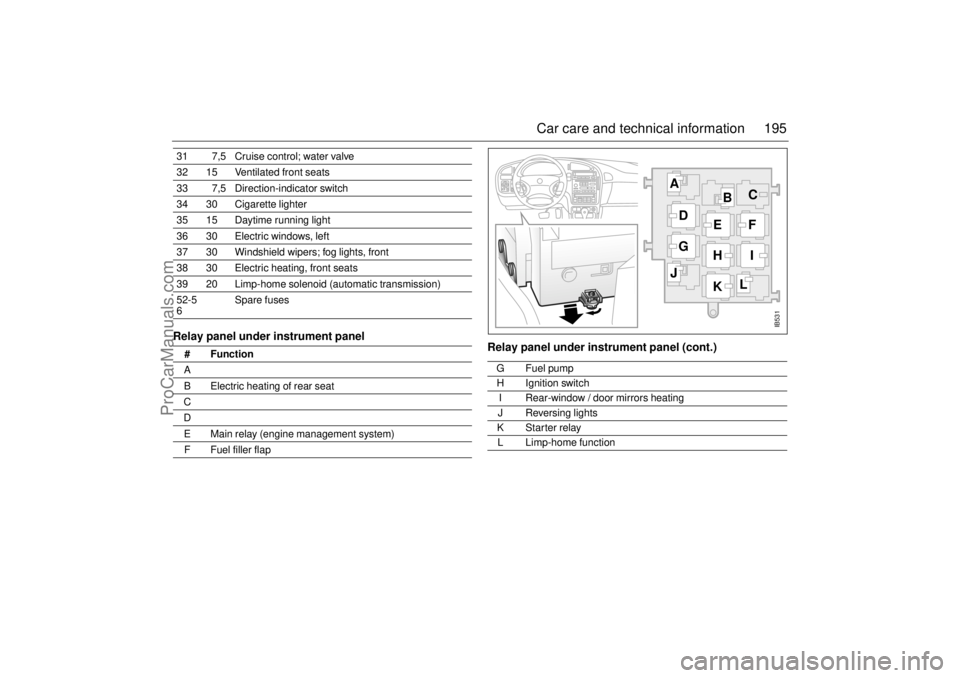
195 Car care and technical information
Relay panel under instrument panel
Relay panel under instrument panel (cont.)31 7,5 Cruise control; water valve
32 15 Ventilated front seats
33 7,5 Direction-indicator switch
34 30 Cigarette lighter
35 15 Daytime running light
36 30 Electric windows, left
37 30 Windshield wipers; fog lights, front
38 30 Electric heating, front seats
39 20 Limp-home solenoid (automatic transmission)
52-5
6Spare fuses
# Function
A
B Electric heating of rear seat
C
D
E Main relay (engine management system)
F Fuel filler flap
G Fuel pump
H Ignition switch
I Rear-window / door mirrors heating
J Reversing lights
KStarter relay
L Limp-home function
IB531
A
BC
D
GEF
HI
KL J
ProCarManuals.com
Page 198 of 256

198 Car care and technical informationWheels Alternative wheels and tiresIf you wish to fit other tires or wheels than
those supplied with the car, consult your
Saab dealer first as to the possibilities avail-
able.
Wheels/tires combinations that are not
approved by Saab can negatively affect the
car´s directional stability, steering and brak-
ing in both wet and dry conditions.
Do not assume that a wheel/tire combina-
tion will function properly just because it will
bolt on.The wheels and tires have been carefully
matched to the characteristics of the car and
play a key role in its outstanding roadhold-
ing and handling.
Tire pressureTires need to be inflated to suit the load car-
ried and the maximum speed the car will be
driven (see the recommended tire pres-
sures on the back cover). Note that all
values apply to cold tires. For tires with an
aspect ratio less than /60, increase the tire
pressure by 3 psi (20 kPa) for rough roads
with potholes to minimize the risk of rim
damage.Never reduce the pressure of a hot tire. If the
tires are hot when you check them, only
increase the pressure, if necessary.
Soft tires will cause faster wear than
over-pressurized tires. They also increase
fuel consumption.
If a valve is leaking, simply unscrew it and fit
a new one.
Important! Remember to adjust the tire
pressures if you change the load in the car
or intend to cruise at a substantially higher
or lower speed than normal.
NOTEFor wide wheels and/or low-profile tires,
bear in mind the following:
Tires and wheels can be damaged in
potholes etc.
Springs and dampers can be over-
loaded.
The wheels can come into contact with
chassis and body components.
The speed and load limits for the tires
must not be exceeded; see page 199.
Wheels larger than 17” must not be fit-
ted. The maximum permissible offset
is 49 mm.
NOTECheck the tire pressures at least once
per month.
Underinflation is the main cause of:
Tires wearing out prematurely.
Damage to the sidewalls.
Damage to the wheels.
ProCarManuals.com