fuel SAAB 9-5 2000 Owner's Guide
[x] Cancel search | Manufacturer: SAAB, Model Year: 2000, Model line: 9-5, Model: SAAB 9-5 2000Pages: 256, PDF Size: 14.24 MB
Page 213 of 256

213 Car care and technical information
For long tripsBefore setting off on a long journey, it is
advisable to have your car checked over by
your Saab dealer.
Obtain a few important items to take along
on your journey such as spare bulbs, wiper
blades, fuses, a Poly-Vee-belt and the like.
You can check some points yourself before-
hand:
Make sure that the engine is in good con-
dition.
Check that no oil or gasoline leaks out of
the engine or gearbox/transmission.
Inspect the Poly-Vee-belt and replace it if
it shows any signs of hard wear.
Check the battery charge.
Check the tires for tread pattern and air
pressure, including the compact spare
wheel.
Check the brakes.
Check all bulbs.
Check for the presence of the tool kit and
the jack in the car.
Recovery and/or
recycling of automotive
materialsA typical car consists of metals (65–75%),
plastics (10–14%), rubber (5%) and small
quantities of glass, wood, paper and tex-
tiles.
Some of these materials can be recycled,
while others can be recovered in chemical
processes for reuse in new products or as a
source of energy.
While the Saab 9-5 was still at the draw-
ing-board stage, Saab engineers were
giving serious consideration to how the
maximum quantity of materials could be
reclaimed from the car on its eventual
scrapping. To facilitate sorting, plastic parts,
for instance, have been marked to identify
the precise nature of the plastic.
Approximately 90% of the materials in the
car can be recycled or recovered, where
facilities exist.
Before the car is scrapped, all the oils and
other fluids that could pollute the environ-
ment should be recovered from the car. It
may be of interest in this context to learn that
the refrigerant used in the Saab 9-5’s A/C
and ACC systems (R134a) contains neither
CFCs nor any other chlorine compounds.
1 A-pillar trim: PP, PP/EPDM
2 Windshield trim: PP, PP/EPDM
3 Seals: EPDM
4 C-pillar trim: PP
5 Rear light cluster: PMMA
6 Corner infill panel: PPO/PA
7 Rear bumper, cellular core: expanded PP;
sheathing: PP/EPDM
8 Side-window casing: PP/EPDM
9 Fuel tank: PE
10 Side trim: PVC
11 A-pillar upholstery trim: PC/ABS, textile
12 Rearview mirror: ABS
13 Sill scuff plate: PP/EPDM
14 Wheel-arch liner: PP
15 Wheel cover: PA
16 Direction-indicator lamp lens: PMMA
17 Washer-fluid reservoir: PE
18 Front spoiler: PP/EPDM
19 Front bumper, cellular core: expanded PP;
sheathing: PP/EPDM
20 Fan shroud: PP
21 Radiator grille: ABS
22 Scuttle panel finisher: PC/ASA
ProCarManuals.com
Page 215 of 256
215 Car care and technical information
To check the aim, the vehicle should be
properly prepared as follows:
Place the vehicle on a level pad or sur-
face.
The vehicle should be unladen and fuel
tank full, and one person or 160 lbs.
(75 kg) on the drivers seat.
The vehicle should not have any snow, ice
or mud attached to it.
Tires should be inflated to the prescribed
pressure.
Rock the vehicle to stabilize the suspen-
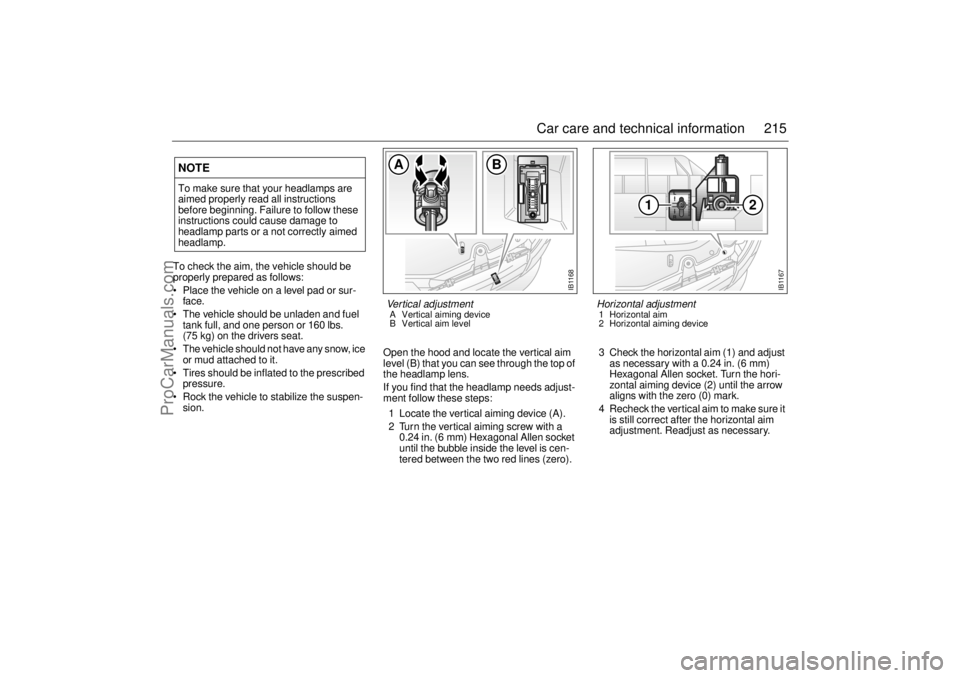
sion.Open the hood and locate the vertical aim
level (B) that you can see through the top of
the headlamp lens.
If you find that the headlamp needs adjust-
ment follow these steps:
1 Locate the vertical aiming device (A).
2 Turn the vertical aiming screw with a
0.24 in. (6 mm) Hexagonal Allen socket
until the bubble inside the level is cen-
tered between the two red lines (zero).3 Check the horizontal aim (1) and adjust
as necessary with a 0.24 in. (6 mm)
Hexagonal Allen socket. Turn the hori-
zontal aiming device (2) until the arrow
aligns with the zero (0) mark.
4 Recheck the vertical aim to make sure it
is still correct after the horizontal aim
adjustment. Readjust as necessary.NOTETo make sure that your headlamps are
aimed properly read all instructions
before beginning. Failure to follow these
instructions could cause damage to
headlamp parts or a not correctly aimed
headlamp.
IB1168
A
B
Vertical adjustmentA Vertical aiming device
B Vertical aim level
IB1167
1
2
Horizontal adjustment1 Horizontal aim
2 Horizontal aiming device
ProCarManuals.com
Page 222 of 256

222 Maintenance and owner assistance* These are the minimum required Emission Control System maintenance steps. Saab urges that all recommended maintenance procedures be performed
according to this program.
(b.) Change automatic transmission fluid at more frequent intervals (20,000; 50,000; 80,000 miles, etc.) if car is driven in dense city traffic where the outside
temperature regularly reach 90°F or higher, or if car is used in a mountainous/high altitude area or for trailer towing.
Service Intervals **
Miles = U.S. Cars
Kilometers = Canadian Cars
1,000
(1,600 km)
10,000
(16,000 km)
20,000
(32,000 km)
30,000
(48,000 km)
40,000
(64,000 km)
50,000
(80,000 km)
60,000
(96,000 km)
70,000
(112,000 km)
80,000
(128,000 km)
90,000
(144,000 km)
100,000
(160,000 km)
Service #
1234567891011
Engine and engine compartment (cont.)
E Evaporative emission system including filler cap, vapor
lines, EVAP canister and canister purge valve"
R Fuel system: leaks and damage""""""""""
E Fuel filter!
E Engine air cleaner element!
*
!*
!*
R Exhaust system and mountings; leaks and condition""""""""""
Electrical
R Battery: state of charge and electrolyte level; clean termi-
nals if necessary"""""""""""
R Head, fog, brake, tail, turn signal, warning lights instru-
ment panel, backup and marker lamps"""""""""""
Transmission
R Automatic transmission fluid change (b.)!!!
R Automatic gearbox oil level"""""""""""
R Manual gearbox oil level"""
R Outer and inner driver joint boots""""""""""
ProCarManuals.com
Page 225 of 256
225 Specifications
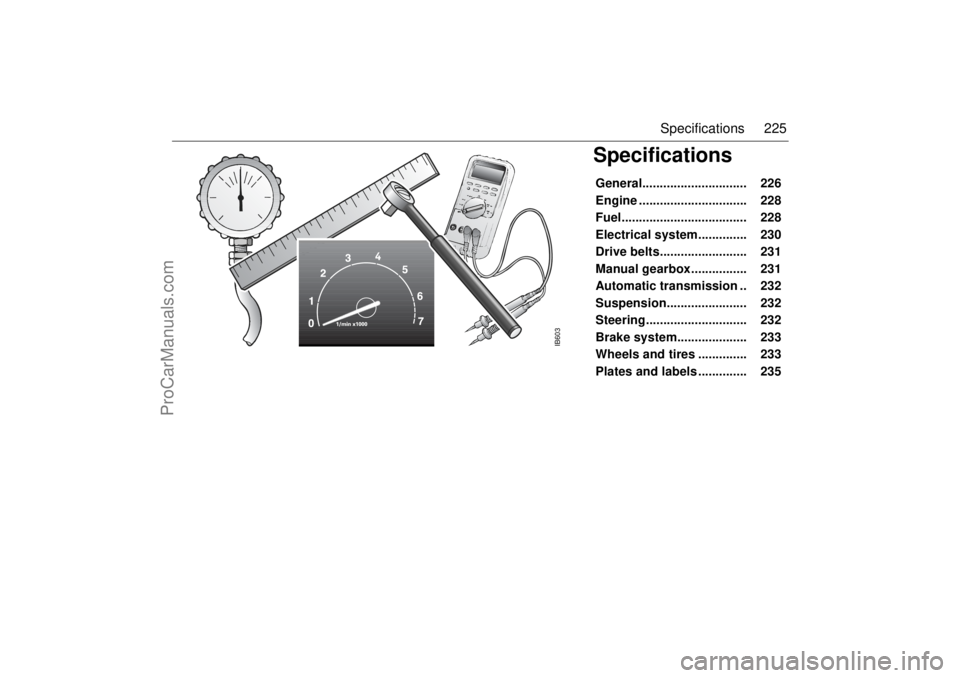
Specifications General.............................. 226
Engine ............................... 228
Fuel.................................... 228
Electrical system.............. 230
Drive belts......................... 231
Manual gearbox................ 231
Automatic transmission .. 232
Suspension....................... 232
Steering............................. 232
Brake system.................... 233
Wheels and tires .............. 233
Plates and labels .............. 235
IB603
ProCarManuals.com
Page 226 of 256
226 SpecificationsGeneral Overall length, including bumpers:
9-5 Sedan _______________________ 189.2 in (4805 mm)
9-5 Wagon ______________________ 189.3 in (4808 mm)
Overall width, including door mirrors ____ 80.4 in (2042 mm)
Maximum height:
9-5 Sedan _______________________ 57.0 in (1449 mm)
9-5 Wagon ______________________ 58.9 in (1497 mm)
Wheelbase _______________________ 106.4 in (2703 mm)
Ground clearance __________________ approx. 6.6 in
(167 mm)
Tr a c k :
Front __________________________ 59.9 in (1522 mm) *)
Rear ___________________________ 59.9 in (1522 mm) *)
Turning circle (curb to curb) ___________ 35.4 ft (10.8 m)
Turning circle (measured at vehicle extrem-
ities) ___________________________ 37.4 ft (11.4 m)
Number of seats (incl. driver) _________ 5
*) Specified track applies to wheel sizes:
6 x 15 & 6.5 x 16
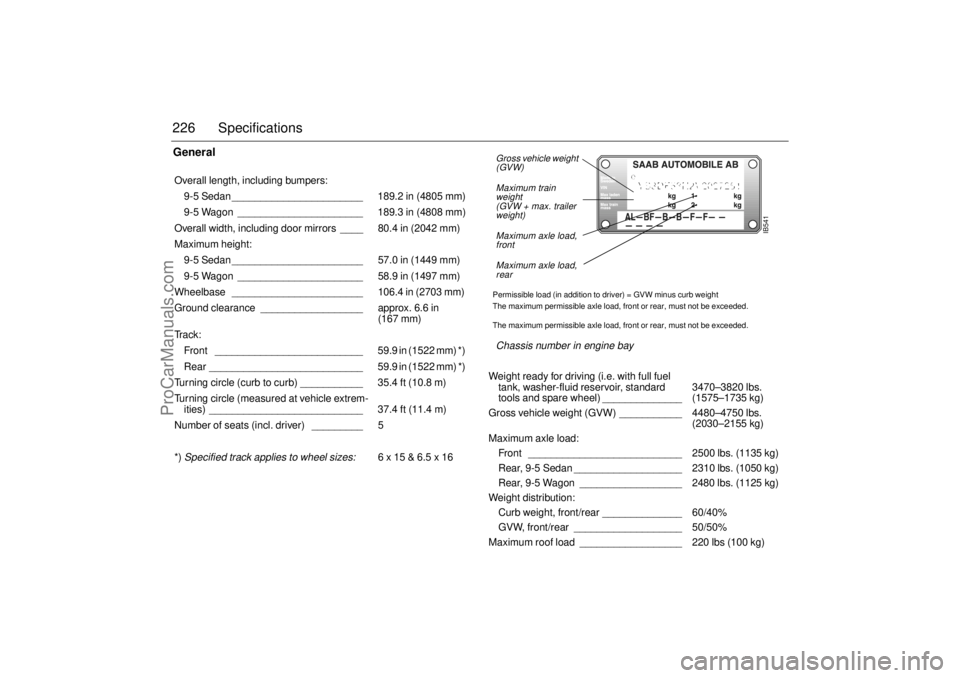
Gross vehicle weight
(GVW)
Maximum train
weight
(GVW + max. trailer
weight)
Maximum axle load,
front
Maximum axle load,
rear Permissible load (in addition to driver) = GVW minus curb weight
The maximum permissible axle load, front or rear, must not be exceeded.
The maximum permissible axle load, front or rear, must not be exceeded. Chassis number in engine bay Weight ready for driving (i.e. with full fuel
tank, washer-fluid reservoir, standard
tools and spare wheel) ______________ 3470–3820 lbs.
(1575–1735 kg)
Gross vehicle weight (GVW) ___________ 4480–4750 lbs.
(2030–2155 kg)
Maximum axle load:
Front ___________________________ 2500 lbs. (1135 kg)
Rear, 9-5 Sedan ___________________ 2310 lbs. (1050 kg)
Rear, 9-5 Wagon __________________ 2480 lbs. (1125 kg)
Weight distribution:
Curb weight, front/rear ______________ 60/40%
GVW, front/rear ___________________ 50/50%
Maximum roof load __________________ 220 lbs (100 kg)
IB541
ProCarManuals.com
Page 228 of 256

228 SpecificationsEngine Fuel4-cylinder ________________________ Four cylinders, twin
overhead cam-
shafts, 16 valves
and two balancer
shafts.
6-cylinder ________________________ V-6 engine, double
overhead cam-
shafts on each cyl-
inder bank,
24 valves
Cylinder bores ___________________ 3.54 in (90 mm)
Stroke:
4-cylinder engine _________________ 3.54 in (90 mm)
6-cylinder engine _________________ 3.34 in (85 mm)
Swept volume:
4-cylinder engine _________________ 139.7 cu.in
(2.290 litres)
6-cylinder engine _________________ 180.6 cu.in
(2.962 litres)
Idling speed:
4-cylinder _______________________ 825 rpm
6-cylinder _______________________ 700 rpm
Antifreeze ________________________ Saab-approved
antifreeze
Coolant capacity:
4-cylinder _______________________ 7.6 qts (7.4 litres)
6-cylinder _______________________ 7.4 qts (7.2 litres) Fuel grade ________________________ Unleaded gasoline
AON 87–93.
For optimum performance Saab recom-
mend the following fuel grades:
2.3t _____________________________ AON 90
2.3 Turbo Aero and V6-models________ AON 93 *)
*) If AON 90 is used and the ambient temperature is above
77 – 86°F (25– 30°C) some decrease in engine power can occur
to some extent.
Fuel-tank capacity __________________ 18.5 gal. (70 litres)
ProCarManuals.com
Page 237 of 256

237 Specifications
Several of the systems in your Saab
car can be adjusted to better fit your
individual needsSome functions are governed by legal
requirements and cannot therefore be
reprogrammed.
Consult an authorized Saab dealer for fur-
ther information.
Car alarm/central locking system:
The sound level of the siren when locking/
unlocking, HIGH or LOW.
The number of blinks when locking/
unlocking, 1 to 7.
Automatic locking of the trunk when the
car is driven, 1 to 8 mph (2-14 km/h), YES
or NO.
Preclude the unlocking of the trunk while
the car is driven, YES or NO.
Automatic locking of the trunk after
1 second-4 minutes if it has not been
opened, YES or NO.
Automatic locking of the trunk when it is
closed, YES or NO.Automatic Climate Control (ACC):
Indoor temperature can be
increased/decreased relative to the
selected temperature.
Delayed start of fan after starting the car,
to reduce risk of fogging windshield.
Temperature at which the defroster mode
is automatically selected.
Response time for the fan speed when
the selected temperature is changed.
Temperature at which the air distribution
switches from defroster mode to
defrost/floor mode.
Last manual selection will be selected the
next time the car is started.Saab Information Display:
Outdoor temperature display can be
adjusted.
Days remaining to next service can be
activated/counted or not.
Delete “Test Brake Light“ message on
SID at start-up.
Miscellaneous:
Select the on-time for heated rear seat.
Coolant temperature gauge adjustment
can be increased/decreased.
Fuel level gauge adjustment can be
increased/decreased.
Additional sweep of the wipers after wind-
shield washer function (ON or OFF).
Follow me home on-time can vary from 20
to 50 seconds.
Night panel illumination deactivation
speed for the speedometer can be
adjusted.
ProCarManuals.com
Page 242 of 256

242 IndexDate code, tires _________________ 201
Dim-dipped beam ________________ 61
Direction indicators _______________ 62
Door handles ____________________ 32
Door mirrors ___________________ 108
Doors, locks & luggage compartment _ 31
Drive belt ______________________ 231
Drive belt, alternator _____________ 179
Drive belts _____________________ 231
Drive belts, length _______________ 231
Driver’s seat, programmable _______ 104
Driving in hot weather ____________ 151
Driving with a load _______________ 157EElectric heating seat _____________ 106
Electric heating, front seats ________ 106
Electric windows ________________ 110
Electrical system, technical data ____ 230
Electrically heated rear seat _______ 106
Electronic starting interlock _________ 33
Emergency operation of sunroof ____ 112
Emission control systems _________ 169
Engine bay, 4-cyl ________________ 167
Engine bay, 6-cyl ________________ 168
Engine bay, cleaning _____________ 210
Engine number _________________ 235
Engine oil, grade ________________ 229
Engine, description __________ 170, 171
Engine, technical data ____________ 228
Engine, temperature gauge _________ 53Engine-oil level, checking _________ 171
Expansion tank, coolant __________ 174
FFault codes, Audio System _________ 99
Flat spot, tire ___________________ 206
Fluid level, automatic transmission __ 173
Folding the rear seat, 9-5 Sedan ____ 116
Folding the rear seat, 9-5 Wagon ___ 119
Follow-me-home function __________ 61
Frequently asked questions on airbag 26
Front fog lights ___________________ 63
Frost warning ____________________ 55
Fuel __________________________ 134
Fuel consumption ________________ 54
Fuel filler flap ___________________ 126
Fuel gauge _____________________ 53
Fuel grade _____________________ 228
Fuse box under hood ____________ 196
Fuse panel _____________________ 192
Fuses _________________________ 192GGearbox number ________________ 235
Gearbox oil, checking ____________ 173
Gearbox, technical data, __________ 231
Glove compartment ______________ 113
HHandbrake _____________________ 162
Hazard warning lights _____________ 63
Head restraint __________________ 104
Headlight flasher _________________ 61
Headlights ______________________ 61
Holidaying abroad _______________ 213
Hood _________________________ 166
Horn __________________________ 107IImmobilizer _____________________ 33
Indicator and warning lights _________ 46
Indicator lights ___________________ 46
Instrument illumination _____________ 62
Instruments and controls ___________ 45
Integral child seat ________________ 21
Interior equipment _______________ 101
Interior lighting ___________________ 64
Interior rearview mirror ___________ 108KKey ___________________________ 32
Key to chassis number ___________ 236LLabels __________________________ 8
Leather upholstery, care of ________ 208
ProCarManuals.com
Page 243 of 256

243 Index
Light horn ______________________ 61
Light switches ___________________ 61
Luggage-compartment lighting ______ 64MMain instrument panel _____________ 46
Main/dipped beam ________________ 61
Maintenance schedule ___________ 218
Manual gearbox, technical data ____ 231
Maxi fuses _____________________ 193
Milometer ______________________ 52
Motoring abroad ________________ 213NNight Panel _____________________ 59OOil capacity, engine ______________ 228
Oil change, engine ______________ 172
Oil specification _________________ 228
OnStar ________________________ 100
Outdoor temperature ______________ 54
Owner assistance _______________ 219PPaintwork, touching-in ____________ 210
Parking lights ____________________ 61Plates and labels ________________ 235
Poly-V-belt _____________________ 179
Power steering _________________ 176
Power-steering fluid ______________ 176
Programming I, ACC ______________ 73
Programming II, ACC _____________ 74
Programming the ACC ____________ 73
QQuestions on function of airbag ______ 26
Quick guide, Audio System _________ 79RRadio __________________________ 82
Rear fog light ____________________ 62
Rear seat, 9-5 Sedan, folding ______ 116
Rear seat, 9-5 Wagon, folding ______ 119
Rear-seat head restraints _________ 105
Rear-view mirror, antidazzle _______ 109
Rearview mirrors ________________ 108
Reclamation ___________________ 213
Refuelling _____________________ 134
Relay panel ____________________ 195
Remote control __________________ 32
Remote-control battery, changing ____ 35
Reporting safety defects __________ 220
Reprogramming of systems _______ 237
Reservoir, power-steering fluid _____ 176
Rev counter _____________________ 52
Reversing lights __________________ 63Roof load ______________________ 155
Running-in _____________________ 149
SSID ____________________________ 54
SRS (airbag) ____________________ 23
SRS, supplementary restraint system _ 23
Saab 9-5 Audio System ____________ 77
Saab Information Display (SID) ______ 54
Safety belts _____________________ 12
Safety belts, care of ______________ 207
Safety-belt pretensioners ___________ 12
Safety-belt reminder ______________ 12
Seats _________________________ 102
Securing a load __________________ 36
Selector lever indication,
automatic transmission ___________ 54
Service costs ___________________ 219
Service information ______________ 220
Service intervals ________________ 218
Service record retention __________ 219
Settings, seats __________________ 102
Side airbags _____________________ 28
Signalling, horn _________________ 107
Sliding floor, 9-5 Wagon __________ 124
Snow chains ___________________ 150
Spare wheel ____________________ 202
Spare wheel and tools ____________ 126
Spark plugs ____________________ 230
Speed rating ___________________ 198
Speedometer _________________ 52, 53
ProCarManuals.com