key SAAB 9-5 2000 Owner's Manual
[x] Cancel search | Manufacturer: SAAB, Model Year: 2000, Model line: 9-5, Model: SAAB 9-5 2000Pages: 256, PDF Size: 14.24 MB
Page 130 of 256

130 Starting and drivingIgnition switchThe combined ignition switch and
gear-lever lock is located in the center con-
sole between the front seats. The ignition
key can only be removed when reverse is
engaged (automatic transmission: selector
in ”P” position).
The key fits all the locks on the car. The key
number is specified on the small plastic
strap that comes with the keys when the car
is delivered. Keep a note of the key number
in a safe place, as you will need to quote it if
ordering a replacement key.
See also page 32.
LOCK position Engage reverse and turn the key to LOCK.
Automatic transmission: select ”P”.
The gear lever is locked. This is the only position in which the key can be
removed.
The parking lights, hazard warning lights and interior lighting all work. OFF position Gear lever no longer locked.
Certain electrical circuits operationalON position All electrical circuits working. Do not leave the key in the ON position
when the engine is not running. Turn the key to OFF to switch off the
electrical circuits. In the ON position certain warning and indicator lights
come on as a check, and they normally are extinguished after about
3 seconds.ST (starter) position The starter operates when the key is turned to this position. When
released, the key will spring back to the ON position. If the engine fails to
start, the key must first be turned back to the position between OFF and
LOCK before the starter can be operated again.
When the starter motor is running, several electrical circuits are
disconnected to facilitate starting.
LOCK
OFFONST
LOCK
OFFONST
LOCK
OFFONST
LOCK
OFFONST
IB1120
ProCarManuals.com
Page 131 of 256

131 Starting and driving
If the car does not startIf the text “KEY NOT ACCEPTED” is shown
on the SID, after a failed start attempt, the
cause could be a fault in the transmitter in
the key, or in the receiver in the ignition lock.
The following should be done:
Turn the key back to the LOCK position.
Turn the key to ON.
Press one of the buttons on the remote
control (the LED stops blinking).
Start the engine.
Try another key. If this works, then the fault
is in the first key.
Contact an authorized Saab dealer for
checking and rectification.
Starting the engine Do not run the starter motor for more than
25 seconds at a time. Wait 20-30 seconds
before running the starter again, to give the
battery time to recover.
Avoid racing the engine or putting a heavy
load on it before it has warmed up. Drive
away as soon as the oil warning light has
been extinguished to enable the engine to
attain its normal temperature as quickly as
possible.
It is possible for air to enter the lubricating
system in conjunction with an oil or oil-filter
change, or if the car has been stored for
some time. This air can cause the hydraulic
cam followers to emit a ticking noise, which
can persist for up to 15 minutes after start-
ing. Although this is quite normal and does
not indicate any malfunction, it is advisable
not to exceed 3,000 rpm before the noise
has disappeared.
The hydraulic cam lifters are completely
service free; the valve clearance is set up at the factory and will not need any subse-
quent adjustment.
Starting the engineThe engine has an automatic choke and
should be started as follows:
Cars with manual gearbox
To start the engine the clutch pedal must
be fully depressed.
1 Depress the clutch pedal fully but do not
touch the accelerator.
2 Start the engine. Let the ignition key
spring back as soon as the engine has
started and is running smoothly – at very
low temperatures, you may need to run
the starter for up to 25 seconds.
Let the engine idle for about 10 seconds. Do
not open the throttle wide for at least
2-3 minutes after starting.
Cars with automatic transmission
1 The selector lever must be in the P or N
position.
2 Keep your foot on the brake pedal.
3 Start the engine. Let the ignition key
spring back as soon as the engine has
started and is running smoothly – at very
low temperatures, you may need to run
the starter for up to 25 seconds.
Let the engine idle for about 10 seconds. Do
not open the throttle wide for at least
2–3 minutes after starting.
NOTETake care not to spill drinks or to drop
crumbs over the ignition switch. If dirt or
liquid gets into it, the switch may not
operate properly.
WARNING
Always remove the key before leaving
the car.
Always apply the parking brake before
removing the ignition key.
WARNING
Carbon monoxide (CO) is a colorless,
odorless, poisonous gas. Be alert to
the danger of CO – always open the
garage doors before starting the
engine in the garage.
There is also a danger of CO poison-
ing if the exhaust system is leaking.
ProCarManuals.com
Page 138 of 256
138 Starting and drivingAutomatic transmission
The electronic control module for the auto-
matic transmission receives information on
engine torque and road speed, and also
controls the hydraulic pressure in the trans-
mission to ensure that gear changing is as
smooth as possible.
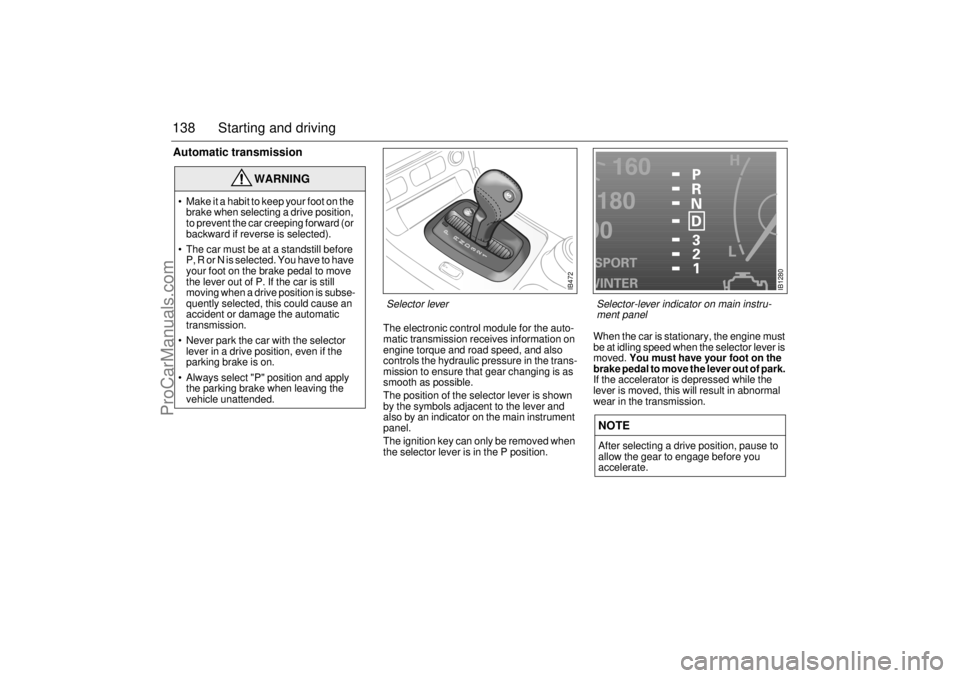
The position of the selector lever is shown
by the symbols adjacent to the lever and
also by an indicator on the main instrument
panel.
The ignition key can only be removed when
the selector lever is in the P position. When the car is stationary, the engine must
be at idling speed when the selector lever is
moved. You must have your foot on the
brake pedal to move the lever out of park.
If the accelerator is depressed while the
lever is moved, this will result in abnormal
wear in the transmission.
WARNING
Make it a habit to keep your foot on the
brake when selecting a drive position,
to prevent the car creeping forward (or
backward if reverse is selected).
The car must be at a standstill before
P, R or N is selected. You have to have
your foot on the brake pedal to move
the lever out of P. If the car is still
moving when a drive position is subse-
quently selected, this could cause an
accident or damage the automatic
transmission.
Never park the car with the selector
lever in a drive position, even if the
parking brake is on.
Always select "P" position and apply
the parking brake when leaving the
vehicle unattended.
NOTEAfter selecting a drive position, pause to
allow the gear to engage before you
accelerate.
Selector lever
IB472
IB1280
Selector-lever indicator on main instru-
ment panel
ProCarManuals.com
Page 140 of 256
140 Starting and driving
Shift Lock override1 Apply the parking brake
2 Make sure the key is in position ON
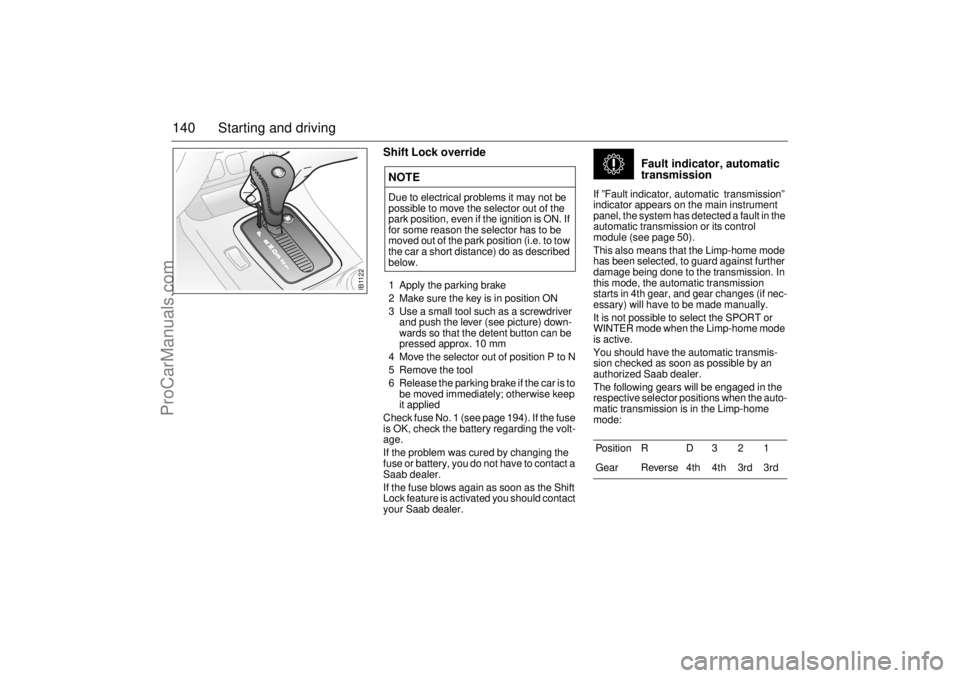
3 Use a small tool such as a screwdriver
and push the lever (see picture) down-
wards so that the detent button can be
pressed approx. 10 mm
4 Move the selector out of position P to N
5 Remove the tool
6 Release the parking brake if the car is to
be moved immediately; otherwise keep
it applied
Check fuse No. 1 (see page 194). If the fuse
is OK, check the battery regarding the volt-
age.
If the problem was cured by changing the
fuse or battery, you do not have to contact a
Saab dealer.
If the fuse blows again as soon as the Shift
Lock feature is activated you should contact
your Saab dealer.
Fault indicator, automatic
transmission
If ”Fault indicator, automatic transmission”
indicator appears on the main instrument
panel, the system has detected a fault in the
automatic transmission or its control
module (see page 50).
This also means that the Limp-home mode
has been selected, to guard against further
damage being done to the transmission. In
this mode, the automatic transmission
starts in 4th gear, and gear changes (if nec-
essary) will have to be made manually.
It is not possible to select the SPORT or
WINTER mode when the Limp-home mode
is active.
You should have the automatic transmis-
sion checked as soon as possible by an
authorized Saab dealer.
The following gears will be engaged in the
respective selector positions when the auto-
matic transmission is in the Limp-home
mode:
NOTEDue to electrical problems it may not be
possible to move the selector out of the
park position, even if the ignition is ON. If
for some reason the selector has to be
moved out of the park position (i.e. to tow
the car a short distance) do as described
below.
Position R D 3 2 1
Gear Reverse 4th 4th 3rd 3rd
IB1122
ProCarManuals.com
Page 142 of 256

142 Starting and drivingSelector positions
P
To shift out of the P position you must
depress the brake pedal and the ignition
must be ON.
The parking position (P) must only be selected
when the car is at a complete standstill. The
selector lever is locked and the transmission is
mechanically immobilized. Always apply the
parking brake after parking the car.
The engine can be started. The key can be
removed.
R
The reverse (R) position must only be selected
when the car is at a complete standstill. The
detent-release button must be pressed before
the selector lever can be moved to R. Wait until
reverse gear has engaged (car starts to creep)
before touching the accelerator.
N
In the Neutral position (N), the transmission is
disengaged from the engine. The engine can be
started, but first ensure that the parking brake is
on, to prevent the car from moving off unexpect-
edly.
To prevent the engine and transmission from
becoming hotter than necessary, select N for
stops other than brief ones, e.g. if stuck in a traf-
fic jam.
The normal drive position (D) is recommended
for waiting at traffic lights.
D
The Drive position (D) is the position for normal
motoring. Gear changes between 1st and 4th
will take place automatically, the timing of which
is determined by the throttle (accelerator) posi-
tion and the speed of the car.
After moving the selector lever to D, pause to
give the gear time to engage (car starts to pull).
3
In position 3, 4th gear is locked out. The car will
start in 1st gear and normal gear changing (up
and down) will take place automatically between
gears 1, 2 and 3.
Position 3 is recommended on roads with fre-
quent bends and in congested traffic.
Moving the selector lever from D to 3 will effect
a change-down to 3rd gear, which will give better
engine-braking.
Do not move the selector to position 3 at speeds
in excess of 90 mph (150 km/h).
2
Position 2 is recommended in hilly country. This
gear enables the performance of the engine to
be exploited better and also provides effective
engine-braking. Normal gear changing (up and
down) between 1st and 2nd gear will take place
automatically. Third and 4th gears are locked
out.
Do not move the selector to position 2 at speeds
in excess of 70 mph (110 km/h).
ProCarManuals.com
Page 148 of 256

148 Starting and drivingTCS eliminates wheelspin. The same
applies when the car is reversing.
On cornering, if there is a tendency for the
inner front wheel to rotate faster than the
other wheels.
On overtaking.
TCS OFF The TCS OFF indicator on the main instru-
ment panel will come on:
If a fault has been detected and the
system has therefore been switched off.
If there is a fault in the ABS system.
If the system has been switched off man-
ually.
The indicator light will also come on for
4 seconds when the ignition key is turned to
ON, while an internal system check is per-
formed. TCS indicator The indicator light will come on for
4 seconds when the ignition key is turned to
ON, while an internal system check is per-
formed.
The TCS light in the tachometer comes on
when the system is operative, i.e. when the
wheels are not rotating at the same speed.
The fact that the TCS system is operative
indicates that the limit for grip has been
exceeded and that the driver must exert
greater care.
Turning the TCS off The TCS is switched on automatically when
the engine is started.
The system can be switched off manually by
the TCS button, whereupon TCS OFF on
the main instrument panel will come on. The
TCS system cannot be switched off if the car
is travelling faster than 35 mph (60 km/h).
It may be necessary to switch off the system
if the car has become bogged down, for
instance. Press TCS to switch it on again.
If a fault is detected in the ABS system, the
TCS will be switched off automatically.
The cruise-control system will automatically
be disengaged after one second if it is active
when the TCS starts to operate.
WARNING
In normal driving, the TCS system
enhances the safety of the car, but it does
not mean that the car can be driven faster.
The same care and prudence normally
applied should be displayed on cornering
and when driving on slippery roads.
IB478
ProCarManuals.com
Page 162 of 256
162 Starting and drivingParking brake The parking brake is situated between the
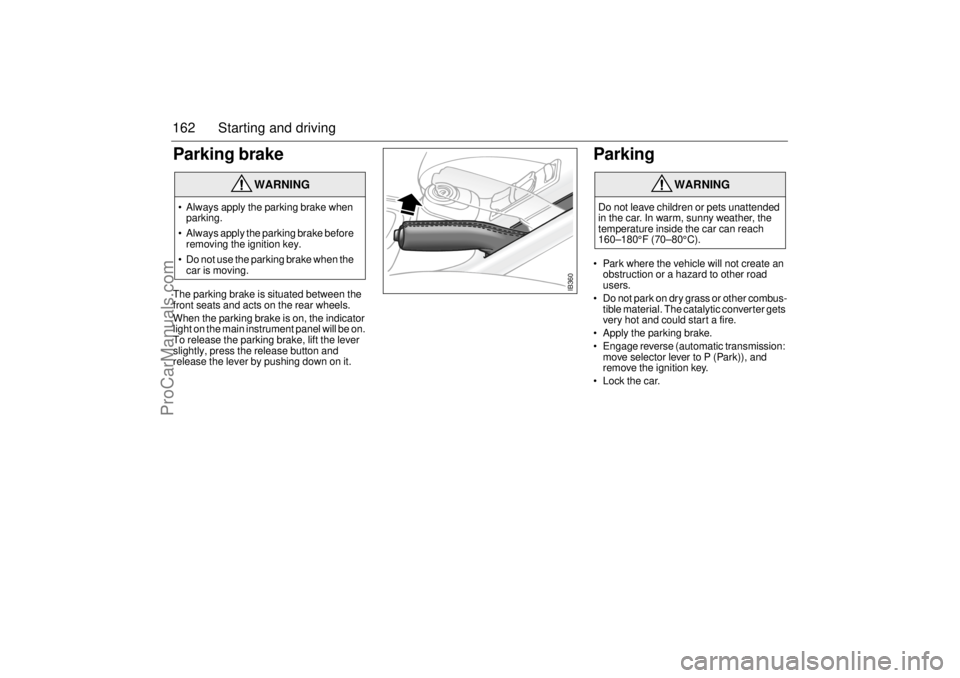
front seats and acts on the rear wheels.
When the parking brake is on, the indicator
light on the main instrument panel will be on.
To release the parking brake, lift the lever
slightly, press the release button and
release the lever by pushing down on it.
Parking Park where the vehicle will not create an
obstruction or a hazard to other road
users.
Do not park on dry grass or other combus-
tible material. The catalytic converter gets
very hot and could start a fire.
Apply the parking brake.
Engage reverse (automatic transmission:
move selector lever to P (Park)), and
remove the ignition key.
Lock the car.
WARNING
Always apply the parking brake when
parking.
Always apply the parking brake before
removing the ignition key.
Do not use the parking brake when the
car is moving.
WARNING
Do not leave children or pets unattended
in the car. In warm, sunny weather, the
temperature inside the car can reach
160–180°F (70–80°C).
IB360
ProCarManuals.com
Page 187 of 256
187 Car care and technical information
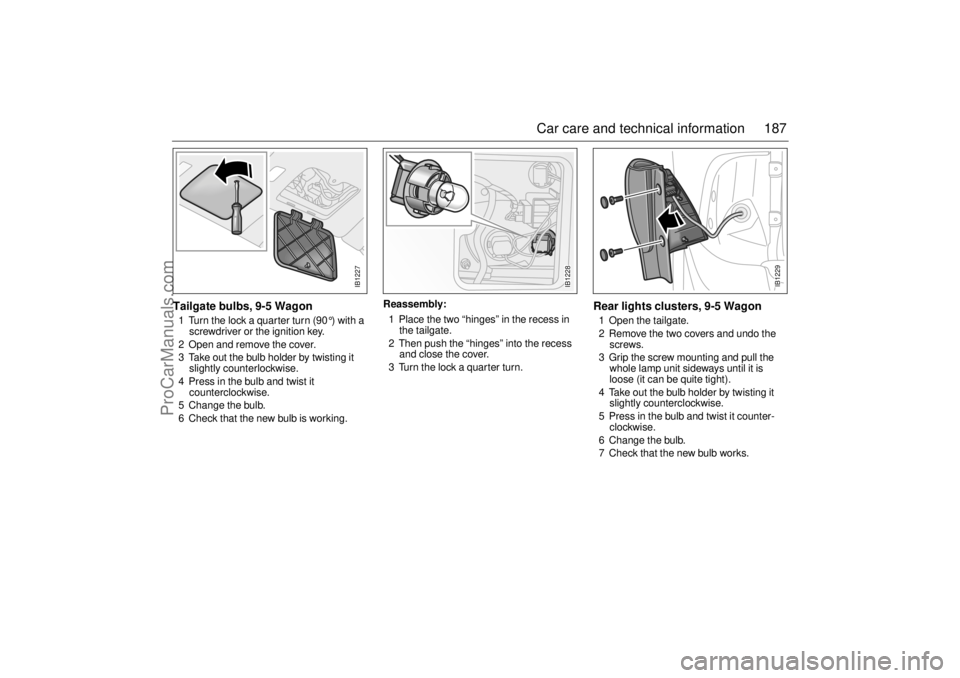
Tailgate bulbs, 9-5 Wagon1 Turn the lock a quarter turn (90 °) with a
screwdriver or the ignition key.
2 Open and remove the cover.
3 Take out the bulb holder by twisting it
slightly counterlockwise.
4 Press in the bulb and twist it
counterclockwise.
5 Change the bulb.
6 Check that the new bulb is working.Reassembly:
1 Place the two “hinges” in the recess in
the tailgate.
2 Then push the “hinges” into the recess
and close the cover.
3 Turn the lock a quarter turn.
Rear lights clusters, 9-5 Wagon1 Open the tailgate.
2 Remove the two covers and undo the
screws.
3 Grip the screw mounting and pull the
whole lamp unit sideways until it is
loose (it can be quite tight).
4 Take out the bulb holder by twisting it
slightly counterclockwise.
5 Press in the bulb and twist it counter-
clockwise.
6 Change the bulb.
7 Check that the new bulb works.
IB1227
IB1228
IB1229
ProCarManuals.com
Page 198 of 256

198 Car care and technical informationWheels Alternative wheels and tiresIf you wish to fit other tires or wheels than
those supplied with the car, consult your
Saab dealer first as to the possibilities avail-
able.
Wheels/tires combinations that are not
approved by Saab can negatively affect the
car´s directional stability, steering and brak-
ing in both wet and dry conditions.
Do not assume that a wheel/tire combina-
tion will function properly just because it will
bolt on.The wheels and tires have been carefully
matched to the characteristics of the car and
play a key role in its outstanding roadhold-
ing and handling.
Tire pressureTires need to be inflated to suit the load car-
ried and the maximum speed the car will be
driven (see the recommended tire pres-
sures on the back cover). Note that all
values apply to cold tires. For tires with an
aspect ratio less than /60, increase the tire
pressure by 3 psi (20 kPa) for rough roads
with potholes to minimize the risk of rim
damage.Never reduce the pressure of a hot tire. If the
tires are hot when you check them, only
increase the pressure, if necessary.
Soft tires will cause faster wear than
over-pressurized tires. They also increase
fuel consumption.
If a valve is leaking, simply unscrew it and fit
a new one.
Important! Remember to adjust the tire
pressures if you change the load in the car
or intend to cruise at a substantially higher
or lower speed than normal.
NOTEFor wide wheels and/or low-profile tires,
bear in mind the following:
Tires and wheels can be damaged in
potholes etc.
Springs and dampers can be over-
loaded.
The wheels can come into contact with
chassis and body components.
The speed and load limits for the tires
must not be exceeded; see page 199.
Wheels larger than 17” must not be fit-
ted. The maximum permissible offset
is 49 mm.
NOTECheck the tire pressures at least once
per month.
Underinflation is the main cause of:
Tires wearing out prematurely.
Damage to the sidewalls.
Damage to the wheels.
ProCarManuals.com
Page 241 of 256

241 Index
IndexAA/C system, fault diagnosis ________ 206
A/C system, maintenance _________ 206
ABS brakes ____________________ 146
ACC ___________________________ 67
ACC functions ___________________ 70
ACC, automatic climate control ______ 67
ACC, calibration _________________ 75
ACC, condensation _______________ 76
ACC, programming _______________ 73
ACC, useful tips _________________ 75
Adjusting the steering wheel _______ 107
Adjustment, seats _______________ 102
Afterheater, V6-engine cars _______ 239
Air conditioning (A/C),
fault diagnosis and maintenance __ 206
Air distribution, ACC ______________ 72
Airbag _________________________ 23
Alarm __________________________ 38
Alarm functions __________________ 41
Alarm signals _________________ 38, 41
Alternator ______________________ 179
Alternator drive belt __________ 179, 231
Alternator rating _________________ 230
Anticorrosion treatment ___________ 211
Antidazzle rear-view mirror ________ 109
Ashtrays ______________________ 112
Audio System ___________________ 77Audio System, quick guide _________ 79
Autochecking of lights on starting ____ 52
Automatic climate control (ACC) _____ 67
Automatic transmission,
technical data _________________ 232
BBattery ________________________ 177
Battery charging/replacing _________ 178
Battery, boost starting ____________ 160
Belt guide ______________________ 12
Boost starting using jump leads ____ 160
Booster cushion __________________ 21
Brake and clutch fluid ____________ 175
Brake-fluid reservoir _____________ 175
Brakes, technical data ____________ 233
Bulbs, changing _________________ 182
Bulbs, table of __________________ 191CCD changer _____________________ 89
CD player ______________________ 87
CHECK messages _______________ 58
CHECKING _____________________ 58
Calibration, ACC _________________ 75
Cancelling the programmed settings __ 73
Car alarm _______________________ 38
Car care _______________________ 165
Car phone, installation _____________ 98
Cargo net, 9-5 Wagon ____________ 123Carpeting, care of _______________ 208
Cassette player __________________ 84
Catalytic converter,
important considerations _________ 133
Central locking ___________________ 32
Change language in SID ___________ 60
Change of address notification _____ 220
Changing a wheel _______________ 203
Changing bulbs _________________ 182
Changing the coolant _____________ 175
Changing the wheels round ________ 199
Changing wiper blades ___________ 180
Chassis number _________________ 235
Chassis number, key to ___________ 236
Child safety _____________________ 18
Child safety locks, rear doors _______ 35
Child seat, integral ________________ 21
Cleaning, engine bay _____________ 210
Clock _______________________ 59, 60
Colour code, body _______________ 235
Colour code, trim ________________ 235
Compact spare wheel ____________ 202
Condensation, ACC _______________ 76
Coolant _______________________ 174
Coolant, changing _______________ 175
Cruise control __________________ 145
Cup holder _____________________ 115
DDICE/TWICE ___________________ 193
Dampers ______________________ 232
ProCarManuals.com