tow SAAB 9-5 2000 Owner's Manual
[x] Cancel search | Manufacturer: SAAB, Model Year: 2000, Model line: 9-5, Model: SAAB 9-5 2000Pages: 256, PDF Size: 14.24 MB
Page 158 of 256
158 Starting and drivingTowing the car
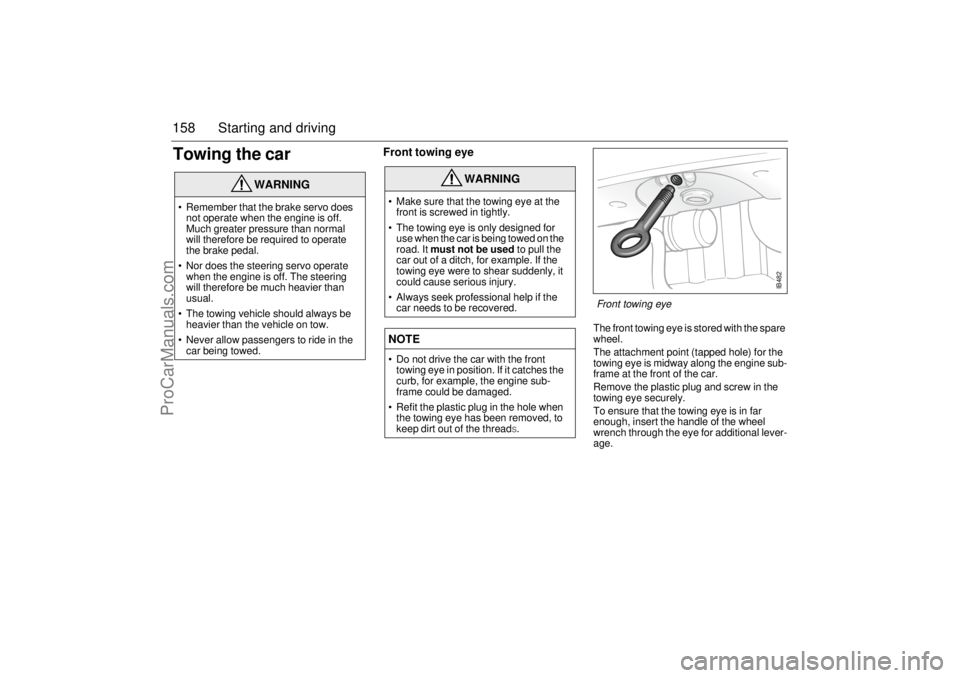
Front towing eye
The front towing eye is stored with the spare
wheel.
The attachment point (tapped hole) for the
towing eye is midway along the engine sub-
frame at the front of the car.
Remove the plastic plug and screw in the
towing eye securely.
To ensure that the towing eye is in far
enough, insert the handle of the wheel
wrench through the eye for additional lever-
age.
WARNING
Remember that the brake servo does
not operate when the engine is off.
Much greater pressure than normal
will therefore be required to operate
the brake pedal.
Nor does the steering servo operate
when the engine is off. The steering
will therefore be much heavier than
usual.
The towing vehicle should always be
heavier than the vehicle on tow.
Never allow passengers to ride in the
car being towed.
WARNING
Make sure that the towing eye at the
front is screwed in tightly.
The towing eye is only designed for
use when the car is being towed on the
road. It must not be used to pull the
car out of a ditch, for example. If the
towing eye were to shear suddenly, it
could cause serious injury.
Always seek professional help if the
car needs to be recovered. NOTE Do not drive the car with the front
towing eye in position. If it catches the
curb, for example, the engine sub-
frame could be damaged.
Refit the plastic plug in the hole when
the towing eye has been removed, to
keep dirt out of the threads.
IB482
Front towing eye
ProCarManuals.com
Page 159 of 256
159 Starting and driving
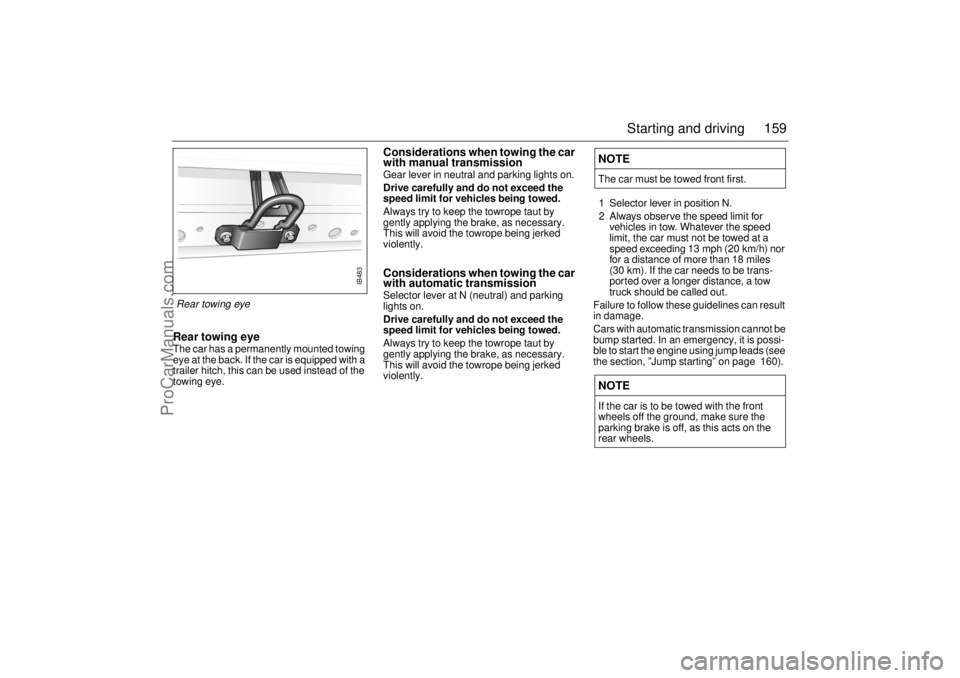
Rear towing eyeThe car has a permanently mounted towing
eye at the back. If the car is equipped with a
trailer hitch, this can be used instead of the
towing eye.
Considerations when towing the car
with manual transmission Gear lever in neutral and parking lights on.
Drive carefully and do not exceed the
speed limit for vehicles being towed.
Always try to keep the towrope taut by
gently applying the brake, as necessary.
This will avoid the towrope being jerked
violently. Considerations when towing the car
with automatic transmission Selector lever at N (neutral) and parking
lights on.
Drive carefully and do not exceed the
speed limit for vehicles being towed.
Always try to keep the towrope taut by
gently applying the brake, as necessary.
This will avoid the towrope being jerked
violently. 1 Selector lever in position N.
2 Always observe the speed limit for
vehicles in tow. Whatever the speed
limit, the car must not be towed at a
speed exceeding 13 mph (20 km/h) nor
for a distance of more than 18 miles
(30 km). If the car needs to be trans-
ported over a longer distance, a tow
truck should be called out.
Failure to follow these guidelines can result
in damage.
Cars with automatic transmission cannot be
bump started. In an emergency, it is possi-
ble to start the engine using jump leads (see
the section, ”Jump starting” on page 160).
NOTEThe car must be towed front first.NOTEIf the car is to be towed with the front
wheels off the ground, make sure the
parking brake is off, as this acts on the
rear wheels.
IB483
Rear towing eye
ProCarManuals.com
Page 163 of 256
163 Starting and driving
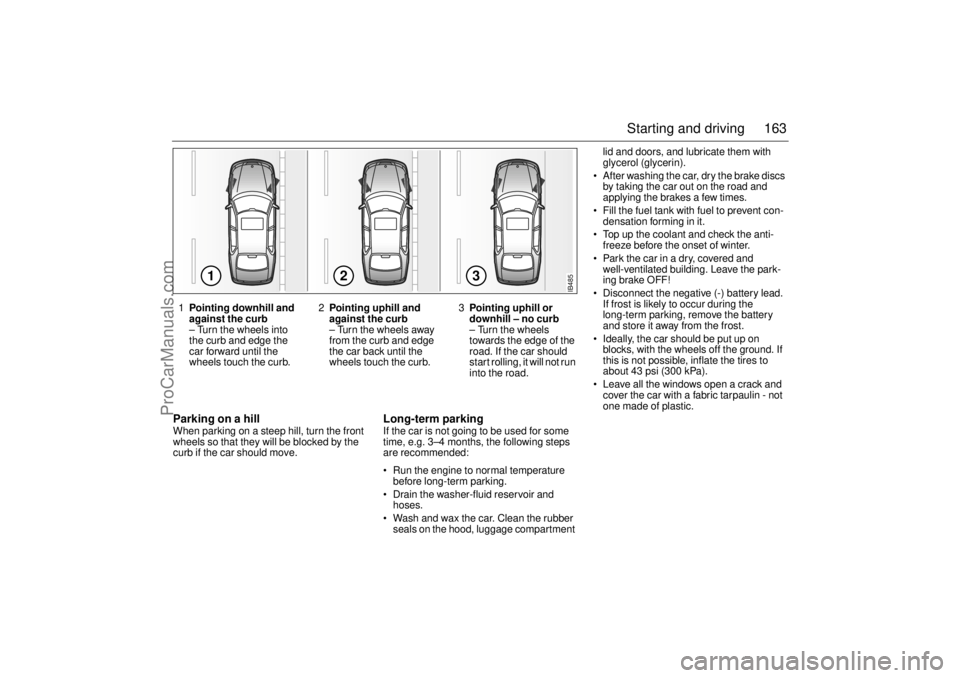
Parking on a hillWhen parking on a steep hill, turn the front
wheels so that they will be blocked by the
curb if the car should move.
Long-term parkingIf the car is not going to be used for some
time, e.g. 3–4 months, the following steps
are recommended:
Run the engine to normal temperature
before long-term parking.
Drain the washer-fluid reservoir and
hoses.
Wash and wax the car. Clean the rubber
seals on the hood, luggage compartment lid and doors, and lubricate them with
glycerol (glycerin).
After washing the car, dry the brake discs
by taking the car out on the road and
applying the brakes a few times.
Fill the fuel tank with fuel to prevent con-
densation forming in it.
Top up the coolant and check the anti-
freeze before the onset of winter.
Park the car in a dry, covered and
well-ventilated building. Leave the park-
ing brake OFF!
Disconnect the negative (-) battery lead.
If frost is likely to occur during the
long-term parking, remove the battery
and store it away from the frost.
Ideally, the car should be put up on
blocks, with the wheels off the ground. If
this is not possible, inflate the tires to
about 43 psi (300 kPa).
Leave all the windows open a crack and
cover the car with a fabric tarpaulin - not
one made of plastic.
123
IB485
1Pointing downhill and
against the curb
– Turn the wheels into
the curb and edge the
car forward until the
wheels touch the curb.2Pointing uphill and
against the curb
– Turn the wheels away
from the curb and edge
the car back until the
wheels touch the curb.3Pointing uphill or
downhill – no curb
– Turn the wheels
towards the edge of the
road. If the car should
start rolling, it will not run
into the road.
ProCarManuals.com
Page 172 of 256
172 Car care and technical informationOil changingThe engine oil must be changed in accor-
dance with the service program, see page
218.
Oil volume and grade, see page 229.
Oil changing should be carried out on a
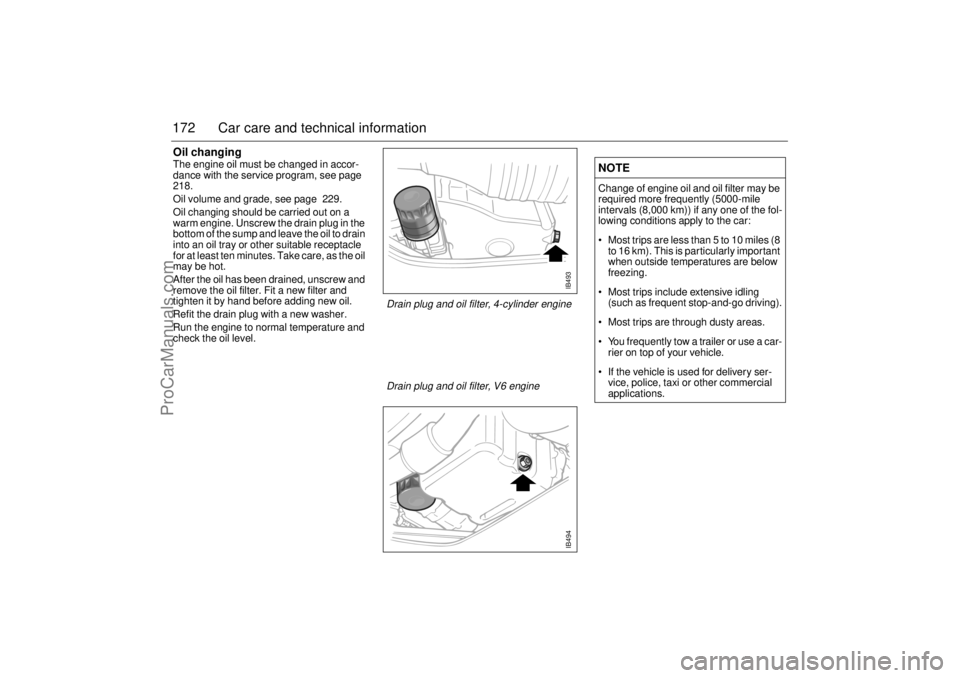
warm engine. Unscrew the drain plug in the
bottom of the sump and leave the oil to drain
into an oil tray or other suitable receptacle
for at least ten minutes. Take care, as the oil
may be hot.
After the oil has been drained, unscrew and
remove the oil filter. Fit a new filter and
tighten it by hand before adding new oil.
Refit the drain plug with a new washer.
Run the engine to normal temperature and
check the oil level.
NOTEChange of engine oil and oil filter may be
required more frequently (5000-mile
intervals (8,000 km)) if any one of the fol-
lowing conditions apply to the car:
Most trips are less than 5 to 10 miles (8
to 16 km). This is particularly important
when outside temperatures are below
freezing.
Most trips include extensive idling
(such as frequent stop-and-go driving).
Most trips are through dusty areas.
You frequently tow a trailer or use a car-
rier on top of your vehicle.
If the vehicle is used for delivery ser-
vice, police, taxi or other commercial
applications.
IB493
Drain plug and oil filter, 4-cylinder engine
IB494
Drain plug and oil filter, V6 engine
ProCarManuals.com
Page 186 of 256

186 Car care and technical informationTrunk lid light and taillights,
9-5 SedanBefore changing bulbs in the trunk, you
must first release the trim at the foot of the
trunk. This involves removing the handle
and the three trim fasteners (studs).
1 Unscrew the handle on the inside of the
tailgate.
2 Using the peg in the top of the screw-
driver handle, push in the button in the
centre of the studs.
3 Remove the studs.
Changing bulbs
1 Squeeze the plastic lug and electrical
connector together and remove the bulb
holder.2 The bulb has a bayonet fitting. Press in
the bulb and twist it counterclockwise.
3 Change the bulb.
Refitting the trim
1 Reset the studs by pushing back the
center buttons so that they protrude by
0.2 inch (5 mm).
2 Insert the studs through the trim and tail-
gate panel. Press the center buttons in,
flush with the collar.
3 Screw the handle back onto the trunk.
High-mounted stop lights, 9-5 SedanThe bulbs can be accessed after the panel
in the rear headlining has been removed.
1 Remove the panel by carefully pushing
in the two clips, one at the time.
2 Release the bulb holder, which is
retained by a clip at either end.
3 Withdraw the bulb gently straight back.
4 Push in the new bulb.
5 Refit the bulb holder.
6 Replace the panel by carefully pushing
the panel towards the headlining so that
the two clips engage their respective
slot.
IB517
IB518
3
2
2
3
1
IB519
High-mounted stop lights1Panel
2Retaining clips
3Bulbs
ProCarManuals.com
Page 202 of 256
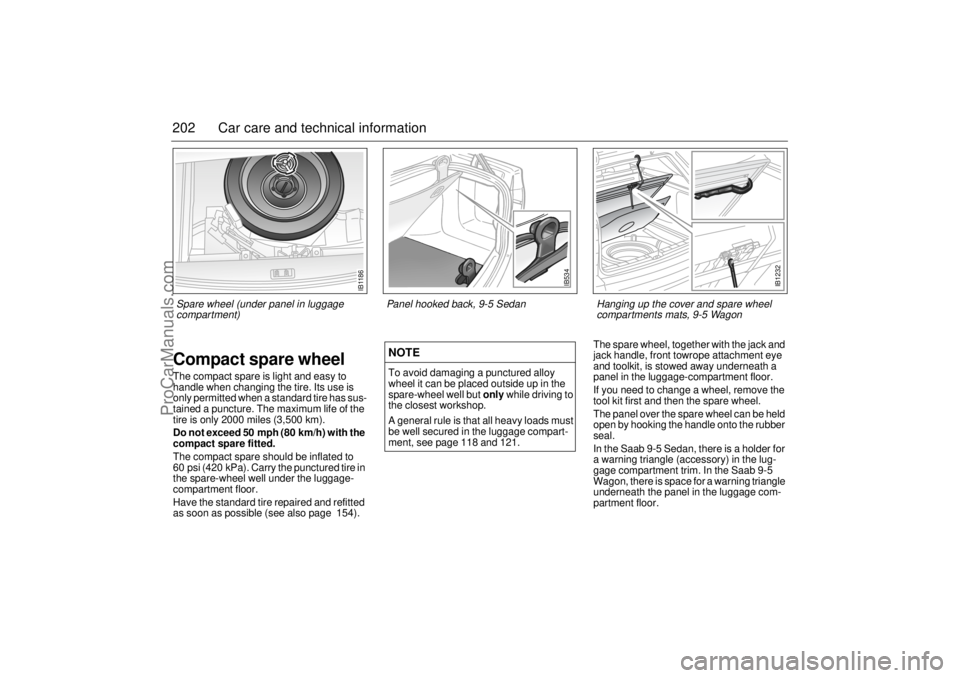
202 Car care and technical informationCompact spare wheelThe compact spare is light and easy to
handle when changing the tire. Its use is
only permitted when a standard tire has sus-
tained a puncture. The maximum life of the
tire is only 2000 miles (3,500 km).
Do not exceed 50 mph (80 km/h) with the
compact spare fitted.
The compact spare should be inflated to
60 psi (420 kPa). Carry the punctured tire in
the spare-wheel well under the luggage-
compartment floor.
Have the standard tire repaired and refitted
as soon as possible (see also page 154).The spare wheel, together with the jack and
jack handle, front towrope attachment eye
and toolkit, is stowed away underneath a
panel in the luggage-compartment floor.
If you need to change a wheel, remove the
tool kit first and then the spare wheel.
The panel over the spare wheel can be held
open by hooking the handle onto the rubber
seal.
In the Saab 9-5 Sedan, there is a holder for
a warning triangle (accessory) in the lug-
gage compartment trim. In the Saab 9-5
Wagon, there is space for a warning triangle
underneath the panel in the luggage com-
partment floor.
NOTETo avoid damaging a punctured alloy
wheel it can be placed outside up in the
spare-wheel well but only while driving to
the closest workshop.
A general rule is that all heavy loads must
be well secured in the luggage compart-
ment, see page 118 and 121.
IB534
Panel hooked back, 9-5 Sedan
IB1232
Hanging up the cover and spare wheel
compartments mats, 9-5 Wagon
IB1186
Spare wheel (under panel in luggage
compartment)
ProCarManuals.com
Page 203 of 256

203 Car care and technical information
Changing a wheel
WARNING
The car jack is designed solely for use
in changing a wheel or fitting snow
chains. It must not be used to support
the car during repair work or servicing.
Never crawl under a car that is
supported only by a jack.
Special care must be taken if the car is
on a slope – use wheel chocks!
Position chocks, one ahead and one
behind, the wheel that is diagonally
opposite to the one to be changed.
Switch on the hazard warning lights if
the car is on a road.
Apply the handbrake and leave the car
in gear (1st or reverse). Automatic
transmission: move selector to the
P position.
Ensure that everybody is out of the car
before jacking it up.
Never start the engine while the car is
jacked up.
The jack must stand on a firm, level
surface.
Stow the jack in the place provided for
it under the panel in the floor of the lug-
gage compartment. Secure it properly
to avert injury to passengers in the
event of an accident.
Do not use the jack for any purpose
other than for jacking up the car.
ProCarManuals.com
Page 204 of 256
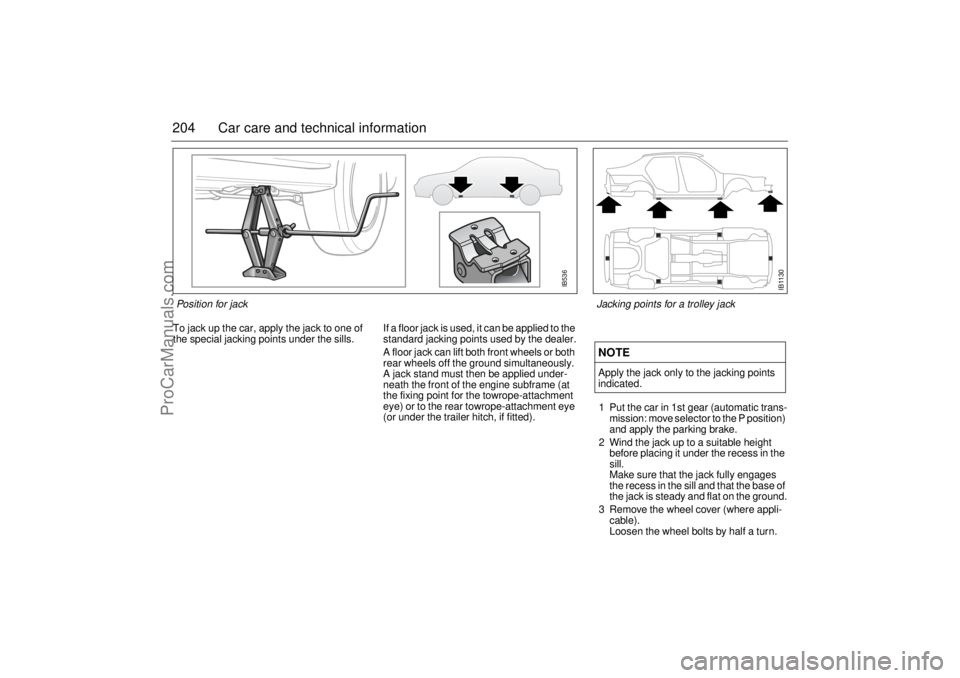
204 Car care and technical informationTo jack up the car, apply the jack to one of
the special jacking points under the sills.If a floor jack is used, it can be applied to the
standard jacking points used by the dealer.
A floor jack can lift both front wheels or both
rear wheels off the ground simultaneously.
A jack stand must then be applied under-
neath the front of the engine subframe (at
the fixing point for the towrope-attachment
eye) or to the rear towrope-attachment eye
(or under the trailer hitch, if fitted).1 Put the car in 1st gear (automatic trans-
mission: move selector to the P position)
and apply the parking brake.
2 Wind the jack up to a suitable height
before placing it under the recess in the
sill.
Make sure that the jack fully engages
the recess in the sill and that the base of
the jack is steady and flat on the ground.
3 Remove the wheel cover (where appli-
cable).
Loosen the wheel bolts by half a turn.
NOTEApply the jack only to the jacking points
indicated.
Pos i ti o n for j ack
IB1130
Jacking points for a trolley jack
IB536
ProCarManuals.com
Page 208 of 256

208 Car care and technical informationUpholstery and trimTo remove fluff or hairs from the seat uphol-
stery or headlining, use a moist, lint-free
cloth or a special lint remover (brush or
roller). Remove any dirty marks using a
cloth moistened with lukewarm soapy
water.
When using a stain remover, always work
from the outside towards the center to avoid
leaving a ring. If a soiled ring or spot should
remain, it can usually be removed using
lukewarm soapy water or water alone.
Wet patches left by spilt soft drinks or thin oil
must be wiped off immediately using an
absorbent material, such as kitchen paper,
and treated with stain remover.
Alcohol is recommended for removing
grease or oil stains, and a semi-stiff brush
may also be used.
Cleaning and caring for leather
upholsteryThe principal reason for treating leather
upholstery is to maintain its elegant appear-
ance and to provide it with a protective film.
Discoloration caused by dust and wear
mainly affects the lighter shades, although
this is not detrimental to the leather –
indeed, the patina resulting from use is often
considered desirable in leather. But if the
leather is allowed to become too grubby, it
can start to look shabby.
It is a good idea to clean and recondition the
leather twice a year – in conjunction with a
general spring-cleaning of the car – after the
winter and in the autumn, for instance. In
hot, dry climates, the leather will need to be
treated more frequently.
Moisten a soft cloth in a mild soap solution.
Carefully apply this damp (not wet) cloth to
the leather, working in light, circular move-
ments until the leather is clean. Repeat the
procedure using clean water and then leave
the leather to dry thoroughly. Finally, treat
the leather with a leather conditioner.Apply the leather conditioner using a soft
cloth and the same circular movements as
described above. After it has dried, polish
the leather with a soft, dry cloth. Follow the
directions given above. Do not use hot
water, unknown abrasive polishes, sol-
vents, sprays or soaps that might scratch
the leather.
Textile carpetingVacuum clean the carpeting regularly. Car-
pets can also be cleaned using a brush, or
carpet shampoo applied with a sponge. Do
not use vacuum cleaners outdoors unless
they are properly grounded.
ProCarManuals.com
Page 222 of 256

222 Maintenance and owner assistance* These are the minimum required Emission Control System maintenance steps. Saab urges that all recommended maintenance procedures be performed
according to this program.
(b.) Change automatic transmission fluid at more frequent intervals (20,000; 50,000; 80,000 miles, etc.) if car is driven in dense city traffic where the outside
temperature regularly reach 90°F or higher, or if car is used in a mountainous/high altitude area or for trailer towing.
Service Intervals **
Miles = U.S. Cars
Kilometers = Canadian Cars
1,000
(1,600 km)
10,000
(16,000 km)
20,000
(32,000 km)
30,000
(48,000 km)
40,000
(64,000 km)
50,000
(80,000 km)
60,000
(96,000 km)
70,000
(112,000 km)
80,000
(128,000 km)
90,000
(144,000 km)
100,000
(160,000 km)
Service #
1234567891011
Engine and engine compartment (cont.)
E Evaporative emission system including filler cap, vapor
lines, EVAP canister and canister purge valve"
R Fuel system: leaks and damage""""""""""
E Fuel filter!
E Engine air cleaner element!
*
!*
!*
R Exhaust system and mountings; leaks and condition""""""""""
Electrical
R Battery: state of charge and electrolyte level; clean termi-
nals if necessary"""""""""""
R Head, fog, brake, tail, turn signal, warning lights instru-
ment panel, backup and marker lamps"""""""""""
Transmission
R Automatic transmission fluid change (b.)!!!
R Automatic gearbox oil level"""""""""""
R Manual gearbox oil level"""
R Outer and inner driver joint boots""""""""""
ProCarManuals.com