tow SAAB 9-5 2000 User Guide
[x] Cancel search | Manufacturer: SAAB, Model Year: 2000, Model line: 9-5, Model: SAAB 9-5 2000Pages: 256, PDF Size: 14.24 MB
Page 126 of 256

126 Interior equipment and trunkSpare wheel and toolsThe spare wheel, together with the jack and
jack handle, front towrope attachment eye
and toolkit, are stowed away underneath
the trunk.
Driving considerations with compact spare
wheel/tire fitted, see page 154.
Fuel filler flapThe fuel filler flap is opened by means of a
button on the driver’s door. The flap is
spring-loaded, so it opens slightly automat-
ically when released.
Refueling, see page 134.
Opening the fuel filler
flap in an emergencyIf the fuel filler flap fails to open after the
button on the driver’s door has been
pressed, it can be opened manually from
inside the trunk.
9-5 Sedan:
Start by checking fuse 25 (see page 194).
A thin cable on the right-hand side in the
trunk is connected to the catch for the filler
flap. To open the flap, pull the yellow plastic
arrow on the end of the cable.
WARNING
Stow all tools carefully away after use, so
that they cannot get loose and cause
injury in the event of an accident.
IB465
Stowage of spare wheel and tools under
trunk floor
IB466
Button for releasing filler flap
IB467
To open fuel filler flap in an emergency
9-5 Sedan
ProCarManuals.com
Page 129 of 256

129 Starting and driving
Starting and driving
IB597
Ignition switch ................. 130
Starting the engine .......... 131
Important considerations
for driving ....................... 132
Refueling .......................... 134
Engine Break-In Period ... 137
Gear changing ................. 137
Cruise control .................. 145
Braking ............................. 146
Traction Control System . 147
Economical motoring ...... 149
Driving in winter .............. 150 Driving in hot weather .... 151
Towing a trailer ................ 152
Driving considerations
with compact spare
wheel/tire fitted .............. 154
Driving with the trunk
lid/tailgate open ............. 154
Driving with a roof rack
load ................................. 155
Driving with a load .......... 157
Towing the car ................. 158
Jump starting .................. 160 Parking brake ................... 162
Parking .............................. 162
ProCarManuals.com
Page 137 of 256

137 Starting and driving
Engine Break-In PeriodPistons, bores and bearings need time to
obtain uniform, wear-resistant surfaces.
If a new engine is driven too hard, this grad-
ual process of bedding-in will not be possi-
ble and the life of the engine will be short-
ened.
During the first 1,200 miles (2,000 km), do
not exceed 5,000 rpm.
In addition, refrain from driving the car at full
throttle, other than for brief instances,
during the first 1,800 miles (3,000 km). Wearing in new brake padsNew brake pads take time to bed in, about
90 miles (150 km) if the car is driven largely
under stop-and-go conditions or about
300 miles (500 km) of highway driving.
To extend the useful life of the pads, avoid
hard braking as much as possible during
this period.Brake-pad wear indicatorsThe outer brake pads on the front wheels
have acoustic wear-indicators. When 3 mm
remains on the pad, a scraping or screech-
ing noise is heard during braking. The brake
pads should be changed as soon as possi-
ble.
Brake pads should only be replaced by
an authorized Saab dealer.
Gear changingManual gearboxTo start the engine the clutch pedal must
be fully depressed.
The gear positions are marked on the gear
lever. Before reverse (R) can be engaged,
you must lift the ring underneath the
gear-lever knob.
To change gear, fully depress the clutch
pedal and then release it smoothly. It is
inadvisable to drive with your hand resting
on the gear lever, as this can increase the
wear on the gearbox.
When changing down from 5th to 4th gear,
ease the gear lever straight back, without
applying any lateral pressure. This will pre-
vent 2nd gear being engaged by mistake,
which can result in overreving and possible
damage to the engine.
Before engaging reverse, wait till the car is
at a standstill, release the accelerator and
fully depress the clutch. From neutral, press
the gear lever firmly to the right before
easing it back into reverse.
Shift-up indicator for improved fuel
economy (U.S. models only)Cars equipped with a manual transmission
have a "Shift-up" light on the instrument
panel. The light begins to work after the
vehicle is warmed up and provides you with
a good indication when to shift to a higher
gear.
It is not necessary or recommended to
follow the shift-up recommendations in all
driving conditions, for example, when driv-
ing in heavy urban traffic or steep downhill
grades.
However, shifting with the light should result
in improved fuel economy. Therefore, for
reduced fuel consumption and better
energy conservation, you should make a
habit of shifting before or when the shift-up
light comes on.Towing Towing of cars with manual gearbox, see
page 158.
IB471
13
25
R
4
ProCarManuals.com
Page 140 of 256
140 Starting and driving
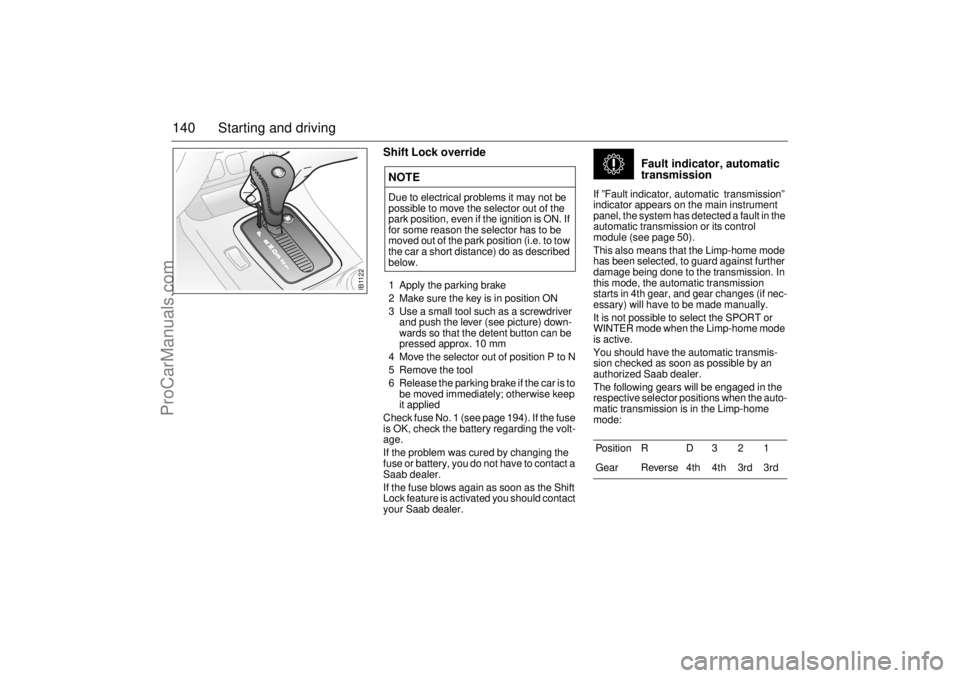
Shift Lock override1 Apply the parking brake
2 Make sure the key is in position ON
3 Use a small tool such as a screwdriver
and push the lever (see picture) down-
wards so that the detent button can be
pressed approx. 10 mm
4 Move the selector out of position P to N
5 Remove the tool
6 Release the parking brake if the car is to
be moved immediately; otherwise keep
it applied
Check fuse No. 1 (see page 194). If the fuse
is OK, check the battery regarding the volt-
age.
If the problem was cured by changing the
fuse or battery, you do not have to contact a
Saab dealer.
If the fuse blows again as soon as the Shift
Lock feature is activated you should contact
your Saab dealer.
Fault indicator, automatic
transmission
If ”Fault indicator, automatic transmission”
indicator appears on the main instrument
panel, the system has detected a fault in the
automatic transmission or its control
module (see page 50).
This also means that the Limp-home mode
has been selected, to guard against further
damage being done to the transmission. In
this mode, the automatic transmission
starts in 4th gear, and gear changes (if nec-
essary) will have to be made manually.
It is not possible to select the SPORT or
WINTER mode when the Limp-home mode
is active.
You should have the automatic transmis-
sion checked as soon as possible by an
authorized Saab dealer.
The following gears will be engaged in the
respective selector positions when the auto-
matic transmission is in the Limp-home
mode:
NOTEDue to electrical problems it may not be
possible to move the selector out of the
park position, even if the ignition is ON. If
for some reason the selector has to be
moved out of the park position (i.e. to tow
the car a short distance) do as described
below.
Position R D 3 2 1
Gear Reverse 4th 4th 3rd 3rd
IB1122
ProCarManuals.com
Page 141 of 256

141 Starting and driving
Overheated transmission fluid If the automatic-transmission fluid should
overheat, the following message will appear
on the SID:
”TRANSMISSION OVERHEATING”. If this
happens, stop the car and wait for the mes-
sage to be extinguished. Continue driving in
a locked gear that produces an engine
speed of about 3,000 rpm.
Overheating of the automatic-transmission
fluid can occur when the car is towing a
heavy load, such as a camping trailer in hilly
country, with the wrong gear selected,
resulting in abnormally frequent gear
changing. Try selecting position 1, 2 or 3.
High ambient temperatures can also
increase the temperature of the transmis-
sion fluid or the oil cooler may be faulty.
Contact an authorized Saab dealer (see
also page 152).
Towing Towing of cars with automatic transmission,
see page 158.
NOTEIf the control module has actuated the
Limp-home function for the automatic
transmission, the car will remain in 4th
gear when D is selected, making it very
sluggish. To overcome this, move the
selector lever to position 2.
WARNING
Remember to use engine-braking (selec-
tor position 1, 2, or 3) to spare the brakes
when you are driving on a long or steep
downhill slope. Select the same gear as
you would on the corresponding uphill
slope.
Brake failure can result from overheated
brakes!
ProCarManuals.com
Page 146 of 256

146 Starting and drivingBrakingTo avoid the brakes becoming overheated,
(e.g. when negotiating long descents with a
drop of several hundred feet), select a low
gear to use the braking effect of the engine.
If the car has automatic transmission, move
the selector lever to position 1 or 2.
When driving fast, you can help to prolong
the life of the brakes by thinking ahead and
braking harder for short periods, rather than
braking more moderately over long
stretches. Brake pad wear indicatorsThe outboard brake pads on the front
wheels incorporate pad-wear indicators.
When the lining is down to 3 mm, the pad
will produce a screeching, squealing or
scraping noise when the brakes are applied.
New pads should be fitted without delay.
Brake pads should only be replaced by
an authorized Saab dealer. To ensure optimum brake performance,
it is recommended that you use only
Saab original brake pads.
ABS brakesABS (antilock braking system) modulates
the brake pressure to the respective
wheels. Wheel sensors detect if a wheel is
about to lock, and the control module
reduces the pressure to that wheel and then
increases it once more until the tendency is
detected again.
The brake system is equipped with an Elec-
tronic Brake-force Distribution device
(EBD), which distributes the brake pressure
between the front and rear wheels, in such
a way as to achieve optimum braking perfor-
mance irrespective of the car’s speed and
load.
The ABS system has a built-in diagnostic
function which will switch on the Anti-lock
brake warning light if a fault is detected in
the system (see page 48).
WARNING
It is prudent to try your brakes from
time to time, especially when driving in
heavy rain, on roads with a lot of sur-
face water, or in snow or slush. In such
conditions, the brakes may take
longer than normal to take effect. To
rectify this, touch the brake pedal peri-
odically to dry the brakes out.
The same applies after the car has
been washed or when the weather is
very humid.
The brakes are power assisted and it
should be kept in mind that the servo
unit only provides the power assis-
tance when the engine is running.
The brake pressure required when the
engine is off,( e.g. when the car is on
tow) is roughly four times the normal
pedal force required. The pedal also
feels hard and unresponsive.
We advise against using wheels with
open wheel covers in winter, as the
brake components are then more
exposed both to slush, road salt and
grit.
WARNING
The additional safety afforded by the
ABS system is not designed to allow
drivers to drive faster but to make
normal driving safer.
To stop as quickly as possible, without
loss of directional stability, whether
the road surface is dry, wet or slippery,
press the brake pedal down hard-
without letting up, declutching
simultaneously, and steer the car to
safety.
ProCarManuals.com
Page 149 of 256
149 Starting and driving
Economical motoringFactors affecting fuel consumption Fuel consumption is greatly affected by the
general driving conditions, the way in which
the car is driven and at what speeds, the
weather, the state of the road, the condition
of the car, etc. Breaking-in Fuel consumption may be somewhat higher
during the break-in period (the first 3,000–
4,000 miles (5,000–7,000 km) than stated
under ”Technical data”.
Weather conditions Fuel consumption can be as much as 10 %
lower in summer than in winter. The higher
consumption in cold weather is explained by
the longer time it takes for the engine to
reach normal operating temperature, and
for the transmission and wheel bearings to
warm up. Fuel economy is also affected by
the distance driven: short journeys of
3-5 miles (5-8 km) do not give the engine
enough time to reach normal temperature.
Strong winds can also affect fuel consump-
tion.
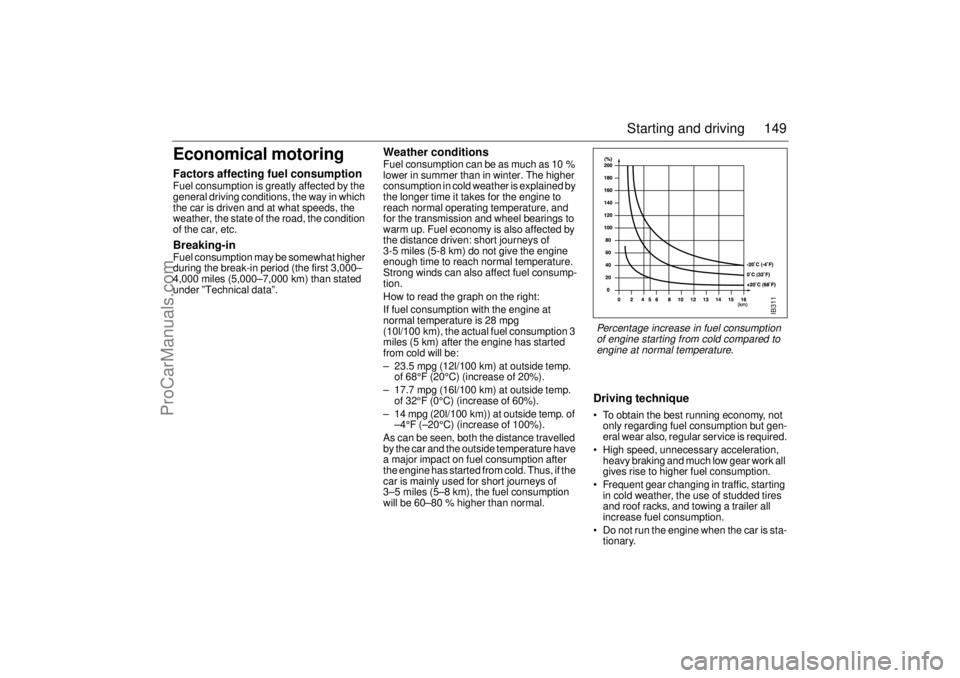
How to read the graph on the right:
If fuel consumption with the engine at
normal temperature is 28 mpg
(10l/100 km), the actual fuel consumption 3
miles (5 km) after the engine has started
from cold will be:
– 23.5 mpg (12l/100 km) at outside temp.
of 68°F (20°C) (increase of 20%).
– 17.7 mpg (16l/100 km) at outside temp.
of 32°F (0°C) (increase of 60%).
– 14 mpg (20l/100 km)) at outside temp. of
–4°F (–20°C) (increase of 100%).
As can be seen, both the distance travelled
by the car and the outside temperature have
a major impact on fuel consumption after
the engine has started from cold. Thus, if the
car is mainly used for short journeys of
3–5 miles (5–8 km), the fuel consumption
will be 60–80 % higher than normal.
Driving technique To obtain the best running economy, not
only regarding fuel consumption but gen-
eral wear also, regular service is required.
High speed, unnecessary acceleration,
heavy braking and much low gear work all
gives rise to higher fuel consumption.
Frequent gear changing in traffic, starting
in cold weather, the use of studded tires
and roof racks, and towing a trailer all
increase fuel consumption.
Do not run the engine when the car is sta-
tionary.
IB311
Percentage increase in fuel consumption
of engine starting from cold compared to
engine at normal temperature.
ProCarManuals.com
Page 152 of 256

152 Starting and driving3 As soon as possible, have the cooling
system checked by an authorized Saab
dealer.
Towing a trailerTrailer hitch attachmentTrailer hitch attachments are available as
accessories. These are designed for a max-
imum trailer weight of 2000 lbs. (900 kg).
Use only the electrical trailer hitch socket
provided in the spare wheel area in the lug-
gage compartment for connecting the trailer
electrics.
Trailer weightMaximum recommended trailer weights for
different gradients, with a view to comfort
and drivability for manual and automatic
cars, are shown on the drawing.
Make sure you are familiar with the law
regarding speed limits for towing, maxi-
mum trailer weights, trailer-braking
requirements, and also any special
driving-licence provisions
(see also page 227).
The specified trailer weights and gradients
assume that the journey starts at the hill and
therefore apply only to short periods.
WARNING
Always undo the expansion tank filler cap
carefully, releasing the pressure and any
vapor before removing the cap com-
pletely.
NOTEUse only a genuine Saab trailer hitch,
since other models can damage the car’s
bodywork and electrical system (or in
Canada, a high quality hitch designed to
fit the car, available from a trailer hitch
specialist).
Consult an authorized Saab dealer for
guidance on how to connect the trailer
hitch electrical system.
WARNING
When towing a trailer, do not attempt to
negotiate a hill having a gradient in
excess of 15%. The weight distribution
over the front wheels of the car will be
insufficient to prevent wheelspin, making
further progress impossible.
In addition, the parking brake may not
always be able to hold the car and trailer
securely, with the result that the wheels
can start to slide downhill.
ProCarManuals.com
Page 153 of 256

153 Starting and driving
Recommendations for cars with auto-
matic transmission.
The following time limits are based on the
capacity of the cooling system in warm
weather, i.e. approximately 104°F (40°C).
When negotiating long hills, bear the follow-
ing important considerations in mind:
If TRANSMISSION OVERHEATING
appears on the SID, stop the car as soon as
it is safe to do so and wait until the warning
has been extinguished. When continuing
your journey, select a locked gear (1, 2 or 3)
that will allow you to drive at an engine
speed of about 3,000 rpm (see page 142).
Do not drive continuously with the WINTER
mode selected in hilly country when you are
towing a trailer, as this will increase fuel con-
sumption and risk overheating the transmis-
sion.
Trailer hitch loadThe weight distribution on the trailer makes
a lot of difference to the handling properties
of the car and trailer combination. As
regards single-axle trailers, whenever pos-
sible, concentrate the load over the wheels
and keep it as low as possible.
The trailer should be loaded so that the
maximum load on the towbar ball is 5% to
7% of the trailer weight with a maximum per-
missible tongue weight of 165 lbs. (75 kg).
Note that this load must be added to the total
load for the car. If this now exceeds the
specified load capacity, the load in the lug-
gage compartment will have to be reduced
by a corresponding amount. Driving considerations Always take extra care when towing a
trailer, as the car’s handling will be different
and its braking effect reduced. The trailer’s
braking system and suspension also have a
considerable effect on these characteris-
tics.
If the car is equipped with automatic trans-
mission, select position 1 when ascending
or descending steep hills. Gradient
of hill, % Maximum
trailer
weight, lbs.
(kg)Maximum dura-
tion, minutes
6-7 2000 (900) unlimited
8-9 2000 (900) 15 max
10-15 1000 (450) 15 max. NOTEIf the “Fault indicator, automatic trans-
mission” indicator comes on, cease
towing until the problem has been recti-
fied.
IB106
Distribution of load in trailer a Light
b Moderate
cHeavy
ProCarManuals.com
Page 155 of 256

155 Starting and driving
Driving with a roof rack
loadThe maximum permissible roof load is
220 lbs. (100 kg).
Note that the roof load is included in the
car’s maximum permissible load (see page
226).
Strong, sturdy roof carriers designed spe-
cially for the car are available from your
Saab dealer. Always secure the roof load
safely. Fitting the roof carriers (accessory)
9-5 SedanThe carrier feet are marked with a top view
of the car and arrow indicating their posi-
tions.
1 Slip the plastic cover onto the adjustable
foot of the carrier (foot with knob for
tightening) to protect the paintwork
during assembly.
2 Open all the doors.
Fold back the rubber strip and find the
fixing holes. 3 Start on the left-hand side of the car.
Rest the carrier carefully across the roof,
with the rigid foot towards you. Hold the
foot clear of the roof to avoid damaging
the paintwork.
Fold back the rubber strip and insert the
pins on the foot into the fixing holes.
Make sure that the rubber strip comes
inside the plastic cover on the carrier.
Repeat the procedure with the other car-
rier.
4 Close the doors on the left-hand side of
the car gently, to hold the carrier feet in
place.
5 Now go around to the other side of the
car and remove the plastic cover from
the carrier’s adjustable foot. Fold back
the rubber strip and insert the pins on
the foot into the fixing holes. Do the
same with the other carrier and close the
doors gently. 6 Tighten each carrier by turning the knob
clockwise (by hand). Tighten just
enough to bring the foot up against the
edges of the fixing holes.
Remove the carriers when not in use, as
they increase fuel consumption.
The instructions that accompany the carri-
ers also include advice on driving with a roof
load - we strongly recommend that you read
them carefully.
WARNING
A roof load will affect the car’s center
of gravity and aerodynamics. Be
aware of this when cornering and driv-
ing in crosswinds.
Suit your speed to the prevailing con-
ditions.
IB480
IB481
ProCarManuals.com