warning SAAB 9-5 2000 Repair Manual
[x] Cancel search | Manufacturer: SAAB, Model Year: 2000, Model line: 9-5, Model: SAAB 9-5 2000Pages: 256, PDF Size: 14.24 MB
Page 123 of 256

123 Interior equipment and trunk
Cargo net (accessory)The pull-out cargo net’s storage cassette is
mounted on the rear of the backrest.
1 Remove the covers near the two rear
fixing points in the roof. Carefully bend in
the lower edge of the cover with a screw-
driver.
2 Pull the cargo net out directly back-
wards.
3 Snap the net’s two fasteners into the two
fixing points on the roof.
4 Make sure that the hooks on the net’s
own storage cassette fit against the net
mesh.
The pull-out cargo net can also be used
when the whole rear seat is folded. There
are two front attachment points in the roof
for this purpose.
WARNING
The cargo in the luggage compart-
ment must be anchored properly,
even if the cargo net is correctly in
position. The only purpose of the net is
to prevent objects from being thrown
about in the cabin during heavy brak-
ing or in the event of a collision.
Take extra care when tipping the wide
section of the rear seat forwards if the
car has a pull-out cargo net on the rear
of the backrest. Make sure that no one
is injured by the cargo net’s storage
cassette on the right-hand side where
the backrest is already folded.
IB1217
Cover over the fixing point for the cargo
net
IB1218
Attaching the cargo net to the roof
IB1219
Hooks on the net’s storage cassette
ProCarManuals.com
Page 124 of 256

124 Interior equipment and trunkSliding floor (accessory)
The function of the sliding floor is to facilitate
loading and unloading.
Securing loads, see page 118.
When the car is parked and the floor is
pulled out, it can bear the weight of two
people (maximum 440 lbs./200 kg).
The maximum load that can be anchored by
anchorage straps and cargo bolts is
170 lbs./80 kg.Setting up
1 Lift up the floor.
2 Fold out the support wheels.
3 Set the floor down on the support
wheels.
WARNING
To avoid personal injury take note of the
following:
Do not leave children unsupervised
when the sliding floor is drawn out.
Be aware of the risk of pinching when
handling the sliding floor.
Never drive the car with the sliding
floor pulled out.
Always use the car’s regular cargo
anchoring when transporting a cargo.
Provide protection on sharp edges to
prevent damage to the anchoring
straps.
The sliding floor must not be changed
or modified in any way.
Put the sliding floor in the folded- down
position when it is not in use.
IB1220
Setting up the sliding floor
ProCarManuals.com
Page 126 of 256

126 Interior equipment and trunkSpare wheel and toolsThe spare wheel, together with the jack and
jack handle, front towrope attachment eye
and toolkit, are stowed away underneath
the trunk.
Driving considerations with compact spare
wheel/tire fitted, see page 154.
Fuel filler flapThe fuel filler flap is opened by means of a
button on the driver’s door. The flap is
spring-loaded, so it opens slightly automat-
ically when released.
Refueling, see page 134.
Opening the fuel filler
flap in an emergencyIf the fuel filler flap fails to open after the
button on the driver’s door has been
pressed, it can be opened manually from
inside the trunk.
9-5 Sedan:
Start by checking fuse 25 (see page 194).
A thin cable on the right-hand side in the
trunk is connected to the catch for the filler
flap. To open the flap, pull the yellow plastic
arrow on the end of the cable.
WARNING
Stow all tools carefully away after use, so
that they cannot get loose and cause
injury in the event of an accident.
IB465
Stowage of spare wheel and tools under
trunk floor
IB466
Button for releasing filler flap
IB467
To open fuel filler flap in an emergency
9-5 Sedan
ProCarManuals.com
Page 130 of 256

130 Starting and drivingIgnition switchThe combined ignition switch and
gear-lever lock is located in the center con-
sole between the front seats. The ignition
key can only be removed when reverse is
engaged (automatic transmission: selector
in ”P” position).
The key fits all the locks on the car. The key
number is specified on the small plastic
strap that comes with the keys when the car
is delivered. Keep a note of the key number
in a safe place, as you will need to quote it if
ordering a replacement key.
See also page 32.
LOCK position Engage reverse and turn the key to LOCK.
Automatic transmission: select ”P”.
The gear lever is locked. This is the only position in which the key can be
removed.
The parking lights, hazard warning lights and interior lighting all work. OFF position Gear lever no longer locked.
Certain electrical circuits operationalON position All electrical circuits working. Do not leave the key in the ON position
when the engine is not running. Turn the key to OFF to switch off the
electrical circuits. In the ON position certain warning and indicator lights
come on as a check, and they normally are extinguished after about
3 seconds.ST (starter) position The starter operates when the key is turned to this position. When
released, the key will spring back to the ON position. If the engine fails to
start, the key must first be turned back to the position between OFF and
LOCK before the starter can be operated again.
When the starter motor is running, several electrical circuits are
disconnected to facilitate starting.
LOCK
OFFONST
LOCK
OFFONST
LOCK
OFFONST
LOCK
OFFONST
IB1120
ProCarManuals.com
Page 131 of 256

131 Starting and driving
If the car does not startIf the text “KEY NOT ACCEPTED” is shown
on the SID, after a failed start attempt, the
cause could be a fault in the transmitter in
the key, or in the receiver in the ignition lock.
The following should be done:
Turn the key back to the LOCK position.
Turn the key to ON.
Press one of the buttons on the remote
control (the LED stops blinking).
Start the engine.
Try another key. If this works, then the fault
is in the first key.
Contact an authorized Saab dealer for
checking and rectification.
Starting the engine Do not run the starter motor for more than
25 seconds at a time. Wait 20-30 seconds
before running the starter again, to give the
battery time to recover.
Avoid racing the engine or putting a heavy
load on it before it has warmed up. Drive
away as soon as the oil warning light has
been extinguished to enable the engine to
attain its normal temperature as quickly as
possible.
It is possible for air to enter the lubricating
system in conjunction with an oil or oil-filter
change, or if the car has been stored for
some time. This air can cause the hydraulic
cam followers to emit a ticking noise, which
can persist for up to 15 minutes after start-
ing. Although this is quite normal and does
not indicate any malfunction, it is advisable
not to exceed 3,000 rpm before the noise
has disappeared.
The hydraulic cam lifters are completely
service free; the valve clearance is set up at the factory and will not need any subse-
quent adjustment.
Starting the engineThe engine has an automatic choke and
should be started as follows:
Cars with manual gearbox
To start the engine the clutch pedal must
be fully depressed.
1 Depress the clutch pedal fully but do not
touch the accelerator.
2 Start the engine. Let the ignition key
spring back as soon as the engine has
started and is running smoothly – at very
low temperatures, you may need to run
the starter for up to 25 seconds.
Let the engine idle for about 10 seconds. Do
not open the throttle wide for at least
2-3 minutes after starting.
Cars with automatic transmission
1 The selector lever must be in the P or N
position.
2 Keep your foot on the brake pedal.
3 Start the engine. Let the ignition key
spring back as soon as the engine has
started and is running smoothly – at very
low temperatures, you may need to run
the starter for up to 25 seconds.
Let the engine idle for about 10 seconds. Do
not open the throttle wide for at least
2–3 minutes after starting.
NOTETake care not to spill drinks or to drop
crumbs over the ignition switch. If dirt or
liquid gets into it, the switch may not
operate properly.
WARNING
Always remove the key before leaving
the car.
Always apply the parking brake before
removing the ignition key.
WARNING
Carbon monoxide (CO) is a colorless,
odorless, poisonous gas. Be alert to
the danger of CO – always open the
garage doors before starting the
engine in the garage.
There is also a danger of CO poison-
ing if the exhaust system is leaking.
ProCarManuals.com
Page 133 of 256

133 Starting and driving
advantages of the system is that it
enables the engine to be run safely on
lower-grade fuel, although not lower
than AON 87.
The maximum boost pressure is
adjusted automatically to the knocking
or pinging tendency of the engine.
Occasional, short-lived knocking when
the engine is under a heavy load is per-
fectly normal; the extent will depend on
the grade of fuel in the tank.
Isolated instances of knocking are
more likely to occur with low-octane
fuel. This controlled form of knocking,
followed by a reduction in the boost
pressure, is a sign that the wastegate is
functioning and is perfectly safe for the
engine.
Important considerations with cata-
lytic convertersThe catalytic converter is an emission-con-
trol device incorporated in the car’s exhaust
system. It consists of a metal canister with a
honeycomb insert, the cells of which have
walls coated in a catalytic layer (mixture of
precious metals).
NOTEIf constant knocking occurs every time a
load is put on the engine, this indicates a
malfunction in the system.
Have the car checked without delay by an
authorized Saab dealer.
WARNING
If the engine is being run with the car on a
rolling road or dynamometer, to ensure
adequate cooling, air must be blown into
the engine compartment and under the
car at a rate equivalent to the ram-air
effect that would be obtained at the corre-
sponding road speed.
NOTEUse only unleaded gasoline. Leaded gas-
oline is detrimental to the catalyst and
oxygen sensor and will seriously impair
the function of the catalytic converter.
IB661
2
1
3
Oxygen-sensor-controlled
injection system 1 Engine control module
2 Oxygen sensor (lambda probe)
3 Catalytic converter
ProCarManuals.com
Page 135 of 256
135 Starting and driving
possible running problems) is to keep the
tank well filled.
Before the onset of freezing temperatures in
winter, it may be advisable to add gasoline
anti-freeze to the fuel a few times to dispel
any condensation in the system.
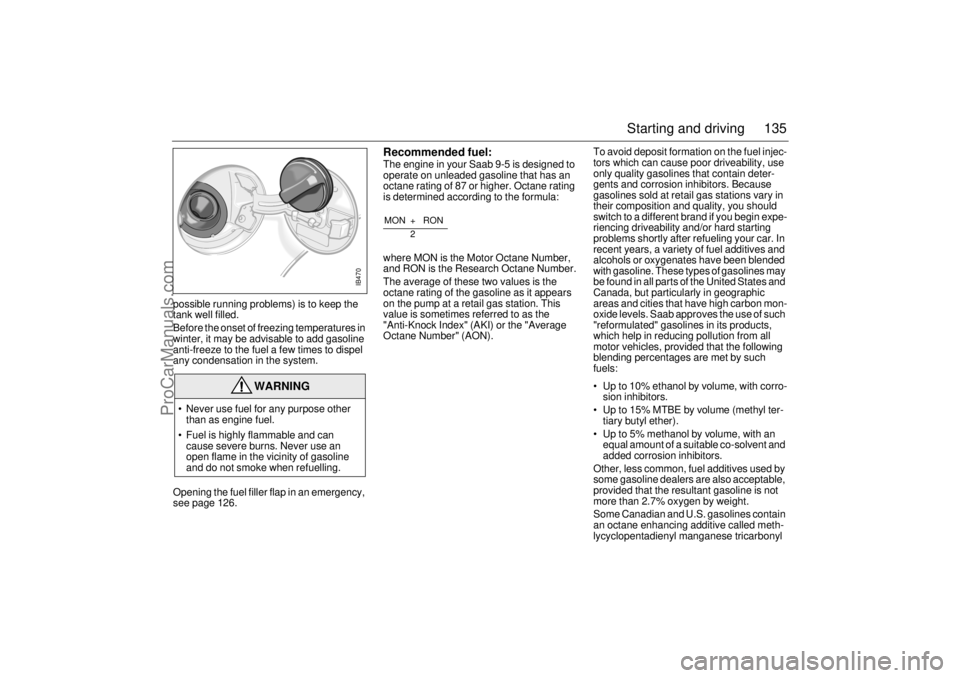
Opening the fuel filler flap in an emergency,
see page 126.
Recommended fuel:The engine in your Saab 9-5 is designed to
operate on unleaded gasoline that has an
octane rating of 87 or higher. Octane rating
is determined according to the formula:
where MON is the Motor Octane Number,
and RON is the Research Octane Number.
The average of these two values is the
octane rating of the gasoline as it appears
on the pump at a retail gas station. This
value is sometimes referred to as the
"Anti-Knock Index" (AKI) or the "Average
Octane Number" (AON).To avoid deposit formation on the fuel injec-
tors which can cause poor driveability, use
only quality gasolines that contain deter-
gents and corrosion inhibitors. Because
gasolines sold at retail gas stations vary in
their composition and quality, you should
switch to a different brand if you begin expe-
riencing driveability and/or hard starting
problems shortly after refueling your car. In
recent years, a variety of fuel additives and
alcohols or oxygenates have been blended
with gasoline. These types of gasolines may
be found in all parts of the United States and
Canada, but particularly in geographic
areas and cities that have high carbon mon-
oxide levels. Saab approves the use of such
"reformulated" gasolines in its products,
which help in reducing pollution from all
motor vehicles, provided that the following
blending percentages are met by such
fuels:
Up to 10% ethanol by volume, with corro-
sion inhibitors.
Up to 15% MTBE by volume (methyl ter-
tiary butyl ether).
Up to 5% methanol by volume, with an
equal amount of a suitable co-solvent and
added corrosion inhibitors.
Other, less common, fuel additives used by
some gasoline dealers are also acceptable,
provided that the resultant gasoline is not
more than 2.7% oxygen by weight.
Some Canadian and U.S. gasolines contain
an octane enhancing additive called meth-
lycyclopentadienyl manganese tricarbonyl
WARNING
Never use fuel for any purpose other
than as engine fuel.
Fuel is highly flammable and can
cause severe burns. Never use an
open flame in the vicinity of gasoline
and do not smoke when refuelling.
MON + RON
2
IB470
ProCarManuals.com
Page 136 of 256

136 Starting and driving(MMT). If such fuel is used, your emission
control system performance may deterio-
rate and the malfunction indicator lamp on
your instrument panel may turn on. If this
occurs, return to your authorized Saab
dealer for service.
However, these blended gasolines are reg-
ulated and should never exceed these rec-
ommended blend percentages and service
station operators should know if their gaso-
lines contain detergents and oxygenates,
and have been reformulated to reduce vehi-
cle emissions. Nevertheless, if you begin to
notice a problem with the way your car starts
or runs shortly after it has been refueled, try
a different brand of gasoline.
FuelUse the correct type of fuel. The fuel filler
cap is located in the right rear fender. Do not
lift the nozzle while filling is in progress. NOTEHigher concentrations of methanol than
listed above, or the use of methanol-
blended gasoline without suitable
co-solvents and corrosion inhibitors,
can damage your car’s fuel system,
leading to the need for repairs which are
not covered by Saab’s product warranty.
WARNING
Gasoline is highly flammable and can
cause severe burns. Never use an
exposed flame in the vicinity of gasoline.
Never smoke when filling the vehicle up
with gasoline.
NOTEThe engine control module (ECM) mon-
itoring the engine parameters also
stores fault codes.
Under certain circumstances, this may
cause constant illumination of the
“Engine malfunction” lamp , thus
indicating a fault that must be checked
by your Saab dealer.
NOTE: always observe the following two
measures:
Make sure that the fuel filler cap is
screwed on correctly before the
engine is started. Screw on the fuel
filler cap until you hear 3 distinct
clicks.
Avoid driving with the fuel low level
indicator illuminated. The symbol
illuminates when less than approxi-
mately 2 gallons (8 litres) of fuel
remains in the tank.
ProCarManuals.com
Page 138 of 256
138 Starting and drivingAutomatic transmission
The electronic control module for the auto-
matic transmission receives information on
engine torque and road speed, and also
controls the hydraulic pressure in the trans-
mission to ensure that gear changing is as
smooth as possible.
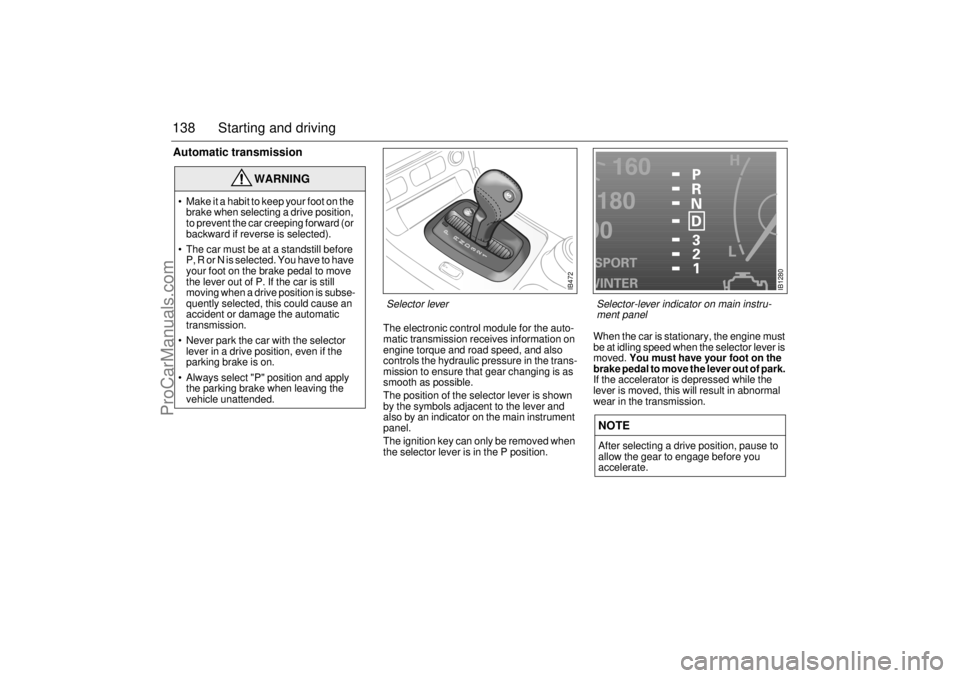
The position of the selector lever is shown
by the symbols adjacent to the lever and
also by an indicator on the main instrument
panel.
The ignition key can only be removed when
the selector lever is in the P position. When the car is stationary, the engine must
be at idling speed when the selector lever is
moved. You must have your foot on the
brake pedal to move the lever out of park.
If the accelerator is depressed while the
lever is moved, this will result in abnormal
wear in the transmission.
WARNING
Make it a habit to keep your foot on the
brake when selecting a drive position,
to prevent the car creeping forward (or
backward if reverse is selected).
The car must be at a standstill before
P, R or N is selected. You have to have
your foot on the brake pedal to move
the lever out of P. If the car is still
moving when a drive position is subse-
quently selected, this could cause an
accident or damage the automatic
transmission.
Never park the car with the selector
lever in a drive position, even if the
parking brake is on.
Always select "P" position and apply
the parking brake when leaving the
vehicle unattended.
NOTEAfter selecting a drive position, pause to
allow the gear to engage before you
accelerate.
Selector lever
IB472
IB1280
Selector-lever indicator on main instru-
ment panel
ProCarManuals.com
Page 141 of 256

141 Starting and driving
Overheated transmission fluid If the automatic-transmission fluid should
overheat, the following message will appear
on the SID:
”TRANSMISSION OVERHEATING”. If this
happens, stop the car and wait for the mes-
sage to be extinguished. Continue driving in
a locked gear that produces an engine
speed of about 3,000 rpm.
Overheating of the automatic-transmission
fluid can occur when the car is towing a
heavy load, such as a camping trailer in hilly
country, with the wrong gear selected,
resulting in abnormally frequent gear
changing. Try selecting position 1, 2 or 3.
High ambient temperatures can also
increase the temperature of the transmis-
sion fluid or the oil cooler may be faulty.
Contact an authorized Saab dealer (see
also page 152).
Towing Towing of cars with automatic transmission,
see page 158.
NOTEIf the control module has actuated the
Limp-home function for the automatic
transmission, the car will remain in 4th
gear when D is selected, making it very
sluggish. To overcome this, move the
selector lever to position 2.
WARNING
Remember to use engine-braking (selec-
tor position 1, 2, or 3) to spare the brakes
when you are driving on a long or steep
downhill slope. Select the same gear as
you would on the corresponding uphill
slope.
Brake failure can result from overheated
brakes!
ProCarManuals.com