cooling SAAB 9-5 2000 Owners Manual
[x] Cancel search | Manufacturer: SAAB, Model Year: 2000, Model line: 9-5, Model: SAAB 9-5 2000Pages: 256, PDF Size: 14.24 MB
Page 6 of 256
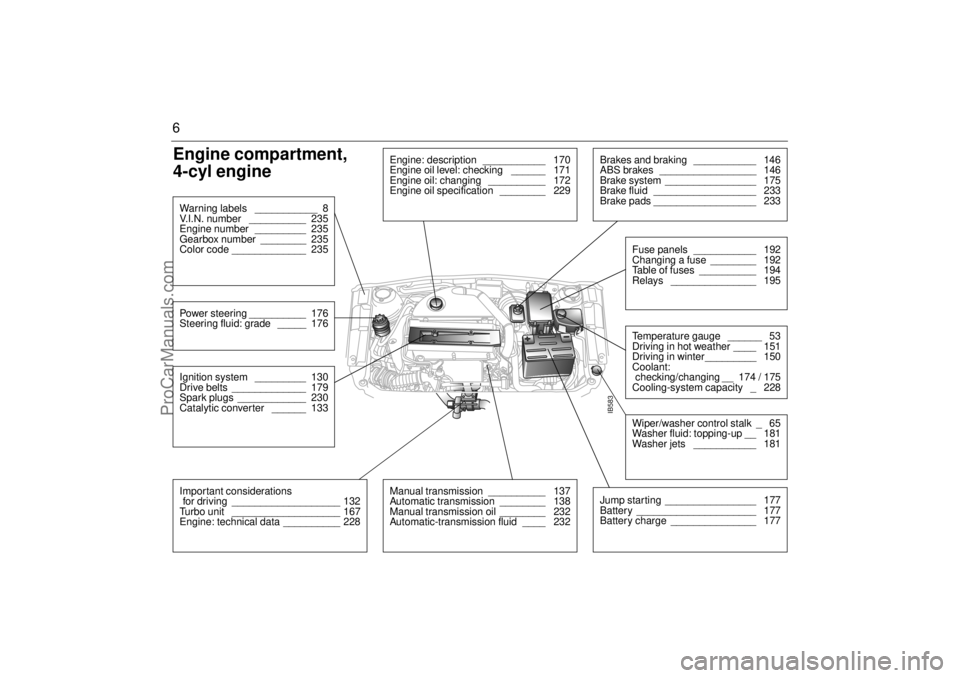
6Engine compartment,
4-cyl engine
IB583
Engine: description ___________ 170
Engine oil level: checking ______ 171
Engine oil: changing __________ 172
Engine oil specification ________ 229
Brakes and braking ___________ 146
ABS brakes _________________ 146
Brake system ________________ 175
Brake fluid __________________ 233
Brake pads __________________ 233
Fuse panels ___________ 192
Changing a fuse ________ 192
Table of fuses __________ 194
Relays _______________ 195Temperature gauge ______ 53
Driving in hot weather ____ 151
Driving in winter_________ 150
Coolant:
checking/changing __ 174 / 175
Cooling-system capacity _ 228
Power steering __________ 176
Steering fluid: grade _____ 176
Wiper/washer control stalk _ 65
Washer fluid: topping-up __ 181
Washer jets ___________ 181
Jump starting ________________ 177
Battery _____________________ 177
Battery charge _______________ 177
Manual transmission __________ 137
Automatic transmission ________ 138
Manual transmission oil ________ 232
Automatic-transmission fluid ____ 232
Important considerations
for driving ___________________ 132
Turbo unit ___________________ 167
Engine: technical data __________ 228Ignition system _________ 130
Drive belts _____________ 179
Spark plugs ____________ 230
Catalytic converter ______ 133Warning labels ___________ 8
V.I.N. number __________ 235
Engine number _________ 235
Gearbox number ________ 235
Color code _____________ 235
ProCarManuals.com
Page 7 of 256
7
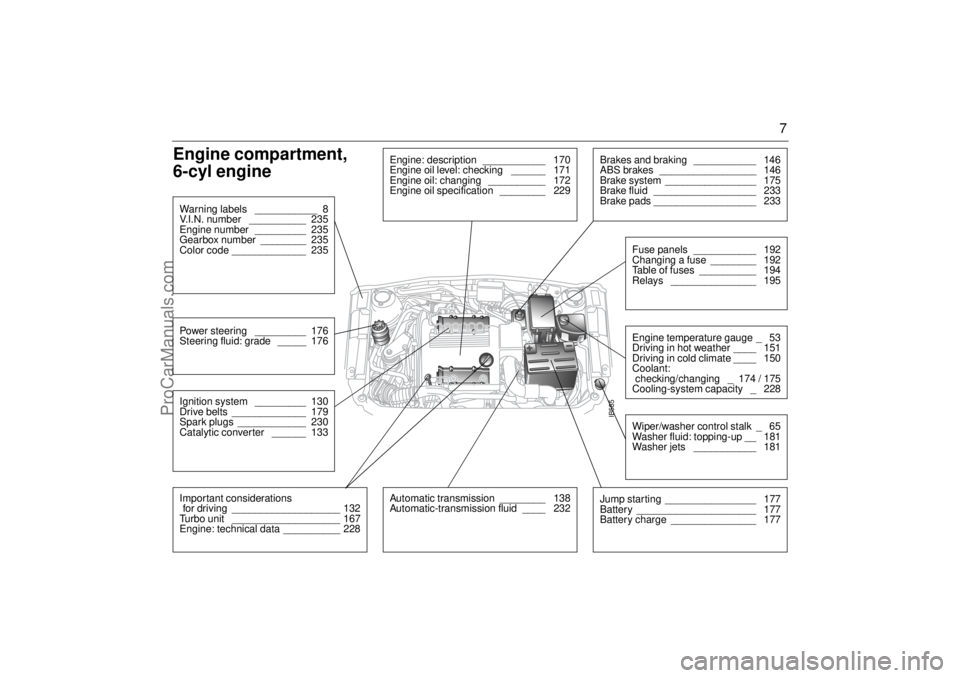
Engine compartment,
6-cyl engine
IB585
Warning labels ___________ 8
V.I.N. number __________ 235
Engine number _________ 235
Gearbox number ________ 235
Color code _____________ 235Ignition system _________ 130
Drive belts _____________ 179
Spark plugs ____________ 230
Catalytic converter ______ 133Important considerations
for driving ___________________ 132
Turbo unit ___________________ 167
Engine: technical data __________ 228
Automatic transmission ________ 138
Automatic-transmission fluid ____ 232
Brakes and braking ___________ 146
ABS brakes _________________ 146
Brake system ________________ 175
Brake fluid __________________ 233
Brake pads __________________ 233Jump starting ________________ 177
Battery _____________________ 177
Battery charge _______________ 177
Fuse panels ___________ 192
Changing a fuse ________ 192
Table of fuses __________ 194
Relays _______________ 195Engine temperature gauge _ 53
Driving in hot weather ____ 151
Driving in cold climate ____ 150
Coolant:
checking/changing _ 174 / 175
Cooling-system capacity _ 228
Power steering _________ 176
Steering fluid: grade _____ 176
Wiper/washer control stalk _ 65
Washer fluid: topping-up __ 181
Washer jets ___________ 181
Engine: description ___________ 170
Engine oil level: checking ______ 171
Engine oil: changing __________ 172
Engine oil specification ________ 229
ProCarManuals.com
Page 47 of 256
47 Instruments and controls
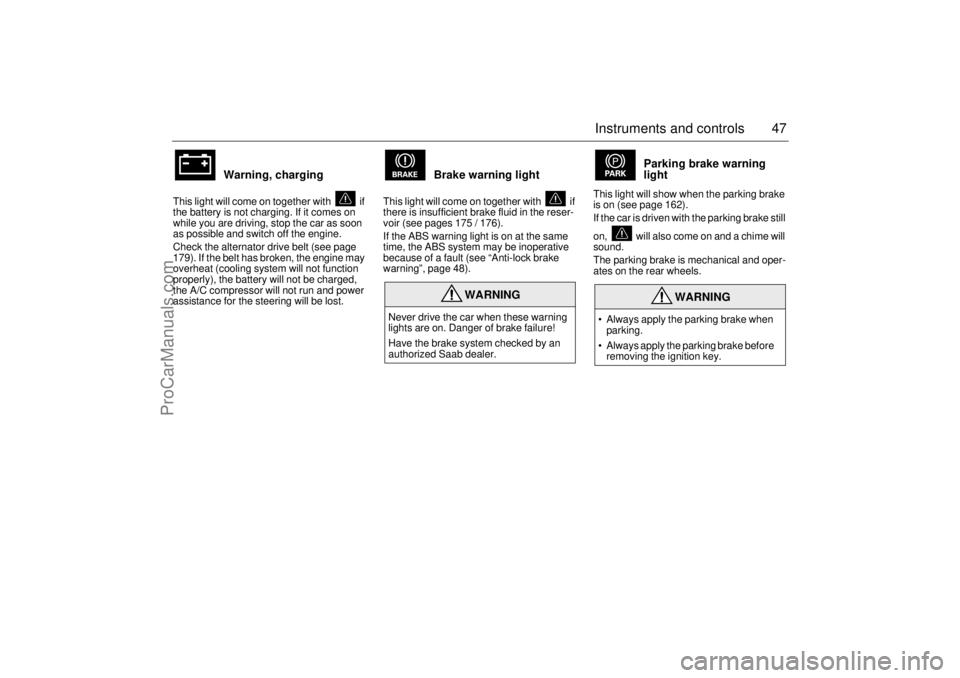
Warning, charging
This light will come on together with if
the battery is not charging. If it comes on
while you are driving, stop the car as soon
as possible and switch off the engine.
Check the alternator drive belt (see page
179). If the belt has broken, the engine may
overheat (cooling system will not function
properly), the battery will not be charged,
the A/C compressor will not run and power
assistance for the steering will be lost.
Brake warning light
This light will come on together with if
there is insufficient brake fluid in the reser-
voir (see pages 175 / 176).
If the ABS warning light is on at the same
time, the ABS system may be inoperative
because of a fault (see “Anti-lock brake
warning”, page 48).
Parking brake warning
light
This light will show when the parking brake
is on (see page 162).
If the car is driven with the parking brake still
on, will also come on and a chime will
sound.
The parking brake is mechanical and oper-
ates on the rear wheels.
WARNING
Never drive the car when these warning
lights are on. Danger of brake failure!
Have the brake system checked by an
authorized Saab dealer.
WARNING
Always apply the parking brake when
parking.
Always apply the parking brake before
removing the ignition key.
ProCarManuals.com
Page 69 of 256
69 Instruments and controls
Temperature control The cabin is divided into two temperature
zones:
The driver’s zone.
The passenger zone (front and rear
seats).
The desired temperature can be set
between 58 and 82°F (15 and 27°C). In
addition, there are also HI and LO settings
(see below). The HI and LO settings for the
passenger zone can only be selected if they
are also selected for the driver’s zone.
The displayed temperature is not the abso-
lute temperature but corresponds to the
comfort level normally experienced at that
temperature after allowance has been
made for the air flow, relative humidity, solar
radiation, etc., currently prevailing inside
the car.
The most usual temperature setting is
64-75°F (18-24°C), depending on per-
sonal preference and what clothing is
worn.
It is recommended that changes in the
temperature setting be made in steps of
2°F (1°C).
Once the desired climate has been
achieved, the rear center vents can be
closed to prevent warm air being distrib-
uted at face height.Settings when HI selected:
Maximum heat.
Air distribution to windshield and floor.
Recirculation OFF (even if manually
selected before).
Fan: high speed.
Settings shown on ACC display.
Settings when LO selected:
Maximum cooling (A/C compressor will
run even if ECON manually selected
before).
Air distribution through panel vents.
Fan: maximum speed.
Recirculation ON.
Settings shown on ACC display.
IB369
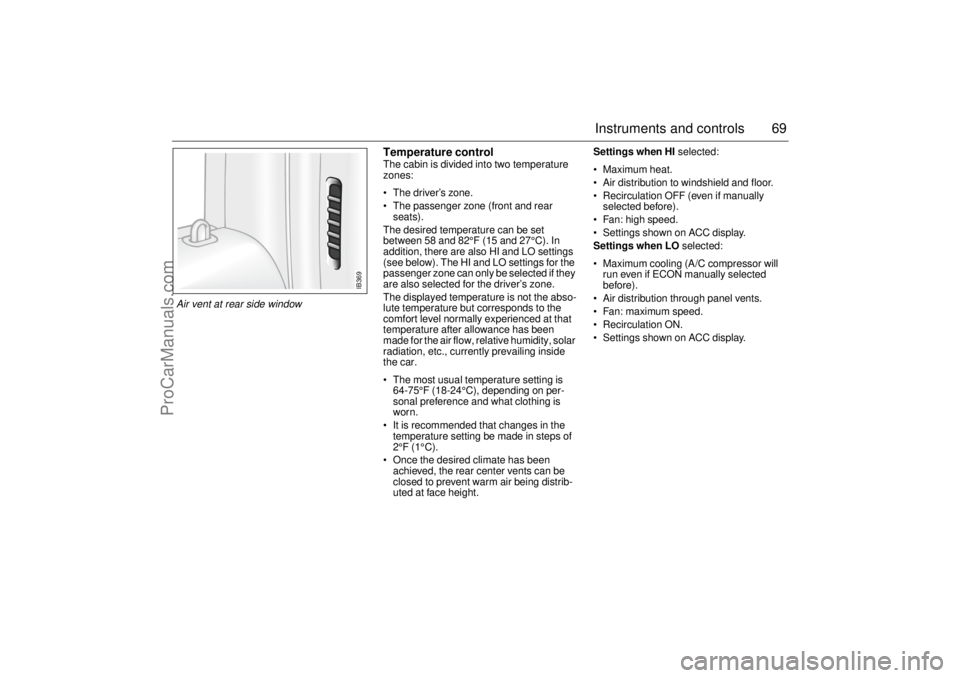
Air vent at rear side window
ProCarManuals.com
Page 70 of 256
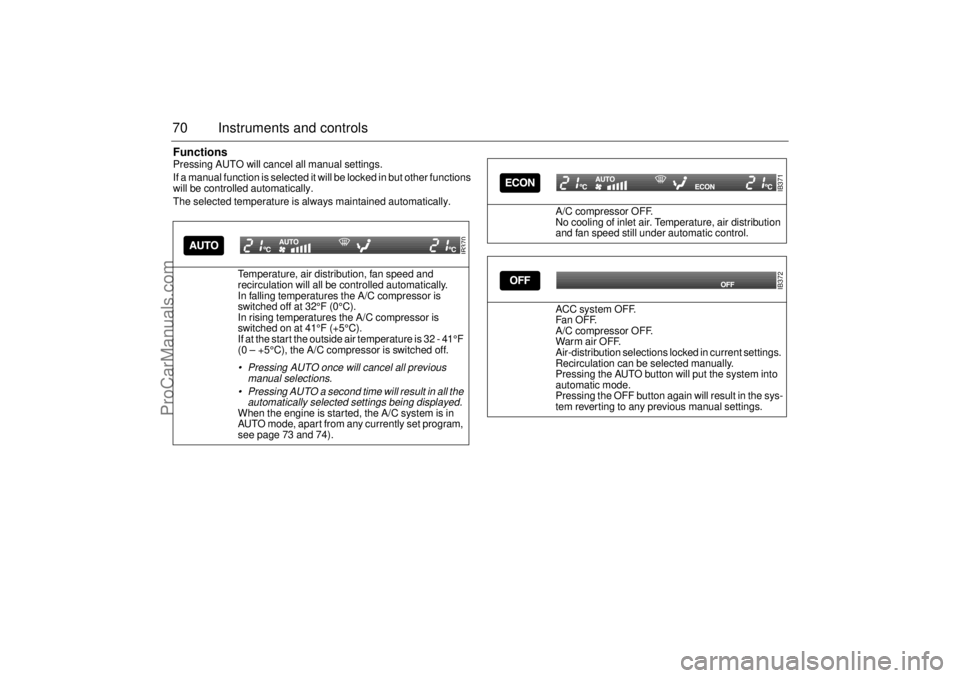
70 Instruments and controlsFunctionsPressing AUTO will cancel all manual settings.
If a manual function is selected it will be locked in but other functions
will be controlled automatically.
The selected temperature is always maintained automatically.
Temperature, air distribution, fan speed and
recirculation will all be controlled automatically.
In falling temperatures the A/C compressor is
switched off at 32°F (0°C).
In rising temperatures the A/C compressor is
switched on at 41°F (+5°C).
If at the start the outside air temperature is 32 - 41°F
(0 – +5°C), the A/C compressor is switched off.
Pressing AUTO once will cancel all previous
manual selections.
Pressing AUTO a second time will result in all the
automatically selected settings being displayed. When the engine is started, the A/C system is in
AUTO mode, apart from any currently set program,
see page 73 and 74).
IB370
A/C compressor OFF.
No cooling of inlet air. Temperature, air distribution
and fan speed still under automatic control.
ACC system OFF.
Fa n OF F.
A/C compressor OFF.
War m air OFF.
Air-distribution selections locked in current settings.
Recirculation can be selected manually.
Pressing the AUTO button will put the system into
automatic mode.
Pressing the OFF button again will result in the sys-
tem reverting to any previous manual settings.
IB371IB372
ProCarManuals.com
Page 71 of 256
71 Instruments and controls
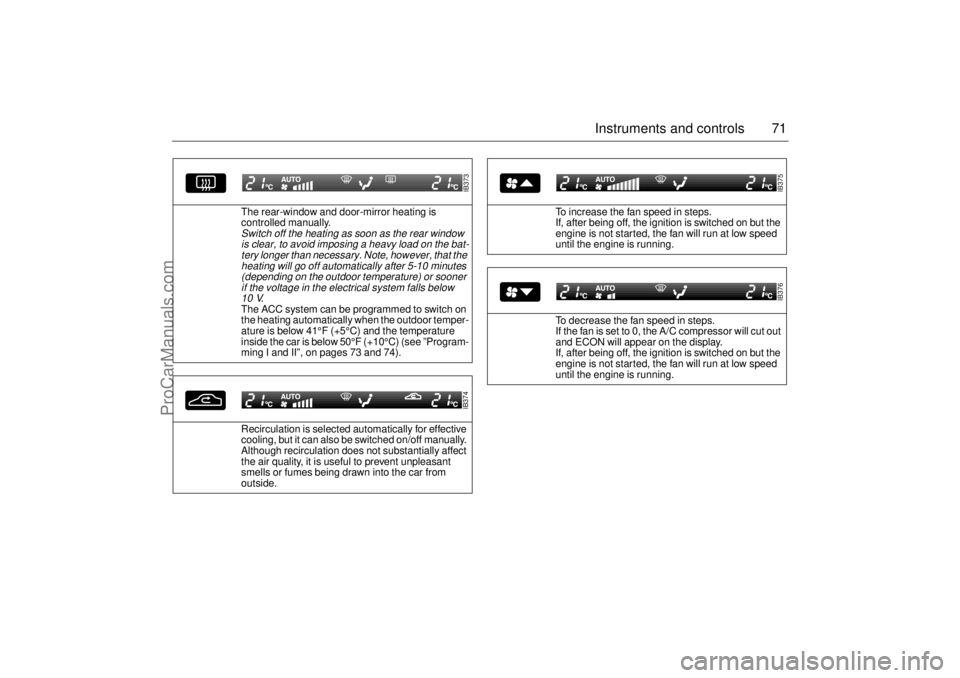
The rear-window and door-mirror heating is
controlled manually. Switch off the heating as soon as the rear window
is clear, to avoid imposing a heavy load on the bat-
tery longer than necessary. Note, however, that the
heating will go off automatically after 5-10 minutes
(depending on the outdoor temperature) or sooner
if the voltage in the electrical system falls below
10 V
.
The ACC system can be programmed to switch on
the heating automatically when the outdoor temper-
ature is below 41°F (+5°C) and the temperature
inside the car is below 50°F (+10°C) (see ”Program-
ming I and II”, on pages 73 and 74).
Recirculation is selected automatically for effective
cooling, but it can also be switched on/off manually.
Although recirculation does not substantially affect
the air quality, it is useful to prevent unpleasant
smells or fumes being drawn into the car from
outside.
IB373IB374
To increase the fan speed in steps.
If, after being off, the ignition is switched on but the
engine is not started, the fan will run at low speed
until the engine is running.
To decrease the fan speed in steps.
If the fan is set to 0, the A/C compressor will cut out
and ECON will appear on the display.
If, after being off, the ignition is switched on but the
engine is not started, the fan will run at low speed
until the engine is running.
IB375IB376
ProCarManuals.com
Page 133 of 256

133 Starting and driving
advantages of the system is that it
enables the engine to be run safely on
lower-grade fuel, although not lower
than AON 87.
The maximum boost pressure is
adjusted automatically to the knocking
or pinging tendency of the engine.
Occasional, short-lived knocking when
the engine is under a heavy load is per-
fectly normal; the extent will depend on
the grade of fuel in the tank.
Isolated instances of knocking are
more likely to occur with low-octane
fuel. This controlled form of knocking,
followed by a reduction in the boost
pressure, is a sign that the wastegate is
functioning and is perfectly safe for the
engine.
Important considerations with cata-
lytic convertersThe catalytic converter is an emission-con-
trol device incorporated in the car’s exhaust
system. It consists of a metal canister with a
honeycomb insert, the cells of which have
walls coated in a catalytic layer (mixture of
precious metals).
NOTEIf constant knocking occurs every time a
load is put on the engine, this indicates a
malfunction in the system.
Have the car checked without delay by an
authorized Saab dealer.
WARNING
If the engine is being run with the car on a
rolling road or dynamometer, to ensure
adequate cooling, air must be blown into
the engine compartment and under the
car at a rate equivalent to the ram-air
effect that would be obtained at the corre-
sponding road speed.
NOTEUse only unleaded gasoline. Leaded gas-
oline is detrimental to the catalyst and
oxygen sensor and will seriously impair
the function of the catalytic converter.
IB661
2
1
3
Oxygen-sensor-controlled
injection system 1 Engine control module
2 Oxygen sensor (lambda probe)
3 Catalytic converter
ProCarManuals.com
Page 152 of 256

152 Starting and driving3 As soon as possible, have the cooling
system checked by an authorized Saab
dealer.
Towing a trailerTrailer hitch attachmentTrailer hitch attachments are available as
accessories. These are designed for a max-
imum trailer weight of 2000 lbs. (900 kg).
Use only the electrical trailer hitch socket
provided in the spare wheel area in the lug-
gage compartment for connecting the trailer
electrics.
Trailer weightMaximum recommended trailer weights for
different gradients, with a view to comfort
and drivability for manual and automatic
cars, are shown on the drawing.
Make sure you are familiar with the law
regarding speed limits for towing, maxi-
mum trailer weights, trailer-braking
requirements, and also any special
driving-licence provisions
(see also page 227).
The specified trailer weights and gradients
assume that the journey starts at the hill and
therefore apply only to short periods.
WARNING
Always undo the expansion tank filler cap
carefully, releasing the pressure and any
vapor before removing the cap com-
pletely.
NOTEUse only a genuine Saab trailer hitch,
since other models can damage the car’s
bodywork and electrical system (or in
Canada, a high quality hitch designed to
fit the car, available from a trailer hitch
specialist).
Consult an authorized Saab dealer for
guidance on how to connect the trailer
hitch electrical system.
WARNING
When towing a trailer, do not attempt to
negotiate a hill having a gradient in
excess of 15%. The weight distribution
over the front wheels of the car will be
insufficient to prevent wheelspin, making
further progress impossible.
In addition, the parking brake may not
always be able to hold the car and trailer
securely, with the result that the wheels
can start to slide downhill.
ProCarManuals.com
Page 153 of 256

153 Starting and driving
Recommendations for cars with auto-
matic transmission.
The following time limits are based on the
capacity of the cooling system in warm
weather, i.e. approximately 104°F (40°C).
When negotiating long hills, bear the follow-
ing important considerations in mind:
If TRANSMISSION OVERHEATING
appears on the SID, stop the car as soon as
it is safe to do so and wait until the warning
has been extinguished. When continuing
your journey, select a locked gear (1, 2 or 3)
that will allow you to drive at an engine
speed of about 3,000 rpm (see page 142).
Do not drive continuously with the WINTER
mode selected in hilly country when you are
towing a trailer, as this will increase fuel con-
sumption and risk overheating the transmis-
sion.
Trailer hitch loadThe weight distribution on the trailer makes
a lot of difference to the handling properties
of the car and trailer combination. As
regards single-axle trailers, whenever pos-
sible, concentrate the load over the wheels
and keep it as low as possible.
The trailer should be loaded so that the
maximum load on the towbar ball is 5% to
7% of the trailer weight with a maximum per-
missible tongue weight of 165 lbs. (75 kg).
Note that this load must be added to the total
load for the car. If this now exceeds the
specified load capacity, the load in the lug-
gage compartment will have to be reduced
by a corresponding amount. Driving considerations Always take extra care when towing a
trailer, as the car’s handling will be different
and its braking effect reduced. The trailer’s
braking system and suspension also have a
considerable effect on these characteris-
tics.
If the car is equipped with automatic trans-
mission, select position 1 when ascending
or descending steep hills. Gradient
of hill, % Maximum
trailer
weight, lbs.
(kg)Maximum dura-
tion, minutes
6-7 2000 (900) unlimited
8-9 2000 (900) 15 max
10-15 1000 (450) 15 max. NOTEIf the “Fault indicator, automatic trans-
mission” indicator comes on, cease
towing until the problem has been recti-
fied.
IB106
Distribution of load in trailer a Light
b Moderate
cHeavy
ProCarManuals.com
Page 174 of 256
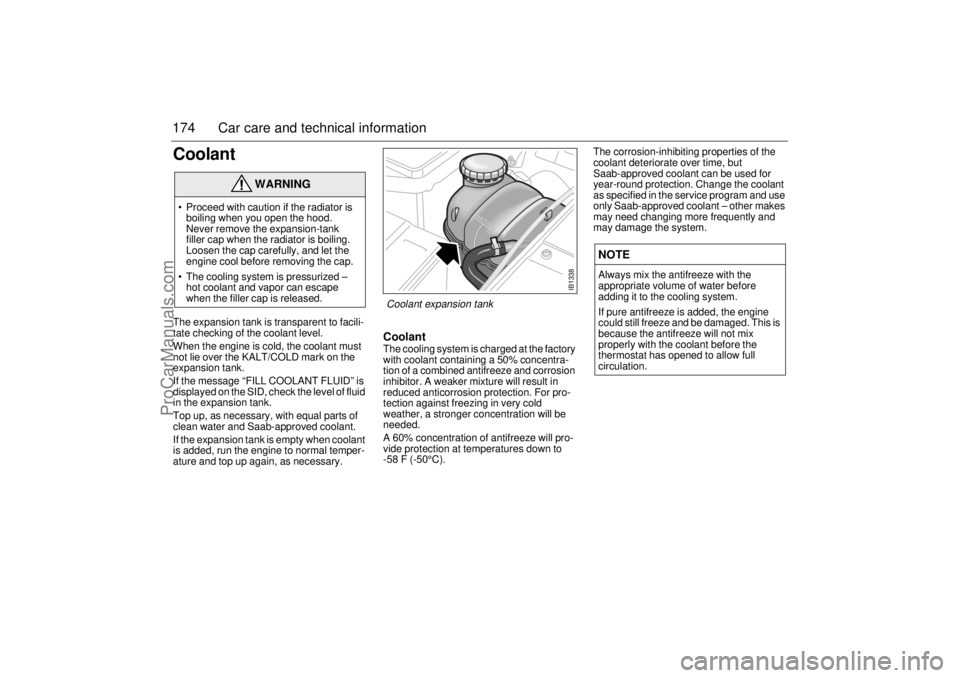
174 Car care and technical informationCoolant The expansion tank is transparent to facili-
tate checking of the coolant level.
When the engine is cold, the coolant must
not lie over the KALT/COLD mark on the
expansion tank.
If the message “FILL COOLANT FLUID” is
displayed on the SID, check the level of fluid
in the expansion tank.
Top up, as necessary, with equal parts of
clean water and Saab-approved coolant.
If the expansion tank is empty when coolant
is added, run the engine to normal temper-
ature and top up again, as necessary.
Coolant The cooling system is charged at the factory
with coolant containing a 50% concentra-
tion of a combined antifreeze and corrosion
inhibitor. A weaker mixture will result in
reduced anticorrosion protection. For pro-
tection against freezing in very cold
weather, a stronger concentration will be
needed.
A 60% concentration of antifreeze will pro-
vide protection at temperatures down to
-58 F (-50°C).The corrosion-inhibiting properties of the
coolant deteriorate over time, but
Saab-approved coolant can be used for
year-round protection. Change the coolant
as specified in the service program and use
only Saab-approved coolant – other makes
may need changing more frequently and
may damage the system.
WARNING
Proceed with caution if the radiator is
boiling when you open the hood.
Never remove the expansion-tank
filler cap when the radiator is boiling.
Loosen the cap carefully, and let the
engine cool before removing the cap.
The cooling system is pressurized –
hot coolant and vapor can escape
when the filler cap is released.
NOTEAlways mix the antifreeze with the
appropriate volume of water before
adding it to the cooling system.
If pure antifreeze is added, the engine
could still freeze and be damaged. This is
because the antifreeze will not mix
properly with the coolant before the
thermostat has opened to allow full
circulation.
IB1338
Coolant expansion tank
ProCarManuals.com