hood open SAAB 9-5 2000 Owners Manual
[x] Cancel search | Manufacturer: SAAB, Model Year: 2000, Model line: 9-5, Model: SAAB 9-5 2000Pages: 256, PDF Size: 14.24 MB
Page 34 of 256
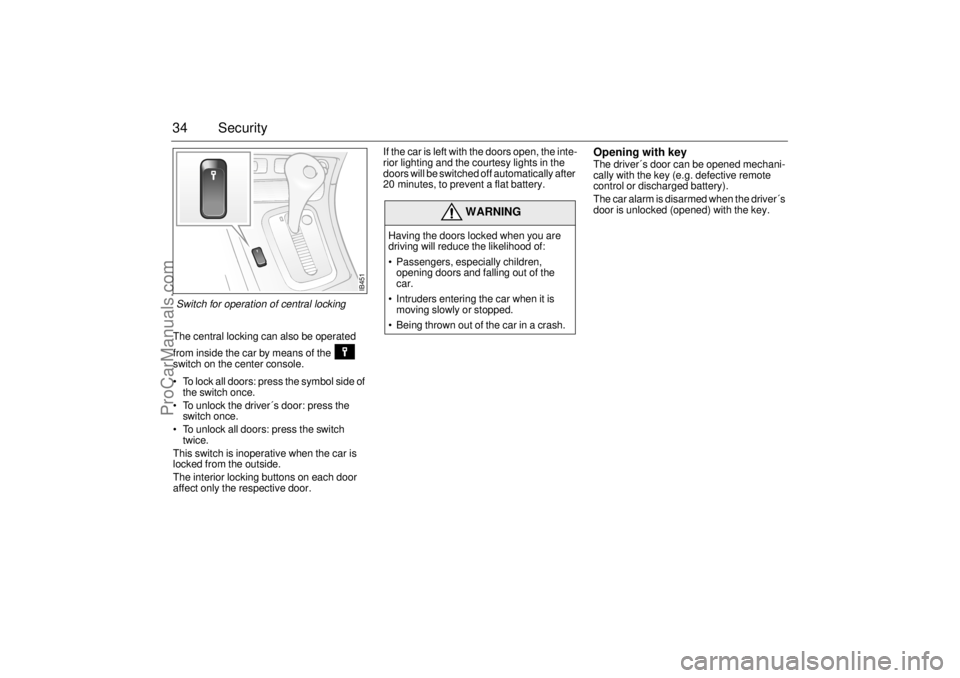
34 SecurityThe central locking can also be operated
from inside the car by means of the
switch on the center console.
To lock all doors: press the symbol side of
the switch once.
To unlock the driver´s door: press the
switch once.
To unlock all doors: press the switch
twice.
This switch is inoperative when the car is
locked from the outside.
The interior locking buttons on each door
affect only the respective door.If the car is left with the doors open, the inte-
rior lighting and the courtesy lights in the
doors will be switched off automatically after
20 minutes, to prevent a flat battery.
Opening with keyThe driver´s door can be opened mechani-
cally with the key (e.g. defective remote
control or discharged battery).
The car alarm is disarmed when the driver´s
door is unlocked (opened) with the key.
WARNING
Having the doors locked when you are
driving will reduce the likelihood of:
Passengers, especially children,
opening doors and falling out of the
car.
Intruders entering the car when it is
moving slowly or stopped.
Being thrown out of the car in a crash.
IB451
Switch for operation of central locking
ProCarManuals.com
Page 38 of 256
38 SecurityCar alarm The car alarm (anti-theft system) is acti-
vated/deactivated when the car is
locked/unlocked by the remote control or by
the key, see page 33.
The antenna for the alarm system is located
in the center console.
All the doors plus trunk lid and hood are
monitored by microswitches, and win-
dow-glass sensors will trigger the alarm if
any glass is broken. Electronic starting interlock (immobilizer),
see page 39.
The car alarm is armed 10 seconds after the
car has been locked by the remote control.
During this ten-second delay period, the
doors, trunk lid and hood may still be
opened without the alarm being triggered.
The LED indicator on the instrument panel
fascia will be on continuously during this
period, at the end of which it will start to flash
(once every third second). If a door or the trunk lid or hood has been left
open when the car is locked, the LED on the
fascia will flash (three times per second) for
ten seconds to indicate that something is
wrong.
Check to ensure that all the doors, plus
trunk lid and hood, are closed properly.
If the fault persists (LED flashing when
renewed attempt made to activate the car
alarm by remote control), lock the car using
the key instead. The car alarm will not have
been activated and you should get in touch
with an authorized Saab dealer.
To avert inconvenience caused by the
alarm being triggered inadvertently, make
sure that anyone else using the car is famil-
iar with how both the car alarm and the lock-
ing system work.
WARNING
Leaving children or pets unattended in a
locked car is dangerous. It is also danger-
ous to leave children in a vehicle with the
ignition key. A child or others could be
badly injured or even killed.
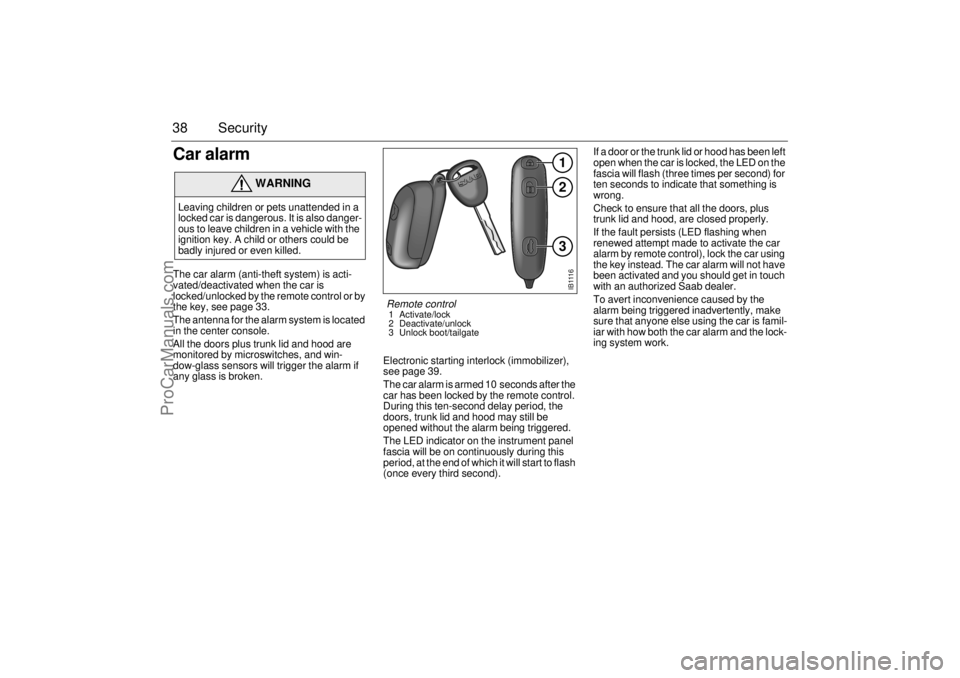
I B 111 6
123
Remote control 1 Activate/lock
2 Deactivate/unlock
3 Unlock boot/tailgate
ProCarManuals.com
Page 39 of 256

39 Security
Activating the car alarm The car alarm (anti-theft system) is
activated/deactivated when the car is
locked/unlocked by the remote control or by
the key.
The car alarm cannot be activated if the
driver’s door is open or if the ignition switch
is in position ON.
If, on the other hand, one of the other doors
or the trunk or hood is open or opened and
not closed again during the 10-seconds
delay period, it will be excluded from the
alarm function.
If it is then closed, a new delay period of ten
seconds will start, and the door (or trunk or
hood will once again be secured by the
alarm system.
As usual, the LED will be on continuously
during the new delay period and will start to
flash once every third second after the
10-seconds period has elapsed.
Window-glass sensorThe car-alarm system incorporates a
sensor that monitors the window glass for
the sound of breakage. The sensor is fitted
inside the rear dome light.
To avoid false alarms, such as the alarm
being triggered by children or pets left inside
the car, the sensor can be temporarily dis-
abled.
To disable the sensor
To disable the sensor, first ensure that the
ignition has been switched off and key
removed from the switch. Then, press and
hold the NIGHT PANEL button until ”DOOR
ALARM ONLY” appears on the SID and a
chime sounds. The car alarm must now be
activated within three minutes, or the glass
sensor will become active again.
The glass sensor will be enabled again
automatically when the car is next unlocked.
The sensor can also be enabled again by
repeating the procedure for disabling it.
When the sensor has been enabled, ”FULL
THEFT ALARM” will appear on the SID.
If a fault is detected in the glass sensor,
”SERVICE THEFT ALARM” will appear on
the SID.
Electronic starting interlock
(immobilizer) When the key is inserted in the ignition, a
signal is sent to the receiver. If the signal is
verified, the engine can be started.
Each time the key is removed from the igni-
tion, the electronic immobilizer is activated.
This means that the car cannot be started
without the correct key is inserted in the igni-
tion and the immobilizer is thus deactivated.
If a fault is detected (e.g. in the transmitter)
”KEY NOT ACCEPTED” will appear on the
SID.
In this case, you can still start the car if you
turn the ignition key to ON and press one of
the buttons on the remote control (providing
that the receiver gets the right signal from
the remote control).
Take the car to an authorized Saab dealer to
have the system checked.
The LED double-flashes when the car is
immobilized.
ProCarManuals.com
Page 40 of 256

40 SecurityAlarm signals When the car alarm is armed, it will be trig-
gered if any door, or the trunk lid or hood, is
opened or if a window is broken.
The alarm will also be triggered if an attempt
is made to bypass or short-circuit the igni-
tion switch, or to disconnect the battery.
If the alarm is triggered, the following alarm
signals will be set off:
Flashing of hazard warning lights for five
minutes.
Siren wailing for 30 seconds.
The alarm signals will stop if the alarm is
deactivated (car unlocked) during the alarm
period.
The alarm siren has a long-life battery
(approx. 10 years), see "SERVICE THEFT
ALARM", on page 42. When the battery
goes dead, the siren must be replaced: it is
not possible to change the batteries.
Panic-functionIn the car alarm system is a function called
"Panic-function".
To activate panic function:
Push and hold one of the buttons on the
remote control for 2 seconds, or if you are
sitting inside the car
Push the LOCK-switch on the center con-
sole for 2 seconds.
These actions will trigger the alarm (hazard
warning lights and siren).
To deactivate panic function:
Push one of the buttons on the remote
control, push the LOCK-switch in the
center console, turn the key in one of the
doors or turn the ignition to ON.
When the panic-function is activated the car
will be locked/unlocked depending upon
which button was pushed.
When the ignition is ON the panic-function
cannot be activated.
NOTE It is possible to inadvertently deacti-
vate the car alarm and at the same
time unlock the car, if the button on the
remote control is pressed by mistake
when the control is still within range of
the car.
When locking the car by remote con-
trol in extremely cold weather, it is
advisable to check that the lock
system has operated properly. To do
so, check that the interior locking but-
tons are all down.
If not, unlock and relock the car again.
ProCarManuals.com
Page 42 of 256

42 SecurityOverview of LED signals and SID messagesSome signals may differ between model variants for different
countries.Status LED signal
Activation (during 10-second delay). Comes on for 10 seconds.
Alarm activated (after delay). Flashes once every third
second.
Deactivation. Comes on for 2 seconds.
Alarm not activated. Off.
Door, trunk lid/tailgate or hood open
or opened during delay period.Flashes three times per sec-
ond for 10 seconds.
Unlocking the trunk lid/tailgate. Flashes three times per sec-
ond for 10 seconds.
Closing of door, trunk lid/tailgate or
hood after delay period.Comes on for 10 seconds.
Car immobilized but not locked.
Car alarm not activated.Flashes twice at three sec-
onds intervals.
SID message Reason/action
SERVICE THEFT ALARM Probably a fault in one of the sensors
or the alarm siren.
Have the car checked by an autho-
rized Saab dealer.
KEY NOT ACCEPTED Fault in key transmitter or in igni-
tion-switch receiver.
Turn ignition switch to ON and press
the unlock button on the remote con-
trol. Start the engine.
Have the car checked by an autho-
rized Saab dealer.
REPLACE KEY BATTERY Fit a new battery in the remote con-
trol, see page 35.
DOOR ALARM ONLY Window-glass sensor disabled.
FULL THEFT ALARM Window-glass sensor in circuit.
REMOTE KEY
TRANSPONDRTurn the ignition key to position ON
and then press the button for open-
ing the trunk lid. SID displays the
number of remote controls and
transmitters (transponders) coded to
the car.
ProCarManuals.com
Page 54 of 256
54 Instruments and controlsCheck fuse 15 (radiator fan) in the fuse
panel under the hood, see page 196.
If the needle repeatedly enters the red zone,
stop the car as soon as it is safe to do so and
check the coolant level by looking at the
level visible through the plastic tank - do not
remove the cap.
If the coolant level falls below the MIN mark,
the SID will display the message ”FILL
COOLANT FLUID”.
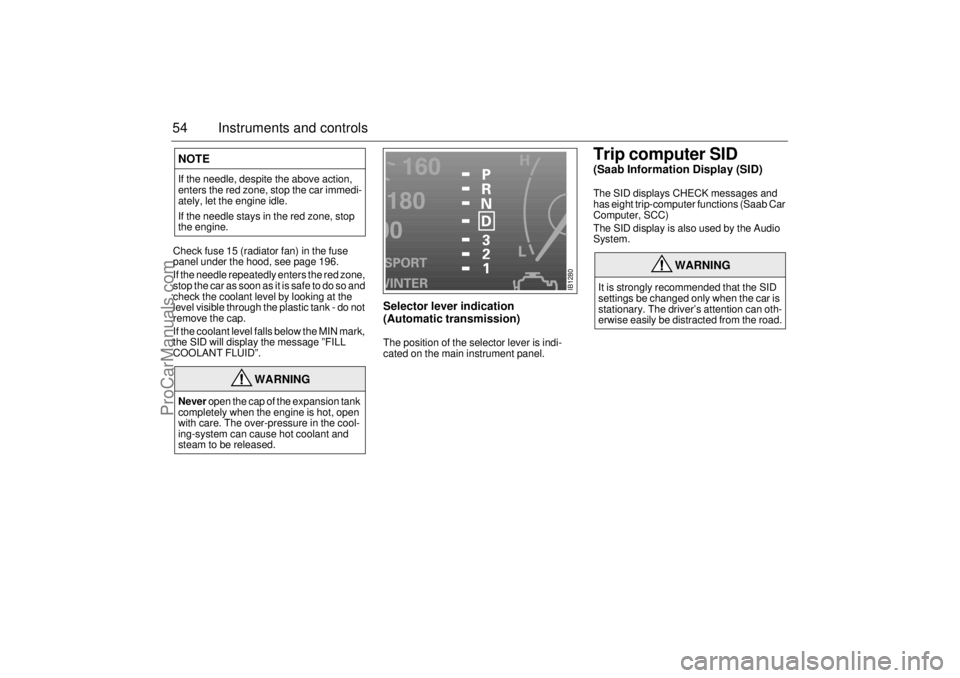
Selector lever indication
(Automatic transmission) The position of the selector lever is indi-
cated on the main instrument panel.
Trip computer SID (Saab Information Display (SID) The SID displays CHECK messages and
has eight trip-computer functions (Saab Car
Computer, SCC)
The SID display is also used by the Audio
System.
NOTEIf the needle, despite the above action,
enters the red zone, stop the car immedi-
ately, let the engine idle.
If the needle stays in the red zone, stop
the engine.
WARNING
Never open the cap of the expansion tank
completely when the engine is hot, open
with care. The over-pressure in the cool-
ing-system can cause hot coolant and
steam to be released.
WARNING
It is strongly recommended that the SID
settings be changed only when the car is
stationary. The driver’s attention can oth-
erwise easily be distracted from the road.
IB1280
ProCarManuals.com
Page 67 of 256
67 Instruments and controls
Automatic climate
control (ACC) The ACC system automatically works to
maintain the desired temperature inside the
car.
The system will achieve the desired temper-
ature in the quickest possible way. Note that
selecting a higher or lower temperature than
that desired will not speed up the process.
For the ACC system to be most effective, all
windows (and sunroof, if fitted) should be
closed.
Fresh air for the cabin is drawn in through an
inlet grille adjacent to the bottom edge of the
windshield. The air flows through a filter
upstream of the ACC system before deliv-
ery to the cabin. Cabin air is evacuated via
openings in the rear parcel shelf and then
through outlets on either side of the car
behind the rear bumper.
The incoming air is treated in three stages:
first it passes through a filter; it is then dehu-
midified and cooled and, finally, if required,
heated.
The ACC system also includes a charcoal
filter which further improves the quality of
the cabin air. This filter is a special benefit to
allergy sufferers, as it reduces concentra-
tions of noxious substances, such as ben-
zene and toluene. To reduce the likelihood of misting on the
insides of the windows, the glass should be
cleaned with a quality window cleaner. How
often this will need to be done depends on
how clean the air is – if there are smokers in
the car, cleaning will need to be done more
frequently.
AUTO
ECON OFF
AUTO
ºF
ºC
ºF
ºC
ECON OFF
IB367
9
1
5
4
23
68
7
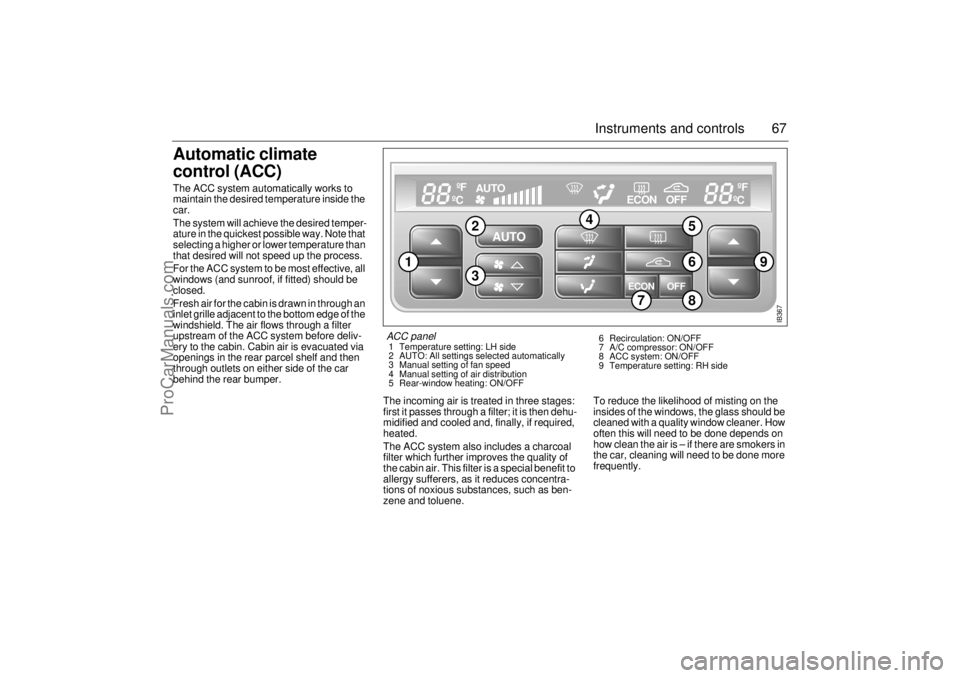
ACC panel 1 Temperature setting: LH side
2 AUTO: All settings selected automatically
3 Manual setting of fan speed
4 Manual setting of air distribution
5 Rear-window heating: ON/OFF 6 Recirculation: ON/OFF
7 A/C compressor: ON/OFF
8 ACC system: ON/OFF
9 Temperature setting: RH side
ProCarManuals.com
Page 150 of 256

150 Starting and drivingIf idling, it will take much longer before the
engine becomes hot. Engine wear is
greatest during this warming-up phase.
Therefore drive away as soon as possible
after the engine is started and avoid high
revving.
Driving in a low gear results in higher fuel
consumption than in a high gear because
of the higher engine speed for a given
road speed. Always change up to a higher
gear as soon as traffic conditions allow
and use the highest gear as much as pos-
sible.
Check the air pressure in the tires once a
month. Incorrect pressures increase tire
wear. It is better to have slightly higher
pressure than lower.
Check fuel consumption regularly.
Increased consumption can indicate that
something is wrong and that the car
needs to be checked by an authorized
Saab dealer.
Practical trials on the roads have demon-
strated that substantial savings in fuel con-
sumption can be made if the above advice
is heeded.
Road conditions Wet roads increase fuel consumption, as do
unpaved roads and driving in hilly country
(the amount of fuel saved driving downhill is
less than the additional amount required to
climb the hill). Engine block heater (standard
equipment in Canada, accessory in
U.S.)The following are just some of the benefits
to the car and the environment of using an
engine block heater:
Lower fuel consumption.
Reduced wear on the engine.
Inside of car warms up faster.
Exhaust emissions substantially reduced
over short runs.
The engine heater is effective at outside
temperatures up to +15-20°C. The warmer
it is outside, the shorter the time the engine
heater needs to be connected. Longer than
1.5 hours is unnecessary.
If the car is equipped with a removable,
electrical cabin heater that is not in use, this
should be stored in the luggage compart-
ment.
Driving in winterBefore starting a journey in cold weather,
check that the wiper blades have not
become frozen to the glass. Brush any snow
away from the air intake for the heater
system (opening between hood and wind-
shield).
Periodically during the winter, add gasoline
anti-freeze to the fuel to dispel any conden-
sation in the fuel tank which could freeze
and cause problems in the system. Keep
the tank well filled to reduce the risk of con-
densation forming.
If the car is parked outside in freezing
weather, fuel additives (gasoline
anti-freeze) will not do any good as any con-
densation in the fuel tank will freeze. Con-
densation is caused by changes in the out-
door temperature or by the car being parked
alternately in a garage and outside.
It is particularly important when the roads
are slippery that the brakes and tires be in
good condition.
The car is equipped with tires designed to
provide optimum grip on both wet and dry
roads, although this has been achieved at
the expense of somewhat reduced grip on
snow and ice. For regular driving on snow
and ice, we therefore recommend that
winter (snow) tires be fitted.
Winter (snow) tires, particularly studded
tires (where use is legally permitted), gener-
ally make driving safer on snow and ice.
If winter tires are fitted, the same type must
be fitted on all wheels. Your Saab dealer will
ProCarManuals.com
Page 160 of 256

160 Starting and drivingJump startingIf your battery has run down, you may want
to use another vehicle and some jumper
cables to start your Saab. Follow the steps
below to do it safely.
To jump start your vehicle:
1 Check the other vehicle. It must have a
12-volt battery with a negative ground
system.
2 Get the vehicles close enough so the
jumper cables can reach, but be sure the
vehicles are not touching each other. If a
poor connection on the negative jumper
cable should exist, it is possible for
damage to be caused to electrical sys-
tems/components of either vehicle
should inadvertent contact be made.
You would not be able to start your car and bad grounding could damage elec-
trical systems.
3 Turn off the ignition on both vehicles.
Turn off all lights that are not needed,
and radios. This will avoid sparks and
help save both batteries and it could
save your radio.
4 Open the hood and locate the battery.
Find the positive (+) and negative (-) termi-
nals on the battery.
WARNING
Batteries can cause injury. They can be
dangerous because:
They contain acid that can burn you.
They contain gas that can explode or
ignite.
They contain enough electricity to
injure you.
If you do not follow these steps exactly,
some or all of these things can hurt you.NOTEIgnoring these steps could result in costly
damage to your vehicle that would not be
covered by your warranty.
Trying to start your car by pushing or pull-
ing it could damage your vehicle, even if
you have a manual transmission. If you
have an automatic transmission, your
vehicle cannot be started by pushing or
pulling it.
NOTEIf the other system is not a 12-volt system
with a negative ground, both vehicles can
be damaged.
WARNING
You could be injured if the vehicles roll.
Set the parking brake firmly on each vehi-
cle. Put an automatic transmission in P
(Park) or a manual transmission in Neu-
tral.NOTEIf you leave your radio on, it could be
badly damaged. The repairs would not be
covered by your warranty.
+
–
+
–
IB484
ProCarManuals.com
Page 163 of 256
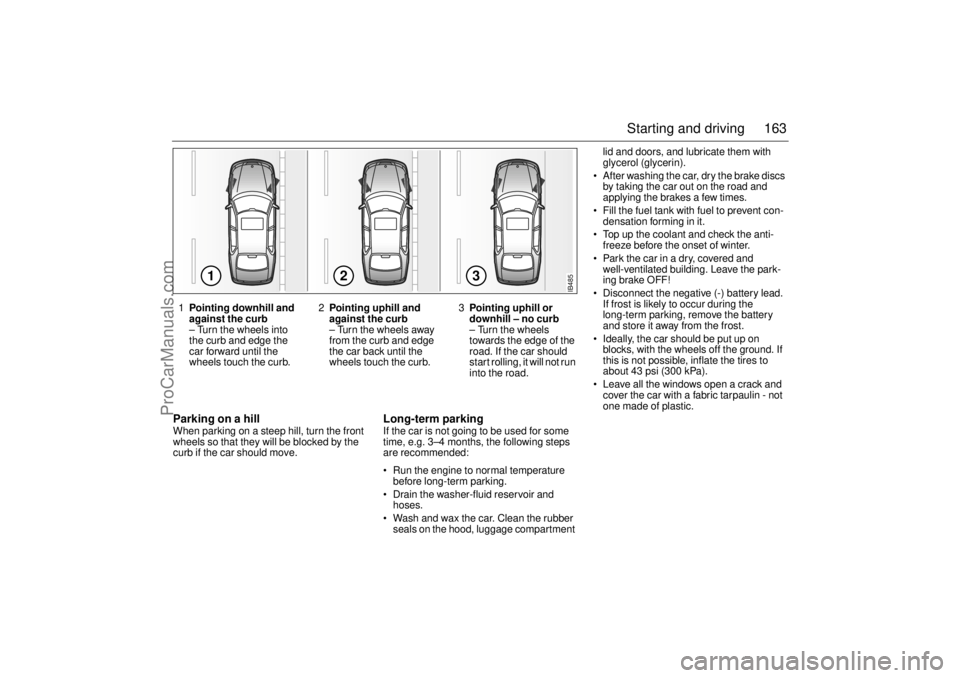
163 Starting and driving
Parking on a hillWhen parking on a steep hill, turn the front
wheels so that they will be blocked by the
curb if the car should move.
Long-term parkingIf the car is not going to be used for some
time, e.g. 3–4 months, the following steps
are recommended:
Run the engine to normal temperature
before long-term parking.
Drain the washer-fluid reservoir and
hoses.
Wash and wax the car. Clean the rubber
seals on the hood, luggage compartment lid and doors, and lubricate them with
glycerol (glycerin).
After washing the car, dry the brake discs
by taking the car out on the road and
applying the brakes a few times.
Fill the fuel tank with fuel to prevent con-
densation forming in it.
Top up the coolant and check the anti-
freeze before the onset of winter.
Park the car in a dry, covered and
well-ventilated building. Leave the park-
ing brake OFF!
Disconnect the negative (-) battery lead.
If frost is likely to occur during the
long-term parking, remove the battery
and store it away from the frost.
Ideally, the car should be put up on
blocks, with the wheels off the ground. If
this is not possible, inflate the tires to
about 43 psi (300 kPa).
Leave all the windows open a crack and
cover the car with a fabric tarpaulin - not
one made of plastic.
123
IB485
1Pointing downhill and
against the curb
– Turn the wheels into
the curb and edge the
car forward until the
wheels touch the curb.2Pointing uphill and
against the curb
– Turn the wheels away
from the curb and edge
the car back until the
wheels touch the curb.3Pointing uphill or
downhill – no curb
– Turn the wheels
towards the edge of the
road. If the car should
start rolling, it will not run
into the road.
ProCarManuals.com