coolant temperature SAAB 9-5 2000 Owners Manual
[x] Cancel search | Manufacturer: SAAB, Model Year: 2000, Model line: 9-5, Model: SAAB 9-5 2000Pages: 256, PDF Size: 14.24 MB
Page 6 of 256
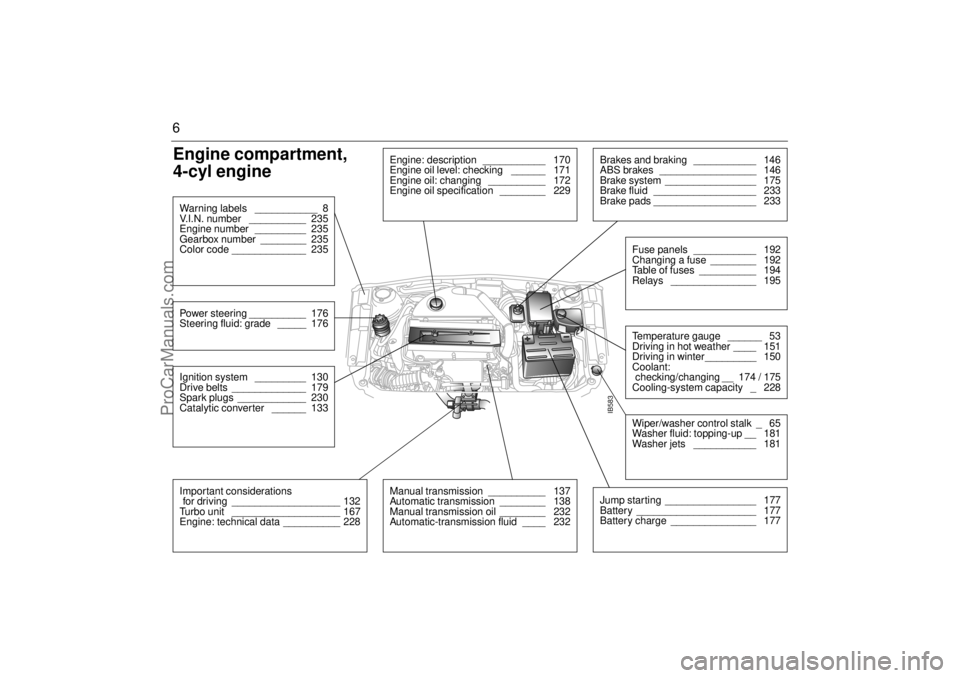
6Engine compartment,
4-cyl engine
IB583
Engine: description ___________ 170
Engine oil level: checking ______ 171
Engine oil: changing __________ 172
Engine oil specification ________ 229
Brakes and braking ___________ 146
ABS brakes _________________ 146
Brake system ________________ 175
Brake fluid __________________ 233
Brake pads __________________ 233
Fuse panels ___________ 192
Changing a fuse ________ 192
Table of fuses __________ 194
Relays _______________ 195Temperature gauge ______ 53
Driving in hot weather ____ 151
Driving in winter_________ 150
Coolant:
checking/changing __ 174 / 175
Cooling-system capacity _ 228
Power steering __________ 176
Steering fluid: grade _____ 176
Wiper/washer control stalk _ 65
Washer fluid: topping-up __ 181
Washer jets ___________ 181
Jump starting ________________ 177
Battery _____________________ 177
Battery charge _______________ 177
Manual transmission __________ 137
Automatic transmission ________ 138
Manual transmission oil ________ 232
Automatic-transmission fluid ____ 232
Important considerations
for driving ___________________ 132
Turbo unit ___________________ 167
Engine: technical data __________ 228Ignition system _________ 130
Drive belts _____________ 179
Spark plugs ____________ 230
Catalytic converter ______ 133Warning labels ___________ 8
V.I.N. number __________ 235
Engine number _________ 235
Gearbox number ________ 235
Color code _____________ 235
ProCarManuals.com
Page 7 of 256
7
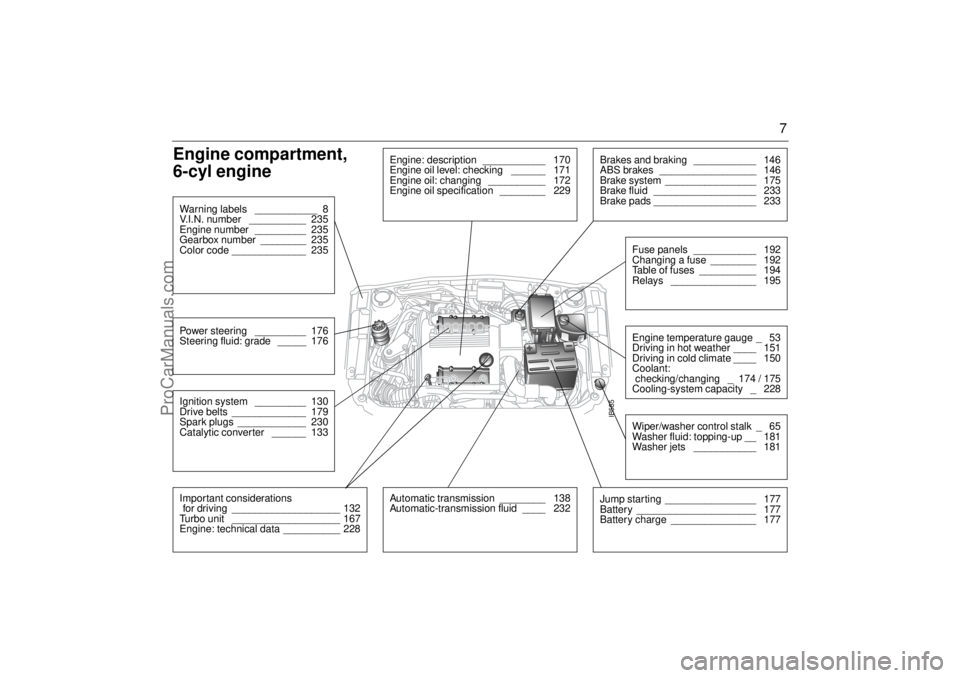
Engine compartment,
6-cyl engine
IB585
Warning labels ___________ 8
V.I.N. number __________ 235
Engine number _________ 235
Gearbox number ________ 235
Color code _____________ 235Ignition system _________ 130
Drive belts _____________ 179
Spark plugs ____________ 230
Catalytic converter ______ 133Important considerations
for driving ___________________ 132
Turbo unit ___________________ 167
Engine: technical data __________ 228
Automatic transmission ________ 138
Automatic-transmission fluid ____ 232
Brakes and braking ___________ 146
ABS brakes _________________ 146
Brake system ________________ 175
Brake fluid __________________ 233
Brake pads __________________ 233Jump starting ________________ 177
Battery _____________________ 177
Battery charge _______________ 177
Fuse panels ___________ 192
Changing a fuse ________ 192
Table of fuses __________ 194
Relays _______________ 195Engine temperature gauge _ 53
Driving in hot weather ____ 151
Driving in cold climate ____ 150
Coolant:
checking/changing _ 174 / 175
Cooling-system capacity _ 228
Power steering _________ 176
Steering fluid: grade _____ 176
Wiper/washer control stalk _ 65
Washer fluid: topping-up __ 181
Washer jets ___________ 181
Engine: description ___________ 170
Engine oil level: checking ______ 171
Engine oil: changing __________ 172
Engine oil specification ________ 229
ProCarManuals.com
Page 53 of 256
53 Instruments and controls
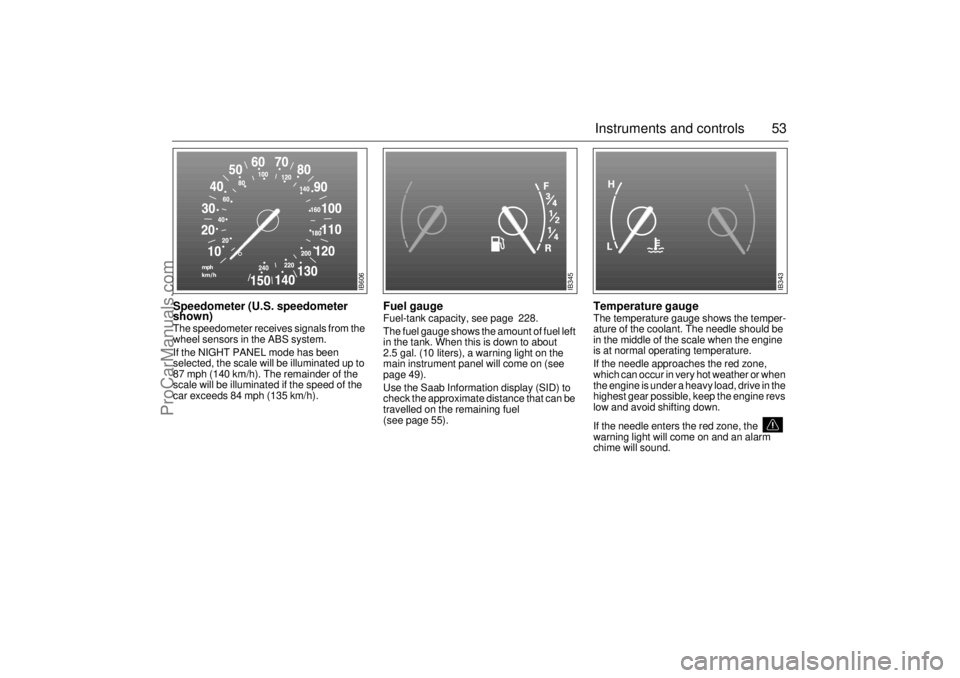
Speedometer (U.S. speedometer
shown)The speedometer receives signals from the
wheel sensors in the ABS system.
If the NIGHT PANEL mode has been
selected, the scale will be illuminated up to
87 mph (140 km/h). The remainder of the
scale will be illuminated if the speed of the
car exceeds 84 mph (135 km/h).
Fuel gauge Fuel-tank capacity, see page 228.
The fuel gauge shows the amount of fuel left
in the tank. When this is down to about
2.5 gal. (10 liters), a warning light on the
main instrument panel will come on (see
page 49).
Use the Saab Information display (SID) to
check the approximate distance that can be
travelled on the remaining fuel
(see page 55).
Temperature gauge The temperature gauge shows the temper-
ature of the coolant. The needle should be
in the middle of the scale when the engine
is at normal operating temperature.
If the needle approaches the red zone,
which can occur in very hot weather or when
the engine is under a heavy load, drive in the
highest gear possible, keep the engine revs
low and avoid shifting down.
If the needle enters the red zone, the
warning light will come on and an alarm
chime will sound.
IB606
IB345
IB343
ProCarManuals.com
Page 151 of 256

151 Starting and driving
be pleased to advise you on the best tires for
your car.
Remember that tires age. It may therefore
be necessary to change them before they
reach the legal wear limit, as they gradually
lose their friction properties.
The best response if the car gets into a
front-wheel skid is to freewheel (manual
gearbox only), i.e. disengage the clutch (so
that the wheels are neither driven or
retarded by the engine.
If the car has automatic transmission, ease
up on the accelerator and steer carefully in
the desired direction.
In a rear-wheel skid, steer in the same direc-
tion that the rear of the car is moving.
Tire chainsIf you want to fit tire chains (where legally
permitted) they should only be fitted to the
tires recommended under ”Specifications”
(see page 233).
Consult your Saab dealer for details of
approved tire chains.
Driving in hot weather Always check the coolant level before
starting a journey. The level should be just
below the MAX mark.
At the end of a journey, if the engine has
worked hard, allow it to idle for two or
three minutes before switching it off.
If the needle on the temperature gauge
enters the red zone:
1 Bring the car to a standstill but leave the
engine running. Do not remove the cap
on the expansion tank even if the tank is
empty. If the needle on the temperature
gauge continues to rise while the engine
is idling, switch off the engine.
2 Wait until the needle has dropped back
to indicate normal temperature (roughly
midway, in the white zone) before stop-
ping the engine. If the coolant needs top-
ping up, unscrew the cap on expansion
tank carefully.
Top up, as necessary, ideally with a
50/50 mixture of Saab-approved coolant
and water. If only water is available, use
that, but remember to have the coolant
mixture checked as soon as possible.
WARNING
Do not exceed 30 mph (50 km/h)
when tire chains are fitted.
Check the links frequently for wear.
Tire chains can reduce the directional
stability of the car.
Tire chains must not be used on the
rear wheels.
Check that the chains do not contact
the wheel-arch liner at full lock.
ProCarManuals.com
Page 163 of 256
163 Starting and driving
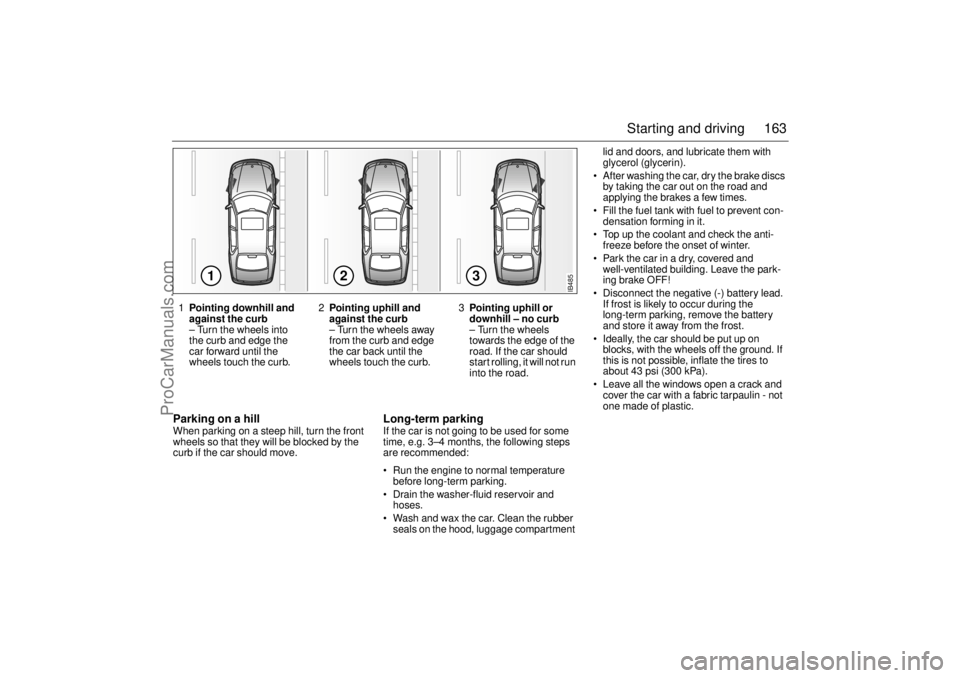
Parking on a hillWhen parking on a steep hill, turn the front
wheels so that they will be blocked by the
curb if the car should move.
Long-term parkingIf the car is not going to be used for some
time, e.g. 3–4 months, the following steps
are recommended:
Run the engine to normal temperature
before long-term parking.
Drain the washer-fluid reservoir and
hoses.
Wash and wax the car. Clean the rubber
seals on the hood, luggage compartment lid and doors, and lubricate them with
glycerol (glycerin).
After washing the car, dry the brake discs
by taking the car out on the road and
applying the brakes a few times.
Fill the fuel tank with fuel to prevent con-
densation forming in it.
Top up the coolant and check the anti-
freeze before the onset of winter.
Park the car in a dry, covered and
well-ventilated building. Leave the park-
ing brake OFF!
Disconnect the negative (-) battery lead.
If frost is likely to occur during the
long-term parking, remove the battery
and store it away from the frost.
Ideally, the car should be put up on
blocks, with the wheels off the ground. If
this is not possible, inflate the tires to
about 43 psi (300 kPa).
Leave all the windows open a crack and
cover the car with a fabric tarpaulin - not
one made of plastic.
123
IB485
1Pointing downhill and
against the curb
– Turn the wheels into
the curb and edge the
car forward until the
wheels touch the curb.2Pointing uphill and
against the curb
– Turn the wheels away
from the curb and edge
the car back until the
wheels touch the curb.3Pointing uphill or
downhill – no curb
– Turn the wheels
towards the edge of the
road. If the car should
start rolling, it will not run
into the road.
ProCarManuals.com
Page 169 of 256

169 Car care and technical information
Engine familiesSaab cars imported into the United States
and Canada meet all applicable emission
control standards. The engine family and
appropriate tune-up specifications are iden-
tified on a label affixed to the left front inner
fender.
These engine families meet applicable EPA
Federal Standards, California State Stan-
dards and Canadian Federal Standards and
are equipped with the following systems:
• Sequential multiport fuel injection system.
Three way catalytic converter.
Crankcase emissions control system.
Evaporative emission control system.
On-Board diagnostic (OBD II) system.
Emission control
systemsThe systems for controlling emissions to the
atmosphere require regular checking and
adjustment at the intervals specified in the
service program.
In addition to meeting the exhaust emission
regulations and thereby helping to keep the
environment clean, a correctly tuned engine
will also give maximum fuel economy.Saab Trionic engine management
systemThe Saab Trionic engine management
system is a unique Saab development that
combines sequential multiport fuel injection,
electronic distributorless ignition and turbo-
charger boost pressure control into one sys-
tem.
The Trionic engine control module (ECM)
monitors many different engine parameters
such as:
Intake manifold pressure.
Intake air temperature.
Crankshaft position.
Engine coolant temperature.
Throttle position and
The oxygen content of the exhaust gases.
The ECM receives information regarding
engine knocking from a sophisticated feed-
back function in the ignition discharge unit.
By processing all of this information, the Tri-
onic system can control fuel injector open-ing duration, ignition timing and turbo-
charger boost pressure to provide excellent
engine performance while maintaining low
emissions and fuel consumption.
NOTEThe Trionic engine management systems
continuously monitors the operation of
these systems and have on-board diag-
nostic capabilities (OBD II).
If the “Engine malfunction” lamp in
the main instrument illuminates, this indi-
cates that the Trionic ECM has detected
a problem. The car will continue to oper-
ate, but performance may be diminished.
You should have your car checked by a
Saab dealer as soon as possible.
ProCarManuals.com
Page 174 of 256
174 Car care and technical informationCoolant The expansion tank is transparent to facili-
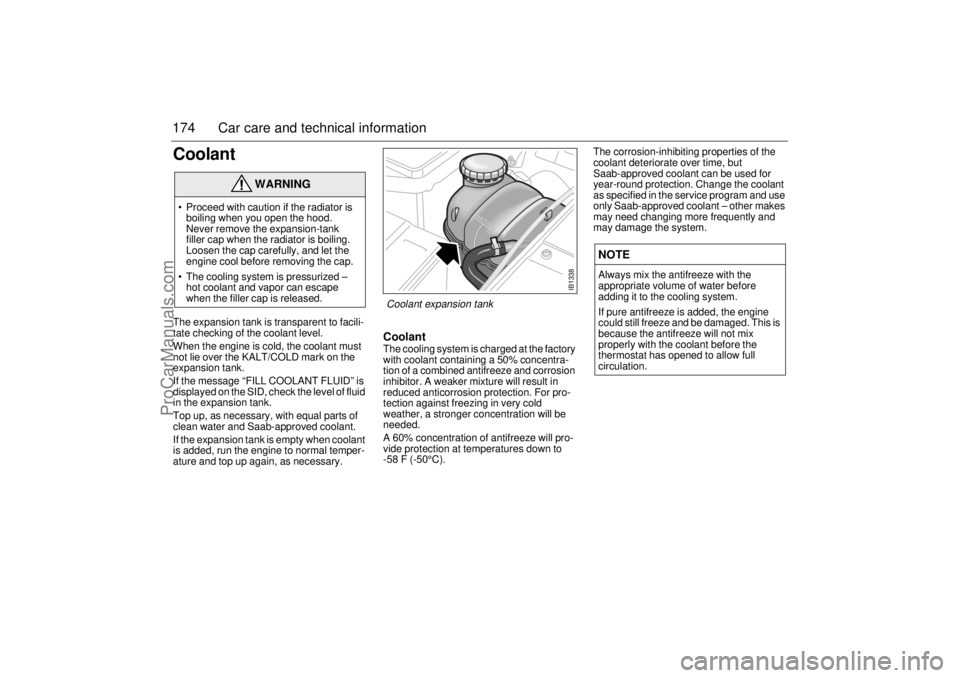
tate checking of the coolant level.
When the engine is cold, the coolant must
not lie over the KALT/COLD mark on the
expansion tank.
If the message “FILL COOLANT FLUID” is
displayed on the SID, check the level of fluid
in the expansion tank.
Top up, as necessary, with equal parts of
clean water and Saab-approved coolant.
If the expansion tank is empty when coolant
is added, run the engine to normal temper-
ature and top up again, as necessary.
Coolant The cooling system is charged at the factory
with coolant containing a 50% concentra-
tion of a combined antifreeze and corrosion
inhibitor. A weaker mixture will result in
reduced anticorrosion protection. For pro-
tection against freezing in very cold
weather, a stronger concentration will be
needed.
A 60% concentration of antifreeze will pro-
vide protection at temperatures down to
-58 F (-50°C).The corrosion-inhibiting properties of the
coolant deteriorate over time, but
Saab-approved coolant can be used for
year-round protection. Change the coolant
as specified in the service program and use
only Saab-approved coolant – other makes
may need changing more frequently and
may damage the system.
WARNING
Proceed with caution if the radiator is
boiling when you open the hood.
Never remove the expansion-tank
filler cap when the radiator is boiling.
Loosen the cap carefully, and let the
engine cool before removing the cap.
The cooling system is pressurized –
hot coolant and vapor can escape
when the filler cap is released.
NOTEAlways mix the antifreeze with the
appropriate volume of water before
adding it to the cooling system.
If pure antifreeze is added, the engine
could still freeze and be damaged. This is
because the antifreeze will not mix
properly with the coolant before the
thermostat has opened to allow full
circulation.
IB1338
Coolant expansion tank
ProCarManuals.com
Page 175 of 256
175 Car care and technical information
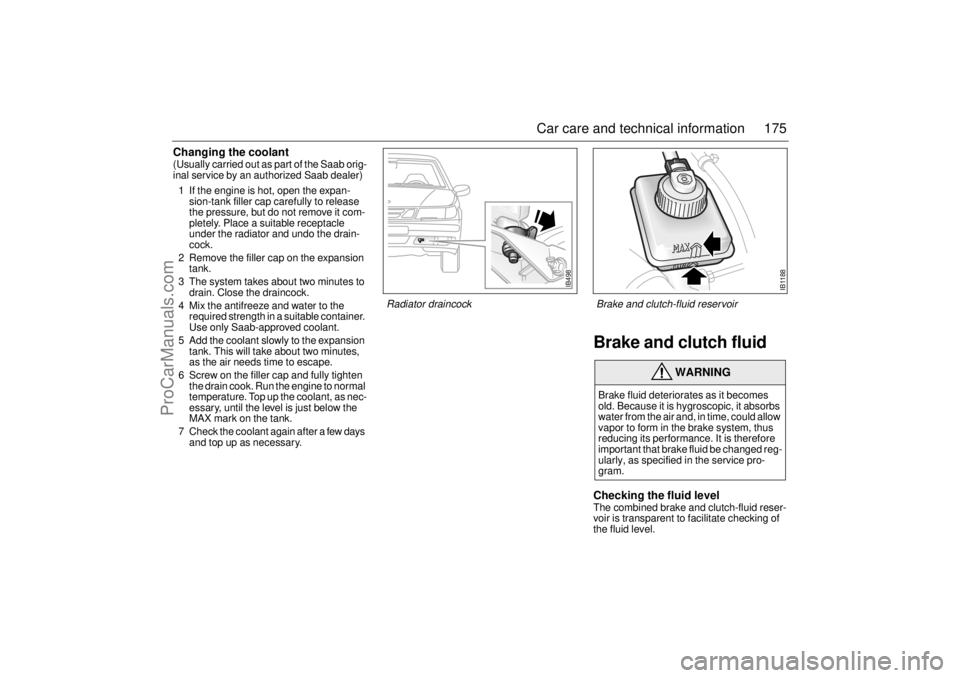
Changing the coolant (Usually carried out as part of the Saab orig-
inal service by an authorized Saab dealer)
1 If the engine is hot, open the expan-
sion-tank filler cap carefully to release
the pressure, but do not remove it com-
pletely. Place a suitable receptacle
under the radiator and undo the drain-
cock.
2 Remove the filler cap on the expansion
tank.
3 The system takes about two minutes to
drain. Close the draincock.
4 Mix the antifreeze and water to the
required strength in a suitable container.
Use only Saab-approved coolant.
5 Add the coolant slowly to the expansion
tank. This will take about two minutes,
as the air needs time to escape.
6 Screw on the filler cap and fully tighten
the drain cook. Run the engine to normal
temperature. Top up the coolant, as nec-
essary, until the level is just below the
MAX mark on the tank.
7 Check the coolant again after a few days
and top up as necessary.
Brake and clutch fluid Checking the fluid level The combined brake and clutch-fluid reser-
voir is transparent to facilitate checking of
the fluid level.
WARNING
Brake fluid deteriorates as it becomes
old. Because it is hygroscopic, it absorbs
water from the air and, in time, could allow
vapor to form in the brake system, thus
reducing its performance. It is therefore
important that brake fluid be changed reg-
ularly, as specified in the service pro-
gram.
IB498
Radiator draincock
IB1188
Brake and clutch-fluid reservoir
ProCarManuals.com
Page 228 of 256

228 SpecificationsEngine Fuel4-cylinder ________________________ Four cylinders, twin
overhead cam-
shafts, 16 valves
and two balancer
shafts.
6-cylinder ________________________ V-6 engine, double
overhead cam-
shafts on each cyl-
inder bank,
24 valves
Cylinder bores ___________________ 3.54 in (90 mm)
Stroke:
4-cylinder engine _________________ 3.54 in (90 mm)
6-cylinder engine _________________ 3.34 in (85 mm)
Swept volume:
4-cylinder engine _________________ 139.7 cu.in
(2.290 litres)
6-cylinder engine _________________ 180.6 cu.in
(2.962 litres)
Idling speed:
4-cylinder _______________________ 825 rpm
6-cylinder _______________________ 700 rpm
Antifreeze ________________________ Saab-approved
antifreeze
Coolant capacity:
4-cylinder _______________________ 7.6 qts (7.4 litres)
6-cylinder _______________________ 7.4 qts (7.2 litres) Fuel grade ________________________ Unleaded gasoline
AON 87–93.
For optimum performance Saab recom-
mend the following fuel grades:
2.3t _____________________________ AON 90
2.3 Turbo Aero and V6-models________ AON 93 *)
*) If AON 90 is used and the ambient temperature is above
77 – 86°F (25– 30°C) some decrease in engine power can occur
to some extent.
Fuel-tank capacity __________________ 18.5 gal. (70 litres)
ProCarManuals.com
Page 237 of 256

237 Specifications
Several of the systems in your Saab
car can be adjusted to better fit your
individual needsSome functions are governed by legal
requirements and cannot therefore be
reprogrammed.
Consult an authorized Saab dealer for fur-
ther information.
Car alarm/central locking system:
The sound level of the siren when locking/
unlocking, HIGH or LOW.
The number of blinks when locking/
unlocking, 1 to 7.
Automatic locking of the trunk when the
car is driven, 1 to 8 mph (2-14 km/h), YES
or NO.
Preclude the unlocking of the trunk while
the car is driven, YES or NO.
Automatic locking of the trunk after
1 second-4 minutes if it has not been
opened, YES or NO.
Automatic locking of the trunk when it is
closed, YES or NO.Automatic Climate Control (ACC):
Indoor temperature can be
increased/decreased relative to the
selected temperature.
Delayed start of fan after starting the car,
to reduce risk of fogging windshield.
Temperature at which the defroster mode
is automatically selected.
Response time for the fan speed when
the selected temperature is changed.
Temperature at which the air distribution
switches from defroster mode to
defrost/floor mode.
Last manual selection will be selected the
next time the car is started.Saab Information Display:
Outdoor temperature display can be
adjusted.
Days remaining to next service can be
activated/counted or not.
Delete “Test Brake Light“ message on
SID at start-up.
Miscellaneous:
Select the on-time for heated rear seat.
Coolant temperature gauge adjustment
can be increased/decreased.
Fuel level gauge adjustment can be
increased/decreased.
Additional sweep of the wipers after wind-
shield washer function (ON or OFF).
Follow me home on-time can vary from 20
to 50 seconds.
Night panel illumination deactivation
speed for the speedometer can be
adjusted.
ProCarManuals.com