tires SAAB 9-5 2000 Owners Manual
[x] Cancel search | Manufacturer: SAAB, Model Year: 2000, Model line: 9-5, Model: SAAB 9-5 2000Pages: 256, PDF Size: 14.24 MB
Page 4 of 256
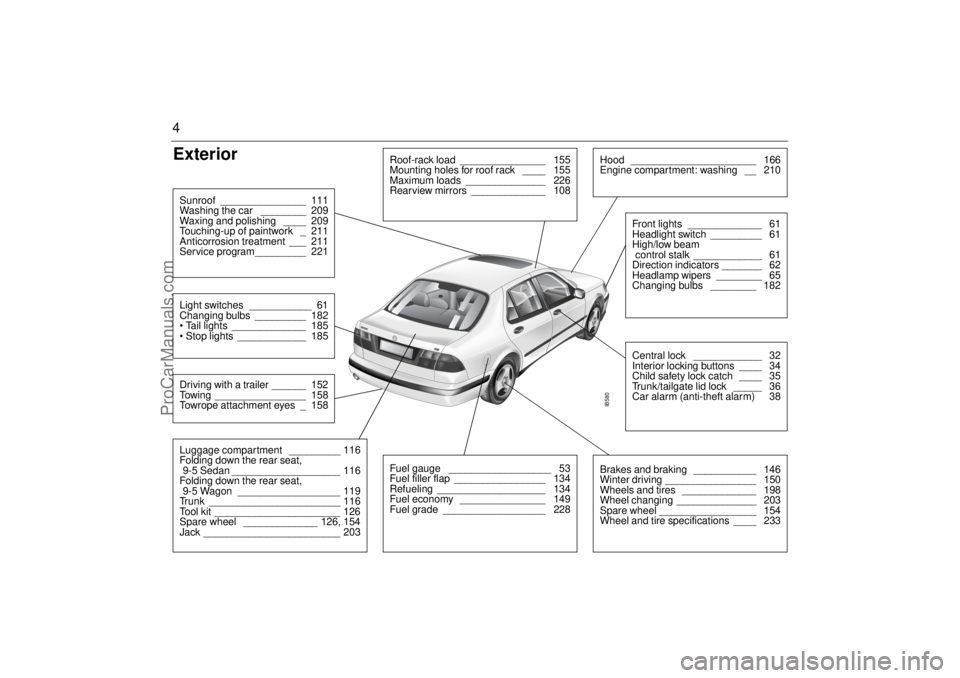
4Exterior
IB580
Roof-rack load _______________ 155
Mounting holes for roof rack ____ 155
Maximum loads ______________ 226
Rearview mirrors _____________ 108
Hood ______________________ 166
Engine compartment: washing __ 210
Central lock ____________ 32
Interior locking buttons ____ 34
Child safety lock catch ____ 35
Trunk/tailgate lid lock _____ 36
Car alarm (anti-theft alarm) 38Front lights _____________ 61
Headlight switch _________ 61
High/low beam
control stalk ____________ 61
Direction indicators _______ 62
Headlamp wipers ________ 65
Changing bulbs ________ 182
Fuel gauge __________________ 53
Fuel filler flap ________________ 134
Refueling ___________________ 134
Fuel economy _______________ 149
Fuel grade __________________ 228
Brakes and braking ___________ 146
Winter driving ________________ 150
Wheels and tires _____________ 198
Wheel changing ______________ 203
Spare wheel _________________ 154
Wheel and tire specifications ____ 233
Luggage compartment _________ 116
Folding down the rear seat,
9-5 Sedan ___________________ 116
Folding down the rear seat,
9-5 Wagon __________________ 119
Trunk _______________________ 116
Tool kit ______________________ 126
Spare wheel _____________ 126, 154
Jack ________________________ 203Driving with a trailer ______ 152
Towing ________________ 158
Towrope attachment eyes _ 158Light switches ___________ 61
Changing bulbs _________ 182
Tail lights _____________ 185
Stop lights ____________ 185Sunroof _______________ 111
Washing the car ________ 209
Waxing and polishing ____ 209
Touching-up of paintwork _ 211
Anticorrosion treatment ___ 211
Service program_________ 221
ProCarManuals.com
Page 51 of 256

51 Instruments and controls
Traction-control-system:
OFF
The indicator light goes on when the Trac-
tion Control System is switched off with the
TCS OFF button.
IMPORTANT: the Traction Control System
is automatically engaged every time the
engine is started (see page 147).
The indicator light also goes on when there
is a fault in the Traction Control System. In
this case the light cannot be turned off by
means of the TCS button. If a fault is indi-
cated, have the system checked by an
authorized Saab dealer.
See also "Traction Control System", on
page 147.
TCS modulation in
progress
The TCS indicator light is located in the
lower half of the tachometer and will be illu-
minated when TCS regulation is occurring,
i.e. when there is insufficient traction
between the tires and the road surface to
provide the grip required for the accelera-
tion called for. The driver can also sense
that the engine is not responding normally to
the accelerator.
Operation of the TCS indicates reduced
traction between the tires and the road, and
that extra care should be taken by the driver.
In normal driving, the TCS will improve both
ride comfort and safety, but must not be
regarded as a system to enable the driver to
drive at or maintain a higher rate of speed.
The same precautions for safe cornering
and driving on slippery roads must still be
applied (see page 147).
ProCarManuals.com
Page 149 of 256
149 Starting and driving
Economical motoringFactors affecting fuel consumption Fuel consumption is greatly affected by the
general driving conditions, the way in which
the car is driven and at what speeds, the
weather, the state of the road, the condition
of the car, etc. Breaking-in Fuel consumption may be somewhat higher
during the break-in period (the first 3,000–
4,000 miles (5,000–7,000 km) than stated
under ”Technical data”.
Weather conditions Fuel consumption can be as much as 10 %
lower in summer than in winter. The higher
consumption in cold weather is explained by
the longer time it takes for the engine to
reach normal operating temperature, and
for the transmission and wheel bearings to
warm up. Fuel economy is also affected by
the distance driven: short journeys of
3-5 miles (5-8 km) do not give the engine
enough time to reach normal temperature.
Strong winds can also affect fuel consump-
tion.
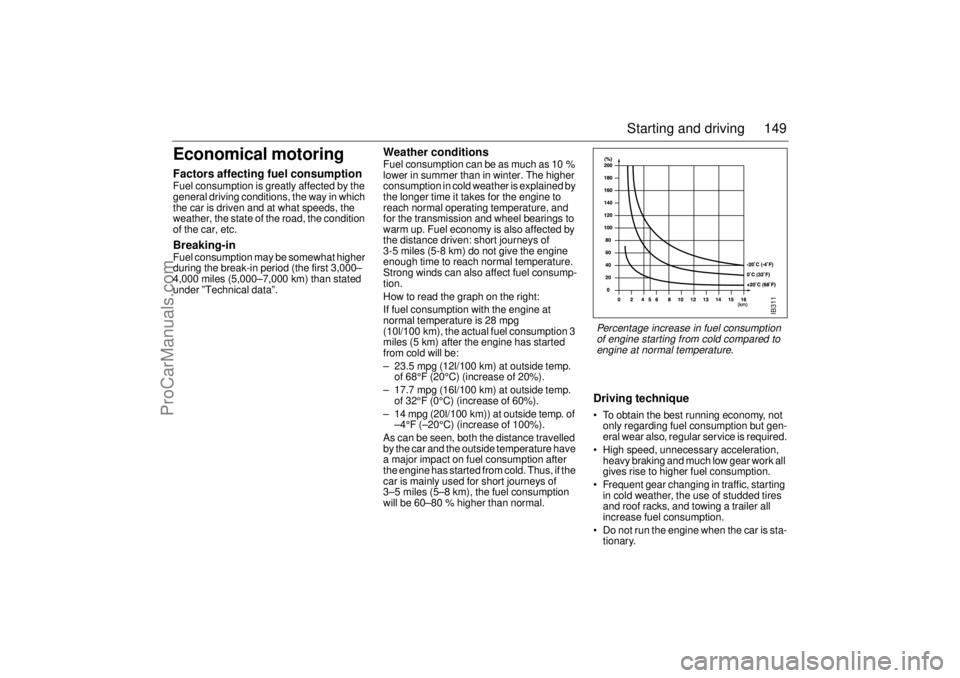
How to read the graph on the right:
If fuel consumption with the engine at
normal temperature is 28 mpg
(10l/100 km), the actual fuel consumption 3
miles (5 km) after the engine has started
from cold will be:
– 23.5 mpg (12l/100 km) at outside temp.
of 68°F (20°C) (increase of 20%).
– 17.7 mpg (16l/100 km) at outside temp.
of 32°F (0°C) (increase of 60%).
– 14 mpg (20l/100 km)) at outside temp. of
–4°F (–20°C) (increase of 100%).
As can be seen, both the distance travelled
by the car and the outside temperature have
a major impact on fuel consumption after
the engine has started from cold. Thus, if the
car is mainly used for short journeys of
3–5 miles (5–8 km), the fuel consumption
will be 60–80 % higher than normal.
Driving technique To obtain the best running economy, not
only regarding fuel consumption but gen-
eral wear also, regular service is required.
High speed, unnecessary acceleration,
heavy braking and much low gear work all
gives rise to higher fuel consumption.
Frequent gear changing in traffic, starting
in cold weather, the use of studded tires
and roof racks, and towing a trailer all
increase fuel consumption.
Do not run the engine when the car is sta-
tionary.
IB311
Percentage increase in fuel consumption
of engine starting from cold compared to
engine at normal temperature.
ProCarManuals.com
Page 150 of 256

150 Starting and drivingIf idling, it will take much longer before the
engine becomes hot. Engine wear is
greatest during this warming-up phase.
Therefore drive away as soon as possible
after the engine is started and avoid high
revving.
Driving in a low gear results in higher fuel
consumption than in a high gear because
of the higher engine speed for a given
road speed. Always change up to a higher
gear as soon as traffic conditions allow
and use the highest gear as much as pos-
sible.
Check the air pressure in the tires once a
month. Incorrect pressures increase tire
wear. It is better to have slightly higher
pressure than lower.
Check fuel consumption regularly.
Increased consumption can indicate that
something is wrong and that the car
needs to be checked by an authorized
Saab dealer.
Practical trials on the roads have demon-
strated that substantial savings in fuel con-
sumption can be made if the above advice
is heeded.
Road conditions Wet roads increase fuel consumption, as do
unpaved roads and driving in hilly country
(the amount of fuel saved driving downhill is
less than the additional amount required to
climb the hill). Engine block heater (standard
equipment in Canada, accessory in
U.S.)The following are just some of the benefits
to the car and the environment of using an
engine block heater:
Lower fuel consumption.
Reduced wear on the engine.
Inside of car warms up faster.
Exhaust emissions substantially reduced
over short runs.
The engine heater is effective at outside
temperatures up to +15-20°C. The warmer
it is outside, the shorter the time the engine
heater needs to be connected. Longer than
1.5 hours is unnecessary.
If the car is equipped with a removable,
electrical cabin heater that is not in use, this
should be stored in the luggage compart-
ment.
Driving in winterBefore starting a journey in cold weather,
check that the wiper blades have not
become frozen to the glass. Brush any snow
away from the air intake for the heater
system (opening between hood and wind-
shield).
Periodically during the winter, add gasoline
anti-freeze to the fuel to dispel any conden-
sation in the fuel tank which could freeze
and cause problems in the system. Keep
the tank well filled to reduce the risk of con-
densation forming.
If the car is parked outside in freezing
weather, fuel additives (gasoline
anti-freeze) will not do any good as any con-
densation in the fuel tank will freeze. Con-
densation is caused by changes in the out-
door temperature or by the car being parked
alternately in a garage and outside.
It is particularly important when the roads
are slippery that the brakes and tires be in
good condition.
The car is equipped with tires designed to
provide optimum grip on both wet and dry
roads, although this has been achieved at
the expense of somewhat reduced grip on
snow and ice. For regular driving on snow
and ice, we therefore recommend that
winter (snow) tires be fitted.
Winter (snow) tires, particularly studded
tires (where use is legally permitted), gener-
ally make driving safer on snow and ice.
If winter tires are fitted, the same type must
be fitted on all wheels. Your Saab dealer will
ProCarManuals.com
Page 151 of 256

151 Starting and driving
be pleased to advise you on the best tires for
your car.
Remember that tires age. It may therefore
be necessary to change them before they
reach the legal wear limit, as they gradually
lose their friction properties.
The best response if the car gets into a
front-wheel skid is to freewheel (manual
gearbox only), i.e. disengage the clutch (so
that the wheels are neither driven or
retarded by the engine.
If the car has automatic transmission, ease
up on the accelerator and steer carefully in
the desired direction.
In a rear-wheel skid, steer in the same direc-
tion that the rear of the car is moving.
Tire chainsIf you want to fit tire chains (where legally
permitted) they should only be fitted to the
tires recommended under ”Specifications”
(see page 233).
Consult your Saab dealer for details of
approved tire chains.
Driving in hot weather Always check the coolant level before
starting a journey. The level should be just
below the MAX mark.
At the end of a journey, if the engine has
worked hard, allow it to idle for two or
three minutes before switching it off.
If the needle on the temperature gauge
enters the red zone:
1 Bring the car to a standstill but leave the
engine running. Do not remove the cap
on the expansion tank even if the tank is
empty. If the needle on the temperature
gauge continues to rise while the engine
is idling, switch off the engine.
2 Wait until the needle has dropped back
to indicate normal temperature (roughly
midway, in the white zone) before stop-
ping the engine. If the coolant needs top-
ping up, unscrew the cap on expansion
tank carefully.
Top up, as necessary, ideally with a
50/50 mixture of Saab-approved coolant
and water. If only water is available, use
that, but remember to have the coolant
mixture checked as soon as possible.
WARNING
Do not exceed 30 mph (50 km/h)
when tire chains are fitted.
Check the links frequently for wear.
Tire chains can reduce the directional
stability of the car.
Tire chains must not be used on the
rear wheels.
Check that the chains do not contact
the wheel-arch liner at full lock.
ProCarManuals.com
Page 157 of 256

157 Starting and driving
Driving with a loadThe driving characteristics of the car are
affected by the way it is loaded.
Place heavy loads as far forward and as
low as possible in the trunk.
Secure the load to the tie downs, see
page 118.
The load should be such that the car´s
total weight or axle weight are not
exceeded, see page 226.
Heavy loads mean that the car’s centre of
gravity is further back. As a result, the car
will sway more during evasive steering.
Never exceed the permissible load in the
roof box, even if there is room for more.
Ensure that the tire pressure is correct –
slight overinflation is preferable to under-
inflation.
The braking distance of a loaded car is
always greater. Keep your distance from
the vehicle in front.
Tire pressure, see page 235 and back
cover.
TiresThe tire pressure should match the current
load and speed of the car; see the back
cover or the tire pressure label on
page 235.
The tire pressures given apply to cold tires,
that is tires that are the same temperature
as the outside air temperature.
The tire pressure increases as the tires
become warm (e.g. during highway driving)
with approximately 0.3 bar (4 psi). When
the temperature of the tires changes by 50°
(10°C), the tire pressure will change 0.1 bar
(2 psi).Never reduce the pressure of a hot tire. If the
tires are hot when you check them, only
increase the pressure, if necessary.
Underinflated tires wear more quickly than
slightly overinflated tires.
If a valve is leaking, simply unscrew it and fit
a new one.
Important! Remember to adjust the tire
pressures if you change the load in the car
or intend to drive at substantially lower or
higher speeds than normal.NOTECheck the tire pressure at least once a
month. Underinflation is the main cause
of:
Damage to the wheels.
Premature tire wear.
Damage to the sidewalls.
ProCarManuals.com
Page 163 of 256
163 Starting and driving
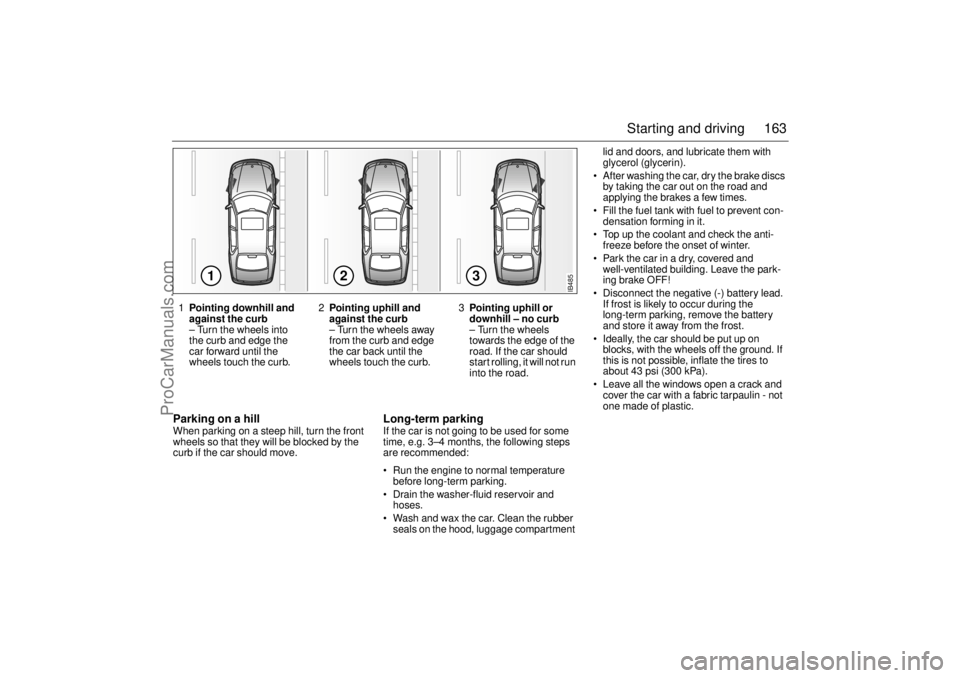
Parking on a hillWhen parking on a steep hill, turn the front
wheels so that they will be blocked by the
curb if the car should move.
Long-term parkingIf the car is not going to be used for some
time, e.g. 3–4 months, the following steps
are recommended:
Run the engine to normal temperature
before long-term parking.
Drain the washer-fluid reservoir and
hoses.
Wash and wax the car. Clean the rubber
seals on the hood, luggage compartment lid and doors, and lubricate them with
glycerol (glycerin).
After washing the car, dry the brake discs
by taking the car out on the road and
applying the brakes a few times.
Fill the fuel tank with fuel to prevent con-
densation forming in it.
Top up the coolant and check the anti-
freeze before the onset of winter.
Park the car in a dry, covered and
well-ventilated building. Leave the park-
ing brake OFF!
Disconnect the negative (-) battery lead.
If frost is likely to occur during the
long-term parking, remove the battery
and store it away from the frost.
Ideally, the car should be put up on
blocks, with the wheels off the ground. If
this is not possible, inflate the tires to
about 43 psi (300 kPa).
Leave all the windows open a crack and
cover the car with a fabric tarpaulin - not
one made of plastic.
123
IB485
1Pointing downhill and
against the curb
– Turn the wheels into
the curb and edge the
car forward until the
wheels touch the curb.2Pointing uphill and
against the curb
– Turn the wheels away
from the curb and edge
the car back until the
wheels touch the curb.3Pointing uphill or
downhill – no curb
– Turn the wheels
towards the edge of the
road. If the car should
start rolling, it will not run
into the road.
ProCarManuals.com
Page 198 of 256

198 Car care and technical informationWheels Alternative wheels and tiresIf you wish to fit other tires or wheels than
those supplied with the car, consult your
Saab dealer first as to the possibilities avail-
able.
Wheels/tires combinations that are not
approved by Saab can negatively affect the
car´s directional stability, steering and brak-
ing in both wet and dry conditions.
Do not assume that a wheel/tire combina-
tion will function properly just because it will
bolt on.The wheels and tires have been carefully
matched to the characteristics of the car and
play a key role in its outstanding roadhold-
ing and handling.
Tire pressureTires need to be inflated to suit the load car-
ried and the maximum speed the car will be
driven (see the recommended tire pres-
sures on the back cover). Note that all
values apply to cold tires. For tires with an
aspect ratio less than /60, increase the tire
pressure by 3 psi (20 kPa) for rough roads
with potholes to minimize the risk of rim
damage.Never reduce the pressure of a hot tire. If the
tires are hot when you check them, only
increase the pressure, if necessary.
Soft tires will cause faster wear than
over-pressurized tires. They also increase
fuel consumption.
If a valve is leaking, simply unscrew it and fit
a new one.
Important! Remember to adjust the tire
pressures if you change the load in the car
or intend to cruise at a substantially higher
or lower speed than normal.
NOTEFor wide wheels and/or low-profile tires,
bear in mind the following:
Tires and wheels can be damaged in
potholes etc.
Springs and dampers can be over-
loaded.
The wheels can come into contact with
chassis and body components.
The speed and load limits for the tires
must not be exceeded; see page 199.
Wheels larger than 17” must not be fit-
ted. The maximum permissible offset
is 49 mm.
NOTECheck the tire pressures at least once
per month.
Underinflation is the main cause of:
Tires wearing out prematurely.
Damage to the sidewalls.
Damage to the wheels.
ProCarManuals.com
Page 199 of 256

199 Car care and technical information
Rotating tiresBecause the car has front-wheel drive, the
front tires tend to wear faster than the rear
ones. New tires should always be fitted in
pairs, so that tires on the same axle have the
same amount of tread.
If swapping the complete set, e.g. winter
tires for summer tires, mark the tires
removed to ensure that they go back in the
same position (e.g. FL for front left, RL rear
left, etc.).
Store wheels lying flat or hanging – never
standing upright.
Tire markingsAn example of the meaning of the different
markings in a tire size is given below for a
tire size of:
205/65 R15 94 V
Winter tiresWinter (snow) tires are recommended for
winter climates where the majority of your
driving will be done on snow and ice. Winter
tires should be fitted to all four wheels to
maintain a proper balance. Your Saab
dealer can advise you as to the correct size
tire for your car (if different from the original
size) and also supply Saab approved winter
tires.Tire quality grading (cars sold in
U.S.)New tires must be graded and labeled in
accordance with new Federal regulations.
Standard tests are conducted to measure
performance in the areas of traction and
temperature resistance. Refer to the tire
sidewall for the specific quality grades of the
tires provided on your new Saab. Compact
spare tires are exempt.
DOT QUALITY GRADES
Treadwear
Traction AA, A, B, C
Temperature A, B, C
All passenger car tires must conform to Fed-
eral safety requirements in addition to these
grades.
WARNING
When fitting just one new pair of tires,
these should be fitted to the rear wheels,
as these are more critical to the direc-
tional stability of the car (e.g. on braking
or in a skid). The existing rear wheels
should therefore be moved to the front.
Always move left rear to left front and right
rear to right front, so that the direction of
rotation remains the same.
205 Tire section width, mm
65 Aspect ratio, i.e. the section height
is 65% of the section width
R Radial ply
15 Wheel rim diameter 15 in at bead
seats
94 Tire load code
V Speed marking
Speed ratings S Tire approved for speeds up to
100 mph (180 km/h)
T Tire approved for speeds up to
118 mph (190 km/h)
H Tire approved for speeds up to
130 mph (210 km/h)
V Tire approved for speeds up to
150 mph (240 km/h)
W Tire approved for speeds up to
167 mph (270 km/h)
Y Tire approved for speeds up to
186 mph (300 km/h)
ProCarManuals.com
Page 200 of 256
200 Car care and technical informationUniform Tire Quality Grading (US)Quality grades can be found where applica-
ble on the tire sidewall between tread shoul-
der and maximum section width. For exam-
ple:
Treadwear 200 Traction AA
Temperature ATreadwearThe treadwear grade is a comparative
rating based on the wear rate of the tire
when tested under controlled conditions on
a specified government test course. For
example, a tire graded 150 would wear one
and one half (1 1/2) times as well on the gov-
ernment course as a tire graded 100. The
relative performance of tires depends upon
the actual conditions of their use, however,
and may depart significantly from the norm
due to variations in driving habits, service
practices and differences in road character-
istics and climate.
TractionThe traction grades, from highest to lowest,
are AA, A, B and C. These grades represent
the tire’s ability to stop on wet pavement as
measured under controlled conditions on
specified government test surfaces of
asphalt and concrete. A tire marked C may
have poor traction performance.
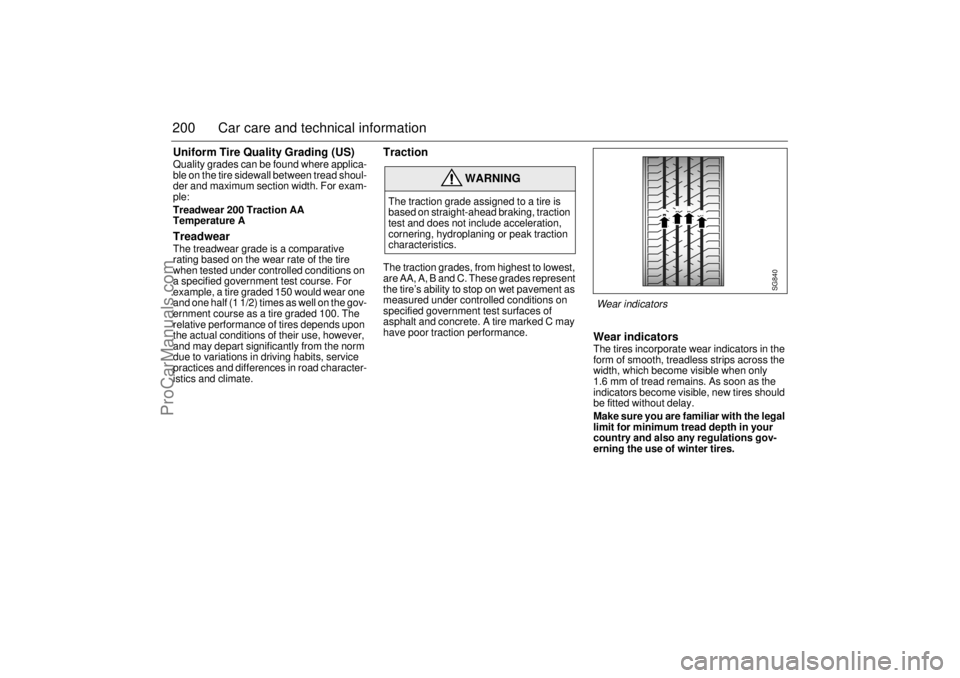
Wear indicatorsThe tires incorporate wear indicators in the
form of smooth, treadless strips across the
width, which become visible when only
1.6 mm of tread remains. As soon as the
indicators become visible, new tires should
be fitted without delay.
Make sure you are familiar with the legal
limit for minimum tread depth in your
country and also any regulations gov-
erning the use of winter tires.
WARNING
The traction grade assigned to a tire is
based on straight-ahead braking, traction
test and does not include acceleration,
cornering, hydroplaning or peak traction
characteristics.
SG840
Wear indicators
ProCarManuals.com