brake SAAB 9-5 2001 User Guide
[x] Cancel search | Manufacturer: SAAB, Model Year: 2001, Model line: 9-5, Model: SAAB 9-5 2001Pages: 272, PDF Size: 14.83 MB
Page 61 of 272

61 Instruments and controls
CHECK messages When the engine is started, CHECKING will
appear on the display for about four sec-
onds, while the SID checks are being per-
formed.
When a CHECK message is generated
while the car is being driven, a chime will
sound, INFO DISPL will illuminate on on the
main instrument panel, and the message
will appear on the SID. The number of mes-
sages that can be displayed by the SID
varies with the specification of the car.
If more than one CHECK message has
been generated, the
+ symbol will appear to
the left of the text on the display. The mes-
sages appear in order of priority.
If a new fault occurs while another message
is being displayed, the message relating to
the new one will appear for 10 seconds,
after which the display will return to the ear-
lier one.
Press CLEAR once to acknowledge a mes-
sage, whereupon it will be cleared from the
display. It will not be displayed again before
the ignition has been switched off and then
on again. The following messages may be displayed:
1 This message will be displayed approxi-
mately 600 miles (1,000 km) before the next
scheduled service is due, or when 365 days
have elapsed since the last service. The
message should be cleared at the time of that
service (see the Saab Warranties & Service
Record Booklet).
This message can also be deleted by first
briefly pressing the CLEAR button, then
depressing it a second time for at least eight
seconds until ”SERVICE” appears on the dis-
play and a chime sounds. The message can
only be deleted when it is shown on the SID.
Night panelTo improve night-driving conditions inside
the car, the Night Panel mode can be
selected. In this mode, the amount of infor-
mation displayed is reduced, and only the
most important instruments and displays
will be illuminated.
When the Night Panel button is pressed,
only the speedometer will be illuminated (up
to the 87-mph or 140-km/h graduation), all
the other instruments illumination being
extinguished and their needles moved to
zero. Both the SID and the ACC displays will
be extinguished and the backlighting for
switches and other controls will be dimmed.
Note: All indicator and warning lights,
together with the display of CHECK mes-
sages, will operate as normal, except ”Out-
door temperature (Frost warning)”, see
page 58. Message See
page
FRONT LIGHT FAILURE 205
REAR LIGHT FAILURE 208
FOG LIGHT FAILURE 209
BRAKE LIGHT FAILURE 208
WASHER FLUID LEVEL LOW 204
FILL COOLANT FLUID 196
REPLACE KEY BATTERY 37
KEY NOT ACCEPTED 45
SERVICE THEFT ALARM 45
TRANSMISSION OVERHEATING 162
TIGHTEN FUEL FILLER CAP 154
TIME FOR SERVICE
1)
242
ProCarManuals.com
Page 64 of 272
64 Instruments and controlsCourtesy Headlight FeatureA delay function allows the headlights to
remain on low beam for about 30 seconds
after the driver’s door has been closed.
To activate this function,
Switch off the ignition and remove the key
Open the driver’s door
Pull the high/low beam control stalk
towards the steering wheel like you are
flashing the high beam, see page 63. The
low beam headlights will now come on
immediately after the driver’s door has
been closed (within 30 seconds) and will
remain on for about 30 seconds.
The length of time for this function can be
adjusted by your authorized Saab dealer.
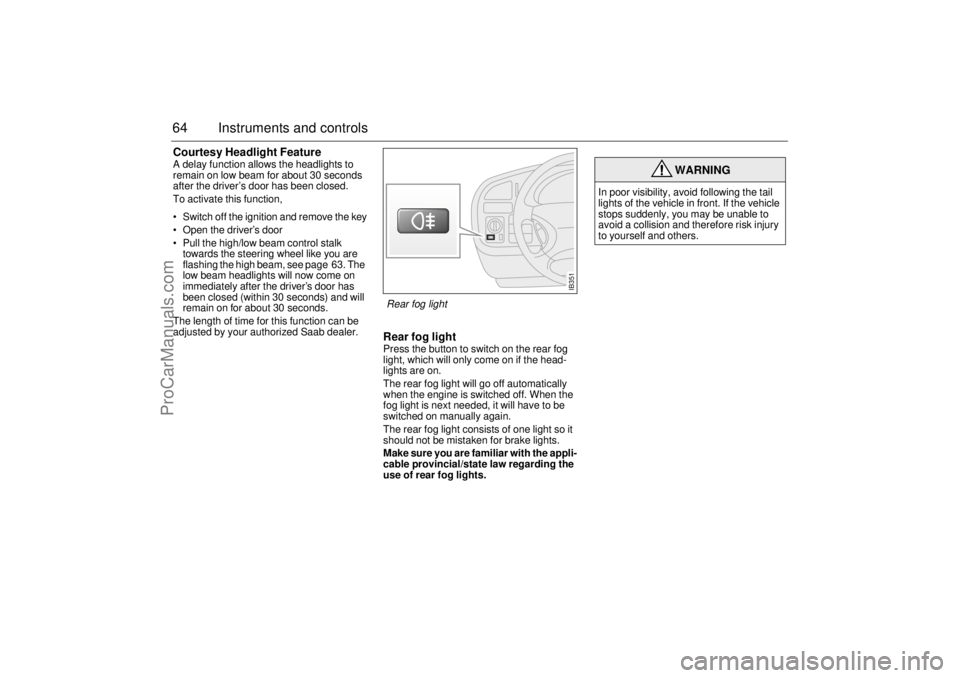
Rear fog lightPress the button to switch on the rear fog
light, which will only come on if the head-
lights are on.
The rear fog light will go off automatically
when the engine is switched off. When the
fog light is next needed, it will have to be
switched on manually again.
The rear fog light consists of one light so it
should not be mistaken for brake lights.
Make sure you are familiar with the appli-
cable provincial/state law regarding the
use of rear fog lights.
WARNING
In poor visibility, avoid following the tail
lights of the vehicle in front. If the vehicle
stops suddenly, you may be unable to
avoid a collision and therefore risk injury
to yourself and others.
IB351
Rear fog light
ProCarManuals.com
Page 134 of 272
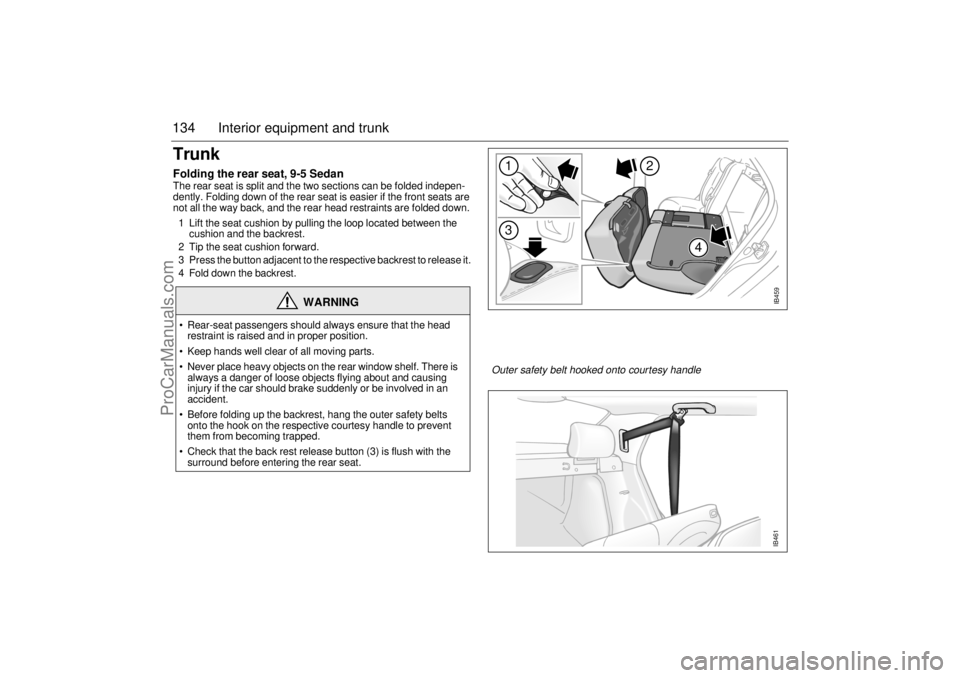
134 Interior equipment and trunkTrunkFolding the rear seat, 9-5 SedanThe rear seat is split and the two sections can be folded indepen-
dently. Folding down of the rear seat is easier if the front seats are
not all the way back, and the rear head restraints are folded down.
1 Lift the seat cushion by pulling the loop located between the
cushion and the backrest.
2 Tip the seat cushion forward.
3 Press the button adjacent to the respective backrest to release it.
4 Fold down the backrest.
WARNING
Rear-seat passengers should always ensure that the head
restraint is raised and in proper position.
Keep hands well clear of all moving parts.
Never place heavy objects on the rear window shelf. There is
always a danger of loose objects flying about and causing
injury if the car should brake suddenly or be involved in an
accident.
Before folding up the backrest, hang the outer safety belts
onto the hook on the respective courtesy handle to prevent
them from becoming trapped.
Check that the back rest release button (3) is flush with the
surround before entering the rear seat.
IB459
1
2
4
3
IB461
Outer safety belt hooked onto courtesy handle
ProCarManuals.com
Page 135 of 272
135 Interior equipment and trunk
WARNING
Place heavy items closest to the backrest and stow smaller
and lighter items on top.
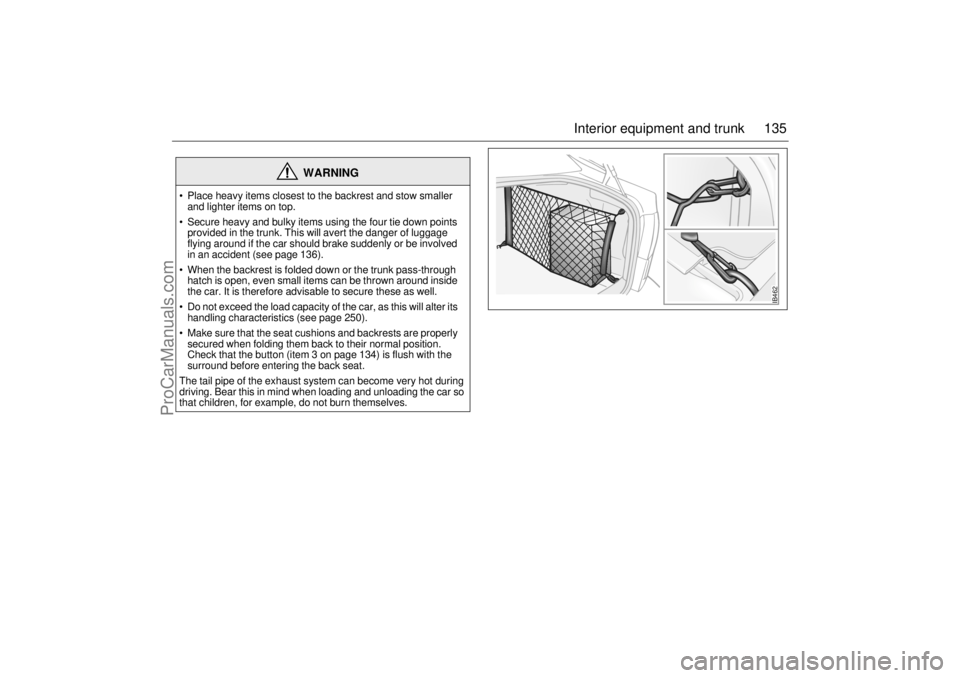
Secure heavy and bulky items using the four tie down points
provided in the trunk. This will avert the danger of luggage
flying around if the car should brake suddenly or be involved
in an accident (see page 136).
When the backrest is folded down or the trunk pass-through
hatch is open, even small items can be thrown around inside
the car. It is therefore advisable to secure these as well.
Do not exceed the load capacity of the car, as this will alter its
handling characteristics (see page 250).
Make sure that the seat cushions and backrests are properly
secured when folding them back to their normal position.
Check that the button (item 3 on page 134) is flush with the
surround before entering the back seat.
The tail pipe of the exhaust system can become very hot during
driving. Bear this in mind when loading and unloading the car so
that children, for example, do not burn themselves.
IB462
ProCarManuals.com
Page 136 of 272
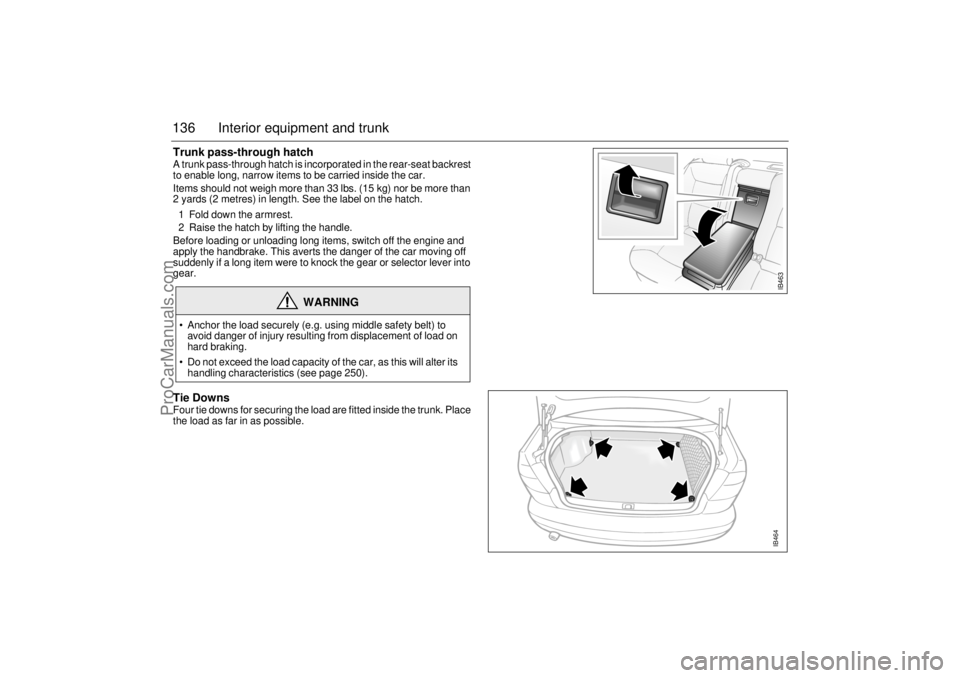
136 Interior equipment and trunkTrunk pass-through hatch A trunk pass-through hatch is incorporated in the rear-seat backrest
to enable long, narrow items to be carried inside the car.
Items should not weigh more than 33 lbs. (15 kg) nor be more than
2 yards (2 metres) in length. See the label on the hatch.
1 Fold down the armrest.
2 Raise the hatch by lifting the handle.
Before loading or unloading long items, switch off the engine and
apply the handbrake. This averts the danger of the car moving off
suddenly if a long item were to knock the gear or selector lever into
gear. Tie DownsFour tie downs for securing the load are fitted inside the trunk. Place
the load as far in as possible.
WARNING
Anchor the load securely (e.g. using middle safety belt) to
avoid danger of injury resulting from displacement of load on
hard braking.
Do not exceed the load capacity of the car, as this will alter its
handling characteristics (see page 250).
IB463IB464
ProCarManuals.com
Page 138 of 272
138 Interior equipment and trunk
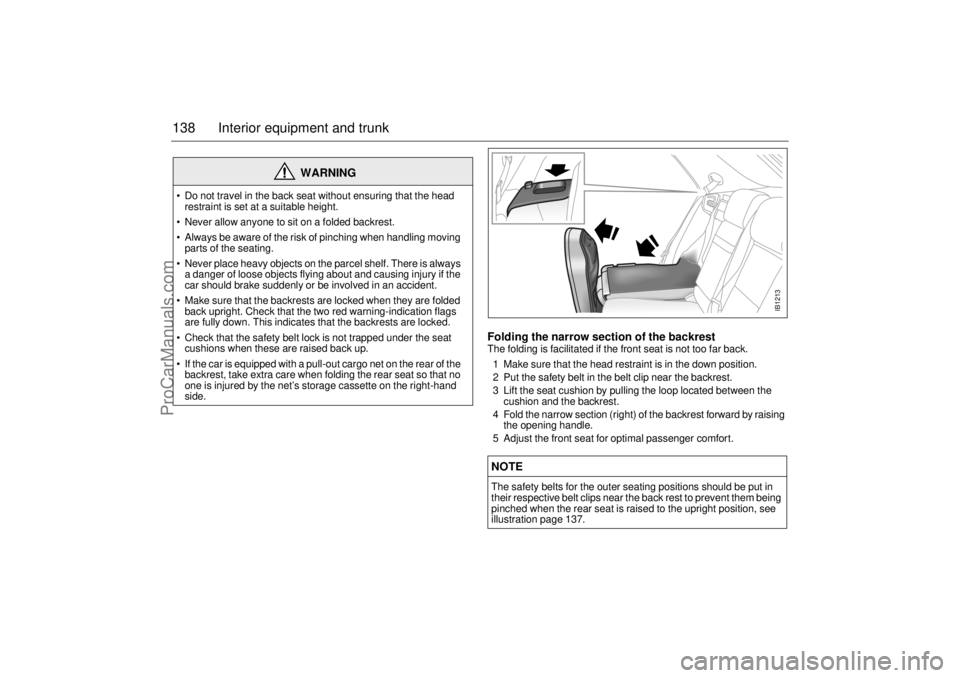
Folding the narrow section of the backrestThe folding is facilitated if the front seat is not too far back.
1 Make sure that the head restraint is in the down position.
2 Put the safety belt in the belt clip near the backrest.
3 Lift the seat cushion by pulling the loop located between the
cushion and the backrest.
4 Fold the narrow section (right) of the backrest forward by raising
the opening handle.
5 Adjust the front seat for optimal passenger comfort.
WARNING
Do not travel in the back seat without ensuring that the head
restraint is set at a suitable height.
Never allow anyone to sit on a folded backrest.
Always be aware of the risk of pinching when handling moving
parts of the seating.
Never place heavy objects on the parcel shelf. There is always
a danger of loose objects flying about and causing injury if the
car should brake suddenly or be involved in an accident.
Make sure that the backrests are locked when they are folded
back upright. Check that the two red warning-indication flags
are fully down. This indicates that the backrests are locked.
Check that the safety belt lock is not trapped under the seat
cushions when these are raised back up.
If the car is equipped with a pull-out cargo net on the rear of the
backrest, take extra care when folding the rear seat so that no
one is injured by the net’s storage cassette on the right-hand
side.
NOTEThe safety belts for the outer seating positions should be put in
their respective belt clips near the back rest to prevent them being
pinched when the rear seat is raised to the upright position, see
illustration page 137.
IB1213
ProCarManuals.com
Page 147 of 272
147 Starting and driving
Starting and driving
IB597
Ignition switch ................. 148
Starting the engine .......... 149
Important considerations
for driving ....................... 151
Refueling .......................... 154
Engine Break-In Period ... 157
Gear changing ................. 158
Cruise control .................. 166
Braking ............................. 167
Traction Control System . 169
Economical motoring ...... 170
Driving in cold weather ... 172 Driving in hot weather .... 173
Towing a trailer ................ 174
Driving with a roof rack
load ................................. 176
Driving with a load .......... 179
Driving considerations
with compact spare
wheel/tire fitted .............. 180
Driving with the trunk
lid/tailgate open ............. 180
Driving in deep water ...... 180
Towing the car ................. 181 Jump starting ................... 183
Parking brake ................... 185
Parking .............................. 185
ProCarManuals.com
Page 149 of 272
149 Starting and driving
If the car does not startIf the text ”KEY NOT ACCEPTED” is shown
on the SID, after a failed start attempt, the
cause could be a fault in the transmitter in
the key, or in the receiver in the ignition lock.
The following should be done:
Turn the key back to the LOCK position.
Turn the key to ON.
Press one of the buttons on the remote
control (the LED stops blinking).
Start the engine.
Try another key. If this works, then the fault
is in the first key.
Contact an authorized Saab dealer for
checking and rectification.
Starting the engine
NOTETake care not to spill drinks or to drop
crumbs over the ignition switch. If dirt or
liquid gets into it, the switch may not
operate properly.
WARNING
Always remove the key before leaving
the car.
Always apply the parking brake before
removing the ignition key.
WARNING
When starting the engine:
- Sit down in the driver’s seat.
- Depress the clutch pedal fully. If gear
lever is not in the neutral position, the
clutch pedal must be fully depressed
or the car will jump forwards or back-
wards, which may cause an acci-
dent.
- Never start the car from outside the
vehicle, e.g. through a wound down
window. This could lead to serious
personal injury.
Engage reverse (R) (position P for
automatic transmission) to remove the
ignition key. The key can only be
removed in this gear position.
Carbon monoxide (CO) is a colorless,
odorless, poisonous gas. Be alert to
the danger of CO – always open the
garage doors before starting the
engine in the garage.
There is also a danger of CO poison-
ing if the exhaust system is leaking.
ProCarManuals.com
Page 150 of 272

150 Starting and drivingIt is possible for air to enter the lubricating
system in conjunction with an oil or oil-filter
change, or if the car has been stored for
some time. This air can cause the hydraulic
cam followers to emit a ticking noise, which
can persist for up to 15 minutes after start-
ing. Although this is quite normal and does
not indicate any malfunction, it is advisable
not to exceed 3,000 rpm before the noise
has disappeared.
The hydraulic cam lifters are completely
service free; the valve clearance is set up at
the factory and will not need any subse-
quent adjustment.
Starting the engineAvoid racing the engine or putting a heavy
load on it before it has warmed up. Drive
away as soon as the oil warning light has
been extinguished to enable the engine to
attain its normal temperature as quickly as
possible.
The engine has an automatic choke and
should be started as follows:
Cars with manual transmission
To start the engine the clutch pedal must
be fully depressed.
1 Depress the clutch pedal fully but do not
touch the accelerator.
2 Start the engine. Let the ignition key
spring back as soon as the engine has
started and is running smoothly – at very
low temperatures, you may need to run
the starter for up to 25 seconds. Wait
20-30 seconds before running the
starter again, to give the battery time to
recover.
Let the engine idle for about 10 seconds. Do
not open the throttle wide for at least
2-3 minutes after starting. Cars with automatic transmission
1 The selector lever must be in the P or N
position.
2 Keep your foot on the brake pedal.
3 Start the engine. Let the ignition key
spring back as soon as the engine has
started and is running smoothly – at very
low temperatures, you may need to run
the starter for up to 25 seconds. Wait
20-30 seconds before running the
starter again, to give the battery time to
recover.
Let the engine idle for about 10 seconds. Do
not open the throttle wide for at least
2–3 minutes after starting.
Useful tips on cold climate starting If the engine has failed to start after several
attempts in very cold weather, press and
hold the accelerator down to the floor and
run the starter for 5–10 seconds. This will
prevent the engine being flooded (exces-
sively rich fuel-air mixture).
Now start the engine in the normal way – do
not touch the accelerator.
If the engine stalls immediately after starting
(e.g. if the clutch was released too quickly),
do not touch the accelerator when restarting
the engine. The tail pipe of the exhaust system
can become very hot during driving.
Bear this in mind when loading and
unloading the car.
Do not rest or sleep in the car when
parked with the engine running. There
is a risk of depressing the accelerator
which could lead to engine damage.
ProCarManuals.com
Page 157 of 272

157 Starting and driving
Canada Only
Be sure the posted octane is at least 87. If
the octane is less than 87, you may get a
heavy knocking noise when you drive. If it’s
bad enough, it can damage your engine. If
you’re using fuel rated at 87 octane or
higher and you hear heavy knocking, your
engine needs service. But don’t worry if you
hear a little pinging noise when you’re accel-
erating or driving up a hill. That’s normal,
and you don’t have to buy a higher octane
fuel to get rid of pinging. It’s the heavy, con-
stant knock that means you have a problem.
If your vehicle is certified to meet California
Emission Standards (indicated on the
underhood emission control label), it is
designed to operate on fuels that meet Cal-
ifornia specifications. If such fuels are not
available in states adopting California emis-
sions standards, your vehicle will operate
satisfactorily on fuels meeting federal spec-
ifications, but emission control system per-
formance may be affected. The ”Engine
malfunction (CHECK ENGINE)” indicator
on your main instrument panel may turn on
and/or your vehicle may fail a smog-check
test. See ”Engine malfunction (CHECK
ENGINE)” indicator on page 51. If this
occurs, return to your authorized Saab
dealer for diagnosis to determine the cause
of failure. In the event it is determined that
the cause of the condition is the type of fuels
used, repairs may not be covered by your
warranty. Some gasolines that are not reformulated
for low emissions may contain an
octane-enhancing additive called methylcy-
clopentadienyl manganese tricarbonyl
(MMT); ask your service station operator
whether or not the fuel contains MMT. Saab
Automobile AB does not recommend the
use of such gasolines. If fuels containing
MMT are used, spark plug life may be
reduced and your emission control system
performance may be affected. The malfunc-
tion indicator lamp on your instrument panel
may turn on. If this occurs, return to your
authorized Saab dealer for service.
Engine Break-In PeriodPistons, bores and bearings need time to
obtain uniform, wear-resistant surfaces.
If a new engine is driven too hard, this grad-
ual process of bedding-in will not be possi-
ble and the life of the engine will be short-
ened.
During the first 1,200 miles (2,000 km), do
not exceed 5,000 rpm.
In addition, refrain from driving the car at full
throttle, other than for brief instances,
during the first 1,800 miles (3,000 km). Wearing in new brake padsNew brake pads take time to bed in, about
90 miles (150 km) if the car is driven largely
under stop-and-go conditions or about
300 miles (500 km) of highway driving.
To extend the useful life of the pads, avoid
hard braking as much as possible during
this period.
ProCarManuals.com