brake SAAB 9-5 2001 Service Manual
[x] Cancel search | Manufacturer: SAAB, Model Year: 2001, Model line: 9-5, Model: SAAB 9-5 2001Pages: 272, PDF Size: 14.83 MB
Page 217 of 272
217 Car care and technical information
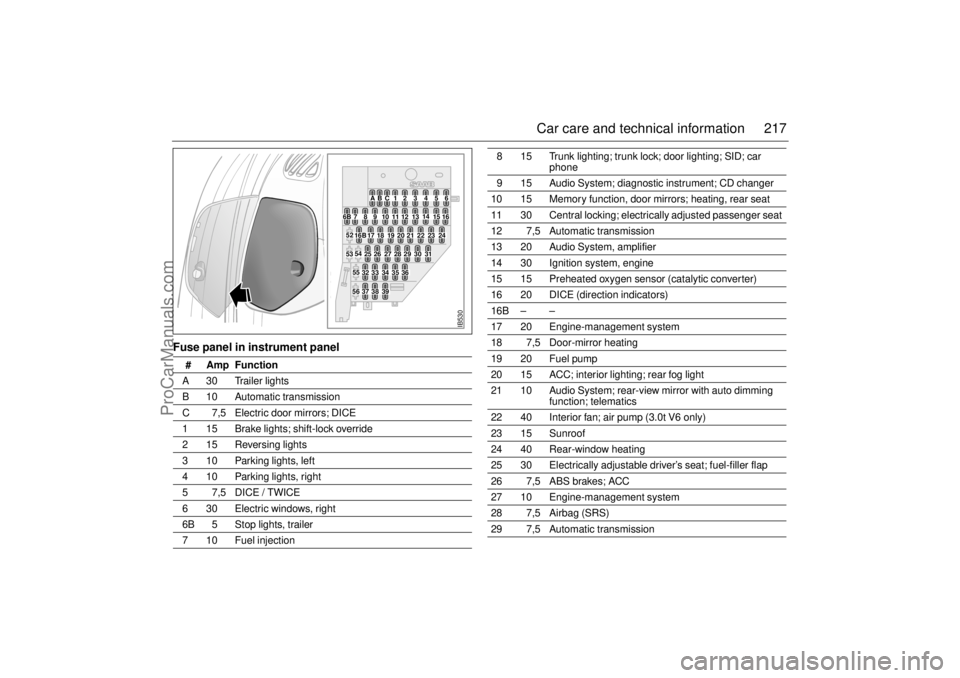
Fuse panel in instrument panel
# Amp Function
A 30 Trailer lights
B 10 Automatic transmission
C 7,5 Electric door mirrors; DICE
1 15 Brake lights; shift-lock override
2 15 Reversing lights
3 10 Parking lights, left
4 10 Parking lights, right
5 7,5 DICE / TWICE
6 30 Electric windows, right
6B 5 Stop lights, trailer
7 10 Fuel injection
8 15 Trunk lighting; trunk lock; door lighting; SID; car
phone
9 15 Audio System; diagnostic instrument; CD changer
10 15 Memory function, door mirrors; heating, rear seat
11 30 Central locking; electrically adjusted passenger seat
12 7,5 Automatic transmission
13 20 Audio System, amplifier
14 30 Ignition system, engine
15 15 Preheated oxygen sensor (catalytic converter)
16 20 DICE (direction indicators)
16B – –
17 20 Engine-management system
18 7,5 Door-mirror heating
19 20 Fuel pump
20 15 ACC; interior lighting; rear fog light
21 10 Audio System; rear-view mirror with auto dimming
function; telematics
22 40 Interior fan; air pump (3.0t V6 only)
23 15 Sunroof
24 40 Rear-window heating
25 30 Electrically adjustable driver’s seat; fuel-filler flap
26 7,5 ABS brakes; ACC
27 10 Engine-management system
28 7,5 Airbag (SRS)
29 7,5 Automatic transmission
IB530
BC123456 A
14
121110987
13
6B
1516
2324
222120191817
16B
5425262728293031
3635343332
39383755525356
ProCarManuals.com
Page 226 of 272

226 Car care and technical informationChanging a wheel
WARNING
The car jack is designed solely for use
in changing a wheel or fitting snow
chains. It must not be used to support
the car during repair work or servicing.
Never crawl under a car that is
supported only by a jack.
Special care must be taken if the car is
on a slope – use wheel chocks!
Position chocks, one ahead and one
behind, the wheel that is diagonally
opposite to the one to be changed.
Switch on the hazard warning lights if
the car is on a road.
Apply the parking brake and leave the
car in gear (1st or reverse). Automatic
transmission: move selector to the
P position.
Ensure that everybody is out of the car
before jacking it up.
Never start the engine while the car is
jacked up.
The jack must stand on a firm, level
surface.
Stow the jack in the place provided for
it under the panel in the floor of the lug-
gage compartment. Secure it properly
to avert injury to passengers in the
event of an accident.
Do not use the jack for any purpose
other than for jacking up the car.
ProCarManuals.com
Page 228 of 272
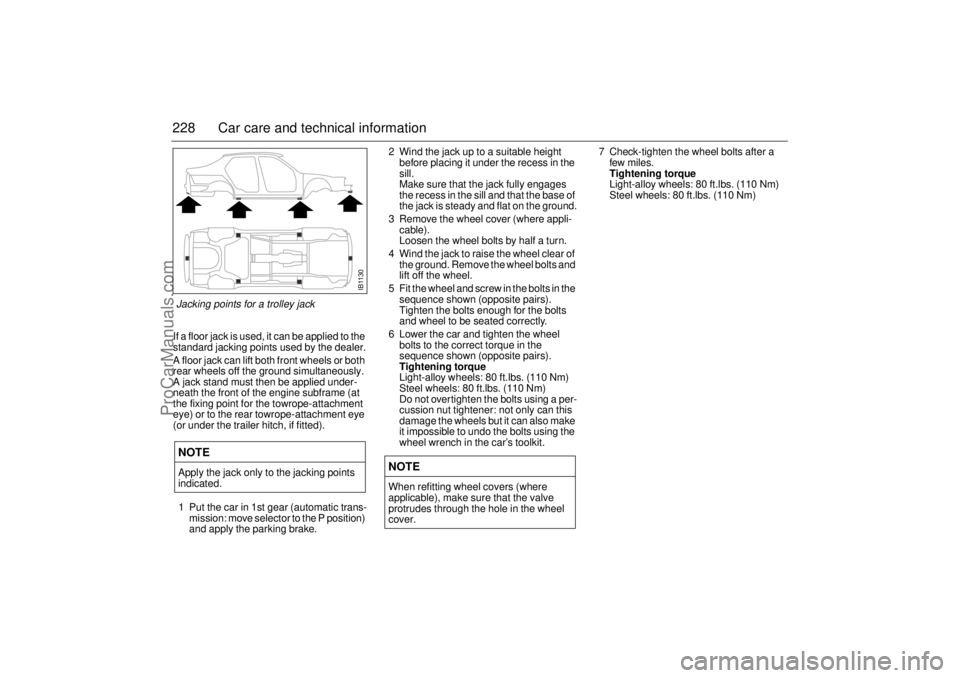
228 Car care and technical informationIf a floor jack is used, it can be applied to the
standard jacking points used by the dealer.
A floor jack can lift both front wheels or both
rear wheels off the ground simultaneously.
A jack stand must then be applied under-
neath the front of the engine subframe (at
the fixing point for the towrope-attachment
eye) or to the rear towrope-attachment eye
(or under the trailer hitch, if fitted).
1 Put the car in 1st gear (automatic trans-
mission: move selector to the P position)
and apply the parking brake.2 Wind the jack up to a suitable height
before placing it under the recess in the
sill.
Make sure that the jack fully engages
the recess in the sill and that the base of
the jack is steady and flat on the ground.
3 Remove the wheel cover (where appli-
cable).
Loosen the wheel bolts by half a turn.
4 Wind the jack to raise the wheel clear of
the ground. Remove the wheel bolts and
lift off the wheel.
5 Fit the wheel and screw in the bolts in the
sequence shown (opposite pairs).
Tighten the bolts enough for the bolts
and wheel to be seated correctly.
6 Lower the car and tighten the wheel
bolts to the correct torque in the
sequence shown (opposite pairs).
Tightening torque
Light-alloy wheels: 80 ft.lbs. (110 Nm)
Steel wheels: 80 ft.lbs. (110 Nm)
Do not overtighten the bolts using a per-
cussion nut tightener: not only can this
damage the wheels but it can also make
it impossible to undo the bolts using the
wheel wrench in the car’s toolkit. 7 Check-tighten the wheel bolts after a
few miles.
Tightening torque
Light-alloy wheels: 80 ft.lbs. (110 Nm)
Steel wheels: 80 ft.lbs. (110 Nm)NOTEApply the jack only to the jacking points
indicated.
NOTEWhen refitting wheel covers (where
applicable), make sure that the valve
protrudes through the hole in the wheel
cover.
IB1130
Jacking points for a trolley jack
ProCarManuals.com
Page 232 of 272

232 Car care and technical informationApply the leather conditioner using a soft
cloth and the same circular movements as
described above. After it has dried, polish
the leather with a soft, dry cloth. Follow the
directions given above. Do not use hot
water, unknown abrasive polishes, sol-
vents, sprays or soaps that might scratch
the leather.Textile carpetingVacuum clean the carpeting regularly. Car-
pets can also be cleaned using a brush, or
carpet shampoo applied with a sponge. Do
not use vacuum cleaners outdoors unless
they are properly grounded.
Washing the carThe bodywork must be washed frequently.
When the car is new, the body should be
washed by hand using plain cold water and
a clean, soft brush, or in a brushless car-
wash that uses mild detergent. Automatic
car washes with brushes should be avoided
when the car is new. Do not use automatic
car washes for the first five or six months,
before the paintwork has hardened prop-
erly. Thereafter, use a high quality car wash
soap added to lukewarm water.
Do not use a pressure washer at close
range on stone chip damage, scratches or
other damage to the paintwork. The paint
can otherwise start to flake.
Remove any bird droppings without delay,
as these can discolor the paintwork and
prove difficult to polish out.
Use a soft cloth moistened with methyl alco-
hol to remove splashes of tar or asphalt. Do
not use strong cleaners, as these can dry
out the paintwork. The underside of the car also needs wash-
ing regularly, and this should be done extra
thoroughly at the end of winter. Clean the
underside of the car by hand if the car is usu-
ally washed in an automatic car wash with-
out special facilities for underbody cleaning.
Never wash or leave the car to dry in the
sun, but wipe it dry with a chamois leather
immediately after washing to avoid smears
and streaks.
Clean the window glass inside and out using
a high quality window cleaner. This is partic-
ularly important when the car is new, as
upholstery and trim have a tendency to
sweat a little at first.
Keep the glass well cleaned, as this helps to
prevent misting. NOTEAvoid using any alcohol-based cleaners
on the front and rear light clusters, as
these can cause cracking of the lenses.
NOTE The door mirrors must be fully
retracted before the car enters an
automatic car wash.
Remove fixed antennas, e.g. for
mobile phone, before putting car
through an automatic car wash.
Try your brakes on leaving a car wash.
Wet brake discs reduce the braking
effect.
ProCarManuals.com
Page 236 of 272

236 Car care and technical information4Inspect the undercoating and touch
up if necessary. Pay particular atten-
tion to the fenders and wheel housings,
which are exposed to abrasion by flying
gravel, etc. If the composition has worn
or flaked off, the steel must be thor-
oughly cleaned and dried before a fresh
coat is applied. The cleaning is best
done with a scraper and a steel wire
brush, followed by washing with solvent.
Apply the new coating thinly, as other-
wise it may run off or fall off when dry.
For long tripsBefore setting off on a long journey, it is
advisable to have your car checked over by
your Saab dealer.
Obtain a few important items to take along
on your journey such as spare bulbs, wiper
blades, fuses, a Poly-V-belt and the like.
You can check some points yourself before-
hand:
Make sure that the engine is in good con-
dition.
Check that no oil or gasoline leaks out of
the engine or gearbox/transmission.
Check the coolant and power steering
fluid levels. Check also for leaks.
Inspect the Poly-V-belt and replace it if it
shows any signs of hard wear.
Check the battery charge.
Check the tires for tread pattern and air
pressure, including the compact spare
wheel.
Check the brakes.
Check all bulbs.
Check for the presence of the tool kit and
the jack in the car.
Recovery and/or
recycling of automotive
materialsA typical car consists of metals (65–75%),
plastics (10–14%), rubber (5%) and small
quantities of glass, wood, paper and tex-
tiles.
Some of these materials can be recycled,
while others can be recovered in chemical
processes for reuse in new products or as a
source of energy.
While the Saab 9-5 was still at the draw-
ing-board stage, Saab engineers were
giving serious consideration to how the
maximum quantity of materials could be
reclaimed from the car on its eventual
scrapping. To facilitate sorting, plastic parts,
for instance, have been marked to identify
the precise nature of the plastic.
Approximately 90% of the materials in the
car can be recycled or recovered, where
facilities exist.
Before the car is scrapped, all the oils and
other fluids that could pollute the environ-
ment should be recovered from the car. It
may be of interest in this context to learn that
the refrigerant used in the Saab 9-5’s ACC
systems (R134a) contains neither CFCs nor
any other chlorine compounds.
ProCarManuals.com
Page 243 of 272

243 Maintenance and owner assistance
Service record retentionService instruction coupons and record
stubs are provided in the Saab Warranties
and Service Record Booklet which accom-
panies this Owner’s Manual. The coupons
are arranged in the order that normal ser-
vice should be performed. The edge of each
coupon is shaded to correspond to the type
of service point:
Striped - "Check Up"
Blue - Oil change/inspection service
Black - Major service
Note that in Canada a combined service
and warranty book is used, but not service
coupons.
When scheduled services are performed,
your dealer will tear out the applicable
coupon and use it to check off the opera-
tions performed and enter it into the service
file at the dealership. The servicing dealer’s
stamp, along with the date and mileage at
which the service was done, should be
entered on the corresponding stub which
remains in your booklet. The booklet is your
permanent record of the services per-
formed. It also includes a log sheet for
unscheduled repairs.
It is advisable to retain receipts and, if pos-
sible, copies of shop work orders for all ser-
vice and repair work, wherever performed.
Service costsDealer pricing practices and labor for ser-
vice work vary. Saab’s recommended ser-
vice times for each service point do not
include the labor required to replace wear
items, such as wiper blades, brake pads or
tires. Nor is labor to perform other service or
repairs found to be necessary as a result of
the inspections included in these times.
Additional labor and parts will be charged
for such work when necessary, except as
covered under an applicable Saab warranty
or any optional extended service contract.
Transmission fluid changes or suspension
alignment, when necessary, are also addi-
tional.
Dealer charges for general shop material,
regulated hazardous waste removal, recy-
cling expenses or other operation costs may
also be applied to service and repair
invoices and are apt to vary by dealer and
locality.
Owner assistanceWarranties and service problem
assistanceFor complete information about all applica-
ble warranties, including the New Car War-
ranty, Perforation Warranty, Vehicle Emis-
sion Warranty and Emission Perforation
Warranty, consult the Warranties and Ser-
vice Record Booklet which accompanies
this Owner’s Manual. It also contains owner
assistance information including Saab
Roadside Assistance. If the booklet is lost or
misplaced, a new one may be ordered
through a Saab dealer or by contacting
Saab.
In the U.S. there is a national Customer
Assistance Center at Saab Cars USA, Inc.
The toll-free number to call from all 50 states
is 1-800-955-9007.
In Canada, please call the Saab Customer
Assistance Centre at 1-800-263-1999.
A list of authorized Saab sales and service
dealers is available for those planning to
travel in the United States and Canada.
Canadian or U.S. travelers may call the
Customer Assistance Center in the country
in which they are traveling.
ProCarManuals.com
Page 246 of 272

246 Maintenance and owner assistance* These are the minimum required Emission Control System maintenance steps. Saab urges that all recommended maintenance procedures be performed
according to this program.
(b.) Change automatic transmission fluid at more frequent intervals (20,000; 50,000; 80,000 miles, etc.) if car is driven in dense city traffic where the outside
temperature regularly reach 90°F or higher, or if car is used in a mountainous/high altitude area or for trailer towing.
Service Intervals **
Miles = U.S. Cars
Kilometers = Canadian Cars
30 day
10,000
(16,000 km)
20,000
(32,000 km)
30,000
(48,000 km)
40,000
(64,000 km)
50,000
(80,000 km)
60,000
(96,000 km)
70,000
(112,000 km)
80,000
(128,000 km)
90,000
(144,000 km)
100,000
(160,000 km)
Service #
1234567891011
Engine and engine compartment (cont.)
E Evaporative emission system including filler cap, vapor
lines, EVAP canister and canister purge valve"
R Fuel system: leaks and damage""""""""""
E Fuel filter!
E Engine air cleaner element!
*
!*
!*
R Exhaust system and mountings; leaks and condition""""""""""
Electrical
R Battery: state of charge and electrolyte level; clean termi-
nals if necessary"""""""""""
R Head, fog, brake, tail, turn signal, warning lights instru-
ment panel, backup and marker lamps"""""""""""
Transmission
R Automatic transmission fluid change (b.)!!!
R Automatic transmission oil level"""""""""""
R Manual transmission oil level"""
R Outer and inner driver joint boots""""""""""
ProCarManuals.com
Page 247 of 272

247 Maintenance and owner assistance
(c.) Check wheel alignment if irregular or premature tire wear is apparent.
Service Intervals **
Miles = U.S. Cars
Kilometers = Canadian Cars
30 day
10,000
(16,000 km)
20,000
(32,000 km)
30,000
(48,000 km)
40,000
(64,000 km)
50,000
(80,000 km)
60,000
(96,000 km)
70,000
(112,000 km)
80,000
(128,000 km)
90,000
(144,000 km)
100,000
(160,000 km)
Service #
1234567891011
Chassis
R Ball joint clearance, outer and inner steering joints and
rubber boots""""""""""
R Shock absorbers and bushes; tightness and condition"""
R Tire pressure, tread depth and wear (c.)"""""""""""
R Rotate tires, front to rear""""""""""
R Brake pads and discs; wear and condition""""""""""
R Brake lines and hoses"""""""""""
R Brake fluid level and renewal (max. 2-year intervals)""" ! "" ! "" ! "
R Check handbrake function"""""""""""
R Power steering fluid level"""""""""""
ProCarManuals.com
Page 248 of 272

248 Maintenance and owner assistance
Service Intervals **
Miles = U.S. Cars
Kilometers = Canadian Cars
30 day
10,000
(16,000 km)
20,000
(32,000 km)
30,000
(48,000 km)
40,000
(64,000 km)
50,000
(80,000 km)
60,000
(96,000 km)
70,000
(112,000 km)
80,000
(128,000 km)
90,000
(144,000 km)
100,000
(160,000 km)
Service #
1234567891011
Chassis (cont.)
RToe-in"""
R Cabin air filter!!!
R Cabin air absorptive filter!
R Door hinges, stops and locks###
R Airbag system, SRS warning lamps, visual inspection"""""""""""
R Safety belts; operation and visual inspection of belt for
tears and fraying"""""""""""
RWipers"""""""""""
R Washer system: check and top-up"""""""""""
R Reset service indicator""""""""""
Customer programming
R Carry out systems programming per customer request"
Road test
R Check performance of drive train, steering and brakes
and verify tire balance.
Check function of instruments and controls, including
horn, windshield wipers, cruise control and climate sys-
tem.
Note any noises or problems for correction."""""""""""
ProCarManuals.com
Page 249 of 272
249 Specifications
Specifications General.............................. 250
Engine ............................... 252
Fuel.................................... 252
Engine oil .......................... 253
Engine variants ................ 254
Electrical system.............. 254
Drive belts......................... 255
Manual gearbox................ 255
Automatic transmission .. 256
Suspension....................... 256
Steering............................. 256
Brake system.................... 257
Wheels and tires .............. 257
Plates and labels .............. 259
IB603
ProCarManuals.com