change wheel SAAB 9-5 2001 User Guide
[x] Cancel search | Manufacturer: SAAB, Model Year: 2001, Model line: 9-5, Model: SAAB 9-5 2001Pages: 272, PDF Size: 14.83 MB
Page 172 of 272

172 Starting and drivingDriving in cold weatherBefore starting a journey in cold weather
you should check the following:
That the wiper blades have not become
frozen to the windshield/glass.
Brush any snow away from the air intake
for the heater system (opening between
hood and windshield).
It may be advisable to lubricate the
door-lock cylinder (use molybdenum
disulphide, MoS
2) to prevent its freezing.
If the lock has frozen, take care not to
break the key (or use the remote control)
– heat it first or spray it with de-icer.
Periodically during the winter, add gaso-
line anti-freeze to the fuel to dispel any
condensation in the fuel tank which could
freeze and cause problems in the system.
Keep the tank well filled to reduce the risk
of condensation forming.
If the car is parked outside in freezing
weather, fuel additives (gasoline
anti-freeze) will not do any good as it
cannot remove water that has already fro-
zen. Park the car in a warm place so that
any ice that may have built up melts, then
add gasoline anti-freeze when filling up
the tank. Condensation is caused by
changes in the outdoor temperature or by
the car being parked alternately in a
garage and outside.
It is particularly important when the roads
are slippery that the brakes and tires be in
good condition. Check the anti-freeze in the engine cool-
ant, see page 196.
The car´s trip computer will warn you when
there is a risk of slippery conditions. For fur-
ther information on this function, see page
58.
The car is equipped with tires designed to
provide optimum grip on both wet and dry
roads, although this has been achieved at
the expense of somewhat reduced grip on
snow and ice. For regular driving on snow
and ice, we therefore recommend that
winter (snow) tires be fitted.
Winter (snow) tires, particularly studded
tires (where use is legally permitted), gener-
ally make driving safer on snow and ice.
Acquaint yourself with the legal provi-
sions governing the use of different
types of winter tires and snow chains.
Studded tires are not allowed in some
countries.If winter tires are fitted, the same type must
be fitted on all wheels. Your Saab dealer will
be pleased to advise you on the best tires for
your car.
Remember that tires age. It may therefore
be necessary to change them before they
reach the legal wear limit, as they gradually
lose their friction properties.
The best response if the car gets into a
front-wheel skid is to freewheel (manual
gearbox only), i.e. disengage the clutch (so
that the wheels are neither driven or
retarded by the engine.
If the car has automatic transmission, ease
up on the accelerator and steer carefully in
the desired direction.
In a rear-wheel skid, steer in the same direc-
tion that the rear of the car is moving.
ProCarManuals.com
Page 179 of 272

179 Starting and driving
Driving with a loadThe driving characteristics of the car are
affected by the way it is loaded.
Place heavy loads as far forward and as
low as possible in the trunk.
Secure the load to the tie downs, see
page 136.
The load should be such that the car´s
total weight or axle weight are not
exceeded, see page 250.
Heavy loads mean that the car’s center of
gravity is further back. As a result, the car
will sway more during evasive steering.
Never exceed the permissible load in the
roof box, even if there is room for more.
Ensure that the tire pressure is correct –
slight overinflation is preferable to under-
inflation.
The braking distance of a loaded car is
always greater. Keep your distance from
the vehicle in front.
Roof loads can negatively affect tele-
communication.
Tire pressure, see page 259 and back
cover.
TiresThe tire pressure should match the current
load and speed of the car; see the back
cover or the tire pressure label on
page 259.
The tire pressures given apply to cold tires,
that is tires that are the same temperature
as the outside air temperature.
The tire pressure increases as the tires
become warm (e.g. during highway driving)
with approximately 0.3 bar (4 psi). When
the temperature of the tires changes by 50°
(10°C), the tire pressure will change 0.1 bar
(2 psi).Never reduce the pressure of a hot tire. If the
tires are hot when you check them, only
increase the pressure, if necessary.
Underinflated tires wear more quickly than
slightly overinflated tires.
If a valve is leaking, simply unscrew it and fit
a new one.
Important! Remember to adjust the tire
pressures if you change the load in the car
or intend to drive at substantially lower or
higher speeds than normal.NOTECheck the tire pressure at least once a
month. Underinflation is the main cause
of:
Damage to the wheels.
Premature tire wear.
Damage to the sidewalls.
ProCarManuals.com
Page 198 of 272
198 Car care and technical informationBrake and clutch fluid Checking the fluid level The combined brake and clutch-fluid reser-
voir is transparent to facilitate checking of
the fluid level.
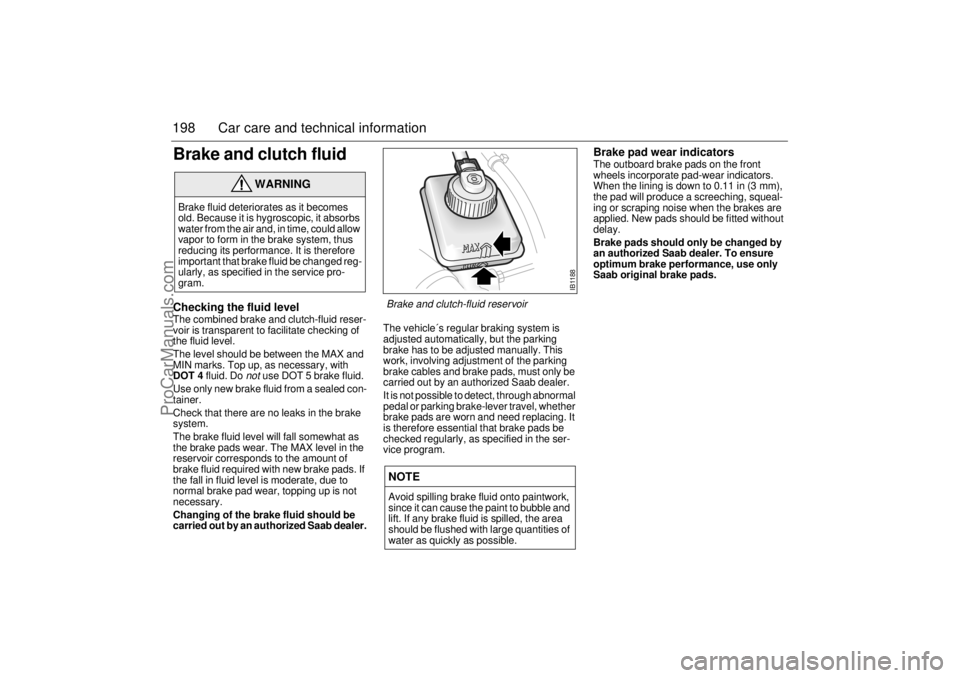
The level should be between the MAX and
MIN marks. Top up, as necessary, with
DOT 4 fluid. Do
not
use DOT 5 brake fluid.
Use only new brake fluid from a sealed con-
tainer.
Check that there are no leaks in the brake
system.
The brake fluid level will fall somewhat as
the brake pads wear. The MAX level in the
reservoir corresponds to the amount of
brake fluid required with new brake pads. If
the fall in fluid level is moderate, due to
normal brake pad wear, topping up is not
necessary.
Changing of the brake fluid should be
carried out by an authorized Saab dealer.The vehicle´s regular braking system is
adjusted automatically, but the parking
brake has to be adjusted manually. This
work, involving adjustment of the parking
brake cables and brake pads, must only be
carried out by an authorized Saab dealer.
It is not possible to detect, through abnormal
pedal or parking brake-lever travel, whether
brake pads are worn and need replacing. It
is therefore essential that brake pads be
checked regularly, as specified in the ser-
vice program.
Brake pad wear indicators The outboard brake pads on the front
wheels incorporate pad-wear indicators.
When the lining is down to 0.11 in (3 mm),
the pad will produce a screeching, squeal-
ing or scraping noise when the brakes are
applied. New pads should be fitted without
delay.
Brake pads should only be changed by
an authorized Saab dealer. To ensure
optimum brake performance, use only
Saab original brake pads.
WARNING
Brake fluid deteriorates as it becomes
old. Because it is hygroscopic, it absorbs
water from the air and, in time, could allow
vapor to form in the brake system, thus
reducing its performance. It is therefore
important that brake fluid be changed reg-
ularly, as specified in the service pro-
gram.
NOTEAvoid spilling brake fluid onto paintwork,
since it can cause the paint to bubble and
lift. If any brake fluid is spilled, the area
should be flushed with large quantities of
water as quickly as possible.
IB1188
Brake and clutch-fluid reservoir
ProCarManuals.com
Page 221 of 272

221 Car care and technical information
Wheels Alternative wheels and tiresIf you wish to fit other tires or wheels than
those supplied with the car, consult your
Saab dealer first as to the possibilities avail-
able.
Wheels/tires combinations that are not
approved by Saab can negatively affect the
car´s directional stability, steering and brak-
ing in both wet and dry conditions.
Do not assume that a wheel/tire combina-
tion will function properly just because it will
bolt on.The wheels and tires have been carefully
matched to the characteristics of the car and
play a key role in its outstanding roadhold-
ing and handling.
Tire pressureTires need to be inflated to suit the load car-
ried and the maximum speed the car will be
driven (see the recommended tire pres-
sures on the back cover). Note that all
values apply to cold tires. For tires with an
aspect ratio less than /60, increase the tire
pressure by 3 psi (20 kPa) for rough roads
with potholes to minimize the risk of rim
damage.Never reduce the pressure of a hot tire. If the
tires are hot when you check them, only
increase the pressure, if necessary.
Soft tires will cause faster wear than
over-pressurized tires. They also increase
fuel consumption.
If a valve is leaking, simply unscrew it and fit
a new one.
Important! Remember to adjust the tire
pressures if you change the load in the car
or intend to cruise at a substantially higher
or lower speed than normal.
NOTEFor wide wheels and/or low-profile tires,
bear in mind the following:
Tires and wheels can be damaged in
potholes etc.
Springs, shock absorbers and wheel
bearings can be overloaded.
The wheels can come into contact with
chassis and body components.
The speed and load limits for the tires
must not be exceeded; see page 222.
Wheels larger than 17” must not be fit-
ted. The maximum permissible offset
is 49 mm.
NOTECheck the tire pressures at least once
per month.
Underinflation is the main cause of:
Tires wearing out prematurely.
Damage to the sidewalls.
Damage to the wheels.
ProCarManuals.com
Page 225 of 272
225 Car care and technical information
Compact spare wheelThe compact spare is light and easy to
handle when changing the tire. Its use is
only permitted when a standard tire has sus-
tained a puncture. The maximum life of the
tire is only 2000 miles (3,500 km).
Do not exceed 50 mph (80 km/h) with the
compact spare fitted.
The compact spare should be inflated to
60 psi (420 kPa). Carry the punctured tire in
the spare-wheel well under the luggage-
compartment floor.
Have the standard tire repaired and refitted
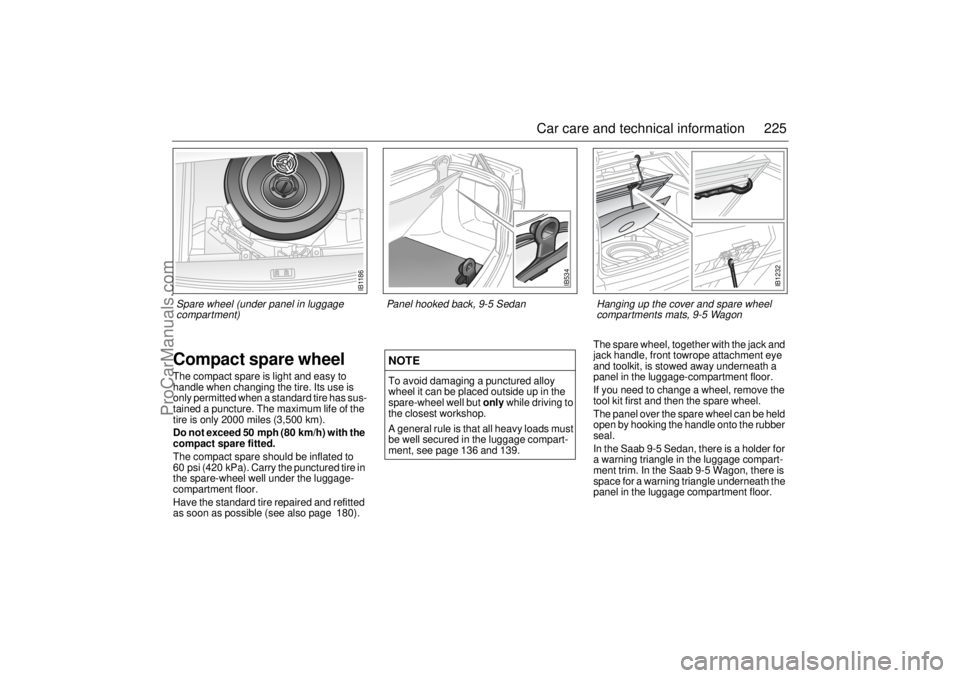
as soon as possible (see also page 180).The spare wheel, together with the jack and
jack handle, front towrope attachment eye
and toolkit, is stowed away underneath a
panel in the luggage-compartment floor.
If you need to change a wheel, remove the
tool kit first and then the spare wheel.
The panel over the spare wheel can be held
open by hooking the handle onto the rubber
seal.
In the Saab 9-5 Sedan, there is a holder for
a warning triangle in the luggage compart-
ment trim. In the Saab 9-5 Wagon, there is
space for a warning triangle underneath the
panel in the luggage compartment floor.
NOTETo avoid damaging a punctured alloy
wheel it can be placed outside up in the
spare-wheel well but only while driving to
the closest workshop.
A general rule is that all heavy loads must
be well secured in the luggage compart-
ment, see page 136 and 139.
IB534
Panel hooked back, 9-5 Sedan
IB1232
Hanging up the cover and spare wheel
compartments mats, 9-5 Wagon
IB1186
Spare wheel (under panel in luggage
compartment)
ProCarManuals.com
Page 226 of 272

226 Car care and technical informationChanging a wheel
WARNING
The car jack is designed solely for use
in changing a wheel or fitting snow
chains. It must not be used to support
the car during repair work or servicing.
Never crawl under a car that is
supported only by a jack.
Special care must be taken if the car is
on a slope – use wheel chocks!
Position chocks, one ahead and one
behind, the wheel that is diagonally
opposite to the one to be changed.
Switch on the hazard warning lights if
the car is on a road.
Apply the parking brake and leave the
car in gear (1st or reverse). Automatic
transmission: move selector to the
P position.
Ensure that everybody is out of the car
before jacking it up.
Never start the engine while the car is
jacked up.
The jack must stand on a firm, level
surface.
Stow the jack in the place provided for
it under the panel in the floor of the lug-
gage compartment. Secure it properly
to avert injury to passengers in the
event of an accident.
Do not use the jack for any purpose
other than for jacking up the car.
ProCarManuals.com
Page 263 of 272

263 Index
Index
AA/C system, fault diagnosis
_______ 230
A/C system, maintenance
_________ 230
ABS brakes
____________________ 167
ACC
__________________________ 70
ACC functions
___________________ 73
ACC, automatic climate control
_____ 70
ACC, calibration
_________________ 78
ACC, condensation _______________ 79
ACC, programming _______________ 76
ACC, useful tips
_________________ 78
Adjusting the steering wheel
_______ 124
Adjustment, seats
_______________ 120
Afterheater, V6-engine cars
________ 80
Air conditioning (A/C), fault diagnosis
and maintenance
______________ 230
Air distribution, ACC ______________ 75
Airbag
_________________________ 26
Alarm _________________________ 41
Alarm functions
__________________ 44
Alarm signals
_______________ 41
, 44
Alternator
_____________________ 202
Alternator drive belt
_________ 202
, 255
Alternator rating
________________ 254
Anticorrosion treatment
___________ 234
Antidazzle rear-view mirror
________ 126
Ashtrays
______________________ 130
Audio System
___________________ 81
Audio System, quick guide
_________ 83Autochecking of lights on starting
____54
Automatic climate control (ACC) _____70
Automatic transmission,
technical data
_________________256
BBattery
________________________199
Battery charging/replacing
________201
Battery, boost starting
____________183
Belt guide
______________________12
Boost starting using jump leads
____183
Booster cushion
_________________24
Brake and clutch fluid
____________198
Brake-fluid reservoir
_____________198
Brakes, technical data ____________257
Bulbs, changing
________________205
Bulbs, table of
__________________214
CCD changer
_____________________93
CD player
______________________91
CHECK messages
_______________61
CHECKING
_____________________61
Calibration, ACC
_________________78
Cancelling the programmed settings
_76
Car alarm
______________________41
Car care
______________________187
Car phone, installation
___________103
Cargo net, 9-5 Wagon ____________141
Carpeting, care of
_______________232Cassette player
_________________ 88
Catalytic converter,
important considerations
________ 152
Central locking
__________________ 34
Change language in SID
__________ 62
Change of address notification
____ 244
Changing a wheel
______________ 226
Changing bulbs
________________ 205
Changing the coolant
___________ 197
Changing the wheels round
_______ 222
Changing wiper blades
__________ 203
Chassis number
_______________ 259
Chassis number, key to
__________ 260
Child safety
____________________ 19
Child safety locks, rear doors
______ 37
Child seat, integral
_______________ 24
Cleaning, engine bay ____________ 233
Clock
______________________ 61
, 62
Colour code, body
______________ 259
Colour code, trim _______________ 259
Compact spare wheel
___________ 225
Condensation, ACC
______________ 79
Coolant
______________________ 196
Coolant, changing
______________ 197
Courtesy Headlight Feature
_______ 64
Cruise control
_________________ 166
Cup holder
____________________ 133
DDICE/TWICE
__________________ 216
Dampers
_____________________ 256
ProCarManuals.com
Page 265 of 272

265 Index
MMain instrument panel
____________ 48
Main/dipped beam
_______________ 63
Maintenance schedule ___________ 242
Manual gearbox, technical data
____ 255
Maxi fuses
_____________________ 216
Milometer ______________________ 54
Motoring abroad
________________ 236
NNight Panel
_____________________ 61
OOil capacity, engine
_____________ 252
Oil change, engine
______________ 194
Oil specification
_________________ 252
OnStar
_______________________ 107
Outdoor temperature
_____________ 57
Owner assistance
_______________ 243
PPaintwork, touching-in
___________ 233
Parking lights
___________________ 63
Plates and labels _______________ 259
Poly-V-belt
____________________ 202
Power steering _________________ 199
Power-steering fluid
_____________ 199
Pressure gauge
_________________ 56
Programming I, ACC
______________ 76Programming II, ACC
_____________77
Programming the ACC ____________76
QQuestions on function of airbag
_____30
Quick guide, Audio System
_________83
RRadio
__________________________86
Rear fog light
____________________64
Rear seat, 9-5 Sedan, folding
______134
Rear seat, 9-5 Wagon, folding _____137
Rear-seat head restraints
__________18
Rear-view mirror, antidazzle _______126
Rearview mirrors
________________125
Reclamation
___________________236
Refuelling
_____________________154
Relay panel ____________________218
Remote control __________________34
Remote-control battery, changing
____37
Remove the key
________________148
Reporting safety defects
__________244
Reprogramming of systems _______261
Reservoir, power-steering fluid _____199
Rev counter
_____________________54
Reversing lights
_________________66
Roof load
______________________176
Running-in _____________________170
SSID
__________________________ 57
SRS (airbag)
___________________ 26
SRS, supplementary restraint system
26
Saab 9-5 Audio System
___________ 81
Saab Information Display (SID)
_____ 57
Safety belts
____________________ 12
Safety belts, care of
_____________ 231
Safety-belt pretensioners
_________ 13
Safety-belt reminder
_____________ 12
Seats
________________________ 120
Securing a load
_________________ 38
Selector lever indication,
automatic transmission
__________ 57
Service costs
__________________ 243
Service information
_____________ 244
Service intervals
_______________ 242
Service record retention
_________ 243
Settings, seats
_________________ 120
Side airbags
___________________ 28
Signalling, horn ________________ 124
Sliding floor, 9-5 Wagon
_________ 142
Snow chains
__________________ 172
Spare wheel __________________ 225
Spare wheel and tools
___________ 144
Spark plugs
___________________ 254
Speed rating __________________ 221
Speedometer ________________ 54
, 55
Starting in cold weather, ACC
______ 76
Starting in hot weather, ACC _______ 76
Steering wheel adjustment
_______ 124
ProCarManuals.com