mirror SAAB 9-5 2001 User Guide
[x] Cancel search | Manufacturer: SAAB, Model Year: 2001, Model line: 9-5, Model: SAAB 9-5 2001Pages: 272, PDF Size: 14.83 MB
Page 126 of 272
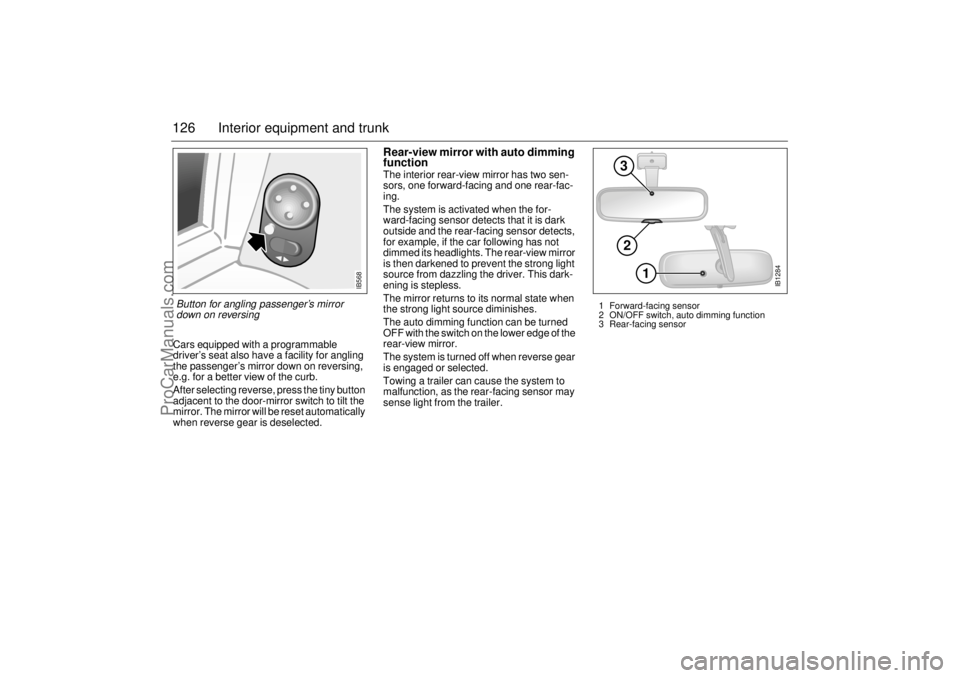
126 Interior equipment and trunkCars equipped with a programmable
driver’s seat also have a facility for angling
the passenger’s mirror down on reversing,
e.g. for a better view of the curb.
After selecting reverse, press the tiny button
adjacent to the door-mirror switch to tilt the
mirror. The mirror will be reset automatically
when reverse gear is deselected.
Rear-view mirror with auto dimming
functionThe interior rear-view mirror has two sen-
sors, one forward-facing and one rear-fac-
ing.
The system is activated when the for-
ward-facing sensor detects that it is dark
outside and the rear-facing sensor detects,
for example, if the car following has not
dimmed its headlights. The rear-view mirror
is then darkened to prevent the strong light
source from dazzling the driver. This dark-
ening is stepless.
The mirror returns to its normal state when
the strong light source diminishes.
The auto dimming function can be turned
OFF with the switch on the lower edge of the
rear-view mirror.
The system is turned off when reverse gear
is engaged or selected.
Towing a trailer can cause the system to
malfunction, as the rear-facing sensor may
sense light from the trailer.
IB568
Button for angling passenger’s mirror
down on reversing
IB1284
1
23
1 Forward-facing sensor
2 ON/OFF switch, auto dimming function
3 Rear-facing sensor
ProCarManuals.com
Page 128 of 272
128 Interior equipment and trunk
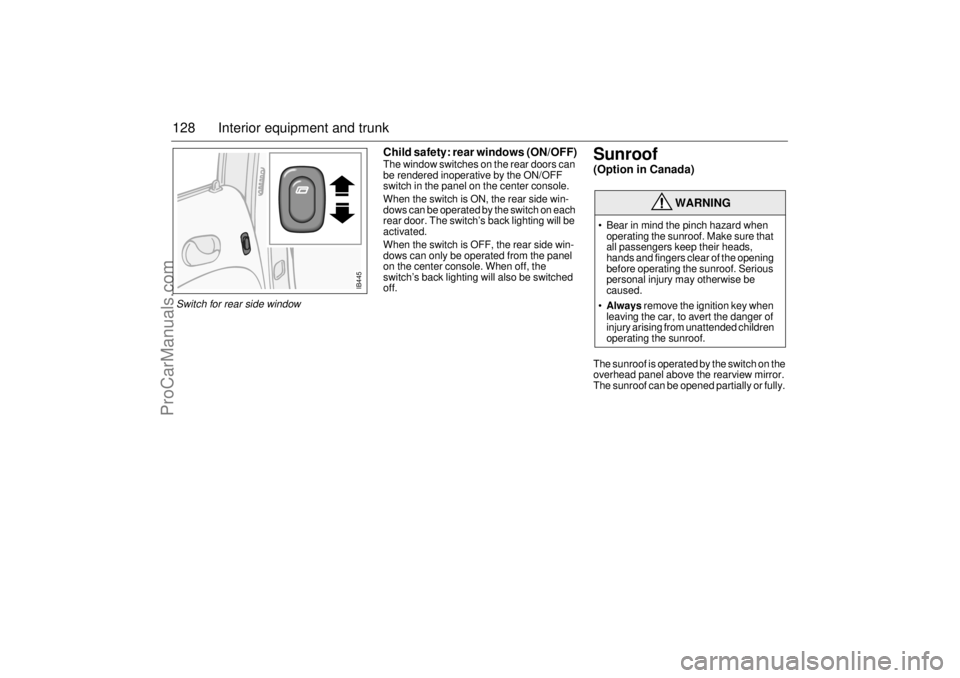
Child safety: rear windows (ON/OFF)The window switches on the rear doors can
be rendered inoperative by the ON/OFF
switch in the panel on the center console.
When the switch is ON, the rear side win-
dows can be operated by the switch on each
rear door. The switch’s back lighting will be
activated.
When the switch is OFF, the rear side win-
dows can only be operated from the panel
on the center console. When off, the
switch’s back lighting will also be switched
off.
Sunroof (Option in Canada) The sunroof is operated by the switch on the
overhead panel above the rearview mirror.
The sunroof can be opened partially or fully.
WARNING
Bear in mind the pinch hazard when
operating the sunroof. Make sure that
all passengers keep their heads,
hands and fingers clear of the opening
before operating the sunroof. Serious
personal injury may otherwise be
caused.
Always remove the ignition key when
leaving the car, to avert the danger of
injury arising from unattended children
operating the sunroof.
IB445
Switch for rear side window
ProCarManuals.com
Page 130 of 272
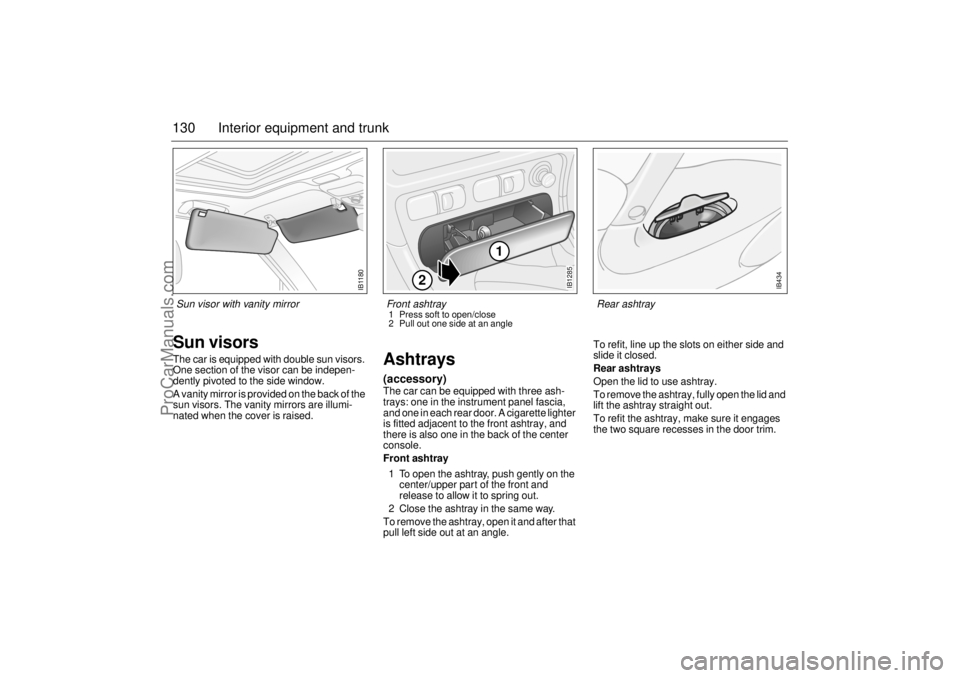
130 Interior equipment and trunkSun visorsThe car is equipped with double sun visors.
One section of the visor can be indepen-
dently pivoted to the side window.
A vanity mirror is provided on the back of the
sun visors. The vanity mirrors are illumi-
nated when the cover is raised.
Ashtrays(accessory) The car can be equipped with three ash-
trays: one in the instrument panel fascia,
and one in each rear door. A cigarette lighter
is fitted adjacent to the front ashtray, and
there is also one in the back of the center
console.
Front ashtray
1 To open the ashtray, push gently on the
center/upper part of the front and
release to allow it to spring out.
2 Close the ashtray in the same way.
To remove the ashtray, open it and after that
pull left side out at an angle. To refit, line up the slots on either side and
slide it closed.
Rear ashtrays
Open the lid to use ashtray.
To remove the ashtray, fully open the lid and
lift the ashtray straight out.
To refit the ashtray, make sure it engages
the two square recesses in the door trim.
IB1180
Sun visor with vanity mirror
IB1285
1
2
Front ashtray 1 Press soft to open/close
2 Pull out one side at an angle
IB434
Rear ashtray
ProCarManuals.com
Page 216 of 272
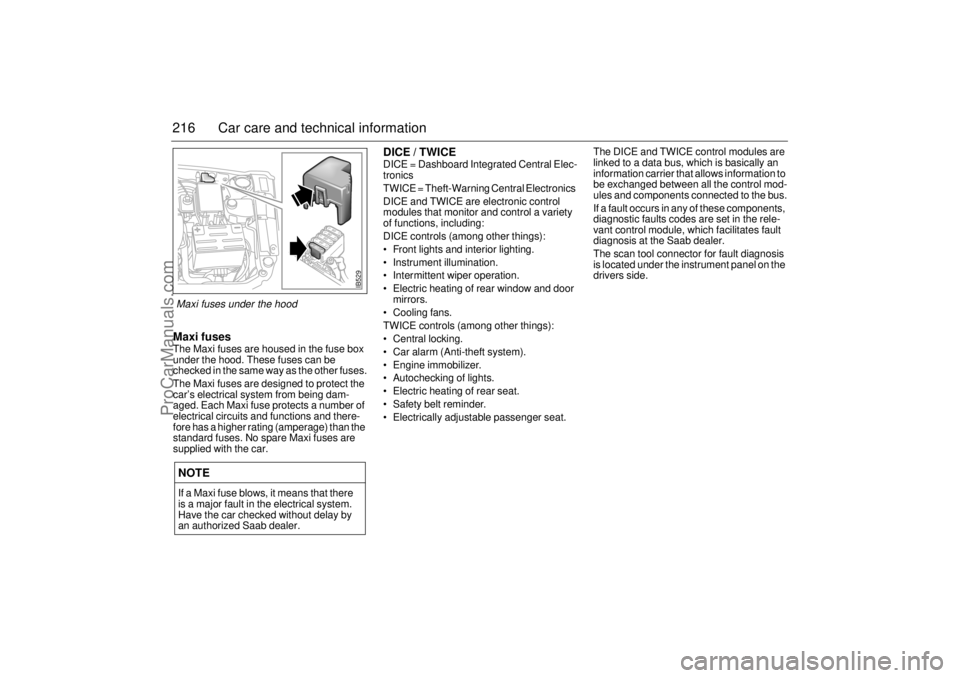
216 Car care and technical informationMaxi fusesThe Maxi fuses are housed in the fuse box
under the hood. These fuses can be
checked in the same way as the other fuses.
The Maxi fuses are designed to protect the
car’s electrical system from being dam-
aged. Each Maxi fuse protects a number of
electrical circuits and functions and there-
fore has a higher rating (amperage) than the
standard fuses. No spare Maxi fuses are
supplied with the car.
DICE / TWICEDICE = Dashboard Integrated Central Elec-
tronics
TWICE = Theft-Warning Central Electronics
DICE and TWICE are electronic control
modules that monitor and control a variety
of functions, including:
DICE controls (among other things):
Front lights and interior lighting.
Instrument illumination.
Intermittent wiper operation.
Electric heating of rear window and door
mirrors.
Cooling fans.
TWICE controls (among other things):
Central locking.
Car alarm (Anti-theft system).
Engine immobilizer.
Autochecking of lights.
Electric heating of rear seat.
Safety belt reminder.
Electrically adjustable passenger seat.The DICE and TWICE control modules are
linked to a data bus, which is basically an
information carrier that allows information to
be exchanged between all the control mod-
ules and components connected to the bus.
If a fault occurs in any of these components,
diagnostic faults codes are set in the rele-
vant control module, which facilitates fault
diagnosis at the Saab dealer.
The scan tool connector for fault diagnosis
is located under the instrument panel on the
drivers side.
NOTEIf a Maxi fuse blows, it means that there
is a major fault in the electrical system.
Have the car checked without delay by
an authorized Saab dealer.
IB529
Maxi fuses under the hood
ProCarManuals.com
Page 217 of 272
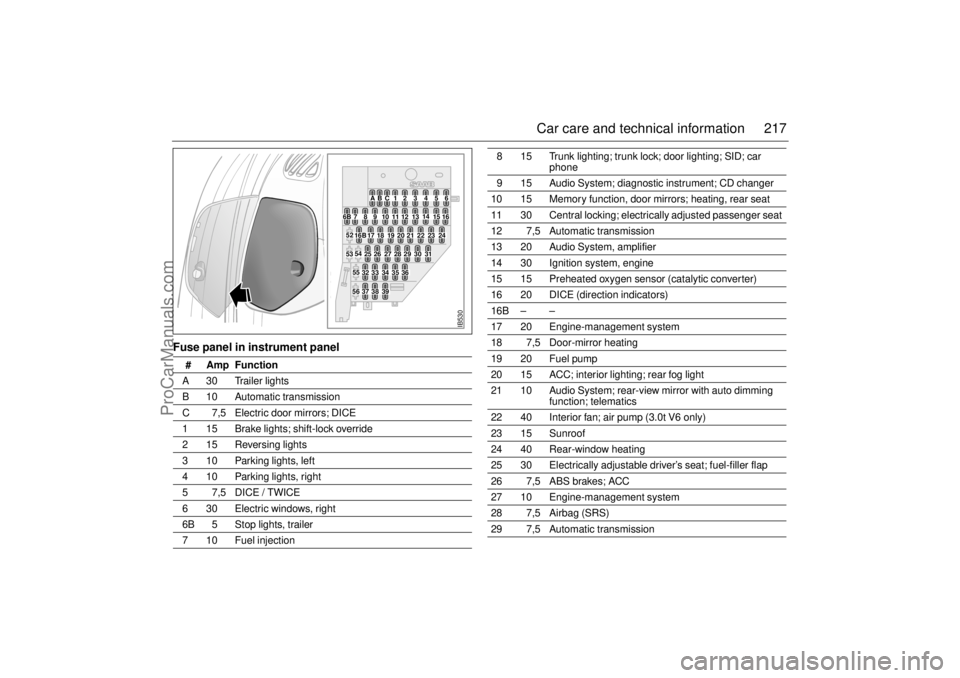
217 Car care and technical information
Fuse panel in instrument panel
# Amp Function
A 30 Trailer lights
B 10 Automatic transmission
C 7,5 Electric door mirrors; DICE
1 15 Brake lights; shift-lock override
2 15 Reversing lights
3 10 Parking lights, left
4 10 Parking lights, right
5 7,5 DICE / TWICE
6 30 Electric windows, right
6B 5 Stop lights, trailer
7 10 Fuel injection
8 15 Trunk lighting; trunk lock; door lighting; SID; car
phone
9 15 Audio System; diagnostic instrument; CD changer
10 15 Memory function, door mirrors; heating, rear seat
11 30 Central locking; electrically adjusted passenger seat
12 7,5 Automatic transmission
13 20 Audio System, amplifier
14 30 Ignition system, engine
15 15 Preheated oxygen sensor (catalytic converter)
16 20 DICE (direction indicators)
16B – –
17 20 Engine-management system
18 7,5 Door-mirror heating
19 20 Fuel pump
20 15 ACC; interior lighting; rear fog light
21 10 Audio System; rear-view mirror with auto dimming
function; telematics
22 40 Interior fan; air pump (3.0t V6 only)
23 15 Sunroof
24 40 Rear-window heating
25 30 Electrically adjustable driver’s seat; fuel-filler flap
26 7,5 ABS brakes; ACC
27 10 Engine-management system
28 7,5 Airbag (SRS)
29 7,5 Automatic transmission
IB530
BC123456 A
14
121110987
13
6B
1516
2324
222120191817
16B
5425262728293031
3635343332
39383755525356
ProCarManuals.com
Page 218 of 272
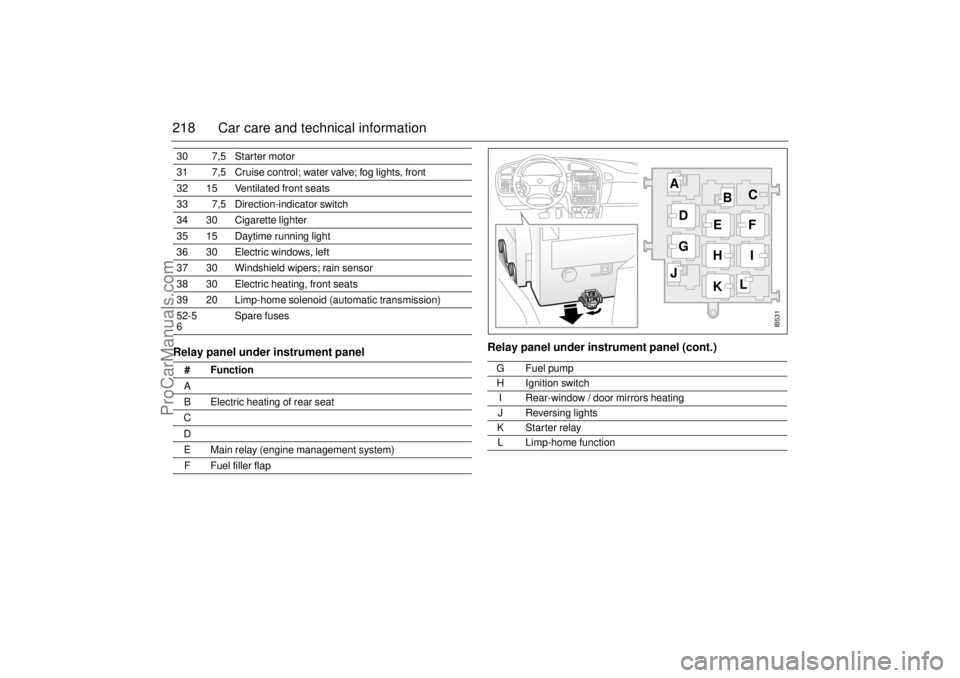
218 Car care and technical informationRelay panel under instrument panel Relay panel under instrument panel (cont.)30 7,5 Starter motor
31 7,5 Cruise control; water valve; fog lights, front
32 15 Ventilated front seats
33 7,5 Direction-indicator switch
34 30 Cigarette lighter
35 15 Daytime running light
36 30 Electric windows, left
37 30 Windshield wipers; rain sensor
38 30 Electric heating, front seats
39 20 Limp-home solenoid (automatic transmission)
52-5
6Spare fuses
# Function
A
B Electric heating of rear seat
C
D
E Main relay (engine management system)
F Fuel filler flap
G Fuel pump
H Ignition switch
I Rear-window / door mirrors heating
J Reversing lights
KStarter relay
L Limp-home function
IB531
A
BC
D
GEF
HI
KL J
ProCarManuals.com
Page 232 of 272

232 Car care and technical informationApply the leather conditioner using a soft
cloth and the same circular movements as
described above. After it has dried, polish
the leather with a soft, dry cloth. Follow the
directions given above. Do not use hot
water, unknown abrasive polishes, sol-
vents, sprays or soaps that might scratch
the leather.Textile carpetingVacuum clean the carpeting regularly. Car-
pets can also be cleaned using a brush, or
carpet shampoo applied with a sponge. Do
not use vacuum cleaners outdoors unless
they are properly grounded.
Washing the carThe bodywork must be washed frequently.
When the car is new, the body should be
washed by hand using plain cold water and
a clean, soft brush, or in a brushless car-
wash that uses mild detergent. Automatic
car washes with brushes should be avoided
when the car is new. Do not use automatic
car washes for the first five or six months,
before the paintwork has hardened prop-
erly. Thereafter, use a high quality car wash
soap added to lukewarm water.
Do not use a pressure washer at close
range on stone chip damage, scratches or
other damage to the paintwork. The paint
can otherwise start to flake.
Remove any bird droppings without delay,
as these can discolor the paintwork and
prove difficult to polish out.
Use a soft cloth moistened with methyl alco-
hol to remove splashes of tar or asphalt. Do
not use strong cleaners, as these can dry
out the paintwork. The underside of the car also needs wash-
ing regularly, and this should be done extra
thoroughly at the end of winter. Clean the
underside of the car by hand if the car is usu-
ally washed in an automatic car wash with-
out special facilities for underbody cleaning.
Never wash or leave the car to dry in the
sun, but wipe it dry with a chamois leather
immediately after washing to avoid smears
and streaks.
Clean the window glass inside and out using
a high quality window cleaner. This is partic-
ularly important when the car is new, as
upholstery and trim have a tendency to
sweat a little at first.
Keep the glass well cleaned, as this helps to
prevent misting. NOTEAvoid using any alcohol-based cleaners
on the front and rear light clusters, as
these can cause cracking of the lenses.
NOTE The door mirrors must be fully
retracted before the car enters an
automatic car wash.
Remove fixed antennas, e.g. for
mobile phone, before putting car
through an automatic car wash.
Try your brakes on leaving a car wash.
Wet brake discs reduce the braking
effect.
ProCarManuals.com
Page 237 of 272
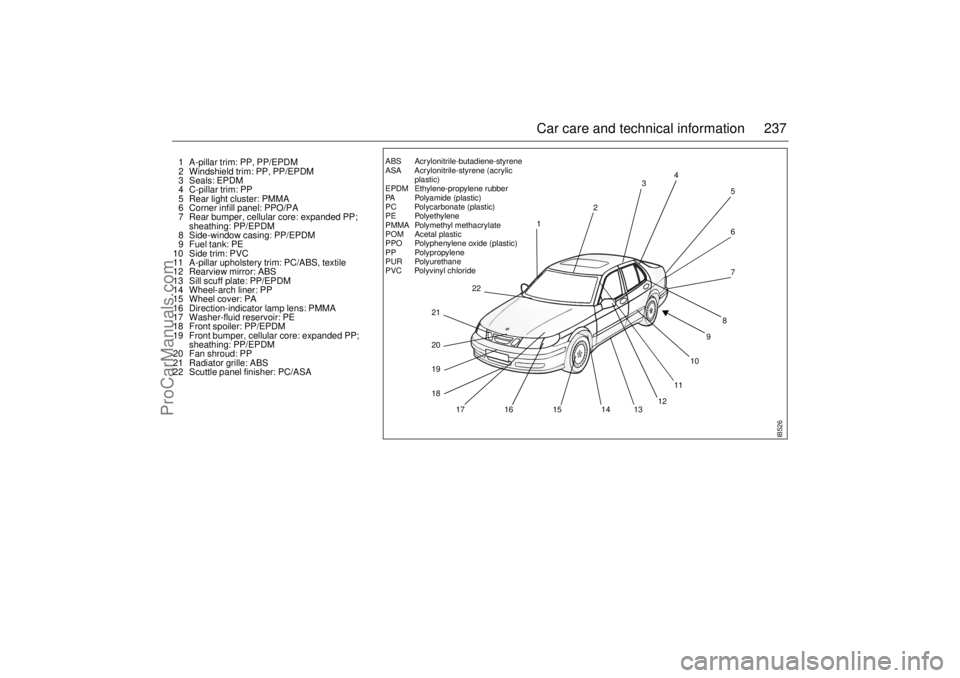
237 Car care and technical information
1 A-pillar trim: PP, PP/EPDM
2 Windshield trim: PP, PP/EPDM
3 Seals: EPDM
4 C-pillar trim: PP
5 Rear light cluster: PMMA
6 Corner infill panel: PPO/PA
7 Rear bumper, cellular core: expanded PP;
sheathing: PP/EPDM
8 Side-window casing: PP/EPDM
9 Fuel tank: PE
10 Side trim: PVC
11 A-pillar upholstery trim: PC/ABS, textile
12 Rearview mirror: ABS
13 Sill scuff plate: PP/EPDM
14 Wheel-arch liner: PP
15 Wheel cover: PA
16 Direction-indicator lamp lens: PMMA
17 Washer-fluid reservoir: PE
18 Front spoiler: PP/EPDM
19 Front bumper, cellular core: expanded PP;
sheathing: PP/EPDM
20 Fan shroud: PP
21 Radiator grille: ABS
22 Scuttle panel finisher: PC/ASA
IB526
ABS Acrylonitrile-butadiene-styrene
ASA Acrylonitrile-styrene (acrylic
plastic)
EPDM Ethylene-propylene rubber
PA Polyamide (plastic)
PC Polycarbonate (plastic)
PE Polyethylene
PMMA Polymethyl methacrylate
POM Acetal plastic
PPO Polyphenylene oxide (plastic)
PP Polypropylene
PUR Polyurethane
PVC Polyvinyl chloride 1234
5
6
7
98
10
11
12
13 14 15 16 19
18 20 21
1722
ProCarManuals.com
Page 250 of 272
250 SpecificationsGeneral Overall length, including bumpers:
9-5 Sedan _______________________ 189.2 in (4805 mm)
9-5 Wagon ______________________ 189.3 in (4808 mm)
Overall width, including door mirrors ____ 80.4 in (2042 mm)
Maximum height:
9-5 Sedan _______________________ 57.0 in (1449 mm)
9-5 Wagon ______________________ 58.9 in (1497 mm)
Wheelbase _______________________ 106.4 in (2703 mm)
Ground clearance __________________ approx. 6.6 in
(167 mm)
Tr a c k :
Front __________________________ 59.9 in (1522 mm) *)
Rear ___________________________ 59.9 in (1522 mm) *)
Turning circle (curb to curb) ___________ 35.4 ft (10.8 m)
Turning circle (measured at vehicle extrem-
ities) ___________________________ 37.4 ft (11.4 m)
Number of seats (incl. driver) _________ 5
*) Specified track applies to wheel sizes:
6 x 15 & 6.5 x 16
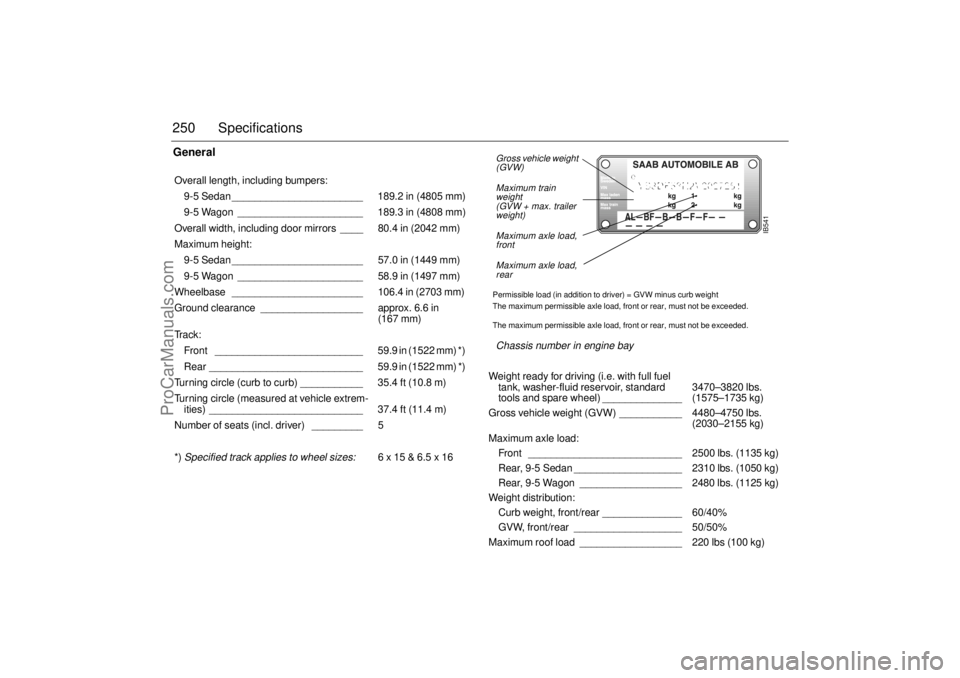
Gross vehicle weight
(GVW)
Maximum train
weight
(GVW + max. trailer
weight)
Maximum axle load,
front
Maximum axle load,
rear Permissible load (in addition to driver) = GVW minus curb weight
The maximum permissible axle load, front or rear, must not be exceeded.
The maximum permissible axle load, front or rear, must not be exceeded. Chassis number in engine bay Weight ready for driving (i.e. with full fuel
tank, washer-fluid reservoir, standard
tools and spare wheel) ______________ 3470–3820 lbs.
(1575–1735 kg)
Gross vehicle weight (GVW) ___________ 4480–4750 lbs.
(2030–2155 kg)
Maximum axle load:
Front ___________________________ 2500 lbs. (1135 kg)
Rear, 9-5 Sedan ___________________ 2310 lbs. (1050 kg)
Rear, 9-5 Wagon __________________ 2480 lbs. (1125 kg)
Weight distribution:
Curb weight, front/rear ______________ 60/40%
GVW, front/rear ___________________ 50/50%
Maximum roof load __________________ 220 lbs (100 kg)
IB541
ProCarManuals.com
Page 263 of 272

263 Index
Index
AA/C system, fault diagnosis
_______ 230
A/C system, maintenance
_________ 230
ABS brakes
____________________ 167
ACC
__________________________ 70
ACC functions
___________________ 73
ACC, automatic climate control
_____ 70
ACC, calibration
_________________ 78
ACC, condensation _______________ 79
ACC, programming _______________ 76
ACC, useful tips
_________________ 78
Adjusting the steering wheel
_______ 124
Adjustment, seats
_______________ 120
Afterheater, V6-engine cars
________ 80
Air conditioning (A/C), fault diagnosis
and maintenance
______________ 230
Air distribution, ACC ______________ 75
Airbag
_________________________ 26
Alarm _________________________ 41
Alarm functions
__________________ 44
Alarm signals
_______________ 41
, 44
Alternator
_____________________ 202
Alternator drive belt
_________ 202
, 255
Alternator rating
________________ 254
Anticorrosion treatment
___________ 234
Antidazzle rear-view mirror
________ 126
Ashtrays
______________________ 130
Audio System
___________________ 81
Audio System, quick guide
_________ 83Autochecking of lights on starting
____54
Automatic climate control (ACC) _____70
Automatic transmission,
technical data
_________________256
BBattery
________________________199
Battery charging/replacing
________201
Battery, boost starting
____________183
Belt guide
______________________12
Boost starting using jump leads
____183
Booster cushion
_________________24
Brake and clutch fluid
____________198
Brake-fluid reservoir
_____________198
Brakes, technical data ____________257
Bulbs, changing
________________205
Bulbs, table of
__________________214
CCD changer
_____________________93
CD player
______________________91
CHECK messages
_______________61
CHECKING
_____________________61
Calibration, ACC
_________________78
Cancelling the programmed settings
_76
Car alarm
______________________41
Car care
______________________187
Car phone, installation
___________103
Cargo net, 9-5 Wagon ____________141
Carpeting, care of
_______________232Cassette player
_________________ 88
Catalytic converter,
important considerations
________ 152
Central locking
__________________ 34
Change language in SID
__________ 62
Change of address notification
____ 244
Changing a wheel
______________ 226
Changing bulbs
________________ 205
Changing the coolant
___________ 197
Changing the wheels round
_______ 222
Changing wiper blades
__________ 203
Chassis number
_______________ 259
Chassis number, key to
__________ 260
Child safety
____________________ 19
Child safety locks, rear doors
______ 37
Child seat, integral
_______________ 24
Cleaning, engine bay ____________ 233
Clock
______________________ 61
, 62
Colour code, body
______________ 259
Colour code, trim _______________ 259
Compact spare wheel
___________ 225
Condensation, ACC
______________ 79
Coolant
______________________ 196
Coolant, changing
______________ 197
Courtesy Headlight Feature
_______ 64
Cruise control
_________________ 166
Cup holder
____________________ 133
DDICE/TWICE
__________________ 216
Dampers
_____________________ 256
ProCarManuals.com