tires SAAB 9-5 2001 User Guide
[x] Cancel search | Manufacturer: SAAB, Model Year: 2001, Model line: 9-5, Model: SAAB 9-5 2001Pages: 272, PDF Size: 14.83 MB
Page 224 of 272
224 Car care and technical informationTemperatureThe temperature grades are A (the highest),
B, and C, representing the tire’s resistance
to the generation of heat and its ability to dis-
sipate heat when tested under controlled
conditions on a specified indoor laboratory
test wheel. Sustained high temperature can
cause the material of the tire to degenerate
and reduce tire life, and excessive temper-
ature can lead to sudden tire failure. The
grade C corresponds to a level of perfor-
mance which all passenger car tires must
meet under the Federal Motor Vehicle
Safety Standard No. 109.
Grades B and A represent higher levels of
performance on the laboratory test wheel
than the minimum required by law.
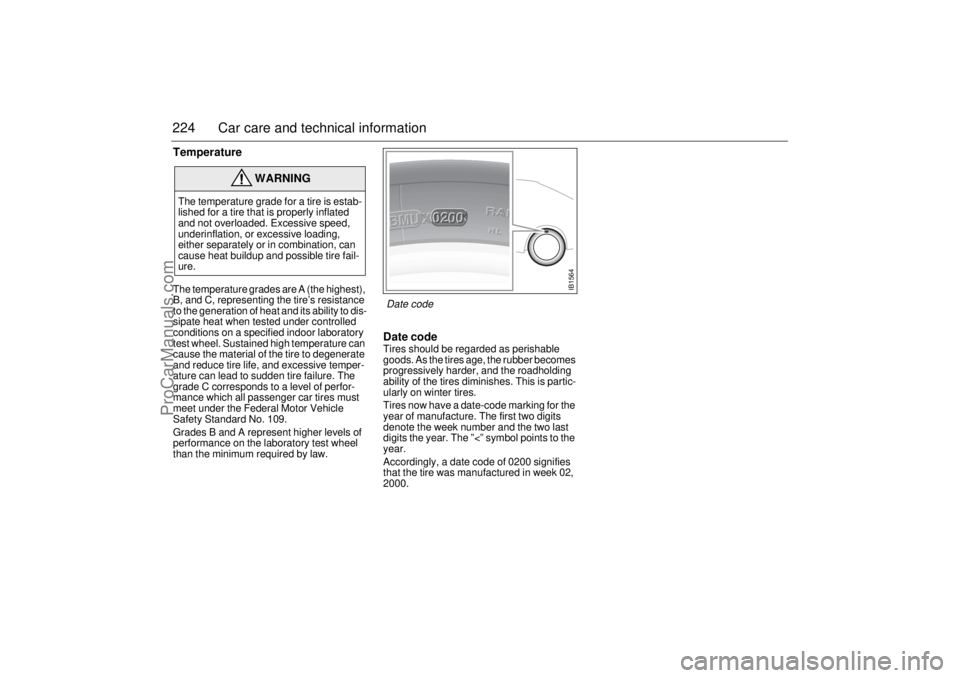
Date codeTires should be regarded as perishable
goods. As the tires age, the rubber becomes
progressively harder, and the roadholding
ability of the tires diminishes. This is partic-
ularly on winter tires.
Tires now have a date-code marking for the
year of manufacture. The first two digits
denote the week number and the two last
digits the year. The ”<” symbol points to the
year.
Accordingly, a date code of 0200 signifies
that the tire was manufactured in week 02,
2000.
WARNING
The temperature grade for a tire is estab-
lished for a tire that is properly inflated
and not overloaded. Excessive speed,
underinflation, or excessive loading,
either separately or in combination, can
cause heat buildup and possible tire fail-
ure.
IB1564
Date code
ProCarManuals.com
Page 229 of 272
229 Car care and technical information
Flat spottingAll tires get hot, especially on long journeys
or when the car is driven hard. After the car
has been parked with hot tires and the tires
have cooled down, a flat spot can appear in
the tire, where it is in contact with the
ground. The same can occur if the car has
not been moved for a long time.
Flat spots can give rise to vibration that can
be felt through the steering wheel, similar to
that experienced when the wheels need bal-
ancing. Flat spots of this type disappear
once the tires get hot again, usually after
10–15 miles (20–25 km) of driving at cruis-
ing speed.
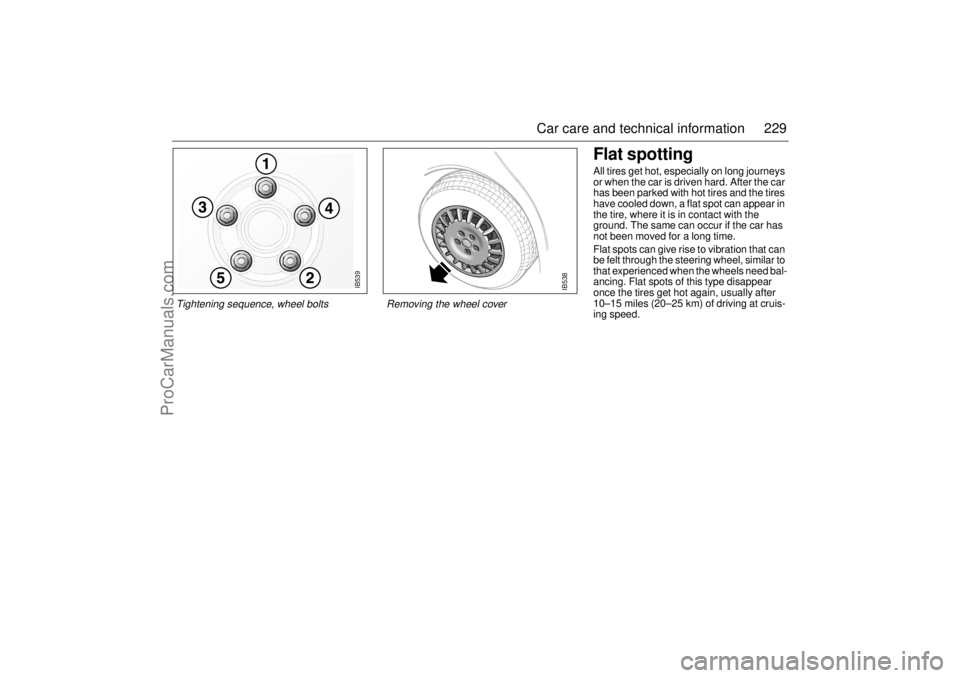
IB539
Tightening sequence, wheel bolts
IB538
Removing the wheel cover
ProCarManuals.com
Page 236 of 272

236 Car care and technical information4Inspect the undercoating and touch
up if necessary. Pay particular atten-
tion to the fenders and wheel housings,
which are exposed to abrasion by flying
gravel, etc. If the composition has worn
or flaked off, the steel must be thor-
oughly cleaned and dried before a fresh
coat is applied. The cleaning is best
done with a scraper and a steel wire
brush, followed by washing with solvent.
Apply the new coating thinly, as other-
wise it may run off or fall off when dry.
For long tripsBefore setting off on a long journey, it is
advisable to have your car checked over by
your Saab dealer.
Obtain a few important items to take along
on your journey such as spare bulbs, wiper
blades, fuses, a Poly-V-belt and the like.
You can check some points yourself before-
hand:
Make sure that the engine is in good con-
dition.
Check that no oil or gasoline leaks out of
the engine or gearbox/transmission.
Check the coolant and power steering
fluid levels. Check also for leaks.
Inspect the Poly-V-belt and replace it if it
shows any signs of hard wear.
Check the battery charge.
Check the tires for tread pattern and air
pressure, including the compact spare
wheel.
Check the brakes.
Check all bulbs.
Check for the presence of the tool kit and
the jack in the car.
Recovery and/or
recycling of automotive
materialsA typical car consists of metals (65–75%),
plastics (10–14%), rubber (5%) and small
quantities of glass, wood, paper and tex-
tiles.
Some of these materials can be recycled,
while others can be recovered in chemical
processes for reuse in new products or as a
source of energy.
While the Saab 9-5 was still at the draw-
ing-board stage, Saab engineers were
giving serious consideration to how the
maximum quantity of materials could be
reclaimed from the car on its eventual
scrapping. To facilitate sorting, plastic parts,
for instance, have been marked to identify
the precise nature of the plastic.
Approximately 90% of the materials in the
car can be recycled or recovered, where
facilities exist.
Before the car is scrapped, all the oils and
other fluids that could pollute the environ-
ment should be recovered from the car. It
may be of interest in this context to learn that
the refrigerant used in the Saab 9-5’s ACC
systems (R134a) contains neither CFCs nor
any other chlorine compounds.
ProCarManuals.com
Page 238 of 272
238 Car care and technical informationHeadlight aimingThe vehicle is equipped with vertical and
horizontal aim indicators. The aim has been
preset at the factory and should normally
not need further adjustments. This is true
even though your vertical and horizontal
aim indicators may not fall exactly on the "0"
(zero) marks on their scales.
If your headlights are damaged in an acci-
dent, the headlight aim may be affected. If
you believe your headlights need to be
re-aimed, we recommend that you take it to
your Saab dealer for service, however, it is
possible for you to re-aim your headlights as
described in the following procedure.To check the aim, the vehicle should be
properly prepared as follows:
Place the vehicle on a level pad or sur-
face.
The vehicle should be unladen and fuel
tank full, and one person or 160 lbs.
(75 kg) on the drivers seat.
The vehicle should not have any snow, ice
or mud attached to it.
Tires should be inflated to the prescribed
pressure.
Rock the vehicle to stabilize the suspen-
sion.
WARNING
Before checking/adjusting the headlight
aiming, switch off the engine to avoid
danger of fingers and hands being injured
by moving parts.
The radiator fan can start up even when
the engine is switched off.
NOTETo make sure that your headlights are
aimed properly read all instructions
before beginning. Failure to follow these
instructions could cause damage to
headlight parts or a not correctly aimed
headlight.
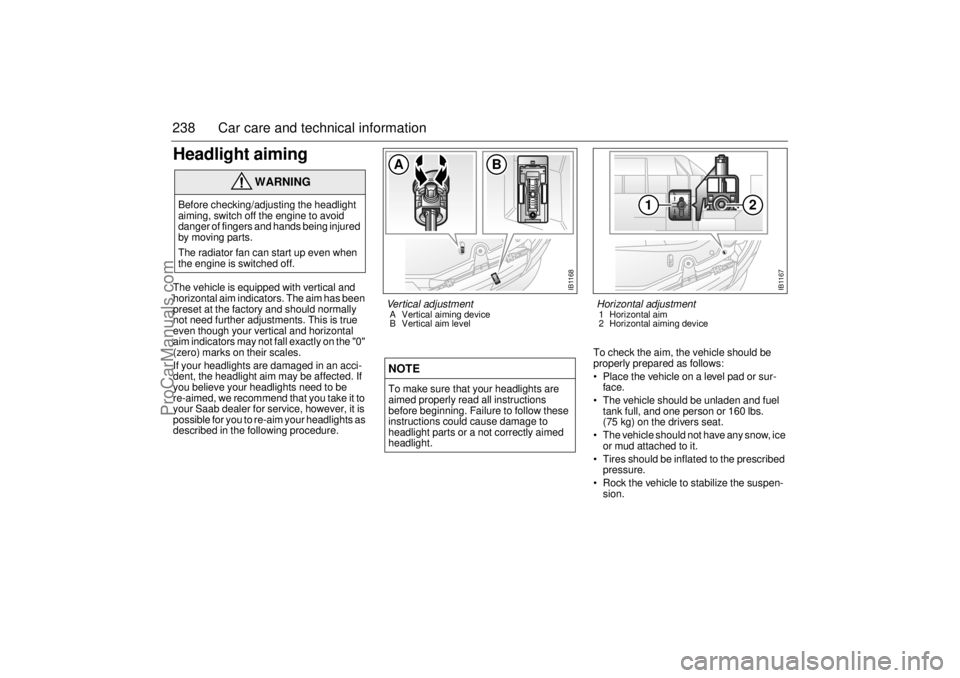
IB1168
A
B
Vertical adjustmentA Vertical aiming device
B Vertical aim level
IB1167
1
2
Horizontal adjustment1 Horizontal aim
2 Horizontal aiming device
ProCarManuals.com
Page 243 of 272

243 Maintenance and owner assistance
Service record retentionService instruction coupons and record
stubs are provided in the Saab Warranties
and Service Record Booklet which accom-
panies this Owner’s Manual. The coupons
are arranged in the order that normal ser-
vice should be performed. The edge of each
coupon is shaded to correspond to the type
of service point:
Striped - "Check Up"
Blue - Oil change/inspection service
Black - Major service
Note that in Canada a combined service
and warranty book is used, but not service
coupons.
When scheduled services are performed,
your dealer will tear out the applicable
coupon and use it to check off the opera-
tions performed and enter it into the service
file at the dealership. The servicing dealer’s
stamp, along with the date and mileage at
which the service was done, should be
entered on the corresponding stub which
remains in your booklet. The booklet is your
permanent record of the services per-
formed. It also includes a log sheet for
unscheduled repairs.
It is advisable to retain receipts and, if pos-
sible, copies of shop work orders for all ser-
vice and repair work, wherever performed.
Service costsDealer pricing practices and labor for ser-
vice work vary. Saab’s recommended ser-
vice times for each service point do not
include the labor required to replace wear
items, such as wiper blades, brake pads or
tires. Nor is labor to perform other service or
repairs found to be necessary as a result of
the inspections included in these times.
Additional labor and parts will be charged
for such work when necessary, except as
covered under an applicable Saab warranty
or any optional extended service contract.
Transmission fluid changes or suspension
alignment, when necessary, are also addi-
tional.
Dealer charges for general shop material,
regulated hazardous waste removal, recy-
cling expenses or other operation costs may
also be applied to service and repair
invoices and are apt to vary by dealer and
locality.
Owner assistanceWarranties and service problem
assistanceFor complete information about all applica-
ble warranties, including the New Car War-
ranty, Perforation Warranty, Vehicle Emis-
sion Warranty and Emission Perforation
Warranty, consult the Warranties and Ser-
vice Record Booklet which accompanies
this Owner’s Manual. It also contains owner
assistance information including Saab
Roadside Assistance. If the booklet is lost or
misplaced, a new one may be ordered
through a Saab dealer or by contacting
Saab.
In the U.S. there is a national Customer
Assistance Center at Saab Cars USA, Inc.
The toll-free number to call from all 50 states
is 1-800-955-9007.
In Canada, please call the Saab Customer
Assistance Centre at 1-800-263-1999.
A list of authorized Saab sales and service
dealers is available for those planning to
travel in the United States and Canada.
Canadian or U.S. travelers may call the
Customer Assistance Center in the country
in which they are traveling.
ProCarManuals.com
Page 247 of 272

247 Maintenance and owner assistance
(c.) Check wheel alignment if irregular or premature tire wear is apparent.
Service Intervals **
Miles = U.S. Cars
Kilometers = Canadian Cars
30 day
10,000
(16,000 km)
20,000
(32,000 km)
30,000
(48,000 km)
40,000
(64,000 km)
50,000
(80,000 km)
60,000
(96,000 km)
70,000
(112,000 km)
80,000
(128,000 km)
90,000
(144,000 km)
100,000
(160,000 km)
Service #
1234567891011
Chassis
R Ball joint clearance, outer and inner steering joints and
rubber boots""""""""""
R Shock absorbers and bushes; tightness and condition"""
R Tire pressure, tread depth and wear (c.)"""""""""""
R Rotate tires, front to rear""""""""""
R Brake pads and discs; wear and condition""""""""""
R Brake lines and hoses"""""""""""
R Brake fluid level and renewal (max. 2-year intervals)""" ! "" ! "" ! "
R Check handbrake function"""""""""""
R Power steering fluid level"""""""""""
ProCarManuals.com
Page 249 of 272
249 Specifications
Specifications General.............................. 250
Engine ............................... 252
Fuel.................................... 252
Engine oil .......................... 253
Engine variants ................ 254
Electrical system.............. 254
Drive belts......................... 255
Manual gearbox................ 255
Automatic transmission .. 256
Suspension....................... 256
Steering............................. 256
Brake system.................... 257
Wheels and tires .............. 257
Plates and labels .............. 259
IB603
ProCarManuals.com
Page 257 of 272

257 Specifications
Brake system Wheels and tiresFootbrake (ABS) ___________________ Hydraulic disc
brakes with vacuum
servo unit. Diago-
nally split circuits;
ventilated discs on
front wheels. EBD
function, see page
167.
Handbrake _______________________ Acts on rear wheels
Brake fluid ________________________ DOT 4
Brake-fluid capacity _________________ 0.925 qts (900 ml)
Disc diameter:
Front __________________________ 11.34 in (288 mm)
Front, 2.3 Turbo Aero ______________ 12.05 in (306 mm)
Rear ___________________________ 11.26 in (286 mm)
Total friction area of brake pads:
Front __________________________ 36.3 in
2 (234 cm
2)
Rear ___________________________ 15.5 in
2 (100 cm
2)Wheel size ________________________ 6.5 x 16 or 7 x 17
2.3 Turbo Aero ______________________ Use 6.5 x 16 or
7 x 17 only
Contact an authorized Saab dealer if you
wish to fit other wheels than those fitted
as standard.
Tire size (summer tires):
6.5 x 16 wheels ___________________ 215/55 R16
7 x 17 wheels _____________________ 225/45 R17
Tire size (winter tires):
6 x 15 wheels (not 2.3 Turbo Aero) _____ 195/65 R15 M+S
6.5 x 16 wheels ___________________ 205/55 R16 M+S
Recommended wheels for snow chains _ 6 x 15 (not 9-5 2.3
Turbo Aero) or
6.5 x 16
Compact spare:
Wheel ___________________________ 4 x 16
Tire _____________________________ T115/70 R16
Pressure_________________________ 60 psi (420 kPa)
Maximum life _____________________ 2,200 miles
(3500 km)
Maximum speed __________________ 50 mph (80 km/h)
ProCarManuals.com
Page 258 of 272

258 SpecificationsNOTESnow chains:
Snow chains must not be fitted to the rear wheels, and may only
be used with the following wheel-tire combinations:
Wheels Tires
6.5 x 15________ 195/65 R15 M+S (not 2.3 Turbo Aero)
205/65 R15 (not 2.3 Turbo Aero)
6.5 x 16________ 205/55 R16 M+S or
215/55 R16
Snow chains must not be fitted to 17" wheels.
Max. permissible speed with snow chains fitted is 30 mph
(50 km/h).
Contact an authorized Saab dealer for advice on snow chains.NOTEWheels larger than 17” must not be fitted.
The wheel offset must not exceed 49 mm.
Vehicles with 12.05 in (306 mm) front brake discs must not use
15” rims.
Front-wheel alignment: toe-in, measured
between rims:
Front __________________________ 0.0585±0.0195 in
(1.5±0.5 mm)
Rear ___________________________ 0.0866±0.0585 in
(2.2±1.5 mm)
ProCarManuals.com
Page 264 of 272

264 IndexDate code, tires
_________________ 224
Dim-dipped beam ________________ 63
Direction indicators _______________ 65
Door handles
___________________ 34
Door mirrors
___________________ 125
Doors, locks & luggage compartment
_33
Drive belt
______________________ 255
Drive belt, alternator
_____________ 202
Drive belts
_____________________ 255
Drive belts, length
_______________ 255
Driver’s seat, programmable
_______ 122
Driving in hot weather
____________ 173
Driving with a load
______________ 179
EElectric heating seat
_____________ 123
Electric heating, front seats
_______ 123
Electric windows
________________ 127
Electrical system, technical data
____ 254
Electrically heated rear seat
_______ 123
Electronic starting interlock _________ 35
Emergency operation of sunroof
____ 129
Emission control systems
_________ 191
Engine bay, 3.0t V6
_____________ 190
Engine bay, 4-cyl
_______________ 189
Engine bay, cleaning ____________ 233
Engine number
_________________ 259
Engine oil, grade ________________ 253
Engine, description _________ 192
, 193
Engine, technical data
___________ 252
Engine, temperature gauge
________ 55Engine-oil level, checking
_________193
Expansion tank, coolant
__________196
FFault codes, Audio System
________104
Flat spot, tire
___________________229
Fluid level, automatic transmission
__195
Folding the rear seat, 9-5 Sedan
___134
Folding the rear seat, 9-5 Wagon ___137
Frequently asked questions on airbag
30
Front fog lights
__________________66
Frost warning
___________________58
Fuel
__________________________154
Fuel consumption
________________57
Fuel filler flap
___________________145
Fuel gauge
_____________________55
Fuel grade _____________________252
Fuse box under hood
____________219
Fuse panel
____________________215
Fuses
________________________215
GGearbox number
________________259
Gearbox oil, checking
____________195
Gearbox, technical data, __________255
Glove compartment
______________131
HHandbrake
____________________185
Hazard warning lights
_____________66Head restraint
__________________ 18
Headlight flasher ________________ 63
Headlights
_____________________ 63
Holidaying abroad
______________ 236
Hood
________________________ 188
Horn _________________________ 124
IIgnition switch
_________________ 148
Immobilizer
____________________ 35
Indicator and warning lights
________ 48
Indicator lights
__________________ 48
Instrument illumination
___________ 65
Instruments and controls __________ 47
Integral child seat
_______________ 24
Interior equipment ______________ 119
Interior lighting
__________________ 67
Interior rearview mirror
__________ 125
KKey
__________________________ 34
Key to chassis number
__________ 260
Key, remove
__________________ 148
LLabels
_________________________ 8
Leather upholstery, care of
_______ 231
Light horn
_____________________ 63
Light switches __________________ 63
Luggage-compartment lighting
_____ 67
ProCarManuals.com