warning SAAB 9-5 2001 User Guide
[x] Cancel search | Manufacturer: SAAB, Model Year: 2001, Model line: 9-5, Model: SAAB 9-5 2001Pages: 272, PDF Size: 14.83 MB
Page 17 of 272
17 Safety
WARNING
Safety belts are designed to bear upon
the bony structure of the body, and should
be worn low across the front of the pelvis
or the pelvis, chest and shoulders, as
applicable; wearing the lap portion of the
belt across the abdominal area must be
avoided.
Safety belts should be adjusted as firmly
as possible, consistent with comfort, to
provide the protection for which they have
been designed. A loose belt will greatly
reduce the protection afforded to the
wearer.
Care should be taken to avoid contamina-
tion of the webbing with polishes, oils and
chemicals, and particularly battery acid.
Cleaning may safely be carried out using
mild soap and water. The belt should be
replaced if webbing becomes frayed,
contaminated or damaged.
It is essential to replace the entire assem-
bly after it has been worn in a severe
impact even if damage to the assembly is
not obvious.
Belts should not be worn with straps
twisted.
Each belt assembly must only be used by
one occupant; it is dangerous to put a belt
around a child being carried on the occu-
pant´s lap.
No modifications or additions should be
made by the user which will either prevent
the safety belt adjusting device from oper-
ating to remove slack, or prevent the
safety belt assembly from being adjusted
to remove slack.
ProCarManuals.com
Page 18 of 272
18 SafetyHead restraintThe front seats in the Saab 9-5 are
equipped with Saab Active Head Restraints
(SAHRs). These reduce the risk of whiplash
injury if the car is hit from behind.
In the event of a rear-end collision, the body
is forced back against the backrest. This, in
turn, causes the mechanism to press the
head restraint forward and upwards, thus
limiting the backward movement of the
head.
The SAHR is a mechanical system, actu-
ated by body weight. The mechanism is built
into the top of the backrest, where it is con-
nected to the head restraint.
The SAHR does not normally need to be
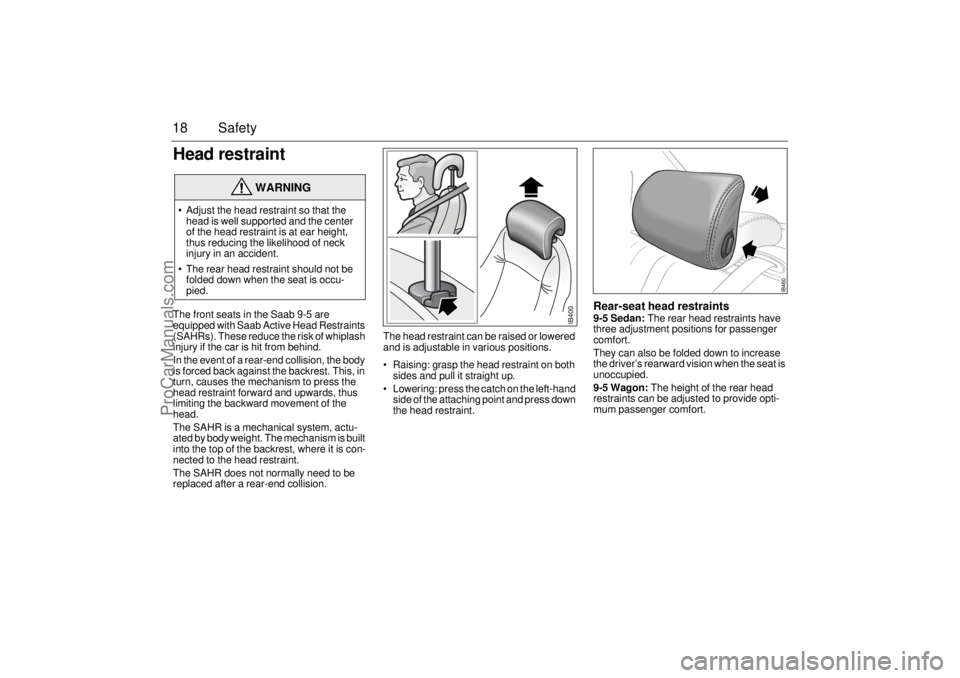
replaced after a rear-end collision. The head restraint can be raised or lowered
and is adjustable in various positions.
Raising: grasp the head restraint on both
sides and pull it straight up.
Lowering: press the catch on the left-hand
side of the attaching point and press down
the head restraint.
Rear-seat head restraints9-5 Sedan: The rear head restraints have
three adjustment positions for passenger
comfort.
They can also be folded down to increase
the driver’s rearward vision when the seat is
unoccupied.
9-5 Wagon: The height of the rear head
restraints can be adjusted to provide opti-
mum passenger comfort.
WARNING
Adjust the head restraint so that the
head is well supported and the center
of the head restraint is at ear height,
thus reducing the likelihood of neck
injury in an accident.
The rear head restraint should not be
folded down when the seat is occu-
pied.
IB460
IB400
ProCarManuals.com
Page 19 of 272
19 Safety
Child safety
Car safety tips Protect your children from getting
trapped in the trunk of a car
WARNING
Children must always be suitably
restrained in the car. All child
restraints and booster seats are
designed to be secured in vehicle
seats by the lap belt or the lap belt of a
lap-shoulder belt. If the child restraint
is not properly secured, a child can be
endangered in a crash.
NEVER put a child seat in the front.
Children 12 and under can be killed by
the airbag.
According to accident statistics, the
BACK SEAT is SAFER for properly
restrained children than the front seat.
Sit as far back as possible from the air
bag.
WARNING
Never leave your children unattended
in a car, even for a short time.
– Children can suffer heat stroke - per-
haps die - in a matter of minutes.
– Children can put the car into gear and
hurt themselves or others.
At gas stations, take the keys from the
car while filling the tank.
Never allow children to climb on top of -
or under motor vehicles.
Always look for children before backing
your motor vehicle out of a garage or
driveway.
To avoid carbon monoxide poisoning,
never let a car idle in the garage.
Supervise young children around buck-
ets of water while washing your car.
Small children can drown in seconds in
less than an inch of water.
WARNING
Teach your kids not to play in or around
cars.
Watch your children when loading or
unloading the car so they don´t get
locked in by mistake.
Always lock the doors and trunk of your
car, and keep the keys out of children´s
sight and reach.
Keep the rear fold-down seats closed
to help prevent kids from getting into
the trunk from inside the car.
ProCarManuals.com
Page 21 of 272
21 Safety
When fitting child seats in cars you must
always read the instructions supplied by
the car seat manufacturer.Saab 9-5 Wagon:
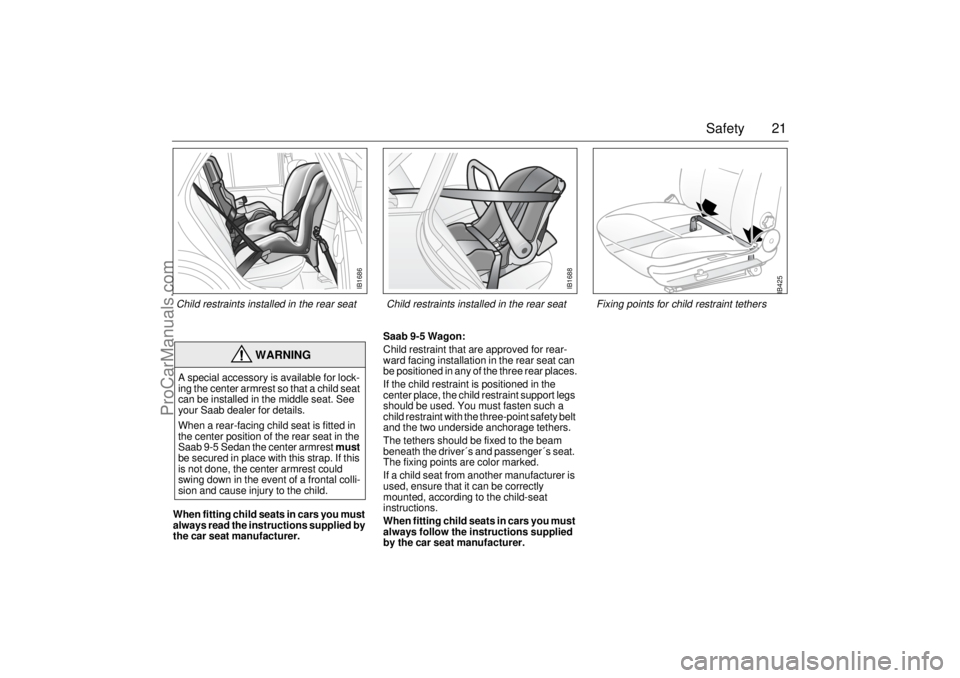
Child restraint that are approved for rear-
ward facing installation in the rear seat can
be positioned in any of the three rear places.
If the child restraint is positioned in the
center place, the child restraint support legs
should be used. You must fasten such a
child restraint with the three-point safety belt
and the two underside anchorage tethers.
The tethers should be fixed to the beam
beneath the driver´s and passenger´s seat.
The fixing points are color marked.
If a child seat from another manufacturer is
used, ensure that it can be correctly
mounted, according to the child-seat
instructions.
When fitting child seats in cars you must
always follow the instructions supplied
by the car seat manufacturer.
WARNING
A special accessory is available for lock-
ing the center armrest so that a child seat
can be installed in the middle seat. See
your Saab dealer for details.
When a rear-facing child seat is fitted in
the center position of the rear seat in the
Saab 9-5 Sedan the center armrest must
be secured in place with this strap. If this
is not done, the center armrest could
swing down in the event of a frontal colli-
sion and cause injury to the child.
IB1686
IB1688
IB425
Child restraints installed in the rear seat Child restraints installed in the rear seat Fixing points for child restraint tethers
ProCarManuals.com
Page 22 of 272
22 SafetyChild tether anchorages for forward
facing child car seatsChild restraints with a tether strap must be
anchored according to Canadian law.
If you have any questions regarding child
tether anchorages please contact your
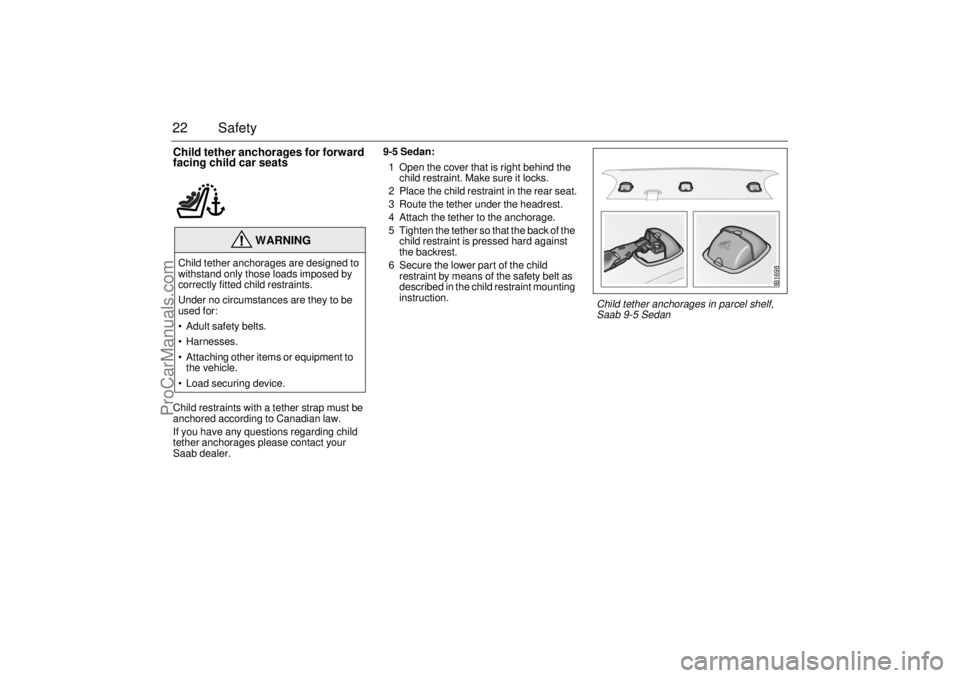
Saab dealer.9-5 Sedan:
1 Open the cover that is right behind the
child restraint. Make sure it locks.
2 Place the child restraint in the rear seat.
3 Route the tether under the headrest.
4 Attach the tether to the anchorage.
5 Tighten the tether so that the back of the
child restraint is pressed hard against
the backrest.
6 Secure the lower part of the child
restraint by means of the safety belt as
described in the child restraint mounting
instruction.
WARNING
Child tether anchorages are designed to
withstand only those loads imposed by
correctly fitted child restraints.
Under no circumstances are they to be
used for:
Adult safety belts.
Harnesses.
Attaching other items or equipment to
the vehicle.
Load securing device.
IB1698
Child tether anchorages in parcel shelf,
Saab 9-5 Sedan
ProCarManuals.com
Page 23 of 272
23 Safety
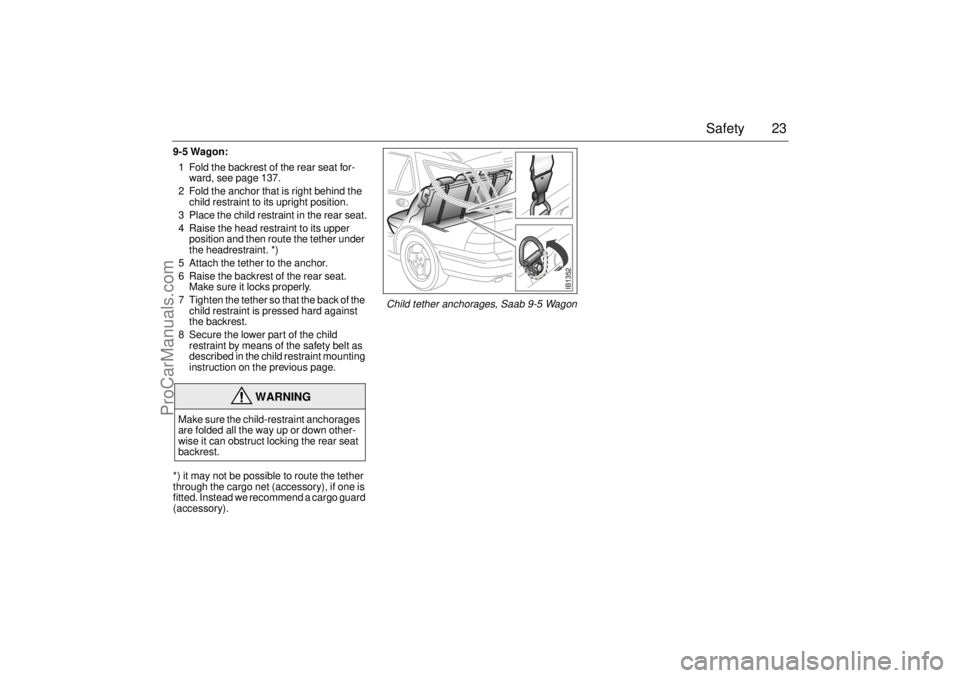
9-5 Wagon:
1 Fold the backrest of the rear seat for-
ward, see page 137.
2 Fold the anchor that is right behind the
child restraint to its upright position.
3 Place the child restraint in the rear seat.
4 Raise the head restraint to its upper
position and then route the tether under
the headrestraint. *)
5 Attach the tether to the anchor.
6 Raise the backrest of the rear seat.
Make sure it locks properly.
7 Tighten the tether so that the back of the
child restraint is pressed hard against
the backrest.
8 Secure the lower part of the child
restraint by means of the safety belt as
described in the child restraint mounting
instruction on the previous page.
*) it may not be possible to route the tether
through the cargo net (accessory), if one is
fitted. Instead we recommend a cargo guard
(accessory).
WARNING
Make sure the child-restraint anchorages
are folded all the way up or down other-
wise it can obstruct locking the rear seat
backrest.
IB1352
Child tether anchorages, Saab 9-5 Wagon
ProCarManuals.com
Page 24 of 272
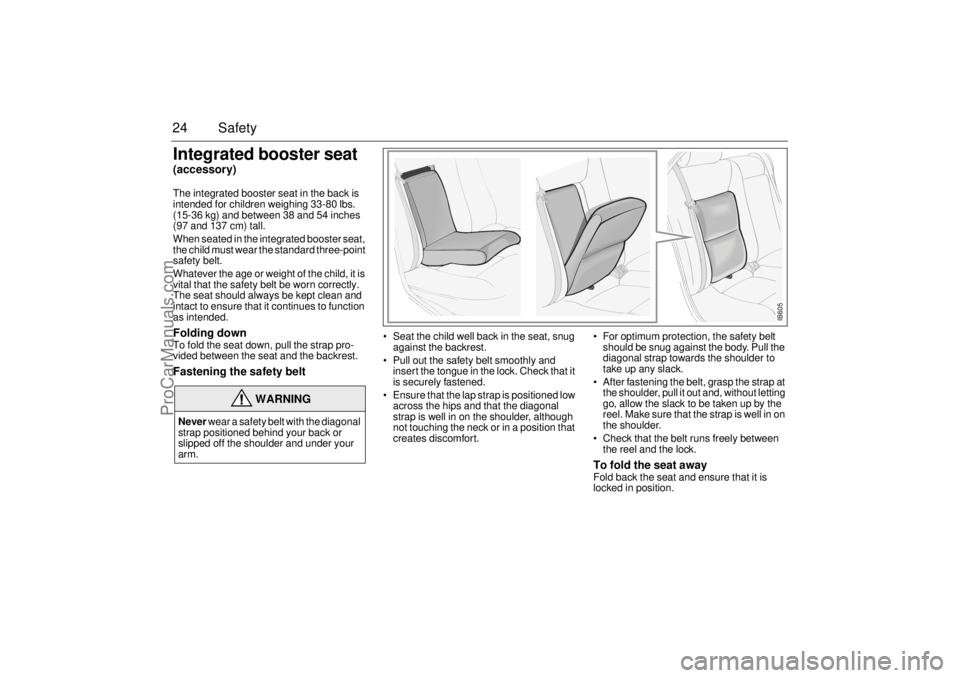
24 SafetyIntegrated booster seat(accessory)The integrated booster seat in the back is
intended for children weighing 33-80 lbs.
(15-36 kg) and between 38 and 54 inches
(97 and 137 cm) tall.
When seated in the integrated booster seat,
the child must wear the standard three-point
safety belt.
Whatever the age or weight of the child, it is
vital that the safety belt be worn correctly.
The seat should always be kept clean and
intact to ensure that it continues to function
as intended. Folding down To fold the seat down, pull the strap pro-
vided between the seat and the backrest. Fastening the safety belt
Seat the child well back in the seat, snug
against the backrest.
Pull out the safety belt smoothly and
insert the tongue in the lock. Check that it
is securely fastened.
Ensure that the lap strap is positioned low
across the hips and that the diagonal
strap is well in on the shoulder, although
not touching the neck or in a position that
creates discomfort. For optimum protection, the safety belt
should be snug against the body. Pull the
diagonal strap towards the shoulder to
take up any slack.
After fastening the belt, grasp the strap at
the shoulder, pull it out and, without letting
go, allow the slack to be taken up by the
reel. Make sure that the strap is well in on
the shoulder.
Check that the belt runs freely between
the reel and the lock.
To fold the seat away Fold back the seat and ensure that it is
locked in position.
WARNING
Never wear a safety belt with the diagonal
strap positioned behind your back or
slipped off the shoulder and under your
arm.
IB605
ProCarManuals.com
Page 25 of 272
25 Safety
WARNING
The standard safety belt must always
be used in conjunction with the inte-
grated booster seat.
The seat must not be modified in any
way.
Never leave a child unattended.
Check to ensure that the belt is not
twisted or rubbing against any sharp
edges.
Adjust the head restraint so that it pro-
vides the best possible support when
there is a passenger in the rear seat.
WARNING
Failure to follow all the manufacturer’s
instructions on the use of this child
restraint system can cause your child to
strike the vehicle´s interior during a
sudden stop or crash.
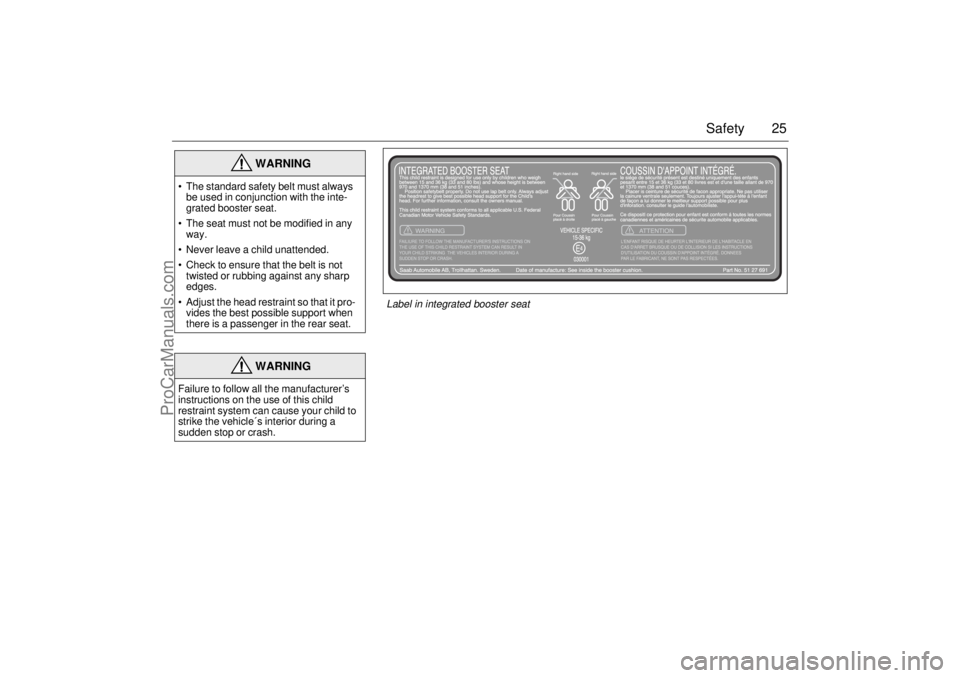
Label in integrated booster seat
ProCarManuals.com
Page 26 of 272
26 SafetyAirbag (Supplemental
Restraint System
"SRS") The supplementary restraint system (SRS)
comprises an airbag in the steering wheel,
a front passenger airbag and side airbags in
the front seats.
The system supplements the protection
provided by the safety belts to further
enhance the safety of the occupants.
If a fault is detected in the SRS, the
AIR BAG warning light on the main instru-
ment panel will come on (see pages 50 and
30). When the system is triggered by impact of a
frontal collision, the airbags in the steering
wheel and passenger side of the dash board
are inflated, after which they deflate through
vents in the back of the bags.
The entire process takes less than
0.1 second – literally, faster than the blink-
ing of an eye.
These airbags are triggered only by moder-
ate to severe frontal or near-frontal colli-
sions. They will not be activated by minor
front-end impacts, rear-end or side impacts,
or by the car rolling over.
WARNING
To reduce risk of injury:
Always wear your safety belt.
Always adjust your seat so that you
are as far back as possible but still
able to reach the steering wheel and
controls comfortably.
Children 12 and under or shorter than
140 cm (55 inches) should always
travel in the rear as the vehicle is
equipped with an airbag on the pas-
senger side.
WARNING
Even if the car is equipped with SRS
(airbag), safety belts must still always
be worn by all occupants.
Note that because an airbag inflates
and deflates extremely rapidly, it will
not provide protection against a
second impact occurring in the same
incident. Always use your safety belt.
Always sit with the whole of your back
in contact with the backrest of the seat,
and with your seat as far back as is
practical. This is to reduce the risk of
injury from contact with the backrest of
the seat when the airbag inflates and
also because the airbag needs space
in which to inflate.
Never attach anything to the steering
wheel or passenger side of the instru-
ment panel, as this could result in
injury if the airbag should inflate. The
same applies to anything you might
have in your mouth, such as a pipe, for
instance.
Some components of the airbag will
be hot for a short time. In some circum-
stances the airbag can cause burns or
abrasions to the body when the airbag
inflates/deflates.
Never rest your hands or forearms on
the steering-wheel center padding.
If the AIR BAG warning light remains
on after the car has been started or
comes on while you are driving, have
the car checked immediately by an
authorized Saab dealer. The warning
light could signify that the airbags may
not inflate in a crash, or they could
even inflate without a crash.
ProCarManuals.com
Page 28 of 272

28 SafetyFront passenger seat The airbags are interconnected and have a
common warning light. The passenger
airbag module is housed in the fascia above
the glove compartment and is marked ”SRS
AIRBAG”.
Both airbags will be inflated in the event of a
moderate to severe frontal, or near-frontal
collision, even if the passenger seat is unoc-
cupied.
Side airbags Side airbags are housed inside the back-
rests of the front seats and are designed to
protect the driver and front passenger in the
event of a side impact.
In a side impact, only the airbag on that side
will be activated, and only then if certain pre-
determined conditions are met such as the
force and angle of the impact, the speed of
the car on impact, and at which point on the
car’s side the impact occurs.
The sensors, which are fitted in the front
doors, sense the rise in pressure caused by
the door panel being pressed in during an
impact condition. The side airbag trigger will
be commanded based on the characteris-
tics of this pressure rise.
WARNING
Never secure a rear-facing child seat in
the right front seat of a car equipped with
a passenger airbag. Inflation of the airbag
in the event of an accident could seriously
injure or kill a child.
WARNING Children 12 and
under can be killed by
the airbag
The back seat is the
safest place for children
Never allow a child to stand in front of
the seat or to sit on the lap of a
front-seat passenger. Serious injury or
death could result if the airbag is
inflated in a collision.
Never place anything on the dash or in
front of the seat as, in addition to being
a hazard to passengers, this could
interfere with the function of the airbag
in the event of an accident. The same
applies to the mounting of accessories
on the dash.
Keep feet on the floor - never put feet
up on the fascia, on the seat or out of
the window.
Do not carry anything in your lap.
IB420
Passenger airbag and driver’s airbag both
inflated
ProCarManuals.com