warning SAAB 9-5 2001 Owner's Manual
[x] Cancel search | Manufacturer: SAAB, Model Year: 2001, Model line: 9-5, Model: SAAB 9-5 2001Pages: 272, PDF Size: 14.83 MB
Page 29 of 272

29 Safety
WARNING
This car is equipped with side airbags
and no extra interior trim should be fit-
ted. Failure to observe this warning
could result in the side airbags not
inflating as intended and thus not pro-
viding the intended protection either.
Never place any object in the area that
would be occupied by the inflated air-
bag.
For optimum protection, sit upright in
the seat, with your safety belt correctly
fastened.
The sensors for the side airbags are
fitted in the front doors.
We advise against doing any work on
the doors that could affect the mois-
ture barrier in the door or the airbag
sensors. It is essential that the mois-
ture barrier (thick plastic film) in the
front door is not damaged in any way.
Improvement of the anticorrosion
treatment of the doors should only be
carried out by an authorized Saab
dealer. Otherwise there is a risk that
the side impact sensor and the mois-
ture barrier in the front door could be
damaged.
The side airbags will inflate only in the
event of a side impact; not in the event
of a front or rear-end collision or of the
car’s rolling over.
Damage or wear to the seat cover, or
the seat seam, in the area of the side
airbag must immediately be repaired
by an authorized Saab dealer.
Do not modify the speaker installation
in the front doors or install speakers
other than those specifically approved
by Saab.
IB1182
Side airbag inflated
IB1707
Side airbag components 1 Side airbag
2 Sensor
3 Moisture barrier
4 Label on seat
ProCarManuals.com
Page 30 of 272
30 SafetyAIR BAG warning light
SRS servicingThe SRS must be inspected as part of the
normal service program but otherwise may
be regarded as maintenance-free.
Scrapping or working on airbags
and belt pretensioners Frequently asked questions on func-
tion of airbags
Do you still need to wear a
safety b
elt if air-
bags are fitted?
Yes, always! The airbag merely supple-
ments the car’s normal safety system.
Moreover, the airbag will only be actuated in
a moderate to severe frontal, or near-frontal
collision, which means, of course, that it pro-
vides no protection in minor frontal colli-
sions, major rear-end or side-on collisions
or if the car rolls over.
The safety belts help reduce the chance of
the car occupants from being thrown around
and injured inside the car.
But they also ensure that, if a collision
occurs in which the airbags are inflated, the
airbag will make the optimum contact with
the occupant, i.e. square on from the front.
If the occupant meets the airbag in an offset
position, the protection afforded will be
reduced.
In addition, airbags provide no protection
against a secondary impact occurring in the
same incident. So there is no doubt about
the benefit of wearing safety belts at all
times.
Do not sit too close to the airbag: it needs
room to inflate.
The airbag inflates very quickly and power-
fully in order to protect an adult person in a
serious frontal collision.
WARNING
If the air bag readiness light stays on
after you start your vehicle, it means
the air bag system may not be working
properly.
The air bags in your vehicle may not
inflate in a crash, or they could even
inflate without a crash.
To help avoid injury to yourself or oth-
ers, have your vehicle serviced right
away if the air bag readiness light
stays on after you start your vehicle.
WARNING
Under no circumstances may any
modifications be made that affect the
steering wheel or the airbag’s electri-
cal circuitry.
Before starting any welding work on
the car, always disconnect the nega-
tive (–) battery lead and cover the con-
ductor.
Airbags and belt pretensioners must
be deployed under controlled condi-
tions before the car is scrapped or any
of the system’s components are
removed. Airbags or belt pretension-
ers that have been deployed as a
result of an accident must be replaced
by new ones.
Airbag-system components must
never be transferred for use in another
vehicle.
All work involving the scrapping or
replacement of airbags or belt preten-
sioners must only be carried out by
knowledgeable personnel.
ProCarManuals.com
Page 31 of 272
31 Safety
How do I position the seat to leave room for
the airbag to inflate?Don’t have your seat too far forward.
Recline the seat back to increase the dis-
tance between you and the airbag. For short
drivers, special accessory pedal extensions
are available through your Saab dealer.
Airbags inflate extremely rapidly and with
great force - to be fast enough to protect an
adult in the seat. When do the front airbags inflate? The airbag will only be inflated under certain
predetermined conditions in a moderate to
severe frontal, or near-frontal collision,
depending on such factors as the force and
angle of the impact, the speed of the car on
impact, and the resistance to deformation of
the impacting object.
The airbag can only be activated once in the
same incident.
Do not attempt to drive the car after an
airbag has been inflated, even if it is possi-
ble.
What won’t trigger the front airbags? The airbag will not be activated in all
front-end collisions. For instance, if the car
has hit something relatively soft and yielding
(e.g. a snow drift or a hedge) or a solid
object at a low impact speed, the airbag will
not necessarily be triggered. How loud is the inflation? The noise of the inflation is certainly loud,
but it is very short-lived and will not damage
your hearing. For a short time afterwards
you could experience a buzzing noise in
your ears.
Most people who have experienced it
cannot remember the noise of the inflation
at all - all they remember is the noise of the
crash. Can you still use a child seat in the front if a
passenger airbag is installed? Definitely not!
Children 12 and under can be injured or
killed by the airbag.
The BACK SEAT is the SAFEST place for
children.
NEVER put a child seat in the front.
Are the smoke and fumes given off when the
airbag operates at all harmful? Most people who have remained in a car
with little or no ventilation for several min-
utes complained only of minor irritation of
the throat and eyes. Avoid as far as possible
getting dust on your skin as there is a risk of
skin irritation.
If this trouble persists, you should consult a
doctor.
If you suffer from asthma, the incident may
bring on an attack, in which case you should
follow the normal procedure advised by
your doctor. It is advisable to consult a
doctor afterwards.
WARNING
When an airbag is inflated there is dust in
the air.
Because the dust sometimes contains
particles of a substance resembling dish
detergent, the following precautions
should be taken:
As soon as possible, wash any
exposed skin using a mild soap and
water.
If there is irritation of the eyes, flush
them liberally with clean water for at
least 20 minutes.
ProCarManuals.com
Page 32 of 272

32 SafetyWhat should I do if the AIR-BAG warning
light comes on? If the warning light is on, it means that a fault
has been detected in the system. The
airbag cannot be relied on to operate as
intended and it might even be activated
erroneously. You should therefore take the
car to an authorized Saab dealer as soon as
possible.
ProCarManuals.com
Page 34 of 272
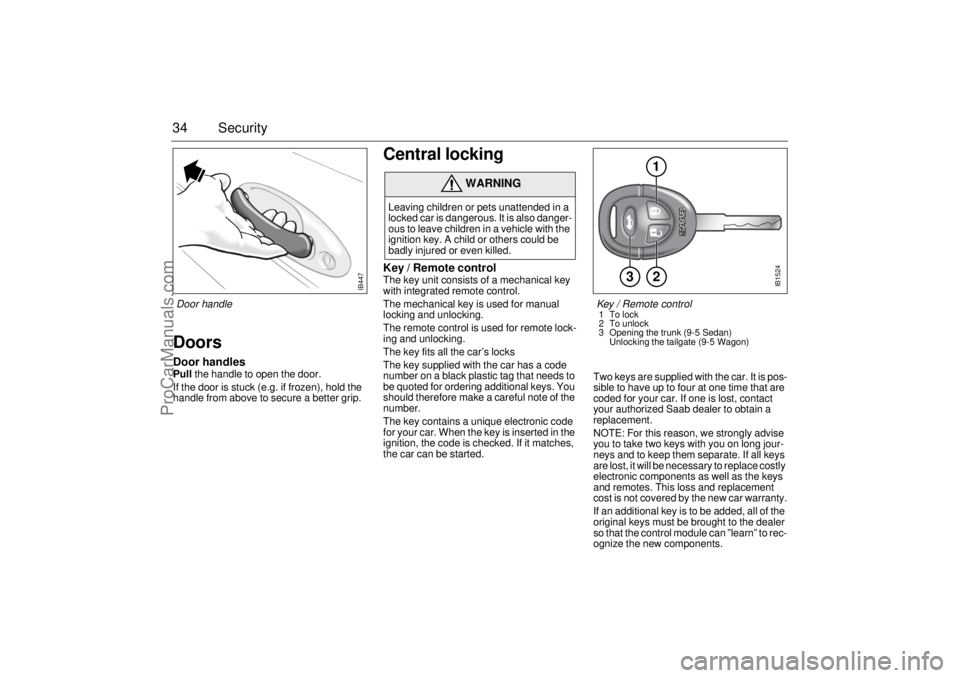
34 SecurityDoorsDoor handlesPull the handle to open the door.
If the door is stuck (e.g. if frozen), hold the
handle from above to secure a better grip.
Central locking
Key / Remote control The key unit consists of a mechanical key
with integrated remote control.
The mechanical key is used for manual
locking and unlocking.
The remote control is used for remote lock-
ing and unlocking.
The key fits all the car’s locks
The key supplied with the car has a code
number on a black plastic tag that needs to
be quoted for ordering additional keys. You
should therefore make a careful note of the
number.
The key contains a unique electronic code
for your car. When the key is inserted in the
ignition, the code is checked. If it matches,
the car can be started. Two keys are supplied with the car. It is pos-
sible to have up to four at one time that are
coded for your car. If one is lost, contact
your authorized Saab dealer to obtain a
replacement.
NOTE: For this reason, we strongly advise
you to take two keys with you on long jour-
neys and to keep them separate. If all keys
are lost, it will be necessary to replace costly
electronic components as well as the keys
and remotes. This loss and replacement
cost is not covered by the new car warranty.
If an additional key is to be added, all of the
original keys must be brought to the dealer
so that the control module can ”learn” to rec-
ognize the new components.
WARNING
Leaving children or pets unattended in a
locked car is dangerous. It is also danger-
ous to leave children in a vehicle with the
ignition key. A child or others could be
badly injured or even killed.
IB447
Door handle Key / Remote control
1To lock
2 To unlock
3 Opening the trunk (9-5 Sedan)
Unlocking the tailgate (9-5 Wagon)
IB1524
3
2 1
ProCarManuals.com
Page 35 of 272
35 Security
To check the number of keys that are pro-
grammed for the car; see page 45.Electronic starting interlock
(immobilizer)Each time the key is removed from the igni-
tion, the electronic starting interlock is acti-
vated and the car is thus immobilized, see
also page 42.Reprogramming lock system
functionsCertain lock system functions can be repro-
grammed by your authorized Saab work-
shop; see page 261.
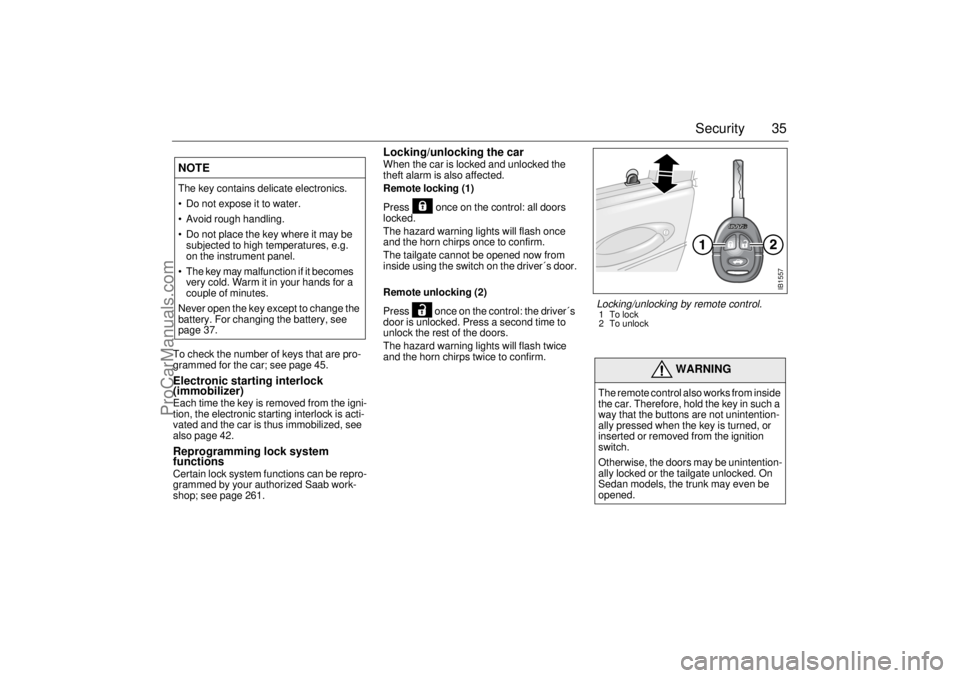
Locking/unlocking the car When the car is locked and unlocked the
theft alarm is also affected.
Remote locking (1)
Press once on the control: all doors
locked.
The hazard warning lights will flash once
and the horn chirps once to confirm.
The tailgate cannot be opened now from
inside using the switch on the driver´s door.
Remote unlocking (2)
Press once on the control: the driver´s
door is unlocked. Press a second time to
unlock the rest of the doors.
The hazard warning lights will flash twice
and the horn chirps twice to confirm.
NOTEThe key contains delicate electronics.
Do not expose it to water.
Avoid rough handling.
Do not place the key where it may be
subjected to high temperatures, e.g.
on the instrument panel.
The key may malfunction if it becomes
very cold. Warm it in your hands for a
couple of minutes.
Never open the key except to change the
battery. For changing the battery, see
page 37.
WARNING
The remote control also works from inside
the car. Therefore, hold the key in such a
way that the buttons are not unintention-
ally pressed when the key is turned, or
inserted or removed from the ignition
switch.
Otherwise, the doors may be unintention-
ally locked or the tailgate unlocked. On
Sedan models, the trunk may even be
opened.
IB1557
Locking/unlocking by remote control.1To lock
2 To unlock
ProCarManuals.com
Page 36 of 272
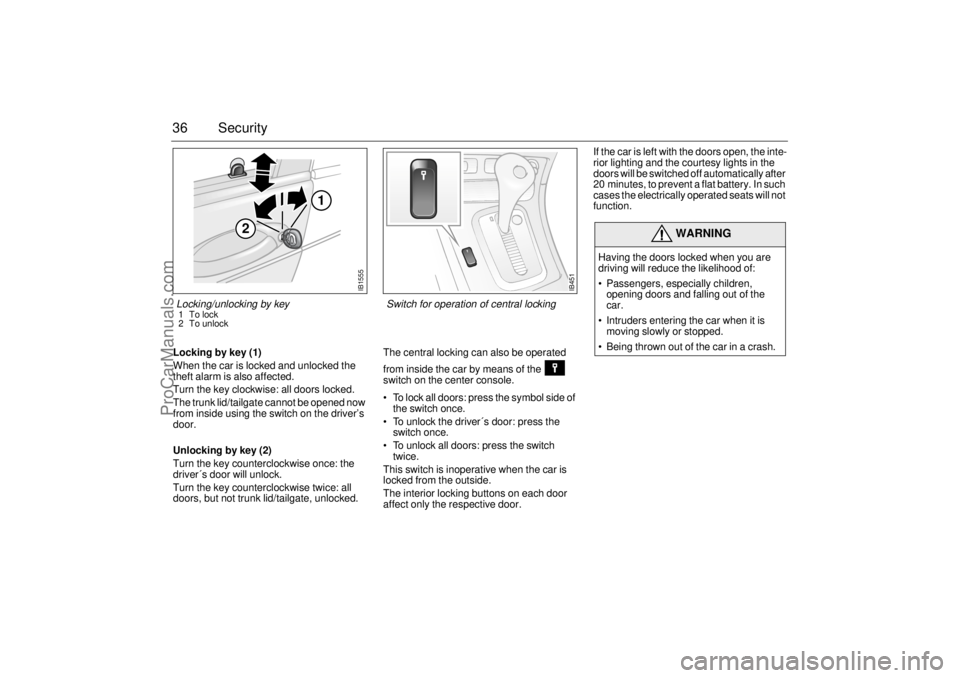
36 SecurityLocking by key (1)
When the car is locked and unlocked the
theft alarm is also affected.
Turn the key clockwise: all doors locked.
The trunk lid/tailgate cannot be opened now
from inside using the switch on the driver’s
door.
Unlocking by key (2)
Turn the key counterclockwise once: the
driver´s door will unlock.
Turn the key counterclockwise twice: all
doors, but not trunk lid/tailgate, unlocked. The central locking can also be operated
from inside the car by means of the
switch on the center console.
To lock all doors: press the symbol side of
the switch once.
To unlock the driver´s door: press the
switch once.
To unlock all doors: press the switch
twice.
This switch is inoperative when the car is
locked from the outside.
The interior locking buttons on each door
affect only the respective door.If the car is left with the doors open, the inte-
rior lighting and the courtesy lights in the
doors will be switched off automatically after
20 minutes, to prevent a flat battery. In such
cases the electrically operated seats will not
function.
WARNING
Having the doors locked when you are
driving will reduce the likelihood of:
Passengers, especially children,
opening doors and falling out of the
car.
Intruders entering the car when it is
moving slowly or stopped.
Being thrown out of the car in a crash.
IB451
Switch for operation of central locking
IB1555
2
1
Locking/unlocking by key1To lock
2 To unlock
ProCarManuals.com
Page 37 of 272
37 Security
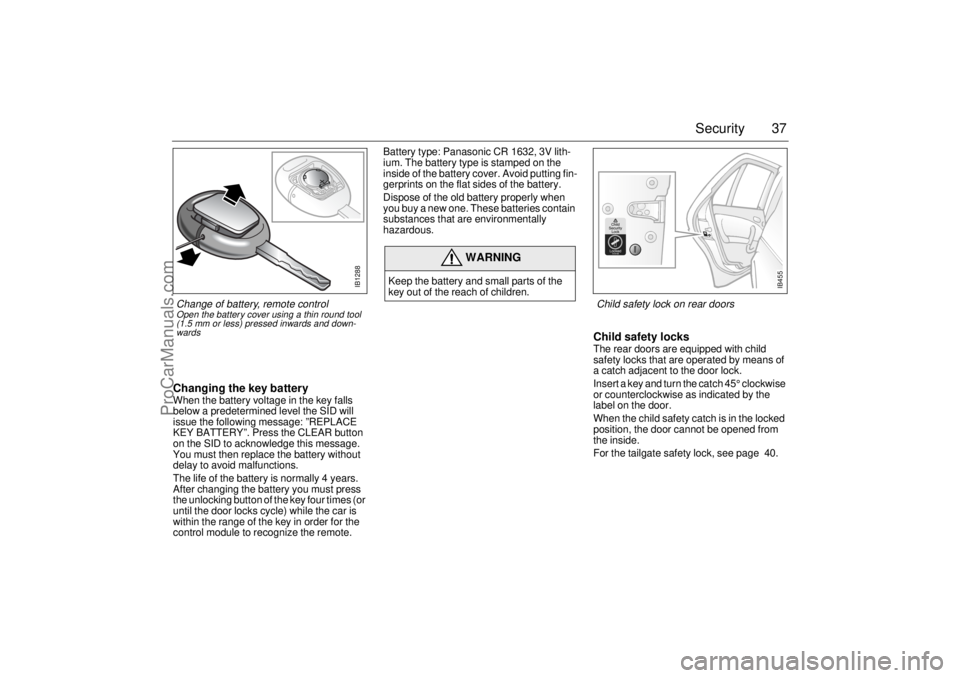
Changing the key batteryWhen the battery voltage in the key falls
below a predetermined level the SID will
issue the following message: ”REPLACE
KEY BATTERY”. Press the CLEAR button
on the SID to acknowledge this message.
You must then replace the battery without
delay to avoid malfunctions.
The life of the battery is normally 4 years.
After changing the battery you must press
the unlocking button of the key four times (or
until the door locks cycle) while the car is
within the range of the key in order for the
control module to recognize the remote. Battery type: Panasonic CR 1632, 3V lith-
ium. The battery type is stamped on the
inside of the battery cover. Avoid putting fin-
gerprints on the flat sides of the battery.
Dispose of the old battery properly when
you buy a new one. These batteries contain
substances that are environmentally
hazardous.
Child safety locksThe rear doors are equipped with child
safety locks that are operated by means of
a catch adjacent to the door lock.
Insert a key and turn the catch 45° clockwise
or counterclockwise as indicated by the
label on the door.
When the child safety catch is in the locked
position, the door cannot be opened from
the inside.
For the tailgate safety lock, see page 40.
WARNING
Keep the battery and small parts of the
key out of the reach of children.
IB1288
Change of battery, remote controlOpen the battery cover using a thin round tool
(1.5 mm or less) pressed inwards and down-
wards
IB455
Child safety lock on rear doors
ProCarManuals.com
Page 40 of 272
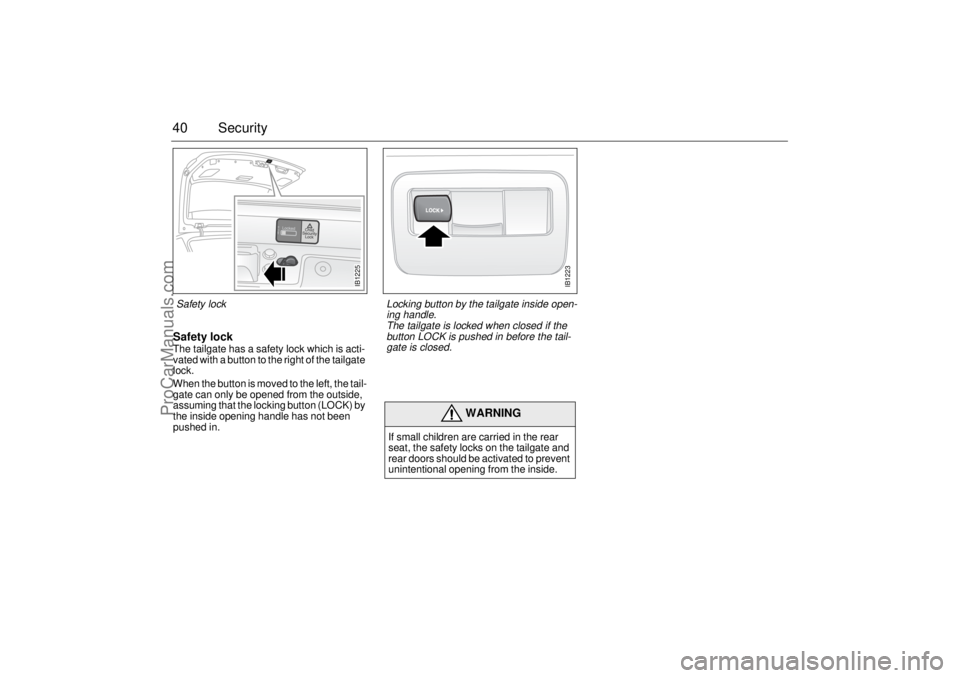
40 SecuritySafety lock The tailgate has a safety lock which is acti-
vated with a button to the right of the tailgate
lock.
When the button is moved to the left, the tail-
gate can only be opened from the outside,
assuming that the locking button (LOCK) by
the inside opening handle has not been
pushed in.
WARNING
If small children are carried in the rear
seat, the safety locks on the tailgate and
rear doors should be activated to prevent
unintentional opening from the inside.
IB1225
Safety lock
IB1223
Locking button by the tailgate inside open-
ing handle.
The tailgate is locked when closed if the
button LOCK is pushed in before the tail-
gate is closed.
ProCarManuals.com
Page 41 of 272

41 Security
Car alarm The car alarm (anti-theft system) is acti-
vated/deactivated when the car is
locked/unlocked by the remote control or by
the key, see page 35.
The antenna for the alarm system is located
in the center console.
All the doors plus trunk lid/tailgate and hood
are monitored by microswitches, and win-
dow-glass sensors will trigger the alarm if
any glass is broken. Your Saab 9-5 is equipped with an Elec-
tronic starting interlock (immobilizer), see
page 42 for details.
The car alarm is armed 10 seconds after the
car has been locked by the remote control.
During this ten-second delay period, the
doors, trunk lid/tailgate and hood may still
be opened without the alarm being trig-
gered.
The LED indicator on the instrument panel
fascia will be on continuously during this
period, at the end of which it will start to flash
(once every other second). If a door or the trunk lid/tailgate or hood has
been left open when the car is locked, the
LED on the fascia will flash (three times per
second) for ten seconds to indicate this.
Check to ensure that all the doors, plus
trunk lid/tailgate and hood, are closed prop-
erly.
If the fault persists (LED flashing when
renewed attempt made to activate the car
alarm by remote control), lock the car using
the key instead. The car alarm will not have
been activated and you should get in touch
with an authorized Saab dealer.
To avert inconvenience caused by the
alarm being triggered inadvertently, make
sure that anyone else using the car is famil-
iar with how both the car alarm and the lock-
ing system work.
If the alarm is tripped (the direction indica-
tors are flashing and the siren is on) it can
be turned off by unlocking the car using the
button.
WARNING
Leaving children or pets unattended in a
locked car is dangerous. It is also danger-
ous to leave children in a vehicle with the
ignition key. A child or others could be
badly injured or even killed.
IB1524
3
2 1
Remote control 1 Activate/lock
2 Deactivate/unlock
3 Unlock trunk/tailgate
ProCarManuals.com