warning SAAB 9-5 2002 Manual PDF
[x] Cancel search | Manufacturer: SAAB, Model Year: 2002, Model line: 9-5, Model: SAAB 9-5 2002Pages: 272, PDF Size: 16.26 MB
Page 150 of 272

150 Starting and driving
AON 93. One of the advantages of the
system is that it enables the engine to
be run safely on lower-grade fuel,
although not lower than AON 87.
The maximum boost pressure is
adjusted automatically to the knocking
or pinging tendency of the engine.
Occasional, short-lived knocking when
the engine is under a heavy load is per-
fectly normal; the extent will depend on
the grade of fuel in the tank.
Isolated instances of knocking are
more likely to occur with low-octane
fuel. This controlled form of knocking,
followed by a reduction in the boost
pressure, is a sign that the wastegate is
functioning and is perfectly safe for the
engine.
Important considerations with cata-
lytic convertersThe catalytic converter is an emission-con-
trol device incorporated in the car’s exhaust
system. It consists of a metal canister with a
honeycomb insert, the cells of which have
walls coated in a catalytic layer (mixture of
precious metals).
To ensure that the catalytic converter con-
tinues to function properly, and also to avoid
damage to the converter and its associated
components, the following points must be
observed:
Have the car serviced regularly in accor-
dance with the service program. The fuel
and ignition systems are particularly
important in this context.
Always be alert to any misfiring of the
engine (not running on all cylinders) and
any loss of power or performance. At the
first sign of a malfunction, reduce speed
and take the car to an authorized Saab
dealer as soon as possible.
If the engine fails to start (in very cold
weather or if the battery is flat), the car can
be push started (manual gearbox only) or
started using jumper cables to a donor
NOTEIf constant knocking occurs every time a
load is put on the engine, this indicates a
malfunction in the system.
Have the car checked without delay by an
authorized Saab dealer.
WARNING
If the engine is being run with the car on a
rolling road or dynamometer, to ensure
adequate cooling, air must be blown into
the engine compartment and under the
car at a rate equivalent to the ram-air
effect that would be obtained at the corre-
sponding road speed.
NOTEUse only unleaded gasoline. Leaded gas-
oline is detrimental to the catalyst and
oxygen sensor and will seriously impair
the function of the catalytic converter.
ProCarManuals.com
Page 152 of 272

152 Starting and drivingRefueling
Only fuel from well-known oil companies
should be used.
All Saab gasoline engines can be driven on
fuel of grade AON 87-93.
For optimum performance we recommend:
AO N 90 for 4-cylinder engines
AO N 93 for 3.0t V6 and 2.3T Aero, (see
page 250).
If fuel containing a mixture of alcohol is
used, the following restrictions apply:
Methanol: max. 5% by volume.
Ethanol: max. 10% by volume.
MTBE: max. 15% by volume.
The fuel filler cap is located in the right rear
quarter panel.
Switch off engine.
Open fuel door
Insert the fuel-pump nozzle beyond the
flange on the filler pipe. Do not withdraw the
nozzle while fueling is in progress. Stop refueling the first time the pump
turns off, indicating the tank is full.
Fuel-tank capacity: 18.5 US gal. (70 liters)
Screw on the filler cap and keep turning until
it has clicked at least three times.
The most effective way to prevent conden-
sation forming in the tank (and thus avoid
possible running problems) is to keep the
tank well filled.
Before the onset of freezing temperatures in
winter, it may be advisable to add gasoline
anti-freeze to the fuel a few times to dispel
any condensation in the system.
WARNING
Never use fuel for any purpose other
than as engine fuel.
Fuel is highly flammable and can
cause severe burns. Never use an
open flame in the vicinity of gasoline
and do not smoke when refuelling.
Do not use the phone when refueling .
Gasoline fuels are highly explosive.
NOTEDo not overfill. Fuel should not come right
up the filler pipe as expansion room is
needed.
IB1755
ProCarManuals.com
Page 157 of 272

157 Starting and driving
Automatic transmission
The electronic control module for the auto-
matic transmission receives information on
engine torque and road speed, and also
controls the hydraulic pressure in the trans-
mission to ensure that gear changing is as
smooth as possible.
The position of the selector lever is shown
by the symbols adjacent to the lever and
also by an indicator on the main instrument
panel.
The ignition key can only be removed when
the selector lever is in the P position. When the car is stationary, the engine must
be at idling speed when the selector lever is
moved.
You must have your foot on the brake
pedal to move the lever out of park.
If the accelerator is depressed while the
lever is moved, this will result in abnormal
wear in the transmission.
WARNING
Make it a habit to keep your foot on the
brake when selecting a drive position,
to prevent the car from creeping for-
ward (or backward if reverse is
selected).
The car must be at a standstill before
P, R or N is selected. You have to have
your foot on the brake pedal to move
the lever out of P. If the car is still
moving when a drive position is subse-
quently selected, this could cause a
crash or damage the automatic trans-
mission.
Never park the car with the selector
lever in a drive position, even if the
parking brake is on.
Always select "P" position and apply
the parking brake when leaving the
vehicle unattended.
NOTEAfter selecting a drive position, pause to
allow the gear to engage before you
accelerate.
IB1756
Selector lever
IB1750
Selector-lever indicator on main instru-
ment panel
ProCarManuals.com
Page 160 of 272

160 Starting and driving
Overheated transmission fluid If the automatic-transmission fluid should
overheat, the following message will appear
on the SID:
”TRANSMISSION OVERHEATING”. If this
happens, stop the car and wait for the mes-
sage to be extinguished. Continue driving in
a locked gear that produces an engine
speed of about 3,000 rpm.
Overheating of the automatic-transmission
fluid can occur when the car is towing a
heavy load, such as a camping trailer in hilly
country, with the wrong gear selected,
resulting in abnormally frequent gear
changing. Try selecting position L, 3 or 4.
High ambient temperatures can also
increase the temperature of the transmis-
sion fluid or the oil cooler may be faulty.
Contact an authorized Saab dealer (see
also page 173).
Driving on hilly roads with a heavy
loadThe transmission fluid can overheat when
the gearbox is strained, for example, when
driving with a trailer on hilly roads with the
wrong gear is selected, resulting in many
extra gear changes. To avoid the transmis-
sion fluid overheating, always drive in
Normal mode. The adaptive gear change
patterns are then active.
High air temperatures or a faulty oil cooler
can also cause the transmission fluid to
overheat. Overheating reduces the service
life of the fluid. Contact an authorized Saab
dealer (see also page 173). Towing Towing of cars with automatic transmission,
see page 180.
NOTEIf the control module has actuated the
Limp-home function for the automatic
transmission, the car will remain in 5th
gear when D is selected, making it very
sluggish. To overcome this, move the
selector lever to position L.
WARNING
Remember to use engine-braking (selec-
tor position L, 3, or 4) to spare the brakes
when you are driving on a long or steep
downhill slope.
Brake failure can result from overheated
brakes!
ProCarManuals.com
Page 164 of 272
164 Starting and drivingCruise controlFor safety reasons (brake system func-
tion) the brakes must be applied once,
when the engine has started, before the
cruise control system can be activated.
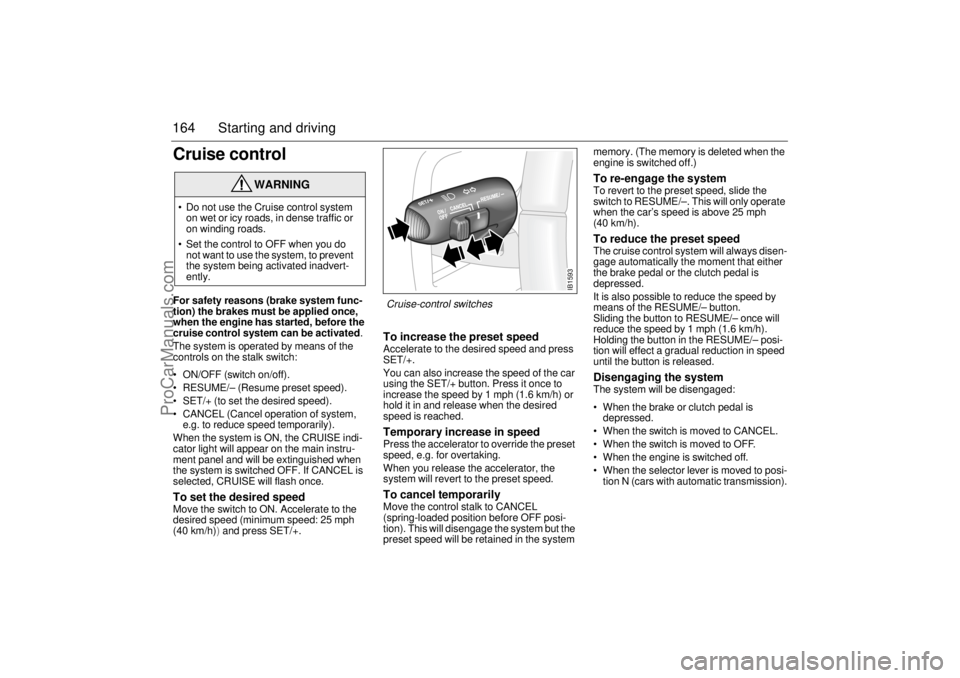
The system is operated by means of the
controls on the stalk switch:
ON/OFF (switch on/off).
RESUME/– (Resume preset speed).
SET/+ (to set the desired speed).
CANCEL (Cancel operation of system,
e.g. to reduce speed temporarily).
When the system is ON, the CRUISE indi-
cator light will appear on the main instru-
ment panel and will be extinguished when
the system is switched OFF. If CANCEL is
selected, CRUISE will flash once. To set the desired speed Move the switch to ON. Accelerate to the
desired speed (minimum speed: 25 mph
(40 km/h)) and press SET/+.
To increase the preset speed Accelerate to the desired speed and press
SET/+.
You can also increase the speed of the car
using the SET/+ button. Press it once to
increase the speed by 1 mph (1.6 km/h) or
hold it in and release when the desired
speed is reached. Temporary increase in speed Press the accelerator to override the preset
speed, e.g. for overtaking.
When you release the accelerator, the
system will revert to the preset speed. To cancel temporarily Move the control stalk to CANCEL
(spring-loaded position before OFF posi-
tion). This will disengage the system but the
preset speed will be retained in the system memory. (The memory is deleted when the
engine is switched off.)
To re-engage the system To revert to the preset speed, slide the
switch to RESUME/–. This will only operate
when the car’s speed is above 25 mph
(40 km/h). To reduce the preset speedThe cruise control system will always disen-
gage automatically the moment that either
the brake pedal or the clutch pedal is
depressed.
It is also possible to reduce the speed by
means of the RESUME/– button.
Sliding the button to RESUME/– once will
reduce the speed by 1 mph (1.6 km/h).
Holding the button in the RESUME/– posi-
tion will effect a gradual reduction in speed
until the button is released. Disengaging the system The system will be disengaged:
When the brake or clutch pedal is
depressed.
When the switch is moved to CANCEL.
When the switch is moved to OFF.
When the engine is switched off.
When the selector lever is moved to posi-
tion N (cars with automatic transmission).
WARNING
Do not use the Cruise control system
on wet or icy roads, in dense traffic or
on winding roads.
Set the control to OFF when you do
not want to use the system, to prevent
the system being activated inadvert-
ently.
IB1593
Cruise-control switches
ProCarManuals.com
Page 165 of 272
165 Starting and driving
BrakingTo avoid the brakes becoming overheated,
(e.g. when negotiating long descents with a
drop of several hundred feet), select a low
gear to use the braking effect of the engine.
If the car has automatic transmission, move
the selector lever to position 1 or 2.
When driving fast, you can help to prolong
the life of the brakes by thinking ahead and
braking harder for short periods, rather than
braking more moderately over long
stretches. Brake pad wear indicatorsThe outboard brake pads on the front
wheels incorporate pad-wear indicators.
When the lining is down to 3 mm, the pad
will produce a screeching, squealing or
scraping noise when the brakes are applied.
New pads should be fitted without delay.
Brake pads should only be replaced by
an authorized Saab dealer.
To ensure optimum brake performance,
it is recommended that you use only
Saab original brake pads.
ABS brakesABS (antilock braking system) modulates
the brake pressure to the respective
wheels. Wheel sensors detect if a wheel is
about to lock, and the control module
reduces the pressure to that wheel and then
increases it once more until the tendency is
detected again.
The brake system is equipped with an Elec-
tronic Brake-force Distribution device
(EBD), which distributes the brake pressure
between the front and rear wheels, in such
a way as to achieve optimum braking perfor-
mance irrespective of the car’s speed and
load.
The ABS system has a built-in diagnostic
function which will switch on the Anti-lock
brake warning light if a fault is detected in
the system (see page 52).
WARNING
It is prudent to try your brakes from
time to time, especially when driving in
heavy rain, through water collected on
the road, in snow, on a wet road sur-
face or in salty slush. In such condi-
tions, the brakes may take longer than
normal to take effect. To rectify this,
touch the brake pedal periodically to
dry the brakes out.
The same applies after the car has
been washed or when the weather is
very humid.
Avoid parking the car with wet brakes.
Before parking, and if the traffic condi-
tions allow, brake quite heavily so that
the brake discs and pads warm up and
dry.
The brakes are power assisted and it
should be kept in mind that the servo
unit only provides the power assis-
tance when the engine is running.
The brake pressure required when the
engine is off,(e.g. when the car is on
tow) is roughly four times the normal
pedal force required. The pedal also
feels hard and unresponsive.
WARNING
The additional safety afforded by the
ABS system is not designed to allow
drivers to drive faster but to make
normal driving safer.
To stop as quickly as possible, without
loss of directional stability, whether
the road surface is dry, wet or slippery,
press the brake pedal down hard-
without letting up, declutching
simultaneously, and steer the car to
safety.
ProCarManuals.com
Page 167 of 272

167 Starting and driving
Traction Control SystemHow the system works The traction control system (TCS) is
designed to prevent wheelspin. This
enables the car to achieve the best possible
grip and, hence, maximum tractive effort,
together with greater stability.
The TCS system uses information from the
ABS system’s wheel sensors to detect
when the front (driving) wheels are rotating
faster then the rear wheels. It then monitors
whether one driving wheel is rotating faster
than the other. If so, the faster wheel is
retarded until both wheels are rotating at the
same speed.
If the two front wheels are rotating at the
same speed but are turning faster than the
rear wheels, the torque from the engine is
reduced to eliminate the difference.
The process continues until all the wheels
are rotating at the same speed.
The advantages of the TCS system become
most apparent when the cohesion between
the front wheels and the road surface is so
low that one or both of the wheels would
lose their grip were the car not equipped
with the TCS, e.g.: When the car is pulling away or accelerat-
ing with the front wheels on different sur-
faces (e.g. one slippery and one dry). The
TCS then functions like an electronic dif-
ferential lock.
When the car is pulling away or accelerat-
ing on a slippery road, in which case the
TCS eliminates wheelspin. The same
applies when the car is reversing.
On cornering, if there is a tendency for the
inner front wheel to rotate faster than the
other wheels.
On overtaking.
TCS OFF The indicator on the main instrument
panel will come on:
If a fault has been detected and the
system has therefore been switched off.
If there is a fault in the ABS system.
If the system has been switched off man-
ually.
The indicator light will also come on for
4 seconds when the ignition key is turned to
ON, while an internal system check is per-
formed. TCS indicator The indicator light will come on for
4 seconds when the ignition key is turned to
ON, while an internal system check is per-
formed.
The light in the tachometer comes on
when the system is operative, i.e. when the
wheels are not rotating at the same speed.
The fact that the TCS system is operative
indicates that the limit for grip has been
exceeded and that the driver must exert
greater care.
WARNING
In normal driving, the TCS system will
help to improve the safety of the car, but
it does not mean that the car can be
driven faster. The same care and pru-
dence normally applied should be dis-
played on cornering and when driving on
slippery roads.
ProCarManuals.com
Page 169 of 272

169 Starting and driving
ESP indicator lightThe indicator light in the rev counter
comes on for a short period of time when the
ESP system is operative.
Operation of the ESP indicates reduced
cohesion between the tires and the road,
and that extra care should be taken by the
driver.Turning ESP offThe system can be turned off manually with
the ESP button, whereupon the light
on the main instrument panel will come on.
The ESP system cannot be switched off if
the car is travelling faster than 35 mph
(60 km/h).
The ESP is always operative during brak-
ing, even if it has been switched off manu-
ally.
WARNING
When driving normally, ESP will help to
improve the stability of the car. This does
not mean that car can be driven faster.
The same care and prudence as normally
applied should be displayed on cornering
and when driving on slippery roads.
NOTESuspension modifications, such as
changing the type of wheels, dampers or
springs, can affect the function of the ESP
system.
Always consult a Saab dealer before
changing any suspension components.
IB1841
Increased stability with ESP.
The system applies the brakes to the
wheels as shown to prevent the car from
skidding
ProCarManuals.com
Page 171 of 272

171 Starting and driving
Driving in a low gear results in higher fuel
consumption than in a high gear because
of the higher engine speed for a given
road speed. Always change up to a higher
gear as soon as traffic conditions allow
and use the highest gear as much as pos-
sible.
Check the air pressure in the tires once a
month. Incorrect pressures increase tire
wear. It is better to have slightly higher
pressure than lower.
Check fuel consumption regularly.
Increased consumption can indicate that
something is wrong and that the car
needs to be checked by an authorized
Saab dealer.
Practical trials on the roads have demon-
strated that substantial savings in fuel con-
sumption can be made if the above advice
is heeded.Road conditions Wet roads increase fuel consumption, as do
unpaved roads and driving in hilly country
(the amount of fuel saved driving downhill is
less than the additional amount required to
climb the hill).
Engine block heater (standard
equipment in Canada, accessory in
U.S.)The following are just some of the benefits
to the car and the environment of using an
engine block heater:
Lower fuel consumption.
Reduced wear on the engine.
Inside of car warms up faster.
Exhaust emissions substantially reduced
over short runs.
The engine heater is effective at outside
temperatures up to +15-20°C. The warmer
it is outside, the shorter the time the engine
heater needs to be connected. Longer than
1.5 hours is unnecessary.
If the car is equipped with a removable,
electrical cabin heater that is not in use, this
should be stored in the luggage compart-
ment.
Driving in cold weatherBefore starting a journey in cold weather
you should check the following:
That the wiper blades have not become
frozen to the windshield/glass.
Brush any snow away from the air intake
for the heater system (opening between
hood and windshield).
It may be advisable to lubricate the
door-lock cylinder (use molybdenum
disulphide, MoS
2) to prevent its freezing.
If the lock has frozen, take care not to
break the key (or use the remote control)
– heat it first or spray it with de-icer.
Periodically during the winter, add gaso-
line anti-freeze to the fuel to dispel any
condensation in the fuel tank which could
freeze and cause problems in the system.
Keep the tank well filled to reduce the risk
of condensation forming.
If the car is parked outside in freezing
weather, fuel additives (gasoline
anti-freeze) will not do any good as it
cannot remove water that has already fro-
zen. Park the car in a warm place so that
any ice that may have built up melts, then
add gasoline anti-freeze when filling up
the tank. Condensation is caused by
changes in the outdoor temperature or by
the car being parked alternately in a
garage and outside.
It is particularly important when the roads
are slippery that the brakes and tires be in
good condition.
WARNING
Never switch the engine off while driving
as the effect of the brakes and power
steering will be greatly reduced.
ProCarManuals.com
Page 172 of 272
172 Starting and driving Check the anti-freeze in the engine cool-
ant, see page 196.
The car´s trip computer will warn you when
there is a risk of slippery conditions. For fur-
ther information on this function, see page
60.
The car is equipped with tires designed to
provide optimum grip on both wet and dry
roads, although this has been achieved at
the expense of somewhat reduced grip on
snow and ice. For regular driving on snow
and ice, we therefore recommend that
winter (snow) tires be fitted.
Winter (snow) tires, particularly studded
tires (where use is legally permitted), gener-
ally make driving safer on snow and ice.
Acquaint yourself with the legal provi-
sions governing the use of different
types of winter tires and snow chains.
Studded tires are not allowed in some
countries.If winter tires are fitted, the same type must
be fitted on all wheels. Your Saab dealer will
be pleased to advise you on the best tires for
your car.
Remember that tires age. It may therefore
be necessary to change them before they
reach the legal wear limit, as they gradually
lose their friction properties.
The best response if the car gets into a
front-wheel skid is to freewheel (manual
gearbox only), i.e. disengage the clutch (so
that the wheels are neither driven or
retarded by the engine.
If the car has automatic transmission, ease
up on the accelerator and steer carefully in
the desired direction.
In a rear-wheel skid, steer in the same direc-
tion that the rear of the car is moving.
Tire chainsIf you want to fit tire chains (where legally
permitted) they should only be fitted to the
tires recommended under ”Specifications”
(see page 256).
Consult your Saab dealer for details of
approved tire chains.
WARNING
Do not exceed 30 mph (50 km/h)
when tire chains are fitted.
Tire chains can reduce the directional
stability of the car.
Tire chains must not be used on the
rear wheels. NOTE Check the links frequently for wear.
Check that the chains do not contact
the wheel-arch liner at full lock.
See section ”Specifications”, page
256, for information on allowable
wheel dimensions for the fitting of tire
chains.
ProCarManuals.com