light SAAB 9-5 2003 User Guide
[x] Cancel search | Manufacturer: SAAB, Model Year: 2003, Model line: 9-5, Model: SAAB 9-5 2003Pages: 288, PDF Size: 16.78 MB
Page 40 of 288
40 SafetyWhat won’t trigger the front airbags? The airbag will not be activated in all
front-end crashes. For instance, if the car
has hit something relatively soft and yielding
(e.g. a snow drift or a hedge) or a solid
object at a low impact speed, the airbag will
not necessarily be triggered. How loud is the inflation? The noise of the inflation is certainly loud,
but it is very short-lived and will not damage
your hearing. For a short time afterwards
you could experience a buzzing noise in
your ears.
Most people who have experienced it
cannot remember the noise of the inflation
at all – all they remember is the noise of the
crash. Can you still use a child seat in the front if a
passenger airbag is installed? Definitely not!
Children 12 and under can be injured or
killed by the airbag.
The BACK SEAT is the SAFEST place for
children.
NEVER put a child seat in the front.
Are the smoke and fumes given off when the
airbag operates at all harmful? Most people who have remained in a car
with little or no ventilation for several
minutes complained only of minor irritation
of the throat and eyes. Avoid as far as possi-
ble getting dust on your skin as there is a risk
of skin irritation.
If you suffer from asthma, the incident may
bring on an attack, in which case you should
follow the normal procedure advised by
your doctor. It is advisable to consult a
doctor afterwards.
What should I do if the AIR-BAG warning
light comes on? If the warning light is on, it means that a fault
has been detected in the system. The
airbag cannot be relied on to operate as
intended and it might even be activated
erroneously. You should therefore take the
car to an authorized Saab dealer as soon as
possible.
WARNING
When an airbag is inflated there is dust in
the air.
Because the dust/smoke can, in certain
cases, cause irritation to the skin, the
following precautions should be taken:
As soon as possible, wash any
exposed skin using a mild soap and
water.
If there is irritation of the eyes, flush
them liberally with clean water for at
least 20 minutes.
If this trouble persists, you should
consult a doctor.
WARNING
To reduce the risk of head injuries in the
event of a crash, the headliner and pillar
trims incorporate energy absorbing mate-
rial. These areas must not be modified in
any way. Work on these areas must only
be carried out at an authorized Saab
dealer.
ProCarManuals.com
Page 43 of 288

43 Security
To check the number of keys that are pro-
grammed for the car; see page 52.Electronic starting interlock
(immobilizer)Each time the key is removed from the igni-
tion, the electronic starting interlock is acti-
vated and the car is thus immobilized, see
also page 49.Reprogramming lock system
functionsCertain lock system functions can be repro-
grammed by your authorized Saab dealer;
see page 271.
Locking/unlocking the car When the car is locked and unlocked the
theft alarm is also affected.
Remote locking (1)
Press once on the control: all doors
locked.
The hazard warning lights will flash once
and the horn chirps once to confirm.
The tailgate cannot be opened now from
inside using the switch on the driver´s door.
Remote unlocking (2)
Press once on the control: the driver´s
door is unlocked. Press a second time to
unlock the rest of the doors.
The hazard warning lights will flash twice
and the horn chirps twice to confirm.
If remote unlocking should fail to work
Unlock the driver’s door with the key. To
silence the alarm, insert the key into the igni-
tion switch and turn it to the ON position.
The car can now be started. Contact your
local Saab dealer to have the system
checked and rectified.
NOTICEThe key contains delicate electronics.
Do not expose it to water.
Avoid rough handling.
Do not place the key where it may be
subjected to high temperatures, e.g.
on the instrument panel.
The key may malfunction if it becomes
very cold. Warm it in your hands for a
couple of minutes.
Never open the key. For changing the
battery, see page 45.
IB1557
Locking/unlocking by remote control.1To lock
2 To unlock
ProCarManuals.com
Page 45 of 288
45 Security
If the car is left with the doors open, the inte-
rior lighting and the courtesy lights in the
doors will be switched off automatically after
20 minutes, to prevent a flat battery. In such
cases the electrically operated seats will not
function.
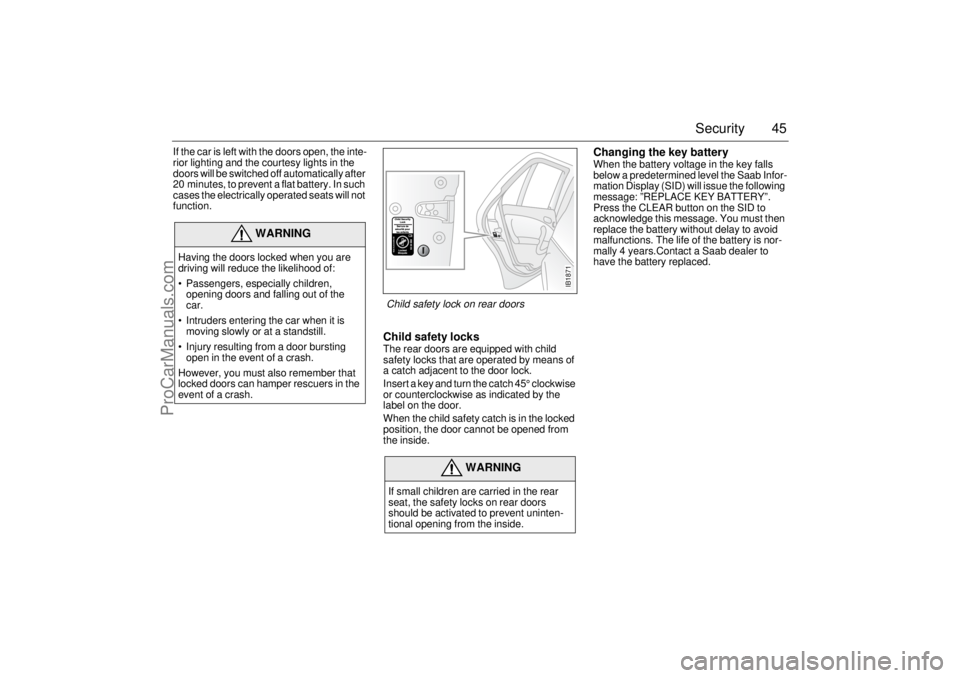
Child safety locksThe rear doors are equipped with child
safety locks that are operated by means of
a catch adjacent to the door lock.
Insert a key and turn the catch 45° clockwise
or counterclockwise as indicated by the
label on the door.
When the child safety catch is in the locked
position, the door cannot be opened from
the inside.
Changing the key batteryWhen the battery voltage in the key falls
below a predetermined level the Saab Infor-
mation Display (SID) will issue the following
message: ”REPLACE KEY BATTERY”.
Press the CLEAR button on the SID to
acknowledge this message. You must then
replace the battery without delay to avoid
malfunctions. The life of the battery is nor-
mally 4 years.Contact a Saab dealer to
have the battery replaced.
WARNING
Having the doors locked when you are
driving will reduce the likelihood of:
Passengers, especially children,
opening doors and falling out of the
car.
Intruders entering the car when it is
moving slowly or at a standstill.
Injury resulting from a door bursting
open in the event of a crash.
However, you must also remember that
locked doors can hamper rescuers in the
event of a crash.
WARNING
If small children are carried in the rear
seat, the safety locks on rear doors
should be activated to prevent uninten-
tional opening from the inside.
IB1871
Child safety lock on rear doors
ProCarManuals.com
Page 46 of 288
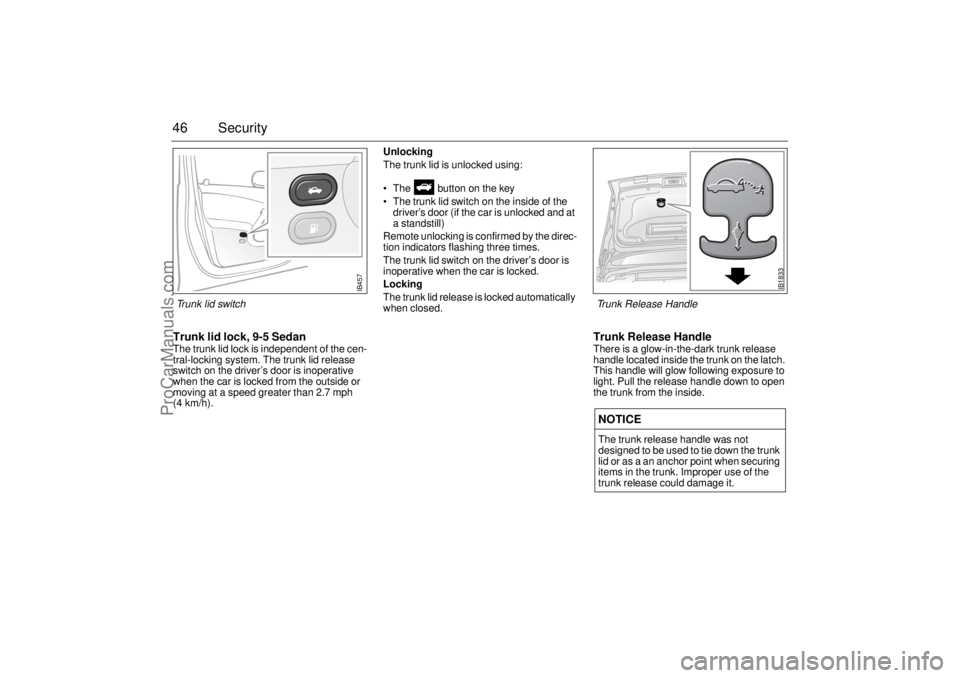
46 SecurityTrunk lid lock, 9-5 SedanThe trunk lid lock is independent of the cen-
tral-locking system. The trunk lid release
switch on the driver’s door is inoperative
when the car is locked from the outside or
moving at a speed greater than 2.7 mph
(4 km/h).Unlocking
The trunk lid is unlocked using:
The button on the key
The trunk lid switch on the inside of the
driver’s door (if the car is unlocked and at
a standstill)
Remote unlocking is confirmed by the direc-
tion indicators flashing three times.
The trunk lid switch on the driver’s door is
inoperative when the car is locked.
Locking
The trunk lid release is locked automatically
when closed.
Trunk Release HandleThere is a glow-in-the-dark trunk release
handle located inside the trunk on the latch.
This handle will glow following exposure to
light. Pull the release handle down to open
the trunk from the inside.NOTICEThe trunk release handle was not
designed to be used to tie down the trunk
lid or as a an anchor point when securing
items in the trunk. Improper use of the
trunk release could damage it.
IB1833
Trunk Release Handle
IB457
Trunk lid switch
ProCarManuals.com
Page 49 of 288

49 Security
Activating the car alarm The car alarm cannot be activated if the
driver’s door is open or if the ignition switch
is in ON position.
If, on the other hand, one of the other doors
or the trunk or hood is open or opened and
not closed again during the 10-seconds
delay period, it will be excluded from the
alarm function.
If it is then closed, a new delay period of ten
seconds will start, and the door (or trunk or
hood) will once again be secured by the
alarm system.
As usual, the LED will be on continuously
during the new delay period and will start to
flash once every other second after the
10-seconds period has elapsed.
Window glass sensorThe car-alarm system incorporates a
sensor that monitors the window glass for
the sound of breakage. The sensor is fitted
inside the rear dome light.
To avoid false alarms, such as the alarm
being triggered by noise from passers by
when the windows have been left open, or
when children or pets are left inside the car,
the sensor can be temporarily disabled.
To disable the sensor
To disable the sensor, first turn off the igni-
tion and remove the key from the switch.
Next, press and hold the NIGHT PANEL
button until ”DOOR ALARM ONLY” appears
on the Saab Information Display (SID) and
a chime sounds. The car alarm must now be
activated within three minutes, or the glass
sensor will become active again.
The glass sensor will be enabled again
automatically when the car is next unlocked.
The sensor can also be enabled again by
repeating the procedure for disabling it.
When the sensor has been enabled, ”FULL
THEFT ALARM” will appear on the Saab
Information Display (SID).
If a fault is detected in the glass sensor,
”SERVICE THEFT ALARM” will appear on
the Saab Information Display (SID).
Electronic starting interlock
(immobilizer) When the key is inserted in the ignition, a
signal is sent to the receiver. If the signal is
verified, the engine can be started.
Each time the key is removed from the igni-
tion, the electronic immobilizer is activated.
This means that the car cannot be started
without the correct key inserted in the igni-
tion and the immobilizer thus deactivated.
If a fault is detected (e.g. in the transmitter)
”KEY NOT ACCEPTED” will appear on the
Saab Information Display (SID).
In this case, you can still start the car if you
turn the ignition key to ON and press one of
the buttons on the key (providing that the
receiver gets the right signal from the key).
Take the car to an authorized Saab dealer to
have the system checked.
The LED double-flashes when the car is
immobilized.
ProCarManuals.com
Page 50 of 288

50 SecurityAlarm signals When the car alarm is armed, it will be trig-
gered if any door, or the trunk lid or hood, is
opened or if a window is broken.
The alarm will also be triggered if an attempt
is made to bypass or short-circuit the igni-
tion switch, or to disconnect the battery.
If the alarm is triggered, the following alarm
signals will be set off:
Flashing of hazard warning lights for five
minutes.
Siren wailing for 30 seconds.
The alarm signals will stop if the alarm is
deactivated (car unlocked) during the alarm
period.
The alarm siren has a long-life battery
(approx. 10 years), see ”SERVICE THEFT
ALARM”, on page 52. When the battery
goes dead, the siren must be replaced: it is
not possible to change the batteries.
Panic-functionIn the car alarm system is a function called
"Panic-function".
To activate panic function:
Push and hold one of the buttons on the
key for 2 seconds. Or, if you are sitting
inside the car, push the LOCK-switch on
the center console for 2 seconds.
These actions will trigger the alarm (hazard
warning lights and siren).
To deactivate panic function:
Push one of the buttons on the key, push
the LOCK-switch in the center console,
turn the key in the driver´s door or turn the
ignition to ON.
When the panic-function is activated the car
will be locked/unlocked depending upon
which button was pushed.
When the ignition is ON the panic-function
cannot be activated.
NOTICE It is possible to inadvertently deacti-
vate the car alarm and at the same
time unlock the car, if the button on the
key is pressed by mistake when the
car is still within its range.
When locking the car by remote con-
trol in extremely cold weather, it is
advisable to check that the lock
system has operated properly. To do
so, check that the interior locking but-
tons are all down.
If not, unlock and relock the car again.
ProCarManuals.com
Page 51 of 288

51 Security
Overview of functions
Alarm signals may differ between model variants for different coun-
tries.
Some of the car-alarm functions can be reprogrammed – con-
sult your Saab dealer for further details (see page 271). Locking/
activation Hazard warning lights flash once and the horn
chirps once.
The LED will come on for 10 seconds.
Unlocking/
deactivation Hazard warning lights flash twice and the horn
chirps twice.
The LED will come on for two seconds.
Unlocking/
deactivation of
trunk lid/tailgate
alarm Hazard warning lights flash three times and the
horn chirps three times.
The LED will flash three times per second for 10
seconds.
Alarm triggered Hazard warning lights flash for 5 min.
Siren wails for 30 seconds.
To switch off the alarm, deactivate the system in
the normal way (unlocking).
Window-glass
sensor The sensor detects if any window is broken and
triggers the alarm.
To disable the sensor, see page 49.
Key The range of the key is normally 5–10 yds. (5–
10 metres), although it can be substantially more
than this in ideal conditions (range can vary
greatly depending on the position of the car and
its surroundings).
If the key is not working, it may be because the
code signal has not been synchronized with that
in the control module for the car alarm. To rectify
this, press the unlock button on the key at least
four times in quick succession. When it is recog-
nized, the door locks will cycle.
If a key is lost, the new one will have to be pro-
grammed (all keys must be present) to match the
car’s unique security code. Contact an author-
ized Saab dealer.Battery for key The battery for the key will normally have a life of
4 years. When the battery needs changing,
”REPLACE KEY BATTERY” will appear on the
Saab Information Display (SID).
Contact an authorized Saab dealer.
Car-battery
voltage If the battery is disconnected while the alarm is
active (car is locked), for example during an
attempt to steal the car, the alarm will be trig-
gered.
ProCarManuals.com
Page 55 of 288

55 Instruments and controls
Instruments and
controls Indicator and warning
lights ................................. 56
Instruments ........................ 62
Saab Information Display
(SID) ................................... 65
Switches ............................. 71
Automatic climate control
(ACC) ................................. 77
ECON OFF
…F
…C
ECON OFF
CLEAR
SET
IB1939
VOL
TREBAL ON
FA D BAS
PULL PUSH
ASSEARCH
2 13
5 46
DOLBY B NR
ProCarManuals.com
Page 56 of 288
56 Instruments and controls
Indicator and warning
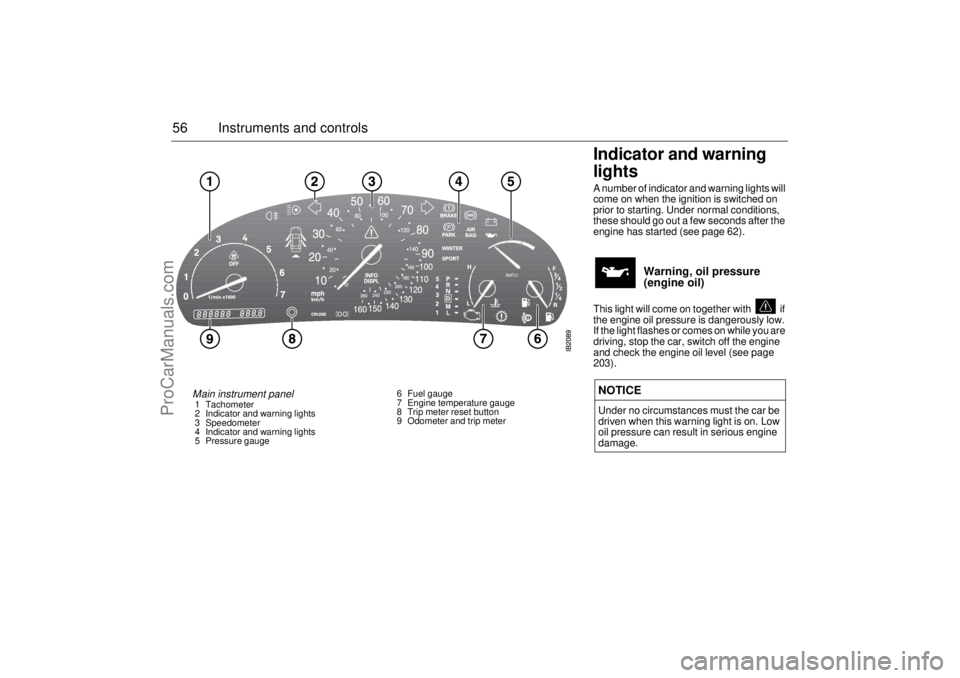
lights A number of indicator and warning lights will
come on when the ignition is switched on
prior to starting. Under normal conditions,
these should go out a few seconds after the
engine has started (see page 62).
Warning, oil pressure
(engine oil)
This light will come on together with if
the engine oil pressure is dangerously low.
If the light flashes or comes on while you are
driving, stop the car, switch off the engine
and check the engine oil level (see page
203). NOTICEUnder no circumstances must the car be
driven when this warning light is on. Low
oil pressure can result in serious engine
damage.
Main instrument panel 1 Tachometer
2 Indicator and warning lights
3 Speedometer
4 Indicator and warning lights
5 Pressure gauge6 Fuel gauge
7 Engine temperature gauge
8 Trip meter reset button
9 Odometer and trip meter
ProCarManuals.com
Page 57 of 288
57 Instruments and controls
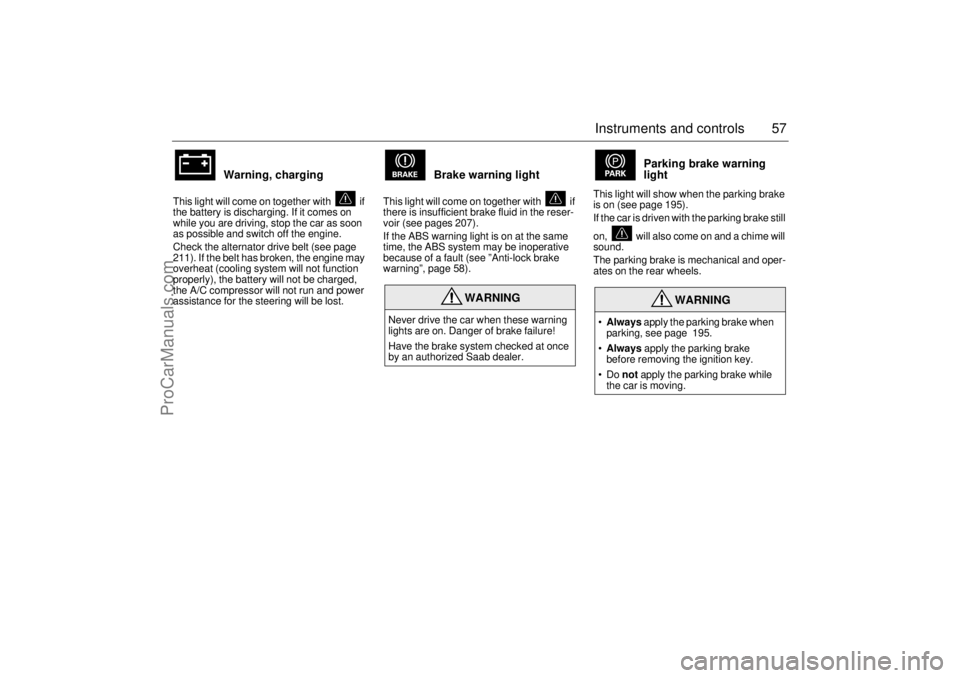
Warning, charging
This light will come on together with if
the battery is discharging. If it comes on
while you are driving, stop the car as soon
as possible and switch off the engine.
Check the alternator drive belt (see page
211). If the belt has broken, the engine may
overheat (cooling system will not function
properly), the battery will not be charged,
the A/C compressor will not run and power
assistance for the steering will be lost.
Brake warning light
This light will come on together with if
there is insufficient brake fluid in the reser-
voir (see pages 207).
If the ABS warning light is on at the same
time, the ABS system may be inoperative
because of a fault (see ”Anti-lock brake
warning”, page 58).
Parking brake warning
light
This light will show when the parking brake
is on (see page 195).
If the car is driven with the parking brake still
on, will also come on and a chime will
sound.
The parking brake is mechanical and oper-
ates on the rear wheels.
WARNING
Never drive the car when these warning
lights are on. Danger of brake failure!
Have the brake system checked at once
by an authorized Saab dealer.
WARNING
Always apply the parking brake when
parking, see page 195.
Always apply the parking brake
before removing the ignition key.
Do not apply the parking brake while
the car is moving.
ProCarManuals.com