trailer SAAB 9-5 2003 User Guide
[x] Cancel search | Manufacturer: SAAB, Model Year: 2003, Model line: 9-5, Model: SAAB 9-5 2003Pages: 288, PDF Size: 16.78 MB
Page 184 of 288
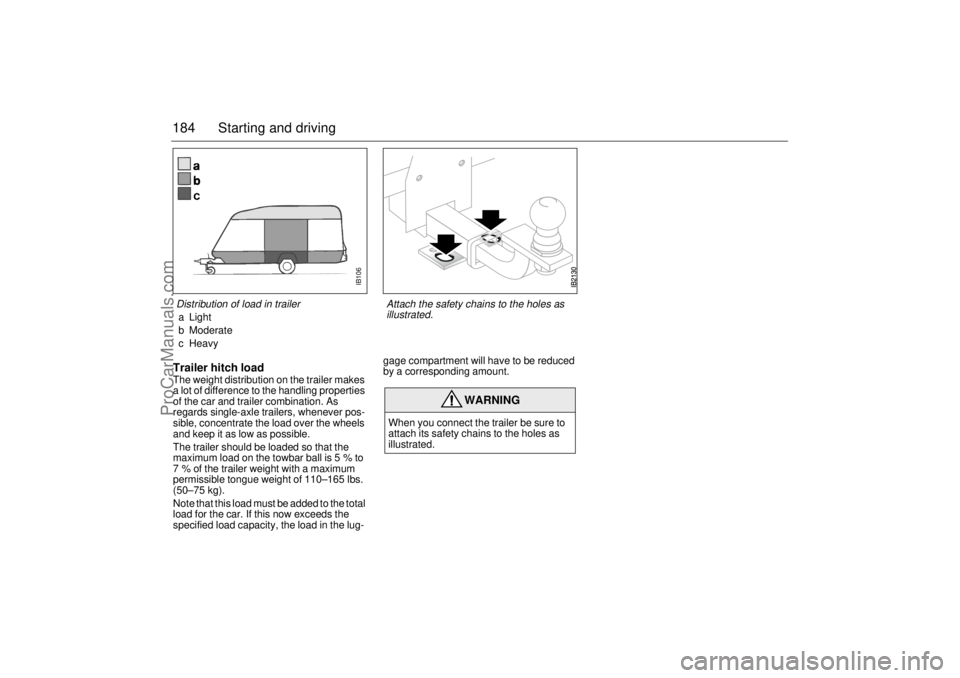
184 Starting and drivingTrailer hitch loadThe weight distribution on the trailer makes
a lot of difference to the handling properties
of the car and trailer combination. As
regards single-axle trailers, whenever pos-
sible, concentrate the load over the wheels
and keep it as low as possible.
The trailer should be loaded so that the
maximum load on the towbar ball is 5 % to
7 % of the trailer weight with a maximum
permissible tongue weight of 110–165 lbs.
(50–75 kg).
Note that this load must be added to the total
load for the car. If this now exceeds the
specified load capacity, the load in the lug-gage compartment will have to be reduced
by a corresponding amount.
WARNING
When you connect the trailer be sure to
attach its safety chains to the holes as
illustrated.
IB106
Distribution of load in trailer a Light
b Moderate
cHeavy
Attach the safety chains to the holes as
illustrated.
ProCarManuals.com
Page 190 of 288
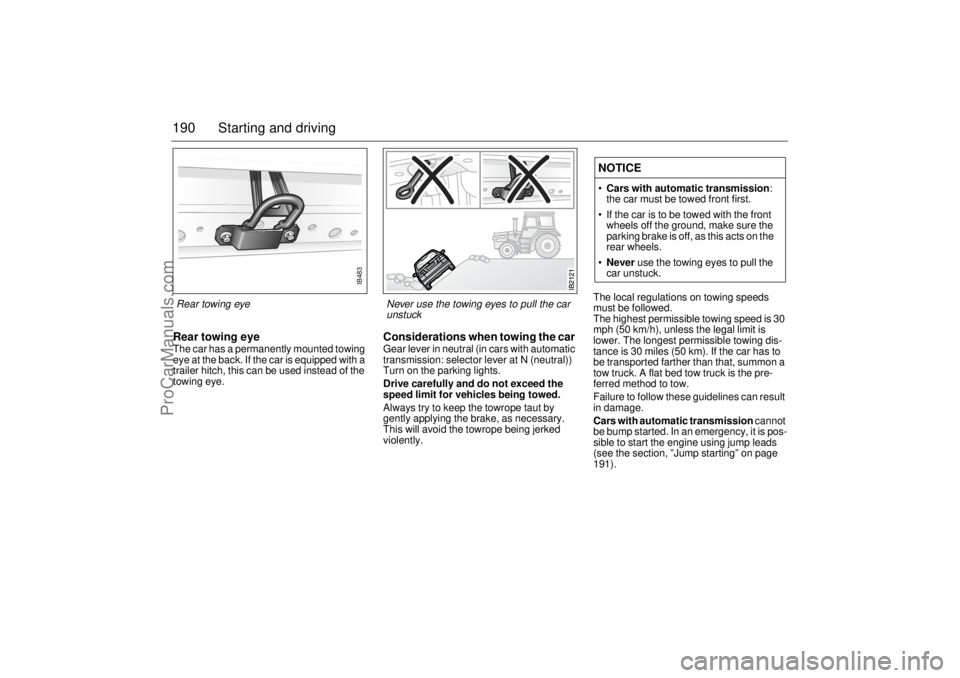
190 Starting and drivingRear towing eyeThe car has a permanently mounted towing
eye at the back. If the car is equipped with a
trailer hitch, this can be used instead of the
towing eye.
Considerations when towing the car Gear lever in neutral (in cars with automatic
transmission: selector lever at N (neutral))
Turn on the parking lights.
Drive carefully and do not exceed the
speed limit for vehicles being towed.
Always try to keep the towrope taut by
gently applying the brake, as necessary.
This will avoid the towrope being jerked
violently.
. The local regulations on towing speeds
must be followed.
The highest permissible towing speed is 30
mph (50 km/h), unless the legal limit is
lower. The longest permissible towing dis-
tance is 30 miles (50 km). If the car has to
be transported farther than that, summon a
tow truck. A flat bed tow truck is the pre-
ferred method to tow.
Failure to follow these guidelines can result
in damage.
Cars with automatic transmission cannot
be bump started. In an emergency, it is pos-
sible to start the engine using jump leads
(see the section, ”Jump starting” on page
191). NOTICECars with automatic transmission:
the car must be towed front first.
If the car is to be towed with the front
wheels off the ground, make sure the
parking brake is off, as this acts on the
rear wheels.
Never use the towing eyes to pull the
car unstuck.
IB483
Rear towing eye
Never use the towing eyes to pull the car
unstuck
ProCarManuals.com
Page 194 of 288

194 Starting and drivingThe system can be disengaged for when
driving with a trailer. Press and hold the
CLEAR button on the SID when the display
shows "PARK ASSIST", until the display
shows "PARK ASSIST OFF". The system is
re-engaged in the same way. The system is
also always activated when the ignition key
is turned to ON.
Pressing a SID button briefly will not disen-
gage the system, the display will simply
show the previously selected function.Ice, snow and dirt can affect the sensitivity
of the sensors. In such cases a continuous
tone will sound warning the driver that the
system cannot measure the distance to an
object. You can turn the system off by press-
ing and holding the CLEAR button for
1.5 seconds.
If the text "PARK ASSIST FAILURE" is dis-
played on the SID, have the system
checked by an authorized Saab dealer.NOTICETo function well, the sensors must be kept
clean. Ice snow and dirt can affect their
sensitivity.
Do not spray the sensors or closer than
8 in. (20 cm) to the sensors with a pres-
sure washer, as this could damage them.
ProCarManuals.com
Page 204 of 288
204 Car care and technical informationOil changingThe engine oil must be changed in accor-
dance with the service program, see page
254.
Oil volume and grade, see page 261.
Oil changing should be carried out on a
warm engine.
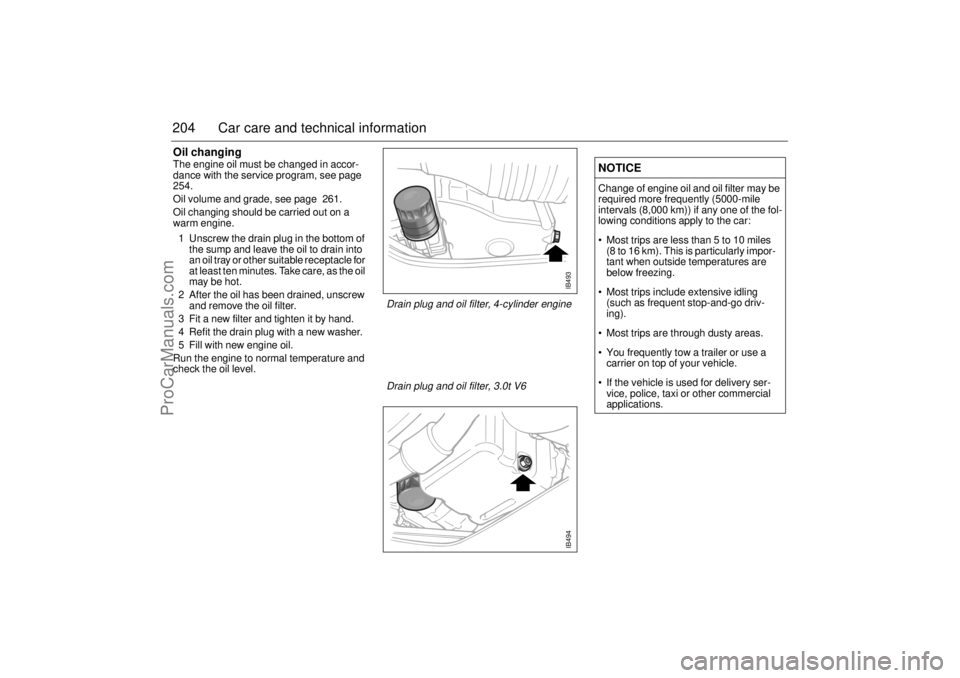
1 Unscrew the drain plug in the bottom of
the sump and leave the oil to drain into
an oil tray or other suitable receptacle for
at least ten minutes. Take care, as the oil
may be hot.
2 After the oil has been drained, unscrew
and remove the oil filter.
3 Fit a new filter and tighten it by hand.
4 Refit the drain plug with a new washer.
5 Fill with new engine oil.
Run the engine to normal temperature and
check the oil level.
NOTICEChange of engine oil and oil filter may be
required more frequently (5000-mile
intervals (8,000 km)) if any one of the fol-
lowing conditions apply to the car:
Most trips are less than 5 to 10 miles
(8 to 16 km). This is particularly impor-
tant when outside temperatures are
below freezing.
Most trips include extensive idling
(such as frequent stop-and-go driv-
ing).
Most trips are through dusty areas.
You frequently tow a trailer or use a
carrier on top of your vehicle.
If the vehicle is used for delivery ser-
vice, police, taxi or other commercial
applications.
IB493
Drain plug and oil filter, 4-cylinder engine
IB494
Drain plug and oil filter, 3.0t V6
ProCarManuals.com
Page 228 of 288
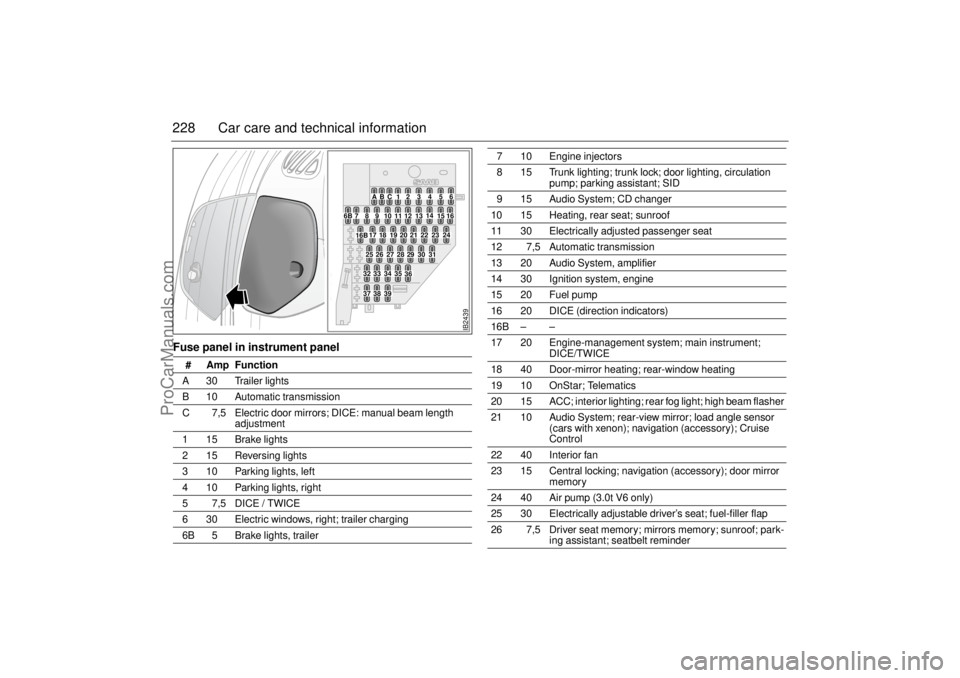
228 Car care and technical informationFuse panel in instrument panel
# Amp Function
A 30 Trailer lights
B 10 Automatic transmission
C 7,5 Electric door mirrors; DICE: manual beam length
adjustment
115Brake lights
2 15 Reversing lights
3 10 Parking lights, left
4 10 Parking lights, right
5 7,5 DICE / TWICE
6 30 Electric windows, right; trailer charging
6B 5 Brake lights, trailer
7 10 Engine injectors
8 15 Trunk lighting; trunk lock; door lighting, circulation
pump; parking assistant; SID
9 15 Audio System; CD changer
10 15 Heating, rear seat; sunroof
11 30 Electrically adjusted passenger seat
12 7,5 Automatic transmission
13 20 Audio System, amplifier
14 30 Ignition system, engine
15 20 Fuel pump
16 20 DICE (direction indicators)
16B – –
17 20 Engine-management system; main instrument;
DICE/TWICE
18 40 Door-mirror heating; rear-window heating
19 10 OnStar; Telematics
20 15 ACC; interior lighting; rear fog light; high beam flasher
21 10 Audio System; rear-view mirror; load angle sensor
(cars with xenon); navigation (accessory); Cruise
Control
22 40 Interior fan
23 15 Central locking; navigation (accessory); door mirror
memory
24 40 Air pump (3.0t V6 only)
25 30 Electrically adjustable driver’s seat; fuel-filler flap
26 7,5 Driver seat memory; mirrors memory; sunroof; park-
ing assistant; seatbelt reminder
IB2439
BC123456 A
14
121110987
13
6B
1516
2324
222120191817
16B25262728293031
3635343332
393837
ProCarManuals.com
Page 239 of 288
239 Car care and technical information
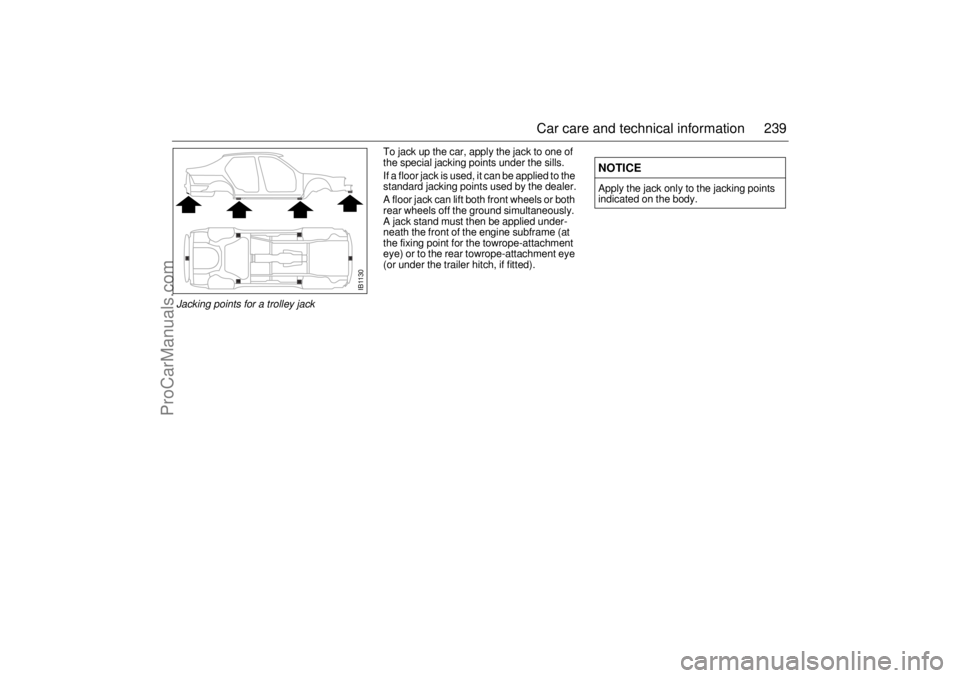
To jack up the car, apply the jack to one of
the special jacking points under the sills.
If a floor jack is used, it can be applied to the
standard jacking points used by the dealer.
A floor jack can lift both front wheels or both
rear wheels off the ground simultaneously.
A jack stand must then be applied under-
neath the front of the engine subframe (at
the fixing point for the towrope-attachment
eye) or to the rear towrope-attachment eye
(or under the trailer hitch, if fitted).
NOTICEApply the jack only to the jacking points
indicated on the body.
IB1130
Jacking points for a trolley jack
ProCarManuals.com
Page 254 of 288

254 Maintenance and owner assistanceMaintenance scheduleThe Maintenance Schedule prescribes a
service program to the purchaser/operator
of a Saab that is reasonable and necessary
to ensure the proper emission control sys-
tems function, safety and reliability of the
Saab automobile in normal use. Additional
maintenance is recommended for specific
components when the car is operated under
certain severe conditions. Proper mainte-
nance is always good advice!
Authorized Saab dealers are equipped and
trained to meet your Saab’s service needs.
They regularly receive up-to-date Saab ser-
vice manuals and parts and technical ser-
vice bulletins from Saab and are able,
through their franchise agreement, to attend
Saab service schools, obtain Saab special
tools and technical assistance and pur-
chase original equipment service and
replacement parts.
Today’s complex automobiles should only
be entrusted to the most knowledgeable
service professionals. A Saab dealer is your
best choice.
Service intervalsThe maintenance schedule is comprised of
a Check -up 30 days after retail delivery, fol-
lowed by services at every 10,000 miles
(16,000 km) thereafter (10,000, 20,000,
30,000 miles/16,000 32,000, 48,000 km
etc.).
Engine oil and filter changesChanging the engine oil and filter is required
at every service point. Use only a Saab
approved long-life oil filter and engine oils
meeting the SAE viscosity ratings and API
service classifications stated in the Specifi-
cation section of this Owner’s Manual. The
use of extra additives in the oil is not neces-
sary and is not recommended, and may be
harmful to turbochargers.
More frequent oil changes are recom-
mended if your vehicle is operated under
the following conditions:
Most trips are less than 5 to 10 miles (8 to
16 km). This is particularly important
when outside temperatures are below
freezing.
Most trips include extensive idling (such
as frequent stop-and-go driving).
Most trips are through dusty areas.
You frequently tow a trailer or use a car-
rier on top of your vehicle.
If the vehicle is used for delivery service,
police, taxi or other commercial applica-
tions.
If your driving habits match this description,
have the engine oil and filter changed in-
between normal services at 5,000 mile
(8,000 km) intervals. The Warranties and
Service Record Booklet has provisions to
record extra oil changes.
NOTICEThe Check-up will be done by your Saab
dealer at no charge and should be done
as close as possible to the scheduled 30
days.
ProCarManuals.com
Page 258 of 288
258 SpecificationsGeneral Overall length, including bumpers:
9-5 Sedan _______________________ 190.0 in (4827 mm)
9-5 Wagon ______________________ 190.1 in (4828 mm)
Overall width, including door mirrors ____ 80.4 in (2042 mm)
Maximum height:
9-5 Sedan _______________________ 58.1 in (1475 mm)
9-5 Wagon ______________________ 59.1 in (1501 mm)
Wheelbase _______________________ 106.4 in (2703 mm)
Ground clearance __________________ approx. 6.6 in
(167 mm)
Tr a c k :
Front __________________________ 59.9 in (1522 mm) *)
Rear ___________________________ 59.9 in (1522 mm) *)
Turning circle (curb to curb) ___________ 37,1 ft (11.3 m)
Turning circle (measured at vehicle extrem-
ities) ___________________________ 39,0 ft (11.9 m)
Number of seats (incl. driver) _________ 5
*) Specified track applies to wheel sizes:
6 x 15 & 6.5 x 16
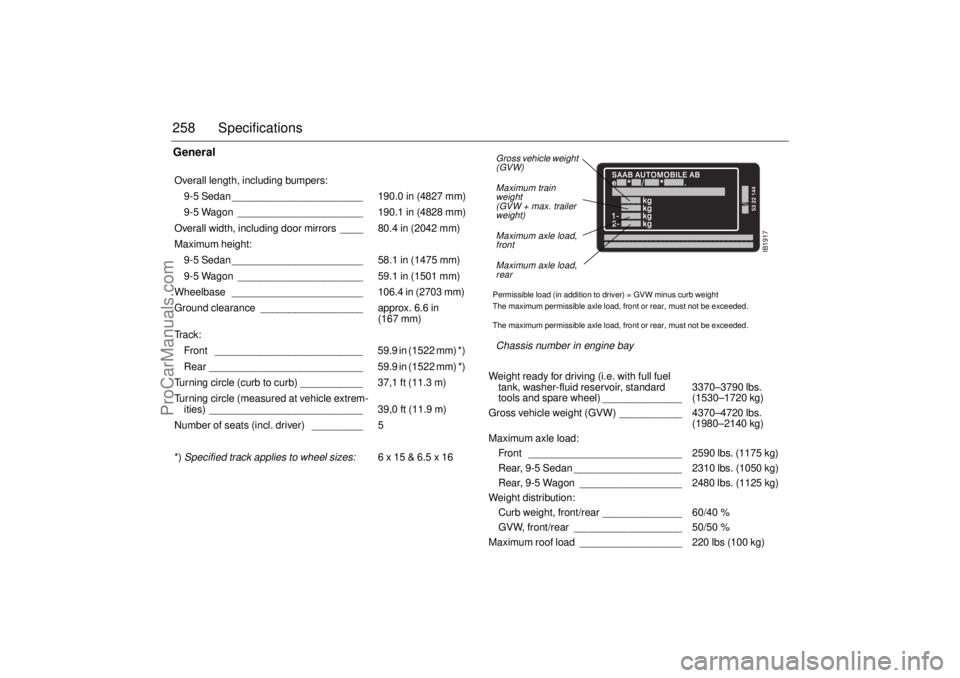
Gross vehicle weight
(GVW)
Maximum train
weight
(GVW + max. trailer
weight)
Maximum axle load,
front
Maximum axle load,
rear Permissible load (in addition to driver) = GVW minus curb weight
The maximum permissible axle load, front or rear, must not be exceeded.
The maximum permissible axle load, front or rear, must not be exceeded. Chassis number in engine bay Weight ready for driving (i.e. with full fuel
tank, washer-fluid reservoir, standard
tools and spare wheel) ______________ 3370–3790 lbs.
(1530–1720 kg)
Gross vehicle weight (GVW) ___________ 4370–4720 lbs.
(1980–2140 kg)
Maximum axle load:
Front ___________________________ 2590 lbs. (1175 kg)
Rear, 9-5 Sedan ___________________ 2310 lbs. (1050 kg)
Rear, 9-5 Wagon __________________ 2480 lbs. (1125 kg)
Weight distribution:
Curb weight, front/rear ______________ 60/40 %
GVW, front/rear ___________________ 50/50 %
Maximum roof load __________________ 220 lbs (100 kg)
IB1917
ProCarManuals.com
Page 259 of 288
259 Specifications
Trailer:
Luggage compartment
Volume (SAE):
9-5 Sedan _______________________ 15.9 cu.ft.
(450 litres)
9-5 Wagon, rear seat upright ________ 31.4 cu. ft.
(890 litres)
9-5 Wagon, rear seat folded _________ 73.0 cu. ft.
(2067 litres)
Luggage compartment, length, 9-5 Sedan:
Rear seat upright _________________ 43.0 in (1092 mm)
Rear seat folded down _____________ 67.5 in (1714 mm)
Luggage compartment, length, 9-5 Wagon:
Rear seat upright _________________ 42.8 in (1087 mm)
Rear seat folded __________________ 61.2 in (1732 mm)
WARNING
The GVW and maximum axle loads must not be exceeded.
Note that if some accessories (e.g. towbar, CD changer) are
fitted, the available load capacity is reduced by the weight of
these.
When carrying a load in the luggage compartment, make sure
that it is tied down securely, particularly when part or all of the
rear seat is folded down.
Maximum towing speed, trailer with brakes 60 mph (100 km/h)
Trailer with brakes _________________ Maximum weight:
3500 lbs (1588 kg)
Trailer without brakes ______________ Maximum weight:
1000 lbs (450 kg)
Maximum load on ball hitch __________ 110–165 lbs
(50–75 kg)
The above speed and weight restrictions are those specified by
Saab Automobile AB.
Note that local restrictions may apply to trailer speeds and
weights (see page 181).
ProCarManuals.com
Page 275 of 288

275 Index
Light switches
___________________ 71
Luggage-compartment lighting
_____ 134
MMain instrument panel
_____________ 56
Main/dipped beam
_______________ 71
Maintenance schedule ___________ 254
Manual gearbox, technical data
____ 264
Maxi fuses
_____________________ 227
Milometer ______________________ 62
Motoring abroad
________________ 248
NNight Panel
_____________________ 69
OOil capacity, engine
______________ 260
Oil change, engine ______________ 204
Oil specification
_________________ 260
OnStar
________________________ 111
Outdoor temperature
______________ 65
Owner assistance
_______________ 255
PPaintwork, touching-in
____________ 245
Parking Assistance
______________ 193
Parking lights
___________________ 71
Plates and labels ________________ 269
Poly-V-belt
____________________ 211
Power steering _________________ 208Power-steering fluid
_____________208
Pressure gauge
__________________64
Programming I, ACC
______________83
Programming II, ACC _____________84
Programming the ACC ____________83
QQuestions on function of airbag
_____39
Quick guide, Audio System
_________91
RRadiator fan
____________________211
Radio
__________________________94
Rain sensor
_____________________75
Rear fog light ____________________72
Rear seat, 9-5 Sedan, folding
______139
Rear seat, 9-5 Wagon, folding _____142
Rear-seat head restraints
__________16
Rear-view mirror, antidazzle _______129
Rearview mirrors
________________125
Reclamation
___________________248
Recommendations for cars with
automatic transmission,
towing a caravan or trailer
________182
Refuelling
_____________________158
Relay panel ____________________229
Remote control __________________42
Remote-control battery, changing
____45
Remove the key
________________152
Reporting safety defects
__________256
Reprogramming of systems _______271Reservoir, power-steering fluid
____ 208
Rev counter
____________________ 62
Reversing lights
_________________ 74
Roof load
_____________________ 185
Running-in ____________________ 178
SSID
__________________________ 65
Saab 9-5 Audio System
___________ 89
Saab Information Display (SID)
_____ 65
Saab Parking Assistance
________ 193
Safety belts
____________________ 17
Safety belts, care of
_____________ 243
Safety-belt pretensioners
_________ 18
Safety-belt reminder
_____________ 17
Seats
_________________________ 12
Securing a load
_________________ 46
Selector lever indication,
automatic transmission
__________ 65
Sentronic, manual mode _________ 167
Service costs
__________________ 255
Service information
_____________ 256
Service intervals
_______________ 254
Service record retention
_________ 255
Settings, seats
__________________ 12
Side airbags
___________________ 36
Signalling, horn ________________ 124
Sliding floor, 9-5 Wagon
_________ 147
Snow chains
__________________ 179
Spare wheel __________________ 236
Spare wheel and tools
___________ 149
Spark plugs
___________________ 263
ProCarManuals.com