belt SAAB 9-5 2003 Owner's Manual
[x] Cancel search | Manufacturer: SAAB, Model Year: 2003, Model line: 9-5, Model: SAAB 9-5 2003Pages: 288, PDF Size: 16.78 MB
Page 32 of 288
32 Safety
WARNING
Use only the vehicle’s lap and shoul-
der belt system when restraining the
child in the booster seat.
The seat must not be modified or
changed in any way.
Never leave a child unattended in the
car.
The car’s regular head restraint must
always be turned 180° back to its orig-
inal position after the integrated
booster seat is folded away.
Check to ensure that the belt is not
twisted or rubbing against any sharp
edges.
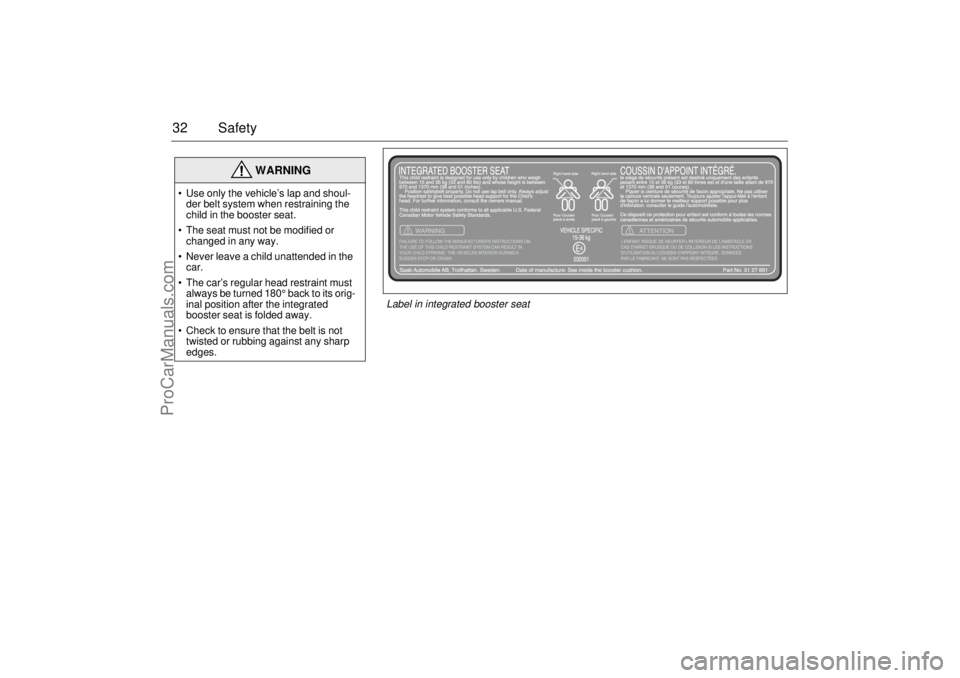
Label in integrated booster seat
ProCarManuals.com
Page 33 of 288
33 Safety
Airbag The AIRBAG system comprises an airbag in
the steering wheel, a front passenger airbag
and side airbags in the front seats.
The system supplements the protection
provided by the safety belts to further
enhance the safety of the occupants.
If a fault is detected in the AIRBAG, the
AIR BAG warning light on the main instru-
ment panel will come on (see pages 58 and
38).
When the system is triggered by impact of a
frontal crash, the airbags in the steering
wheel and passenger side of the dash board are inflated, after which they deflate through
vents in the back of the bags.
The front airbags are inflated in two stages.
Stage 1: process is a less severe, softer
inflation of the airbag. This stage is used in
lower force crashes, or if the seat is posi-
tioned close to the steering wheel or dash-
board.
Stage 2: process is a more forceful and
quicker inflation of the airbag. This stage is
used in more severe crashes and/or when
the seat adjustment is back a significant
distance from the steering wheel or dash-
board.
Note:
The sensor reacts differently depending on
whether or not the front seatbelts on the
driver’s and passenger sides are used. Situ-
ations can therefore arise where only one of
the airbags inflates.
The entire process takes less than
0.1 second – literally, faster than the blink-
ing of an eye.
These airbags are triggered only by moder-
ate to severe frontal or near-frontal crashes.
They will not be activated by minor front-end
impacts, rear-end or side impacts, or by the
car rolling over.
WARNING
To reduce risk of injury:
Always wear your safety belt.
Always adjust your seat so that you
are as far back as possible but still
able to reach the steering wheel and
controls comfortably.
Children 12 and under or shorter than
55 inches (140 cm) should always
travel in the rear as the vehicle is
equipped with an airbag on the
passenger side.
WARNING
Even if the car is equipped with
AIRBAG, safety belts must still
always be worn by all occupants.
Note that because an airbag inflates
and deflates extremely rapidly, it will
not provide protection against a
second impact occurring in the same
incident. Always use your safety belt.
Always sit with the whole of your back
in contact with the backrest of the seat,
and with your seat as far back as is
practical. Otherwise you will be thrown
back against the backrest when the
airbag inflates which could cause you
injury or death. The airbag needs
room in which to inflate.
Never attach anything to the steering
wheel or passenger side of the instru-
ment panel, as this could result in
injury if the airbag should inflate. The
same applies to anything you might
have in your mouth, such as a pipe, for
instance.
Some components of the airbag will
be warm for a short time. In some
circumstances the airbag can cause
minor burns or abrasions to the body
when the airbag inflates/deflates.
ProCarManuals.com
Page 35 of 288
35 Safety
IB1742
5
1
4
2
6
3
2
6
7
7
5
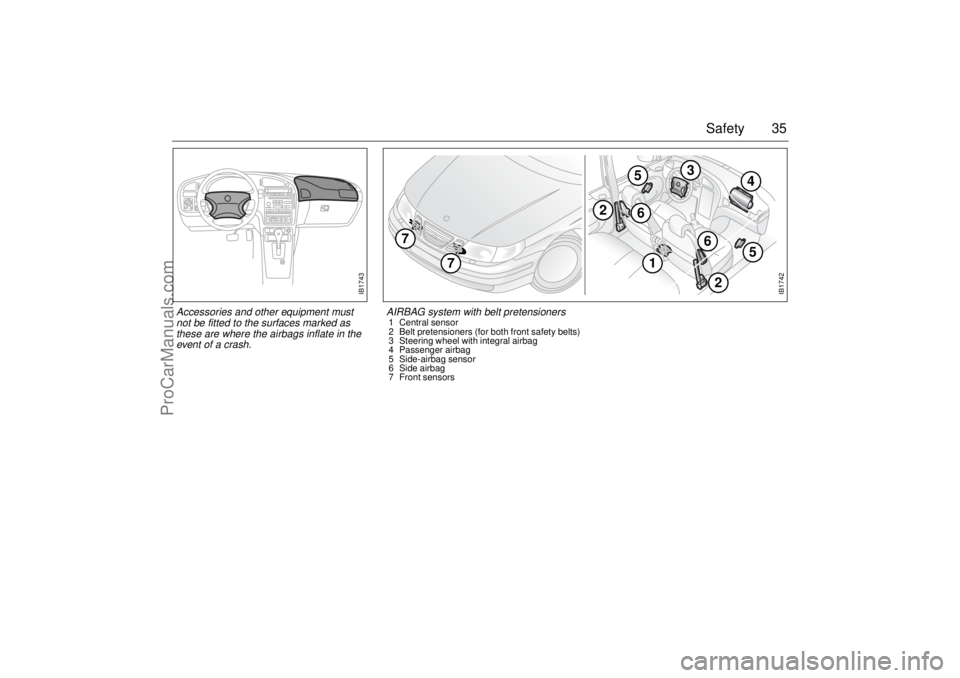
AIRBAG system with belt pretensioners 1 Central sensor
2 Belt pretensioners (for both front safety belts)
3 Steering wheel with integral airbag
4 Passenger airbag
5 Side-airbag sensor
6 Side airbag
7 Front sensors
IB1743
Accessories and other equipment must
not be fitted to the surfaces marked as
these are where the airbags inflate in the
event of a crash.
ProCarManuals.com
Page 37 of 288
37 Safety
impact condition. The side airbag trigger will
be commanded based on the characteris-
tics of this pressure rise.
WARNING
This car is equipped with side airbags
and no extra interior trim should be
fitted. Failure to observe this warning
could result in the side airbags not
inflating as intended and thus not
providing the intended protection
either.
Never place any object in the area that
would be occupied by the inflated
airbag.
For optimum protection, sit upright in
the seat, with your safety belt correctly
fastened.
The sensors for the side airbags are
fitted in the front doors. We advise
against doing any work on the doors
that could affect the moisture barrier in
the door or the airbag sensors. It is
essential that the moisture barrier
(thick plastic film) in the front door is
not damaged in any way.
Improvement of the anticorrosion
treatment of the doors should only be
carried out by an authorized Saab
dealer. Otherwise there is a risk that
the side impact sensor and the mois-
ture barrier in the front door could be
damaged.
IB1182
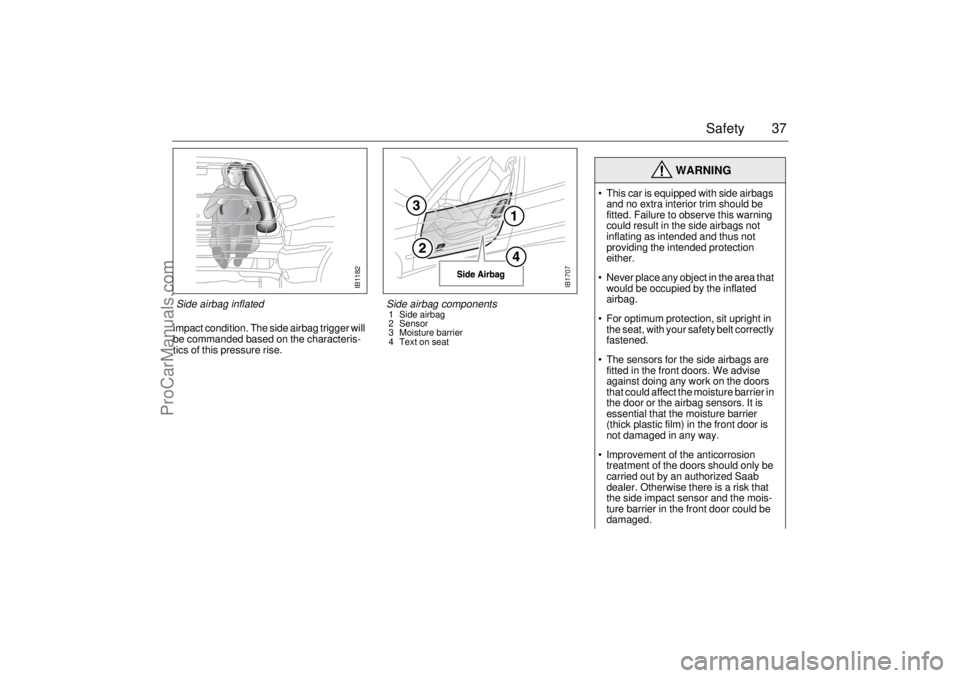
Side airbag inflated
IB1707
Side airbag components 1 Side airbag
2 Sensor
3 Moisture barrier
4 Text on seat
ProCarManuals.com
Page 38 of 288
38 Safety
Crash sensingCrash sensing and diagnostic modules
have been used in many automobiles since
air bags were first produced. The technical
information gained from these modules can
be useful to understanding the circum-
stances that led to the air bag deployment.
In addition, information from many field
events can be used in the aggregate to help
manufactures and others better understand
real world crashes. This, in turn, can lead to
improved automotive safety.
Your vehicle is equipped with two electronic
frontal sensors, which helps the sensing
system distinguish between a moderate
frontal impact and a more severe frontal
impact. Your vehicle is also equipped with a
crash sensing and diagnostic module,
which records information about the frontal
air bag system. The module records infor-
mation about the readiness of the system,
when the system commands air bag infla-
tion and driver´s safety belt usage at deploy-
ment or in a near-deployment crash. The
module also records speed, engine rpm,
brake and throttle data etc.
AIR BAG warning light
AIRBAG servicingThe AIRBAG must be inspected as part of
the normal service program but otherwise
may be regarded as maintenance-free. The side airbags will inflate only in the
event of a side impact; not in the event
of a front or rear-end crash or of the
car’s rolling over.
Damage or wear to the seat cover, or
the seat seam, in the area of the side
airbag must immediately be repaired
by an authorized Saab dealer.
Do not modify the speaker installation
in the front doors or install speakers
other than those specifically approved
by Saab.
WARNING
If the airbag readiness light stays on
after you start your vehicle, it means
the air bag system may not be working
properly. See page. 58. The airbags
in your vehicle may not inflate in a
crash, or they could even inflate with-
out a crash.
To help avoid injury to yourself or
others, have your vehicle serviced
right away if the air bag readiness light
stays on after you start your vehicle.
ProCarManuals.com
Page 39 of 288
39 Safety
Scrapping or working on airbags
and belt pretensioners Frequently asked questions on func-
tion of airbags
Do you still need to wear a
safety b
elt if
airbags are fitted?
Yes, always! The airbag merely supple-
ments the car’s normal safety system.
Moreover, the airbag will only be actuated in
a moderate to severe frontal, or near-frontal
crash, which means, of course, that it
provides no protection in minor frontal
crashes, major rear-end or side-on crashes
or if the car rolls over.
The safety belts help reduce the chance of
the car occupants from being thrown around
and injured or killed inside the car.
But they also ensure that, if a crash occurs
in which the airbags are inflated, the airbag
will make the optimum contact with the
occupant, i.e. square on from the front. If the
occupant meets the airbag in an offset posi-
tion, the protection afforded will be reduced.
In addition, airbags provide no protection
against a secondary impact occurring in the
same incident. So there is no doubt about
the benefit of wearing safety belts at all
times.
Do not sit too close to the airbag: it needs
room to inflate.
The airbag inflates very quickly and power-
fully in order to protect an adult person,
before they are thrown forward, in a serious
frontal crash.
How do I position the seat to leave room for
the airbag to inflate?Don’t have your seat too far forward.
Recline the seat back to increase the
distance between you and the airbag. For
short drivers, special accessory pedal
extensions are available through your Saab
dealer.
Airbags inflate extremely rapidly and with
great force – to be fast enough to protect an
adult in the seat. When do the front airbags inflate? The airbag will only be inflated under certain
predetermined conditions in a moderate to
severe frontal, or near-frontal crash,
depending on such factors as the force and
angle of the impact, the speed of the car on
impact, and the resistance to deformation of
the impacting object.
The airbag can only be activated once in the
same incident.
Do not attempt to drive the car after an
airbag has been inflated, even if it is possi-
ble.
WARNING
Under no circumstances should any
modifications be made that affect the
steering wheel or the airbag’s electri-
cal circuitry.
Before starting any welding work on
the car, always disconnect the nega-
tive (–) battery lead and cover the
conductor.
Airbags and belt pretensioners must
be deployed under controlled condi-
tions before the car is scrapped or any
of the system’s components are
removed. Airbags or belt pretension-
ers that have been deployed as a
result of a crash must be replaced by
new ones.
Airbag-system components must
never be transferred for use in another
vehicle.
All work involving the scrapping or
replacement of airbags or belt preten-
sioners must only be carried out by
knowledgeable personnel.
ProCarManuals.com
Page 57 of 288
57 Instruments and controls
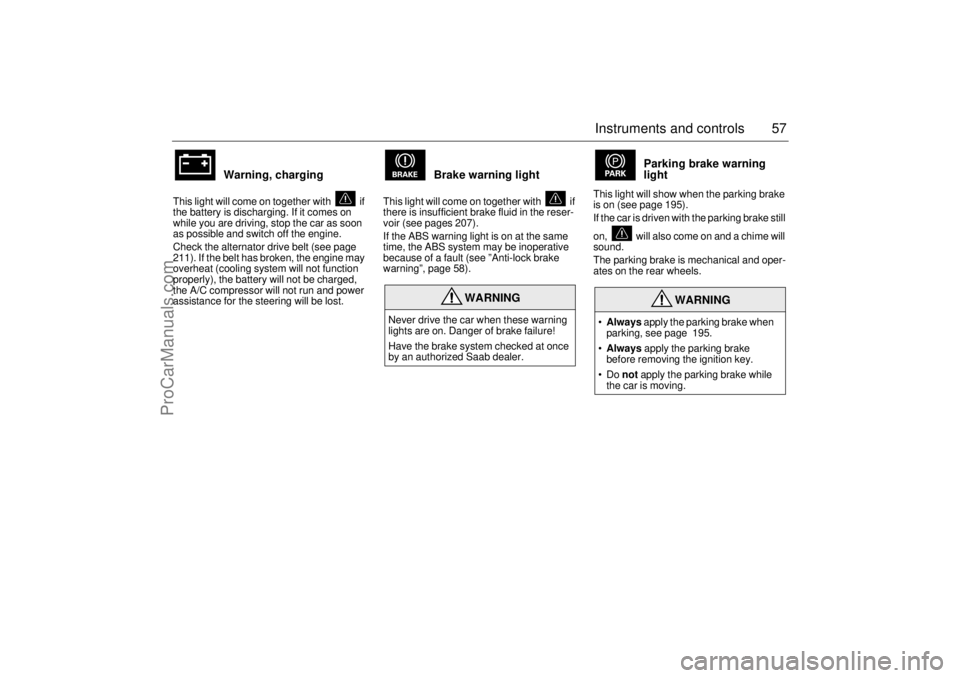
Warning, charging
This light will come on together with if
the battery is discharging. If it comes on
while you are driving, stop the car as soon
as possible and switch off the engine.
Check the alternator drive belt (see page
211). If the belt has broken, the engine may
overheat (cooling system will not function
properly), the battery will not be charged,
the A/C compressor will not run and power
assistance for the steering will be lost.
Brake warning light
This light will come on together with if
there is insufficient brake fluid in the reser-
voir (see pages 207).
If the ABS warning light is on at the same
time, the ABS system may be inoperative
because of a fault (see ”Anti-lock brake
warning”, page 58).
Parking brake warning
light
This light will show when the parking brake
is on (see page 195).
If the car is driven with the parking brake still
on, will also come on and a chime will
sound.
The parking brake is mechanical and oper-
ates on the rear wheels.
WARNING
Never drive the car when these warning
lights are on. Danger of brake failure!
Have the brake system checked at once
by an authorized Saab dealer.
WARNING
Always apply the parking brake when
parking, see page 195.
Always apply the parking brake
before removing the ignition key.
Do not apply the parking brake while
the car is moving.
ProCarManuals.com
Page 139 of 288
139 Interior equipment and trunk
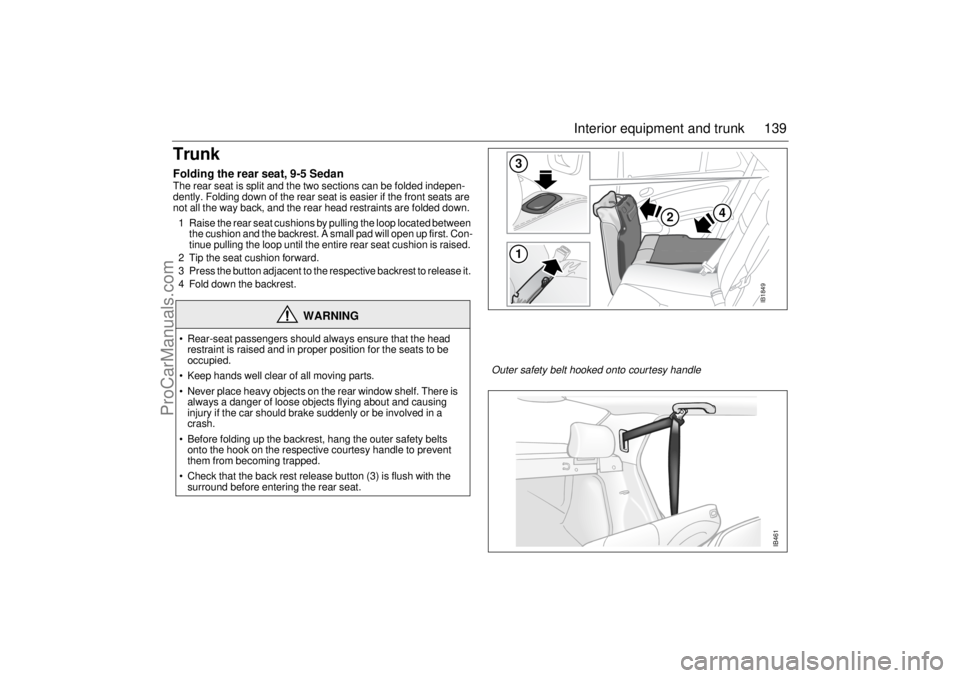
TrunkFolding the rear seat, 9-5 SedanThe rear seat is split and the two sections can be folded indepen-
dently. Folding down of the rear seat is easier if the front seats are
not all the way back, and the rear head restraints are folded down.
1 Raise the rear seat cushions by pulling the loop located between
the cushion and the backrest. A small pad will open up first. Con-
tinue pulling the loop until the entire rear seat cushion is raised.
2 Tip the seat cushion forward.
3 Press the button adjacent to the respective backrest to release it.
4 Fold down the backrest.
WARNING
Rear-seat passengers should always ensure that the head
restraint is raised and in proper position for the seats to be
occupied.
Keep hands well clear of all moving parts.
Never place heavy objects on the rear window shelf. There is
always a danger of loose objects flying about and causing
injury if the car should brake suddenly or be involved in a
crash.
Before folding up the backrest, hang the outer safety belts
onto the hook on the respective courtesy handle to prevent
them from becoming trapped.
Check that the back rest release button (3) is flush with the
surround before entering the rear seat.
31
2
4
IB1849
IB461
Outer safety belt hooked onto courtesy handle
ProCarManuals.com
Page 141 of 288
141 Interior equipment and trunk
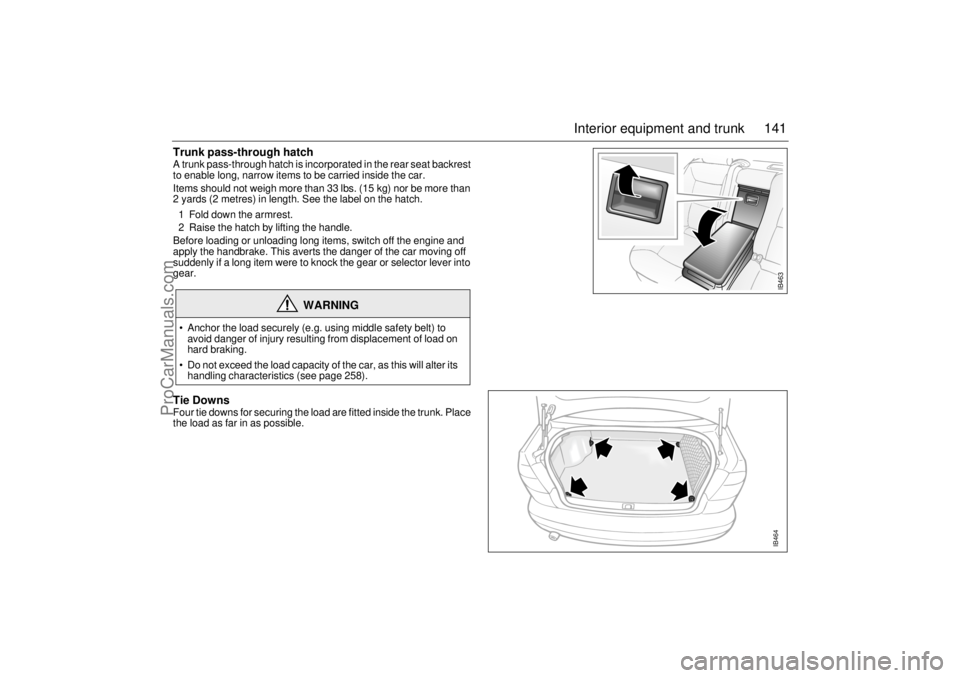
Trunk pass-through hatch A trunk pass-through hatch is incorporated in the rear seat backrest
to enable long, narrow items to be carried inside the car.
Items should not weigh more than 33 lbs. (15 kg) nor be more than
2 yards (2 metres) in length. See the label on the hatch.
1 Fold down the armrest.
2 Raise the hatch by lifting the handle.
Before loading or unloading long items, switch off the engine and
apply the handbrake. This averts the danger of the car moving off
suddenly if a long item were to knock the gear or selector lever into
gear. Tie DownsFour tie downs for securing the load are fitted inside the trunk. Place
the load as far in as possible.
WARNING
Anchor the load securely (e.g. using middle safety belt) to
avoid danger of injury resulting from displacement of load on
hard braking.
Do not exceed the load capacity of the car, as this will alter its
handling characteristics (see page 258).
IB463IB464
ProCarManuals.com
Page 142 of 288
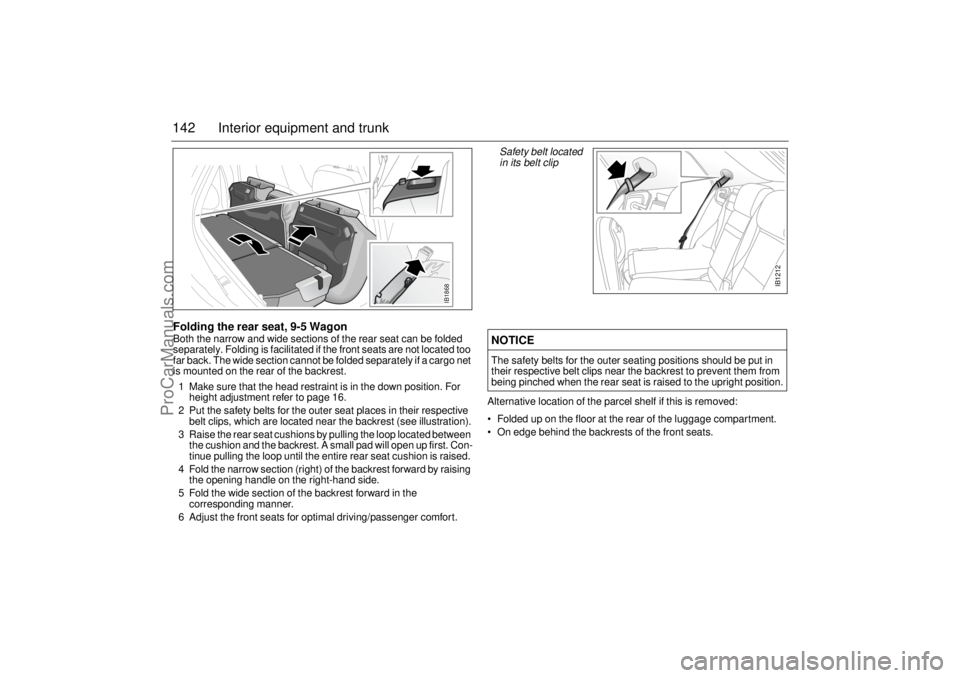
142 Interior equipment and trunkFolding the rear seat, 9-5 WagonBoth the narrow and wide sections of the rear seat can be folded
separately. Folding is facilitated if the front seats are not located too
far back. The wide section cannot be folded separately if a cargo net
is mounted on the rear of the backrest.
1 Make sure that the head restraint is in the down position. For
height adjustment refer to page 16.
2 Put the safety belts for the outer seat places in their respective
belt clips, which are located near the backrest (see illustration).
3 Raise the rear seat cushions by pulling the loop located between
the cushion and the backrest. A small pad will open up first. Con-
tinue pulling the loop until the entire rear seat cushion is raised.
4 Fold the narrow section (right) of the backrest forward by raising
the opening handle on the right-hand side.
5 Fold the wide section of the backrest forward in the
corresponding manner.
6 Adjust the front seats for optimal driving/passenger comfort.
Alternative location of the parcel shelf if this is removed:
Folded up on the floor at the rear of the luggage compartment.
On edge behind the backrests of the front seats.NOTICEThe safety belts for the outer seating positions should be put in
their respective belt clips near the backrest to prevent them from
being pinched when the rear seat is raised to the upright position.
IB1868
IB1212
Safety belt located
in its belt clip
ProCarManuals.com