ESP SAAB 9-5 2003 Service Manual
[x] Cancel search | Manufacturer: SAAB, Model Year: 2003, Model line: 9-5, Model: SAAB 9-5 2003Pages: 288, PDF Size: 16.78 MB
Page 193 of 288
193 Starting and driving
Saab Parking
Assistance(Option)The parking aid system facilitates parking
and reversing. There are four sensors in
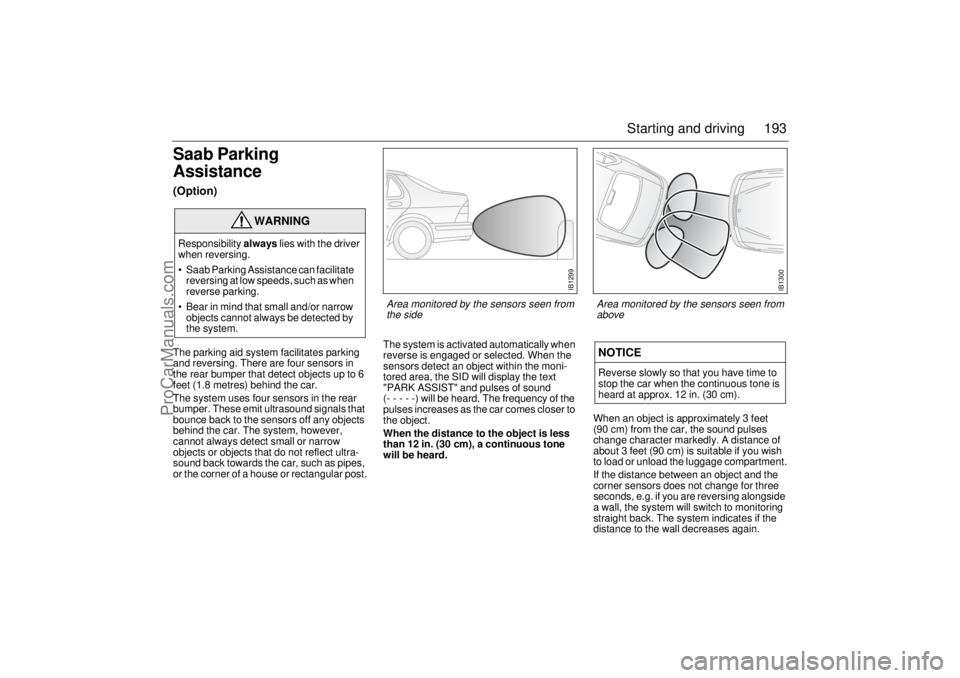
the rear bumper that detect objects up to 6
feet (1.8 metres) behind the car.
The system uses four sensors in the rear
bumper. These emit ultrasound signals that
bounce back to the sensors off any objects
behind the car. The system, however,
cannot always detect small or narrow
objects or objects that do not reflect ultra-
sound back towards the car, such as pipes,
or the corner of a house or rectangular post.The system is activated automatically when
reverse is engaged or selected. When the
sensors detect an object within the moni-
tored area, the SID will display the text
"PARK ASSIST" and pulses of sound
(-----) will be heard. The frequency of the
pulses increases as the car comes closer to
the object.
When the distance to the object is less
than 12 in. (30 cm), a continuous tone
will be heard.When an object is approximately 3 feet
(90 cm) from the car, the sound pulses
change character markedly. A distance of
about 3 feet (90 cm) is suitable if you wish
to load or unload the luggage compartment.
If the distance between an object and the
corner sensors does not change for three
seconds, e.g. if you are reversing alongside
a wall, the system will switch to monitoring
straight back. The system indicates if the
distance to the wall decreases again.
WARNING
Responsibility always lies with the driver
when reversing.
Saab Parking Assistance can facilitate
reversing at low speeds, such as when
reverse parking.
Bear in mind that small and/or narrow
objects cannot always be detected by
the system.
NOTICEReverse slowly so that you have time to
stop the car when the continuous tone is
heard at approx. 12 in. (30 cm).
IB1299
Area monitored by the sensors seen from
the side
IB1300
Area monitored by the sensors seen from
above
ProCarManuals.com
Page 203 of 288
203 Car care and technical information
Engine oilChecking the oil level Check the engine-oil level regularly. This
should be done after the engine has been
run to normal temperature and then allowed
to cool for 2–5 minutes, with the car stand-
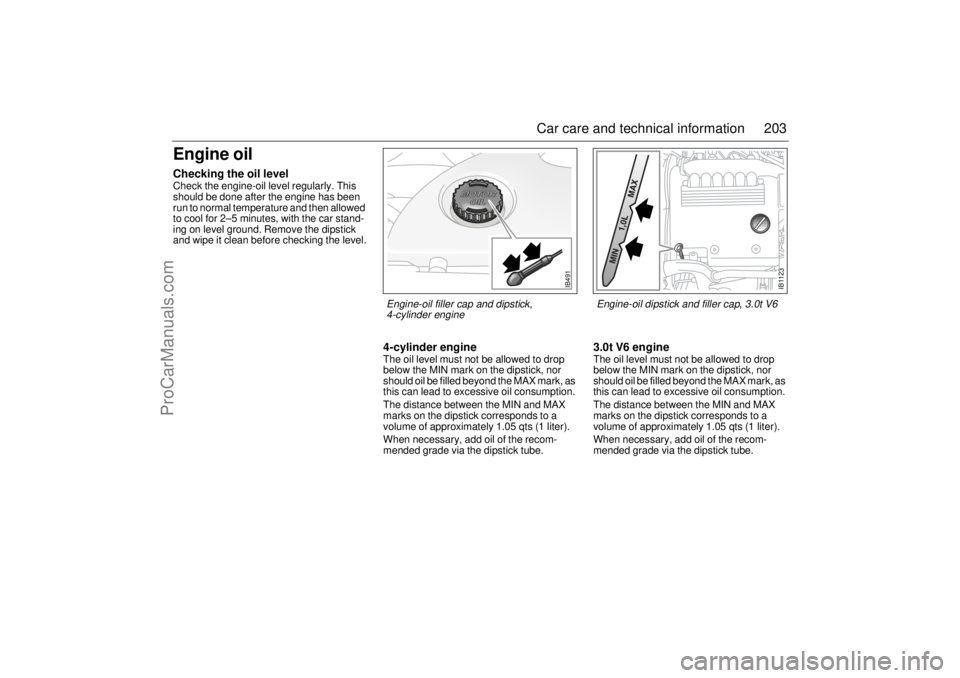
ing on level ground. Remove the dipstick
and wipe it clean before checking the level.
4-cylinder engine The oil level must not be allowed to drop
below the MIN mark on the dipstick, nor
should oil be filled beyond the MAX mark, as
this can lead to excessive oil consumption.
The distance between the MIN and MAX
marks on the dipstick corresponds to a
volume of approximately 1.05 qts (1 liter).
When necessary, add oil of the recom-
mended grade via the dipstick tube.
3.0t V6 engine The oil level must not be allowed to drop
below the MIN mark on the dipstick, nor
should oil be filled beyond the MAX mark, as
this can lead to excessive oil consumption.
The distance between the MIN and MAX
marks on the dipstick corresponds to a
volume of approximately 1.05 qts (1 liter).
When necessary, add oil of the recom-
mended grade via the dipstick tube.
IB491
Engine-oil filler cap and dipstick,
4-cylinder engine
IB1123
Engine-oil dipstick and filler cap, 3.0t V6
ProCarManuals.com
Page 205 of 288
205 Car care and technical information
Transmission fluidManual transmission Check and top up the fluid in accordance
with the service program.
If original fluid cannot be obtained for top-
ping up (see page 264), automatic trans-
mission fluid Dexron III (synthetic oil) can be
used. If so, the car should be taken to an
authorized Saab dealer immediately to
have the reason for low fluid level corrected
and original fluid installed.Automatic transmission Check the fluid level as follows:
1 Stand the car on level ground and apply
the parking brake. The automatic trans-
mission fluid must be at normal running
temperature, approximately 175°F
(80°C). This can be achieved by driving
the car for about 30 min on the open
road.
2 With the engine idling, move the selector
lever to D and wait for at least
15 seconds. Next, move the selector
lever to R and wait for 15 seconds again.
Finally, move the selector lever to P. Let
the engine idle.
3 Wipe the dipstick clean with a lint-free
cloth and put it back.
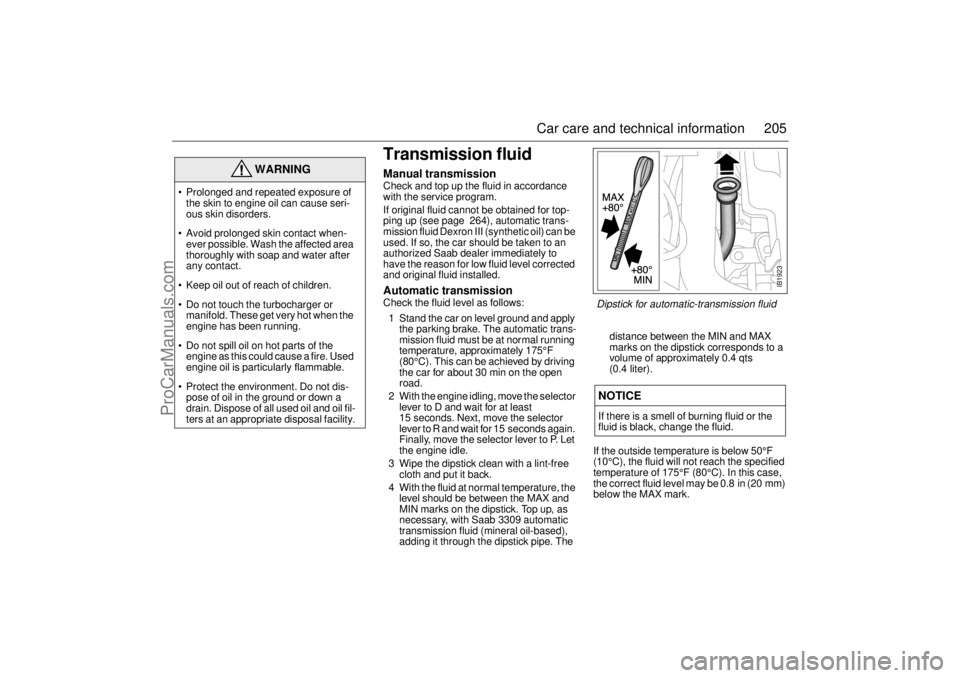
4 With the fluid at normal temperature, the
level should be between the MAX and
MIN marks on the dipstick. Top up, as
necessary, with Saab 3309 automatic
transmission fluid (mineral oil-based),
adding it through the dipstick pipe. The distance between the MIN and MAX
marks on the dipstick corresponds to a
volume of approximately 0.4 qts
(0.4 liter).
If the outside temperature is below 50°F
(10°C), the fluid will not reach the specified
temperature of 175°F (80°C). In this case,
the correct fluid level may be 0.8 in (20 mm)
below the MAX mark.
WARNING
Prolonged and repeated exposure of
the skin to engine oil can cause seri-
ous skin disorders.
Avoid prolonged skin contact when-
ever possible. Wash the affected area
thoroughly with soap and water after
any contact.
Keep oil out of reach of children.
Do not touch the turbocharger or
manifold. These get very hot when the
engine has been running.
Do not spill oil on hot parts of the
engine as this could cause a fire. Used
engine oil is particularly flammable.
Protect the environment. Do not dis-
pose of oil in the ground or down a
drain. Dispose of all used oil and oil fil-
ters at an appropriate disposal facility.
NOTICEIf there is a smell of burning fluid or the
fluid is black, change the fluid.
IB1923
Dipstick for automatic-transmission fluid
ProCarManuals.com
Page 207 of 288
207 Car care and technical information
Brake and clutch fluid Checking the fluid level The combined brake and clutch-fluid reser-
voir is transparent to facilitate checking of
the fluid level.
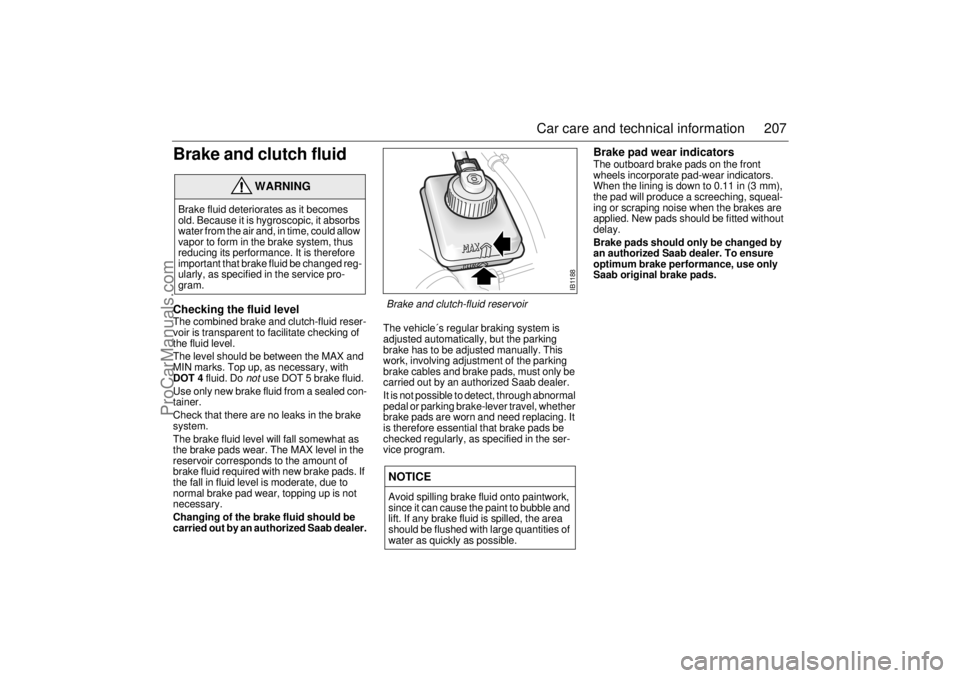
The level should be between the MAX and
MIN marks. Top up, as necessary, with
DOT 4 fluid. Do
not
use DOT 5 brake fluid.
Use only new brake fluid from a sealed con-
tainer.
Check that there are no leaks in the brake
system.
The brake fluid level will fall somewhat as
the brake pads wear. The MAX level in the
reservoir corresponds to the amount of
brake fluid required with new brake pads. If
the fall in fluid level is moderate, due to
normal brake pad wear, topping up is not
necessary.
Changing of the brake fluid should be
carried out by an authorized Saab dealer.The vehicle´s regular braking system is
adjusted automatically, but the parking
brake has to be adjusted manually. This
work, involving adjustment of the parking
brake cables and brake pads, must only be
carried out by an authorized Saab dealer.
It is not possible to detect, through abnormal
pedal or parking brake-lever travel, whether
brake pads are worn and need replacing. It
is therefore essential that brake pads be
checked regularly, as specified in the ser-
vice program.
Brake pad wear indicators The outboard brake pads on the front
wheels incorporate pad-wear indicators.
When the lining is down to 0.11 in (3 mm),
the pad will produce a screeching, squeal-
ing or scraping noise when the brakes are
applied. New pads should be fitted without
delay.
Brake pads should only be changed by
an authorized Saab dealer. To ensure
optimum brake performance, use only
Saab original brake pads.
WARNING
Brake fluid deteriorates as it becomes
old. Because it is hygroscopic, it absorbs
water from the air and, in time, could allow
vapor to form in the brake system, thus
reducing its performance. It is therefore
important that brake fluid be changed reg-
ularly, as specified in the service pro-
gram.
NOTICEAvoid spilling brake fluid onto paintwork,
since it can cause the paint to bubble and
lift. If any brake fluid is spilled, the area
should be flushed with large quantities of
water as quickly as possible.
IB1188
Brake and clutch-fluid reservoir
ProCarManuals.com
Page 218 of 288
218 Car care and technical information
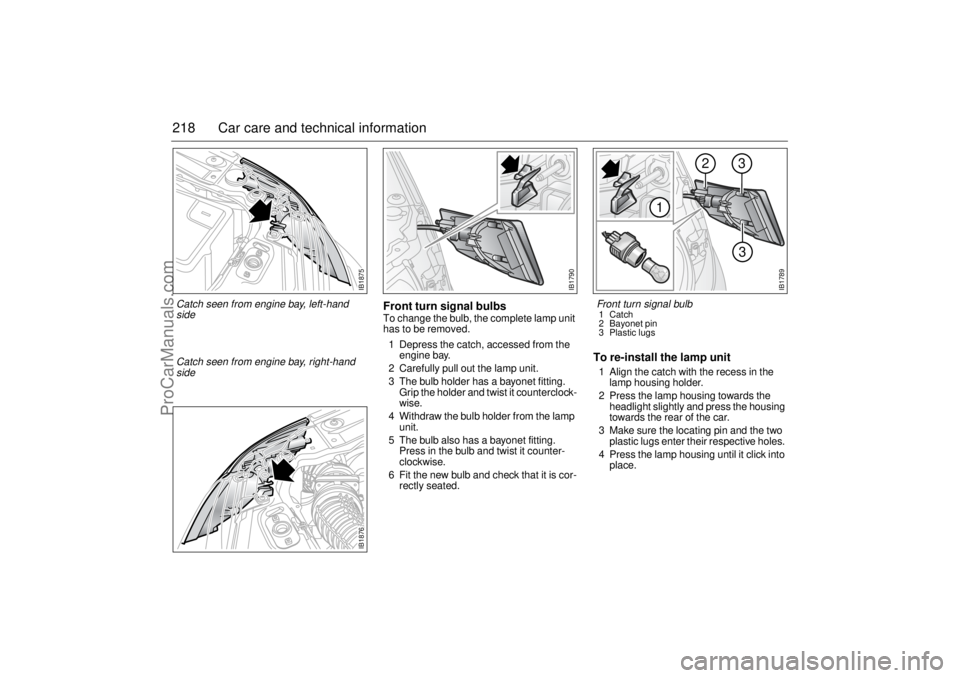
Front turn signal bulbsTo change the bulb, the complete lamp unit
has to be removed.
1 Depress the catch, accessed from the
engine bay.
2 Carefully pull out the lamp unit.
3 The bulb holder has a bayonet fitting.
Grip the holder and twist it counterclock-
wise.
4 Withdraw the bulb holder from the lamp
unit.
5 The bulb also has a bayonet fitting.
Press in the bulb and twist it counter-
clockwise.
6 Fit the new bulb and check that it is cor-
rectly seated.
To re-install the lamp unit1 Align the catch with the recess in the
lamp housing holder.
2 Press the lamp housing towards the
headlight slightly and press the housing
towards the rear of the car.
3 Make sure the locating pin and the two
plastic lugs enter their respective holes.
4 Press the lamp housing until it click into
place.
IB1789
2
13
3
Front turn signal bulb1Catch
2 Bayonet pin
3 Plastic lugs
IB1875
Catch seen from engine bay, left-hand
side
IB1876
Catch seen from engine bay, right-hand
side
IB1790
ProCarManuals.com
Page 220 of 288
220 Car care and technical information2 The bulb has a bayonet fitting. Press in
the bulb and twist it counterclockwise.
3 Change the bulb.
Refitting the trim
1 Reset the studs by pushing back the
center buttons so that they protrude by
0.2 inch (5 mm).
2 Insert the studs through the trim and tail-
gate panel. Press the center buttons in,
flush with the collar.
3 Screw the handle back onto the trunk.
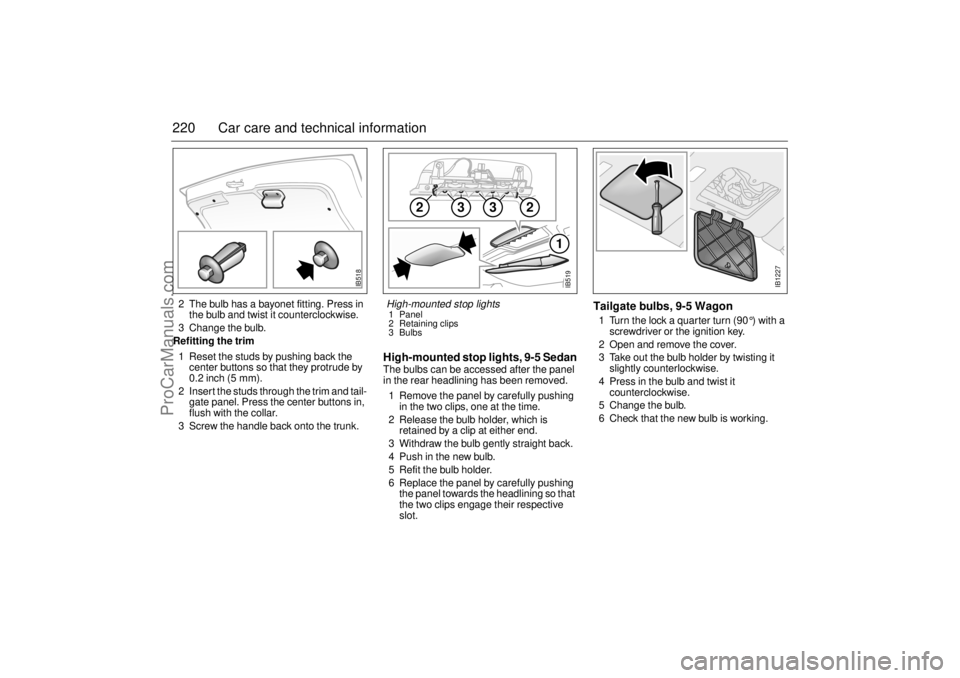
High-mounted stop lights, 9-5 SedanThe bulbs can be accessed after the panel
in the rear headlining has been removed.
1 Remove the panel by carefully pushing
in the two clips, one at the time.
2 Release the bulb holder, which is
retained by a clip at either end.
3 Withdraw the bulb gently straight back.
4 Push in the new bulb.
5 Refit the bulb holder.
6 Replace the panel by carefully pushing
the panel towards the headlining so that
the two clips engage their respective
slot.
Tailgate bulbs, 9-5 Wagon1 Turn the lock a quarter turn (90 °) with a
screwdriver or the ignition key.
2 Open and remove the cover.
3 Take out the bulb holder by twisting it
slightly counterlockwise.
4 Press in the bulb and twist it
counterclockwise.
5 Change the bulb.
6 Check that the new bulb is working.
IB518
3
2
2
3
1
IB519
High-mounted stop lights1 Panel
2 Retaining clips
3 Bulbs
IB1227
ProCarManuals.com
Page 229 of 288
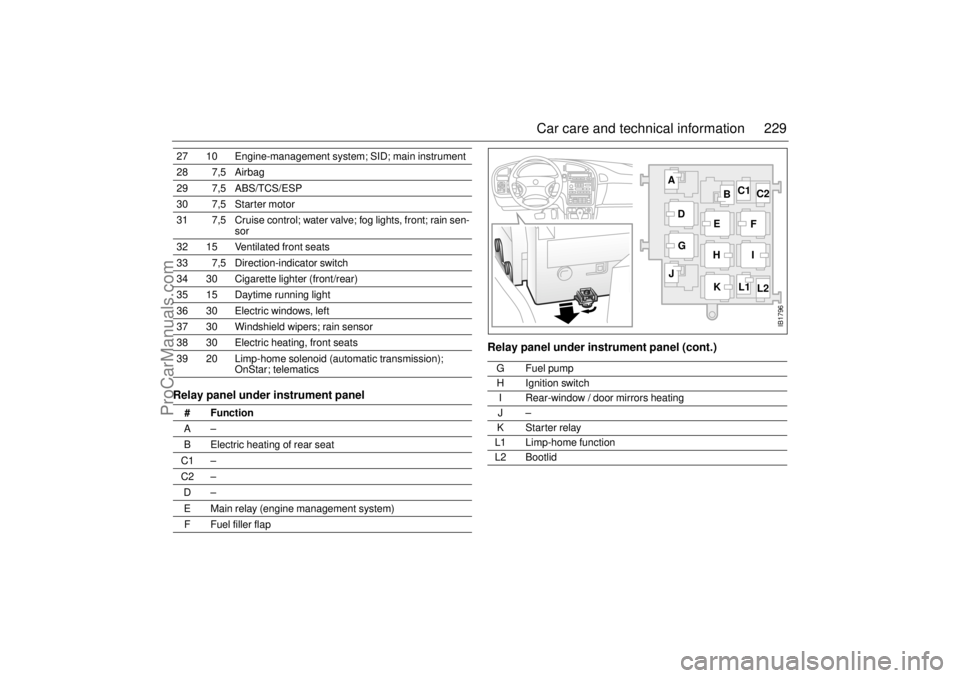
229 Car care and technical information
Relay panel under instrument panel Relay panel under instrument panel (cont.)27 10 Engine-management system; SID; main instrument
28 7,5 Airbag
29 7,5 ABS/TCS/ESP
30 7,5 Starter motor
31 7,5 Cruise control; water valve; fog lights, front; rain sen-
sor
32 15 Ventilated front seats
33 7,5 Direction-indicator switch
34 30 Cigarette lighter (front/rear)
35 15 Daytime running light
36 30 Electric windows, left
37 30 Windshield wipers; rain sensor
38 30 Electric heating, front seats
39 20 Limp-home solenoid (automatic transmission);
OnStar; telematics
# Function
A –
B Electric heating of rear seat
C1 –
C2 –
D –
E Main relay (engine management system)
F Fuel filler flap
G Fuel pump
H Ignition switch
I Rear-window / door mirrors heating
J–
KStarter relay
L1 Limp-home function
L2 Bootlid
IB1796
A
BC1
C2
L2 L1 D
GE
F
H
I
K J
ProCarManuals.com
Page 230 of 288
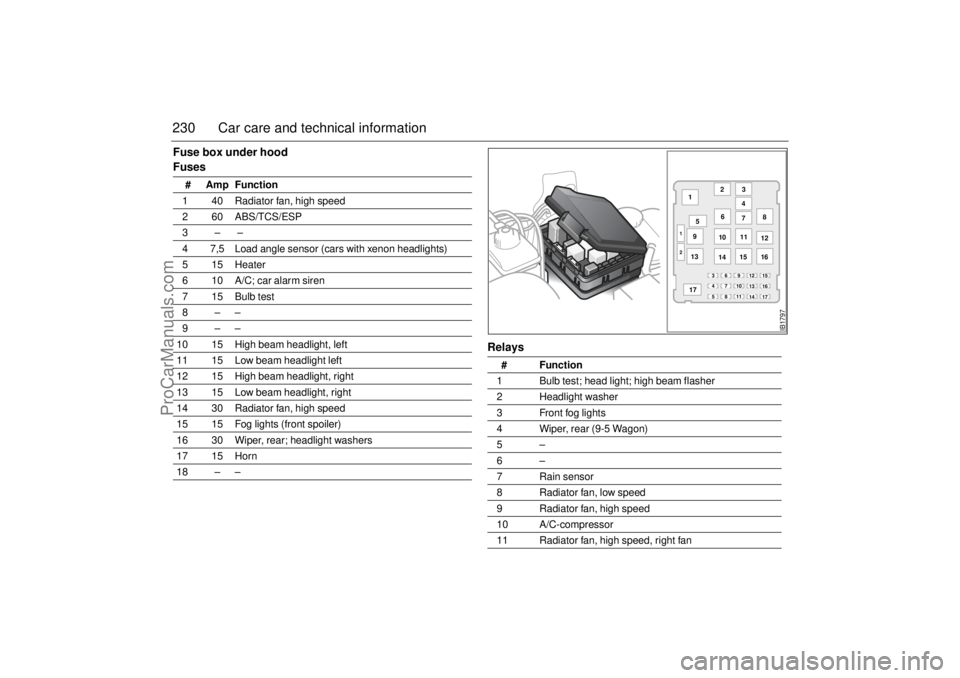
230 Car care and technical informationFuse box under hood
Fuses
Relays
# Amp Function
1 40 Radiator fan, high speed
2 60 ABS/TCS/ESP
3– –
4 7,5 Load angle sensor (cars with xenon headlights)
5 15 Heater
6 10 A/C; car alarm siren
7 15 Bulb test
8––
9––
10 15 High beam headlight, left
11 15 Low beam headlight left
12 15 High beam headlight, right
13 15 Low beam headlight, right
14 30 Radiator fan, high speed
15 15 Fog lights (front spoiler)
16 30 Wiper, rear; headlight washers
17 15 Horn
18 – –
# Function
1 Bulb test; head light; high beam flasher
2 Headlight washer
3 Front fog lights
4 Wiper, rear (9-5 Wagon)
5–
6–
7 Rain sensor
8 Radiator fan, low speed
9 Radiator fan, high speed
10 A/C-compressor
11 Radiator fan, high speed, right fan
43
2
IB1797
2 1
14 1312 7 6
5 1
15 168
11
10 9
178 5
17 14 11 7 4
16 13 69
10 3
15 12
ProCarManuals.com
Page 232 of 288
232 Car care and technical informationWheels Alternative wheels and tiresIf you wish to fit other tires or wheels than
those supplied with the car, consult your
Saab dealer first as to the possibilities avail-
able.
Wheels/tires combinations that are not
approved by Saab can negatively affect the
car´s directional stability, steering and brak-
ing in both wet and dry conditions.
Do not assume that a wheel/tire combina-
tion will function properly just because it will
bolt on.
The wheels and tires have been carefully
matched to the characteristics of the car and
play a key role in its outstanding roadhold-
ing and handling.
To ensure that the speedometer is as accu-
rate as possible it should be reprogrammed
if wheels of a different dimension are fitted.
Contact an authorized Saab workshop.
Tire pressureTires need to be inflated to suit the load car-
ried and the maximum speed the car will be
driven (see the recommended tire pres-
sures page 268). Note that all values apply
to cold tires. For tires with an aspect ratio
less than /60, increase the tire pressure by
3 psi (20 kPa) for rough roads with potholes
to minimize the risk of rim damage.
Never reduce the pressure of a hot tire. If the
tires are hot when you check them, only
increase the pressure, if necessary.
Soft tires will cause faster wear than
over-pressurized tires. They also increase
fuel consumption.
If a valve is leaking, simply unscrew it and fit
a new one.
NOTICEAlways consult your Saab dealer before
changing the wheels and tires on your
Saab.
Wide wheels and tyres with sidewalls that
are too low can:
be damaged in potholes etc.
cause springs, shock absorbers and
wheel bearings and body mountings
can be overloaded.
cause that the wheels can come into
contact with chassis and body compo-
nents.
can affect the function of the Elec-
tronic Stability Program (ESP).
The speed and load limits for the tires
must not be exceeded; see page 233.
Wheels larger than 17” must not be fitted.
The maximum permissible offset is
49 mm.
WARNING
Check the tire pressure at least once a
month and before long journeys. Under-
inflation can result in:
Punctures
Separation of the tire and tread
Damage to the sidewalls
Damage to the rims on poor roads
Poor handling characteristics
Premature tire wear
Increased fuel consumption.
ProCarManuals.com
Page 235 of 288
235 Car care and technical information
Temperature The temperature grades are A (the highest),
B, and C, representing the tire’s resistance
to the generation of heat and its ability to dis-
sipate heat when tested under controlled
conditions on a specified indoor laboratory
test wheel. Sustained high temperature can
cause the material of the tire to degenerate
and reduce tire life, and excessive temper-
ature can lead to sudden tire failure. The
grade C corresponds to a level of perfor-
mance which all passenger car tires must
meet under the Federal Motor Vehicle
Safety Standard No. 109.
Grades B and A represent higher levels of
performance on the laboratory test wheel
than the minimum required by law.
Date codeTires should be regarded as perishable
goods. As the tires age, the rubber becomes
progressively harder, and the roadholding
ability of the tires diminishes. This is partic-
ularly true on winter tires.
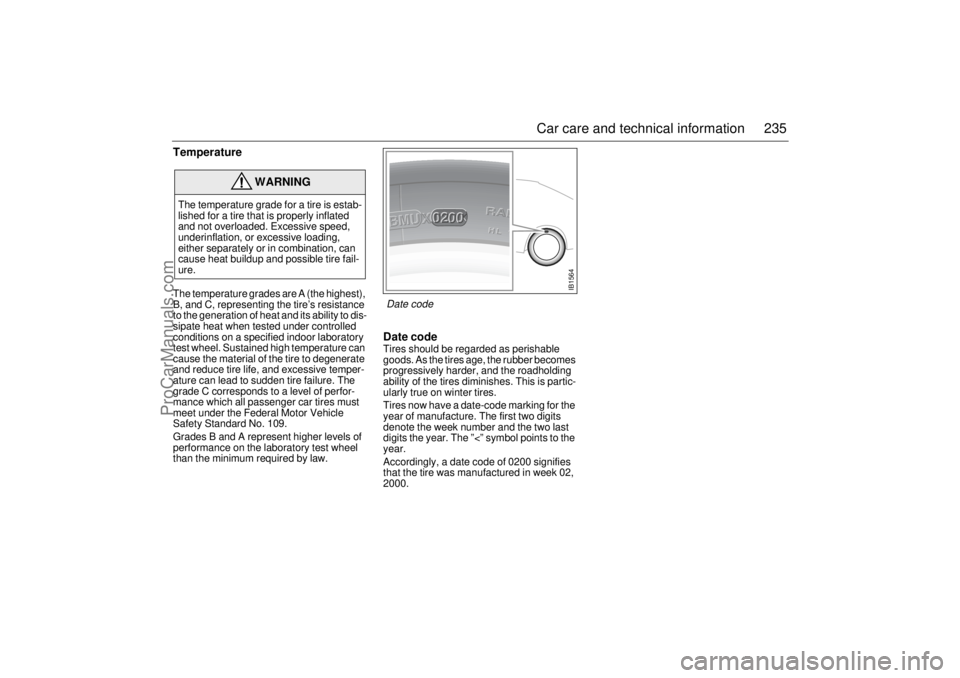
Tires now have a date-code marking for the
year of manufacture. The first two digits
denote the week number and the two last
digits the year. The ”<” symbol points to the
year.
Accordingly, a date code of 0200 signifies
that the tire was manufactured in week 02,
2000.
WARNING
The temperature grade for a tire is estab-
lished for a tire that is properly inflated
and not overloaded. Excessive speed,
underinflation, or excessive loading,
either separately or in combination, can
cause heat buildup and possible tire fail-
ure.
IB1564
Date code
ProCarManuals.com