phone SAAB 9-5 2004 User Guide
[x] Cancel search | Manufacturer: SAAB, Model Year: 2004, Model line: 9-5, Model: SAAB 9-5 2004Pages: 288, PDF Size: 16.91 MB
Page 210 of 288
210 Car care and technical informationBattery
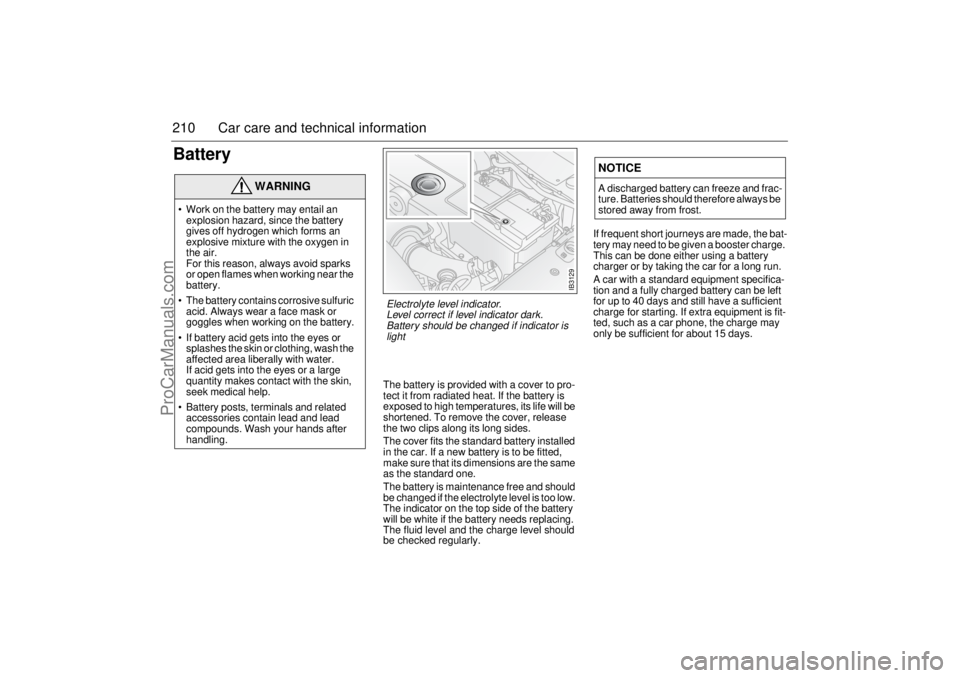
The battery is provided with a cover to pro-
tect it from radiated heat. If the battery is
exposed to high temperatures, its life will be
shortened. To remove the cover, release
the two clips along its long sides.
The cover fits the standard battery installed
in the car. If a new battery is to be fitted,
make sure that its dimensions are the same
as the standard one.
The battery is maintenance free and should
be changed if the electrolyte level is too low.
The indicator on the top side of the battery
will be white if the battery needs replacing.
The fluid level and the charge level should
be checked regularly.
If frequent short journeys are made, the bat-
tery may need to be given a booster charge.
This can be done either using a battery
charger or by taking the car for a long run.
A car with a standard equipment specifica-
tion and a fully charged battery can be left
for up to 40 days and still have a sufficient
charge for starting. If extra equipment is fit-
ted, such as a car phone, the charge may
only be sufficient for about 15 days.
WARNING
Work on the battery may entail an
explosion hazard, since the battery
gives off hydrogen which forms an
explosive mixture with the oxygen in
the air.
For this reason, always avoid sparks
or open flames when working near the
battery.
The battery contains corrosive sulfuric
acid. Always wear a face mask or
goggles when working on the battery.
If battery acid gets into the eyes or
splashes the skin or clothing, wash the
affected area liberally with water.
If acid gets into the eyes or a large
quantity makes contact with the skin,
seek medical help.
Battery posts, terminals and related
accessories contain lead and lead
compounds. Wash your hands after
handling.
NOTICEA discharged battery can freeze and frac-
ture. Batteries should therefore always be
stored away from frost.
IB3129
Electrolyte level indicator.
Level correct if level indicator dark.
Battery should be changed if indicator is
light
ProCarManuals.com
Page 254 of 288

254 Car care and technical informationWashing the carWash your car frequently. To facilitate
cleaning, a suitable detergent can be added
to the water, which should be lukewarm.
Do not use a pressure washer at close
range on stone chip damage, scratches or
other damage to the paintwork. The paint
can otherwise start to flake.
Remove any bird droppings without delay,
as these can discolor the paintwork and
prove difficult to polish out.
Use a soft cloth moistened with methyl alco-
hol to remove splashes of tar or asphalt. Do
not use strong cleaners, as these can dry
out the paintwork.
The underside of the car also needs wash-
ing regularly, and this should be done extra
thoroughly at the end of winter. Clean the
underside of the car by hand if the car is usu-
ally washed in an automatic car wash with-
out special facilities for underbody cleaning.
Never wash or leave the car to dry in the
sun, but wipe it dry with a chamois leather
immediately after washing to avoid smears
and streaks.
Clean the window glass inside and out using
a high quality window cleaner. This is partic-
ularly important when the car is new, as
upholstery and trim have a tendency to
sweat a little at first.
Keep the glass well cleaned, as this helps to
prevent misting.
NOTICEAvoid using any alcohol-based cleaners
on the front and rear light clusters, as
these can cause cracking of the lenses.
NOTICE The door mirrors must be fully
retracted before the car enters an
automatic car wash.
Remove fixed antennas, e.g. for
mobile phone, before putting car
through an automatic car wash.
Try your brakes on leaving a car wash.
Wet brake discs may reduce the per-
formance of the brakes.
Cars with Saab Parking Assistance:
Do not spray the sensors or closer
than 20 cm to the sensors with a pres-
sure washer, as this can damage
them.
ProCarManuals.com
Page 282 of 288

282 SpecificationsSeveral of the systems in your Saab
car can be adjusted to better fit your
individual needsSome functions are governed by legal
requirements and cannot therefore be
reprogrammed.
Consult an authorized Saab dealer for fur-
ther information.
Car alarm/central locking system:
The sound level of the siren when locking/
unlocking, HIGH or LOW.
The number of blinks when locking/
unlocking, 1 to 7.
Automatic locking of the trunk when the
car is driven, 1 to 8 mph (2–14 km/h), YES
or NO.
Preclude the unlocking of the trunk while
the car is driven, YES or NO.
Automatic locking of the trunk after
1 second–4 minutes if it has not been
opened, YES or NO.
Automatic locking of the trunk when it is
closed, YES or NO.
Automatic locking of all doors when the
car is driven above 7.5 mph (12 km/h),
YES or NO.Saab Information Display:
Outdoor temperature display can be
adjusted.
Miscellaneous:
Select the on-time for heated rear seat.
Coolant temperature gauge adjustment
can be increased/decreased.
Fuel level gauge adjustment can be
increased/decreased.
Additional sweep of the wipers after wind-
shield washer function (ON or OFF).
Follow me home on-time can vary from 20
to 50 seconds.
Night panel illumination deactivation
speed for the speedometer can be
adjusted.
Following adjustments can be done
by the driver:Automatic Climate Control (ACC):
To alter the preprogrammed ”AUTO” start
up mode with your own preferences you can
manually select the desired settings for:
Temperature.
Fan speed.
Air distribution.
See ”Programming I” on page 81 and ”Pro-
gramming II” on page 82.
Saab 9-5 Audio System (see page 101):
Maximum starting volume (when the
radio is switched on).
Telephone volume (if the car is equipped
with a phone connected to the audio sys-
tem).
Speed dependent volume (volume
increases or decreases with vehicle
speed).
Loudness.
Daytime Running Lights:
To disable, turn off the ignition and pull out
fuse 35, see page 229.
ProCarManuals.com