roof SAAB 9-5 2004 User Guide
[x] Cancel search | Manufacturer: SAAB, Model Year: 2004, Model line: 9-5, Model: SAAB 9-5 2004Pages: 288, PDF Size: 16.91 MB
Page 175 of 288

175 Starting and driving
a major impact on fuel consumption after
the engine has started from cold. Thus, if the
car is mainly used for short journeys of
3–5 miles (5–8 km), the fuel consumption
will be 60–80 % higher than normal.Driving technique To obtain the best running economy, not
only regarding fuel consumption but gen-
eral wear also, regular service is required.
High speed, unnecessary acceleration,
heavy braking and much low gear work all
gives rise to higher fuel consumption.
Frequent gear changing in traffic, starting
in cold weather, the use of studded tires
and roof racks, and towing a trailer all
increase fuel consumption.
Do not run the engine when the car is sta-
tionary.
If idling, it will take much longer before the
engine becomes hot. Engine wear is
greatest during this warming-up phase.
Therefore drive away as soon as possible
after the engine is started and avoid high
revving. Driving in a low gear results in higher fuel
consumption than in a high gear because
of the higher engine speed for a given
road speed. Always change up to a higher
gear as soon as traffic conditions allow
and use the highest gear as much as pos-
sible.
Check the air pressure in the tires once a
month. Incorrect pressures increase tire
wear. It is better to have slightly higher
pressure than lower.
Check fuel consumption regularly.
Increased consumption can indicate that
something is wrong and that the car
needs to be checked by an authorized
Saab dealer.
Practical trials on the roads have demon-
strated that substantial savings in fuel con-
sumption can be made if the above advice
is heeded.
Road conditions Wet roads increase fuel consumption, as do
unpaved roads and driving in hilly country
(the amount of fuel saved driving downhill is
less than the additional amount required to
climb the hill).
WARNING
Never switch the engine off while driving
as the effect of the brakes and power
steering will be greatly reduced.
ProCarManuals.com
Page 183 of 288
183 Starting and driving
Driving with a roof rack
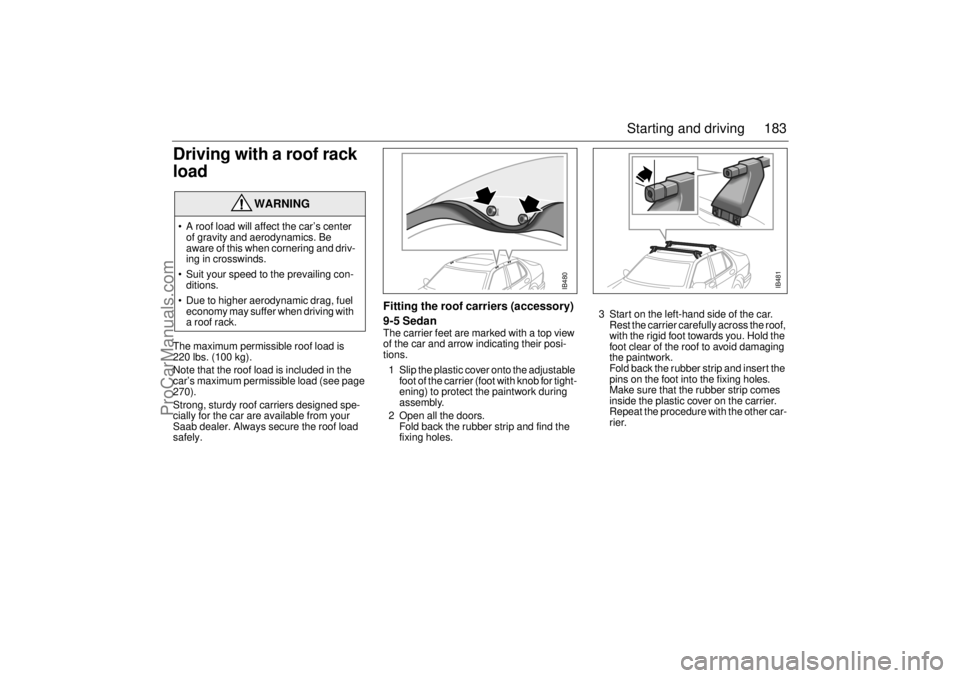
loadThe maximum permissible roof load is
220 lbs. (100 kg).
Note that the roof load is included in the
car’s maximum permissible load (see page
270).
Strong, sturdy roof carriers designed spe-
cially for the car are available from your
Saab dealer. Always secure the roof load
safely.
Fitting the roof carriers (accessory)
9-5 SedanThe carrier feet are marked with a top view
of the car and arrow indicating their posi-
tions.
1 Slip the plastic cover onto the adjustable
foot of the carrier (foot with knob for tight-
ening) to protect the paintwork during
assembly.
2 Open all the doors.
Fold back the rubber strip and find the
fixing holes. 3 Start on the left-hand side of the car.
Rest the carrier carefully across the roof,
with the rigid foot towards you. Hold the
foot clear of the roof to avoid damaging
the paintwork.
Fold back the rubber strip and insert the
pins on the foot into the fixing holes.
Make sure that the rubber strip comes
inside the plastic cover on the carrier.
Repeat the procedure with the other car-
rier.
WARNING
A roof load will affect the car’s center
of gravity and aerodynamics. Be
aware of this when cornering and driv-
ing in crosswinds.
Suit your speed to the prevailing con-
ditions.
Due to higher aerodynamic drag, fuel
economy may suffer when driving with
a roof rack.
IB480
IB481
ProCarManuals.com
Page 184 of 288
184 Starting and driving4 Close the doors on the left-hand side of
the car gently, to hold the carrier feet in
place.
5 Now go around to the other side of the
car and remove the plastic cover from
the carrier’s adjustable foot. Fold back
the rubber strip and insert the pins on
the foot into the fixing holes. Do the
same with the other carrier and close the
doors gently.
6 Tighten each carrier by turning the knob
clockwise (by hand). Tighten just
enough to bring the foot up against the
edges of the fixing holes.
Remove the carriers when not in use, as
they increase fuel consumption.
The instructions that accompany the carri-
ers also include advice on driving with a roof
load – we strongly recommend that you
read them carefully.
Fitting the roof carriers (accessory)
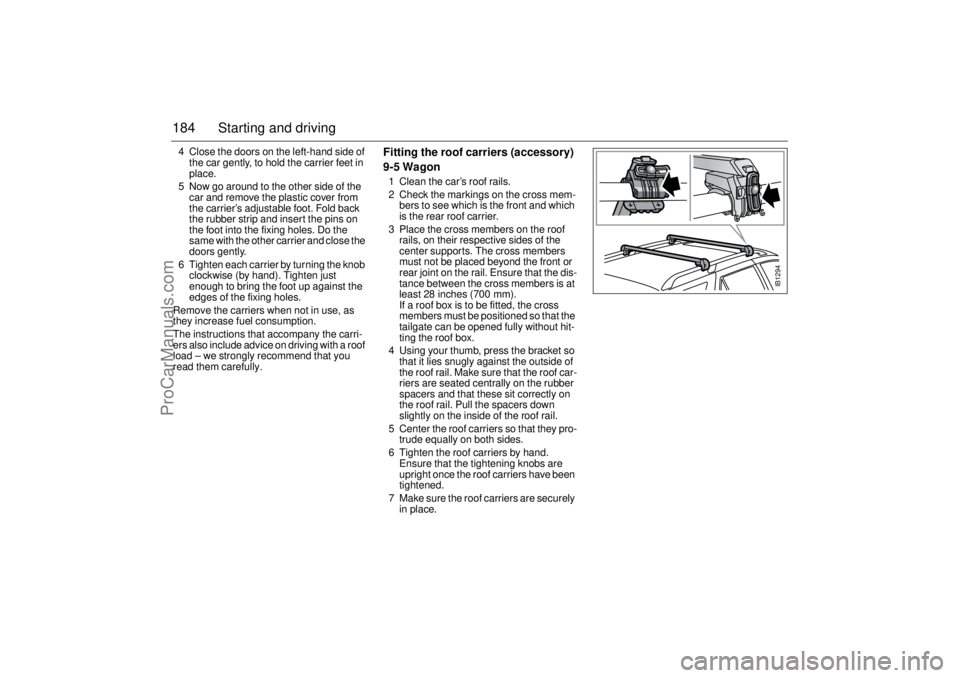
9-5 Wagon1 Clean the car’s roof rails.
2 Check the markings on the cross mem-
bers to see which is the front and which
is the rear roof carrier.
3 Place the cross members on the roof
rails, on their respective sides of the
center supports. The cross members
must not be placed beyond the front or
rear joint on the rail. Ensure that the dis-
tance between the cross members is at
least 28 inches (700 mm).
If a roof box is to be fitted, the cross
members must be positioned so that the
tailgate can be opened fully without hit-
ting the roof box.
4 Using your thumb, press the bracket so
that it lies snugly against the outside of
the roof rail. Make sure that the roof car-
riers are seated centrally on the rubber
spacers and that these sit correctly on
the roof rail. Pull the spacers down
slightly on the inside of the roof rail.
5 Center the roof carriers so that they pro-
trude equally on both sides.
6 Tighten the roof carriers by hand.
Ensure that the tightening knobs are
upright once the roof carriers have been
tightened.
7 Make sure the roof carriers are securely
in place.
IB1294
ProCarManuals.com
Page 185 of 288
185 Starting and driving
Driving at nightBear in mind the following points when
driving at night:
Nighttime driving requires your full con-
centration.
Do not rush. Count on your journey taking
slightly longer.
The number of drivers under the influence
of drugs is likely to be greater at night than
during the day.
Do not stare at the headlights of oncom-
ing vehicles.
Avoid driving at night if you have poor eye-
sight. Night vision deteriorates with age.
Keep your car's headlights, windows and
mirrors clean. Also, if you wear glasses,
make sure they are clean.
Make sure you are well rested before
starting a long journey. Take a break every
other hour.
Only eat light meals. Heavy meals have a
tendency to induce tiredness.
Driving with a loadThe driving characteristics of the car are
affected by the way it is loaded.
Place heavy loads as far forward and as
low as possible in the trunk.
Secure the load to the tie downs, see
page 137.
The load should be such that the car´s
total weight or axle weight are not
exceeded, see page 270.
Heavy loads mean that the car’s center of
gravity is further back. As a result, the car
will sway more during evasive steering.
Never exceed the permissible load in the
roof box, even if there is room for more.
Ensure that the tire pressure is correct –
slight overinflation is preferable to under-
inflation.
The braking distance of a loaded car is
always greater. Keep your distance from
the vehicle in front.
Roof loads can negatively affect tele-
communication.
Tire pressure, see page 280 and back
cover.
IB1295
ProCarManuals.com
Page 188 of 288

188 Starting and drivingDriving with the trunk
lid/tailgate openAvoid driving with the trunk lid/tailgate partly
or fully open, since exhaust fumes can be
drawn into the cabin.
If you must drive with the trunk lid/tailgate
open, all windows and the sunroof (if fitted)
must be closed and the cabin fan on at its
highest speed setting.
Driving in deep water Towing the carNOTICEDo not drive in water deeper than
12 inches (30 cm) and do not drive faster
than 3–4 mph. Water can otherwise be
sucked into the engine. The engine will be
seriously damaged if water enters the
intake system.
WARNING
Remember that the brake servo does
not operate when the engine is off.
Much greater pressure than normal
will therefore be required to operate
the brake pedal.
Nor does the steering servo operate
when the engine is off. The steering
will therefore be much heavier than
usual.
The towing vehicle should always be
heavier than the vehicle on tow.
Never allow passengers to ride in the
car being towed.
Always seek professional help if the
car needs to be towed.
ProCarManuals.com
Page 229 of 288
229 Car care and technical information
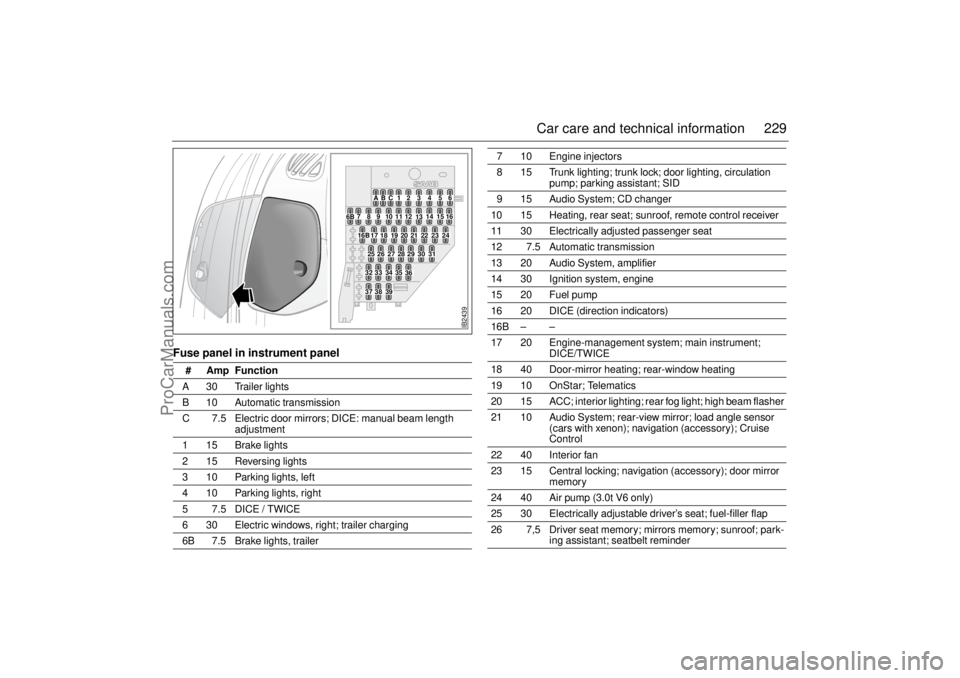
Fuse panel in instrument panel
# Amp Function
A 30 Trailer lights
B 10 Automatic transmission
C 7.5 Electric door mirrors; DICE: manual beam length
adjustment
115Brake lights
2 15 Reversing lights
3 10 Parking lights, left
4 10 Parking lights, right
5 7.5 DICE / TWICE
6 30 Electric windows, right; trailer charging
6B 7.5 Brake lights, trailer
7 10 Engine injectors
8 15 Trunk lighting; trunk lock; door lighting, circulation
pump; parking assistant; SID
9 15 Audio System; CD changer
10 15 Heating, rear seat; sunroof, remote control receiver
11 30 Electrically adjusted passenger seat
12 7.5 Automatic transmission
13 20 Audio System, amplifier
14 30 Ignition system, engine
15 20 Fuel pump
16 20 DICE (direction indicators)
16B – –
17 20 Engine-management system; main instrument;
DICE/TWICE
18 40 Door-mirror heating; rear-window heating
19 10 OnStar; Telematics
20 15 ACC; interior lighting; rear fog light; high beam flasher
21 10 Audio System; rear-view mirror; load angle sensor
(cars with xenon); navigation (accessory); Cruise
Control
22 40 Interior fan
23 15 Central locking; navigation (accessory); door mirror
memory
24 40 Air pump (3.0t V6 only)
25 30 Electrically adjustable driver’s seat; fuel-filler flap
26 7,5 Driver seat memory; mirrors memory; sunroof; park-
ing assistant; seatbelt reminder
IB2439
BC123456 A
14
121110987
13
6B
1516
2324
222120191817
16B25262728293031
3635343332
393837
ProCarManuals.com
Page 270 of 288

270 SpecificationsGeneral Overall length, including bumpers:
9-5 Sedan _______________________ 190.0 in (4827 mm)
9-5 Wagon ______________________ 190.1 in (4828 mm)
Overall width, including door mirrors ____ 80.4 in (2042 mm)
Maximum height:
9-5 Sedan _______________________ 58.1 in (1475 mm)
9-5 Wagon ______________________ 59.1 in (1501 mm)
Wheelbase _______________________ 106.4 in (2703 mm)
Ground clearance __________________ approx. 6.6 in
(167 mm)
Tr a c k :
Front __________________________ 59.9 in (1522 mm) *)
Rear ___________________________ 59.9 in (1522 mm) *)
Turning circle (curb to curb) ___________ 37,1 ft (11.3 m)
Turning circle (measured at vehicle extrem-
ities) ___________________________ 39,0 ft (11.9 m)
Number of seats (incl. driver) _________ 5
*) Specified track applies to wheel sizes:
6 x 15 & 6.5 x 16
Gross vehicle weight
(GVW)
Maximum train
weight
(GVW + max. trailer
weight)
Maximum axle load,
front
Maximum axle load,
rear Permissible load (in addition to driver) = GVW minus curb weight
The maximum permissible axle load, front or rear, must not be exceeded.
The maximum permissible axle load, front or rear, must not be exceeded. Chassis number in engine bay Weight ready for driving (i.e. with full fuel
tank, washer-fluid reservoir, standard
tools and spare wheel) ______________ 3460–3780 lbs.
(1570–1715 kg)
Gross vehicle weight (GVW) ___________ 4390–4710 lbs.
(1990–2135 kg)
Maximum axle load:
Front ___________________________ 2590 lbs. (1175 kg)
Rear, 9-5 Sedan ___________________ 2310 lbs. (1050 kg)
Rear, 9-5 Wagon __________________ 2480 lbs. (1125 kg)
Weight distribution:
Curb weight, front/rear ______________ 60/40 %
GVW, front/rear ___________________ 50/50 %
Maximum roof load __________________ 220 lbs (100 kg)
IB1917
ProCarManuals.com
Page 284 of 288

284 IndexDDICE/TWICE
___________________ 228
Dampers
______________________ 277
Date code, tires
_________________ 245
Definitions and terminology, tire
____ 242
Determining correct load, tires
_____ 244
Dim-dipped beam
________________ 69
Direction indicators _______________ 71
Door handles
___________________ 40
Door mirrors
___________________ 121
Doors, locks & luggage compartment
_39
Drive belt
______________________ 275
Drive belt, alternator
_____________ 212
Drive belts, length
_______________ 275
Driver’s seat, programmable
________ 14
Driving at night
_________________ 185
Driving in hot weather
____________ 177
Driving with a load
______________ 185
EEDR
_________________________ 267
ESP __________________________ 172
Electric heating seat
______________ 15
Electric heating, front seats
________ 15
Electric windows
________________ 127
Electrical system, technical data
____ 275
Electronic Stability Program, ESP __ 172
Electronic starting interlock
_________ 41
Emergency operation of sunroof
____ 129
Emission control systems
_________ 202Engine bay
____________________ 201
Engine bay, cleaning
_____________ 255
Engine number
_________________ 280
Engine oil, grade ________________ 273
Engine, description ______________ 203
Engine, technical data ____________ 272
Engine, temperature gauge
________ 61
Engine-oil level, checking
_________ 204
Event Data Recorder
____________ 267
Expansion tank, coolant __________ 207
FFault codes, Audio System
________ 106
Flat spots, tires
_________________ 234
Fluid level, automatic transmission
__ 206
Folding the rear seat, 9-5 Sedan
___ 135
Folding the rear seat, 9-5 Wagon ___ 138
Frequently asked questions on airbag
37
Front fog lights
__________________ 72
Frost warning
___________________ 64
Fuel
__________________________ 154
Fuel consumption
________________ 63
Fuel filler door
__________________ 146
Fuel gauge
_____________________ 61
Fuel grade _____________________ 272
Fuse box under hood
____________ 231
Fuse panel
____________________ 227
Fuses
________________________ 227
GGarage door opener
_____________ 122
Gearbox number
________________ 280
Gearbox oil, checking
____________ 206
Gearbox, technical data, __________ 276
Glove compartment
______________ 132
HHandbrake
_____________________ 196
Hazard warning lights
_____________ 72
Head restraint
___________________ 16
Headlight flasher _________________ 69
Headlights
______________________ 69
Hood
_________________________ 200
Horn __________________________ 120
IIf a tire goes flat
_________________ 239
Ignition switch
__________________ 148
Immobilizer
_____________________ 41
Indicator and warning lights
_________ 54
Indicator lights
___________________ 54
Instrument illumination
____________ 71
Instruments and controls ___________ 53
Interior equipment
_______________ 119
Interior lighting
__________________ 130
Interior rearview mirror
___________ 121
ProCarManuals.com
Page 286 of 288

286 IndexRoof load
_____________________ 183
Running-in ____________________ 174
SSDM
_________________________ 267
SID
___________________________ 63
Saab 9-5 Audio System
___________ 85
Saab Information Display (SID)
_____ 63
Saab Parking Assistance
_________ 194
Safety belts
_____________________ 17
Safety belts, care of
_____________ 253
Safety-belt pretensioners
__________ 18
Safety-belt reminder
______________ 17
Seats
__________________________ 12
Securing a load
__________________ 44
Selector lever indication, automatic
transmission
___________________ 63
Sentronic, manual mode
__________ 163
Service costs
__________________ 265
Service information
______________ 266
Service intervals
________________ 264
Service record retention
__________ 265
Settings, seats
__________________ 12
Side airbags
____________________ 35
Signalling, horn _________________ 120
Sliding floor, 9-5 Wagon
__________ 143
Snow chains
___________________ 176
Spare wheel ___________________ 246
Spare wheel and tools
___________ 145
Spark plugs
____________________ 275
Speedometer ________________ 60
, 61Starting in cold weather, ACC
_______ 81
Starting in hot weather, ACC _______ 81
Steering wheel adjustment
________ 120
Steering, technical data
__________ 277
Steps for determining correct load
limit
_________________________ 244
Stone-chip damage, repairing
______ 255
Storage compartments
___________ 132
Sun visors
_____________________ 131
Sunroof
_______________________ 128
Suspension ____________________ 277
Suspension, technical data
________ 277
Switches
_______________________ 69
Symboler ________________________ 9
Systems, adjustment
_____________ 282
TTCS OFF
_______________________ 59
Table of fuses
__________________ 229
Tachometer
_____________________ 60
Tailgate, opening
________________ 44
Tank gauge
_____________________ 61
Technical data __________________ 269
Telematics
_____________________ 107
Temperature control, ACC
_________ 77
Temperature gauge, engine ________ 61
Temperature zones, ACC
__________ 77
Textile carpeting
________________ 253
Through-load hatch ______________ 137
Tie Downs
_____________________ 137
Tightening torque, wheel studs
_____ 247Tip, driving at night
______________ 185
Tip, to avoid theft
________________ 197
Tire chains
_____________________ 239
Tire date code __________________ 245
Tire inspection and rotation
________ 234
Tire markings
___________________ 241
Tire pressure ___________________ 186
Tire sidewall labeling
_____________ 240
Tire terminology and definitions
____ 242
Tire, compact spare
______________ 246
Tires
_____________________ 233
, 278
Tires, winter
____________________ 278
Tools
_________________________ 145
Touching-in the paintwork
_________ 255
Towbar attachment
______________ 178
Towbar load
____________________ 182
Towing the car __________________ 188
Towing, automatics
______________ 188
Traction
_______________________ 171
Trailer weights
__________________ 271
Treadwear indicators
_____________ 235
Trionic
________________________ 202
Trip computer
___________________ 63
Trip meter
______________________ 60
Trunk
_________________________ 135
Trunk lid, opening
________________ 44
Turbo gauge
____________________ 62
Turbo, points to note
_____________ 151
ProCarManuals.com