tire SAAB 9-5 2004 Owner's Manual
[x] Cancel search | Manufacturer: SAAB, Model Year: 2004, Model line: 9-5, Model: SAAB 9-5 2004Pages: 288, PDF Size: 16.91 MB
Page 181 of 288
181 Starting and driving
Recommendations for cars with manual
gearbox
Rises in coolant temperature are indicated
by the temperature gauge in the main instru-
ment panel.
The following steps are taken in order as the
temperature of the engine increases:
A/C compressor is switched off.
engine torque is reduced.
When continuing your journey, select a gear
in which the engine speed is about
3,000 rpm until the incline eases.
Driving considerations Always take extra care when towing a
trailer, as the car’s handling will be different
and its braking effect reduced. The trailer’s
braking system and suspension also have a
considerable effect on these characteris-
tics, see also ”Driving with a load” page 185.
If the car has automatic transmission, select
position D when ascending steep hills. This
ensures that the adaptive gear change pat-
terns are operational, see page 165. Use
position D or L for steep descents.
Checks before drivingMake sure that the car and caravan or trailer
are in good working order. This is essential
since towing a caravan increases the strain
on the car.
Check and if necessary adjust the tire
pressure of the car and caravan.
Make sure all wheel bolts are properly
tightened.
Make sure that the equipment joining the
car and caravan is properly secured and
adjusted.
Make sure the caravan’s electrical cable
is properly connected and is not so long
that it drags along the ground. Also, make
sure the cable is not too short and risks
breaking when turning a corner.
Check all bulbs.
Check the car and caravan brakes.
Make sure that all items on or in the cara-
van or trailer are properly secured.
Make sure that the caravan’s jockey
wheel is raised and locked.
Check the distribution of the load so that
the car and caravan are well balanced.
Check that the rearview mirrors provide
the best possible rearward vision.
Make sure the caravan’s safety cable is
correctly attached.
VARNING
Utilize the braking effect of the engine
(1st, 2nd or 3rd gear) when you are
descending long or steep hills to spare
the brakes.
Brake failure can result from overheated
brakes!
NOTICEIf the ”Automatic transmission, fault indi-
cator” indicator comes on, cease
towing until the problem has been recti-
fied.
ProCarManuals.com
Page 185 of 288
185 Starting and driving
Driving at nightBear in mind the following points when
driving at night:
Nighttime driving requires your full con-
centration.
Do not rush. Count on your journey taking
slightly longer.
The number of drivers under the influence
of drugs is likely to be greater at night than
during the day.
Do not stare at the headlights of oncom-
ing vehicles.
Avoid driving at night if you have poor eye-
sight. Night vision deteriorates with age.
Keep your car's headlights, windows and
mirrors clean. Also, if you wear glasses,
make sure they are clean.
Make sure you are well rested before
starting a long journey. Take a break every
other hour.
Only eat light meals. Heavy meals have a
tendency to induce tiredness.
Driving with a loadThe driving characteristics of the car are
affected by the way it is loaded.
Place heavy loads as far forward and as
low as possible in the trunk.
Secure the load to the tie downs, see
page 137.
The load should be such that the car´s
total weight or axle weight are not
exceeded, see page 270.
Heavy loads mean that the car’s center of
gravity is further back. As a result, the car
will sway more during evasive steering.
Never exceed the permissible load in the
roof box, even if there is room for more.
Ensure that the tire pressure is correct –
slight overinflation is preferable to under-
inflation.
The braking distance of a loaded car is
always greater. Keep your distance from
the vehicle in front.
Roof loads can negatively affect tele-
communication.
Tire pressure, see page 280 and back
cover.
IB1295
ProCarManuals.com
Page 186 of 288
186 Starting and drivingTires
The tire pressure should match the current
load and speed of the car; see page 279 or
the tire pressure label on page 280.
The tire pressures given apply to cold tires,
that is tires that are the same temperature
as the outside air temperature.
The tire pressure increases as the tires
become warm (e.g. during highway driving)
with approximately 0.3 bar (4 psi). When
the temperature of the tires changes by 50°
(10°C), the tire pressure will change 0.1 bar
(2 psi).Never reduce the pressure of a hot tire. If the
tires are hot when you check them, only
increase the pressure, if necessary.
Underinflated tires wear more quickly than
slightly overinflated tires.
If a valve is leaking, simply unscrew it and fit
a new one.
Important! Remember to adjust the tire
pressures if you change the load in the car
or intend to drive at substantially lower or
higher speeds than normal.
WARNING
Check the tire pressure at least once a
month and before long journeys. Under-
inflation can result in:
Punctures
Separation of the tire and tread
Damage to the sidewalls
Damage to the rims on poor roads
Poor handling characteristics
Premature tire wear
Increased fuel consumption.
ProCarManuals.com
Page 187 of 288
187 Starting and driving
Driving considerations
with compact spare
wheel/tire fitted
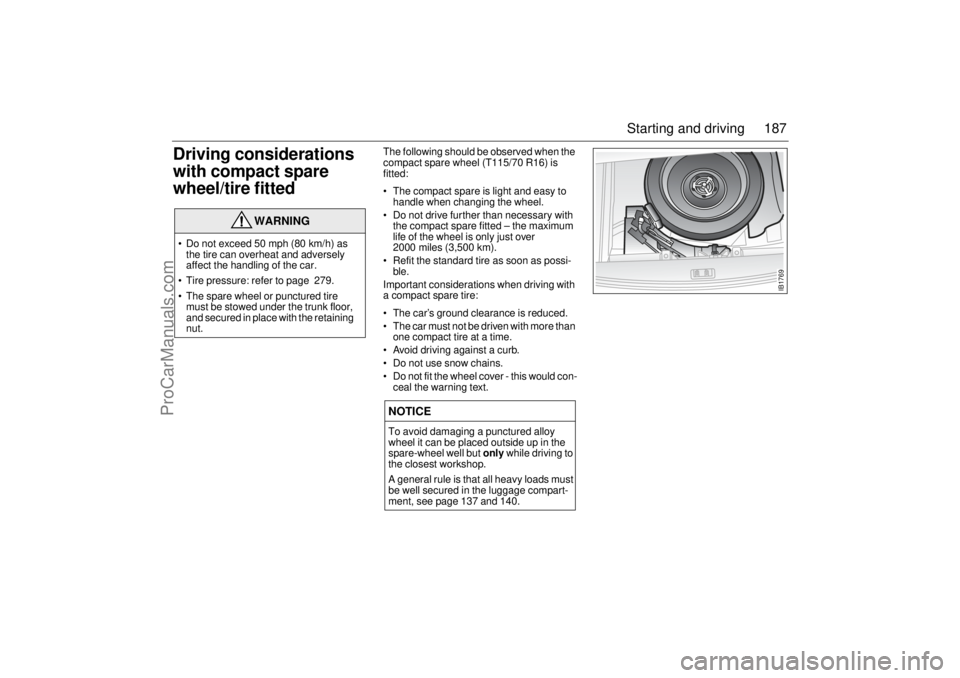
The following should be observed when the
compact spare wheel (T115/70 R16) is
fitted:
The compact spare is light and easy to
handle when changing the wheel.
Do not drive further than necessary with
the compact spare fitted – the maximum
life of the wheel is only just over
2000 miles (3,500 km).
Refit the standard tire as soon as possi-
ble.
Important considerations when driving with
a compact spare tire:
The car’s ground clearance is reduced.
The car must not be driven with more than
one compact tire at a time.
Avoid driving against a curb.
Do not use snow chains.
Do not fit the wheel cover - this would con-
ceal the warning text.
WARNING
Do not exceed 50 mph (80 km/h) as
the tire can overheat and adversely
affect the handling of the car.
Tire pressure: refer to page 279.
The spare wheel or punctured tire
must be stowed under the trunk floor,
and secured in place with the retaining
nut.
NOTICETo avoid damaging a punctured alloy
wheel it can be placed outside up in the
spare-wheel well but only while driving to
the closest workshop.
A general rule is that all heavy loads must
be well secured in the luggage compart-
ment, see page 137 and 140.
IB1769
ProCarManuals.com
Page 197 of 288
197 Starting and driving
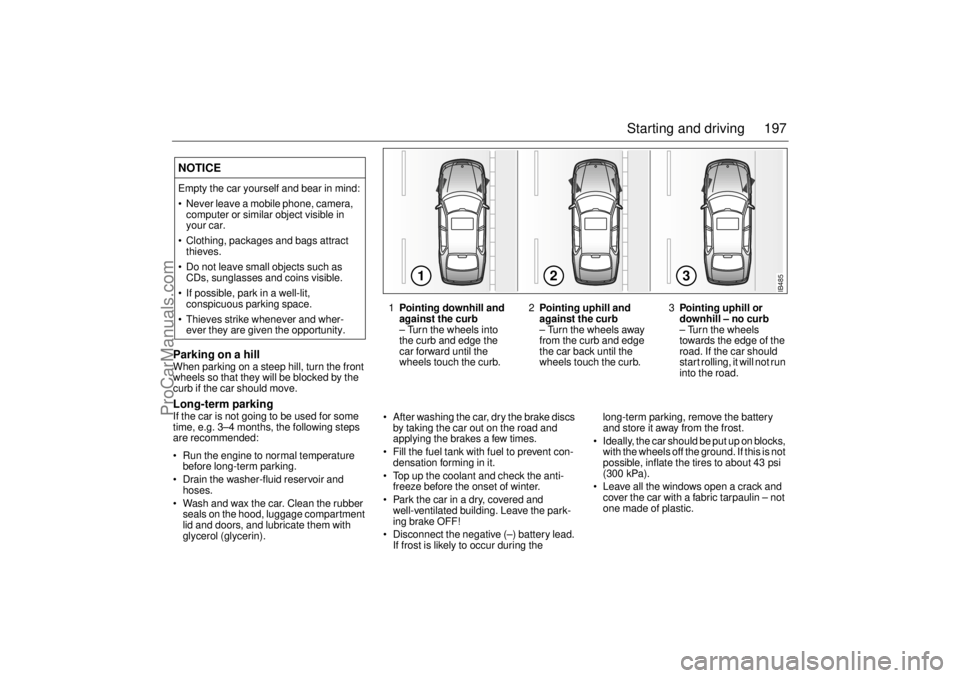
Parking on a hillWhen parking on a steep hill, turn the front
wheels so that they will be blocked by the
curb if the car should move. Long-term parkingIf the car is not going to be used for some
time, e.g. 3–4 months, the following steps
are recommended:
Run the engine to normal temperature
before long-term parking.
Drain the washer-fluid reservoir and
hoses.
Wash and wax the car. Clean the rubber
seals on the hood, luggage compartment
lid and doors, and lubricate them with
glycerol (glycerin). After washing the car, dry the brake discs
by taking the car out on the road and
applying the brakes a few times.
Fill the fuel tank with fuel to prevent con-
densation forming in it.
Top up the coolant and check the anti-
freeze before the onset of winter.
Park the car in a dry, covered and
well-ventilated building. Leave the park-
ing brake OFF!
Disconnect the negative (–) battery lead.
If frost is likely to occur during the long-term parking, remove the battery
and store it away from the frost.
Ideally, the car should be put up on blocks,
with the wheels off the ground. If this is not
possible, inflate the tires to about 43 psi
(300 kPa).
Leave all the windows open a crack and
cover the car with a fabric tarpaulin – not
one made of plastic.NOTICEEmpty the car yourself and bear in mind:
Never leave a mobile phone, camera,
computer or similar object visible in
your car.
Clothing, packages and bags attract
thieves.
Do not leave small objects such as
CDs, sunglasses and coins visible.
If possible, park in a well-lit,
conspicuous parking space.
Thieves strike whenever and wher-
ever they are given the opportunity.
123
IB485
1Pointing downhill and
against the curb
– Turn the wheels into
the curb and edge the
car forward until the
wheels touch the curb.2Pointing uphill and
against the curb
– Turn the wheels away
from the curb and edge
the car back until the
wheels touch the curb.3Pointing uphill or
downhill – no curb
– Turn the wheels
towards the edge of the
road. If the car should
start rolling, it will not run
into the road.
ProCarManuals.com
Page 199 of 288
199 Car care and technical information
Car care and
technical
information
IB1772
Hood ________________ 200
Engine compartment ___ 201
Emission control systems 202
Engine_______________ 203
Engine oil ____________ 204
Transmission fluid_____ 206
Coolant ______________ 207
Brake and clutch fluid __ 208
Power steering fluid ___ 209
Air filter ______________ 209
Battery ______________ 210
Drive belts ___________ 212
Wipers and washers ___ 213 Changing bulbs _______ 215
Fuses _______________ 227
Tires ________________ 233
Compact spare tire ____ 246
Air conditioning (ACC) _ 252
Safety belts __________ 253
Upholstery and trim ___ 253
Textile carpeting ______ 253
Washing the car ______ 254
Waxing and polishing __ 255
Engine compartment __ 255
Touching up the paint__ 255
Anti-corrosion treatment 256 For long trips _________ 258
Recovery and/or recycling
of automotive materials 258
Headlight aiming ______ 259
ProCarManuals.com
Page 225 of 288

225 Car care and technical information
Dome light, front1 Ease the leading edge of the glass out
of the overhead panel.
2 Release one of the contacts and remove
the bulb.
3 Fit the new bulb.
Dome light, rear1 Remove the entire overhead panel:
ease out the trailing end first, and then
both front edges.
2 Fit the new bulb.
Glove-compartment illumination1 Insert a small screwdriver in the slot in
the end of the lamp fitting and ease it out
to gain access to the bulb.
2 Bend out one of the contacts and
remove the bulb.
3 Fit the new bulb.
On refitting, insert the connector-end of the
lamp fitting first.Other bulbs If any other bulbs need changing, you are
advised to take the car to an authorized
Saab dealer.
IB524
IB525
IB523
ProCarManuals.com
Page 233 of 288
233 Car care and technical information
Tires Your new vehicle comes with high-quality
tires made by a leading tire manufacturer. If
you ever have questions about your tire
warranty and where to obtain service, see
your Saab Warranty and Service Record
Booklet for details.
Inflation - Tire PressureThe Tire-Loading Information label, which is
on the inside of the trunk lid, shows the cor-
rect inflation pressures for your tires when
they’re cold. “Cold” means your vehicle has
been sitting for at least three hours or driven
no more than 1 mile (1.6 km).Notice:
Don’t let anyone tell you that
underinflation or overinflation is all
right. It’s not. If your tires don’t have
enough air (underinflation), you can get
the following:
Too much flexing
Too much heat
Tire overloading
Bad wear
Bad handling
Bad fuel economy
If your tires have too much air (overinfla-
tion), you can get the following:
Unusual wear
Bad handling
Rough ride
Needless damage from road hazardsAdjust the tire pressure to match the current
load and speed of the car (see page 279).
The stated tire pressures apply to cold tires,
i.e. tires that are the same temperature as
the outside air temperature. Tire pressure
increases as the tires become warm (e.g.
during highway driving) by approximately
0.3 bar (4 psi). When the temperature of the
tires changes by 50°F (10°C), the tire pres-
sure will change 0.1 bar (2 psi).
Never reduce the pressure of a hot tire. If the
tires are hot when you check them, only
increase the pressure, if necessary.
WARNING
Poor maintained and improperly used
tires are dangerous.
Overloading your tires can cause
overheating as a result of too much
friction. You could have an air-out and
a serious accident. See “Loading Your
Vehicle” on page 242.
Underinflated tires pose the same
danger as overloaded tires. The
resulting accident could cause serious
injury. Check all tires frequently to
maintain the recommended pressure.
Tire pressure should be checked
when your tires are cold.
Overinflated tires are more likely to be
cut, punctured or broken by a sudden
impact – such as when you hit a pot-
hole. Keep tires at the recommended
pressure.
Worn, old tires can cause accidents. If
your tread is badly worn, or if your tires
have been damaged, replace them.
ProCarManuals.com
Page 234 of 288
234 Car care and technical informationWhen to checkCheck your tires once a month or more.
Don’t forget your compact spare tire. It
should be at 60 psi (420 kPa).How to CheckUse a good quality pocket-type gage to
check tire pressure. You can’t tell if your
tires are properly inflated simply by looking
at them. Radial tires may look properly
inflated even when they’re underinflated.
Be sure to put the valve caps back on the
valve stems. They help prevent leaks by
keeping out dirt and moisture.Tire Inspection and RotationTires should be rotated every 7,500 miles
(12 500 km).
Any time you notice unusual wear, rotate
your tires as soon as possible and check
wheel alignment. Also check for damaged
tires or wheels. See “When It Is Time for
New Tires” on page 235 and “Wheel
Replacement” on page 238 for more infor-
mation.
The purpose of regular rotation is to achieve
more uniform wear for all tires on the vehi-
cle. The first rotation is the most important.
When rotating your tires, always use the
correct rotation pattern. Left front tire to left
rear. Left rear tire to right front. Right front to
right rear. Right rear to left front.
Don’t include the compact spare tire in your
tire rotation.After the tires have been rotated, adjust the
front and rear inflation pressures as shown
on the Tire-Loading Information label. Make
certain that all wheel nuts are properly tight-
ened. See page 250.
Flat spottingAll tires get hot, especially on long journeys
or when the car is driven hard. After the car
has been parked with hot tires and the tires
have cooled down, a flat spot can form in the
tire, where it is in contact with the ground.
The same can occur if the car has not been
moved for a long time.
Flat spots can cause vibration that can be
felt through the steering wheel, similar to
that experienced when the wheels need bal-
ancing.
Flat spots of this type disappear once the
tires get hot again, usually after 10–15 miles
(20–25 km) of driving at cruising speed.
WARNING
Rust or dirt on a wheel, or on the parts to
which it is fastened, can make wheel nuts
become loose after a time. The wheel
could come off and cause an accident.
When you change a wheel, remove any
rust or dirt from places where the wheel
attaches to the vehicle. In an emergency,
you can use a cloth or a paper towel to do
this; but be sure to use a scraper or wire
brush later, if you need to, to get all the
rust or dirt off. See “Changing a wheel” on
page 247.
ProCarManuals.com
Page 235 of 288
235 Car care and technical information
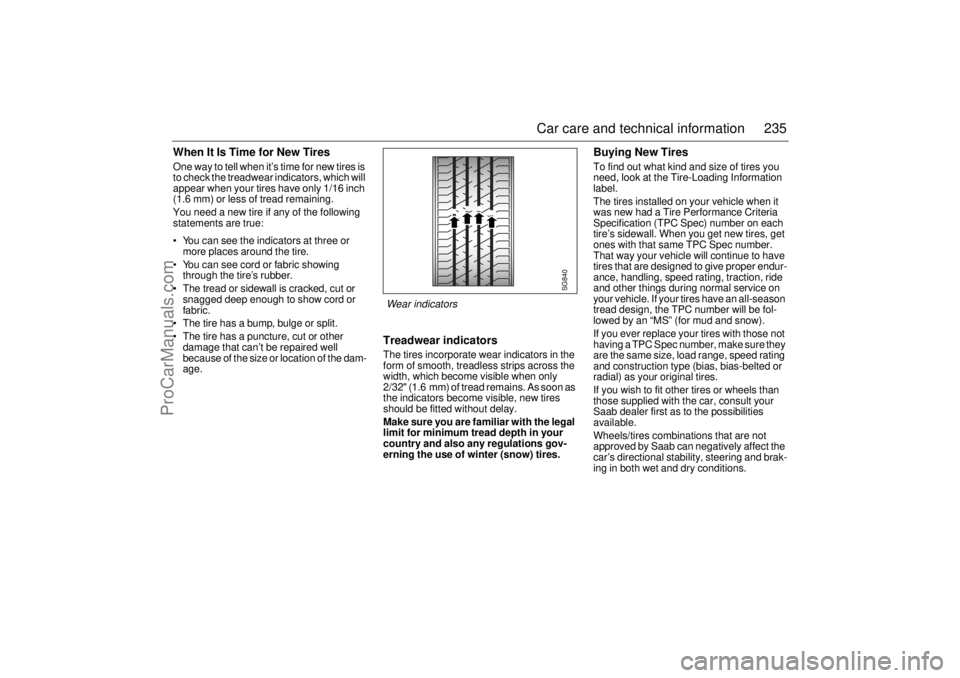
When It Is Time for New TiresOne way to tell when it’s time for new tires is
to check the treadwear indicators, which will
appear when your tires have only 1/16 inch
(1.6 mm) or less of tread remaining.
You need a new tire if any of the following
statements are true:
You can see the indicators at three or
more places around the tire.
You can see cord or fabric showing
through the tire’s rubber.
The tread or sidewall is cracked, cut or
snagged deep enough to show cord or
fabric.
The tire has a bump, bulge or split.
The tire has a puncture, cut or other
damage that can’t be repaired well
because of the size or location of the dam-
age.
Treadwear indicatorsThe tires incorporate wear indicators in the
form of smooth, treadless strips across the
width, which become visible when only
2/32" (1.6 mm) of tread remains. As soon as
the indicators become visible, new tires
should be fitted without delay.
Make sure you are familiar with the legal
limit for minimum tread depth in your
country and also any regulations gov-
erning the use of winter (snow) tires.
Buying New TiresTo find out what kind and size of tires you
need, look at the Tire-Loading Information
label.
The tires installed on your vehicle when it
was new had a Tire Performance Criteria
Specification (TPC Spec) number on each
tire’s sidewall. When you get new tires, get
ones with that same TPC Spec number.
That way your vehicle will continue to have
tires that are designed to give proper endur-
ance, handling, speed rating, traction, ride
and other things during normal service on
your vehicle. If your tires have an all-season
tread design, the TPC number will be fol-
lowed by an “MS” (for mud and snow).
If you ever replace your tires with those not
having a TPC Spec number, make sure they
are the same size, load range, speed rating
and construction type (bias, bias-belted or
radial) as your original tires.
If you wish to fit other tires or wheels than
those supplied with the car, consult your
Saab dealer first as to the possibilities
available.
Wheels/tires combinations that are not
approved by Saab can negatively affect the
car’s directional stability, steering and brak-
ing in both wet and dry conditions.
SG840
Wear indicators
ProCarManuals.com