lock SAAB 9-5 2004 Manual PDF
[x] Cancel search | Manufacturer: SAAB, Model Year: 2004, Model line: 9-5, Model: SAAB 9-5 2004Pages: 288, PDF Size: 16.91 MB
Page 229 of 288
229 Car care and technical information
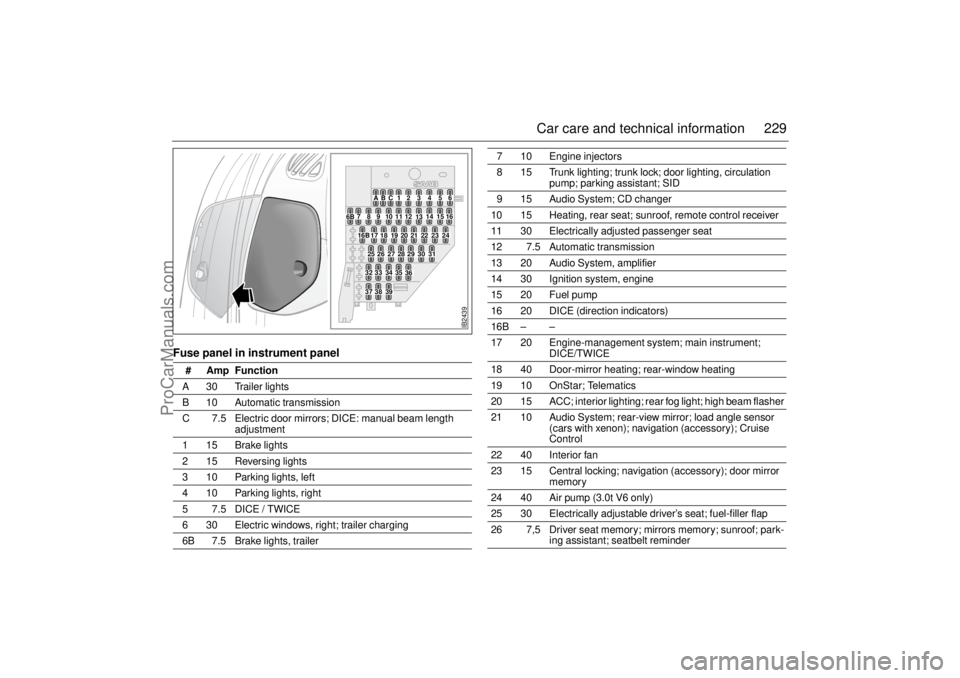
Fuse panel in instrument panel
# Amp Function
A 30 Trailer lights
B 10 Automatic transmission
C 7.5 Electric door mirrors; DICE: manual beam length
adjustment
115Brake lights
2 15 Reversing lights
3 10 Parking lights, left
4 10 Parking lights, right
5 7.5 DICE / TWICE
6 30 Electric windows, right; trailer charging
6B 7.5 Brake lights, trailer
7 10 Engine injectors
8 15 Trunk lighting; trunk lock; door lighting, circulation
pump; parking assistant; SID
9 15 Audio System; CD changer
10 15 Heating, rear seat; sunroof, remote control receiver
11 30 Electrically adjusted passenger seat
12 7.5 Automatic transmission
13 20 Audio System, amplifier
14 30 Ignition system, engine
15 20 Fuel pump
16 20 DICE (direction indicators)
16B – –
17 20 Engine-management system; main instrument;
DICE/TWICE
18 40 Door-mirror heating; rear-window heating
19 10 OnStar; Telematics
20 15 ACC; interior lighting; rear fog light; high beam flasher
21 10 Audio System; rear-view mirror; load angle sensor
(cars with xenon); navigation (accessory); Cruise
Control
22 40 Interior fan
23 15 Central locking; navigation (accessory); door mirror
memory
24 40 Air pump (3.0t V6 only)
25 30 Electrically adjustable driver’s seat; fuel-filler flap
26 7,5 Driver seat memory; mirrors memory; sunroof; park-
ing assistant; seatbelt reminder
IB2439
BC123456 A
14
121110987
13
6B
1516
2324
222120191817
16B25262728293031
3635343332
393837
ProCarManuals.com
Page 253 of 288
253 Car care and technical information
Safety beltsRegularly check the function of the safety
belts as follows:
Hold the diagonal strap and pull it sharply.
The safety belt should
lock
and it should
not be possible to withdraw it further.
Check the anchorage points in the floor.
They must not have suffered rust damage.
There must be no frayed threads in the web-
bing.
Safety belts must not come into contact with
substances such as polishes, oils or other
chemicals. If the straps are dirty, wash them
with warm water and a detergent or have
them replaced.
Upholstery and trimTo remove fluff or hairs from the seat uphol-
stery or headlining, use a moist, lint-free
cloth or a special lint remover (brush or
roller). Remove any dirty marks using a
cloth moistened with lukewarm soapy
water.
When using a stain remover, always work
from the outside towards the center to avoid
leaving a ring. If a soiled ring or spot should
remain, it can usually be removed using
lukewarm soapy water or water alone.
Wet patches left by spilt soft drinks or thin oil
must be wiped off immediately using an
absorbent material, such as kitchen paper,
and treated with stain remover.
Alcohol is recommended for removing
grease or oil stains, and a semi-stiff brush
may also be used.
Cleaning and caring for leather
upholsteryThe principal reason for treating leather
upholstery is to maintain its elegant appear-
ance and to provide it with a protective film.
Discoloration caused by dust and wear
mainly affects the lighter shades, although
this is not detrimental to the leather –
indeed, the patina resulting from use is often
considered desirable in leather. But if the
leather is allowed to become too grubby, it
can start to look shabby.
It is a good idea to clean and recondition the
leather twice a year – in conjunction with a
general spring-cleaning of the car – after the
winter and in the autumn, for instance. In
hot, dry climates, the leather will need to be
treated more frequently. Recommended
conditioner – Saab Leather Care Lotion.
Do not use unknown harsh polishing
agents, cleaning agents, sprays, coarse
soap or hot water.Textile carpetingVacuum clean the carpeting regularly. Car-
pets can also be cleaned using a brush, or
carpet shampoo applied with a sponge. Do
not use vacuum cleaners outdoors unless
they are properly grounded.
WARNING
If the car is involved in a crash, the safety
belts, belt pretensioners and other com-
ponents must be inspected by an autho-
rized Saab dealer.
Never make any alterations or repairs to
the safety belt yourself.
ProCarManuals.com
Page 267 of 288

267 Customer Assistance and Information
Vehicle Data Collection and Event
Data RecordersYour vehicle, like other modern motor vehi-
cles, has a number of sophisticated com-
puter systems that monitor and control sev-
eral aspects of the vehicle’s performance.
Your vehicle uses on-board vehicle comput-
ers to monitor emission control components
to optimize fuel economy, to monitor condi-
tions for airbag deployment, to provide
anti-lock braking and to help the driver con-
trol the vehicle in difficult driving situations.
Some information may be stored during reg-
ular operations to facilitate repair of
detected malfunctions; other information is
stored only in a crash or near crash event by
computer systems commonly called event
data recorders (EDR).
In a crash or near crash event, computer
systems, such as the Airbag Sensing and
Diagnostic Module (SDM) in your vehicle
may record information about the condition
of the vehicle and how it was operated, such
as engine speed, throttle position, vehicle
speed, seat belt usage, airbag readiness,
airbag performance data, and the severity
of a collision. These data have been used to
improve vehicle crash performance and
may be used to improve crash performance
of future vehicles and driving safety. These
on-board systems are somewhat like the
data recorders on many airplanes, but they
do not record sounds, such as conversation
of vehicle occupants.To read this information, special equipment
is needed and access to the vehicle or the
SDM is required. Saab will not access infor-
mation about a crash event or share it with
others other than
(a) with the consent of the vehicle owner or,
if the vehicle is leased, with the consent of
the lessee,
(b) in response to an official request of
police or similar government office,
(c) as part of Saab’s defense of litigation
through the discovery process, or
(d) as required by law.
In addition, once Saab collects or receives
data, Saab may
(a) use the data for GM research needs,
(b) make it available for research where
appropriate confidentiality is to be main-
tained and need is shown, or
(c) share summary data which is not tied to
a specific vehicle with non-Saab organiza-
tions for research purposes.
Others, such as law enforcement, may have
access to the special equipment that can
read the information if they have access to
the vehicle or SDM.Please check the OnStar subscription ser-
vice agreement or manual for information
on its operations and data collection.
ProCarManuals.com
Page 276 of 288

276 SpecificationsManual gearbox Automatic transmission Type ____________________________ All-synchromesh
5-speed with final
drive and differen-
tial
Oil ______________________________ Saab MTF 0063
Oil capacity _______________________ 1.9 qts (1.8 litres)
Oil volume (on changing) ____________ 1.6 qts (1.5 litres)
Clutch type _______________________ Hydraulic, single
dry-plate clutch of
diaphragm-spring
type
Speed (mph / km/h) at 1000 rpm in 5th gear: 27–29 / 43–47Type _____________________________ Electronically con-
trolled 5-speed,
fully automatic with
hydraulic torque
converter, plane-
tary gear set and
integral final drive
Lock-up function in
selector positions 3,
4 and 5.
Selector-lever positions ______________ P R N D M L
Transmission-fluid capacity, dry transmis-
sion (incl. torque converter and oil cooler) 7.5 qts (7 litres)
If fluid change required, approximately
3.5 litres can be drained through the drain
plug in the transmission casing
Transmission fluid ___________________ Saab 3309 (mineral
oil based)
Clutch type ________________________ Hydraulic plate
clutches, brake
bands and one-way
couplings
Speed (mph / km/h) at 1000 rpm in 5th gear: 29–30 / 46–48
ProCarManuals.com
Page 277 of 288

277 Specifications
Suspension
Steering Brake system Spring type, front and rear ___________ Coil springs
Maximum deflection of springs:
Front __________________________ 7.09 in (180 mm)
Rear ___________________________ 7.87 in (200 mm)
Dampers, front and rear _____________ Gas-filled dampers
Steering _________________________ Power-assisted
steering of
rack-and-pinion
type; telescopic
steering-column
shaft with universal
joints
Number of turns, lock to lock __________ 2,9
Power-steering fluid ________________ Power-steering fluid
CHF 11S Footbrake (ABS) ____________________ Hydraulic, dual-cir-
cuit brake system.
Diagonally split cir-
cuit with vacuum
servo unit. Disc
brakes front and
rear. EBD, see page
168.
Handbrake ________________________ Acts on rear wheels
Brake fluid _________________________ DOT 4
Brake-fluid capacity _________________ 0.925 qts (900 ml)
Disc diameter:
Front, ventilated ___________________ 11.34 in (288 mm)
Front, ventilated, certain variants *) ____ 12.05 in (306 mm)
Rear, solid _______________________ 11.26 in (286 mm)
Rear, ventilated, certain variants *) ____ 11.81 in (300 mm)
*) 15” wheel must not be used on these
variants.
Total friction area of brake pads:
Front ___________________________ 36.3 in
2 (234 cm
2)
Rear ___________________________ 15.5 in
2 (100 cm
2)
ProCarManuals.com
Page 282 of 288

282 SpecificationsSeveral of the systems in your Saab
car can be adjusted to better fit your
individual needsSome functions are governed by legal
requirements and cannot therefore be
reprogrammed.
Consult an authorized Saab dealer for fur-
ther information.
Car alarm/central locking system:
The sound level of the siren when locking/
unlocking, HIGH or LOW.
The number of blinks when locking/
unlocking, 1 to 7.
Automatic locking of the trunk when the
car is driven, 1 to 8 mph (2–14 km/h), YES
or NO.
Preclude the unlocking of the trunk while
the car is driven, YES or NO.
Automatic locking of the trunk after
1 second–4 minutes if it has not been
opened, YES or NO.
Automatic locking of the trunk when it is
closed, YES or NO.
Automatic locking of all doors when the
car is driven above 7.5 mph (12 km/h),
YES or NO.Saab Information Display:
Outdoor temperature display can be
adjusted.
Miscellaneous:
Select the on-time for heated rear seat.
Coolant temperature gauge adjustment
can be increased/decreased.
Fuel level gauge adjustment can be
increased/decreased.
Additional sweep of the wipers after wind-
shield washer function (ON or OFF).
Follow me home on-time can vary from 20
to 50 seconds.
Night panel illumination deactivation
speed for the speedometer can be
adjusted.
Following adjustments can be done
by the driver:Automatic Climate Control (ACC):
To alter the preprogrammed ”AUTO” start
up mode with your own preferences you can
manually select the desired settings for:
Temperature.
Fan speed.
Air distribution.
See ”Programming I” on page 81 and ”Pro-
gramming II” on page 82.
Saab 9-5 Audio System (see page 101):
Maximum starting volume (when the
radio is switched on).
Telephone volume (if the car is equipped
with a phone connected to the audio sys-
tem).
Speed dependent volume (volume
increases or decreases with vehicle
speed).
Loudness.
Daytime Running Lights:
To disable, turn off the ignition and pull out
fuse 35, see page 229.
ProCarManuals.com
Page 283 of 288

283 Index
Index
AA/C system, fault diagnosis
_______ 252
A/C system, maintenance
_________ 252
ABS brakes
____________________ 168
ACC
__________________________ 75
ACC functions
___________________ 78
ACC, automatic climate control
_____ 75
ACC, calibration
_________________ 83
ACC, condensation _______________ 84
ACC, programming _______________ 81
ACC, useful tips
_________________ 83
Adjusting the steering wheel
_______ 120
Adjustment, seats
________________ 12
Air conditioning (A/C), fault diagnosis
and maintenance ______________ 252
Air distribution, ACC ______________ 80
Airbag
_________________________ 31
Alarm _________________________ 46
Alarm functions
__________________ 49
Alarm signals
________________ 46
, 49
Alternator
_____________________ 212
Alternator drive belt
__________ 212
, 275
Alternator rating
________________ 275
Anticorrosion treatment
___________ 256
Antidazzle rear-view mirror
________ 125
Ashtrays
______________________ 131
Audio System
___________________ 85
Audio System, quick guide
_________ 87
Autochecking of lights on starting
____ 60Automatic climate control (ACC)
_____ 75
Automatic transmission, technical
data
_________________________ 276
Aviod theft, tip
__________________ 197
BBattery
________________________ 210
Battery charging/replacing
________ 211
Battery, boost starting
____________ 191
Before a long journey ____________ 258
Before towing a camper or trailer
___ 181
Belt guide
______________________ 17
Boost starting using jump leads
____ 191
Brake and clutch fluid
____________ 208
Brake-fluid reservoir
_____________ 208
Brakes, technical data ____________ 277
Bulbs, changing
________________ 215
Bulbs, table of
__________________ 226
Buying new tires ________________ 235
CCD changer
_____________________ 97
CD player
______________________ 95
CHECK messages
_______________ 67
CHECKING
_____________________ 67
Calibration, ACC
_________________ 83
Cancelling the programmed settings
_81
Car alarm
______________________ 46
Car care
______________________ 199
Cargo net, 9-5 Wagon
____________ 142Carpeting, care of
_______________ 253
Cassette player
__________________ 92
Catalytic converter, important
considerations _________________ 152
Central locking ___________________ 40
Change language in SID
___________ 68
Change of address notification
_____ 266
Changing a wheel
_______________ 247
Changing bulbs
_________________ 215
Changing wiper blades
___________ 213
Charger/Jump starting ____________ 193
Charging the battery/Jump starting
__ 193
Chassis number
________________ 280
Chassis number, key to
___________ 281
Checks before towing a camper or
trailer
________________________ 181
Child safety
_____________________ 23
Child safety locks, rear doors
_______ 43
Cleaning, engine bay
_____________ 255
Clock
_______________________ 67
, 68
Color code, body
________________ 280
Color code, trim _________________ 280
Compact spare wheel
____________ 246
Compass
______________________ 126
Condensation, ACC
_______________ 84
Coolant
_______________________ 207
Courtesy Headlight Feature
________ 70
Cruise control
__________________ 167
Cup holder
_____________________ 134
ProCarManuals.com
Page 284 of 288

284 IndexDDICE/TWICE
___________________ 228
Dampers
______________________ 277
Date code, tires
_________________ 245
Definitions and terminology, tire
____ 242
Determining correct load, tires
_____ 244
Dim-dipped beam
________________ 69
Direction indicators _______________ 71
Door handles
___________________ 40
Door mirrors
___________________ 121
Doors, locks & luggage compartment
_39
Drive belt
______________________ 275
Drive belt, alternator
_____________ 212
Drive belts, length
_______________ 275
Driver’s seat, programmable
________ 14
Driving at night
_________________ 185
Driving in hot weather
____________ 177
Driving with a load
______________ 185
EEDR
_________________________ 267
ESP __________________________ 172
Electric heating seat
______________ 15
Electric heating, front seats
________ 15
Electric windows
________________ 127
Electrical system, technical data
____ 275
Electronic Stability Program, ESP __ 172
Electronic starting interlock
_________ 41
Emergency operation of sunroof
____ 129
Emission control systems
_________ 202Engine bay
____________________ 201
Engine bay, cleaning
_____________ 255
Engine number
_________________ 280
Engine oil, grade ________________ 273
Engine, description ______________ 203
Engine, technical data ____________ 272
Engine, temperature gauge
________ 61
Engine-oil level, checking
_________ 204
Event Data Recorder
____________ 267
Expansion tank, coolant __________ 207
FFault codes, Audio System
________ 106
Flat spots, tires
_________________ 234
Fluid level, automatic transmission
__ 206
Folding the rear seat, 9-5 Sedan
___ 135
Folding the rear seat, 9-5 Wagon ___ 138
Frequently asked questions on airbag
37
Front fog lights
__________________ 72
Frost warning
___________________ 64
Fuel
__________________________ 154
Fuel consumption
________________ 63
Fuel filler door
__________________ 146
Fuel gauge
_____________________ 61
Fuel grade _____________________ 272
Fuse box under hood
____________ 231
Fuse panel
____________________ 227
Fuses
________________________ 227
GGarage door opener
_____________ 122
Gearbox number
________________ 280
Gearbox oil, checking
____________ 206
Gearbox, technical data, __________ 276
Glove compartment
______________ 132
HHandbrake
_____________________ 196
Hazard warning lights
_____________ 72
Head restraint
___________________ 16
Headlight flasher _________________ 69
Headlights
______________________ 69
Hood
_________________________ 200
Horn __________________________ 120
IIf a tire goes flat
_________________ 239
Ignition switch
__________________ 148
Immobilizer
_____________________ 41
Indicator and warning lights
_________ 54
Indicator lights
___________________ 54
Instrument illumination
____________ 71
Instruments and controls ___________ 53
Interior equipment
_______________ 119
Interior lighting
__________________ 130
Interior rearview mirror
___________ 121
ProCarManuals.com