speed warning SAAB 9-5 2004 Owners Manual
[x] Cancel search | Manufacturer: SAAB, Model Year: 2004, Model line: 9-5, Model: SAAB 9-5 2004Pages: 288, PDF Size: 16.91 MB
Page 3 of 288
3
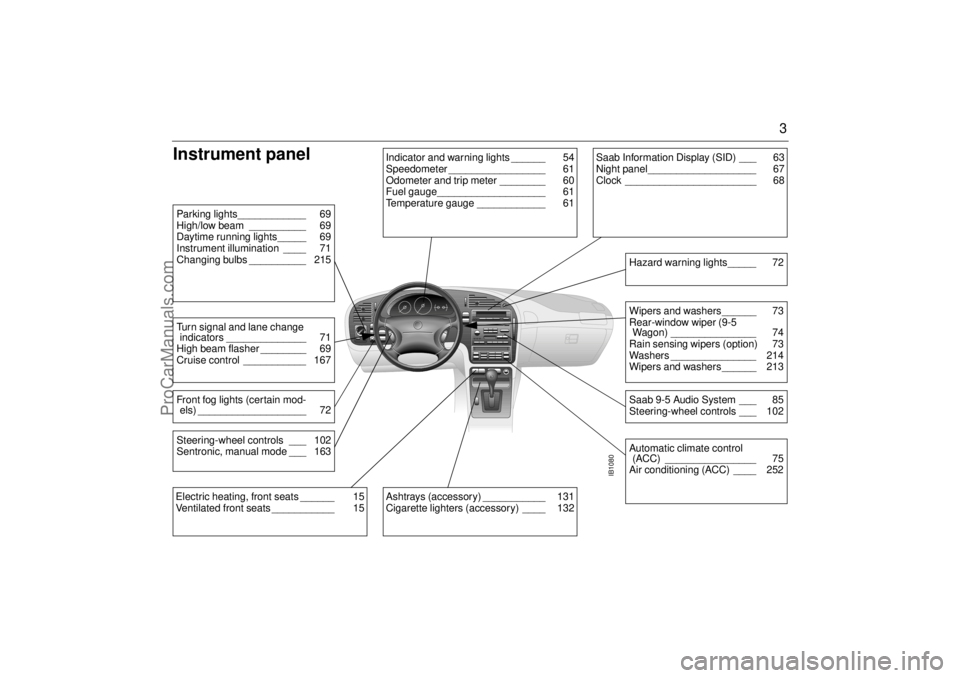
Instrument panel
IB1080
Indicator and warning lights ______ 54
Speedometer _________________ 61
Odometer and trip meter ________ 60
Fuel gauge___________________ 61
Temperature gauge ____________ 61
Parking lights____________ 69
High/low beam __________ 69
Daytime running lights_____ 69
Instrument illumination ____ 71
Changing bulbs __________ 215Turn signal and lane change
indicators ______________ 71
High beam flasher ________ 69
Cruise control ___________ 167Front fog lights (certain mod-
els) ___________________ 72
Ashtrays (accessory) ___________ 131
Cigarette lighters (accessory) ____ 132
Saab Information Display (SID) ___ 63
Night panel___________________ 67
Clock _______________________ 68
Wipers and washers ______ 73
Rear-window wiper (9-5
Wagon) _______________ 74
Rain sensing wipers (option) 73
Washers _______________ 214
Wipers and washers ______ 213Saab 9-5 Audio System ___ 85
Steering-wheel controls ___ 102Hazard warning lights_____ 72Automatic climate control
(ACC) ________________ 75
Air conditioning (ACC) ____ 252
Electric heating, front seats ______ 15
Ventilated front seats ___________ 15Steering-wheel controls ___ 102
Sentronic, manual mode ___ 163
ProCarManuals.com
Page 35 of 288
35 Safety
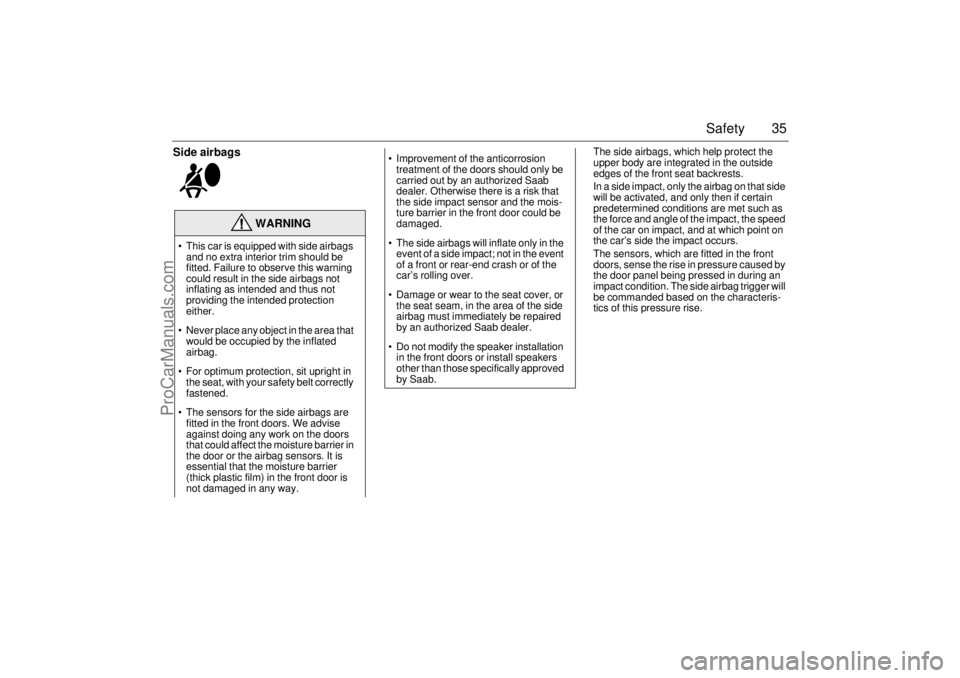
Side airbags
The side airbags, which help protect the
upper body are integrated in the outside
edges of the front seat backrests.
In a side impact, only the airbag on that side
will be activated, and only then if certain
predetermined conditions are met such as
the force and angle of the impact, the speed
of the car on impact, and at which point on
the car’s side the impact occurs.
The sensors, which are fitted in the front
doors, sense the rise in pressure caused by
the door panel being pressed in during an
impact condition. The side airbag trigger will
be commanded based on the characteris-
tics of this pressure rise.
WARNING
This car is equipped with side airbags
and no extra interior trim should be
fitted. Failure to observe this warning
could result in the side airbags not
inflating as intended and thus not
providing the intended protection
either.
Never place any object in the area that
would be occupied by the inflated
airbag.
For optimum protection, sit upright in
the seat, with your safety belt correctly
fastened.
The sensors for the side airbags are
fitted in the front doors. We advise
against doing any work on the doors
that could affect the moisture barrier in
the door or the airbag sensors. It is
essential that the moisture barrier
(thick plastic film) in the front door is
not damaged in any way.
Improvement of the anticorrosion
treatment of the doors should only be
carried out by an authorized Saab
dealer. Otherwise there is a risk that
the side impact sensor and the mois-
ture barrier in the front door could be
damaged.
The side airbags will inflate only in the
event of a side impact; not in the event
of a front or rear-end crash or of the
car’s rolling over.
Damage or wear to the seat cover, or
the seat seam, in the area of the side
airbag must immediately be repaired
by an authorized Saab dealer.
Do not modify the speaker installation
in the front doors or install speakers
other than those specifically approved
by Saab.
ProCarManuals.com
Page 37 of 288

37 Safety
Scrapping or working on airbags
and belt pretensioners Frequently asked questions on func-
tion of airbags
Do you still need to wear a
safety b
elt if
airbags are fitted?
Yes, always! The airbag merely supple-
ments the car’s normal safety system.
Moreover, the airbag will only be actuated in
a moderate to severe frontal, or near-frontal
crash, which means, of course, that it
provides no protection in minor frontal
crashes, major rear-end or side-on crashes
or if the car rolls over.
The safety belts help reduce the chance of
the car occupants from being thrown around
and injured or killed inside the car.
But they also ensure that, if a crash occurs
in which the airbags are inflated, the airbag
will make the optimum contact with the
occupant, i.e. square on from the front. If the
occupant meets the airbag in an offset posi-
tion, the protection afforded will be reduced.
In addition, airbags provide no protection
against a secondary impact occurring in the
same incident. So there is no doubt about
the benefit of wearing safety belts at all
times.
Do not sit too close to the airbag: it needs
room to inflate.
The airbag inflates very quickly and power-
fully in order to protect an adult person,
before they are thrown forward, in a serious
frontal crash.
How do I position the seat to leave room for
the airbag to inflate?Don’t have your seat too far forward.
Recline the seat back to increase the
distance between you and the airbag. For
short drivers, special accessory pedal
extensions are available through your Saab
dealer.
Airbags inflate extremely rapidly and with
great force – to be fast enough to protect an
adult in the seat. When do the front airbags inflate? The airbag will only be inflated under certain
predetermined conditions in a moderate to
severe frontal, or near-frontal crash,
depending on such factors as the force and
angle of the impact, the speed of the car on
impact, and the resistance to deformation of
the impacting object.
The airbag can only be activated once in the
same incident.
Do not attempt to drive the car after an
airbag has been inflated, even if it is possi-
ble.
WARNING
Under no circumstances should any
modifications be made that affect the
steering wheel or the airbag’s electri-
cal circuitry.
Before starting any welding work on
the car, always disconnect the nega-
tive (–) battery lead and cover the
conductor.
Airbags and belt pretensioners must
be deployed under controlled condi-
tions before the car is scrapped or any
of the system’s components are
removed. Airbags or belt pretension-
ers that have been deployed as a
result of a crash must be replaced by
new ones.
Airbag-system components must
never be transferred for use in another
vehicle.
All work involving the scrapping or
replacement of airbags or belt preten-
sioners must only be carried out by
knowledgeable personnel.
The headlining and roof pillar trim
must not be modified in any way. Work
on these areas must only be carried
out at a Saab dealer.
ProCarManuals.com
Page 38 of 288

38 SafetyWhat won’t trigger the front airbags? The airbag will not be activated in all
front-end crashes. For instance, if the car
has hit something relatively soft and yielding
(e.g. a snow drift or a hedge) or a solid
object at a low impact speed, the airbag will
not necessarily be triggered. How loud is the inflation? The noise of the inflation is certainly loud,
but it is very short-lived and will not damage
your hearing. For a short time afterwards
you could experience a buzzing noise in
your ears.
Most people who have experienced it
cannot remember the noise of the inflation
at all – all they remember is the noise of the
crash. Can you still use a child seat in the front if a
passenger airbag is installed? Definitely not!
Children 12 and under or shorter than
55 inches (140 cm) can be killed by the
airbag.
The BACK SEAT is the SAFEST place for
children.
NEVER put a child seat in the front.
Sit as far back as possible from the air bag.
Always use safety belts and child restraints.
Are the smoke and fumes given off when the
airbag operates at all harmful? Most people who have remained in a car
with little or no ventilation for several
minutes complained only of minor irritation
of the throat and eyes. Avoid as far as possi-
ble getting dust on your skin as there is a risk
of skin irritation.
If you suffer from asthma, the incident may
bring on an attack, in which case you should
follow the normal procedure advised by
your doctor. It is advisable to consult a
doctor afterwards.
What should I do if the AIR-BAG warning
light comes on? If the warning light is on, it means that a fault
has been detected in the system. The
airbag cannot be relied on to operate as
intended and it might even be activated
erroneously. You should therefore take the
car to an authorized Saab dealer as soon as
possible.
ProCarManuals.com
Page 54 of 288
54 Instruments and controls
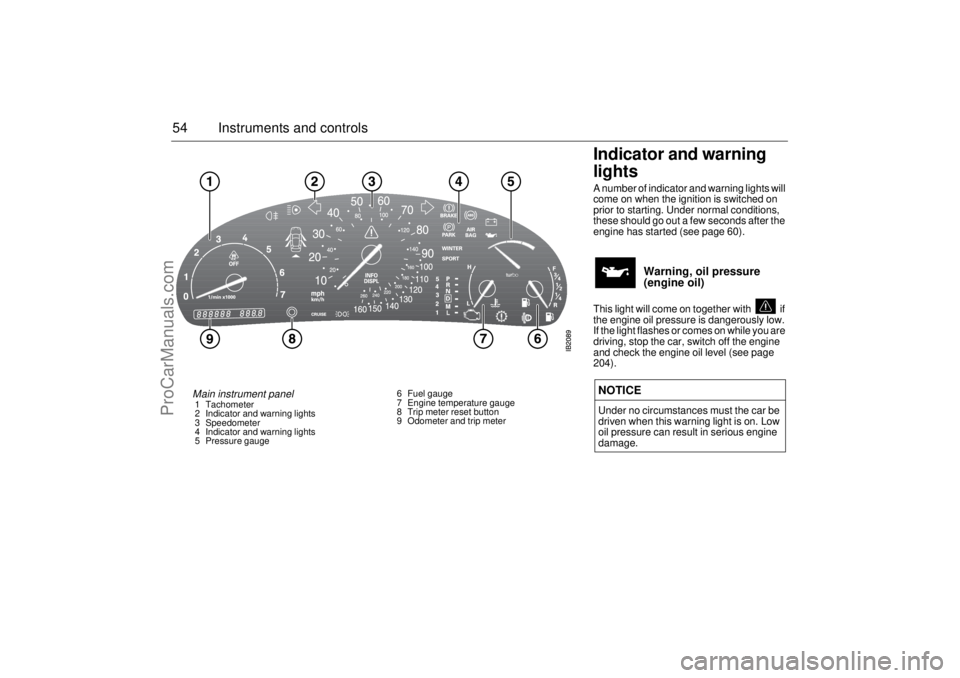
Indicator and warning
lights A number of indicator and warning lights will
come on when the ignition is switched on
prior to starting. Under normal conditions,
these should go out a few seconds after the
engine has started (see page 60).
Warning, oil pressure
(engine oil)
This light will come on together with if
the engine oil pressure is dangerously low.
If the light flashes or comes on while you are
driving, stop the car, switch off the engine
and check the engine oil level (see page
204). NOTICEUnder no circumstances must the car be
driven when this warning light is on. Low
oil pressure can result in serious engine
damage.
Main instrument panel 1 Tachometer
2 Indicator and warning lights
3 Speedometer
4 Indicator and warning lights
5 Pressure gauge6 Fuel gauge
7 Engine temperature gauge
8 Trip meter reset button
9 Odometer and trip meter
ProCarManuals.com
Page 59 of 288
59 Instruments and controls
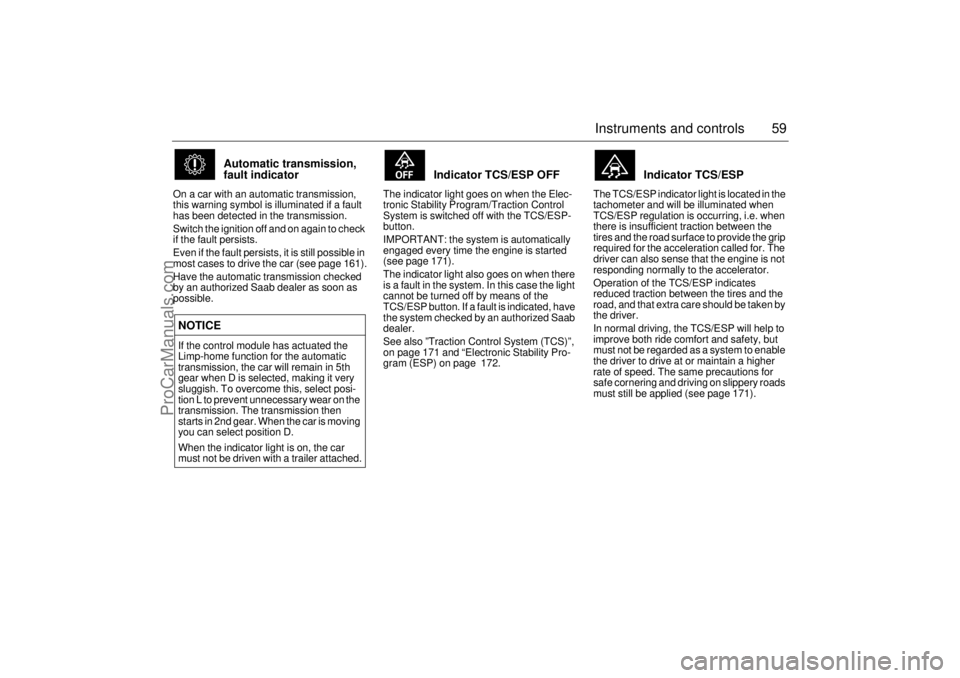
Automatic transmission,
fault indicator
On a car with an automatic transmission,
this warning symbol is illuminated if a fault
has been detected in the transmission.
Switch the ignition off and on again to check
if the fault persists.
Even if the fault persists, it is still possible in
most cases to drive the car (see page 161).
Have the automatic transmission checked
by an authorized Saab dealer as soon as
possible.
Indicator TCS/ESP OFF
The indicator light goes on when the Elec-
tronic Stability Program/Traction Control
System is switched off with the TCS/ESP-
button.
IMPORTANT: the system is automatically
engaged every time the engine is started
(see page 171).
The indicator light also goes on when there
is a fault in the system. In this case the light
cannot be turned off by means of the
TCS/ESP button. If a fault is indicated, have
the system checked by an authorized Saab
dealer.
See also ”Traction Control System (TCS)”,
on page 171 and “Electronic Stability Pro-
gram (ESP) on page 172.
Indicator TCS/ESP
The TCS/ESP indicator light is located in the
tachometer and will be illuminated when
TCS/ESP regulation is occurring, i.e. when
there is insufficient traction between the
tires and the road surface to provide the grip
required for the acceleration called for. The
driver can also sense that the engine is not
responding normally to the accelerator.
Operation of the TCS/ESP indicates
reduced traction between the tires and the
road, and that extra care should be taken by
the driver.
In normal driving, the TCS/ESP will help to
improve both ride comfort and safety, but
must not be regarded as a system to enable
the driver to drive at or maintain a higher
rate of speed. The same precautions for
safe cornering and driving on slippery roads
must still be applied (see page 171).
NOTICEIf the control module has actuated the
Limp-home function for the automatic
transmission, the car will remain in 5th
gear when D is selected, making it very
sluggish. To overcome this, select posi-
tion L to prevent unnecessary wear on the
transmission. The transmission then
starts in 2nd gear. When the car is moving
you can select position D.
When the indicator light is on, the car
must not be driven with a trailer attached.
ProCarManuals.com
Page 60 of 288
60 Instruments and controlsAutochecking of lights,
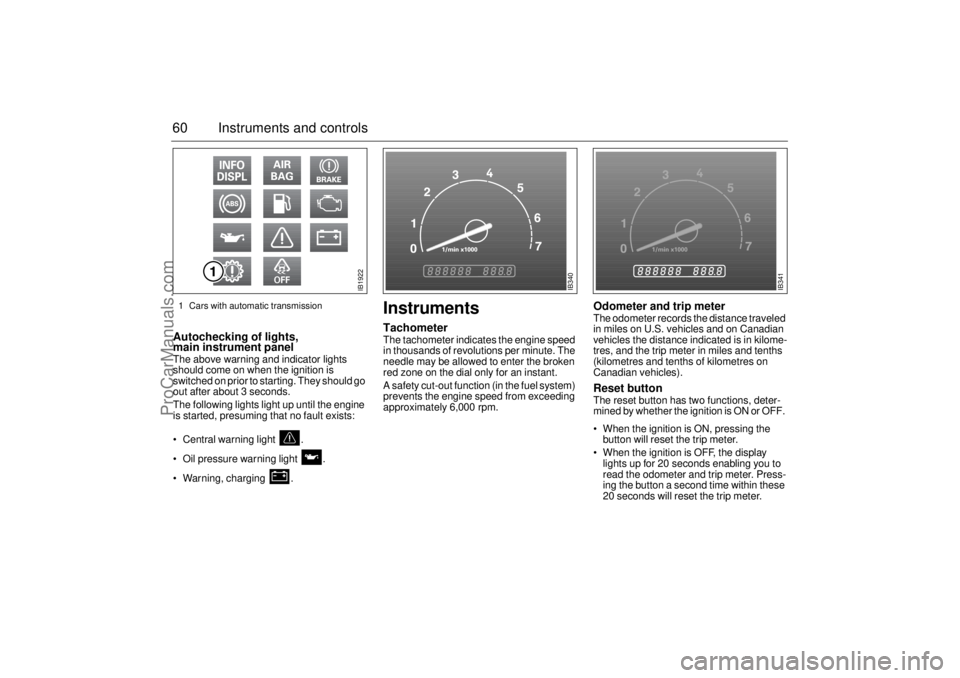
main instrument panel The above warning and indicator lights
should come on when the ignition is
switched on prior to starting. They should go
out after about 3 seconds.
The following lights light up until the engine
is started, presuming that no fault exists:
Central warning light .
Oil pressure warning light .
Warning, charging .
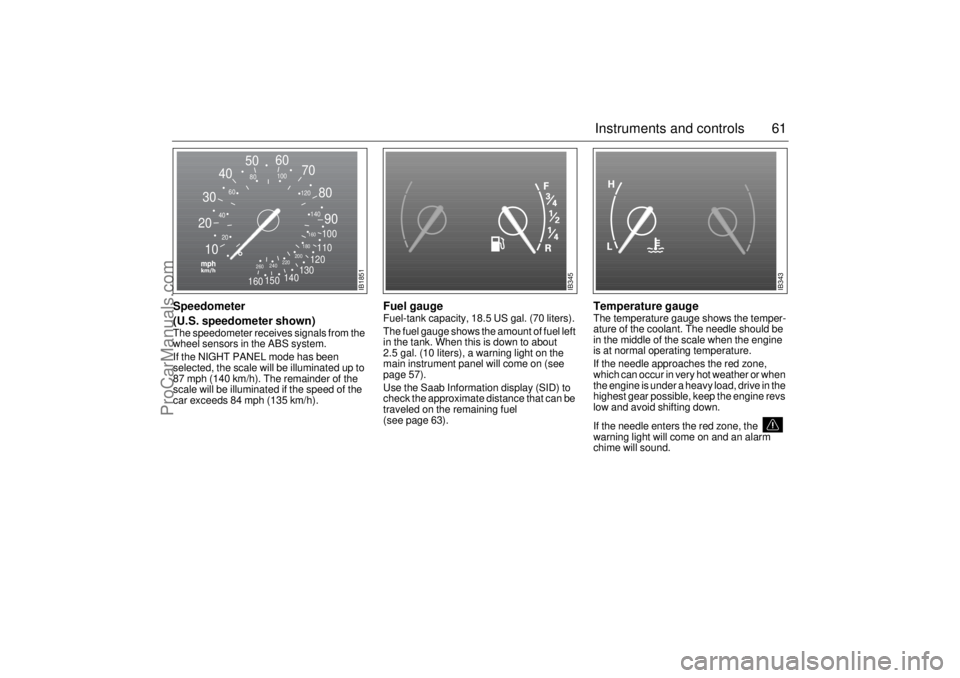
InstrumentsTachometerThe tachometer indicates the engine speed
in thousands of revolutions per minute. The
needle may be allowed to enter the broken
red zone on the dial only for an instant.
A safety cut-out function (in the fuel system)
prevents the engine speed from exceeding
approximately 6,000 rpm.
Odometer and trip meter The odometer records the distance traveled
in miles on U.S. vehicles and on Canadian
vehicles the distance indicated is in kilome-
tres, and the trip meter in miles and tenths
(kilometres and tenths of kilometres on
Canadian vehicles). Reset button The reset button has two functions, deter-
mined by whether the ignition is ON or OFF.
When the ignition is ON, pressing the
button will reset the trip meter.
When the ignition is OFF, the display
lights up for 20 seconds enabling you to
read the odometer and trip meter. Press-
ing the button a second time within these
20 seconds will reset the trip meter.
IB1922
IB340
IB341
1 Cars with automatic transmission
ProCarManuals.com
Page 61 of 288
61 Instruments and controls
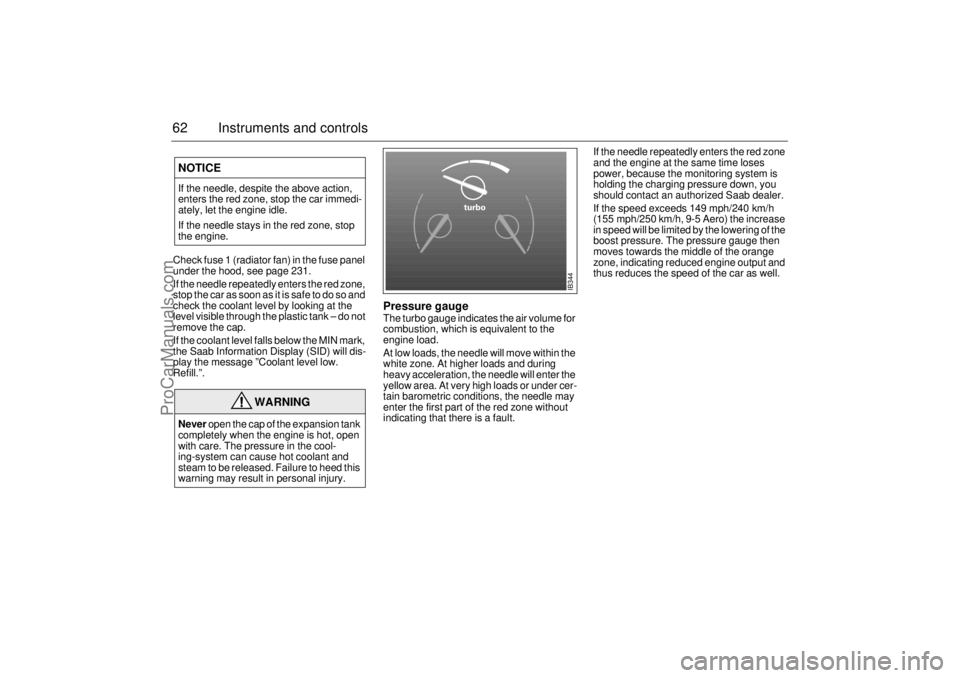
Speedometer
(U.S. speedometer shown)The speedometer receives signals from the
wheel sensors in the ABS system.
If the NIGHT PANEL mode has been
selected, the scale will be illuminated up to
87 mph (140 km/h). The remainder of the
scale will be illuminated if the speed of the
car exceeds 84 mph (135 km/h).
Fuel gauge Fuel-tank capacity, 18.5 US gal. (70 liters).
The fuel gauge shows the amount of fuel left
in the tank. When this is down to about
2.5 gal. (10 liters), a warning light on the
main instrument panel will come on (see
page 57).
Use the Saab Information display (SID) to
check the approximate distance that can be
traveled on the remaining fuel
(see page 63).
Temperature gauge The temperature gauge shows the temper-
ature of the coolant. The needle should be
in the middle of the scale when the engine
is at normal operating temperature.
If the needle approaches the red zone,
which can occur in very hot weather or when
the engine is under a heavy load, drive in the
highest gear possible, keep the engine revs
low and avoid shifting down.
If the needle enters the red zone, the
warning light will come on and an alarm
chime will sound.
2030405060
70
80
90
100
110
120
130
140
150
160
240
260220200180160
140 120 100
80
60
40
20
10
IB1851
IB345
IB343
ProCarManuals.com
Page 62 of 288
62 Instruments and controls Check fuse 1 (radiator fan) in the fuse panel
under the hood, see page 231.
If the needle repeatedly enters the red zone,
stop the car as soon as it is safe to do so and
check the coolant level by looking at the
level visible through the plastic tank – do not
remove the cap.
If the coolant level falls below the MIN mark,
the Saab Information Display (SID) will dis-
play the message ”Coolant level low.
Refill.”.
Pressure gaugeThe turbo gauge indicates the air volume for
combustion, which is equivalent to the
engine load.
At low loads, the needle will move within the
white zone. At higher loads and during
heavy acceleration, the needle will enter the
yellow area. At very high loads or under cer-
tain barometric conditions, the needle may
enter the first part of the red zone without
indicating that there is a fault.If the needle repeatedly enters the red zone
and the engine at the same time loses
power, because the monitoring system is
holding the charging pressure down, you
should contact an authorized Saab dealer.
If the speed exceeds 149 mph/240 km/h
(155 mph/250 km/h, 9-5 Aero) the increase
in speed will be limited by the lowering of the
boost pressure. The pressure gauge then
moves towards the middle of the orange
zone, indicating reduced engine output and
thus reduces the speed of the car as well.
NOTICEIf the needle, despite the above action,
enters the red zone, stop the car immedi-
ately, let the engine idle.
If the needle stays in the red zone, stop
the engine.
WARNING
Never open the cap of the expansion tank
completely when the engine is hot, open
with care. The pressure in the cool-
ing-system can cause hot coolant and
steam to be released. Failure to heed this
warning may result in personal injury.
IB344
ProCarManuals.com
Page 63 of 288
63 Instruments and controls
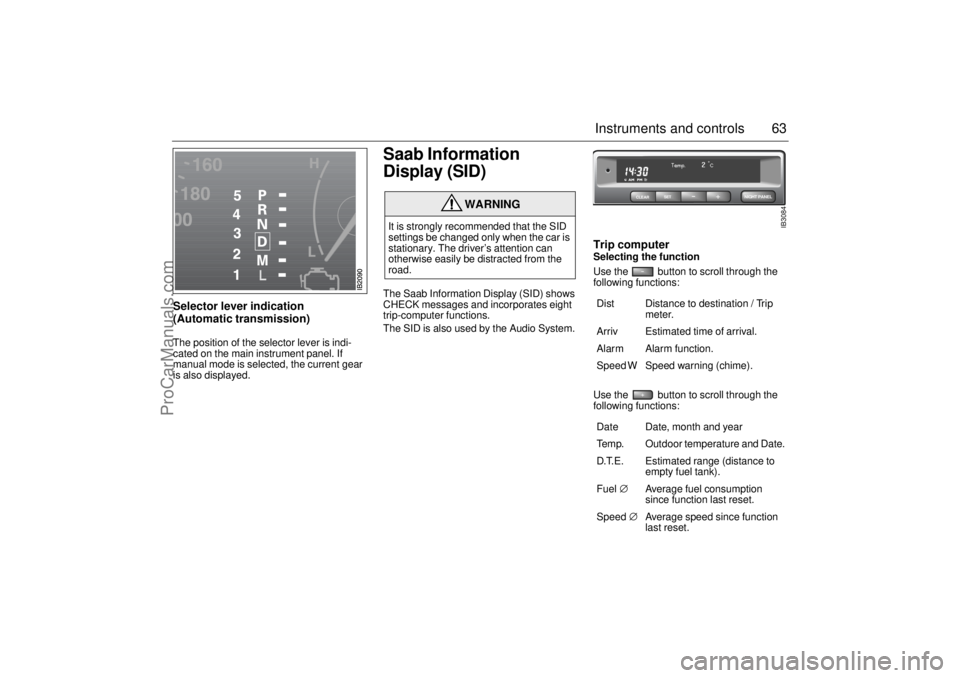
Selector lever indication
(Automatic transmission) The position of the selector lever is indi-
cated on the main instrument panel. If
manual mode is selected, the current gear
is also displayed.
Saab Information
Display (SID) The Saab Information Display (SID) shows
CHECK messages and incorporates eight
trip-computer functions.
The SID is also used by the Audio System.
Trip computerSelecting the function
Use the button to scroll through the
following functions: Use the button to scroll through the
following functions:
WARNING
It is strongly recommended that the SID
settings be changed only when the car is
stationary. The driver’s attention can
otherwise easily be distracted from the
road.
Dist Distance to destination / Trip
meter.
Arriv Estimated time of arrival.
Alarm Alarm function.
Speed W Speed warning (chime).
Date Date, month and year
Temp. Outdoor temperature and Date.
D.T.E. Estimated range (distance to
empty fuel tank).
Fuel∅ Average fuel consumption
since function last reset.
Speed∅ Average speed since function
last reset.
CLEARSET
NIGHT PANEL
IB3084
ProCarManuals.com