flat tire SAAB 9-5 2005 User Guide
[x] Cancel search | Manufacturer: SAAB, Model Year: 2005, Model line: 9-5, Model: SAAB 9-5 2005Pages: 276, PDF Size: 16.72 MB
Page 228 of 276
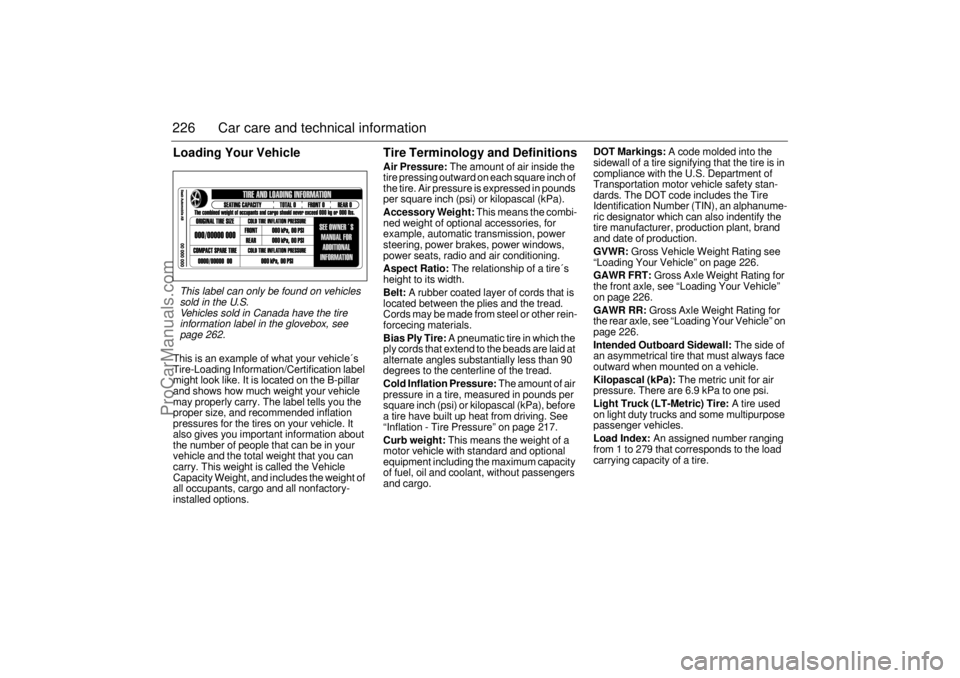
226 Car care and technical informationLoading Your VehicleThis is an example of what your vehicle´s
Tire-Loading Information/Certification label
might look like. It is located on the B-pillar
and shows how much weight your vehicle
may properly carry. The label tells you the
proper size, and recommended inflation
pressures for the tires on your vehicle. It
also gives you important information about
the number of people that can be in your
vehicle and the total weight that you can
carry. This weight is called the Vehicle
Capacity Weight, and includes the weight of
all occupants, cargo and all nonfactory-
installed options.
Tire Terminology and DefinitionsAir Pressure:
The amount of air inside the
tire pressing outward on each square inch of
the tire. Air pressure is expressed in pounds
per square inch (psi) or kilopascal (kPa).
Accessory Weight:
This means the combi-
ned weight of optional accessories, for
example, automatic transmission, power
steering, power brakes, power windows,
power seats, radio and air conditioning.
Aspect Ratio:
The relationship of a tire´s
height to its width.
Belt:
A rubber coated layer of cords that is
located between the plies and the tread.
Cords may be made from steel or other rein-
forcecing materials.
Bias Ply Tire:
A pneumatic tire in which the
ply cords that extend to the beads are laid at
alternate angles substantially less than 90
degrees to the centerline of the tread.
Cold Inflation Pressure:
The amount of air
pressure in a tire, measured in pounds per
square inch (psi) or kilopascal (kPa), before
a tire have built up heat from driving. See
“Inflation - Tire Pressure” on page 217.
Curb weight:
This means the weight of a
motor vehicle with standard and optional
equipment including the maximum capacity
of fuel, oil and coolant, without passengers
and cargo.
DOT Markings:
A code molded into the
sidewall of a tire signifying that the tire is in
compliance with the U.S. Department of
Transportation motor vehicle safety stan-
dards. The DOT code includes the Tire
Identification Number (TIN), an alphanume-
ric designator which can also indentify the
tire manufacturer, production plant, brand
and date of production.
GVWR:
Gross Vehicle Weight Rating see
“Loading Your Vehicle” on page 226.
GAWR FRT:
Gross Axle Weight Rating for
the front axle, see “Loading Your Vehicle”
on page 226.
GAWR RR:
Gross Axle Weight Rating for
the rear axle, see “Loading Your Vehicle” on
page 226.
Intended Outboard Sidewall:
The side of
an asymmetrical tire that must always face
outward when mounted on a vehicle.
Kilopascal (kPa):
The metric unit for air
pressure. There are 6.9 kPa to one psi.
Light Truck (LT-Metric) Tire:
A tire used
on light duty trucks and some multipurpose
passenger vehicles.
Load Index:
An assigned number ranging
from 1 to 279 that corresponds to the load
carrying capacity of a tire.
This label can only be found on vehicles
sold in the U.S.
Vehicles sold in Canada have the tire
information label in the glovebox, see
page 262.
ProCarManuals.com
Page 229 of 276

227 Car care and technical information
Maximum Load rating:
The load rating for
a tire at the maximum permissible inflation
pressure for that tire.
Maximum Loaded Vehicle Weight:
The
sum of curb weight; accessory weight;
vehicle capacity weight; and production
options weight.
Maximum Permissible Inflation Pres-
sure:
The maximum cold inflation pressure
to which a tire may be inflated.
Normal occupant weight:
The number of
occupants a vehicle is designed to seat mul-
tipled by 150 pounds (68 kg). See “Loading
Your Vehicle” on page 226.
Occupant Distribution:
Designated sea-
ting positions.
Outward Facing Sidewall: The side of a
asymmetrical tire that has a particular side
that faces outward when mounted on a
vehicle. The side of the tire that contains a
whitewall bears white lettering or bears
manufacturer, brand and or model name
molding on the other sidewall of the tire.
Passenger (P-Metric) Tire:
A tire used on
passenger cars and some light duty trucks
and multipurpose vehicles.
Recommended Inflation Pressure:
Vehicle manufacturer´s recommended tire
inflation pressure shown on the tire label,
see “Inflation - Tire Pressure” on page 217
and “Loading Your Vehicle” on page 226.
Radial Ply Tire:
A pneumatic tire in which
the ply cords that extend to the beads are
laid at substantially 90 degrees to the cen-
terline of the tread.
Rim:
A metal support for a tire or a tire and
tube assembly upon which the tire beads
are seated.
Sidewall:
The portion of a tire between the
tread and the bead.
Speed rating:
An alphanumeric code
assigned to a tire indicating the maximum
speed at which a tire can operate.
Traction:
The friction between the tire and
the road surface. The amount of grip provi-
ded.
Treadwear Indicators:
Narrow bands,
sometimes called “wear bars”, that show
across the tread of a tire when only
2/32 inch of tread remains. See “When It Is
Time for New Tires” on page 219.
Tread Width:
The width of the tire´s tread.
UTQGS:
Uniform Tire Quality Grade Stan-
dards, a tire information system that provi-
des consumers with ratings for a tire´s trac-
tion, temperature and treadwear. Ratings
are determined by tire manufacturers using
government testing procedures. The rating
are molded into the sidewall of the tire. See
“Uniform Tire Quality Grading” on
page 221.
Vehicle Capacity Weight:
Is the number of
designated seating positions multipled by
150 pounds (68 kg) plus the rated cargo
load. See “Loading Your Vehicle” on
page 226.
Vehicle Maximum Load on the Tire:
Load
on an individual tire due to curb weight,
accessory weight, occupant weight and
cargo weight.
Vehicle label:
A label permanently
attached to a vehicle showing original
equipment tire size and the recommended
cold inflation pressure. See “Loading Your
Vehicle” on page 226.
ProCarManuals.com
Page 232 of 276
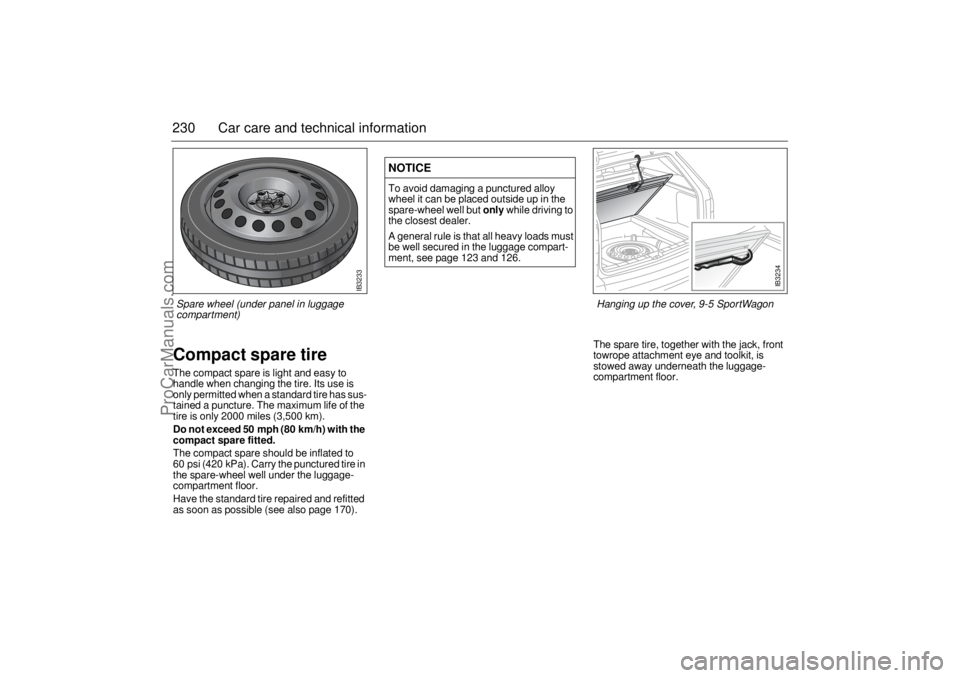
230 Car care and technical informationCompact spare tireThe compact spare is light and easy to
handle when changing the tire. Its use is
only permitted when a standard tire has sus-
tained a puncture. The maximum life of the
tire is only 2000 miles (3,500 km).Do not exceed 50 mph (80 km/h) with the
compact spare fitted.The compact spare should be inflated to
60 psi (420 kPa). Carry the punctured tire in
the spare-wheel well under the luggage-
compartment floor.
Have the standard tire repaired and refitted
as soon as possible (see also page 170).The spare tire, together with the jack, front
towrope attachment eye and toolkit, is
stowed away underneath the luggage-
compartment floor.
NOTICETo avoid damaging a punctured alloy
wheel it can be placed outside up in the
spare-wheel well but
only
while driving to
the closest dealer.
A general rule is that all heavy loads must
be well secured in the luggage compart-
ment, see page 123 and 126.
IB3234
Hanging up the cover, 9-5 SportWagon
IB3233
Spare wheel (under panel in luggage
compartment)
ProCarManuals.com
Page 233 of 276

231 Car care and technical information
Changing a wheel
WARNING
Lifting a vehicle and getting under it to do
maintenance or repairs is dangerous
without the appropriate safety equipment
and training. The jack provided with your
vehicle is designed only for changing a
flat tire. If it is used for anything else, you
or others could be badly injured or killed if
the vehicle slips off the jack. Use the jack
provided with your vehicle only for chang-
ing a flat tire.
Changing a tire can be dangerous. The
vehicle can slip off the jack and roll over
or fall on you or other people. You and
they could be badly injured or even killed.
Find a level place to change your tire. To
help prevent the vehicle from moving:
1 Set the parking brake firmly.
2 If you have an automatic transmis-
sion, put the shift lever in PARK (P).
For a manual transmission, leave the
car in gear (1st or REVERSE (R)).
3 Turn off the engine and do not restart
while the vehicle is raised.
4 Do not allow passengers to remain in
the vehicle.
To be even more certain the vehicle won't
move, you should put blocks at the front
and rear of the tire farthest away from the
one being changed. That would be the
tire, on the other side, at the opposite end
of the vehicle.
The car jack is designed solely for use
in changing a wheel or fitting snow
chains.
It must not be used to
support the car during repair work
or servicing.
Never
crawl under a car that is
supported only by a jack.
Raising your vehicle too high or with
the jack improperly positioned can
damage the vehicle and even make
the vehicle fall. To help avoid personal
injury and vehicle damage, be sure to
fit the jack lift head into the proper
location before raising the vehicle, and
raise the vehicle only far enough off
the ground so there is enough room for
the spare tire to fit (no more than 25
mm or 1 inch clearance between the
ground and the bottom of the tire).
Switch on the hazard warning lights if
the car is on a road.
The jack should be stored correctly
under the carpeting in the trunk. If it
lies loose in the car, it could thrown
forward and cause personal injury in
the event of a crash or if the car rolls
over.
Grit, salt and rust can clog the inner
threads of the wheel bolts if the car has
been driven for several years exclu-
sively with alloy wheels.
If steel wheels are being installed, the
bolt hole threads in the brake hubs
should be cleaned before the thinner
steel wheels are fitted. It may other-
wise not be possible to achieve the
correct clamping force, despite tight-
ening the wheel bolts to the correct
torque.
ProCarManuals.com
Page 245 of 276
243 Car care and technical information
The vehicle should be fully assembled
and all other work stopped while headlight
aiming is being done.
The vehicle should not have any snow, ice
or mud attached to it.
Tires should be inflated to the prescribed
pressure.
Close all doors.
Rock the vehicle to stabilize the suspen-
sion.
Headlight aiming is done with the vehicle
low beam lamps. The high beam lamps will
be correctly aimed if the low beam lamps
are aimed properly.
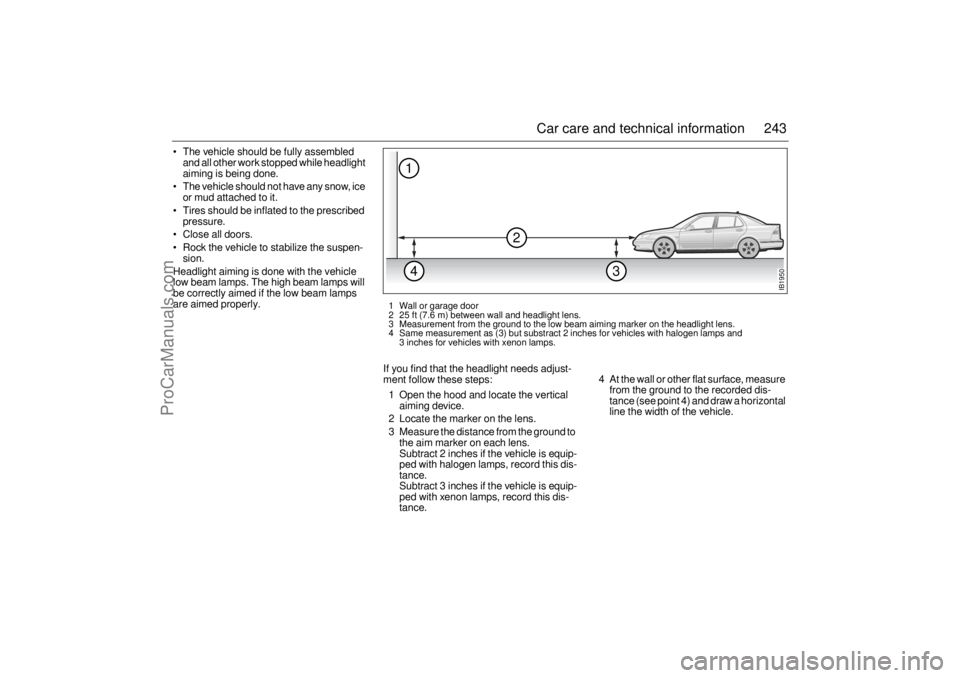
If you find that the headlight needs adjust-
ment follow these steps:
1 Open the hood and locate the vertical
aiming device.
2 Locate the marker on the lens.
3 Measure the distance from the ground to
the aim marker on each lens.
Subtract 2 inches if the vehicle is equip-
ped with halogen lamps, record this dis-
tance.
Subtract 3 inches if the vehicle is equip-
ped with xenon lamps, record this dis-
tance.4 At the wall or other flat surface, measure
from the ground to the recorded dis-
tance (see point 4) and draw a horizontal
line the width of the vehicle.
IB1950
2
14
3
1 Wall or garage door
2 25 ft (7.6 m) between wall and headlight lens.
3 Measurement from the ground to the low beam aiming marker on the headlight lens.
4 Same measurement as (3) but substract 2 inches for vehicles with halogen lamps and
3 inches for vehicles with xenon lamps.
ProCarManuals.com
Page 268 of 276

266 IndexCoolant
_______________________ 188
Courtesy Headlight Feature
________ 68
Crash memory, see EDR
_________ 249
Cruise control
__________________ 151
Cup holder
____________________ 120
DDICE/TWICE
___________________ 212
Dampers
______________________ 259
Date code, tires
_________________ 229
Definitions and terminology, tire
____ 226
Determining correct load, tires
_____ 228
Dim-dipped beam
________________ 67
Direction indicators _______________ 69
Door handles
___________________ 38
Door mirrors
___________________ 107
Doors, locks & luggage compartment
_37
Drive belt
______________________ 257
Drive belt, alternator
_____________ 194
Drive belts, length
_______________ 257
Driver’s seat, programmable
________ 14
Driving at night
_________________ 168
Driving in hot weather
____________ 160
Driving with a load
______________ 168
EEDR (Event Data Recorders)
______ 249
ESP
__________________________ 155
Electric heating seat
______________ 15
Electric heating, front seats
_________ 15
Electric windows
________________ 113
Electrical system, technical data
____ 257
Electronic Stability Program, ESP ___ 155
Electronic starting interlock
_________ 43
Emergency operation of sunroof
____ 115
Emission control systems
_________ 184
Engine bay
____________________ 183
Engine bay, cleaning
_____________ 238
Engine number
_________________ 262
Engine oil, grade ________________ 255
Engine, description ______________ 186
Engine, technical data ____________ 254
Engine, temperature gauge
________ 59
Engine-oil level, checking
_________ 186
Event Data Recorders (EDR) ______ 249
Expansion tank, coolant
__________ 188
FFault codes, Audio System
________ 104
Flat spots, tires
_________________ 218
Fluid level, automatic transmission
__ 188
Folding the rear seat, 9-5 Sedan
___ 121
Folding the rear seat,
9-5 SportWagon
_______________ 124Frequently asked questions on airbag
35
Front fog lights
___________________ 70
Frost warning ____________________ 62
Fuel
__________________________ 138
Fuel consumption
________________ 61
Fuel gauge
_____________________ 59
Fuel grade _____________________ 254
Fuse box under hood
____________ 215
Fuse panel
_____________________ 211
Fuses
_________________________ 211
GGarage door opener
_____________ 108
Gearbox number
________________ 262
Gearbox oil, checking
____________ 188
Gearbox, technical data, __________ 258
Glove compartment
______________ 118
HHandbrake
_____________________ 179
Hazard warning lights
_____________ 70
Head restraint
___________________ 15
Headlight flasher _________________ 67
Headlights
______________________ 67
Hood
_________________________ 182
Horn __________________________ 106
ProCarManuals.com
Page 269 of 276

267 Index
IIf a tire goes flat
________________ 223
Ignition switch
__________________ 132
Immobilizer
_____________________ 43
Indicator and warning lights
________ 52
Indicator lights
___________________ 52
Instrument illumination
____________ 69
Instruments and controls __________ 51
Interior equipment
_______________ 105
Interior lighting
_________________ 116
Interior rearview mirror
___________ 107
JJack
_________________________ 232
KKey
___________________________ 38
Key to chassis number
___________ 263
Key, remove
___________________ 132
LLATCH (child safety)
______________ 22
Labeling, tire sidewall ____________ 224
Labels
__________________________ 7Leather upholstery, care of
________ 236
Light horn
______________________ 67
Light switches ___________________ 67
Loading your vehicle
_____________ 226
Luggage-compartment lighting
_____ 116
MMain instrument panel
_____________ 52
Main/dipped beam
_______________ 67
Maintenance schedule ___________ 246
Maintenance, A/C-system _________ 234
Manual gearbox, technical data
____ 258
Maxi fuses
_____________________ 212
Milometer ______________________ 58
Motoring abroad
________________ 241
NNew tires, buying
_______________ 219
Night Panel
_____________________ 65
OOil capacity, engine
______________ 254
Oil change, engine ______________ 187
Oil specification
_________________ 254
Outdoor temperature
______________ 61
Owner assistance
_______________ 247
PPaintwork, touching-in
____________ 238
Parking Assistance
______________ 177
Parking lights
____________________ 67
Plates and labels
________________ 262
Poly-V-belt
_____________________ 194
Power steering
_________________ 191
Power-steering fluid
______________ 191
Pressure gauge
__________________ 60
Programming I, ACC
______________ 79
Programming II, ACC _____________ 80
Programming the ACC ____________ 79
QQuality grading, tires
_____________ 221
Questions on function of airbag
______ 35
Quick guide, Audio System
_________ 85
RRadiator fan
____________________ 194
Radio
__________________________ 88
Rain sensor
_____________________ 71
Rear fog light ____________________ 68
Rear seat, 9-5 Sedan, folding
______ 121
Rear seat, 9-5 SportWagon, folding
_ 124
Rear-seat head restraints
__________ 16
Rear-view mirror, auto-dimming
____ 111
ProCarManuals.com
Page 271 of 276

269 Index
Towing, automatics
______________ 171
Trailer weights
_________________ 253
Treadwear indicators
____________ 219
Trionic
________________________ 184
Trip computer
___________________ 61
Trip meter
______________________ 58
Trunk
_________________________ 121
Trunk lid, opening
________________ 42
Turbo gauge
____________________ 60
Turbo, points to note
_____________ 136
UUnder the hood
_________________ 183
Uniform tire quality grading
________ 221
Upholstery and trim
______________ 236
Upholstery and trim, care of
_______ 236
Useful tips, ACC
_________________ 81
VVanity mirrors
__________________ 117
Vehicle Data Collection
___________ 249
Ventilated front seats
_____________ 14
Viscosity, engine oil
_____________ 254
WWarning labels
___________________ 7
Warning light, AIR BAG
___________ 33
Warning lights
___________________ 52
Washers
______________________ 195
Washers, windshield
_____________ 196
Washing the car
________________ 237
Waxing and polishing
____________ 238
Wear indicators, tires ____________ 219
What Will You See After an Airbag
Inflates?
______________________ 34
Wheel replacement
______________ 222
Wheel, change
_________________ 231
Wheels and tires ________________ 260
Wheels and tires, sizes
___________ 260
When it is time for new tires
_______ 219
Windshield washers
______________ 71
Windshield wipers
________________ 71
Winter tires
________________ 228
, 260
Wiper blades, replacing
__________ 195
Wipers and washers
__________ 71
, 195
XXenon headlight
________________ 197
ProCarManuals.com