seats SAAB 9-5 2005 Owners Manual
[x] Cancel search | Manufacturer: SAAB, Model Year: 2005, Model line: 9-5, Model: SAAB 9-5 2005Pages: 276, PDF Size: 16.72 MB
Page 5 of 276
3
Instrument panel
IB1080
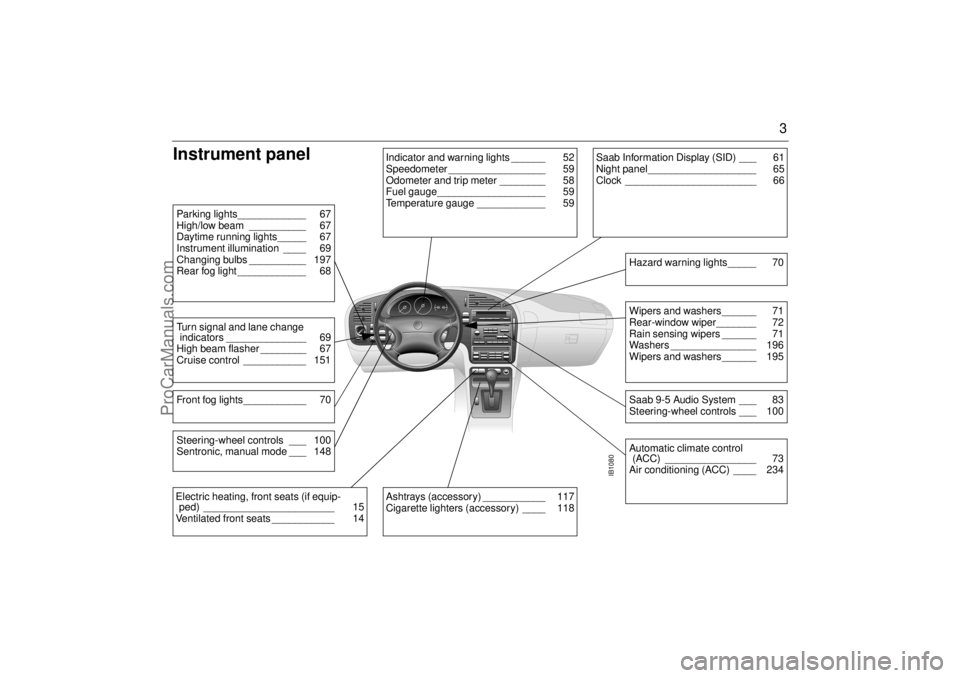
Indicator and warning lights ______ 52
Speedometer _________________ 59
Odometer and trip meter ________ 58
Fuel gauge___________________ 59
Temperature gauge ____________ 59
Parking lights____________ 67
High/low beam __________ 67
Daytime running lights_____ 67
Instrument illumination ____ 69
Changing bulbs __________ 197
Rear fog light ____________ 68Turn signal and lane change
indicators ______________ 69
High beam flasher ________ 67
Cruise control ___________ 151Front fog lights___________ 70
Ashtrays (accessory) ___________ 117
Cigarette lighters (accessory) ____ 118
Saab Information Display (SID) ___ 61
Night panel___________________ 65
Clock _______________________ 66
Wipers and washers ______ 71
Rear-window wiper_______ 72
Rain sensing wipers ______ 71
Washers _______________ 196
Wipers and washers ______ 195Saab 9-5 Audio System ___ 83
Steering-wheel controls ___ 100Hazard warning lights_____ 70Automatic climate control
(ACC) ________________ 73
Air conditioning (ACC) ____ 234
Electric heating, front seats (if equip-
ped) _______________________ 15
Ventilated front seats ___________ 14Steering-wheel controls ___ 100
Sentronic, manual mode ___ 148
ProCarManuals.com
Page 7 of 276
5
Interior
IB3150
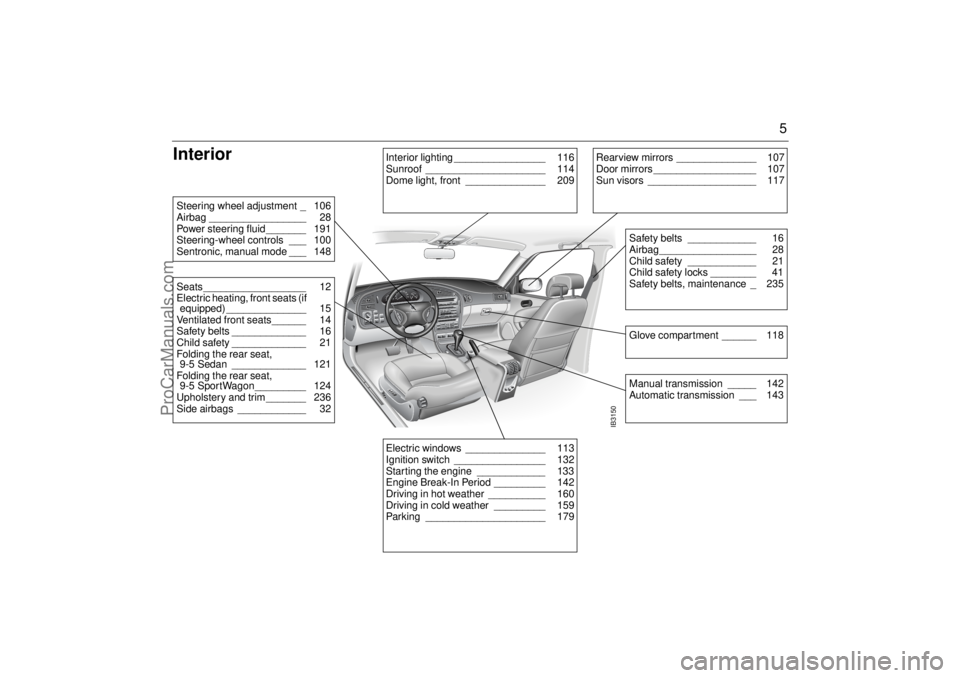
Rearview mirrors ______________ 107
Door mirrors __________________ 107
Sun visors ___________________ 117
Safety belts ____________ 16
Airbag_________________ 28
Child safety ____________ 21
Child safety locks ________ 41
Safety belts, maintenance _ 235Glove compartment ______ 118Manual transmission _____ 142
Automatic transmission ___ 143
Electric windows ______________ 113
Ignition switch ________________ 132
Starting the engine ____________ 133
Engine Break-In Period _________ 142
Driving in hot weather __________ 160
Driving in cold weather _________ 159
Parking _____________________ 179
Steering wheel adjustment _ 106
Airbag _________________ 28
Power steering fluid _______ 191
Steering-wheel controls ___ 100
Sentronic, manual mode ___ 148Seats __________________ 12
Electric heating, front seats (if
equipped) ______________ 15
Ventilated front seats______ 14
Safety belts _____________ 16
Child safety _____________ 21
Folding the rear seat,
9-5 Sedan _____________ 121
Folding the rear seat,
9-5 SportWagon_________ 124
Upholstery and trim _______ 236
Side airbags ____________ 32
Interior lighting ________________ 116
Sunroof _____________________ 114
Dome light, front ______________ 209
ProCarManuals.com
Page 13 of 276
11 Safety
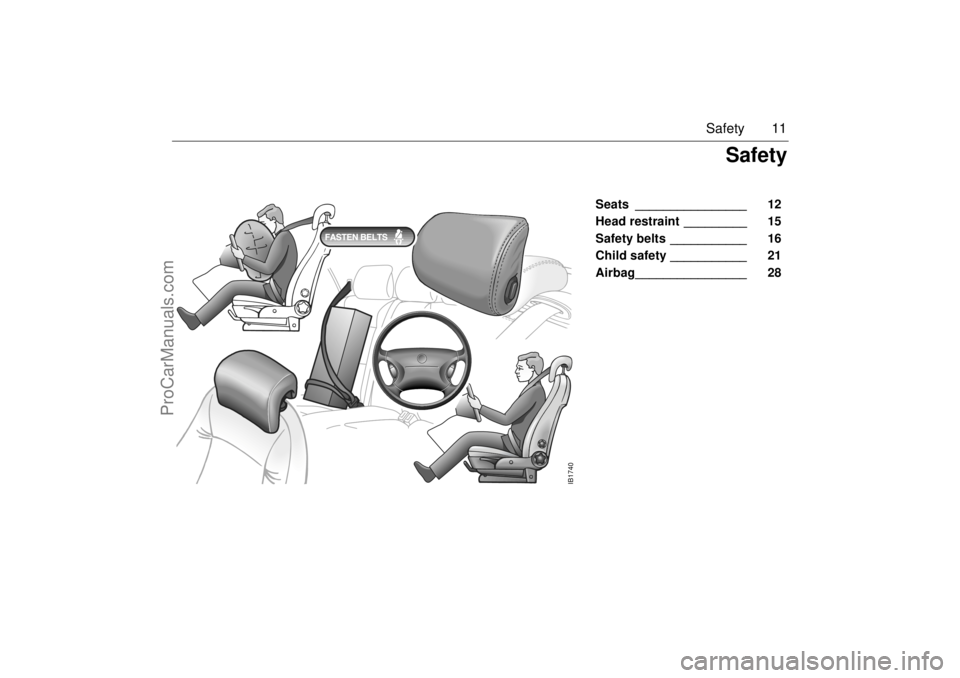
Seats ________________ 12
Head restraint _________ 15
Safety belts ___________ 16
Child safety ___________ 21
Airbag________________ 28
IB1740
Safety
ProCarManuals.com
Page 14 of 276
12 SafetySeats Both front seats are electrically operated.
On certain models the driver´s seat is equip-
ped with a memory function.
To facilitate getting into the car, both seats
can be adjusted when either of the front
doors is open.
For safety reasons, if the door is closed, the
seat can only be adjusted when the ignition
is ON.
Note, however, that both seats can be
adjusted for 30 seconds after both doors
have been closed. The following seat adjustments can be
made to achieve a comfortable driving
position:
height
legroom
backrest rake angle
lumbar support (driver´s seat)
head-restraint height
We recommend that adjustments to the
driver’s seat be performed in the following
order:
1height
2 legroom
3 seat tilt angle
4 backrest rake angle
Lastly, adjust the steering wheel (see
page 106).
Side airbags(see page 32).Head restraint(see page 15).
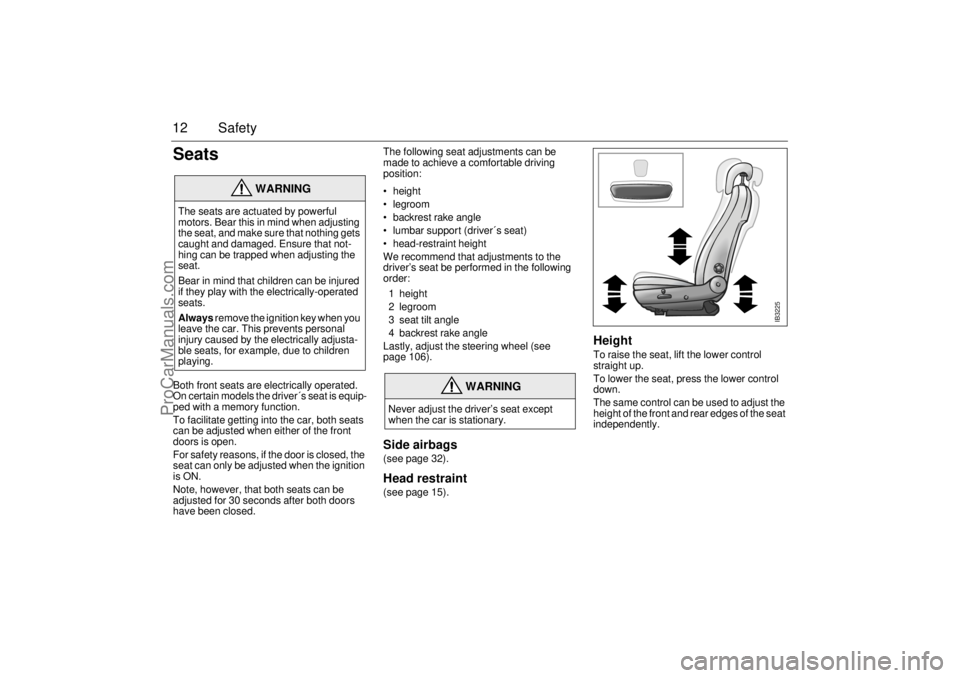
HeightTo raise the seat, lift the lower control
straight up.
To lower the seat, press the lower control
down.
The same control can be used to adjust the
height of the front and rear edges of the seat
independently.
WARNING
The seats are actuated by powerful
motors. Bear this in mind when adjusting
the seat, and make sure that nothing gets
caught and damaged. Ensure that not-
hing can be trapped when adjusting the
seat.
Bear in mind that children can be injured
if they play with the electrically-operated
seats.
Always remove the ignition key when you
leave the car. This prevents personal
injury caused by the electrically adjusta-
ble seats, for example, due to children
playing.
WARNING
Never adjust the driver’s seat except
when the car is stationary.
IB3225
ProCarManuals.com
Page 16 of 276

14 SafetyMemory driver’s seat(if equipped)
In certain models the driver´s seat is equip-
ped with a programmable memory function.
This function also includes the door mirrors.
Adjust the seat and door mirrors.
To save the settings, press and hold the M
button and, at the same time, press one of
the preselect buttons (1, 2 or 3). The Saab
Information Display (SID) will chime to con-
firm that the settings have been saved.To recall the programmed settings, press
and hold the appropriate preset button,
whereupon the seat and mirrors will be
adjusted automatically.
To change the settings stored in a preset
button, adjust the seat and mirrors as before
and save the new settings by pressing M
and the appropriate preset button.
To facilitate reversing, the passenger side
door mirror can be tilted down automati-
cally, e.g. to show the curb. To do this,
select reverse and press the small grey
button adjacent to the door-mirror control.
When you deselect reverse, the mirror will
automatically return to its original setting
(see page 107).
Ventilated front seats(if equipped)
Ventilated front seats, that enhance seating
comfort in hot weather, are an option on Arc
and Aero models (certain markets).
Ventilated seats are equipped with two fans
that extract the moist air from between the
seat and the body.
The fans have three speeds and are OFF
when the switch is set to 0.
IB404
IB405
ProCarManuals.com
Page 17 of 276
15 Safety
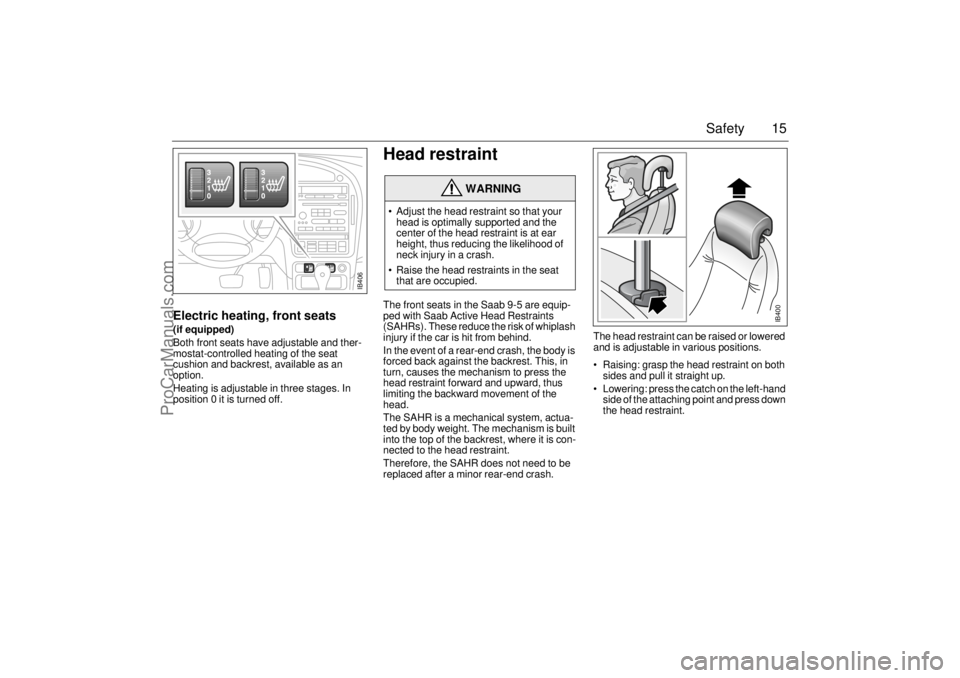
Electric heating, front seats(if equipped)
Both front seats have adjustable and ther-
mostat-controlled heating of the seat
cushion and backrest, available as an
option.
Heating is adjustable in three stages. In
position 0 it is turned off.
Head restraintThe front seats in the Saab 9-5 are equip-
ped with Saab Active Head Restraints
(SAHRs). These reduce the risk of whiplash
injury if the car is hit from behind.
In the event of a rear-end crash, the body is
forced back against the backrest. This, in
turn, causes the mechanism to press the
head restraint forward and upward, thus
limiting the backward movement of the
head.
The SAHR is a mechanical system, actua-
ted by body weight. The mechanism is built
into the top of the backrest, where it is con-
nected to the head restraint.
Therefore, the SAHR does not need to be
replaced after a minor rear-end crash.The head restraint can be raised or lowered
and is adjustable in various positions.
Raising: grasp the head restraint on both
sides and pull it straight up.
Lowering: press the catch on the left-hand
side of the attaching point and press down
the head restraint.
WARNING
Adjust the head restraint so that your
head is optimally supported and the
center of the head restraint is at ear
height, thus reducing the likelihood of
neck injury in a crash.
Raise the head restraints in the seat
that are occupied.
IB406
IB400
ProCarManuals.com
Page 18 of 276
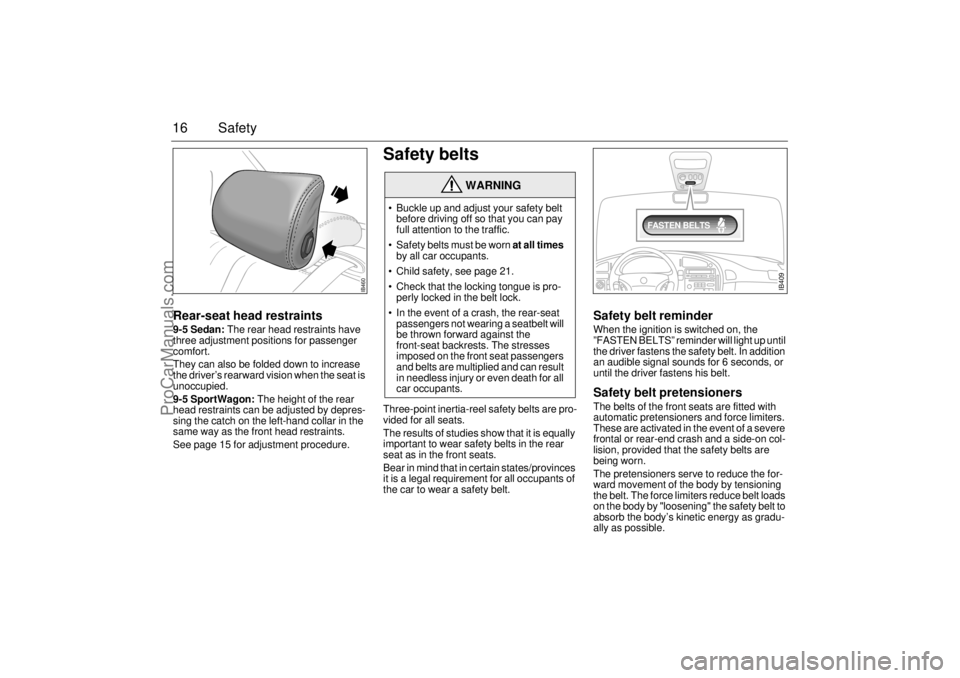
16 SafetyRear-seat head restraints9-5 Sedan: The rear head restraints have
three adjustment positions for passenger
comfort.
They can also be folded down to increase
the driver’s rearward vision when the seat is
unoccupied.
9-5 SportWagon: The height of the rear
head restraints can be adjusted by depres-
sing the catch on the left-hand collar in the
same way as the front head restraints.
See page 15 for adjustment procedure.
Safety belts Three-point inertia-reel safety belts are pro-
vided for all seats.
The results of studies show that it is equally
important to wear safety belts in the rear
seat as in the front seats.
Bear in mind that in certain states/provinces
it is a legal requirement for all occupants of
the car to wear a safety belt.
Safety belt reminderWhen the ignition is switched on, the
”FASTEN BELTS” reminder will light up until
the driver fastens the safety belt. In addition
an audible signal sounds for 6 seconds, or
until the driver fastens his belt. Safety belt pretensionersThe belts of the front seats are fitted with
automatic pretensioners and force limiters.
These are activated in the event of a severe
frontal or rear-end crash and a side-on col-
lision, provided that the safety belts are
being worn.
The pretensioners serve to reduce the for-
ward movement of the body by tensioning
the belt. The force limiters reduce belt loads
on the body by "loosening" the safety belt to
absorb the body’s kinetic energy as gradu-
ally as possible.
WARNING
Buckle up and adjust your safety belt
before driving off so that you can pay
full attention to the traffic.
Safety belts must be worn at all times
by all car occupants.
Child safety, see page 21.
Check that the locking tongue is pro-
perly locked in the belt lock.
In the event of a crash, the rear-seat
passengers not wearing a seatbelt will
be thrown forward against the
front-seat backrests. The stresses
imposed on the front seat passengers
and belts are multiplied and can result
in needless injury or even death for all
car occupants.
IB460
IB409
FASTEN BELTS
ProCarManuals.com
Page 21 of 276
19 Safety
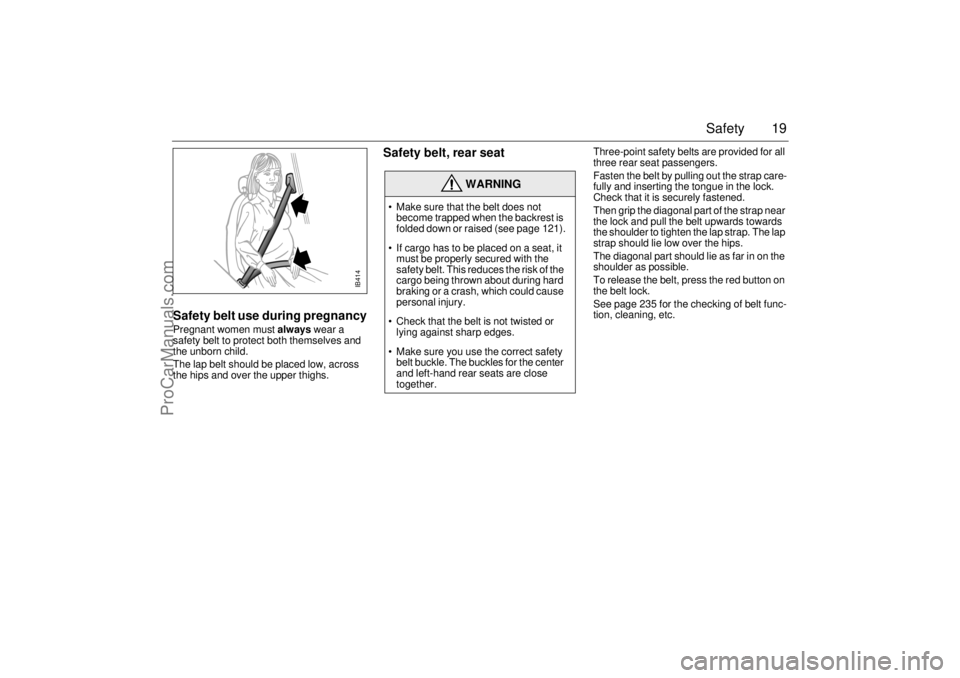
Safety belt use during pregnancyPregnant women must always wear a
safety belt to protect both themselves and
the unborn child.
The lap belt should be placed low, across
the hips and over the upper thighs.
Safety belt, rear seat
Three-point safety belts are provided for all
three rear seat passengers.
Fasten the belt by pulling out the strap care-
fully and inserting the tongue in the lock.
Check that it is securely fastened.
Then grip the diagonal part of the strap near
the lock and pull the belt upwards towards
the shoulder to tighten the lap strap. The lap
strap should lie low over the hips.
The diagonal part should lie as far in on the
shoulder as possible.
To release the belt, press the red button on
the belt lock.
See page 235 for the checking of belt func-
tion, cleaning, etc.
WARNING
Make sure that the belt does not
become trapped when the backrest is
folded down or raised (see page 121).
If cargo has to be placed on a seat, it
must be properly secured with the
safety belt. This reduces the risk of the
cargo being thrown about during hard
braking or a crash, which could cause
personal injury.
Check that the belt is not twisted or
lying against sharp edges.
Make sure you use the correct safety
belt buckle. The buckles for the center
and left-hand rear seats are close
together.
IB414
ProCarManuals.com
Page 23 of 276
21 Safety
Child safety
Car safety tips
For Trunk Release Handle information see
page 42 and 130.
WARNING
Children must always be suitably res-
trained in the car.
DEATH or SERIOUS
INJURY can occur.
Children 12 and under or
shorter than 55 inches
(140 cm) can be killed by
the airbag.
The BACK SEAT is the SAFEST place
for children.
NEVER put a rear-facing child seat in
the front.
Sit as far back as possible from the air-
bag.
ALWAYS use SAFETY BELTS and
CHILD RESTRAINTS.
WARNING
Never leave children unattended in a
car, even for a short time.
– Children can suffer heat stroke – per-
haps die – in a matter of minutes.
– Children can put the car into gear and
hurt themselves or others.
At gas stations, take the keys from the
car while filling the tank.
Never allow children to climb on top of
– or under cars.
Always look for children before back-
ing your car out of a garage or drive-
way.
To avoid carbon monoxide poisoning,
never let a car idle in an enclosed
garage.
Supervise young children around
buckets of water while washing your
car. Small children can drown in a
short time in less than an inch of water.
WARNING
Protect children from getting
trapped in the trunk of a car Teach children not to play in or around
cars.
Watch children when loading or unlo-
ading the car so they don’t get locked
in by mistake.
Always lock the doors and trunk of
your car, and keep the keys out of
children´s sight and reach.
Keep the rear fold-down seats closed
to help prevent kids from getting into
the trunk from inside the car.
ProCarManuals.com
Page 24 of 276
22 SafetyThe same attention must be given to child
safety in the car as is given to adults.
Saab recommends rearward facing child
restraints.
Children travel most safely when properly
restrained, but restraints must be suitable
for the size of the child. Always follow the
child seat/booster cushion manufacturer´s
instructions when installing these devices in
your vehicle.
Make sure you are acquainted with the
legal requirements for seating children
in the car.
Make sure that it is possible to fit a child res-
traint in accordance with the manufacturer’s
child seat instructions.
When fitting child seats in cars you must
always read the instructions supplied by
the manufacturer.
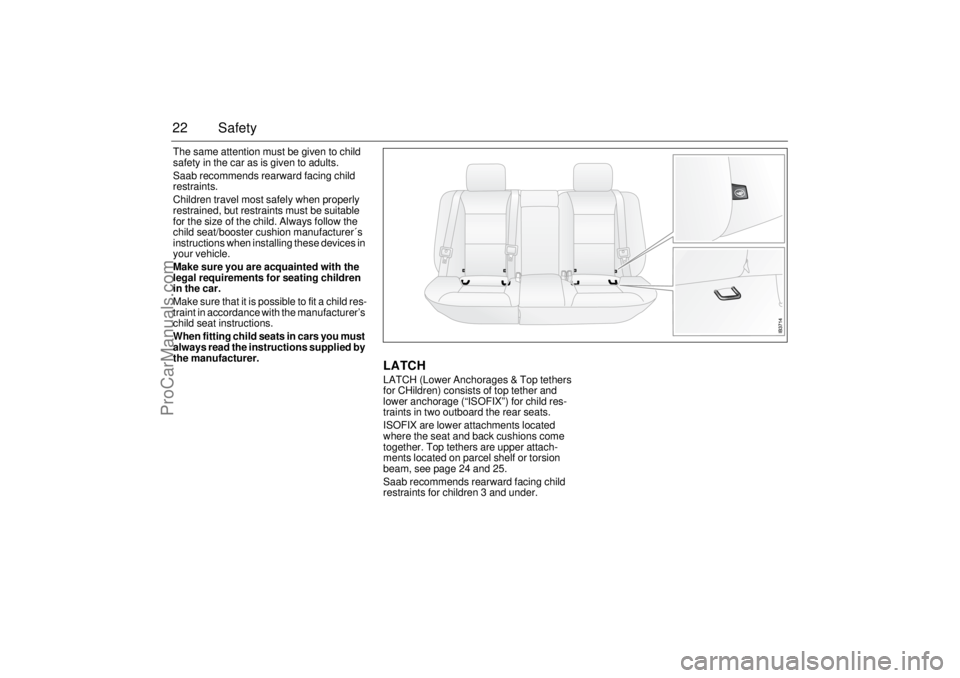
LATCHLATCH (Lower Anchorages & Top tethers
for CHildren) consists of top tether and
lower anchorage (“ISOFIX”) for child res-
traints in two outboard the rear seats.
ISOFIX are lower attachments located
where the seat and back cushions come
together. Top tethers are upper attach-
ments located on parcel shelf or torsion
beam, see page 24 and 25.
Saab recommends rearward facing child
restraints for children 3 and under.
ProCarManuals.com