ignition SAAB 9-5 2005 User Guide
[x] Cancel search | Manufacturer: SAAB, Model Year: 2005, Model line: 9-5, Model: SAAB 9-5 2005Pages: 276, PDF Size: 16.72 MB
Page 54 of 276
52 Instruments and controls
Indicator and warning
lights A number of indicator and warning lights will
come on when the ignition is switched on
prior to starting. Under normal conditions,
these should go out a few seconds after the
engine has started (see page 58).
This light will come on and a chime will
sound if a fault has been detected in any
system that is critical to safety. Any of the
following can activate the central warning
light and alarm:
Airbag system.
Low oil pressure in engine.
Parking brake is on (when car is moving).
Brake fluid level low.
Fault detected in ABS system.
Electronic brake force distribution (distri-
bution of brake pressure between front
and rear wheels).
Engine overheating.
Alternator not charging properly.
Central warning light
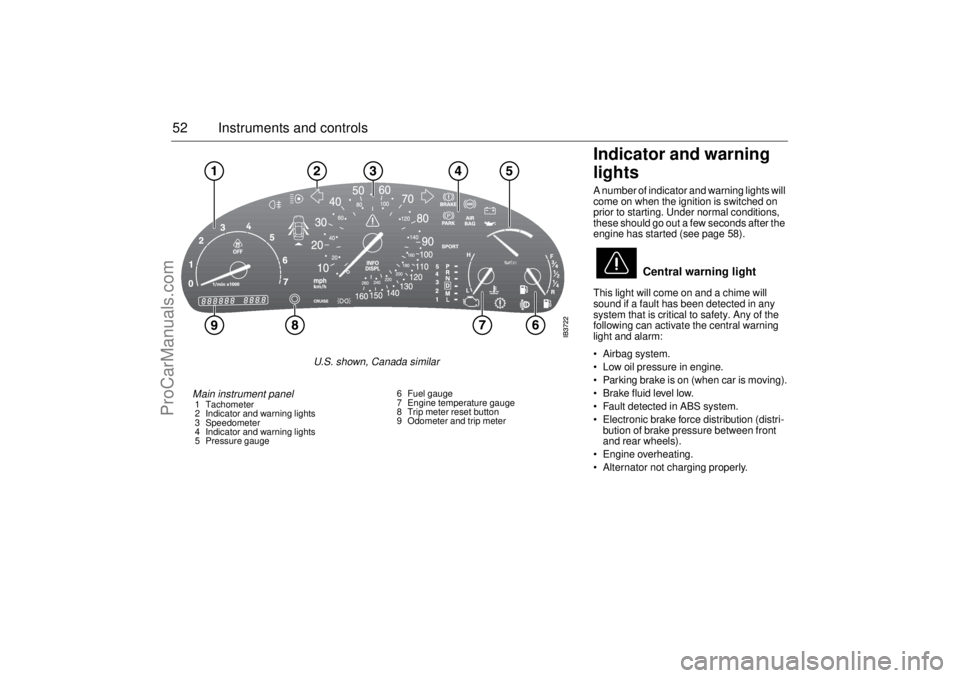
Main instrument panel 1 Tachometer
2 Indicator and warning lights
3 Speedometer
4 Indicator and warning lights
5 Pressure gauge6 Fuel gauge
7 Engine temperature gauge
8 Trip meter reset button
9 Odometer and trip meter
U.S. shown, Canada similar
ProCarManuals.com
Page 56 of 276
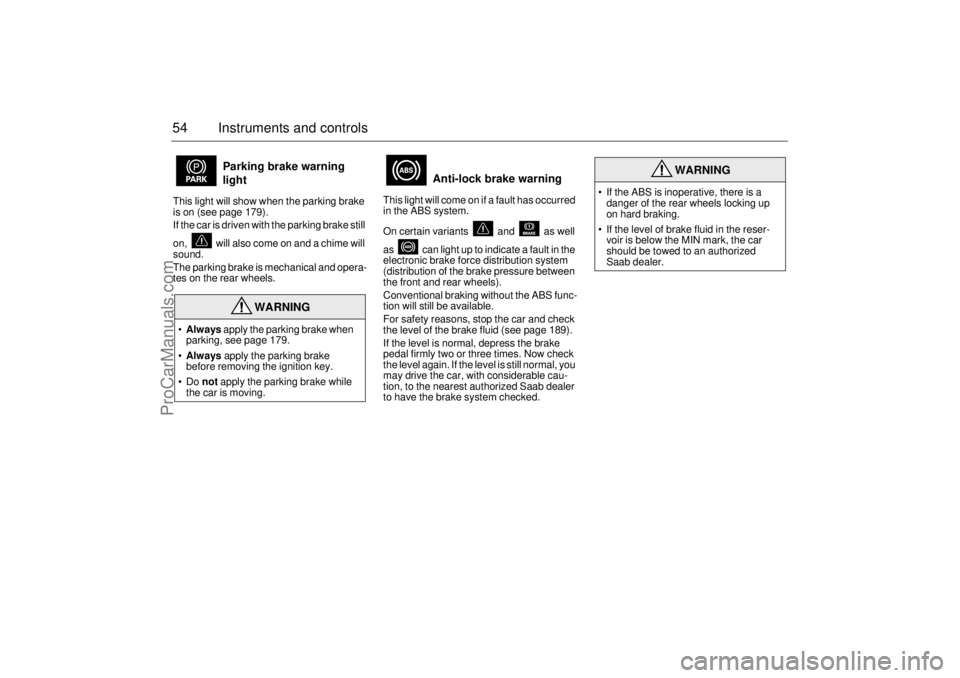
54 Instruments and controlsThis light will show when the parking brake
is on (see page 179).
If the car is driven with the parking brake still
on, will also come on and a chime will
sound.
The parking brake is mechanical and opera-
tes on the rear wheels. This light will come on if a fault has occurred
in the ABS system.
On certain variants and as well
as can light up to indicate a fault in the
electronic brake force distribution system
(distribution of the brake pressure between
the front and rear wheels).
Conventional braking without the ABS func-
tion will still be available.
For safety reasons, stop the car and check
the level of the brake fluid (see page 189).
If the level is normal, depress the brake
pedal firmly two or three times. Now check
the level again. If the level is still normal, you
may drive the car, with considerable cau-
tion, to the nearest authorized Saab dealer
to have the brake system checked.
Parking brake warning
light
WARNING
Always apply the parking brake when
parking, see page 179.
Always apply the parking brake
before removing the ignition key.
Do not apply the parking brake while
the car is moving.
Anti-lock brake warning
WARNING
If the ABS is inoperative, there is a
danger of the rear wheels locking up
on hard braking.
If the level of brake fluid in the reser-
voir is below the MIN mark, the car
should be towed to an authorized
Saab dealer.
ProCarManuals.com
Page 57 of 276

55 Instruments and controls
This light together with will come on if
a potentially serious fault has occurred in
the airbag system. The light will come on for about three
seconds when the ignition switch is turned
to the Start or Drive position. It should go out
after the engine has started.This light indicates a malfunction in the
fuel-injection or ignition system. The car
may still be driven with care and with
somewhat diminished performance (see
page 136).This light comes on when there is less than
about 2.5 gallons (10 liters) of fuel left in the
tank.
This light indicates that there is a message
in the Saab Information Display (SID). A
chime will also sound (see page 64).
Airbag warning light
WARNING
If the airbag readiness light stays on
after you start your vehicle, it means
the airbag system may not be working
properly. One or more of the following
conditions may occur:
– Non-deployment of the airbags in the
event of a crash.
– Deployment of the airbags without a
crash.
– Deployment of the airbags in crashes
less severe than intended.
To help avoid injury to yourself or
others, have your vehicle serviced
right away if the airbag readiness light
stays on after you start your vehicle.
Engine malfunction
(CHECK ENGINE)
WARNING
An illuminated ”Engine malfunction
(CHECK ENGINE)” indicator light indica-
tes an engine-related problem. While
your car may be able to be driven with the
”Engine malfunction (CHECK ENGINE)”
indicator light illuminated (Limp-home
mode), you are advised to have your car
serviced at an authorized Saab dealer as
soon as possible.
Continued driving without this problem
being corrected might cause serious
further damage to your car and create
unsafe driving conditions. The driver
should be prepared to take action if such
unsafe conditions arise (e.g.brake
smoothly, engage neutral, stop in a suita-
ble place, switch off the engine, etc.).
NOTICEThe car should be checked immediately
at an authorized Saab dealer to prevent
more serious faults from arising.
Indicator, fuel
NOTICE
If the car runs out of fuel, air can be drawn
in with the fuel, which, in turn, can cause
the catalytic converter to be damaged by
overheating.
CHECK message indicator
ProCarManuals.com
Page 58 of 276
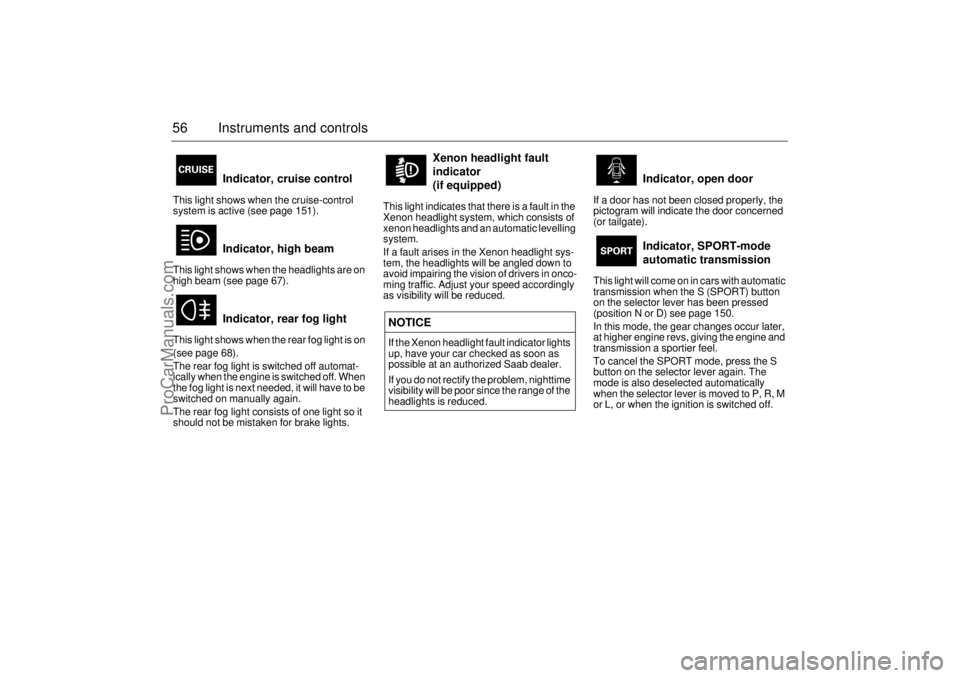
56 Instruments and controlsThis light shows when the cruise-control
system is active (see page 151).
This light shows when the headlights are on
high beam (see page 67).
This light shows when the rear fog light is on
(see page 68).
The rear fog light is switched off automat-
ically when the engine is switched off. When
the fog light is next needed, it will have to be
switched on manually again.
The rear fog light consists of one light so it
should not be mistaken for brake lights.This light indicates that there is a fault in the
Xenon headlight system, which consists of
xenon headlights and an automatic levelling
system.
If a fault arises in the Xenon headlight sys-
tem, the headlights will be angled down to
avoid impairing the vision of drivers in onco-
ming traffic. Adjust your speed accordingly
as visibility will be reduced.If a door has not been closed properly, the
pictogram will indicate the door concerned
(or tailgate).
This light will come on in cars with automatic
transmission when the S (SPORT) button
on the selector lever has been pressed
(position N or D) see page 150.
In this mode, the gear changes occur later,
at higher engine revs, giving the engine and
transmission a sportier feel.
To cancel the SPORT mode, press the S
button on the selector lever again. The
mode is also deselected automatically
w h e n t h e s e l e c t o r l e v e r i s m o v e d t o P , R , M
or L, or when the ignition is switched off.
Indicator, cruise control
Indicator, high beam
Indicator, rear fog light
Xenon headlight fault
indicator
(if equipped)
NOTICE
If the Xenon headlight fault indicator lights
up, have your car checked as soon as
possible at an authorized Saab dealer.
If you do not rectify the problem, nighttime
visibility will be poor since the range of the
headlights is reduced.
Indicator, open door
Indicator, SPORT-mode
automatic transmission
ProCarManuals.com
Page 59 of 276

57 Instruments and controls
On a car with an automatic transmission,
this warning symbol is illuminated if a fault
has been detected in the transmission.
Switch the ignition off and on again to check
if the fault persists.
Even if the fault persists, it is still possible in
most cases to drive the car (see page 146).
Have the automatic transmission checked
by an authorized Saab dealer as soon as
possible.
The indicator light goes on when the Elec-
tronic Stability Program is switched off with
the ESP-button.
IMPORTANT: the system is automatically
engaged every time the engine is started
(see page 155).
The indicator light also goes on when there
is a fault in the system. In this case the light
cannot be turned off by means of the ESP
button. If a fault is indicated, have the
system checked by an authorized Saab
dealer.
See also “Electronic Stability Program
(ESP) on page 155.The ESP indicator light is located in the
tachometer and will be illuminated when
ESP regulation is occurring, i.e. when there
is insufficient traction between the tires and
the road surface to provide the grip required
for the acceleration called for. The driver
can also sense that the engine is not
responding normally to the accelerator.
Operation of the ESP indicates reduced
traction between the tires and the road, and
that extra care should be taken by the driver.
In normal driving, the ESP will help to
improve both ride comfort and safety, but
must not be regarded as a system to enable
the driver to drive at or maintain a higher
rate of speed. The same precautions for
safe cornering and driving on slippery roads
must still be applied (see page 155).
Automatic transmission,
fault indicator
NOTICE
If the control module has actuated the
Limp-home function for the automatic
transmission, the car will remain in 5th
gear when D is selected, making it very
sluggish. To overcome this, select posi-
tion L to prevent unnecessary wear on the
transmission. The transmission then
starts in 2nd gear. When the car is moving
you can select position D.
When the indicator light is on, the car
must not be driven with a trailer attached.
Indicator ESP OFF
Indicator ESP
ProCarManuals.com
Page 60 of 276
58 Instruments and controlsAutochecking of lights,
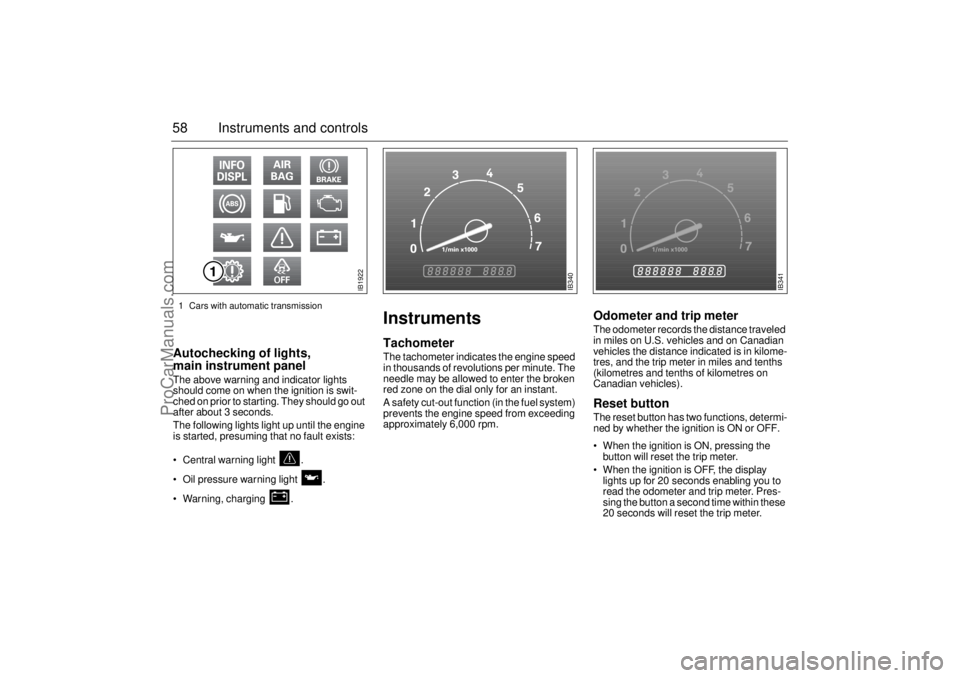
main instrument panel The above warning and indicator lights
should come on when the ignition is swit-
ched on prior to starting. They should go out
after about 3 seconds.
The following lights light up until the engine
is started, presuming that no fault exists:
Central warning light .
Oil pressure warning light .
Warning, charging .
InstrumentsTachometerThe tachometer indicates the engine speed
in thousands of revolutions per minute. The
needle may be allowed to enter the broken
red zone on the dial only for an instant.
A safety cut-out function (in the fuel system)
prevents the engine speed from exceeding
approximately 6,000 rpm.
Odometer and trip meter The odometer records the distance traveled
in miles on U.S. vehicles and on Canadian
vehicles the distance indicated is in kilome-
tres, and the trip meter in miles and tenths
(kilometres and tenths of kilometres on
Canadian vehicles). Reset button The reset button has two functions, determi-
ned by whether the ignition is ON or OFF.
When the ignition is ON, pressing the
button will reset the trip meter.
When the ignition is OFF, the display
lights up for 20 seconds enabling you to
read the odometer and trip meter. Pres-
sing the button a second time within these
20 seconds will reset the trip meter.
IB1922
IB340
IB341
1 Cars with automatic transmission
ProCarManuals.com
Page 66 of 276

64 Instruments and controlsTo calculate the arrival time if a specified
average speed is maintained
1 Select Dist using the button.
2 Set the distance to be covered.
3 Press to select Speed Ø.
4 Set the average speed you intend to
drive.
5 Press SET to display the estimated arri-
val time.
At the beginning of a journey, the Speed Ø
and Arriv functions will display current
values. If values are set during the journey,
the new values will be displayed after a
delay of about 10 seconds.
Calculating the requisite average speed:
1 Press to select Dist.
2 Set the distance to be covered.
3 Press to select Arriv.
4 Set the desired arrival time.
5 Press SET to display the average speed
you need to maintain to arrive at the
desired time.
At the beginning of a journey, the Speed Ø
and Arriv functions will display current
values. If values are set during the journey,
the new values will be displayed after a
delay of about 10 seconds.Resetting values
To reset the values, press CLEAR for at
least four seconds.
The following functions will be reset
simultaneously:
Estimated range on remaining fuel
(function based on a fuel consumption of
28 mpg).
Average fuel consumption.
Average speed.
Arrival time (function based on current
speed).
Programmed values for Dist, Alarm and
Speed W will not be reset (see the respec-
tive function).
CHECK messages When the engine is started, CHECKING will
appear on the display for about four
seconds, while the SID checks are being
performed.
When a CHECK message is generated
while the car is being driven, a chime will
sound, INFO DISPL will illuminate on the
main instrument panel, and the message
will appear on the SID. The number of mes-
sages that can be displayed by the SID
varies with the specification of the car.
If more than one CHECK message has
been generated, the
+ symbol will appear to
the left of the text on the display. The mes-
sages appear in order of priority.
If a new fault occurs while another message
is being displayed, the message relating to
the new one will appear for 10 seconds,
after which the display will return to the ear-
lier one.
Press CLEAR once to acknowledge a mes-
sage, whereupon it will be cleared from the
display. It will not be displayed again before
the ignition has been switched off and then
on again.
ProCarManuals.com
Page 68 of 276
66 Instruments and controlsUnits and language versionsThe SID has four sets of units:
CHECK messages can be displayed in six
language options: English, Swedish,
German, French, Italian and Spanish.
Selecting units and language
1 Press CLEAR and SET simultaneously
for four seconds until a chime sounds.
2 Press or to select the requi-
red units.
3 Touch SET.
4 Press or to select the requi-
red language.
5 Touch SET.
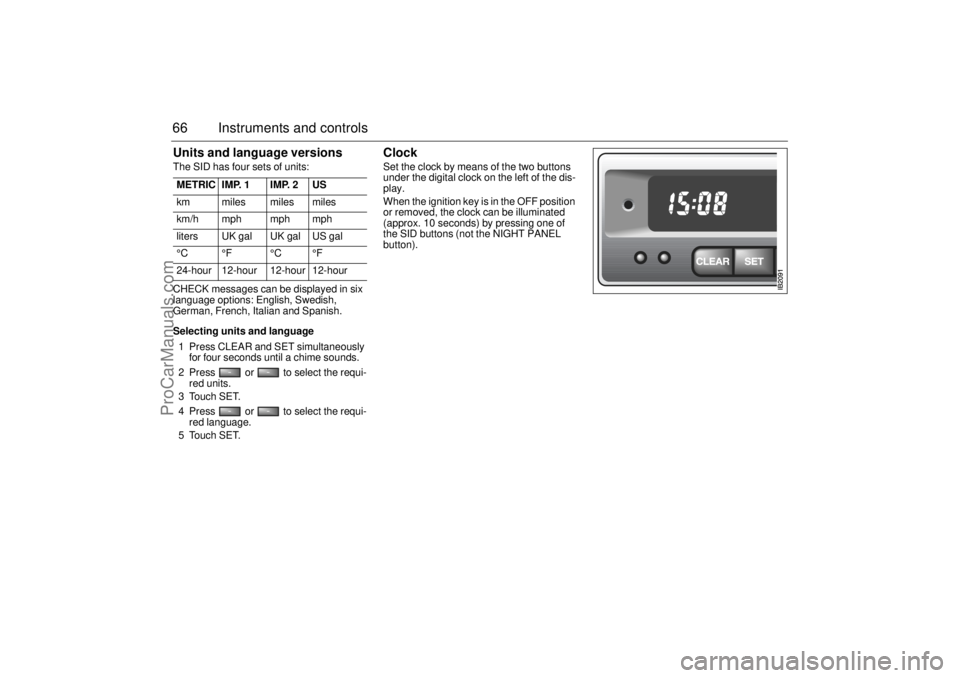
Clock Set the clock by means of the two buttons
under the digital clock on the left of the dis-
play.
When the ignition key is in the OFF position
or removed, the clock can be illuminated
(approx. 10 seconds) by pressing one of
the SID buttons (not the NIGHT PANEL
button). METRIC IMP. 1 IMP. 2 US
km miles miles miles
km/h mph mph mph
liters UK gal UK gal US gal
°C °F °C °F
24-hour 12-hour 12-hour 12-hour
ProCarManuals.com
Page 69 of 276
67 Instruments and controls
Switches The parking lights and daytime running
lights come on automatically when the igni-
tion switch is ON.
Note to owners in the U.S.: If you do not
want Daytime Running Lights, this feature
can be disconnected: switch off the engine
and remove fuse No. 35 (see page 213).
Note to owners in Canada: Daytime Run-
ning Lights must not be disconnected as
they are a Canadian Federal legal require-
ment.
The parking lights can be switched on
regardless of the position of the ignition
switch. Do not use parking lights when dri-
ving.
Note: The lighting switch must be in parking
light or headlight position (low beam posi-
tion only) to operate the fog lights (see
page 70).The headlights come on automatically when
the ignition is ON and go off when the igni-
tion switch is turned to the LOCK position.
The parking lights, however, can be on
when the ignition switch is in the LOCK posi-
tion.
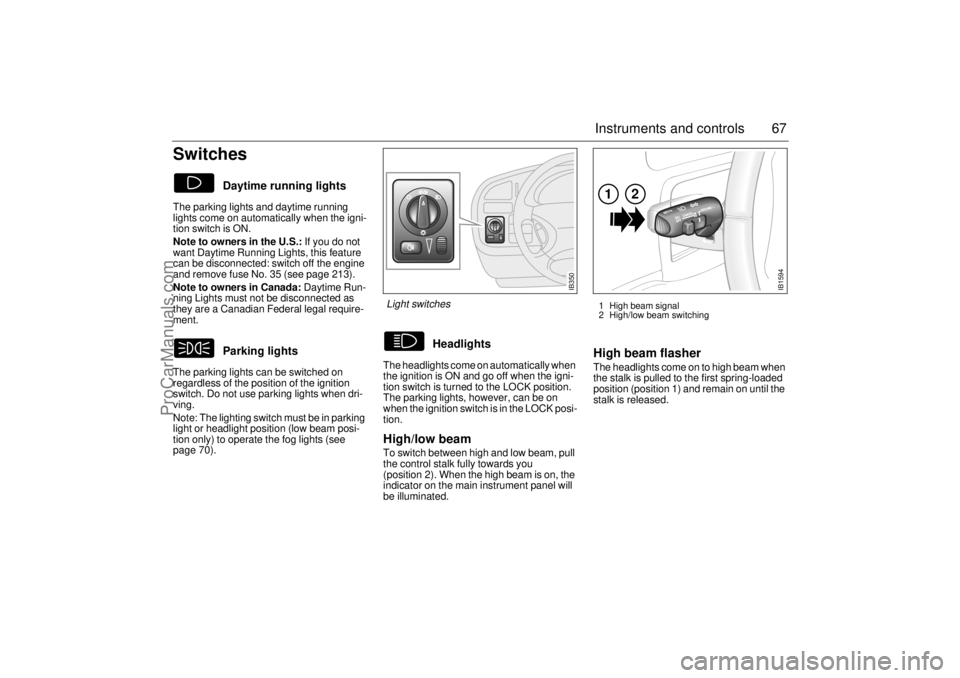
High/low beamTo switch between high and low beam, pull
the control stalk fully towards you
(position 2). When the high beam is on, the
indicator on the main instrument panel will
be illuminated.
High beam flasher The headlights come on to high beam when
the stalk is pulled to the first spring-loaded
position (position 1) and remain on until the
stalk is released.
Daytime running lights
Parking lights
Headlights
IB1594
121 High beam signal
2 High/low beam switching
IB350
Light switches
ProCarManuals.com
Page 70 of 276
68 Instruments and controlsCourtesy Headlight FeatureA delay function allows the headlights to
remain on low beam for about 30 seconds
after the driver’s door has been closed.
To activate this function,
Switch off the ignition and remove the key
Open the driver’s door
Pull the high/low beam control stalk
towards the steering wheel like you are
flashing the high beam, see page 67. The
low beam headlights will now come on
immediately after the driver’s door has
been closed (within 30 seconds) and will
remain on for about 30 seconds.
The length of time for this function can be
adjusted by your authorized Saab dealer.
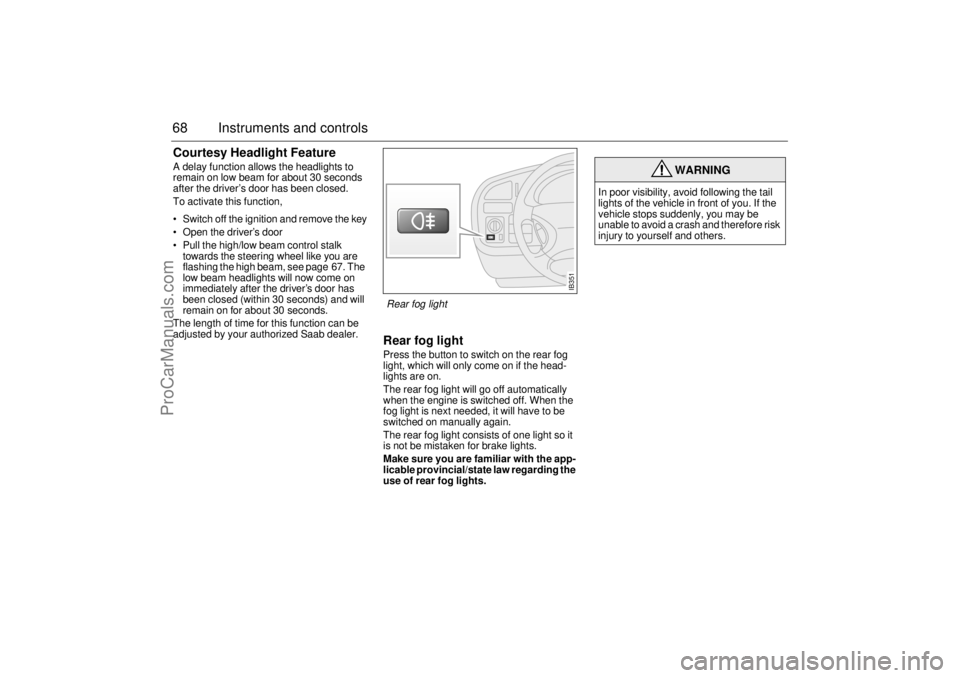
Rear fog lightPress the button to switch on the rear fog
light, which will only come on if the head-
lights are on.
The rear fog light will go off automatically
when the engine is switched off. When the
fog light is next needed, it will have to be
switched on manually again.
The rear fog light consists of one light so it
is not be mistaken for brake lights.
Make sure you are familiar with the app-
licable provincial/state law regarding the
use of rear fog lights.
WARNING
In poor visibility, avoid following the tail
lights of the vehicle in front of you. If the
vehicle stops suddenly, you may be
unable to avoid a crash and therefore risk
injury to yourself and others.
IB351
Rear fog light
ProCarManuals.com