instrument panel SAAB 9-5 2005 User Guide
[x] Cancel search | Manufacturer: SAAB, Model Year: 2005, Model line: 9-5, Model: SAAB 9-5 2005Pages: 276, PDF Size: 16.72 MB
Page 66 of 276

64 Instruments and controlsTo calculate the arrival time if a specified
average speed is maintained
1 Select Dist using the button.
2 Set the distance to be covered.
3 Press to select Speed Ø.
4 Set the average speed you intend to
drive.
5 Press SET to display the estimated arri-
val time.
At the beginning of a journey, the Speed Ø
and Arriv functions will display current
values. If values are set during the journey,
the new values will be displayed after a
delay of about 10 seconds.
Calculating the requisite average speed:
1 Press to select Dist.
2 Set the distance to be covered.
3 Press to select Arriv.
4 Set the desired arrival time.
5 Press SET to display the average speed
you need to maintain to arrive at the
desired time.
At the beginning of a journey, the Speed Ø
and Arriv functions will display current
values. If values are set during the journey,
the new values will be displayed after a
delay of about 10 seconds.Resetting values
To reset the values, press CLEAR for at
least four seconds.
The following functions will be reset
simultaneously:
Estimated range on remaining fuel
(function based on a fuel consumption of
28 mpg).
Average fuel consumption.
Average speed.
Arrival time (function based on current
speed).
Programmed values for Dist, Alarm and
Speed W will not be reset (see the respec-
tive function).
CHECK messages When the engine is started, CHECKING will
appear on the display for about four
seconds, while the SID checks are being
performed.
When a CHECK message is generated
while the car is being driven, a chime will
sound, INFO DISPL will illuminate on the
main instrument panel, and the message
will appear on the SID. The number of mes-
sages that can be displayed by the SID
varies with the specification of the car.
If more than one CHECK message has
been generated, the
+ symbol will appear to
the left of the text on the display. The mes-
sages appear in order of priority.
If a new fault occurs while another message
is being displayed, the message relating to
the new one will appear for 10 seconds,
after which the display will return to the ear-
lier one.
Press CLEAR once to acknowledge a mes-
sage, whereupon it will be cleared from the
display. It will not be displayed again before
the ignition has been switched off and then
on again.
ProCarManuals.com
Page 67 of 276

65 Instruments and controls
The following messages may be displayed: 1) This message will be displayed approximately
600 miles (1,000 km) before the next scheduled
service is due, or when 365 days have elapsed
since the last service. The message should be
cleared at the time of that service (see the Saab
Warranties & Service Record Booklet).
This message can also be deleted by first briefly
pressing the CLEAR button, then depressing it a
second time for at least eight seconds until
”SERVICE” appears on the display and a chime
sounds. The message can only be deleted when
it is shown on the SID.
Night panelTo improve night-driving conditions inside
the car, the Night Panel mode can be selec-
ted. In this mode, the amount of information
displayed is reduced, and only the most
important instruments and displays will be
illuminated.
When the Night Panel button is pressed,
only the speedometer will be illuminated (up
to the 87-mph or 140-km/h graduation), all
the other instruments illumination being ext-
inguished and their needles moved to zero.
Both the SID and the ACC displays will be
extinguished and the backlighting for swit-
ches and other controls will be dimmed.
Note: All indicator and warning lights,
together with the display of CHECK messa-
ges, will operate as normal, except ”Out-
door temperature”, see page 62.The following conditions will wake up the
respective displays in the Night-Panel
mode:
Setting of the Audio system, SID or ACC
(display comes on for ten seconds).
CHECK message generated in the SID.
High engine revs cause the rev counter to
be illuminated until the engine speed has
fallen again.
If the quantity of fuel remaining falls below
4 gallons (15 liters), the fuel gauge will be
illuminated.
If the engine temperature rises above nor-
mal, the temperature gauge will be illumi-
nated.
If the speed of the car exceeds 84 mph
(135 km/h), the entire speedometer will
be illuminated.
In cars with automatic transmission, if the
selector lever is moved from D to position
M or L, the selector indication on the main
instrument panel will be illuminated.
To restore the displays and lighting to the
normal mode, press the Night-Panel button. Message See
page
Fog light failure. 198
Rear light failure. 203
Brake light failure. 203
Washer fluid level low.
Refill. 196
Coolant level low.
Refill. 188
Remote control battery
low. Replace battery. 41
Key not accepted.
Contact service. 48
Theft protection failure.
Contact service. 48
Gearbox too hot.
Make a safe stop. 146
Time for ser vice.
1)
246
ProCarManuals.com
Page 68 of 276
66 Instruments and controlsUnits and language versionsThe SID has four sets of units:
CHECK messages can be displayed in six
language options: English, Swedish,
German, French, Italian and Spanish.
Selecting units and language
1 Press CLEAR and SET simultaneously
for four seconds until a chime sounds.
2 Press or to select the requi-
red units.
3 Touch SET.
4 Press or to select the requi-
red language.
5 Touch SET.
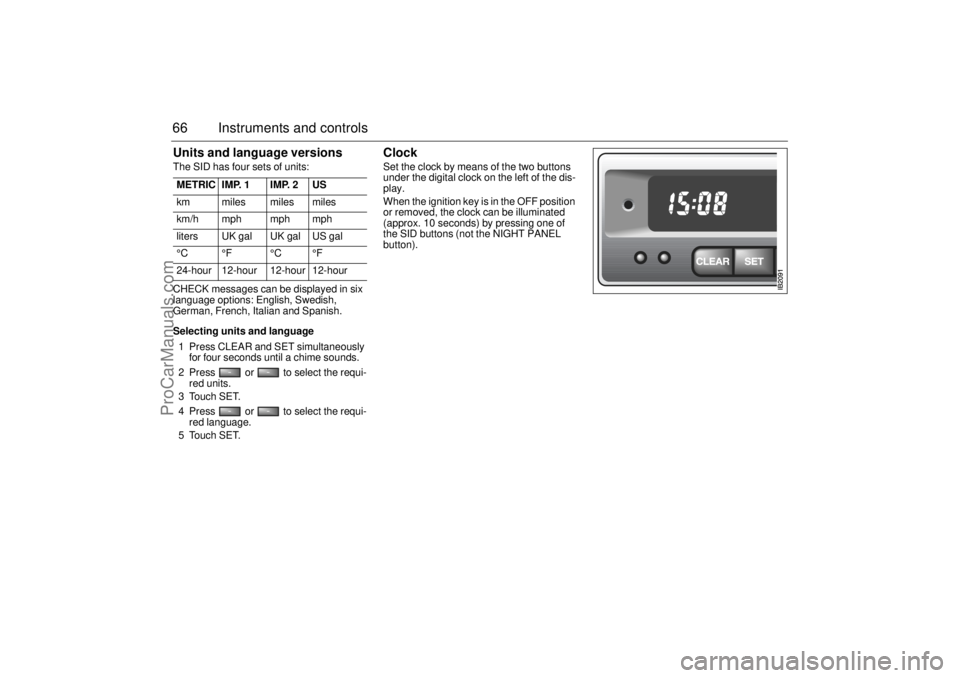
Clock Set the clock by means of the two buttons
under the digital clock on the left of the dis-
play.
When the ignition key is in the OFF position
or removed, the clock can be illuminated
(approx. 10 seconds) by pressing one of
the SID buttons (not the NIGHT PANEL
button). METRIC IMP. 1 IMP. 2 US
km miles miles miles
km/h mph mph mph
liters UK gal UK gal US gal
°C °F °C °F
24-hour 12-hour 12-hour 12-hour
ProCarManuals.com
Page 69 of 276
67 Instruments and controls
Switches The parking lights and daytime running
lights come on automatically when the igni-
tion switch is ON.
Note to owners in the U.S.: If you do not
want Daytime Running Lights, this feature
can be disconnected: switch off the engine
and remove fuse No. 35 (see page 213).
Note to owners in Canada: Daytime Run-
ning Lights must not be disconnected as
they are a Canadian Federal legal require-
ment.
The parking lights can be switched on
regardless of the position of the ignition
switch. Do not use parking lights when dri-
ving.
Note: The lighting switch must be in parking
light or headlight position (low beam posi-
tion only) to operate the fog lights (see
page 70).The headlights come on automatically when
the ignition is ON and go off when the igni-
tion switch is turned to the LOCK position.
The parking lights, however, can be on
when the ignition switch is in the LOCK posi-
tion.
High/low beamTo switch between high and low beam, pull
the control stalk fully towards you
(position 2). When the high beam is on, the
indicator on the main instrument panel will
be illuminated.
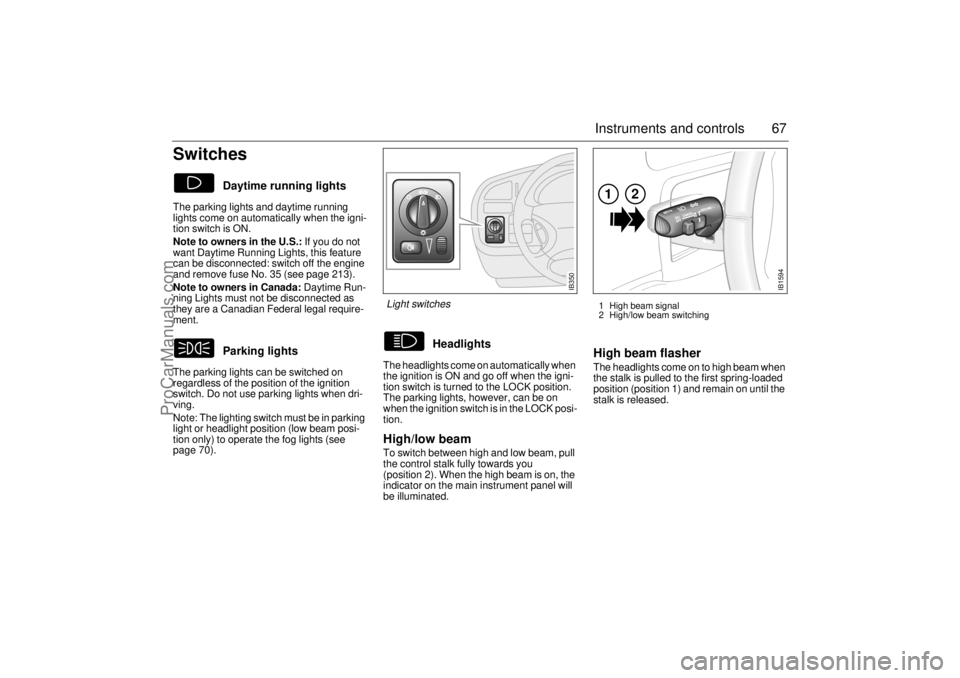
High beam flasher The headlights come on to high beam when
the stalk is pulled to the first spring-loaded
position (position 1) and remain on until the
stalk is released.
Daytime running lights
Parking lights
Headlights
IB1594
121 High beam signal
2 High/low beam switching
IB350
Light switches
ProCarManuals.com
Page 71 of 276
69 Instruments and controls
Instrument illuminationThe brightness of the instrument illumina-
tion can be varied by means of the dimmer
switch adjacent to the headlight switch.
(See also Night panel on page 65).
In daylight or other equally bright light, the
instrument and switch illumination is auto-
matically extinguished.
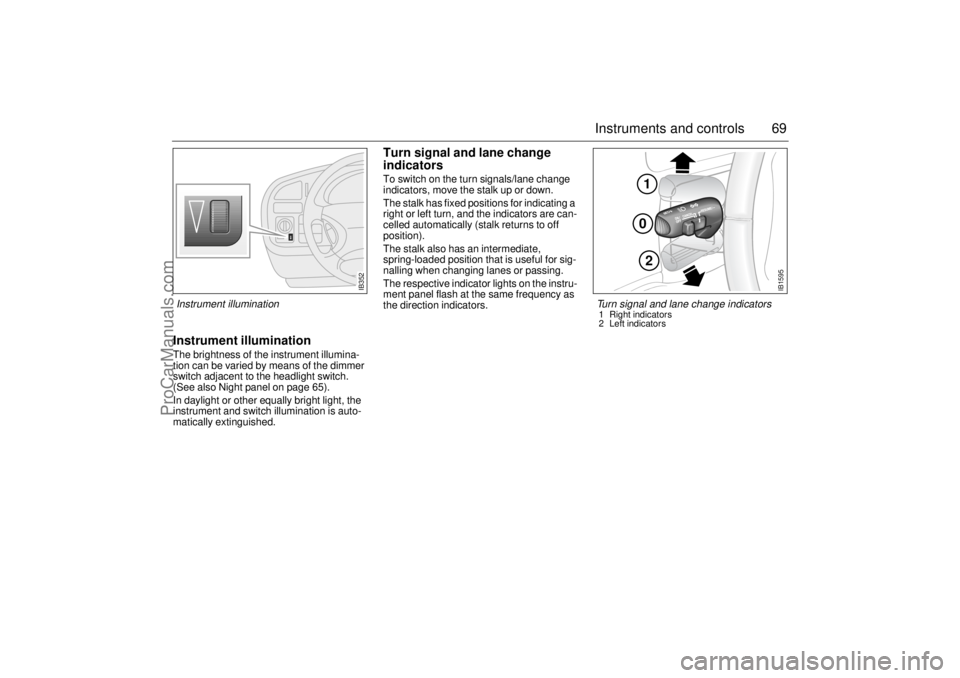
Turn signal and lane change
indicatorsTo switch on the turn signals/lane change
indicators, move the stalk up or down.
The stalk has fixed positions for indicating a
right or left turn, and the indicators are can-
celled automatically (stalk returns to off
position).
The stalk also has an intermediate,
spring-loaded position that is useful for sig-
nalling when changing lanes or passing.
The respective indicator lights on the instru-
ment panel flash at the same frequency as
the direction indicators.
IB352
102
IB1595
Turn signal and lane change indicators 1 Right indicators
2 Left indicators
Instrument illumination
ProCarManuals.com
Page 72 of 276
70 Instruments and controlsFront fog lights(if equipped)
The front fog lights can be activated in both
low beam headlight and parking light posi-
tions. Fog lights should only be used in poor
visibility conditions.
Make sure you are familiar with the app-
licable provincial/state law regarding the
use of fog lights.
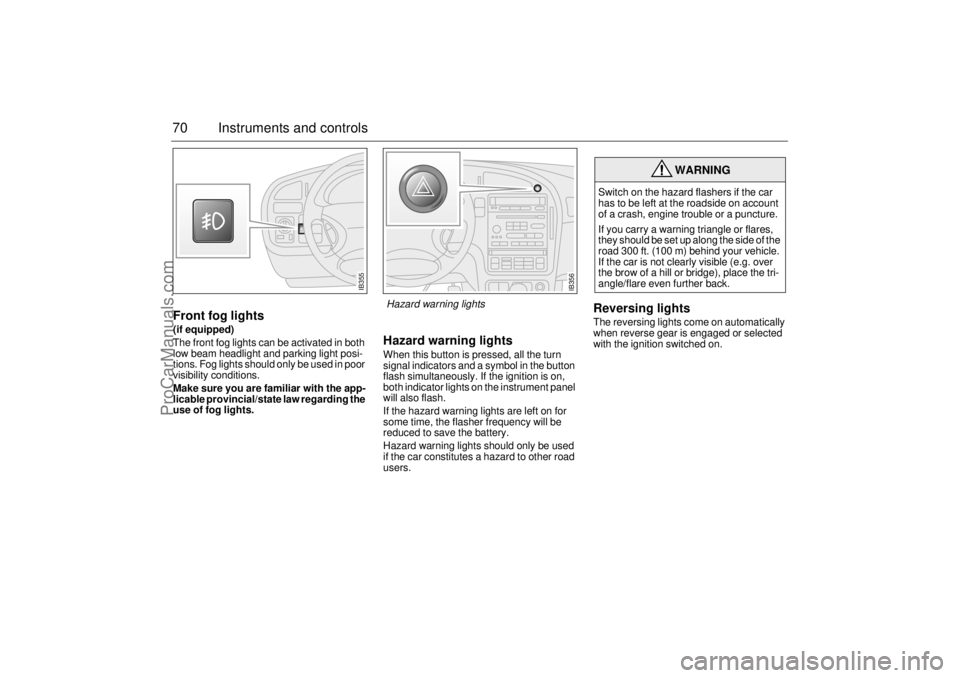
Hazard warning lightsWhen this button is pressed, all the turn
signal indicators and a symbol in the button
flash simultaneously. If the ignition is on,
both indicator lights on the instrument panel
will also flash.
If the hazard warning lights are left on for
some time, the flasher frequency will be
reduced to save the battery.
Hazard warning lights should only be used
if the car constitutes a hazard to other road
users.
Reversing lightsThe reversing lights come on automatically
when reverse gear is engaged or selected
with the ignition switched on.
WARNING
Switch on the hazard flashers if the car
has to be left at the roadside on account
of a crash, engine trouble or a puncture.
If you carry a warning triangle or flares,
they should be set up along the side of the
road 300 ft. (100 m) behind your vehicle.
If the car is not clearly visible (e.g. over
the brow of a hill or bridge), place the tri-
angle/flare even further back.
IB355
IB356
Hazard warning lights
ProCarManuals.com
Page 75 of 276
73 Instruments and controls
Automatic climate
control (ACC) The ACC system automatically works to
maintain the desired temperature inside the
car.
The system will achieve the desired tempe-
rature in the quickest possible way. Note
that selecting a higher or lower temperature
than that desired will not speed up the pro-
cess.
For the ACC system to be most effective, all
windows (and sunroof, if fitted) should be
closed.
Fresh air for the cabin is drawn in through an
inlet grille adjacent to the bottom edge of the
windshield. The air flows through a filter
upstream of the ACC system before deli-
very to the cabin. Cabin air is evacuated via
openings in the rear parcel shelf and then
through outlets on either side of the car
behind the rear bumper.
The incoming air is treated in three stages:
first it passes through a filter; it is then dehu-
midified and cooled and, finally, if required,
heated.
The filter is a combined particle and char-
coal filter. It is so efficient that levels of nox-
ious substances such as benzene and tolu-
ene are also reduced.To reduce the likelihood of misting on the
insides of the windows, the glass should be
cleaned with a quality window cleaner. How
often this will need to be done depends on
how clean the air is – if there are smokers in
the car, cleaning will need to be done more
frequently.
AUTO
ECON OFF
AUTO
ECON OFF
IB367
9
1
5
4
23
68
7
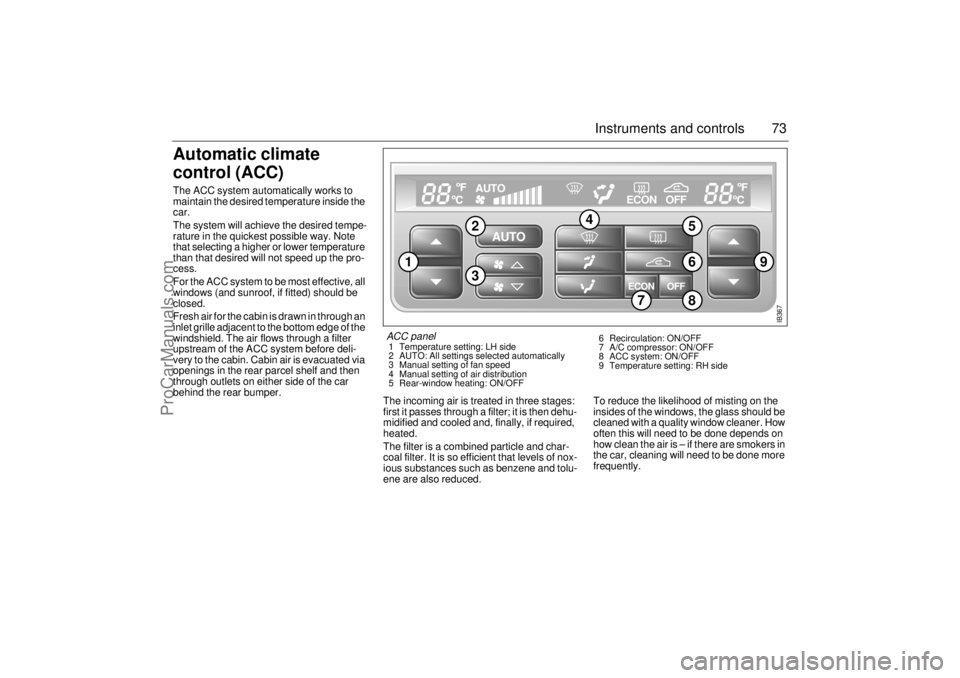
ACC panel 1 Temperature setting: LH side
2 AUTO: All settings selected automatically
3 Manual setting of fan speed
4 Manual setting of air distribution
5 Rear-window heating: ON/OFF 6 Recirculation: ON/OFF
7 A/C compressor: ON/OFF
8 ACC system: ON/OFF
9 Temperature setting: RH side
ProCarManuals.com
Page 76 of 276

74 Instruments and controls
The system has five sensors:
Outdoor temperature sensor
Interior temperature sensor
Sun sensor (mounted on top of the fascia)
Two blended-air temperature sensors
(mounted inside the front floor vents)
Note: If anything is placed over the sun sen-
sor, the ACC system will not function pro-
perly.
Panel vents The panel vents swivel in all directions so
that air can be directed as desired. In winter,
for instance, the outer vents can be directed
onto the door windows for enhanced
demisting.
The flow of air through the panel vents can
be controlled individually for each vent by
means of the adjacent control. The climate
control system works best if the panel vents
are open. If you find the air cold or that it is
drafty, start by directing the air away from
the body. If the center vent is aimed up, it will
cool the interior temperature sensor and
you may need to adjust ACC up or down,
depending upon temperature desired.
IB362
Panel vent
IB368
1
2
1 Interior-temperature sensor
2 Sun sensor
ProCarManuals.com
Page 77 of 276
75 Instruments and controls
Temperature control The cabin is divided into two temperature
zones:
• The driver’s zone
The passenger zone (front and rear
seats)
The desired temperature can be set bet-
ween 58 and 82°F (15 and 27°C). In addi-
tion, there are also HI and LO settings (see
below). The HI and LO settings for the pas-
senger zone can only be selected if they are
also selected for the driver’s zone.
The displayed temperature is not the abso-
lute temperature but corresponds to the
comfort level normally experienced at that
temperature after allowance has been
made for the air flow, relative humidity, solar
radiation, etc., currently prevailing inside
the car.
The most usual temperature setting is
64–76°F (18–24°C), depending on perso-
nal preference and what clothing is worn.
To allow the system time to adjust, chan-
ges in the temperature setting can only be
made in steps of 2°F (1°C).
Once the desired climate has been achie-
ved, the rear center vents can be closed
to prevent warm air being distributed at
face height.
Settings when HI
selected:
Maximum heat
Air distribution to windshield and floor
Recirculation OFF (even if manually
selected before)
Fan: high speed
Settings shown on ACC display
Settings when LO
selected:
Maximum cooling (A/C compressor will
run even if ECON manually selected
before)
Air distribution through panel vents
Fan: maximum speed
Recirculation ON
Settings shown on ACC display
IB369
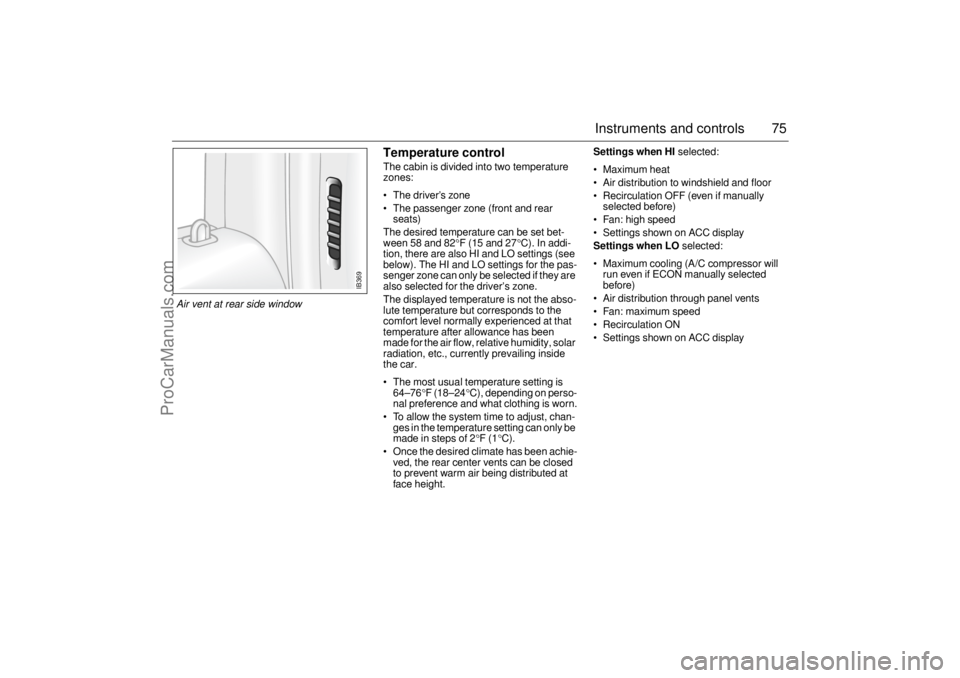
Air vent at rear side window
ProCarManuals.com
Page 80 of 276
78 Instruments and controlsAir distribution
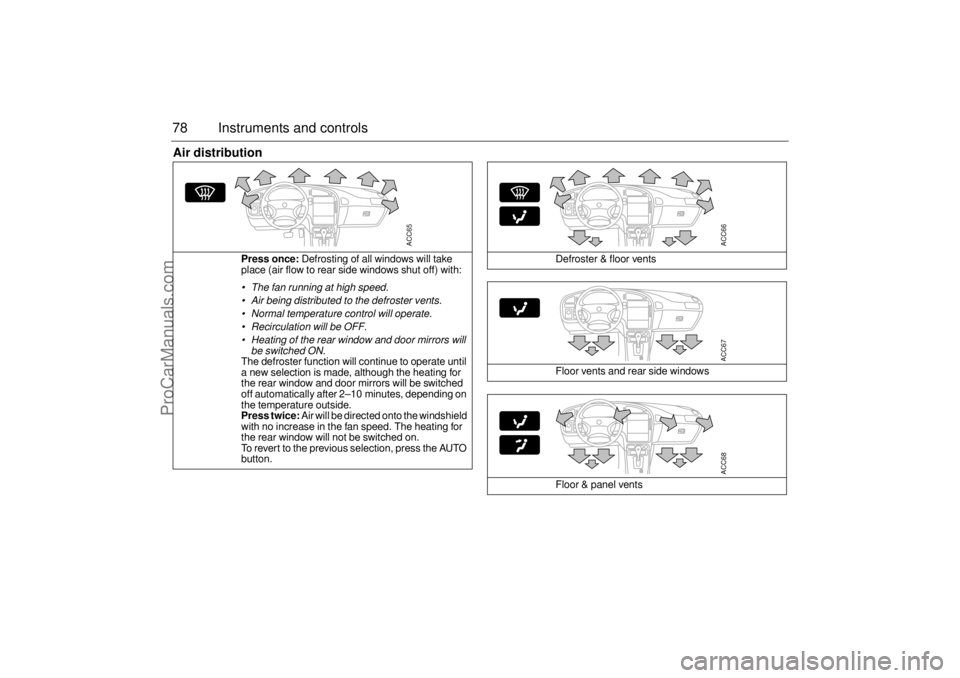
Press once:
Defrosting of all windows will take
place (air flow to rear side windows shut off) with:
The fan running at high speed.
Air being distributed to the defroster vents.
Normal temperature control will operate.
Recirculation will be OFF.
Heating of the rear window and door mirrors will
be switched ON.The defroster function will continue to operate until
a new selection is made, although the heating for
the rear window and door mirrors will be switched
off automatically after 2–10 minutes, depending on
the temperature outside.Press twice:
Air will be directed onto the windshield
with no increase in the fan speed. The heating for
the rear window will not be switched on.
To revert to the previous selection, press the AUTO
button.
ACC65
Defroster & floor vents
Floor vents and rear side windows
Floor & panel vents
ACC66ACC67ACC68
ProCarManuals.com