height SAAB 9-5 2005 Owners Manual
[x] Cancel search | Manufacturer: SAAB, Model Year: 2005, Model line: 9-5, Model: SAAB 9-5 2005Pages: 276, PDF Size: 16.72 MB
Page 14 of 276
12 SafetySeats Both front seats are electrically operated.
On certain models the driver´s seat is equip-
ped with a memory function.
To facilitate getting into the car, both seats
can be adjusted when either of the front
doors is open.
For safety reasons, if the door is closed, the
seat can only be adjusted when the ignition
is ON.
Note, however, that both seats can be
adjusted for 30 seconds after both doors
have been closed. The following seat adjustments can be
made to achieve a comfortable driving
position:
height
legroom
backrest rake angle
lumbar support (driver´s seat)
head-restraint height
We recommend that adjustments to the
driver’s seat be performed in the following
order:
1height
2 legroom
3 seat tilt angle
4 backrest rake angle
Lastly, adjust the steering wheel (see
page 106).
Side airbags(see page 32).Head restraint(see page 15).
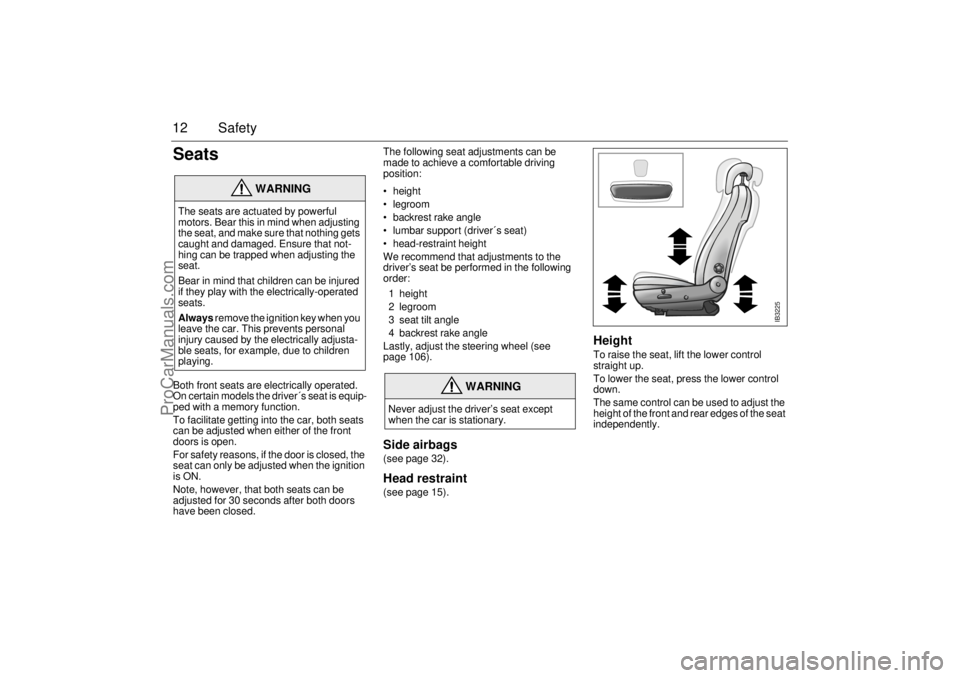
HeightTo raise the seat, lift the lower control
straight up.
To lower the seat, press the lower control
down.
The same control can be used to adjust the
height of the front and rear edges of the seat
independently.
WARNING
The seats are actuated by powerful
motors. Bear this in mind when adjusting
the seat, and make sure that nothing gets
caught and damaged. Ensure that not-
hing can be trapped when adjusting the
seat.
Bear in mind that children can be injured
if they play with the electrically-operated
seats.
Always remove the ignition key when you
leave the car. This prevents personal
injury caused by the electrically adjusta-
ble seats, for example, due to children
playing.
WARNING
Never adjust the driver’s seat except
when the car is stationary.
IB3225
ProCarManuals.com
Page 17 of 276
15 Safety
Electric heating, front seats(if equipped)
Both front seats have adjustable and ther-
mostat-controlled heating of the seat
cushion and backrest, available as an
option.
Heating is adjustable in three stages. In
position 0 it is turned off.
Head restraintThe front seats in the Saab 9-5 are equip-
ped with Saab Active Head Restraints
(SAHRs). These reduce the risk of whiplash
injury if the car is hit from behind.
In the event of a rear-end crash, the body is
forced back against the backrest. This, in
turn, causes the mechanism to press the
head restraint forward and upward, thus
limiting the backward movement of the
head.
The SAHR is a mechanical system, actua-
ted by body weight. The mechanism is built
into the top of the backrest, where it is con-
nected to the head restraint.
Therefore, the SAHR does not need to be
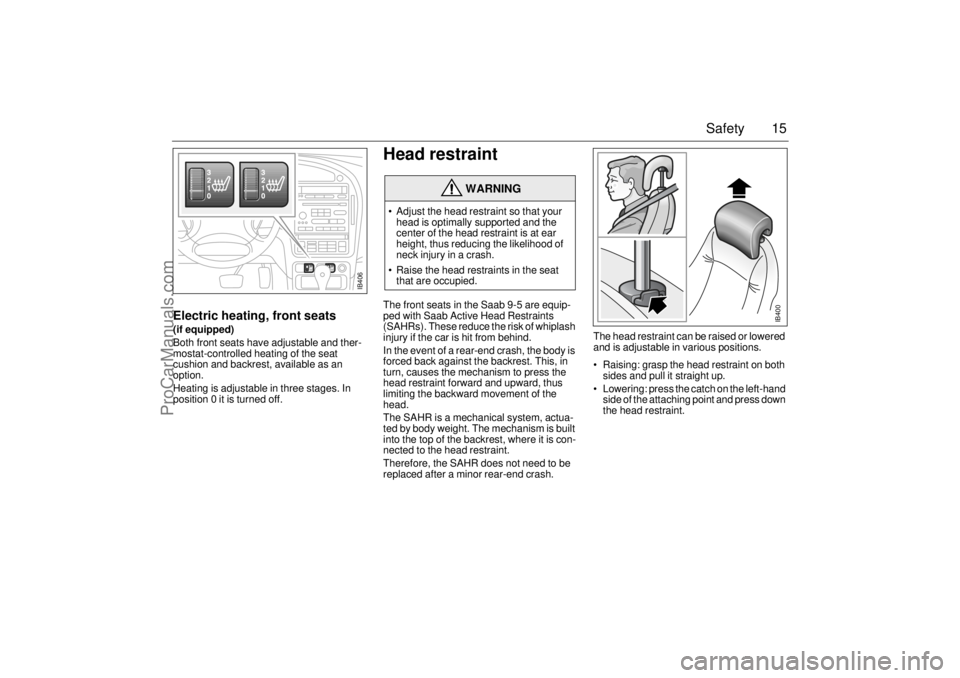
replaced after a minor rear-end crash.The head restraint can be raised or lowered
and is adjustable in various positions.
Raising: grasp the head restraint on both
sides and pull it straight up.
Lowering: press the catch on the left-hand
side of the attaching point and press down
the head restraint.
WARNING
Adjust the head restraint so that your
head is optimally supported and the
center of the head restraint is at ear
height, thus reducing the likelihood of
neck injury in a crash.
Raise the head restraints in the seat
that are occupied.
IB406
IB400
ProCarManuals.com
Page 18 of 276
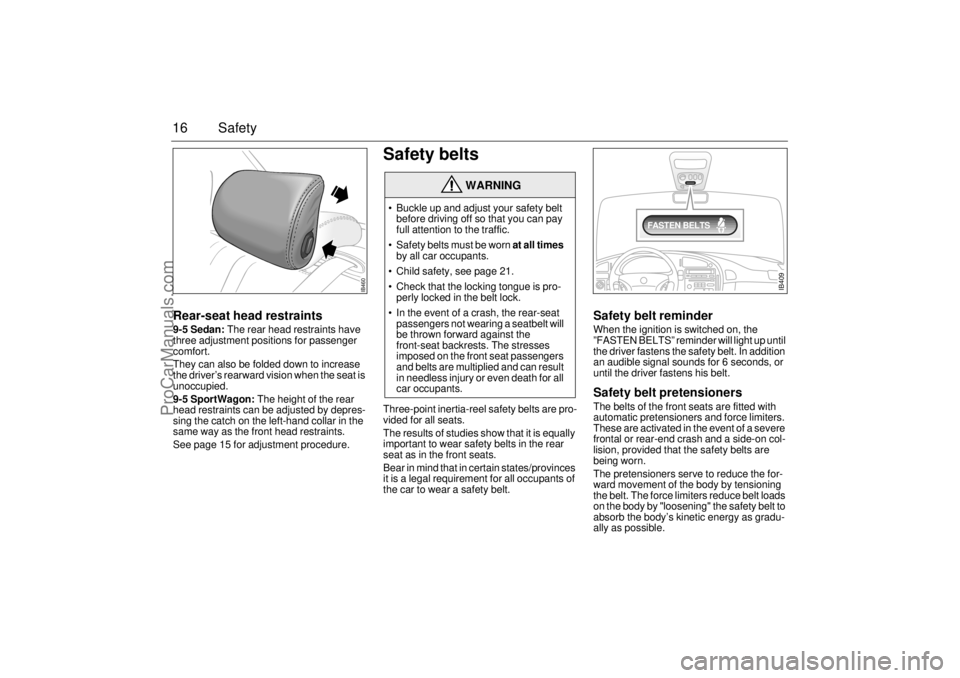
16 SafetyRear-seat head restraints9-5 Sedan: The rear head restraints have
three adjustment positions for passenger
comfort.
They can also be folded down to increase
the driver’s rearward vision when the seat is
unoccupied.
9-5 SportWagon: The height of the rear
head restraints can be adjusted by depres-
sing the catch on the left-hand collar in the
same way as the front head restraints.
See page 15 for adjustment procedure.
Safety belts Three-point inertia-reel safety belts are pro-
vided for all seats.
The results of studies show that it is equally
important to wear safety belts in the rear
seat as in the front seats.
Bear in mind that in certain states/provinces
it is a legal requirement for all occupants of
the car to wear a safety belt.
Safety belt reminderWhen the ignition is switched on, the
”FASTEN BELTS” reminder will light up until
the driver fastens the safety belt. In addition
an audible signal sounds for 6 seconds, or
until the driver fastens his belt. Safety belt pretensionersThe belts of the front seats are fitted with
automatic pretensioners and force limiters.
These are activated in the event of a severe
frontal or rear-end crash and a side-on col-
lision, provided that the safety belts are
being worn.
The pretensioners serve to reduce the for-
ward movement of the body by tensioning
the belt. The force limiters reduce belt loads
on the body by "loosening" the safety belt to
absorb the body’s kinetic energy as gradu-
ally as possible.
WARNING
Buckle up and adjust your safety belt
before driving off so that you can pay
full attention to the traffic.
Safety belts must be worn at all times
by all car occupants.
Child safety, see page 21.
Check that the locking tongue is pro-
perly locked in the belt lock.
In the event of a crash, the rear-seat
passengers not wearing a seatbelt will
be thrown forward against the
front-seat backrests. The stresses
imposed on the front seat passengers
and belts are multiplied and can result
in needless injury or even death for all
car occupants.
IB460
IB409
FASTEN BELTS
ProCarManuals.com
Page 20 of 276
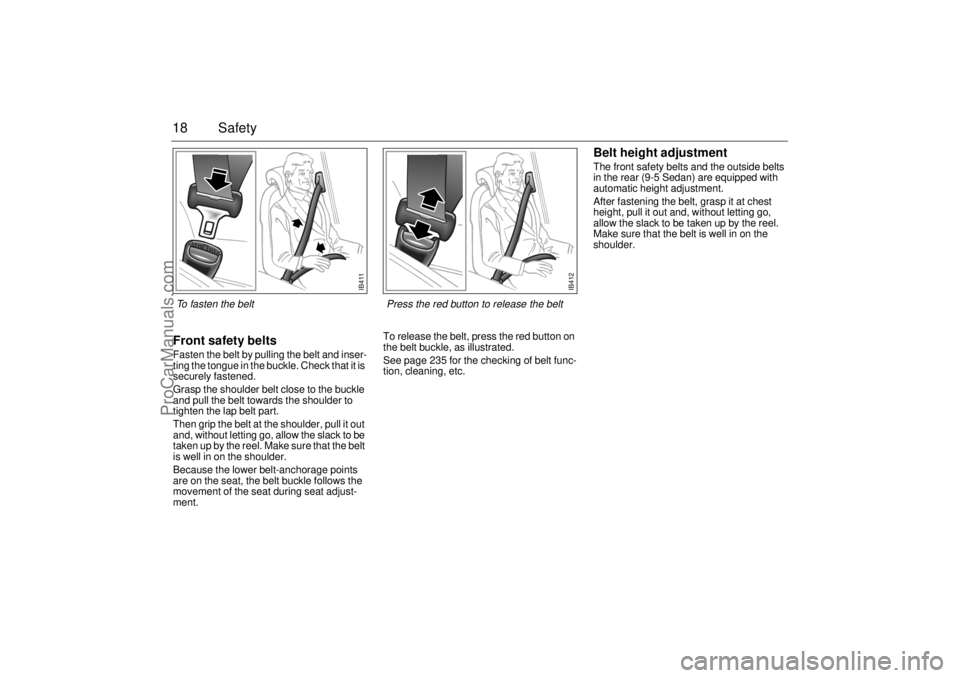
18 SafetyFront safety belts Fasten the belt by pulling the belt and inser-
ting the tongue in the buckle. Check that it is
securely fastened.
Grasp the shoulder belt close to the buckle
and pull the belt towards the shoulder to
tighten the lap belt part.
Then grip the belt at the shoulder, pull it out
and, without letting go, allow the slack to be
taken up by the reel. Make sure that the belt
is well in on the shoulder.
Because the lower belt-anchorage points
are on the seat, the belt buckle follows the
movement of the seat during seat adjust-
ment.To release the belt, press the red button on
the belt buckle, as illustrated.
See page 235 for the checking of belt func-
tion, cleaning, etc.
Belt height adjustmentThe front safety belts and the outside belts
in the rear (9-5 Sedan) are equipped with
automatic height adjustment.
After fastening the belt, grasp it at chest
height, pull it out and, without letting go,
allow the slack to be taken up by the reel.
Make sure that the belt is well in on the
shoulder.
IB411
To fasten the belt
IB412
Press the red button to release the belt
ProCarManuals.com
Page 77 of 276
75 Instruments and controls
Temperature control The cabin is divided into two temperature
zones:
• The driver’s zone
The passenger zone (front and rear
seats)
The desired temperature can be set bet-
ween 58 and 82°F (15 and 27°C). In addi-
tion, there are also HI and LO settings (see
below). The HI and LO settings for the pas-
senger zone can only be selected if they are
also selected for the driver’s zone.
The displayed temperature is not the abso-
lute temperature but corresponds to the
comfort level normally experienced at that
temperature after allowance has been
made for the air flow, relative humidity, solar
radiation, etc., currently prevailing inside
the car.
The most usual temperature setting is
64–76°F (18–24°C), depending on perso-
nal preference and what clothing is worn.
To allow the system time to adjust, chan-
ges in the temperature setting can only be
made in steps of 2°F (1°C).
Once the desired climate has been achie-
ved, the rear center vents can be closed
to prevent warm air being distributed at
face height.
Settings when HI
selected:
Maximum heat
Air distribution to windshield and floor
Recirculation OFF (even if manually
selected before)
Fan: high speed
Settings shown on ACC display
Settings when LO
selected:
Maximum cooling (A/C compressor will
run even if ECON manually selected
before)
Air distribution through panel vents
Fan: maximum speed
Recirculation ON
Settings shown on ACC display
IB369
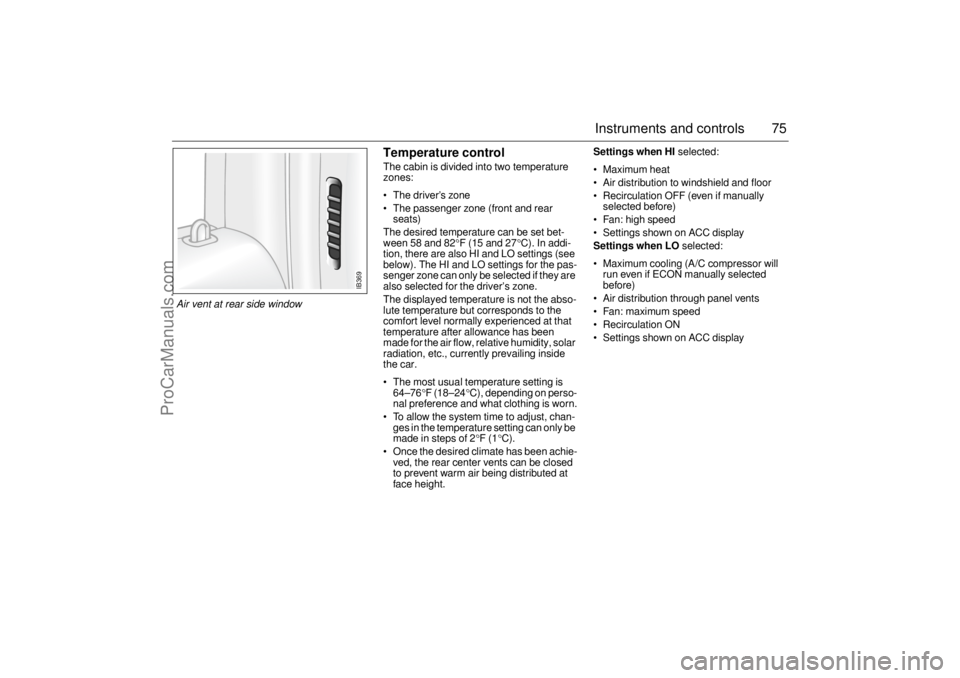
Air vent at rear side window
ProCarManuals.com
Page 126 of 276
124 Interior equipment and trunkFolding the rear seat, 9-5 SportWagonBoth the narrow and wide sections of the rear seat can be folded
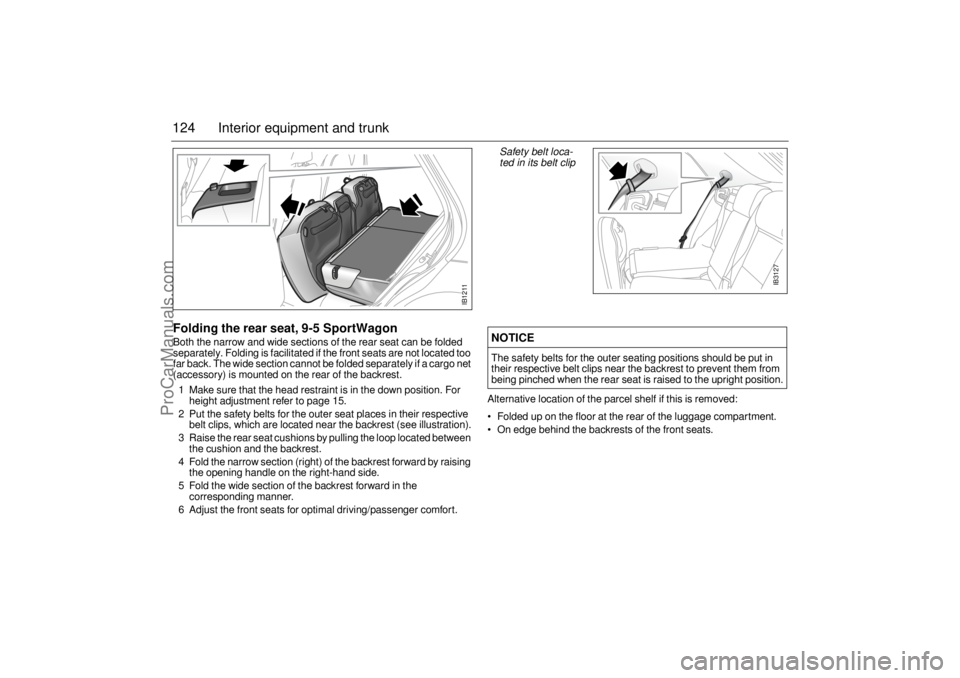
separately. Folding is facilitated if the front seats are not located too
far back. The wide section cannot be folded separately if a cargo net
(accessory) is mounted on the rear of the backrest.
1 Make sure that the head restraint is in the down position. For
height adjustment refer to page 15.
2 Put the safety belts for the outer seat places in their respective
belt clips, which are located near the backrest (see illustration).
3 Raise the rear seat cushions by pulling the loop located between
the cushion and the backrest.
4 Fold the narrow section (right) of the backrest forward by raising
the opening handle on the right-hand side.
5 Fold the wide section of the backrest forward in the
corresponding manner.
6 Adjust the front seats for optimal driving/passenger comfort.
Alternative location of the parcel shelf if this is removed:
Folded up on the floor at the rear of the luggage compartment.
On edge behind the backrests of the front seats.NOTICEThe safety belts for the outer seating positions should be put in
their respective belt clips near the backrest to prevent them from
being pinched when the rear seat is raised to the upright position.
IB1211
IB3127
Safety belt loca-
ted in its belt clip
ProCarManuals.com
Page 127 of 276
125 Interior equipment and trunk
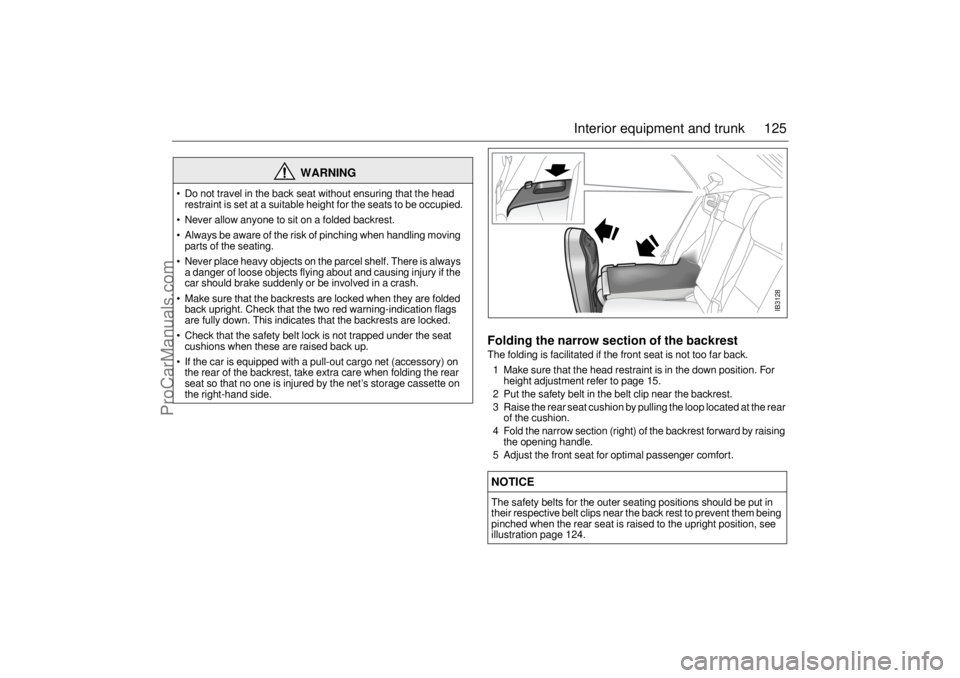
Folding the narrow section of the backrestThe folding is facilitated if the front seat is not too far back.
1 Make sure that the head restraint is in the down position. For
height adjustment refer to page 15.
2 Put the safety belt in the belt clip near the backrest.
3 Raise the rear seat cushion by pulling the loop located at the rear
of the cushion.
4 Fold the narrow section (right) of the backrest forward by raising
the opening handle.
5 Adjust the front seat for optimal passenger comfort.
WARNING
Do not travel in the back seat without ensuring that the head
restraint is set at a suitable height for the seats to be occupied.
Never allow anyone to sit on a folded backrest.
Always be aware of the risk of pinching when handling moving
parts of the seating.
Never place heavy objects on the parcel shelf. There is always
a danger of loose objects flying about and causing injury if the
car should brake suddenly or be involved in a crash.
Make sure that the backrests are locked when they are folded
back upright. Check that the two red warning-indication flags
are fully down. This indicates that the backrests are locked.
Check that the safety belt lock is not trapped under the seat
cushions when these are raised back up.
If the car is equipped with a pull-out cargo net (accessory) on
the rear of the backrest, take extra care when folding the rear
seat so that no one is injured by the net’s storage cassette on
the right-hand side.
NOTICEThe safety belts for the outer seating positions should be put in
their respective belt clips near the back rest to prevent them being
pinched when the rear seat is raised to the upright position, see
illustration page 124.
IB3128
ProCarManuals.com
Page 184 of 276
182 Car care and technical informationHood The hood release handle is located under-
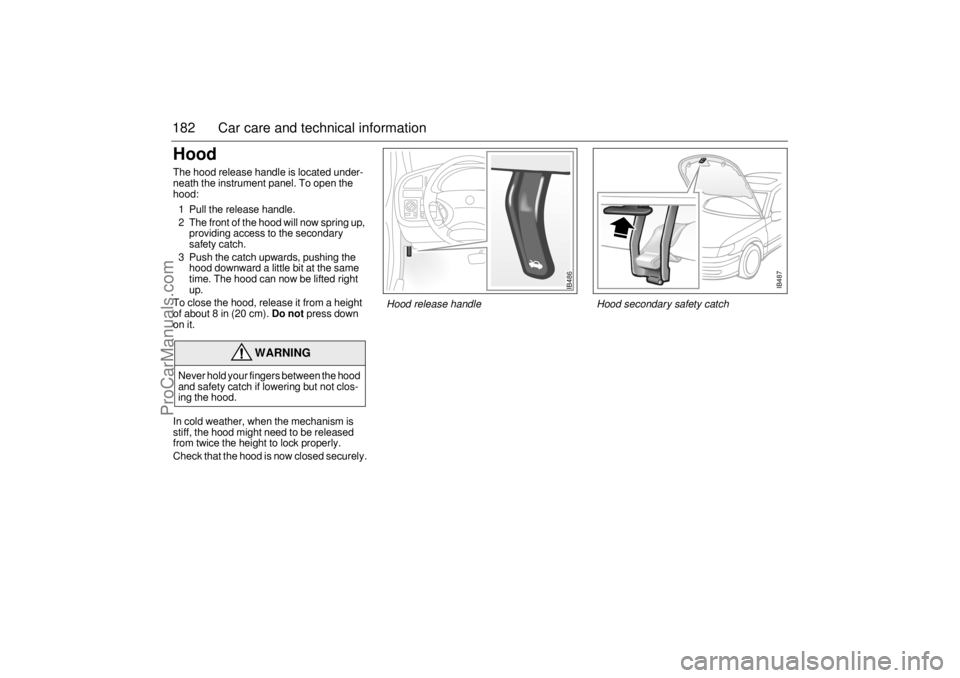
neath the instrument panel. To open the
hood:
1 Pull the release handle.
2 The front of the hood will now spring up,
providing access to the secondary
safety catch.
3 Push the catch upwards, pushing the
hood downward a little bit at the same
time. The hood can now be lifted right
up.
To close the hood, release it from a height
of about 8 in (20 cm).
Do not
press down
on it.
In cold weather, when the mechanism is
stiff, the hood might need to be released
from twice the height to lock properly.
Check that the hood is now closed securely.
WARNING
Never hold your fingers between the hood
and safety catch if lowering but not clos-
ing the hood.
IB487
IB486
Hood release handle Hood secondary safety catch
ProCarManuals.com
Page 224 of 276
222 Car care and technical informationWheel Alignment and Tire BalanceThe wheels on your vehicle were aligned
and balanced carefully at the factory to give
you the longest tire life and best overall per-
formance.
Scheduled wheel alignment and wheel
balancing are not needed. However, if you
notice unusual tire wear or your vehicle pul-
ling one way or the other, the alignment may
need to be reset. If you notice your vehicle
vibrating when driving on a smooth road,
your wheels may need to be rebalanced.Wheel ReplacementReplace any wheel that is bent, cracked or
badly rusted or corroded. If wheel nuts keep
coming loose, the wheel, wheel bolts and
wheel nuts should be replaced. If the wheel
leaks air, replace it (except some aluminum
wheels, which can sometimes be repaired).
See your dealer if any of these conditions
exist.
Your dealer will know the kind of wheel you
need.
Each new wheel should have the same
load-carrying capacity, diameter, width,
offset and be mounted the same way as the
one it replaces.
If you need to replace any of your wheels,
wheel bolts or wheel nuts, replace them only
with new Saab original equipment parts.
This way, you will be sure to have the right
wheel, wheel bolts and wheel nuts for your
vehicle.Make sure tires with Tire Pressure Monitors
are fitted as replacement tires on cars with
this system.
Notice:
The wrong wheel can also cause
problems with bearing life, brake coo-
ling, speedometer or odometer calibra-
tion, headlamp aim, bumper height,
vehicle ground clearance and tire or tire
chain clearance to the body and chassis.
See “Changing a wheel” on page 231.
Used Replacement Wheels
WARNING
Using the wrong replacement wheels,
wheel bolts or wheel nuts on your vehicle
can be dangerous. It could affect the
braking and handling of your vehicle,
make your tires lose air and make you
lose control. You could have a collision in
which you or others could be injured.
Always use the correct wheel, wheel bolts
and wheel nuts for replacement.
WARNING
When fitting just
one
new pair of tires,
these should be fitted to the rear wheels,
as these are more critical to the direc-
tional stability of the car (e.g. on braking
or in a skid). The existing rear wheels
should therefore be moved to the front.
WARNING
Putting a used wheel on your vehicle is
dangerous. You can’t know how it’s been
used or how far it’s been driven. It could
fail suddenly and cause a crash. If you
have to replace a wheel, use a new GM
original equipment wheel.
ProCarManuals.com
Page 226 of 276

224 Car care and technical informationTire Sidewall LabelingUseful information about a tire is molded
into it´s sidewall.Tire size:
The tire size ia a combination of
letters and numbers used to define a parti-
cular tire´s width, height, aspect ratio, cons-
truction type and service description.
Department of Transportation (DOT):
The Department of Transportation (DOT)
code indicates that the tire is in compliance
with the U.S. Department of Transportation
Motor Vehicle Safety standards.
Tire Identification Number (TIN):
The let-
ters and numbers following DOT code are
the Tire Identification Number (TIN). The
TIN shows the manufacturer and plant
code, tire size, and date the tire was manu-
factured. The TIN is molded onto both sides
of the tire.
Tire Ply Material:
The type of cord and
number of plies in the sidewall and under
the tread.
Uniform Tire Quality Grading (UTQG):
Tire manufacturers are required to grade
tires based on performance factors:
treadwear, traction and temperature resis-
tance. For more information see “Uniform
Tire Quality Grading” on page 221.
Maximum Cold Inflation Load Limit:
Max-
imum load that can be carried and the max-
imum pressure needed to support that load.
For information on recommended tire pres-
sure see “Lowest recommended tire pres-
sure, cold tires” on page 261and “Loading
Your Vehicle” on page 226.
Tire SizeThe following illustration shows an example
of a typical passenger car tire size.Tire Width:
The three-digit number indica-
tes the tire section width in millimeters from
sidewall to sidewall.
215
/55 R 16 93 H
| |||||
abcdef
aTire Width
b Aspect Ratio
c Belt Rating
d Rim diameter
e Load range
f Speed rating
ProCarManuals.com