lane SAAB 9-5 2005 Owners Manual
[x] Cancel search | Manufacturer: SAAB, Model Year: 2005, Model line: 9-5, Model: SAAB 9-5 2005Pages: 276, PDF Size: 16.72 MB
Page 5 of 276
3
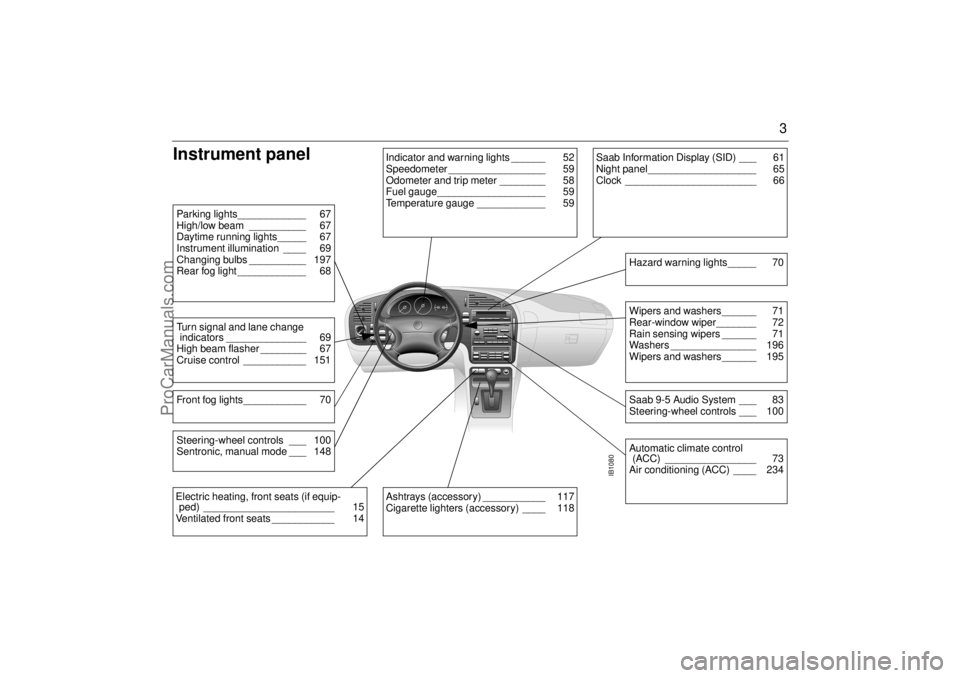
Instrument panel
IB1080
Indicator and warning lights ______ 52
Speedometer _________________ 59
Odometer and trip meter ________ 58
Fuel gauge___________________ 59
Temperature gauge ____________ 59
Parking lights____________ 67
High/low beam __________ 67
Daytime running lights_____ 67
Instrument illumination ____ 69
Changing bulbs __________ 197
Rear fog light ____________ 68Turn signal and lane change
indicators ______________ 69
High beam flasher ________ 67
Cruise control ___________ 151Front fog lights___________ 70
Ashtrays (accessory) ___________ 117
Cigarette lighters (accessory) ____ 118
Saab Information Display (SID) ___ 61
Night panel___________________ 65
Clock _______________________ 66
Wipers and washers ______ 71
Rear-window wiper_______ 72
Rain sensing wipers ______ 71
Washers _______________ 196
Wipers and washers ______ 195Saab 9-5 Audio System ___ 83
Steering-wheel controls ___ 100Hazard warning lights_____ 70Automatic climate control
(ACC) ________________ 73
Air conditioning (ACC) ____ 234
Electric heating, front seats (if equip-
ped) _______________________ 15
Ventilated front seats ___________ 14Steering-wheel controls ___ 100
Sentronic, manual mode ___ 148
ProCarManuals.com
Page 6 of 276
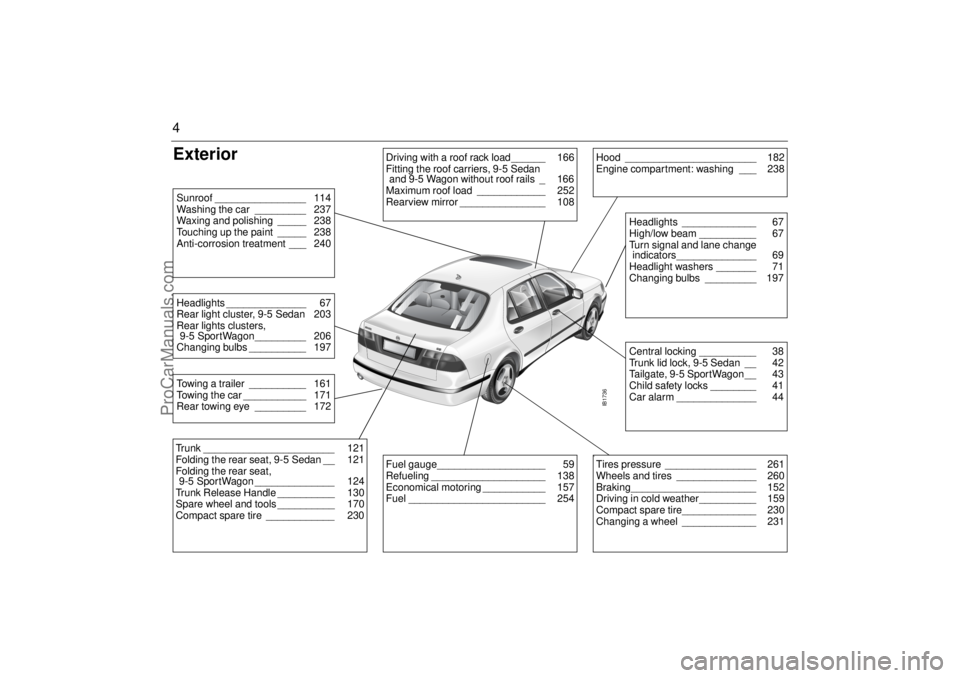
4Exterior
IB1736
Driving with a roof rack load______ 166
Fitting the roof carriers, 9-5 Sedan
and 9-5 Wagon without roof rails _ 166
Maximum roof load ____________ 252
Rearview mirror _______________ 108
Hood _______________________ 182
Engine compartment: washing ___ 238
Central locking __________ 38
Trunk lid lock, 9-5 Sedan __ 42
Tailgate, 9-5 SportWagon __ 43
Child safety locks ________ 41
Car alarm ______________ 44Headlights _____________ 67
High/low beam __________ 67
Turn signal and lane change
indicators______________ 69
Headlight washers _______ 71
Changing bulbs _________ 197
Fuel gauge___________________ 59
Refueling ____________________ 138
Economical motoring ___________ 157
Fuel ________________________ 254
b Tires pressure ________________ 261
Wheels and tires ______________ 260
Braking______________________ 152
Driving in cold weather__________ 159
Compact spare tire_____________ 230
Changing a wheel _____________ 231
Trunk _______________________ 121
Folding the rear seat, 9-5 Sedan __ 121
Folding the rear seat,
9-5 SportWagon ______________ 124
Trunk Release Handle __________ 130
Spare wheel and tools __________ 170
Compact spare tire ____________ 230Towing a trailer __________ 161
Towing the car ___________ 171
Rear towing eye _________ 172Headlights ______________ 67
Rear light cluster, 9-5 Sedan 203
Rear lights clusters,
9-5 SportWagon_________ 206
Changing bulbs __________ 197Sunroof ________________ 114
Washing the car _________ 237
Waxing and polishing _____ 238
Touching up the paint _____ 238
Anti-corrosion treatment ___ 240
ProCarManuals.com
Page 71 of 276
69 Instruments and controls
Instrument illuminationThe brightness of the instrument illumina-
tion can be varied by means of the dimmer
switch adjacent to the headlight switch.
(See also Night panel on page 65).
In daylight or other equally bright light, the
instrument and switch illumination is auto-
matically extinguished.
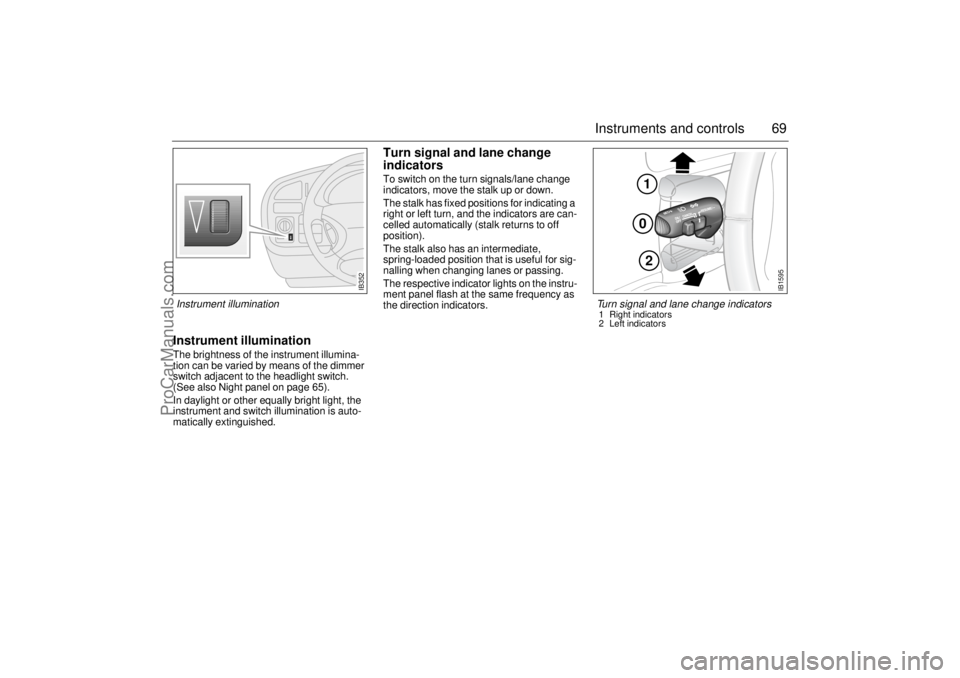
Turn signal and lane change
indicatorsTo switch on the turn signals/lane change
indicators, move the stalk up or down.
The stalk has fixed positions for indicating a
right or left turn, and the indicators are can-
celled automatically (stalk returns to off
position).
The stalk also has an intermediate,
spring-loaded position that is useful for sig-
nalling when changing lanes or passing.
The respective indicator lights on the instru-
ment panel flash at the same frequency as
the direction indicators.
IB352
102
IB1595
Turn signal and lane change indicators 1 Right indicators
2 Left indicators
Instrument illumination
ProCarManuals.com
Page 225 of 276
223 Car care and technical information
Tire Chains
Notice:
If your vehicle does not have
225/45R17 size tires, use tire chains only
where legal and only when you must.
Contact your Saab dealer regarding sui-
table snow chains. Install them on the
front tires and tighten them as tightly as
possible with the ends securely faste-
ned. Drive slowly and follow the chain
manufacturer’s instructions. If you can
hear the chains contacting your vehicle,
stop and retighten them. If the contact
continues, slow down until it stops. Dri-
ving too fast or spinning the wheels with
chains on will damage your vehicle.If a Tire Goes Flat
It’s unusual for a tire to “blow-out” while
you’re driving, especially if you maintain
your tires properly. If air goes out of a tire,
it’s much more likely to leak out slowly. But
if you should ever have a “blow-out”, here
are a few tips about what to expect and what
to do:
If a front tire fails, the flat tire will create a
drag that pulls the vehicle toward that side.
Take your foot off the accelerator pedal and
grip the steering wheel firmly. Steer to main-
tain lane position, and then gently brake to
a stop well out of the traffic lane.
A rear blow-out, particularly on a curve, acts
much like a skid and may require the same
correction you’d use in a skid. In any rear
blowout, remove your foot from the accele-
rator pedal. Get the vehicle under control by
steering the way you want the vehicle to go.
It may be very bumpy and noisy, but you can
still steer. Gently brake to a stop – well off
the road if possible.
If a tire goes flat, the next part shows how to
use your jacking equipment to change a flat
tire safely.
WARNING
If your vehicle has 225/45 R17 size tires,
don’t use tire chains, there’s not enough
clearance.
Tire chains used on a vehicle without the
proper amount of clearance can cause
damage to the brakes, suspension or
other vehicle parts. The area damaged by
the tire chains could cause you to lose
control of your vehicle and you or others
may be injured in a crash.
Use another type of traction device only if
its manufacturer recommends it for use
on your vehicle and tire size combination
and road conditions. Follow that manu-
facturer’s instructions. To help avoid
damage to your vehicle, drive slowly,
readjust or remove the device if it’s
contacting your vehicle, and don’t spin
your wheels.
If you do find traction devices that will fit,
install them on the front tires.
ProCarManuals.com
Page 251 of 276

249 Customer Assistance and Information
Vehicle Data Collection and
Event Data RecordersYour vehicle, like other modern motor vehi-
cles, has a number of sophisticated com-
puter systems that monitor and control sev-
eral aspects of the vehicle’s performance.
Your vehicle uses on-board vehicle comput-
ers to monitor emission control components
to optimize fuel economy, to monitor condi-
tions for air bag deployment and, if so
equipped, to provide anti-lock braking and
to help the driver control the vehicle in diffi-
cult driving situations. Some information
may be stored during regular operations to
facilitate repair of detected malfunctions;
other information is stored only in a crash
event by computer systems commonly
called event data recorders (EDR).
In a crash event, computer systems, such
as the Air Bag Sensing and Diagnostic
Module (SDM) in your vehicle may record
information about the condition of the vehi-
cle and how it was operated, such as data
related to engine speed, brake application,
throttle position, vehicle speed, steering
wheel angle, lateral acceleration, safety belt
usage, air bag readiness, air bag perfor-
mance, and the severity of a collision. This
information has been used to improve vehi-
cle crash performance and may be used to
improve crash performance of future vehi-
cles and driving safety. Unlike the data
recorders on many airplanes, these on-
board systems do not record sounds, such
as conversation of vehicle occupants.To read this information, special equipment
is needed and access to the vehicle or the
SDM is required.
Saab will not access information about a
crash event or share it with others other than
with the consent of the vehicle owner or, if
the vehicle is leased, with the consent of
the lessee,
in response to an official request of police
or similar government office,
as part of Saab’s defense of litigation
through the discovery process, or
as required by law.
In addition, once Saab collects or receives
data, Saab may
use the data for Saab research needs,
make it available for research where
appropriate confidentiality is to be main-
tained and need is shown, or
share summary data which is not tied to a
specific vehicle with non-Saab organiza-
tions for research purposes.
Others, such as law enforcement, may have
access to the special equipment that can
read the information if they have access to
the vehicle or SDM.
If your vehicle is equipped with OnStar®,
please check lthe OnStar® subscription
service agreement or manual for informa-
tion on its operations and data collection.
ProCarManuals.com
Page 260 of 276

258 SpecificationsManual gearbox Automatic transmission Type ____________________________ All-synchromesh
5-speed with final
drive and differen-
tial
Oil ______________________________ Saab MTF 0063
Oil capacity _______________________ 1.9 qts (1.8 litres)
Oil volume (on changing) ____________ 1.6 qts (1.5 litres)
Clutch type _______________________ Hydraulic, single
dry-plate clutch of
diaphragm-spring
type
Speed (mph / km/h) at 1000 rpm in 5th gear: 27–29 / 43–47Type _____________________________ Electronically con-
trolled 5-speed,
fully automatic with
hydraulic torque
converter, plane-
tary gear set and
integral final drive
Lock-up function in
selector positions 3,
4 and 5.
Selector-lever positions ______________ P R N D M L
Transmission-fluid capacity, dry transmis-
sion (incl. torque converter and oil cooler) 7.4 qts (7 litres)
Transmission fluid ___________________ Saab 3309 (mineral
oil based)
Clutch type ________________________ Hydraulic plate clut-
ches, brake bands
and one-way coup-
lings
Speed (mph / km/h) at 1000 rpm in 5th gear: 29–30 / 46–48
ProCarManuals.com
Page 266 of 276

264 SpecificationsSeveral of the systems in your
Saab car can be adjusted to
better fit your individual needsSome functions are governed by legal
requirements and cannot therefore be
reprogrammed.
Consult an authorized Saab dealer for
further information.Car alarm/central locking system: The number of blinks when locking/
unlocking.
Automatic locking of the trunk when the
car is driven, 1 to 8 mph (2–14 km/h), YES
or NO.
Preclude the unlocking of the trunk while
the car is driven, YES or NO.
Automatic locking of the trunk after
1 second–4 minutes if it has not been
opened, YES or NO.
Automatic locking of the trunk when it is
closed, YES or NO.
Automatic locking of all doors when the
car is driven above 7.5 mph (12 km/h),
YES or NO.
Saab Information Display: Outdoor temperature display can be
adjusted.Miscellaneous: Select the on-time for heated rear seat.
Additional sweep of the wipers after
windshield washer function (ON or OFF).
Courtesy Headlight Feature on-time can
vary from 20 to 50 seconds.
Night panel illumination deactivation
speed for the speedometer can be adjus-
ted.
Following adjustments can be
done by the driver:Automatic Climate Control (ACC):To alter the preprogrammed ”AUTO” start
up mode with your own preferences you can
manually select the desired settings for:
Temperature.
Fan speed.
Air distribution.
See ”Programming I” on page 79 and ”Pro-
gramming II” on page 80.Saab 9-5 Audio System (see page 99): Maximum starting volume (when the
radio is switched on).
Telephone volume (if the car is equipped
with a phone connected to the audio
system).
Speed dependent volume (volume
increases or decreases with vehicle
speed).
Loudness.Daytime Running Lights:To disable, turn off the ignition and pull out
fuse 35, see page 214.
ProCarManuals.com