parking brake SAAB 9-5 2005 Owners Manual
[x] Cancel search | Manufacturer: SAAB, Model Year: 2005, Model line: 9-5, Model: SAAB 9-5 2005Pages: 276, PDF Size: 16.72 MB
Page 10 of 276
8
IB336
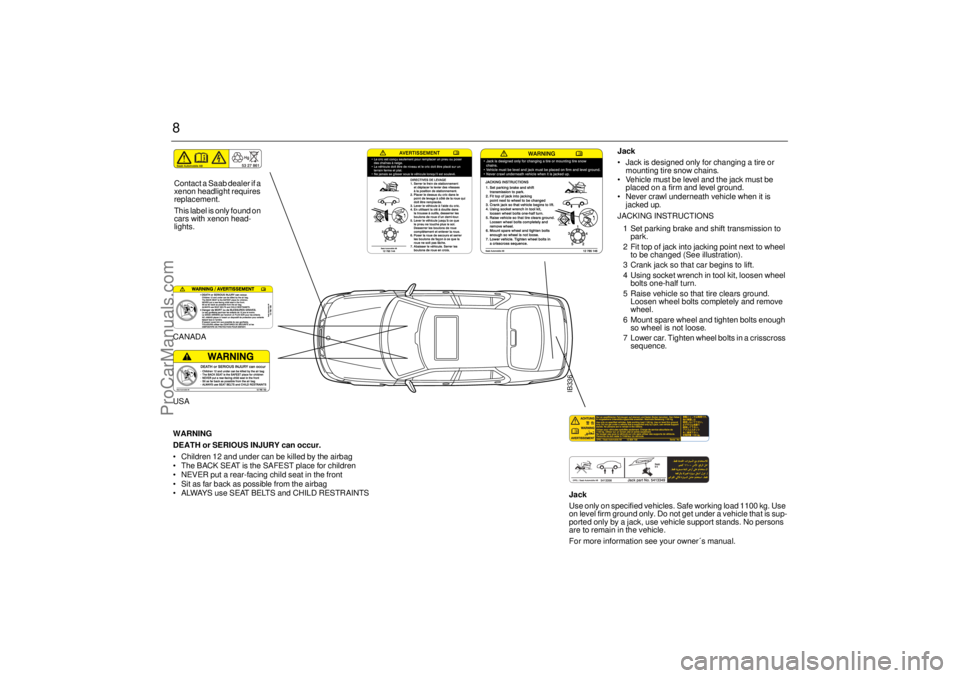
Jack
Jack is designed only for changing a tire or
mounting tire snow chains.
Vehicle must be level and the jack must be
placed on a firm and level ground.
Never crawl underneath vehicle when it is
jacked up.
JACKING INSTRUCTIONS
1 Set parking brake and shift transmission to
park.
2 Fit top of jack into jacking point next to wheel
to be changed (See illustration).
3 Crank jack so that car begins to lift.
4 Using socket wrench in tool kit, loosen wheel
bolts one-half turn.
5 Raise vehicle so that tire clears ground.
Loosen wheel bolts completely and remove
wheel.
6 Mount spare wheel and tighten bolts enough
so wheel is not loose.
7 Lower car. Tighten wheel bolts in a crisscross
sequence.
CANADAUSA
WARNING
DEATH or SERIOUS INJURY can occur.
Children 12 and under can be killed by the airbag
The BACK SEAT is the SAFEST place for children
NEVER put a rear-facing child seat in the front
Sit as far back as possible from the airbag
ALWAYS use SEAT BELTS and CHILD RESTRAINTSContact a Saab dealer if a
xenon headlight requires
replacement.
This label is only found on
cars with xenon head-
lights.
Jack
Use only on specified vehicles. Safe working load 1100 kg. Use
on level firm ground only. Do not get under a vehicle that is sup-
ported only by a jack, use vehicle support stands. No persons
are to remain in the vehicle.
For more information see your owner´s manual.
ProCarManuals.com
Page 11 of 276
9
No sparks, fla-
mes or smo-
king.Buckle up
Use protective
gogglesAirbag
Keep out of
reach of
children.Never place a
rear-facing
child seat in
this seat.
Battery acid
contains
sulfuric acid.Electric
windows
Refer to the
Owner’s
Manual.Deactivating
of rear window
switches
Risk of
explosive gas.Central
locking, lock
.Central
locking,
unlock
Tr u n k
lid/tailgate,
opening
HeadlightsWindshield
wipers
Direction
indicatorsWindshield
washers
Parking lights Defroster
Hazard
warning lightsRear window
heating
Front fog
lightsVentilation fan
Rear fog
light
Coolant
temperatureRadiator fan
Battery
chargingFuel
Foot brake
Coolant level
Engine oil
pressure
ABS brakes
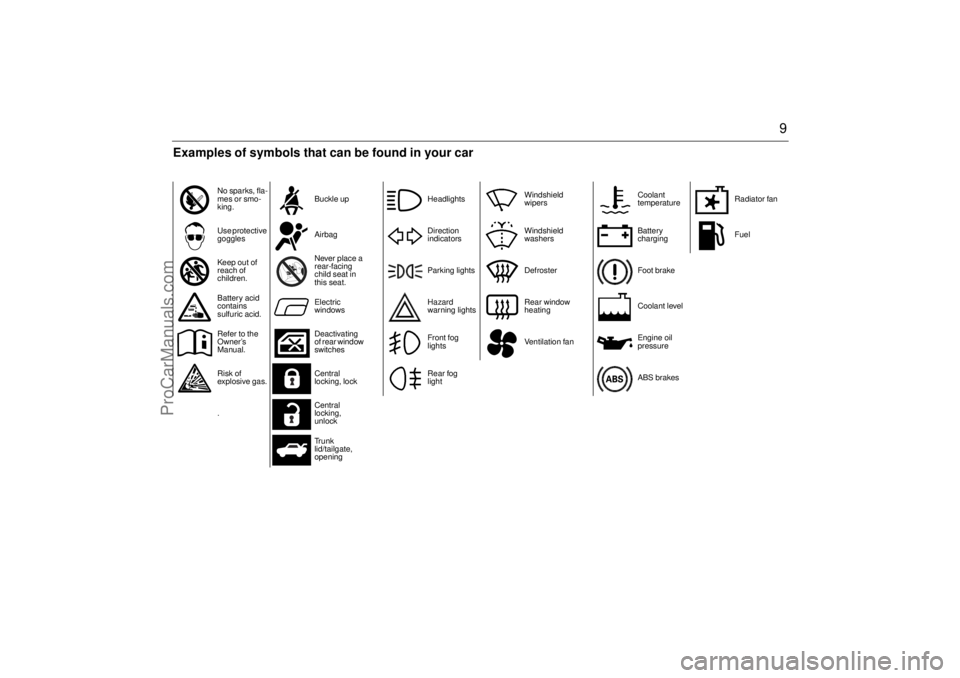
Examples of symbols that can be found in your car
ProCarManuals.com
Page 54 of 276
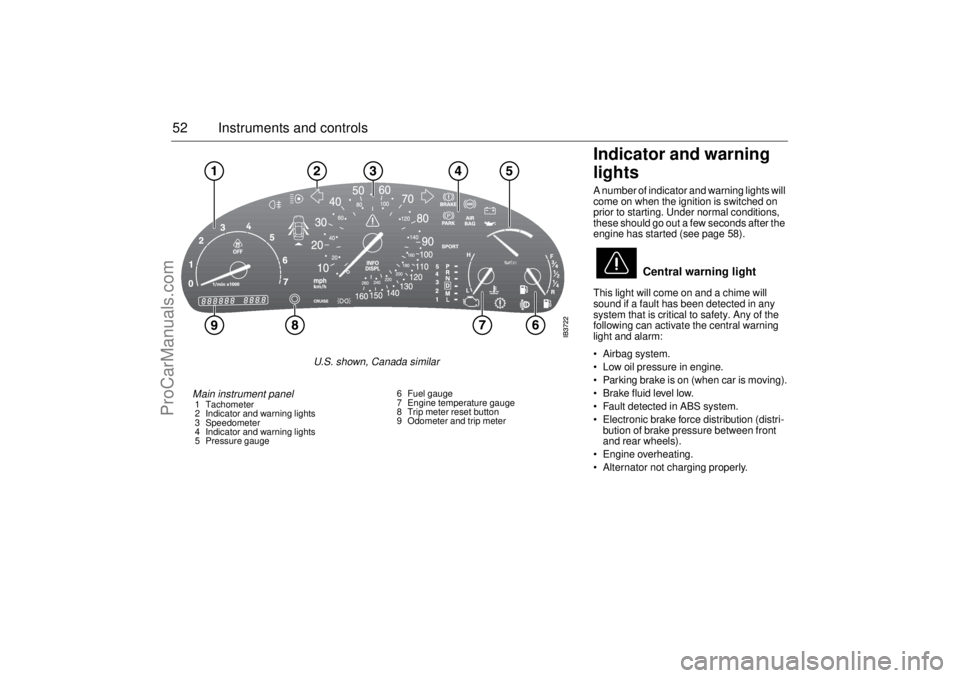
52 Instruments and controls
Indicator and warning
lights A number of indicator and warning lights will
come on when the ignition is switched on
prior to starting. Under normal conditions,
these should go out a few seconds after the
engine has started (see page 58).
This light will come on and a chime will
sound if a fault has been detected in any
system that is critical to safety. Any of the
following can activate the central warning
light and alarm:
Airbag system.
Low oil pressure in engine.
Parking brake is on (when car is moving).
Brake fluid level low.
Fault detected in ABS system.
Electronic brake force distribution (distri-
bution of brake pressure between front
and rear wheels).
Engine overheating.
Alternator not charging properly.
Central warning light
Main instrument panel 1 Tachometer
2 Indicator and warning lights
3 Speedometer
4 Indicator and warning lights
5 Pressure gauge6 Fuel gauge
7 Engine temperature gauge
8 Trip meter reset button
9 Odometer and trip meter
U.S. shown, Canada similar
ProCarManuals.com
Page 56 of 276
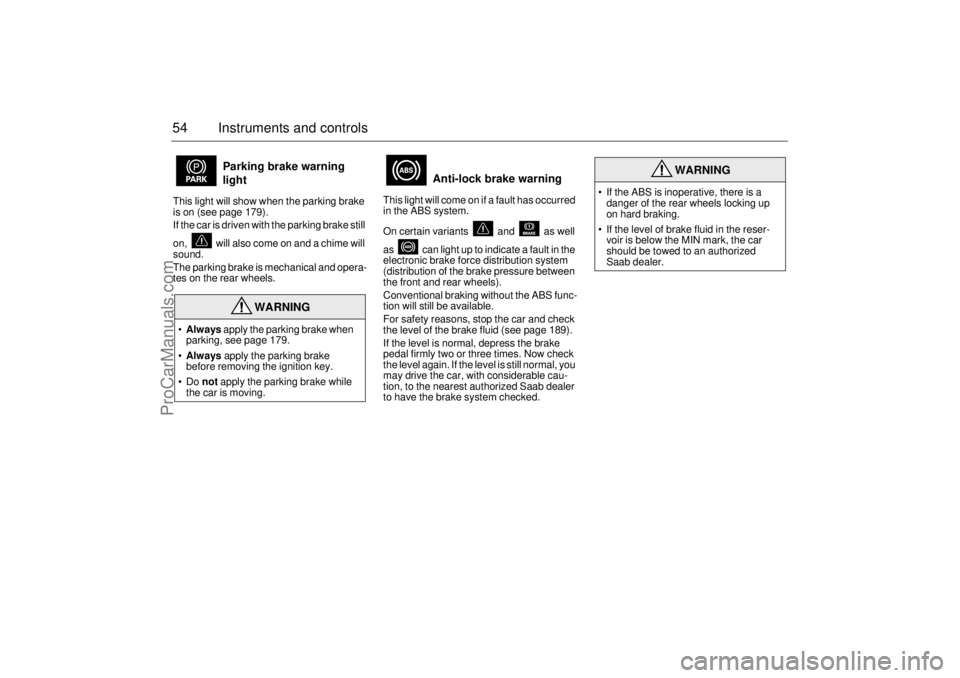
54 Instruments and controlsThis light will show when the parking brake
is on (see page 179).
If the car is driven with the parking brake still
on, will also come on and a chime will
sound.
The parking brake is mechanical and opera-
tes on the rear wheels. This light will come on if a fault has occurred
in the ABS system.
On certain variants and as well
as can light up to indicate a fault in the
electronic brake force distribution system
(distribution of the brake pressure between
the front and rear wheels).
Conventional braking without the ABS func-
tion will still be available.
For safety reasons, stop the car and check
the level of the brake fluid (see page 189).
If the level is normal, depress the brake
pedal firmly two or three times. Now check
the level again. If the level is still normal, you
may drive the car, with considerable cau-
tion, to the nearest authorized Saab dealer
to have the brake system checked.
Parking brake warning
light
WARNING
Always apply the parking brake when
parking, see page 179.
Always apply the parking brake
before removing the ignition key.
Do not apply the parking brake while
the car is moving.
Anti-lock brake warning
WARNING
If the ABS is inoperative, there is a
danger of the rear wheels locking up
on hard braking.
If the level of brake fluid in the reser-
voir is below the MIN mark, the car
should be towed to an authorized
Saab dealer.
ProCarManuals.com
Page 133 of 276

131 Starting and driving
IB1754
Starting and driving
Ignition switch ________ 132
Starting the engine ____ 133
Important considerations
for driving___________ 136
Refueling ____________ 138
Engine Break-In Period_ 142
Gear changing ________ 142
Cruise control ________ 151
Braking ______________ 152
Electronic Stability
Program (ESP) _______ 155
Economical motoring __ 157
Driving in cold weather_ 159
Driving in hot weather _ 160
Towing a trailer _______ 161 Driving with a roof rack
load_________________ 166
Driving at night ________ 168
Driving with a load _____ 168
Driving considerations
with compact spare
wheel/tire fitted _______ 170
Spare wheel and tools __ 170
Driving with the trunk
lid/tailgate open _______ 171
Driving in deep water ___ 171
Towing the car_________ 171
Jump starting _________ 174
Saab Parking Assistance 177
Parking brake _________ 179
Parking _______________ 179
ProCarManuals.com
Page 135 of 276

133 Starting and driving
If the car does not startIf the text
”Key not accepted.
Contact service.”
is shown on the SID, after a failed start
attempt, the cause could be a fault in the
transmitter in the key, or in the receiver in
the ignition lock. The following should be
done:
Turn the key back to the LOCK position.
Turn the key to ON.
Press one of the buttons on the remote
control (the LED stops blinking).
Start the engine.
Try another key. If this works, then the fault
is in the first key.
Contact an authorized Saab dealer for
checking and rectification.
Note:
Certain electronic items, such as cellular
phones, may affect the starting produce-
dure. Be sure that all devices are clear of the
key/ignition switch area.
Starting the engine
NOTICETake care not to spill drinks or to drop
crumbs over the ignition switch. If dirt or
liquid gets into it, the switch may not
operate properly.
WARNING
Always remove the key before leaving
the car.
Always apply the parking brake before
removing the ignition key.
WARNING
When starting the engine:
– Sit down in the driver’s seat.
– Depress the clutch pedal fully. If the
gear lever is not in the neutral position,
the clutch pedal must be fully depres-
sed or the car will jump forwards or
backwards, which may cause a crash.
– Never start the car from outside the
vehicle, e.g. through a wound down
window. This could lead to serious
personal injury.
Engage reverse (R) (position P for
automatic transmission) to remove the
ignition key. The key can only be
removed in this gear position.
Carbon monoxide (CO) is a colorless,
odorless, poisonous gas. Be alert to
the danger of CO – always open the
garage doors before starting the
engine in the garage.
There is also a danger of CO poiso-
ning if the exhaust system is leaking.
ProCarManuals.com
Page 145 of 276
143 Starting and driving
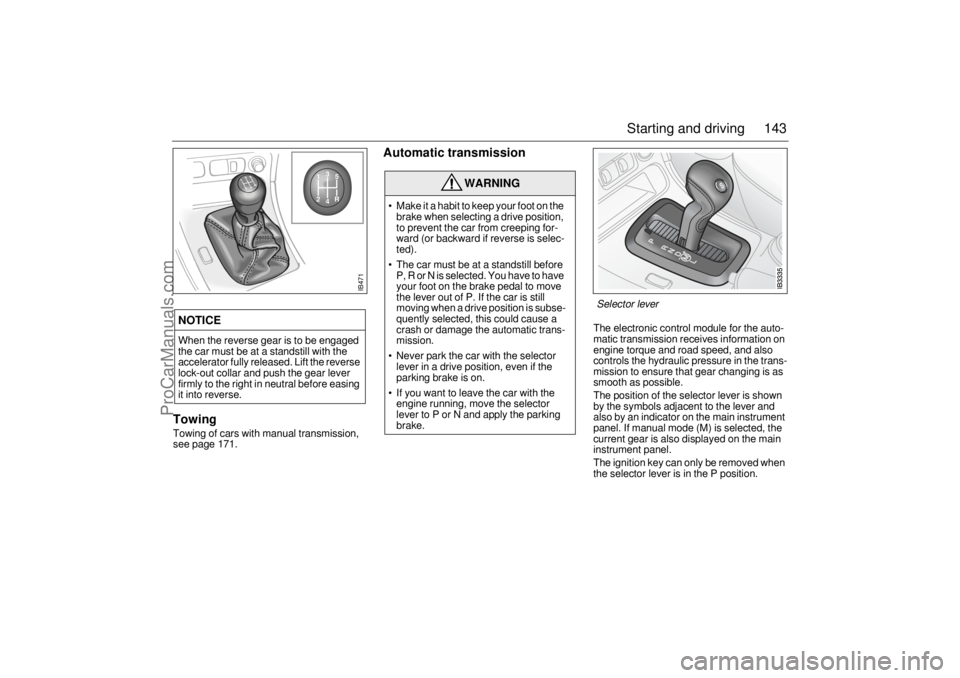
Towing Towing of cars with manual transmission,
see page 171.
Automatic transmission
The electronic control module for the auto-
matic transmission receives information on
engine torque and road speed, and also
controls the hydraulic pressure in the trans-
mission to ensure that gear changing is as
smooth as possible.
The position of the selector lever is shown
by the symbols adjacent to the lever and
also by an indicator on the main instrument
panel. If manual mode (M) is selected, the
current gear is also displayed on the main
instrument panel.
The ignition key can only be removed when
the selector lever is in the P position.
NOTICEWhen the reverse gear is to be engaged
the car must be at a standstill with the
accelerator fully released. Lift the reverse
lock-out collar and push the gear lever
firmly to the right in neutral before easing
it into reverse.
WARNING
Make it a habit to keep your foot on the
brake when selecting a drive position,
to prevent the car from creeping for-
ward (or backward if reverse is selec-
ted).
The car must be at a standstill before
P, R or N is selected. You have to have
your foot on the brake pedal to move
the lever out of P. If the car is still
moving when a drive position is subse-
quently selected, this could cause a
crash or damage the automatic trans-
mission.
Never park the car with the selector
lever in a drive position, even if the
parking brake is on.
If you want to leave the car with the
engine running, move the selector
lever to P or N and apply the parking
brake.
Selector lever
IB471
13
25
R
4
ProCarManuals.com
Page 147 of 276
145 Starting and driving
Lock-up function The automatic transmission has a lock-up
function, which can render the torque con-
verter inoperative in 3rd, 4th and 5th gears,
thus reducing the engine speed and fuel
consumption.
When the lock-up function comes into oper-
ation, it may give the impression of an over-
drive being engaged.Kick-downWhen the accelerator is pressed down hard,
a change-down to the next gear will be
effected to provide maximum acceleration,
e.g. for overtaking.
Following this, the next higher gear will be
selected at the optimum engine speed for
acceleration or, if you ease off the acceler-
ator, before reaching this.
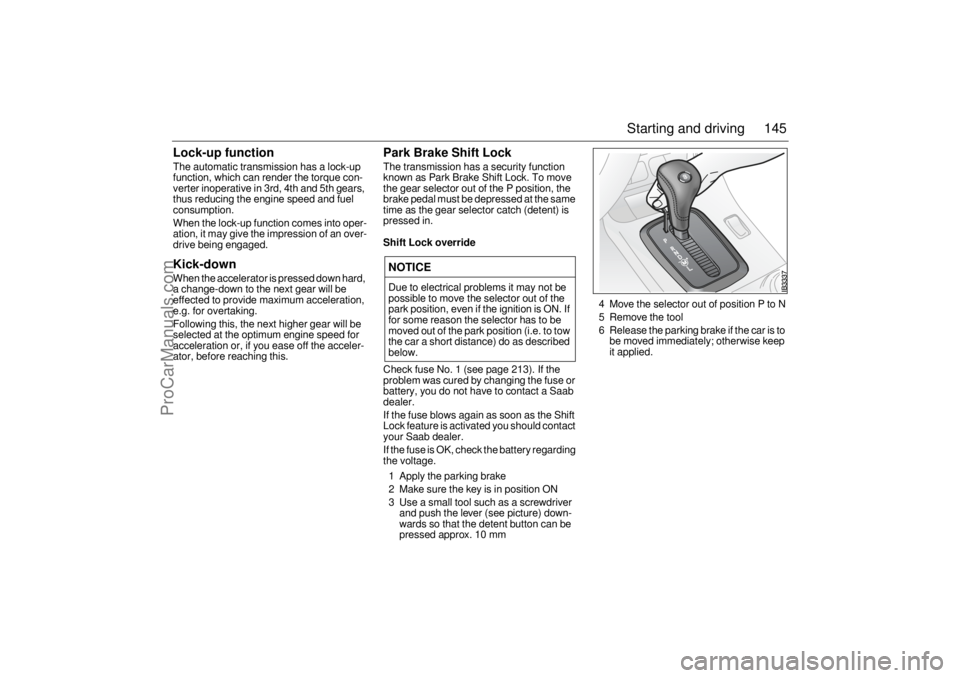
Park Brake Shift LockThe transmission has a security function
known as Park Brake Shift Lock. To move
the gear selector out of the P position, the
brake pedal must be depressed at the same
time as the gear selector catch (detent) is
pressed in.Shift Lock overrideCheck fuse No. 1 (see page 213). If the
problem was cured by changing the fuse or
battery, you do not have to contact a Saab
dealer.
If the fuse blows again as soon as the Shift
Lock feature is activated you should contact
your Saab dealer.
If the fuse is OK, check the battery regarding
the voltage.
1 Apply the parking brake
2 Make sure the key is in position ON
3 Use a small tool such as a screwdriver
and push the lever (see picture) down-
wards so that the detent button can be
pressed approx. 10 mm4 Move the selector out of position P to N
5 Remove the tool
6 Release the parking brake if the car is to
be moved immediately; otherwise keep
it applied.NOTICEDue to electrical problems it may not be
possible to move the selector out of the
park position, even if the ignition is ON. If
for some reason the selector has to be
moved out of the park position (i.e. to tow
the car a short distance) do as described
below.
ProCarManuals.com
Page 151 of 276
149 Starting and driving
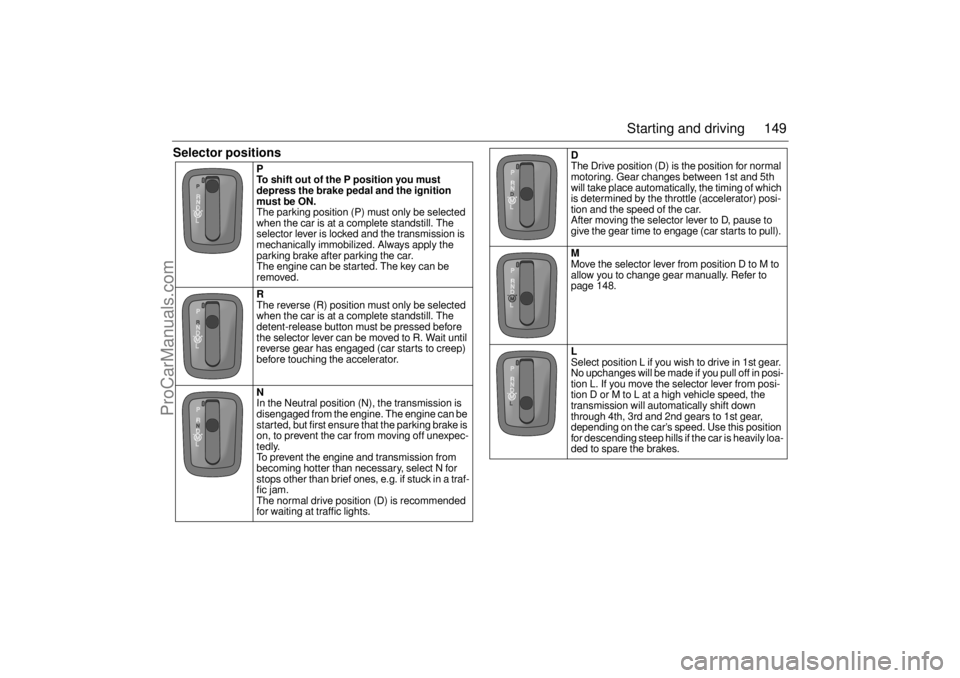
Selector positions
P
To shift out of the P position you must
depress the brake pedal and the ignition
must be ON. The parking position (P) must only be selected
when the car is at a complete standstill. The
selector lever is locked and the transmission is
mechanically immobilized. Always apply the
parking brake after parking the car.
The engine can be started. The key can be
removed.R The reverse (R) position must only be selected
when the car is at a complete standstill. The
detent-release button must be pressed before
the selector lever can be moved to R. Wait until
reverse gear has engaged (car starts to creep)
before touching the accelerator. N In the Neutral position (N), the transmission is
disengaged from the engine. The engine can be
started, but first ensure that the parking brake is
on, to prevent the car from moving off unexpec-
tedly.
To prevent the engine and transmission from
becoming hotter than necessary, select N for
stops other than brief ones, e.g. if stuck in a traf-
fic jam.
The normal drive position (D) is recommended
for waiting at traffic lights.
D The Drive position (D) is the position for normal
motoring. Gear changes between 1st and 5th
will take place automatically, the timing of which
is determined by the throttle (accelerator) posi-
tion and the speed of the car.
After moving the selector lever to D, pause to
give the gear time to engage (car starts to pull). MMove the selector lever from position D to M to
allow you to change gear manually. Refer to
page 148.LSelect position L if you wish to drive in 1st gear.
No upchanges will be made if you pull off in posi-
tion L. If you move the selector lever from posi-
tion D or M to L at a high vehicle speed, the
transmission will automatically shift down
through 4th, 3rd and 2nd gears to 1st gear,
depending on the car’s speed. Use this position
for descending steep hills if the car is heavily loa-
ded to spare the brakes.
ProCarManuals.com
Page 155 of 276
153 Starting and driving
ABS brakes
ABS (antilock braking system) modulates
the brake pressure to the respective
wheels. Wheel sensors detect if a wheel is
about to lock, and the control module redu-
ces the pressure to that wheel and then
increases it once more until the tendency is
detected again.
The brake system is equipped with an Elec-
tronic Brake-force Distribution device
(EBD), which distributes the brake pressure
between the front and rear wheels, in such
a way as to achieve optimum braking perfor-
mance irrespective of the car’s speed and
load.
WARNING
It is prudent to try your brakes from
time to time, especially when driving in
heavy rain, through water collected on
the road, in snow, on a wet road sur-
face or in salty slush. In such condi-
tions, the brakes may take longer than
normal to take effect. To rectify this,
touch the brake pedal periodically to
dry the brakes out.
The same applies after the car has
been washed or when the weather is
very humid.
Avoid parking the car with wet brakes.
Before parking, and if the traffic condi-
tions allow, brake quite heavily so that
the brake discs and pads warm up and
dry.
The brakes are power assisted and it
should be kept in mind that the servo
unit only provides the power assis-
tance when the engine is running.
The brake pressure required when the
engine is off,(e.g. when the car is
being towed) is roughly four times the
normal pedal force required. The
pedal also feels hard and unre-
sponsive.
WARNING
The additional safety afforded by the
ABS system is not designed to allow
drivers to drive faster but to make
normal driving safer.
To stop as quickly as possible, without
loss of directional stability, whether
the road surface is dry, wet or slippery, press the brake pedal down hard-
without letting up (do not pump the
pedal),
declutching simultan-
eously, and steer the car to safety.
ProCarManuals.com