ESP SAAB 9-5 2007 User Guide
[x] Cancel search | Manufacturer: SAAB, Model Year: 2007, Model line: 9-5, Model: SAAB 9-5 2007Pages: 288, PDF Size: 18.14 MB
Page 85 of 288
85 Instruments and controls
Adaptation of ACCIt is also possible to customize the ACC system, e.g. to adapt to
driving and weather conditions.
Adaptation and restoration of factory settings is done by holding
the respective button depressed approx. 2 seconds until a chime
sounds.
Make sure the ignition is ON.
Example: If you want the ACC system to handle activation and deac-
tivation of rear window/door mirror heating, hold the button
depressed approx. 2 seconds until a chime sounds.
The display shows:
ACC:AUTO
RDEFR CTRL
When “Adaptation of ACC“ is done, it will apply until factory settings
are restored. Function Operation in AUTO mode
after adaptationFactory setting
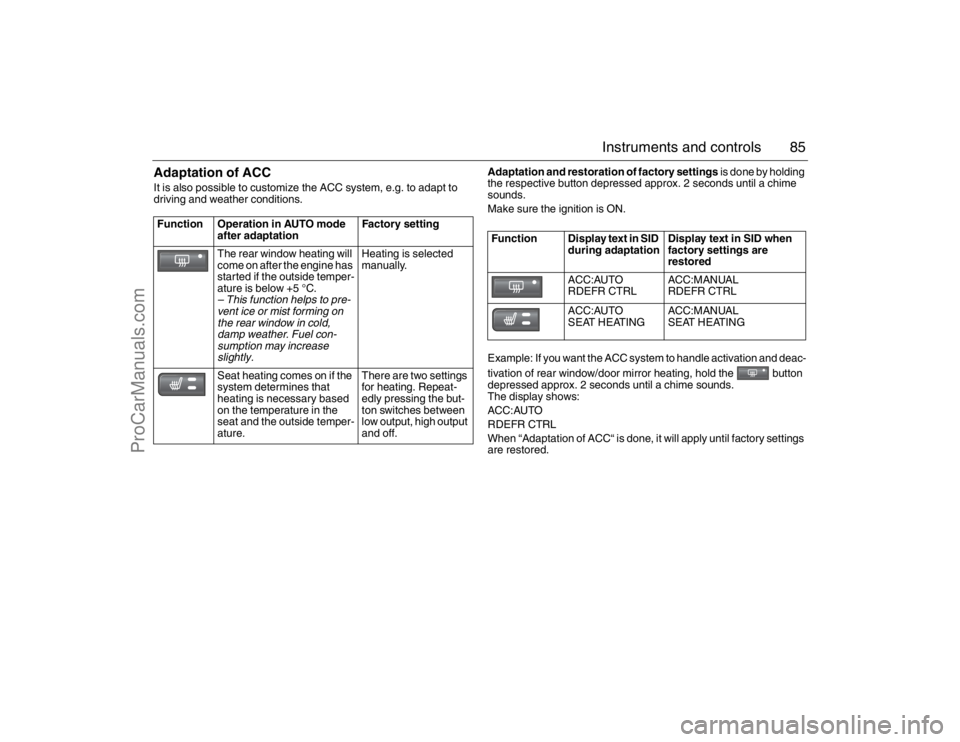
The rear window heating will
come on after the engine has
started if the outside temper-
ature is below +5 °C.
– This function helps to pre-
vent ice or mist forming on
the rear window in cold,
damp weather. Fuel con-
sumption may increase
slightly.
Heating is selected
manually.
Seat heating comes on if the
system determines that
heating is necessary based
on the temperature in the
seat and the outside temper-
ature
.
There are two settings
for heating. Repeat-
edly pressing the but-
ton switches between
low output, high output
and off.
Function Display text in SID
during adaptationDisplay text in SID when
factory settings are
restored
ACC:AUTO
RDEFR CTRLACC:MANUAL
RDEFR CTRL
ACC:AUTO
SEAT HEATINGACC:MANUAL
SEAT HEATING
95_U S _M 07.book Page 85 Friday, June 9, 2006 8:58 AM
ProCarManuals.com
Page 115 of 288

115 Interior equipment and trunk
Electric windowsThe electric motors of the front windows are
equipped with overload protection (inte-
grated thermal protection). This protection
operates when the windows are wound
down automatically (switch pressed fully
down).To open:
Front windows: press the front of the switch
Rear windows: Press the back of the switch.
The switches for the front windows have a
third position for automatic opening of the
window. Press the switch fully down to lower
the window completely.
To cancel automatic lowering of the win-
dow, lift the switch briefly.To close:
Front windows: Lift the front of the switch.
Rear windows: Lift the back of the switch.
The actuating motor will be switched off
automatically when the window is fully
closed or when the switch is released.
WARNING
Bear in mind the pinch hazard when the
side windows are being wound up.
Always remove the ignition key when
you leave the car. This prevents per-
sonal injury caused by the electric win-
dows, for example, due to children
playing.
The person operating the electric win-
dows is responsible for ensuring that
no one, especially children, has their
head, hands or fingers in the window
openings, before raising the windows.
Raising the windows could otherwise
cause serious or fatal injuries.
Do not extend your arm, head etc. out
of an open window while driving.
IB3231
1 Window switches
2 Switch for rendering rear door window switches inoperative
95_U S _M 07.book Page 115 Friday, June 9, 2006 8:58 AM
ProCarManuals.com
Page 123 of 288

123 Interior equipment and trunk
Moonroof3 The moonroof is operated by the switch on
the overhead panel above the rearview mir-
ror. The moonroof can be opened partially
or fully.
To open:
Slide the control towards the rear to open
the moonroof to the comfort position.
To open it fully, slide the control back a
second time. Press the control to stop it
earlier. To close:
Slide the control forwards until the moon-
roof is closed.
Ventilation position
Press the middle of the control (when
moonroof closed).
To close: slide the control forwards.
To fully open the moonroof from the ventila-
tion position, slide the control back.
The moonroof incorporates an interior,
manual, sliding sun blind.
If the car is newly waxed, the moonroof may
creak when opened to the ventilation posi-
tion or when driving with the moonroof
closed. The sound comes from the area
where the front edge of the moonroof meets the metal roof. Open the moonroof fully and,
using washer fluid, clean the seal on the
leading edge of the moonroof and the
painted surface against which this seals
when the moonroof is closed.
WARNING
Bear in mind the pinch hazard when clos-
ing the moonroof.
Always remove the ignition key when
you leave the car. This prevents per-
sonal injury caused by the electric
moonroof, for example, due to chil-
dren playing.
The person operating the electric
moonroof is responsible for ensuring
that no one, especially children, has
their head, hands or fingers in the
opening, before closing the moonroof.
Operating the moonroof could other-
wise cause serious or fatal injuries.
Do not extend your arm, head etc. out
of an open moonroof while driving.
IB430
1
3
2
Moonroof control 1 To open
2 To close
3 Ventilation position
95_U S _M 07.book Page 123 Friday, June 9, 2006 8:58 AM
ProCarManuals.com
Page 124 of 288

124 Interior equipment and trunkEmergency operation of
moonroofIn an emergency (e.g. if there is an electrical
failure) the moonroof can be operated by a
screwdriver. Remove the cover at the front
of the moonroof opening, insert a screw-
driver in the groove, and rotate.
Rotate counterclockwise to close moonroof.
Interior lighting The interior lighting consists of one dome
light in the front and one in the back, a
map-reading light in the front, two reading
lights in the back, floor courtesy lights in the
front (in some model variants) and door
courtesy lights on all doors.
The courtesy lights come on automatically
when the respective door is opened. Each
reading light has its own switch adjacent to
the lamp.The switch for the dome lights is on the front
overhead panel. When the switch is in the
mid-position (door-activated), the interior
lighting will come on:
When the car is unlocked from the out-
side.
When any door is opened.
When the ignition key is withdrawn from
the ignition switch.
Lighting goes out 30 seconds after the
doors have been closed or:
when the ignition is switched ON, pro-
vided that the cabin lighting control is in
the center position
when the car is locked with the remote
control.
IB431
Manual operation of moonroof
123
IB357
1 Interior lighting on continuously
2 Lighting comes on when a door is opened
3 Lighting always off
95_U S _M 07.book Page 124 Friday, June 9, 2006 8:58 AM
ProCarManuals.com
Page 129 of 288

129 Interior equipment and trunkTrunkFolding the rear seat, 9-5 SedanThe rear seat is split and the two sections can be folded indepen-
dently. Folding down of the rear seat is easier if the front seats are
not all the way back, and the rear head restraints are folded down.
1 Raise the rear seat cushions by pulling the loop located between
the cushion and the backrest.
2 Tip the seat cushion forward.
3 Press the button adjacent to the respective backrest to release it.
4 Fold down the backrest.
WARNING
Never leave a child or animal unattended in the car. During
sunny weather the temperature in the passenger and luggage
compartments can climb to 158–176°F (70–80°C). Small chil-
dren are very susceptible to heat stroke.
Rear-seat passengers should always ensure that the head
restraint is raised and in proper position for the seats to be
occupied.
Keep hands well clear of all moving parts.
Never place heavy objects on the rear window shelf. There is
always a danger of loose objects flying about and causing
injury if the car should brake suddenly or be involved in a
crash.
Before folding up the backrest, hang the outer safety belts
onto the hook on the respective courtesy handle to prevent
them from becoming trapped.
Check that the seatbelt locks do not get trapped under the
seat cushions when these are raised back up.
Make sure that the backrest is locked when it is restored to an
upright position. Check that the back rest release button (3) is
flush with the surround before entering the rear seat. This indi-
cates that the backrest is locked.
IB459
1
2
4
3
95_U S _M 07.book Page 129 Friday, June 9, 2006 8:58 AM
ProCarManuals.com
Page 132 of 288
132 Interior equipment and trunk
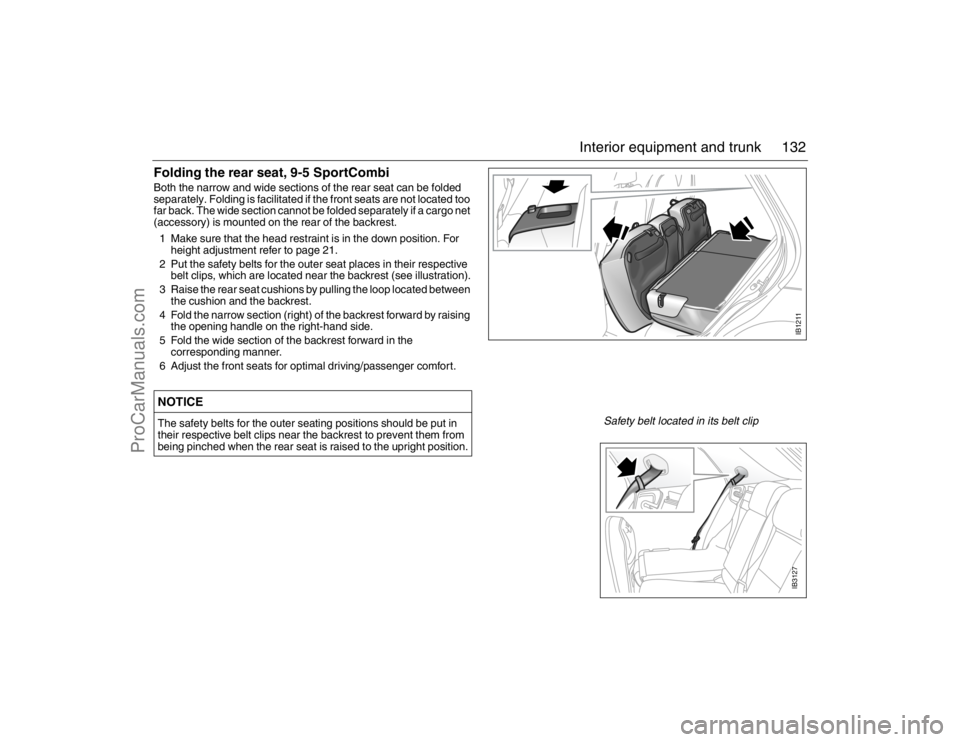
Folding the rear seat, 9-5 SportCombiBoth the narrow and wide sections of the rear seat can be folded
separately. Folding is facilitated if the front seats are not located too
far back. The wide section cannot be folded separately if a cargo net
(accessory) is mounted on the rear of the backrest.
1 Make sure that the head restraint is in the down position. For
height adjustment refer to page 21.
2 Put the safety belts for the outer seat places in their respective
belt clips, which are located near the backrest (see illustration).
3 Raise the rear seat cushions by pulling the loop located between
the cushion and the backrest.
4 Fold the narrow section (right) of the backrest forward by raising
the opening handle on the right-hand side.
5 Fold the wide section of the backrest forward in the
corresponding manner.
6 Adjust the front seats for optimal driving/passenger comfort. NOTICEThe safety belts for the outer seating positions should be put in
their respective belt clips near the backrest to prevent them from
being pinched when the rear seat is raised to the upright position.
IB1211IB3127
Safety belt located in its belt clip
95_U S _M 07.book Page 132 Friday, June 9, 2006 8:58 AM
ProCarManuals.com
Page 134 of 288
134 Interior equipment and trunk
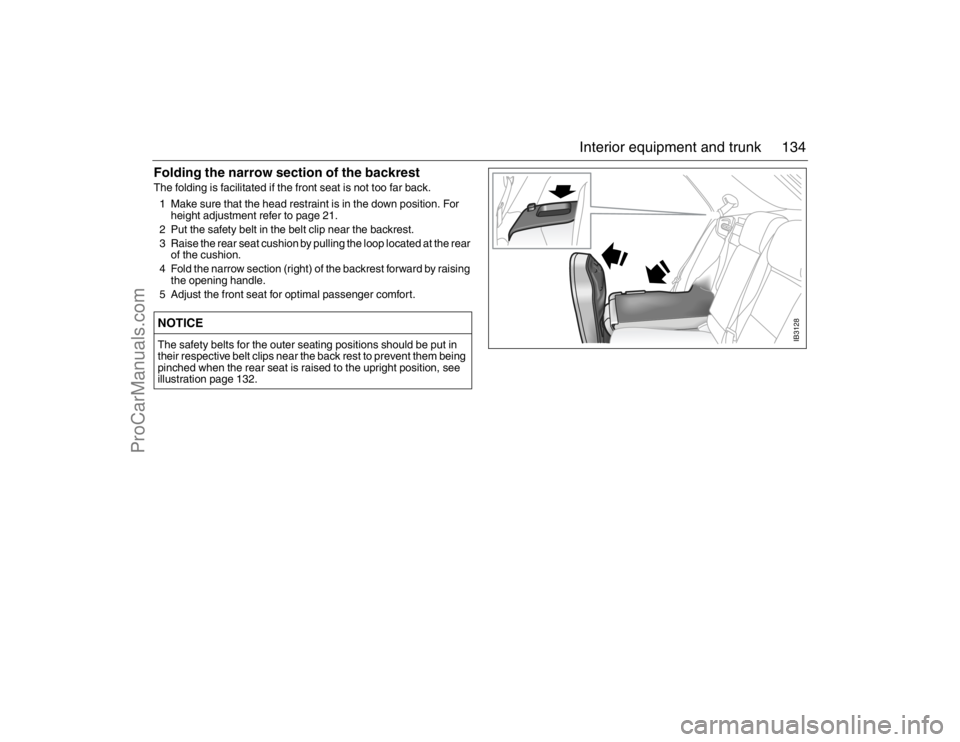
Folding the narrow section of the backrestThe folding is facilitated if the front seat is not too far back.
1 Make sure that the head restraint is in the down position. For
height adjustment refer to page 21.
2 Put the safety belt in the belt clip near the backrest.
3 Raise the rear seat cushion by pulling the loop located at the rear
of the cushion.
4 Fold the narrow section (right) of the backrest forward by raising
the opening handle.
5 Adjust the front seat for optimal passenger comfort.NOTICEThe safety belts for the outer seating positions should be put in
their respective belt clips near the back rest to prevent them being
pinched when the rear seat is raised to the upright position, see
illustration page 132.
IB3128
95_U S _M 07.book Page 134 Friday, June 9, 2006 8:58 AM
ProCarManuals.com
Page 135 of 288
135 Interior equipment and trunk
Load anchoring
Driving with the trunk lid/tailgate open,
see page 183.
WARNING
Put heavy loads as low down and as
far forward as possible in the luggage
compartment, i.e. against the back of
the rear seat.
Never overload the cargo net3. If the
elastic breaks this may cause personal
injury. Do not use a cargo net that
shows signs of wear.
Never stack cargo so high that any part
of the cargo lies above the edge of the
backrest, if a cargo guard3 is not
being used.
Always tie down the cargo so that it
cannot be thrown forward during
heavy braking or in the event of a
crash.
Unsecured and heavy cargo can
increase the risk of injury during hard
braking, sudden avoidance maneu-
vers and in the event of a crash.
For the best load anchoring, use the
special cargo tie down eye and load
straps3.
Load the cargo tie down eyes evenly.
Never attach more than one strap to
each tie down eye.
Provide protection on sharp edges to
prevent damage to the load straps.
Never use the elastic floor net3 and
elastic side net (accessory) when the
rear seat is folded down. These nets
are only intended to keep light objects
tidy, not for the anchoring of loads.
If possible, avoid having the rear seat
folded down when driving with a heavy
load because the anchoring possibili-
ties are restricted when the rear seat is
in this position. That the rear seat is
in the upright position is a basic
requirement for protection against
cargo displacement in the event of
a crash.
Cargo can intrude into the passenger
compartment during a sudden stop or
front crash if the outer safety belts are
not fastened. Check that the two red
warning-indication flags are fully
down. This shows that the backrests
are locked.
WARNING
Match the speed and driving style
according to how the car is loaded.
The driving characteristics of the car
can be affected because the center of
gravity is altered when there is a cargo
in the luggage compartment.
An object weighing 55 lbs. (25 kg) cor-
responds to a weight of 2200 lbs.
(1000 kg) in a head on crash at
32 mph (50 km/h).
Adjust the car’s load (passengers and
luggage) so that the gross vehicle
weight or the axle weight is not
exceeded, see page 258.
95_U S _M 07.book Page 135 Friday, June 9, 2006 8:58 AM
ProCarManuals.com
Page 136 of 288
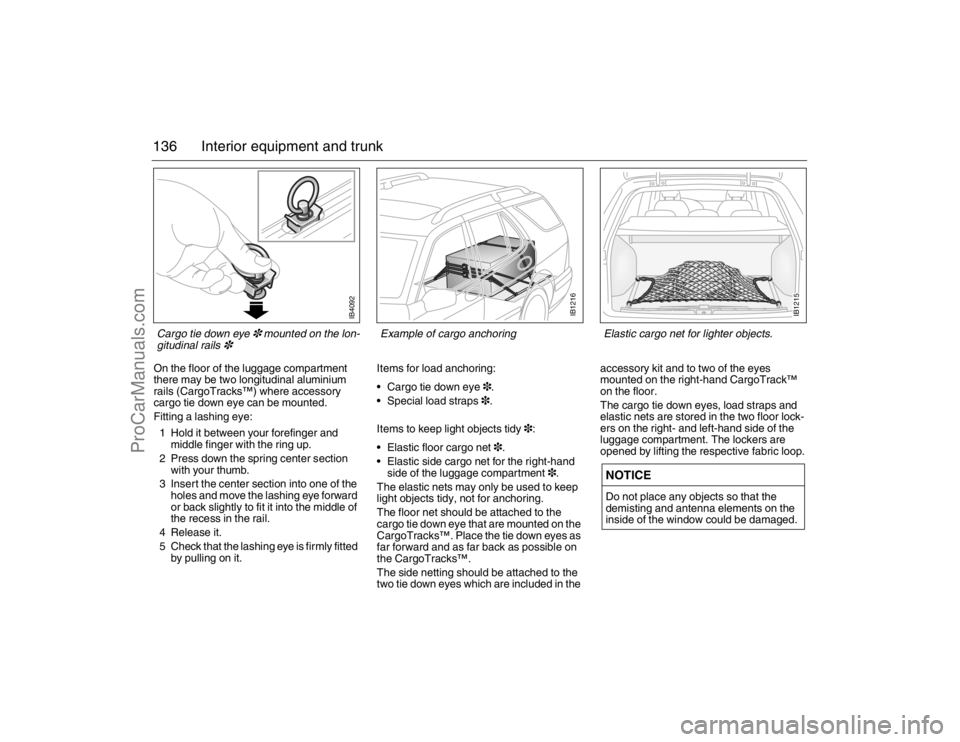
136 Interior equipment and trunkOn the floor of the luggage compartment
there may be two longitudinal aluminium
rails (CargoTracks™) where accessory
cargo tie down eye can be mounted.
Fitting a lashing eye:
1 Hold it between your forefinger and
middle finger with the ring up.
2 Press down the spring center section
with your thumb.
3 Insert the center section into one of the
holes and move the lashing eye forward
or back slightly to fit it into the middle of
the recess in the rail.
4 Release it.
5 Check that the lashing eye is firmly fitted
by pulling on it.Items for load anchoring:
Cargo tie down eye3.
Special load straps3.
Items to keep light objects tidy3:
Elastic floor cargo net3.
Elastic side cargo net for the right-hand
side of the luggage compartment3.
The elastic nets may only be used to keep
light objects tidy, not for anchoring.
The floor net should be attached to the
cargo tie down eye that are mounted on the
CargoTracks™. Place the tie down eyes as
far forward and as far back as possible on
the CargoTracks™.
The side netting should be attached to the
two tie down eyes which are included in the accessory kit and to two of the eyes
mounted on the right-hand CargoTrack™
on the floor.
The cargo tie down eyes, load straps and
elastic nets are stored in the two floor lock-
ers on the right- and left-hand side of the
luggage compartment. The lockers are
opened by lifting the respective fabric loop.
NOTICEDo not place any objects so that the
demisting and antenna elements on the
inside of the window could be damaged.
IB4092
Cargo tie down eye
3 mounted on the lon-
gitudinal rails
3
IB1216
Example of cargo anchoring
IB1215
Elastic cargo net for lighter objects.
95_U S _M 07.book Page 136 Friday, June 9, 2006 8:58 AM
ProCarManuals.com
Page 139 of 288
139 Starting and driving
IB3878
Starting and driving
Ignition switch ________ 140
Starting the engine ____ 141
Important considerations
for driving___________ 144
Refueling ____________ 146
Engine Break-In Period_ 150
Gear changing ________ 150
Cruise control ________ 159
Braking ______________ 160
Electronic Stability
Program (ESP
®) ______ 163
Economical motoring __ 170
Driving in cold weather_ 172
Driving in hot weather _ 173
Towing a trailer3_____ 174 Driving with a roof rack
load________________ 179
Driving at night _______ 181
Driving with a load ____ 181
Driving with a spare
wheel fitted _________ 183
Driving with the trunk
lid/tailgate open______ 183
Driving in deep water __ 183
Towing the car________ 183
Jump starting ________ 186
Saab Parking
Assistance3________ 168
Parking brake ________ 165
Parking ______________ 165
3 Asterisk means: equipment not fitted in all cars
(can depend on model variant, engine variant,
market specification, options or accessories).95_U S _M 07.book Page 139 Friday, June 9, 2006 8:58 AM
ProCarManuals.com