tow SAAB 9-5 2007 User Guide
[x] Cancel search | Manufacturer: SAAB, Model Year: 2007, Model line: 9-5, Model: SAAB 9-5 2007Pages: 288, PDF Size: 18.14 MB
Page 130 of 288

130 Interior equipment and trunk
WARNING
Place heavy items closest to the backrest and stow smaller
and lighter items on top.
Never overload the cargo net3. If the elastic breaks this may
cause personal injury. Do not use a cargo net that shows signs
of wear.
Secure heavy and bulky items using the tie down points
provided in the trunk. This will avert the danger of luggage
flying around if the car should brake suddenly or be involved
in a crash (see page 131).
Secure small items if the backrest is folded down or the
load-through hatch is open. Small items can also be thrown
around inside the car and cause personal injury.
Do not exceed the load capacity of the car, as this will alter its
handling characteristics (see page 258).
Make sure that the seat cushions and backrests are properly
secured when folding them back to their normal position.
Check that the button (item 3 on page 129) is flush with the
surround before entering the back seat.
The tail pipe of the exhaust system can become very hot during
driving. Bear this in mind when loading and unloading the car so
that children, for example, do not burn themselves.
IB4140IB461
Outer safety belt hooked onto courtesy handle
95_U S _M 07.book Page 130 Friday, June 9, 2006 8:58 AM
ProCarManuals.com
Page 139 of 288
139 Starting and driving
IB3878
Starting and driving
Ignition switch ________ 140
Starting the engine ____ 141
Important considerations
for driving___________ 144
Refueling ____________ 146
Engine Break-In Period_ 150
Gear changing ________ 150
Cruise control ________ 159
Braking ______________ 160
Electronic Stability
Program (ESP
®) ______ 163
Economical motoring __ 170
Driving in cold weather_ 172
Driving in hot weather _ 173
Towing a trailer3_____ 174 Driving with a roof rack
load________________ 179
Driving at night _______ 181
Driving with a load ____ 181
Driving with a spare
wheel fitted _________ 183
Driving with the trunk
lid/tailgate open______ 183
Driving in deep water __ 183
Towing the car________ 183
Jump starting ________ 186
Saab Parking
Assistance3________ 168
Parking brake ________ 165
Parking ______________ 165
3 Asterisk means: equipment not fitted in all cars
(can depend on model variant, engine variant,
market specification, options or accessories).95_U S _M 07.book Page 139 Friday, June 9, 2006 8:58 AM
ProCarManuals.com
Page 143 of 288

143 Starting and driving
Useful tips on cold climate
startingIf the engine has failed to start after several
attempts in very cold weather, press and
hold the accelerator down to the floor and
run the starter for 5–10 seconds. This will
prevent the engine being flooded (exces-
sively rich fuel-air mixture).
Now start the engine in the normal way – do
not touch the accelerator.
If the engine stalls immediately after starting
(e.g. if the clutch was released too quickly),
do not touch the accelerator when restarting
the engine.
Limp-home modeThe engine management system has a
diagnostic feature that continually checks a
number of internal functions.
If, for example, a fault is detected in the
throttle valve, the engine management
system will go into Limp-home mode.This
limits:
idling control,
disables the cruise-control system and
limits the capacity of the A/C compressor.
If the limp-home mode is in operation
(”Engine malfunction (CHECK ENGINE)”
light on, see below) and the outside temper-
ature is close to or below freezing, you may
need to use some throttle on starting (some
pressure on the accelerator).
If the diagnostic system has detected a fault
in the engine-management system, the
”Engine malfunction (CHECK ENGINE)”
light on the main instrument panel will
come on (see page 58), indicating that you
should have the car checked as soon as
possible by a workshop. We recommend
that you contact an authorized Saab dealer.
NOTICEIf the CHECK ENGINE warning light
starts to flash, ease off the accelerator
slightly. If the light does not cease to flash
within 5 seconds, stop the car in a suit-
able place as soon as possible and turn
off the engine. The car must be towed to
a workshop. We recommend that you
contact an authorized Saab dealer.
If the CHECK ENGINE warning light
flashes, it indicates that the engine is mis-
firing which can result in damage to the
catalytic converter.
95_U S _M 07.book Page 143 Friday, June 9, 2006 8:58 AM
ProCarManuals.com
Page 151 of 288
151 Starting and driving
Towing Towing of cars with manual transmission,
see page 183.
Automatic transmission3
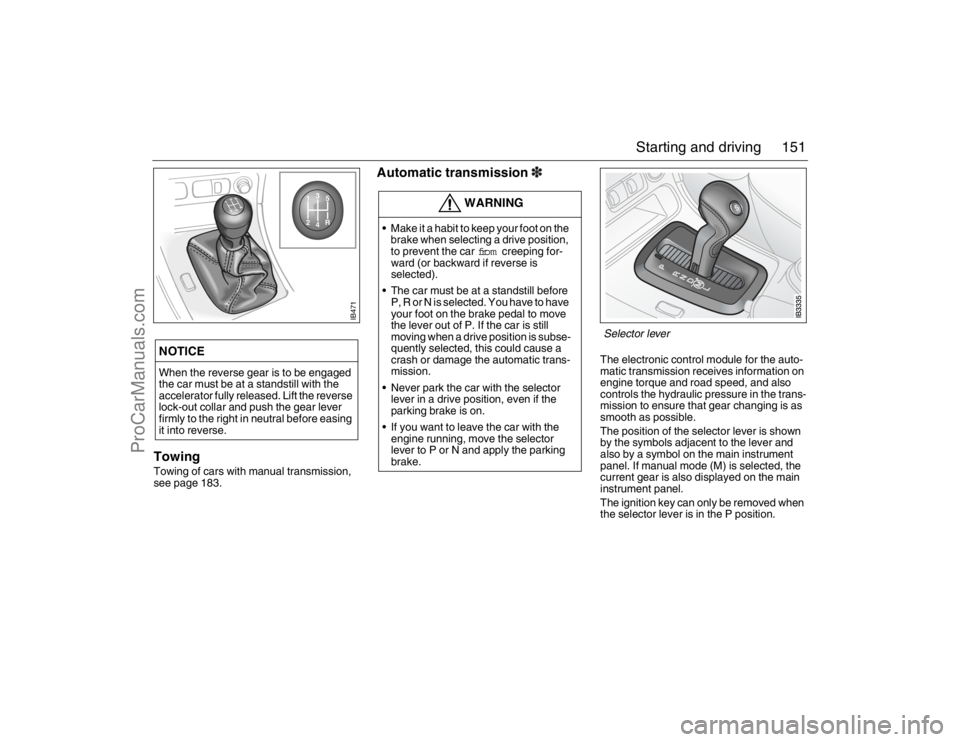
The electronic control module for the auto-
matic transmission receives information on
engine torque and road speed, and also
controls the hydraulic pressure in the trans-
mission to ensure that gear changing is as
smooth as possible.
The position of the selector lever is shown
by the symbols adjacent to the lever and
also by a symbol on the main instrument
panel. If manual mode (M) is selected, the
current gear is also displayed on the main
instrument panel.
The ignition key can only be removed when
the selector lever is in the P position.
NOTICEWhen the reverse gear is to be engaged
the car must be at a standstill with the
accelerator fully released. Lift the reverse
lock-out collar and push the gear lever
firmly to the right in neutral before easing
it into reverse.
WARNING
Make it a habit to keep your foot on the
brake when selecting a drive position,
to prevent the car from creeping for-
ward (or backward if reverse is
selected).
The car must be at a standstill before
P, R or N is selected. You have to have
your foot on the brake pedal to move
the lever out of P. If the car is still
moving when a drive position is subse-
quently selected, this could cause a
crash or damage the automatic trans-
mission.
Never park the car with the selector
lever in a drive position, even if the
parking brake is on.
If you want to leave the car with the
engine running, move the selector
lever to P or N and apply the parking
brake.
Selector lever
IB471
13
25
R
4
95_U S _M 07.book Page 151 Friday, June 9, 2006 8:58 AM
ProCarManuals.com
Page 153 of 288
153 Starting and driving
Lock-up function The automatic transmission has a lock-up
function, which can render the torque con-
verter inoperative in 3rd, 4th and 5th gears,
thus reducing the engine speed and fuel
consumption.
When the lock-up function comes into oper-
ation, it may give the impression of an over-
drive being engaged.Kick-downWhen the accelerator is pressed down hard,
a change-down to the next gear will be
effected to provide maximum acceleration,
e.g. for overtaking.
Following this, the next higher gear will be
selected at the optimum engine speed for
acceleration or, if you ease off the acceler-
ator, before reaching this.
Park Brake Shift LockThe transmission has a security function
known as Park Brake Shift Lock. To move
the gear selector out of the P position, the
brake pedal must be depressed at the same
time as the gear selector catch (detent) is
pressed in.
Shift Lock override
Check fuse No. 1 (see page 218). If the
problem was cured by changing the fuse or
battery, you do not have to contact a work-
shop.
If the fuse blows again as soon as the Shift
Lock feature is activated you should contact
a workshop. We recommend that you con-
tact an authorized Saab dealer.If the fuse is OK, check the battery regarding
the voltage.
1 Apply the parking brake
2 Make sure the key is in position ON
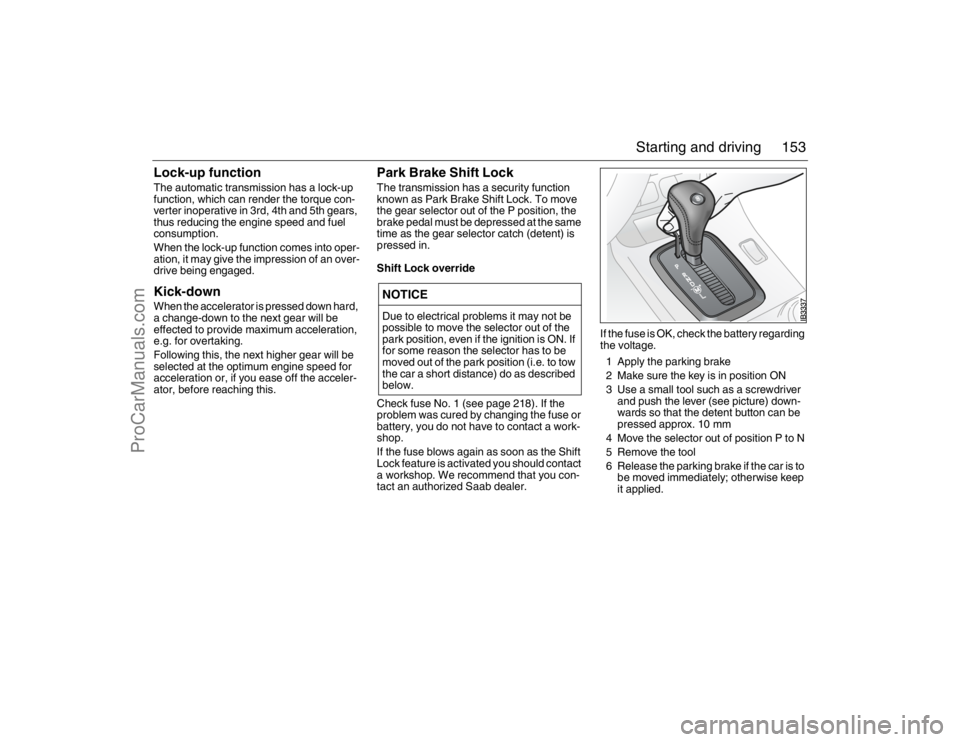
3 Use a small tool such as a screwdriver
and push the lever (see picture) down-
wards so that the detent button can be
pressed approx. 10 mm
4 Move the selector out of position P to N
5 Remove the tool
6 Release the parking brake if the car is to
be moved immediately; otherwise keep
it applied.NOTICEDue to electrical problems it may not be
possible to move the selector out of the
park position, even if the ignition is ON. If
for some reason the selector has to be
moved out of the park position (i.e. to tow
the car a short distance) do as described
below.
95_U S _M 07.book Page 153 Friday, June 9, 2006 8:58 AM
ProCarManuals.com
Page 154 of 288

154 Starting and drivingIf ”Automatic transmission3, fault indicator”
light appears on the main instrument panel,
the system has detected a fault in the auto-
matic transmission or its control module
(see page 62).
This also means that the Limp-home mode
has been selected, to guard against further
damage being done to the transmission. In
this mode, the automatic transmission
starts in 5th gear, and gear changes (if nec-
essary) will have to be made manually.
Stop the car in a safe place. Switch off then
restart the engine. If the fault is intermittent,
the transmission will operate as normal
despite the fault indicator being on. Have
the car checked at a workshop. We recom-
mend that you contact an authorized Saab
dealer.
It is not possible to select the SPORT or
Sentronic mode when the Limp-home mode
is active.
Gear changes must be made manually.
The following gears will be engaged in the
respective selector positions when the auto-
matic transmission is in Limp-home mode:
Overheated transmission fluid If the automatic-transmission fluid should
overheat, the following message will appear
on the SID:
”Gearbox too hot.
Make a safe stop.”
In this event, stop the car in a suitable place,
switch off the engine and open the hood.
Wait for several minutes then turn on the
ignition to check that the message has gone
out. When driving subsequent to the trans-
mission fluid overheating, select a gear in
which the engine speed is about 3,000 rpm.
Overheating of the automatic-transmission
fluid can occur when the car is towing a
heavy load, such as a camping trailer in hilly
country. High ambient temperatures can
also increase the temperature of the trans-
mission fluid or the oil cooler may be faulty.
Contact a workshop. We recommend that
you contact an authorized Saab dealer (see
also page 174).
Automatic transmission3,
fault indicator
Position R D M L
Gear Reverse 5th 5th 2nd
NOTICEIf the control module has actuated the
Limp-home function for the automatic
transmission, the car will remain in 5th
gear when D is selected, making it very
sluggish.
Select position L to prevent unnecessary
wear on the transmission. The transmis-
sion then starts in 2nd gear. Once the car
is moving you can select position D.
When the indicator light is on, the car
must not be driven with a caravan or
trailer attached.
95_U S _M 07.book Page 154 Friday, June 9, 2006 8:58 AM
ProCarManuals.com
Page 155 of 288

155 Starting and driving
Driving on hilly roads with a
heavy loadThe transmission fluid can overheat when
the gearbox is strained, for example, when
driving with a trailer on hilly roads. To avoid
the transmission fluid overheating, always
drive in Normal mode. The adaptive gear
change patterns are then active.
High air temperatures or a faulty oil cooler
can also cause the transmission fluid to
overheat. Overheating reduces the service
life of the fluid. Contact an authorized Saab
dealer (see also page 174).
Towing Towing of cars with automatic transmission,
see page 183.
Descending hillsIf the speed of the car increases while
descending a steep hill, despite the acceler-
ator being released, the control module will
change down a gear when you brake. If you
desire more powerful engine braking, man-
ually select a lower gear.
WARNING
Remember to use engine-braking (selec-
tor position D or L) to spare the brakes
when you are driving on a long or steep
downhill slope.
Brake failure can result from overheated
brakes!
95_U S _M 07.book Page 155 Friday, June 9, 2006 8:58 AM
ProCarManuals.com
Page 161 of 288
161 Starting and driving
ABS brakes
ABS (antilock braking system) modulates
the brake pressure to the respective
wheels. Wheel sensors detect if a wheel is
about to lock, and the control module
reduces the pressure to that wheel and then
increases it once more until the tendency is
detected again.
The brake system is equipped with an Elec-
tronic Brake-force Distribution device
(EBD), which distributes the brake pressure
between the front and rear wheels, in such
a way as to achieve optimum braking perfor-
mance irrespective of the car’s speed and
load.
WARNING
It is prudent to try your brakes from
time to time, especially when driving in
heavy rain, through water collected on
the road, in snow, on a wet road sur-
face or in salty slush. In such condi-
tions, the brakes may take longer than
normal to take effect. To rectify this,
touch the brake pedal periodically to
dry the brakes out.
The same applies after the car has
been washed or when the weather is
very humid.
Avoid parking the car with wet brakes.
Before parking, and if the traffic condi-
tions allow, brake quite heavily so that
the brake discs and pads warm up and
dry.
The brakes are power assisted and it
should be kept in mind that the servo
unit only provides the power assis-
tance when the engine is running.
The brake pressure required when the
engine is off,(e.g. when the car is
being towed) is roughly four times the
normal pedal force required. The
pedal also feels hard and unre-
sponsive.
WARNING
The additional safety afforded by the
ABS system is not designed to allow
drivers to drive faster but to make
normal driving safer.
To stop as quickly as possible, without
loss of directional stability, whether
the road surface is dry, wet or slippery,
press the brake pedal down hard-
without letting up (do not pump the
pedal), declutching simulta-
neously, and steer the car to safety.
95_U S _M 07.book Page 161 Friday, June 9, 2006 8:58 AM
ProCarManuals.com
Page 166 of 288
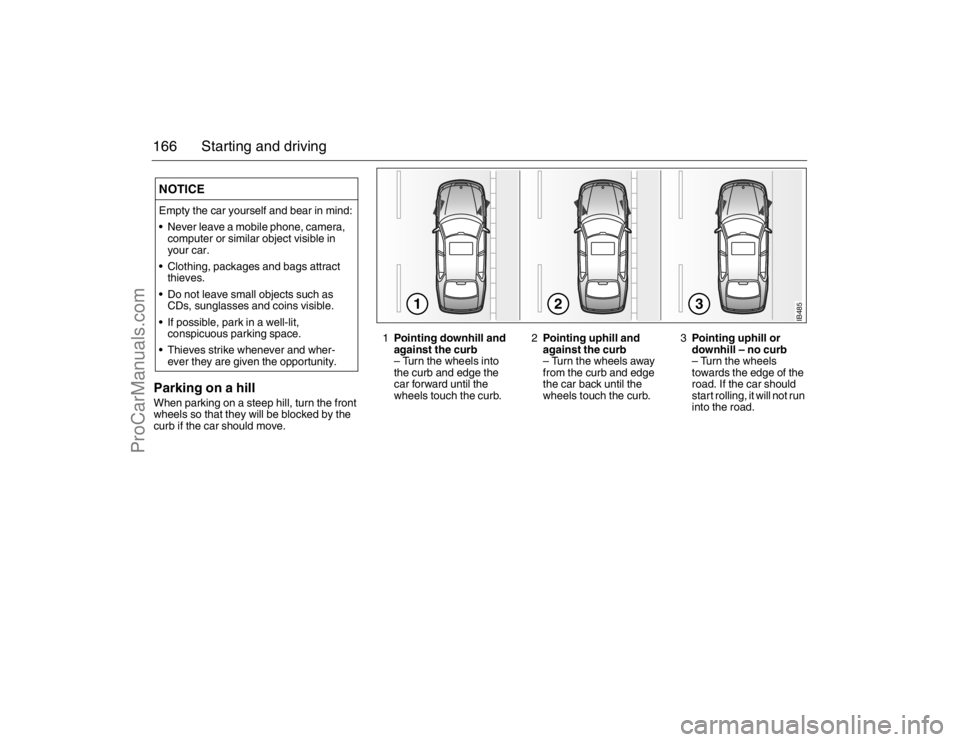
166 Starting and drivingParking on a hillWhen parking on a steep hill, turn the front
wheels so that they will be blocked by the
curb if the car should move. NOTICEEmpty the car yourself and bear in mind:
Never leave a mobile phone, camera,
computer or similar object visible in
your car.
Clothing, packages and bags attract
thieves.
Do not leave small objects such as
CDs, sunglasses and coins visible.
If possible, park in a well-lit,
conspicuous parking space.
Thieves strike whenever and wher-
ever they are given the opportunity.
123
IB485
1Pointing downhill and
against the curb
– Turn the wheels into
the curb and edge the
car forward until the
wheels touch the curb.2Pointing uphill and
against the curb
– Turn the wheels away
from the curb and edge
the car back until the
wheels touch the curb.3Pointing uphill or
downhill – no curb
– Turn the wheels
towards the edge of the
road. If the car should
start rolling, it will not run
into the road.
95_U S _M 07.book Page 166 Friday, June 9, 2006 8:58 AM
ProCarManuals.com
Page 168 of 288
168 Starting and drivingSaab Parking
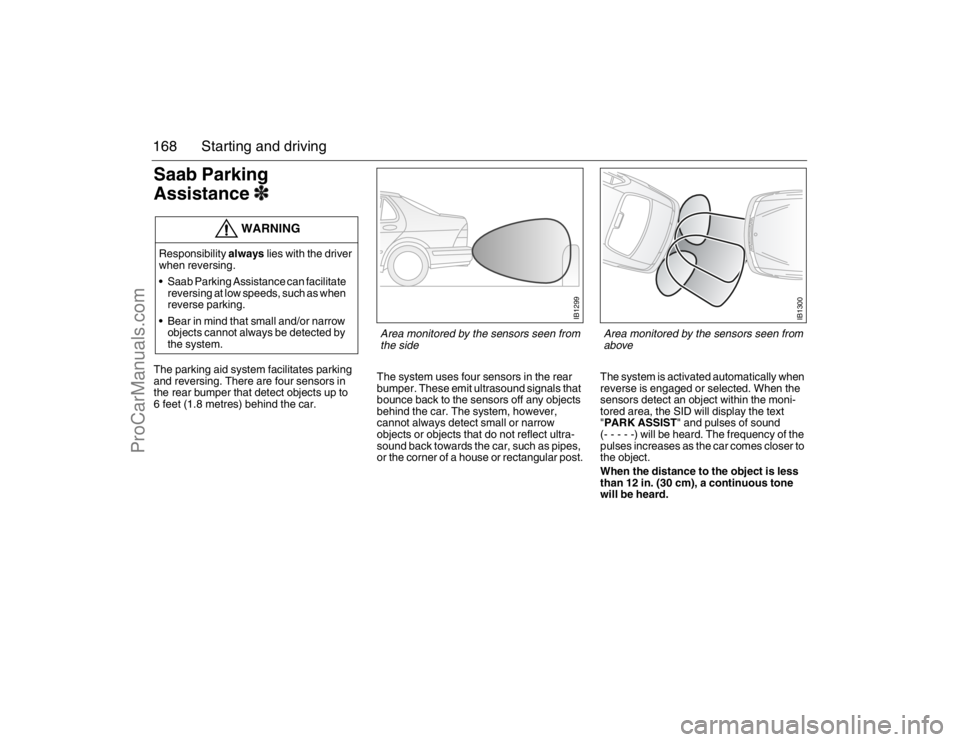
Assistance3The parking aid system facilitates parking
and reversing. There are four sensors in
the rear bumper that detect objects up to
6 feet (1.8 metres) behind the car.The system uses four sensors in the rear
bumper. These emit ultrasound signals that
bounce back to the sensors off any objects
behind the car. The system, however,
cannot always detect small or narrow
objects or objects that do not reflect ultra-
sound back towards the car, such as pipes,
or the corner of a house or rectangular post.The system is activated automatically when
reverse is engaged or selected. When the
sensors detect an object within the moni-
tored area, the SID will display the text
"PARK ASSIST" and pulses of sound
(- - - - -) will be heard. The frequency of the
pulses increases as the car comes closer to
the object.
When the distance to the object is less
than 12 in. (30 cm), a continuous tone
will be heard.
WARNING
Responsibility always lies with the driver
when reversing.
Saab Parking Assistance can facilitate
reversing at low speeds, such as when
reverse parking.
Bear in mind that small and/or narrow
objects cannot always be detected by
the system.
IB1299
Area monitored by the sensors seen from
the side
IB1300
Area monitored by the sensors seen from
above
95_U S _M 07.book Page 168 Friday, June 9, 2006 8:58 AM
ProCarManuals.com