seats SAAB 9-5 2007 Owner's Manual
[x] Cancel search | Manufacturer: SAAB, Model Year: 2007, Model line: 9-5, Model: SAAB 9-5 2007Pages: 288, PDF Size: 18.14 MB
Page 129 of 288

129 Interior equipment and trunkTrunkFolding the rear seat, 9-5 SedanThe rear seat is split and the two sections can be folded indepen-
dently. Folding down of the rear seat is easier if the front seats are
not all the way back, and the rear head restraints are folded down.
1 Raise the rear seat cushions by pulling the loop located between
the cushion and the backrest.
2 Tip the seat cushion forward.
3 Press the button adjacent to the respective backrest to release it.
4 Fold down the backrest.
WARNING
Never leave a child or animal unattended in the car. During
sunny weather the temperature in the passenger and luggage
compartments can climb to 158–176°F (70–80°C). Small chil-
dren are very susceptible to heat stroke.
Rear-seat passengers should always ensure that the head
restraint is raised and in proper position for the seats to be
occupied.
Keep hands well clear of all moving parts.
Never place heavy objects on the rear window shelf. There is
always a danger of loose objects flying about and causing
injury if the car should brake suddenly or be involved in a
crash.
Before folding up the backrest, hang the outer safety belts
onto the hook on the respective courtesy handle to prevent
them from becoming trapped.
Check that the seatbelt locks do not get trapped under the
seat cushions when these are raised back up.
Make sure that the backrest is locked when it is restored to an
upright position. Check that the back rest release button (3) is
flush with the surround before entering the rear seat. This indi-
cates that the backrest is locked.
IB459
1
2
4
3
95_U S _M 07.book Page 129 Friday, June 9, 2006 8:58 AM
ProCarManuals.com
Page 132 of 288
132 Interior equipment and trunk
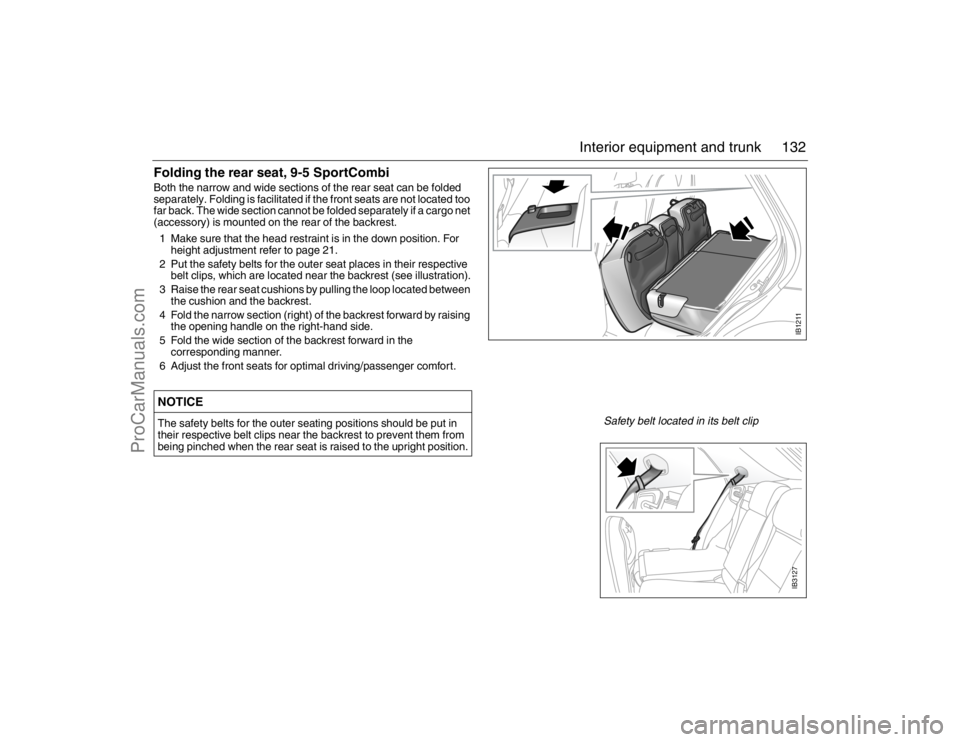
Folding the rear seat, 9-5 SportCombiBoth the narrow and wide sections of the rear seat can be folded
separately. Folding is facilitated if the front seats are not located too
far back. The wide section cannot be folded separately if a cargo net
(accessory) is mounted on the rear of the backrest.
1 Make sure that the head restraint is in the down position. For
height adjustment refer to page 21.
2 Put the safety belts for the outer seat places in their respective
belt clips, which are located near the backrest (see illustration).
3 Raise the rear seat cushions by pulling the loop located between
the cushion and the backrest.
4 Fold the narrow section (right) of the backrest forward by raising
the opening handle on the right-hand side.
5 Fold the wide section of the backrest forward in the
corresponding manner.
6 Adjust the front seats for optimal driving/passenger comfort. NOTICEThe safety belts for the outer seating positions should be put in
their respective belt clips near the backrest to prevent them from
being pinched when the rear seat is raised to the upright position.
IB1211IB3127
Safety belt located in its belt clip
95_U S _M 07.book Page 132 Friday, June 9, 2006 8:58 AM
ProCarManuals.com
Page 133 of 288

133 Interior equipment and trunk
Parcel shelf, 9-5 SportCombiFold the parcel shelf as follows:
1 Press the rear edge of the shelf downwards and forwards.
2 Continue pressing the folded section forward until it is folded over
the front section.
Extend the parcel shelf as follows:
1 Hold the rear edge of the shelf and pull it back.
2 The shelf rests on a track located beneath the rear side windows.
Make sure that the rear corner fits in the recess. Otherwise it will
not lie flat.
Alternative location of the parcel shelf if this is removed:
Folded up on the floor at the rear of the luggage compartment.
On its end on the floor behind the front seat backrest.
WARNING
Do not travel in the back seat without ensuring that the head
restraint is set at a suitable height for the seats to be occupied.
Never allow anyone to sit on a folded backrest.
Always be aware of the risk of pinching when handling moving
parts of the seating.
Never place heavy objects on the parcel shelf. There is always
a danger of loose objects flying about and causing injury if the
car should brake suddenly or be involved in a crash.
Make sure that the backrests are locked when they are folded
back upright. Check that the two red warning-indication flags
are fully down. This indicates that the backrests are locked.
Check that the safety belt lock is not trapped under the seat
cushions when these are raised back up.
Never leave a child or animal unattended in the car. During
sunny weather the temperature in the passenger and luggage
compartments can climb to 158–176°F (70–80°C). Small chil-
dren are very susceptible to heat stroke.95_U S _M 07.book Page 133 Friday, June 9, 2006 8:58 AM
ProCarManuals.com
Page 137 of 288
137 Interior equipment and trunk
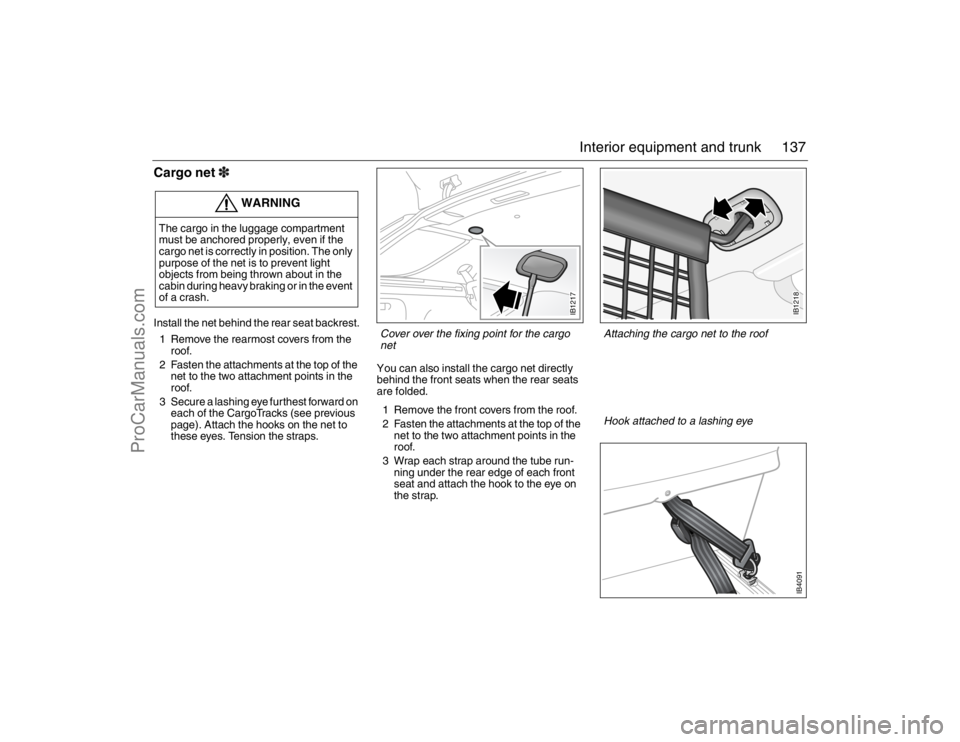
Cargo net3Install the net behind the rear seat backrest.
1 Remove the rearmost covers from the
roof.
2 Fasten the attachments at the top of the
net to the two attachment points in the
roof.
3 Secure a lashing eye furthest forward on
each of the CargoTracks (see previous
page). Attach the hooks on the net to
these eyes. Tension the straps.You can also install the cargo net directly
behind the front seats when the rear seats
are folded.
1 Remove the front covers from the roof.
2 Fasten the attachments at the top of the
net to the two attachment points in the
roof.
3 Wrap each strap around the tube run-
ning under the rear edge of each front
seat and attach the hook to the eye on
the strap.
WARNING
The cargo in the luggage compartment
must be anchored properly, even if the
cargo net is correctly in position. The only
purpose of the net is to prevent light
objects from being thrown about in the
cabin during heavy braking or in the event
of a crash.
IB1217
Cover over the fixing point for the cargo
net
IB1218
Attaching the cargo net to the roof
IB4091
Hook attached to a lashing eye
95_U S _M 07.book Page 137 Friday, June 9, 2006 8:58 AM
ProCarManuals.com
Page 140 of 288

140 Starting and drivingIgnition switchThe combined ignition switch and
gear-lever lock is located in the center con-
sole between the front seats. The ignition
key can only be removed when reverse is
engaged (automatic transmission: selector
in ”P” position).
The key fits all the locks on the car. The key
number is specified on the small plastic
strap that comes with the keys when the car
is delivered. Keep a note of the key number
in a safe place, as you will need to quote it if
ordering a replacement key.
See also page 44.
LOCK position Engage reverse and turn the key to LOCK.
Automatic transmission: select ”P”.
The gear lever is locked. This is the only
position in which the key can be removed.
The parking lights, hazard warning lights
and interior lighting all work.OFF position Gear lever no longer locked.
Certain electrical circuits operational.
ON position All electrical circuits working.
Do not leave the key in the ON position
when the engine is not running.
Turn the key to OFF to switch off the electri-
cal circuits. In the ON position certain warn-
ing and indicator lights come on as a check,
and they normally are extinguished after
about 3 seconds.ST (starter) position The starter operates when the key is turned
to this position. When released, the key will
spring back to the ON position.
If the engine fails to start, the key must first
be turned back to the position between OFF
and LOCK before the starter can be oper-
ated again.
When the starter motor is running, several
electrical circuits are disconnected to facili-
tate starting.
IB1120
LOCK
OFFONST
95_U S _M 07.book Page 140 Friday, June 9, 2006 8:58 AM
ProCarManuals.com
Page 165 of 288
165 Starting and driving
Parking brake
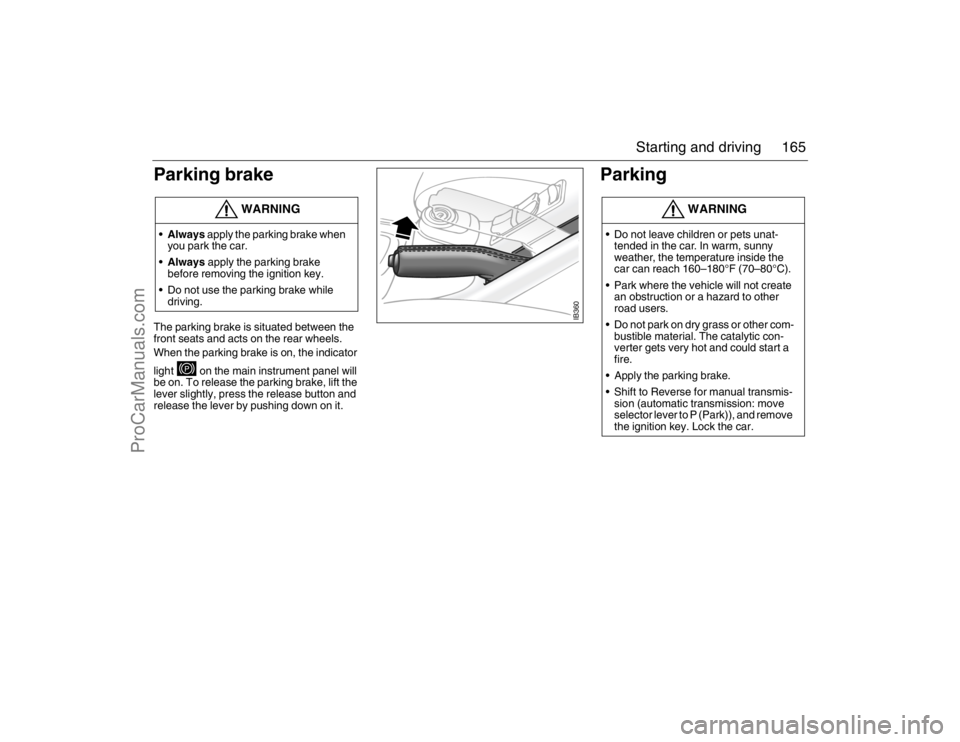
The parking brake is situated between the
front seats and acts on the rear wheels.
When the parking brake is on, the indicator
light on the main instrument panel will
be on. To release the parking brake, lift the
lever slightly, press the release button and
release the lever by pushing down on it.
Parking
WARNING
Always apply the parking brake when
you park the car.
Always apply the parking brake
before removing the ignition key.
Do not use the parking brake while
driving.
WARNING
Do not leave children or pets unat-
tended in the car. In warm, sunny
weather, the temperature inside the
car can reach 160–180°F (70–80°C).
Park where the vehicle will not create
an obstruction or a hazard to other
road users.
Do not park on dry grass or other com-
bustible material. The catalytic con-
verter gets very hot and could start a
fire.
Apply the parking brake.
Shift to Reverse for manual transmis-
sion (automatic transmission: move
selector lever to P (Park)), and remove
the ignition key. Lock the car.
IB360
95_U S _M 07.book Page 165 Friday, June 9, 2006 8:58 AM
ProCarManuals.com
Page 219 of 288
219 Car care and technical information
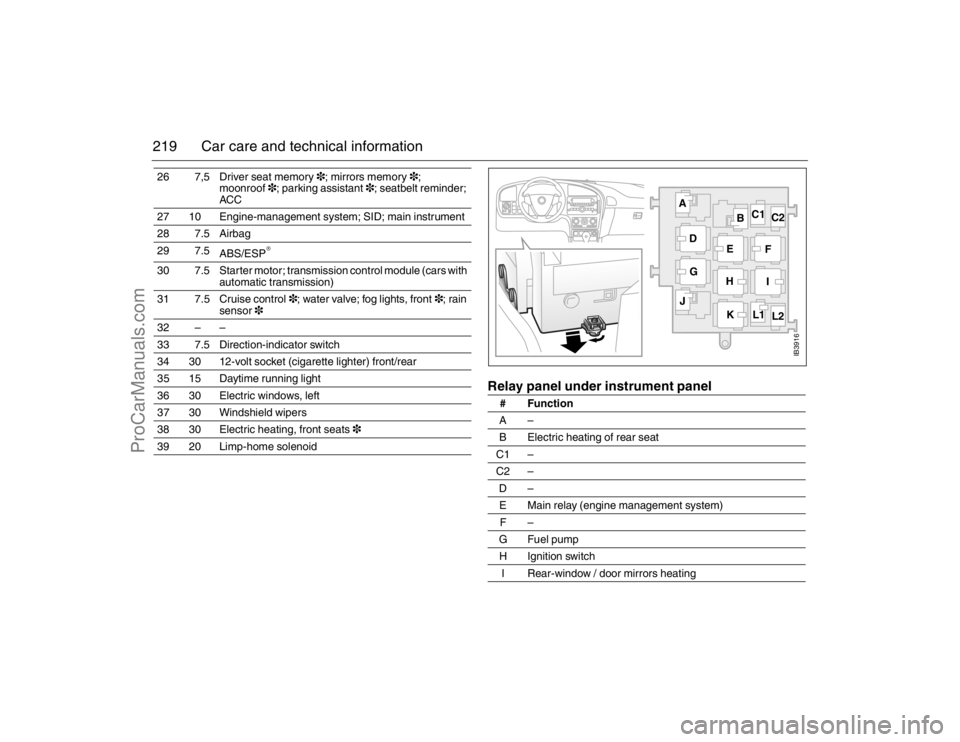
Relay panel under instrument panel
26 7,5 Driver seat memory3; mirrors memory3;
moonroof3; parking assistant3; seatbelt reminder;
ACC
27 10 Engine-management system; SID; main instrument
28 7.5 Airbag
29 7.5
ABS/ESP
®
30 7.5 Starter motor; transmission control module (cars with
automatic transmission)
31 7.5 Cruise control3; water valve; fog lights, front3; rain
sensor3
32 – –
33 7.5 Direction-indicator switch
34 30 12-volt socket (cigarette lighter) front/rear
35 15 Daytime running light
36 30 Electric windows, left
37 30 Windshield wipers
38 30 Electric heating, front seats3
39 20 Limp-home solenoid
# Function
A –
B Electric heating of rear seat
C1 –
C2 –
D–
E Main relay (engine management system)
F–
G Fuel pump
H Ignition switch
I Rear-window / door mirrors heating
IB3916
A
BC1
C2
L2 L1 D
GE
F
H
I
K J
95_U S _M 07.book Page 219 Friday, June 9, 2006 8:58 AM
ProCarManuals.com
Page 230 of 288
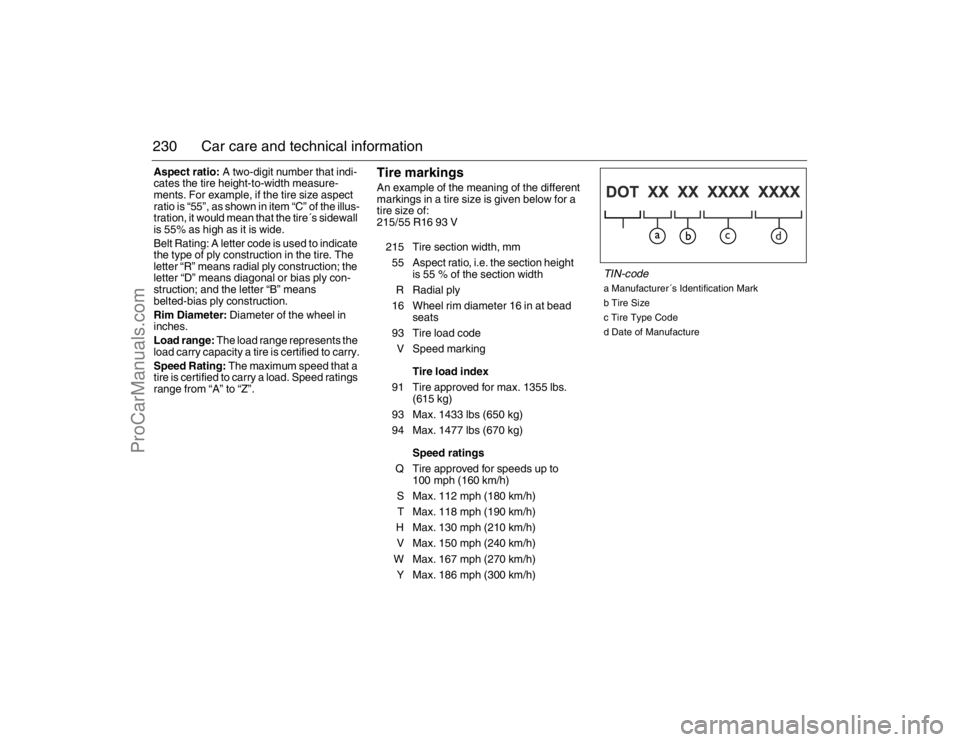
230 Car care and technical informationAspect ratio: A two-digit number that indi-
cates the tire height-to-width measure-
ments. For example, if the tire size aspect
ratio is “55”, as shown in item “C” of the illus-
tration, it would mean that the tire´s sidewall
is 55% as high as it is wide.
Belt Rating: A letter code is used to indicate
the type of ply construction in the tire. The
letter “R” means radial ply construction; the
letter “D” means diagonal or bias ply con-
struction; and the letter “B” means
belted-bias ply construction.
Rim Diameter: Diameter of the wheel in
inches.
Load range: The load range represents the
load carry capacity a tire is certified to carry.
Speed Rating: The maximum speed that a
tire is certified to carry a load. Speed ratings
range from “A” to “Z”.
Tire markingsAn example of the meaning of the different
markings in a tire size is given below for a
tire size of:
215/55 R16 93 V 215 Tire section width, mm
55 Aspect ratio, i.e. the section height
is 55 % of the section width
R Radial ply
16 Wheel rim diameter 16 in at bead
seats
93 Tire load code
V Speed marking
Tire load index
91 Tire approved for max. 1355 lbs.
(615 kg)
93 Max. 1433 lbs (650 kg)
94 Max. 1477 lbs (670 kg)
Speed ratings
Q Tire approved for speeds up to
100 mph (160 km/h)
S Max. 112 mph (180 km/h)
T Max. 118 mph (190 km/h)
H Max. 130 mph (210 km/h)
V Max. 150 mph (240 km/h)
W Max. 167 mph (270 km/h)
Y Max. 186 mph (300 km/h)
TIN-codea Manufacturer´s Identification Mark
b Tire Size
c Tire Type Code
d Date of Manufacture
95_U S _M 07.book Page 230 Friday, June 9, 2006 8:58 AM
ProCarManuals.com
Page 231 of 288

231 Car care and technical information
Loading Your VehicleThis is an example of what your vehicle´s
Tire-Loading Information/Certification label
might look like. It is located on the B-pillar
and shows how much weight your vehicle
may properly carry. The label tells you the
proper size, and recommended inflation
pressures for the tires on your vehicle. It
also gives you important information about
the number of people that can be in your
vehicle and the total weight that you can
carry. This weight is called the Vehicle
Capacity Weight, and includes the weight of
all occupants, cargo and all nonfac-
tory-installed options.
Tire Terminology and DefinitionsAir Pressure: The amount of air inside the
tire pressing outward on each square inch of
the tire. Air pressure is expressed in pounds
per square inch (psi) or kilopascal (kPa).
Accessory Weight: This means the com-
bined weight of optional accessories, for
example, automatic transmission, power
steering, power brakes, power windows,
power seats, radio and air conditioning.
Aspect Ratio: The relationship of a tire´s
height to its width.
Belt: A rubber coated layer of cords that is
located between the plies and the tread.
Cords may be made from steel or other rein-
forcing materials.
Bias Ply Tire: A pneumatic tire in which the
ply cords that extend to the beads are laid at
alternate angles substantially less than 90
degrees to the centerline of the tread.
Cold Inflation Pressure: The amount of air
pressure in a tire, measured in pounds per
square inch (psi) or kilopascal (kPa), before
a tire have built up heat from driving. See
“Inflation - Tire Pressure” on page 222.
Curb weight: This means the weight of a
motor vehicle with standard and optional
equipment including the maximum capacity
of fuel, oil and coolant, without passengers
and cargo.DOT Markings: A code molded into the
sidewall of a tire signifying that the tire is in
compliance with the U.S. Department of
Transportation motor vehicle safety stan-
dards. The DOT code includes the Tire
Identification Number (TIN), an alphanu-
meric designator which can also identify the
tire manufacturer, production plant, brand
and date of production.
GVWR: Gross Vehicle Weight Rating see
“Loading Your Vehicle” on page 231.
GAWR FRT: Gross Axle Weight Rating for
the front axle, see “Loading Your Vehicle”
on page 231.
GAWR RR: Gross Axle Weight Rating for
the rear axle, see “Loading Your Vehicle” on
page 231.
Intended Outboard Sidewall: The side of
an asymmetrical tire that must always face
outward when mounted on a vehicle.
Kilopascal (kPa): The metric unit for air
pressure. There are 6.9 kPa to one psi.
Light Truck (LT-Metric) Tire: A tire used
on light duty trucks and some multipurpose
passenger vehicles.
Load Index: An assigned number ranging
from 1 to 279 that corresponds to the load
carrying capacity of a tire.
This label can only be found on vehicles
sold in the U.S.
Vehicles sold in Canada have the tire
information label in the glovebox, see
page 268.
95_U S _M 07.book Page 231 Friday, June 9, 2006 8:58 AM
ProCarManuals.com
Page 258 of 288
258 SpecificationsGeneral Overall length, including bumpers:
9-5 Sedan _______________________ 190.4 in (4836 mm)
9-5 SportCombi __________________ 190.6 in (4841 mm)
Overall width, including door mirrors ____ 80.4 in (2042 mm)
Maximum height:
9-5 Sedan _______________________ 57.3 in (1454 mm)
9-5 SportCombi __________________ 57.7 in (1465 mm)
Wheelbase _______________________ 106.4 in (2703 mm)
Ground clearance at gross vehicle weight approx. 4.6 in
(116 mm)
Tr a c k :
Front __________________________ 59.9 in (1522 mm) *)
Rear ___________________________ 60.2 in (1528 mm) *)
Turning circle (curb to curb) ___________ 37.1 ft (11.3 m)
Turning circle (measured at vehicle extremi-
ties) _____________________________ 39.0 ft (11.9 m)
Number of seats (incl. driver) _________ 5
*) Specified track applies to wheel sizes:
6 x 15 & 6.5 x 16
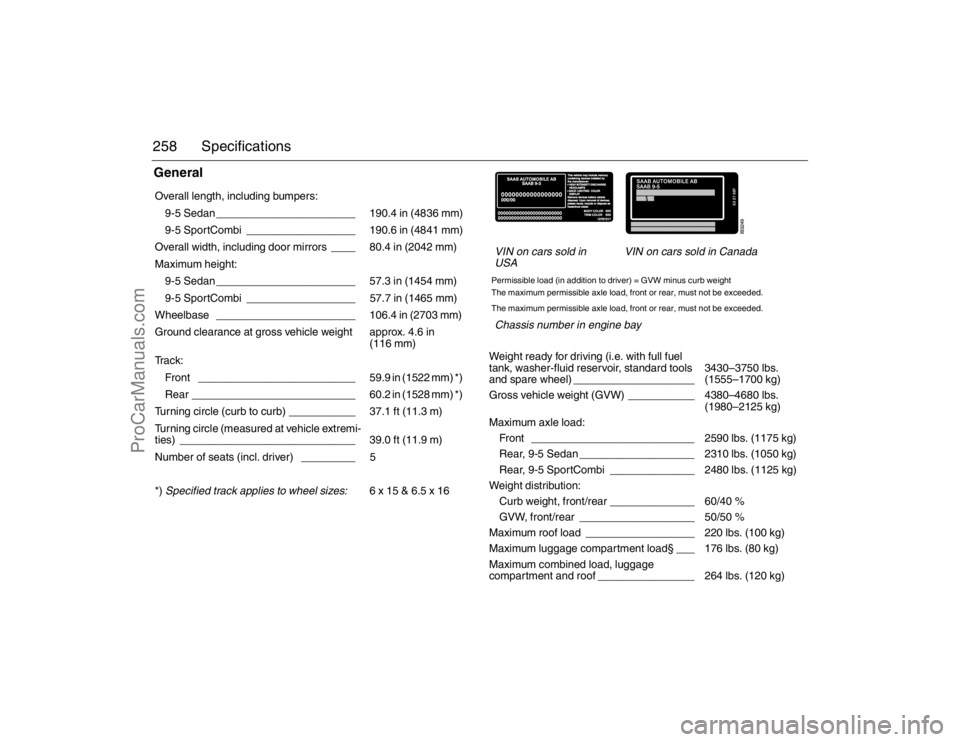
VIN on cars sold in
USAVIN on cars sold in CanadaPermissible load (in addition to driver) = GVW minus curb weight
The maximum permissible axle load, front or rear, must not be exceeded.
The maximum permissible axle load, front or rear, must not be exceeded. Chassis number in engine bay Weight ready for driving (i.e. with full fuel
tank, washer-fluid reservoir, standard tools
and spare wheel) ____________________ 3430–3750 lbs.
(1555–1700 kg)
Gross vehicle weight (GVW) ___________ 4380–4680 lbs.
(1980–2125 kg)
Maximum axle load:
Front ___________________________ 2590 lbs. (1175 kg)
Rear, 9-5 Sedan ___________________ 2310 lbs. (1050 kg)
Rear, 9-5 SportCombi ______________ 2480 lbs. (1125 kg)
Weight distribution:
Curb weight, front/rear ______________ 60/40 %
GVW, front/rear ___________________ 50/50 %
Maximum roof load __________________ 220 lbs. (100 kg)
Maximum luggage compartment load§ ___ 176 lbs. (80 kg)
Maximum combined load, luggage
compartment and roof ________________ 264 lbs. (120 kg)
95_U S _M 07.book Page 258 Friday, June 9, 2006 8:58 AM
ProCarManuals.com